The Mathematics of Game Shows Bowen Kerins Senior Curriculum Designer, EDC (and part-time game consultant) [email_address]
Overview Game shows are filled with math problems… Contestants How do I play best? How much is enough? Producers How do I build a fun game to watch? How will contestants behave? How much money are we giving out?
PRIZES! Want to win? We’ll need some volunteers for  three games . You could win as much as, um,  $4  in prizes!
CME Project Fundamental Organizing Principle The widespread utility and e ff ectiveness of mathematics come not just from mastering specific skills, topics, and techniques, but more importantly, from developing the ways of thinking—the  habits of mind —used to create the results. Four-year, NSF-funded curriculum written by EDC Published in 2008 by Pearson Education 25,000 students use it nationally, 1000 in Boston
CME Project  Overview “ Traditional” course structure: it’s familiar but different Structured around the sequence of Algebra 1, Geometry, Algebra 2, Precalculus Uses a variety of instructional approaches Organized around mathematical themes Come to one of our summer sessions! June 21-23 and August 2-6, in Newton
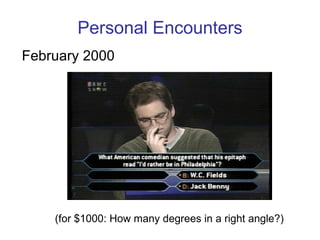
Personal Encounters February 2000 (for $1000: How many degrees in a right angle?)
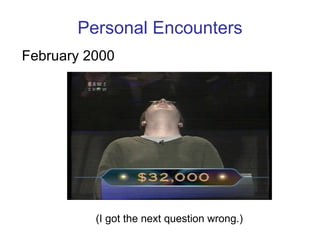
Personal Encounters February 2000 (I got the next question wrong.)
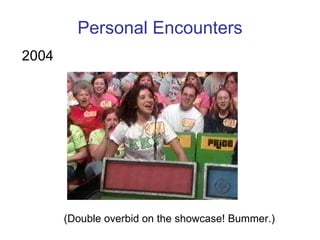
Personal Encounters 2004 (Double overbid on the showcase! Bummer.)
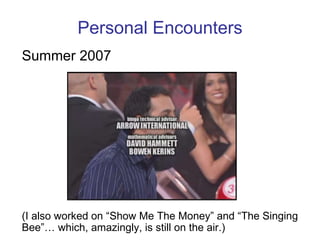
Personal Encounters Summer 2007 (I also worked on “Show Me The Money” and “The Singing Bee”… which, amazingly, is still on the air.)
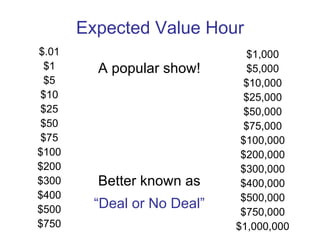
Expected Value Hour A popular show! Better known as “ Deal or No Deal” $.01 $1 $5 $10 $25 $50 $75 $100 $200 $300 $400 $500 $750 $1,000 $5,000 $10,000 $25,000 $50,000 $75,000 $100,000 $200,000 $300,000 $400,000 $500,000 $750,000 $1,000,000
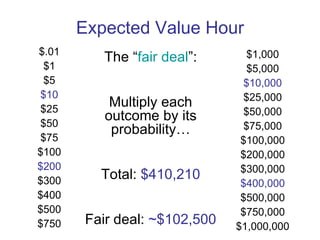
Expected Value Hour The “ fair deal ”: Multiply each outcome by its probability… Total:  $410,210 Fair deal:  ~$102,500 $.01 $1 $5 $10 $25 $50 $75 $100 $200 $300 $400 $500 $750 $1,000 $5,000 $10,000 $25,000 $50,000 $75,000 $100,000 $200,000 $300,000 $400,000 $500,000 $750,000 $1,000,000
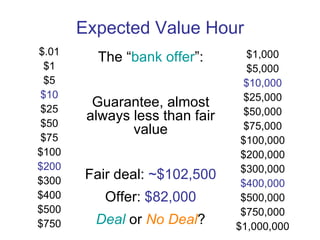
Expected Value Hour The “ bank offer ”: Guarantee, almost always less than fair value Fair deal:  ~$102,500 Offer:  $82,000 Deal  or  No Deal ? $.01 $1 $5 $10 $25 $50 $75 $100 $200 $300 $400 $500 $750 $1,000 $5,000 $10,000 $25,000 $50,000 $75,000 $100,000 $200,000 $300,000 $400,000 $500,000 $750,000 $1,000,000
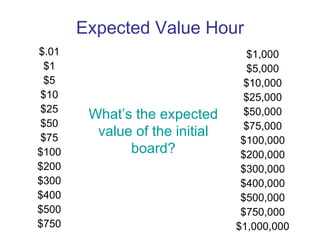
Expected Value Hour $.01 $1 $5 $10 $25 $50 $75 $100 $200 $300 $400 $500 $750 $1,000 $5,000 $10,000 $25,000 $50,000 $75,000 $100,000 $200,000 $300,000 $400,000 $500,000 $750,000 $1,000,000 What’s the expected value of the initial board?
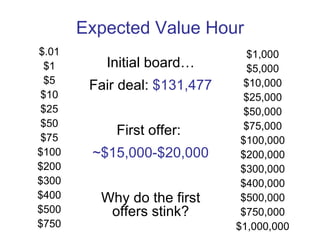
Expected Value Hour $.01 $1 $5 $10 $25 $50 $75 $100 $200 $300 $400 $500 $750 $1,000 $5,000 $10,000 $25,000 $50,000 $75,000 $100,000 $200,000 $300,000 $400,000 $500,000 $750,000 $1,000,000 Initial board… Fair deal:  $131,477 First offer:  ~$15,000-$20,000 Why do the first offers stink?
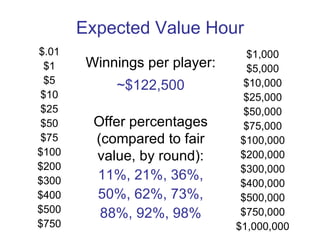
Expected Value Hour $.01 $1 $5 $10 $25 $50 $75 $100 $200 $300 $400 $500 $750 $1,000 $5,000 $10,000 $25,000 $50,000 $75,000 $100,000 $200,000 $300,000 $400,000 $500,000 $750,000 $1,000,000 Winnings per player: ~$122,500 Offer percentages (compared to fair value, by round): 11%, 21%, 36%, 50%, 62%, 73%, 88%, 92%, 98%
The Price Is Right Now in its  38th year Lots of good math problems! Also a huge sample size of repeatedly-  played games  (for agonizing detail,  visit http://tpirsummaries.8m.com) Who wants to play a game??
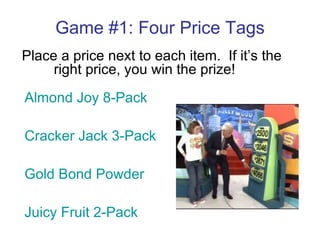
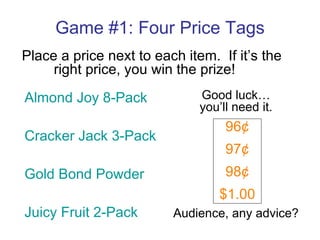
Game #1: Four Price Tags Place a price next to each item.  If it’s the  right price, you win the prize! Almond Joy 8-Pack Cracker Jack 3-Pack Gold Bond Powder Juicy Fruit 2-Pack
Game #1: Four Price Tags Place a price next to each item.  If it’s the  right price, you win the prize! Almond Joy 8-Pack Cracker Jack 3-Pack Gold Bond Powder Juicy Fruit 2-Pack 96¢ 97¢ 98¢ $1.00 Good luck… you’ll need it. Audience, any advice?
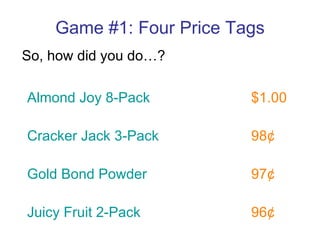
Game #1: Four Price Tags So, how did you do…? Almond Joy 8-Pack $1.00 Cracker Jack 3-Pack 98¢ Gold Bond Powder 97¢ Juicy Fruit 2-Pack 96¢
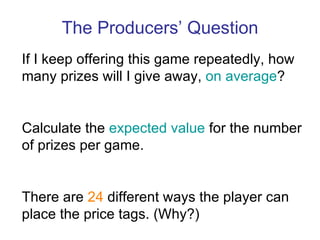
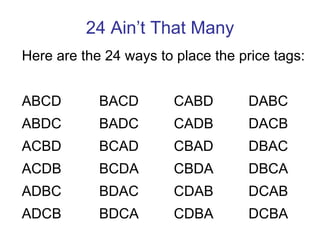
The Producers’ Question If I keep offering this game repeatedly, how many prizes will I give away,  on average ? Calculate the  expected value  for the number of prizes per game. There are  24  different ways the player can place the price tags.  (Why?)
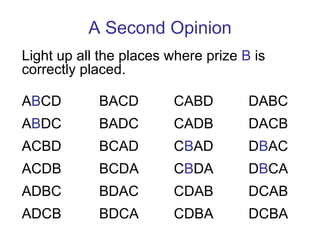
24 Ain’t That Many Here are the 24 ways to place the price tags: ABCD ABDC ACBD ACDB ADBC ADCB BACD BADC BCAD BCDA BDAC BDCA CABD CADB CBAD CBDA CDAB CDBA DABC DACB DBAC DBCA DCAB DCBA
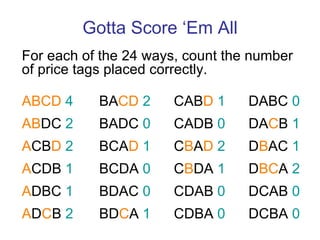
Gotta Score ‘Em All For each of the 24 ways, count the number of price tags placed correctly. ABCD   4 AB DC  2 A CB D   2 A CDB  1 A DBC  1 A D C B  2 BA CD   2 BADC  0 BCA D   1 BCDA  0 BDAC  0 BD C A  1 CAB D   1 CADB  0 C B A D   2 C B DA  1 CDAB  0 CDBA  0 DABC  0 DA C B  1 D B AC  1 D BC A  2 DCAB  0 DCBA  0
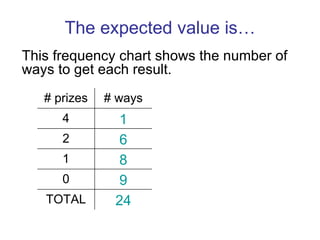
The expected value is… This frequency chart shows the number of ways to get each result. 24 TOTAL 9 0 8 1 6 2 1 4 # ways # prizes
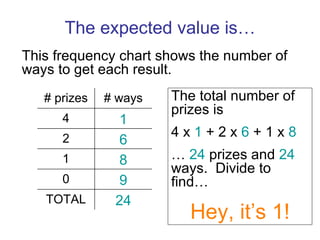
The expected value is… This frequency chart shows the number of ways to get each result. The total number of prizes is 4 x  1  + 2 x  6  + 1 x  8   …  24  prizes and  24  ways.  Divide to find… Hey, it’s 1! 24 TOTAL 9 0 8 1 6 2 1 4 # ways # prizes
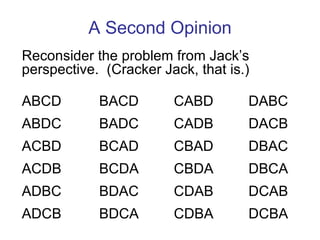
A Second Opinion Reconsider the problem from Jack’s perspective.  (Cracker Jack, that is.) ABCD ABDC ACBD ACDB ADBC ADCB BACD BADC BCAD BCDA BDAC BDCA CABD CADB CBAD CBDA CDAB CDBA DABC DACB DBAC DBCA DCAB DCBA
A Second Opinion Light up all the places where prize  B  is correctly placed. A B CD A B DC ACBD ACDB ADBC ADCB BACD BADC BCAD BCDA BDAC BDCA CABD CADB C B AD C B DA CDAB CDBA DABC DACB D B AC D B CA DCAB DCBA
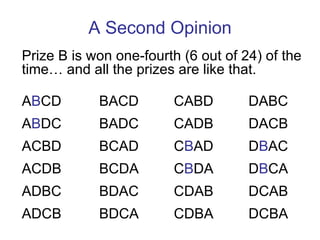
A Second Opinion Prize B is won one-fourth (6 out of 24) of the time… and all the prizes are like that. A B CD A B DC ACBD ACDB ADBC ADCB BACD BADC BCAD BCDA BDAC BDCA CABD CADB C B AD C B DA CDAB CDBA DABC DACB D B AC D B CA DCAB DCBA
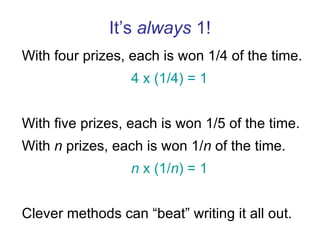
It’s  always  1! With four prizes, each is won 1/4 of the time. 4 x (1/4) = 1 With five prizes, each is won 1/5 of the time. With  n  prizes, each is won 1/ n  of the time. n  x (1/ n ) = 1 Clever methods can “beat” writing it all out.
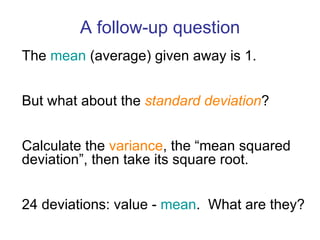
The  mean  (average) given away is 1. But what about the  standard deviation ? Calculate the  variance , the “mean squared deviation”, then take its square root. 24 deviations: value -  mean .  What are they? A follow-up question
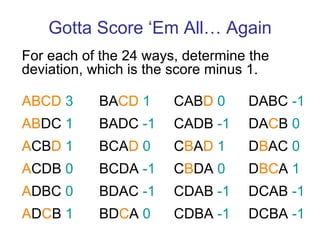
Gotta Score ‘Em All… Again For each of the 24 ways, determine the deviation, which is the score minus 1. ABCD   3 AB DC  1 A CB D   1 A CDB  0 A DBC  0 A D C B  1 BA CD   1 BADC  -1 BCA D   0 BCDA  -1 BDAC  -1 BD C A  0 CAB D   0 CADB  -1 C B A D   1 C B DA  0 CDAB  -1 CDBA  -1 DABC  -1 DA C B  0 D B AC  0 D BC A  1 DCAB  -1 DCBA  -1
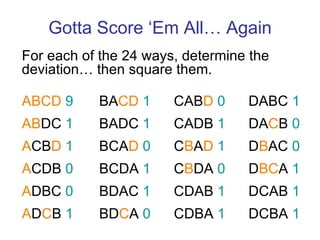
Gotta Score ‘Em All… Again For each of the 24 ways, determine the deviation… then square them. ABCD   9 AB DC  1 A CB D   1 A CDB  0 A DBC  0 A D C B  1 BA CD   1 BADC  1 BCA D   0 BCDA  1 BDAC  1 BD C A  0 CAB D   0 CADB  1 C B A D   1 C B DA  0 CDAB  1 CDBA  1 DABC  1 DA C B  0 D B AC  0 D BC A  1 DCAB  1 DCBA  1
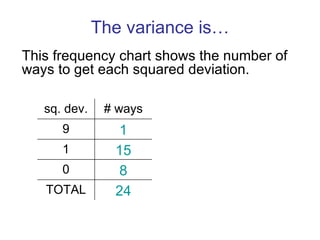
The variance is… This frequency chart shows the number of ways to get each squared deviation. 24 TOTAL 8 0 15 1 1 9 # ways sq. dev.
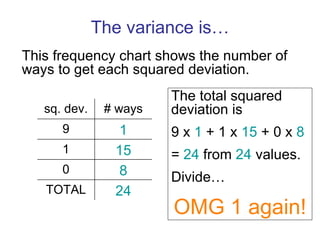
The variance is… This frequency chart shows the number of ways to get each squared deviation. The total squared deviation is 9 x  1  + 1 x  15  + 0 x  8 =  24  from  24  values.  Divide… OMG 1 again! 24 TOTAL 8 0 15 1 1 9 # ways sq. dev.
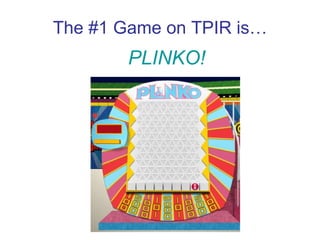
The #1 Game on TPIR is… PLINKO!
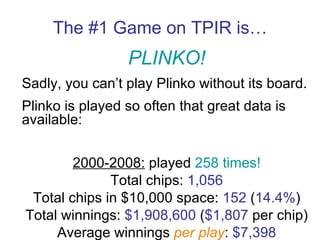
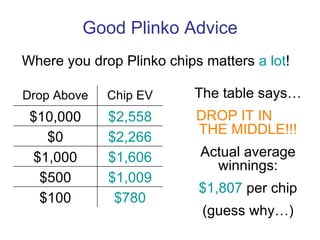
The #1 Game on TPIR is… PLINKO! Sadly, you can’t play Plinko without its board. Plinko is played so often that great data is available: 2000-2008:  played  258 times! Total chips:  1,056 Total chips in $10,000 space:  152  ( 14.4% ) Total winnings:  $1,908,600  ( $1,807  per chip) Average winnings  per play :  $7,398
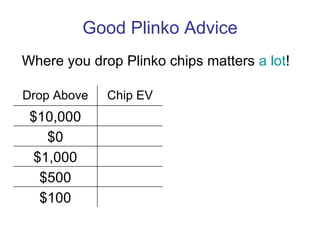
Good Plinko Advice Where you drop Plinko chips matters  a lot ! $100 $500 $1,000 $0 $10,000 Chip EV Drop Above
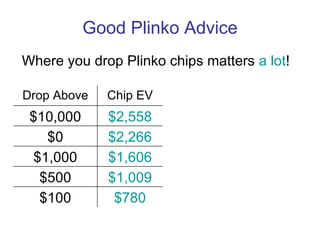
Good Plinko Advice Where you drop Plinko chips matters  a lot ! $780 $100 $1,009 $500 $1,606 $1,000 $2,266 $0 $2,558 $10,000 Chip EV Drop Above
Good Plinko Advice Where you drop Plinko chips matters  a lot ! The table says… DROP IT IN  THE MIDDLE!!! Actual average winnings: $1,807  per chip (guess why…) $780 $100 $1,009 $500 $1,606 $1,000 $2,266 $0 $2,558 $10,000 Chip EV Drop Above
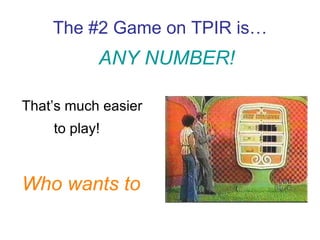
The #2 Game on TPIR is… ANY NUMBER! That’s much easier to play! Who wants to play a game??
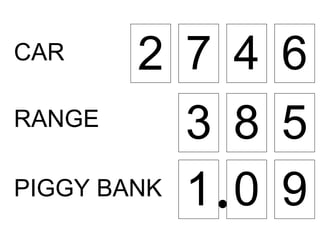
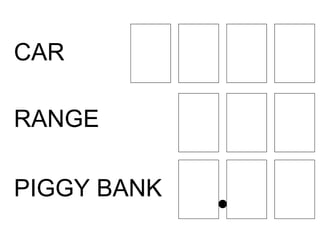
2 7 4 6 3 8 5 1 0 9 CAR RANGE PIGGY BANK
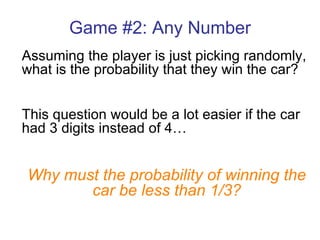
Game #2: Any Number Assuming the player is just picking randomly  (which seems about right) , what is the probability that they win the car? This is a hard question!
Game #2: Any Number Assuming the player is just picking randomly, what is the probability that they win the car? This question would be a lot easier if the car had 3 digits instead of 4… Why must the probability of winning the car be less than 1/3?
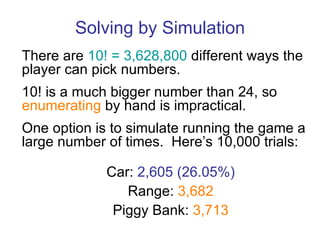
Solving by Simulation There are  10! = 3,628,800  different ways the player can pick numbers. 10! is a much bigger number than 24, so  enumerating  by hand is impractical. One option is to simulate running the game a large number of times.  Here’s 10,000 trials: Car:  2,605 (26.05%) Range:  3,682 Piggy Bank:  3,713
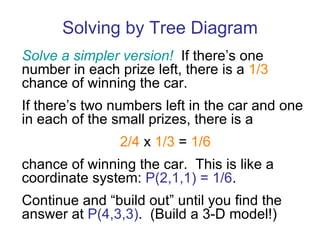
Solving by Tree Diagram Solve a simpler version!   If there’s one number in each prize left, there is a  1/3  chance of winning the car. If there’s two numbers left in the car and one in each of the small prizes, there is a 2/4  x  1/3  =  1/6 chance of winning the car.  This is like a coordinate system:  P(2,1,1) = 1/6 . Continue and “build out” until you find the answer at  P(4,3,3) .  (Build a 3-D model!)
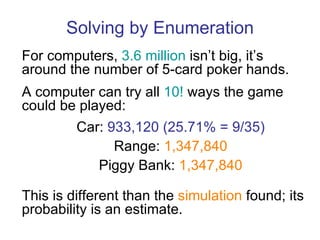
Solving by Enumeration For computers,  3.6 million  isn’t big, it’s around the number of 5-card poker hands. A computer can try all  10!  ways the game could be played: This is different than the  simulation  found; its probability is an estimate. Car:  933,120 (25.71% = 9/35) Range:  1,347,840 Piggy Bank:  1,347,840
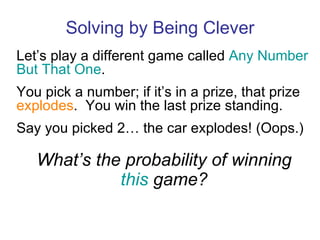
Solving by Being Clever Let’s play a different game called  Any Number But That One . You pick a number; if it’s in a prize, that prize  explodes .  You win the last prize standing. Say you picked 2… the car explodes!  (Oops.)   What’s the probability of winning this  game?
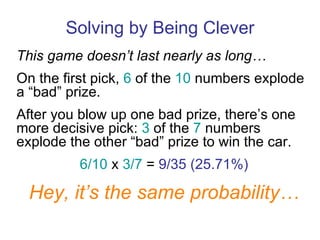
Solving by Being Clever This game doesn’t last nearly as long… On the first pick,  6  of the  10  numbers explode a “bad” prize. After you blow up one bad prize, there’s one more decisive pick:  3  of the  7  numbers explode the other “bad” prize to win the car. 6/10  x  3/7  =  9/35 (25.71%) Hey, it’s the same probability…
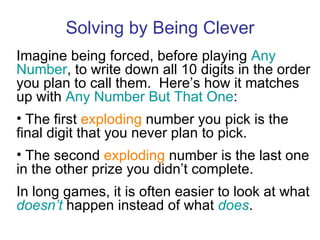
Solving by Being Clever Imagine being forced, before playing  Any Number , to write down all 10 digits in the order you plan to call them.  Here’s how it matches up with  Any Number But That One : The first  exploding  number you pick is the final digit that you never plan to pick. The second  exploding  number is the last one in the other prize you didn’t complete. In long games, it is often easier to look at what  doesn’t  happen instead of what  does .
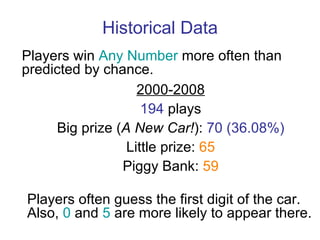
Historical Data Players win  Any Number  more often than predicted by chance. 2000-2008 194  plays Big prize  ( A New Car! ) :  70 (36.08%) Little prize:  65 Piggy Bank:  59 Players often guess the first digit of the car. Also,  0  and  5  are more likely to appear there.
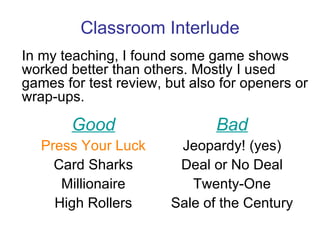
Classroom Interlude In my teaching, I found some game shows worked better than others. Mostly I used games for test review, but also for openers or wrap-ups. Good Press Your Luck Card Sharks Millionaire High Rollers Bad Jeopardy!  (yes) Deal or No Deal Twenty-One Sale of the Century
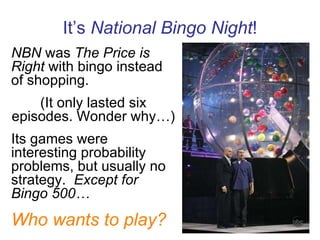
It’s  National Bingo Night ! NBN  was  The Price is Right  with bingo instead of shopping. (It only lasted six episodes. Wonder why…) Its games were interesting probability problems, but usually no strategy.  Except for Bingo 500… Who wants to play?
Get Out Your Bingo Cards… The final game of the night is  Bingo 500 . If you complete a bingo before the contestant wins,  you win  all remaining prizes! (Ties will be broken by a math problem.) Important:  if you are one number away from a bingo,  STAND UP  so we can tell you are one away.
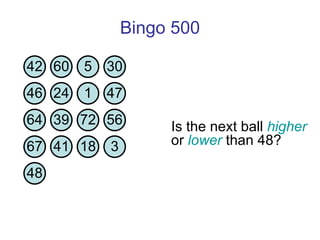
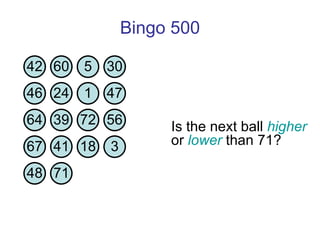
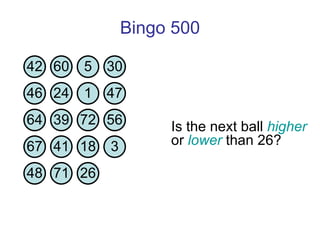
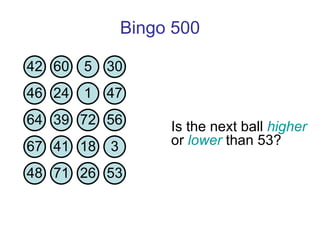
Bingo 500 For each bingo ball, the contestant guesses whether the next ball will be  higher  or  lower  than the one that just came out. If they are right, the  ball number  is added to their score. 75 is better than 23. The first ball is a “freebie”. The contestant wins if they get a total of  500 points  or more before anyone in the audience completes a bingo. (The audience: 200 players, one card each.)
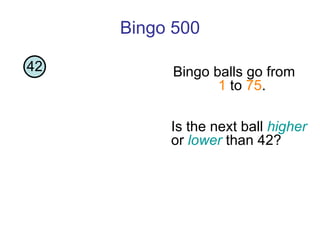
Bingo 500 Is the next ball  higher  or  lower  than 42? Bingo balls go from  1  to  75 . 42
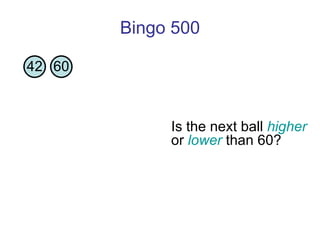
Bingo 500 Is the next ball  higher  or  lower  than 60?  42 60
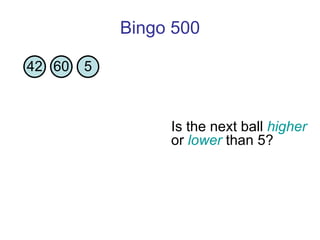
Bingo 500 Is the next ball  higher  or  lower  than 5?  42 60 5
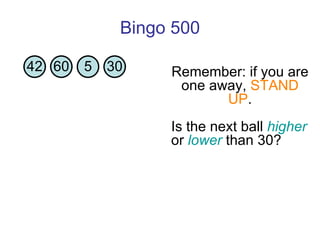
Bingo 500 Is the next ball  higher  or  lower  than 30?  Remember: if you are one away,  STAND UP . 42 60 5 30
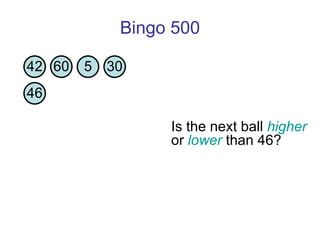
Bingo 500 Is the next ball  higher  or  lower  than 46?  42 60 5 30 46
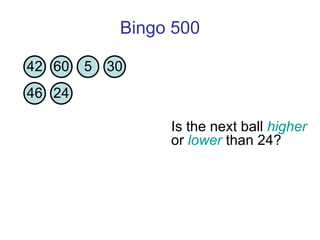
Bingo 500 Is the next ball  higher  or  lower  than 24?  42 60 5 30 46 24
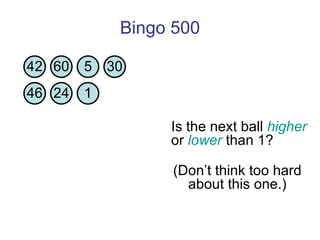
Bingo 500 Is the next ball  higher  or  lower  than 1?  (Don’t think too hard about this one.) 42 60 5 30 46 24 1
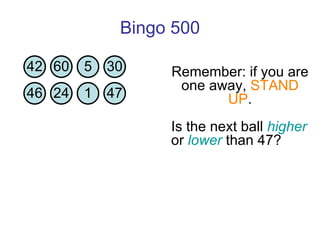
Bingo 500 Is the next ball  higher  or  lower  than 47?  Remember: if you are one away,  STAND UP . 42 60 5 30 46 24 1 47
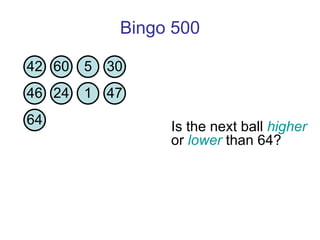
Bingo 500 Is the next ball  higher  or  lower  than 64?  42 60 5 30 46 24 1 47 64
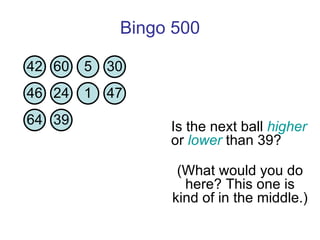
Bingo 500 Is the next ball  higher  or  lower  than 39?  (What would you do here? This one is kind of in the middle.) 42 60 5 30 46 24 1 47 64 39
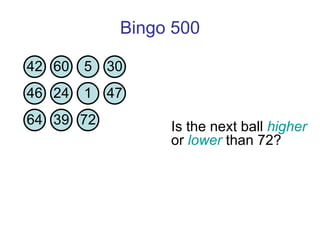
Bingo 500 Is the next ball  higher  or  lower  than 72?  42 60 5 30 46 24 1 47 64 39 72
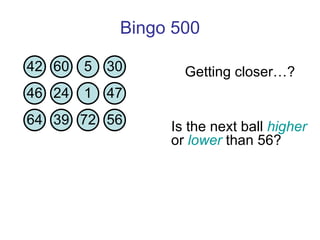
Bingo 500 Is the next ball  higher  or  lower  than 56?  Getting closer…? 42 60 5 30 46 24 1 47 64 39 72 56
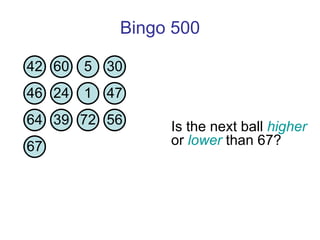
Bingo 500 Is the next ball  higher  or  lower  than 67?  42 60 5 30 46 24 1 47 64 39 72 56 67
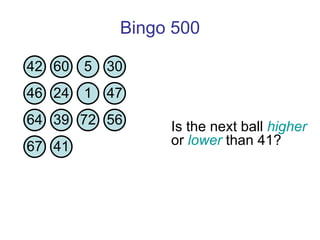
Bingo 500 Is the next ball  higher  or  lower  than 41?  42 60 5 30 46 24 1 47 64 39 72 56 67 41
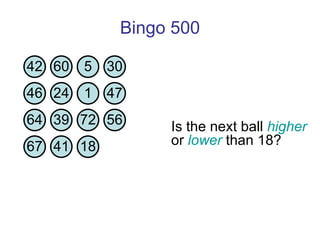
Bingo 500 Is the next ball  higher  or  lower  than 18?  42 60 5 30 46 24 1 47 64 39 72 56 67 41 18
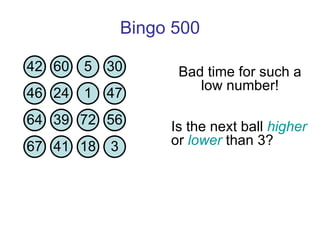
Bingo 500 Is the next ball  higher  or  lower  than 3?  Bad time for such a low number! 42 60 5 30 46 24 1 47 64 39 72 56 67 41 18 3
Bingo 500 Is the next ball  higher  or  lower  than 48?  42 60 5 30 46 24 1 47 64 39 72 56 67 41 18 3 48
Bingo 500 Is the next ball  higher  or  lower  than 71?  42 60 5 30 46 24 1 47 64 39 72 56 67 41 18 3 48 71
Bingo 500 Is the next ball  higher  or  lower  than 26?  42 60 5 30 46 24 1 47 64 39 72 56 67 41 18 3 48 71 26
Bingo 500 Is the next ball  higher  or  lower  than 53?  42 60 5 30 46 24 1 47 64 39 72 56 67 41 18 3 48 71 26 53
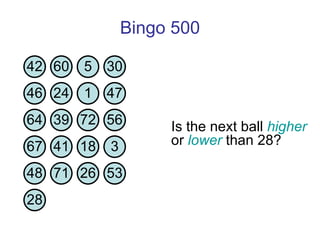
Bingo 500 Is the next ball  higher  or  lower  than 28?  42 60 5 30 46 24 1 47 64 39 72 56 67 41 18 3 48 71 26 53 28
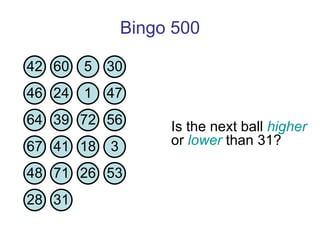
Bingo 500 Is the next ball  higher  or  lower  than 31?  42 60 5 30 46 24 1 47 64 39 72 56 67 41 18 3 48 71 26 53 28 31
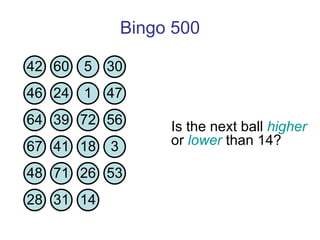
Bingo 500 Is the next ball  higher  or  lower  than 14?  42 60 5 30 46 24 1 47 64 39 72 56 67 41 18 3 48 71 26 53 28 31 14
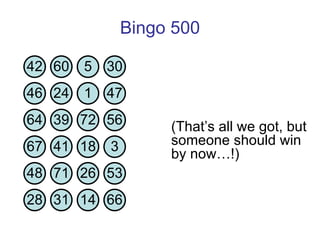
Bingo 500 (That’s all we got, but someone should win by now…!) 42 60 5 30 46 24 1 47 64 39 72 56 67 41 18 3 48 71 26 53 28 31 14 66
Bingo 500 Strategy Did strategy change as the game went on? One strategy is to  go higher if in the bottom half, otherwise lower .  Is this the best strategy?  Or what? What’s this got to do with summations? Balance?  Similar triangles?? Players did not follow good strategy on the actual show:  the first contestant to play Bingo 500 picked “lower” on a 30.   (He lost.)
More to Explore Many related topics are asked about in  CME Project  Precalculus , and in the  Park City Math Institute  materials at www.mathforum.org/pcmi/hstp/sum2007/morning How can spinners or dice be represented by polynomials? How often is  Four Price Tags  a total bust? What about  N  Price Tags… Would it be reasonable for 30 of 100 people to win  Any Number  by chance? 35? 40?
Thanks and good luck! Any questions? Bowen Kerins Senior Curriculum Designer, EDC (and part-time game consultant) [email_address]

Game Show Math

  • 1.
    The Mathematics ofGame Shows Bowen Kerins Senior Curriculum Designer, EDC (and part-time game consultant) [email_address]
  • 2.
    Overview Game showsare filled with math problems… Contestants How do I play best? How much is enough? Producers How do I build a fun game to watch? How will contestants behave? How much money are we giving out?
  • 3.
    PRIZES! Want towin? We’ll need some volunteers for three games . You could win as much as, um, $4 in prizes!
  • 4.
    CME Project FundamentalOrganizing Principle The widespread utility and e ff ectiveness of mathematics come not just from mastering specific skills, topics, and techniques, but more importantly, from developing the ways of thinking—the habits of mind —used to create the results. Four-year, NSF-funded curriculum written by EDC Published in 2008 by Pearson Education 25,000 students use it nationally, 1000 in Boston
  • 5.
    CME Project Overview “ Traditional” course structure: it’s familiar but different Structured around the sequence of Algebra 1, Geometry, Algebra 2, Precalculus Uses a variety of instructional approaches Organized around mathematical themes Come to one of our summer sessions! June 21-23 and August 2-6, in Newton
  • 6.
    Personal Encounters February2000 (for $1000: How many degrees in a right angle?)
  • 7.
    Personal Encounters February2000 (I got the next question wrong.)
  • 8.
    Personal Encounters 2004(Double overbid on the showcase! Bummer.)
  • 9.
    Personal Encounters Summer2007 (I also worked on “Show Me The Money” and “The Singing Bee”… which, amazingly, is still on the air.)
  • 10.
    Expected Value HourA popular show! Better known as “ Deal or No Deal” $.01 $1 $5 $10 $25 $50 $75 $100 $200 $300 $400 $500 $750 $1,000 $5,000 $10,000 $25,000 $50,000 $75,000 $100,000 $200,000 $300,000 $400,000 $500,000 $750,000 $1,000,000
  • 11.
    Expected Value HourThe “ fair deal ”: Multiply each outcome by its probability… Total: $410,210 Fair deal: ~$102,500 $.01 $1 $5 $10 $25 $50 $75 $100 $200 $300 $400 $500 $750 $1,000 $5,000 $10,000 $25,000 $50,000 $75,000 $100,000 $200,000 $300,000 $400,000 $500,000 $750,000 $1,000,000
  • 12.
    Expected Value HourThe “ bank offer ”: Guarantee, almost always less than fair value Fair deal: ~$102,500 Offer: $82,000 Deal or No Deal ? $.01 $1 $5 $10 $25 $50 $75 $100 $200 $300 $400 $500 $750 $1,000 $5,000 $10,000 $25,000 $50,000 $75,000 $100,000 $200,000 $300,000 $400,000 $500,000 $750,000 $1,000,000
  • 13.
    Expected Value Hour$.01 $1 $5 $10 $25 $50 $75 $100 $200 $300 $400 $500 $750 $1,000 $5,000 $10,000 $25,000 $50,000 $75,000 $100,000 $200,000 $300,000 $400,000 $500,000 $750,000 $1,000,000 What’s the expected value of the initial board?
  • 14.
    Expected Value Hour$.01 $1 $5 $10 $25 $50 $75 $100 $200 $300 $400 $500 $750 $1,000 $5,000 $10,000 $25,000 $50,000 $75,000 $100,000 $200,000 $300,000 $400,000 $500,000 $750,000 $1,000,000 Initial board… Fair deal: $131,477 First offer: ~$15,000-$20,000 Why do the first offers stink?
  • 15.
    Expected Value Hour$.01 $1 $5 $10 $25 $50 $75 $100 $200 $300 $400 $500 $750 $1,000 $5,000 $10,000 $25,000 $50,000 $75,000 $100,000 $200,000 $300,000 $400,000 $500,000 $750,000 $1,000,000 Winnings per player: ~$122,500 Offer percentages (compared to fair value, by round): 11%, 21%, 36%, 50%, 62%, 73%, 88%, 92%, 98%
  • 16.
    The Price IsRight Now in its 38th year Lots of good math problems! Also a huge sample size of repeatedly- played games (for agonizing detail, visit http://tpirsummaries.8m.com) Who wants to play a game??
  • 17.
    Game #1: FourPrice Tags Place a price next to each item. If it’s the right price, you win the prize! Almond Joy 8-Pack Cracker Jack 3-Pack Gold Bond Powder Juicy Fruit 2-Pack
  • 18.
    Game #1: FourPrice Tags Place a price next to each item. If it’s the right price, you win the prize! Almond Joy 8-Pack Cracker Jack 3-Pack Gold Bond Powder Juicy Fruit 2-Pack 96¢ 97¢ 98¢ $1.00 Good luck… you’ll need it. Audience, any advice?
  • 19.
    Game #1: FourPrice Tags So, how did you do…? Almond Joy 8-Pack $1.00 Cracker Jack 3-Pack 98¢ Gold Bond Powder 97¢ Juicy Fruit 2-Pack 96¢
  • 20.
    The Producers’ QuestionIf I keep offering this game repeatedly, how many prizes will I give away, on average ? Calculate the expected value for the number of prizes per game. There are 24 different ways the player can place the price tags. (Why?)
  • 21.
    24 Ain’t ThatMany Here are the 24 ways to place the price tags: ABCD ABDC ACBD ACDB ADBC ADCB BACD BADC BCAD BCDA BDAC BDCA CABD CADB CBAD CBDA CDAB CDBA DABC DACB DBAC DBCA DCAB DCBA
  • 22.
    Gotta Score ‘EmAll For each of the 24 ways, count the number of price tags placed correctly. ABCD 4 AB DC 2 A CB D 2 A CDB 1 A DBC 1 A D C B 2 BA CD 2 BADC 0 BCA D 1 BCDA 0 BDAC 0 BD C A 1 CAB D 1 CADB 0 C B A D 2 C B DA 1 CDAB 0 CDBA 0 DABC 0 DA C B 1 D B AC 1 D BC A 2 DCAB 0 DCBA 0
  • 23.
    The expected valueis… This frequency chart shows the number of ways to get each result. 24 TOTAL 9 0 8 1 6 2 1 4 # ways # prizes
  • 24.
    The expected valueis… This frequency chart shows the number of ways to get each result. The total number of prizes is 4 x 1 + 2 x 6 + 1 x 8 … 24 prizes and 24 ways. Divide to find… Hey, it’s 1! 24 TOTAL 9 0 8 1 6 2 1 4 # ways # prizes
  • 25.
    A Second OpinionReconsider the problem from Jack’s perspective. (Cracker Jack, that is.) ABCD ABDC ACBD ACDB ADBC ADCB BACD BADC BCAD BCDA BDAC BDCA CABD CADB CBAD CBDA CDAB CDBA DABC DACB DBAC DBCA DCAB DCBA
  • 26.
    A Second OpinionLight up all the places where prize B is correctly placed. A B CD A B DC ACBD ACDB ADBC ADCB BACD BADC BCAD BCDA BDAC BDCA CABD CADB C B AD C B DA CDAB CDBA DABC DACB D B AC D B CA DCAB DCBA
  • 27.
    A Second OpinionPrize B is won one-fourth (6 out of 24) of the time… and all the prizes are like that. A B CD A B DC ACBD ACDB ADBC ADCB BACD BADC BCAD BCDA BDAC BDCA CABD CADB C B AD C B DA CDAB CDBA DABC DACB D B AC D B CA DCAB DCBA
  • 28.
    It’s always 1! With four prizes, each is won 1/4 of the time. 4 x (1/4) = 1 With five prizes, each is won 1/5 of the time. With n prizes, each is won 1/ n of the time. n x (1/ n ) = 1 Clever methods can “beat” writing it all out.
  • 29.
    The mean (average) given away is 1. But what about the standard deviation ? Calculate the variance , the “mean squared deviation”, then take its square root. 24 deviations: value - mean . What are they? A follow-up question
  • 30.
    Gotta Score ‘EmAll… Again For each of the 24 ways, determine the deviation, which is the score minus 1. ABCD 3 AB DC 1 A CB D 1 A CDB 0 A DBC 0 A D C B 1 BA CD 1 BADC -1 BCA D 0 BCDA -1 BDAC -1 BD C A 0 CAB D 0 CADB -1 C B A D 1 C B DA 0 CDAB -1 CDBA -1 DABC -1 DA C B 0 D B AC 0 D BC A 1 DCAB -1 DCBA -1
  • 31.
    Gotta Score ‘EmAll… Again For each of the 24 ways, determine the deviation… then square them. ABCD 9 AB DC 1 A CB D 1 A CDB 0 A DBC 0 A D C B 1 BA CD 1 BADC 1 BCA D 0 BCDA 1 BDAC 1 BD C A 0 CAB D 0 CADB 1 C B A D 1 C B DA 0 CDAB 1 CDBA 1 DABC 1 DA C B 0 D B AC 0 D BC A 1 DCAB 1 DCBA 1
  • 32.
    The variance is…This frequency chart shows the number of ways to get each squared deviation. 24 TOTAL 8 0 15 1 1 9 # ways sq. dev.
  • 33.
    The variance is…This frequency chart shows the number of ways to get each squared deviation. The total squared deviation is 9 x 1 + 1 x 15 + 0 x 8 = 24 from 24 values. Divide… OMG 1 again! 24 TOTAL 8 0 15 1 1 9 # ways sq. dev.
  • 34.
    The #1 Gameon TPIR is… PLINKO!
  • 35.
    The #1 Gameon TPIR is… PLINKO! Sadly, you can’t play Plinko without its board. Plinko is played so often that great data is available: 2000-2008: played 258 times! Total chips: 1,056 Total chips in $10,000 space: 152 ( 14.4% ) Total winnings: $1,908,600 ( $1,807 per chip) Average winnings per play : $7,398
  • 36.
    Good Plinko AdviceWhere you drop Plinko chips matters a lot ! $100 $500 $1,000 $0 $10,000 Chip EV Drop Above
  • 37.
    Good Plinko AdviceWhere you drop Plinko chips matters a lot ! $780 $100 $1,009 $500 $1,606 $1,000 $2,266 $0 $2,558 $10,000 Chip EV Drop Above
  • 38.
    Good Plinko AdviceWhere you drop Plinko chips matters a lot ! The table says… DROP IT IN THE MIDDLE!!! Actual average winnings: $1,807 per chip (guess why…) $780 $100 $1,009 $500 $1,606 $1,000 $2,266 $0 $2,558 $10,000 Chip EV Drop Above
  • 39.
    The #2 Gameon TPIR is… ANY NUMBER! That’s much easier to play! Who wants to play a game??
  • 40.
    2 7 46 3 8 5 1 0 9 CAR RANGE PIGGY BANK
  • 41.
    2 7 46 3 8 5 1 0 9 CAR RANGE PIGGY BANK
  • 42.
    Game #2: AnyNumber Assuming the player is just picking randomly (which seems about right) , what is the probability that they win the car? This is a hard question!
  • 43.
    Game #2: AnyNumber Assuming the player is just picking randomly, what is the probability that they win the car? This question would be a lot easier if the car had 3 digits instead of 4… Why must the probability of winning the car be less than 1/3?
  • 44.
    Solving by SimulationThere are 10! = 3,628,800 different ways the player can pick numbers. 10! is a much bigger number than 24, so enumerating by hand is impractical. One option is to simulate running the game a large number of times. Here’s 10,000 trials: Car: 2,605 (26.05%) Range: 3,682 Piggy Bank: 3,713
  • 45.
    Solving by TreeDiagram Solve a simpler version! If there’s one number in each prize left, there is a 1/3 chance of winning the car. If there’s two numbers left in the car and one in each of the small prizes, there is a 2/4 x 1/3 = 1/6 chance of winning the car. This is like a coordinate system: P(2,1,1) = 1/6 . Continue and “build out” until you find the answer at P(4,3,3) . (Build a 3-D model!)
  • 46.
    Solving by EnumerationFor computers, 3.6 million isn’t big, it’s around the number of 5-card poker hands. A computer can try all 10! ways the game could be played: This is different than the simulation found; its probability is an estimate. Car: 933,120 (25.71% = 9/35) Range: 1,347,840 Piggy Bank: 1,347,840
  • 47.
    Solving by BeingClever Let’s play a different game called Any Number But That One . You pick a number; if it’s in a prize, that prize explodes . You win the last prize standing. Say you picked 2… the car explodes! (Oops.) What’s the probability of winning this game?
  • 48.
    Solving by BeingClever This game doesn’t last nearly as long… On the first pick, 6 of the 10 numbers explode a “bad” prize. After you blow up one bad prize, there’s one more decisive pick: 3 of the 7 numbers explode the other “bad” prize to win the car. 6/10 x 3/7 = 9/35 (25.71%) Hey, it’s the same probability…
  • 49.
    Solving by BeingClever Imagine being forced, before playing Any Number , to write down all 10 digits in the order you plan to call them. Here’s how it matches up with Any Number But That One : The first exploding number you pick is the final digit that you never plan to pick. The second exploding number is the last one in the other prize you didn’t complete. In long games, it is often easier to look at what doesn’t happen instead of what does .
  • 50.
    Historical Data Playerswin Any Number more often than predicted by chance. 2000-2008 194 plays Big prize ( A New Car! ) : 70 (36.08%) Little prize: 65 Piggy Bank: 59 Players often guess the first digit of the car. Also, 0 and 5 are more likely to appear there.
  • 51.
    Classroom Interlude Inmy teaching, I found some game shows worked better than others. Mostly I used games for test review, but also for openers or wrap-ups. Good Press Your Luck Card Sharks Millionaire High Rollers Bad Jeopardy! (yes) Deal or No Deal Twenty-One Sale of the Century
  • 52.
    It’s NationalBingo Night ! NBN was The Price is Right with bingo instead of shopping. (It only lasted six episodes. Wonder why…) Its games were interesting probability problems, but usually no strategy. Except for Bingo 500… Who wants to play?
  • 53.
    Get Out YourBingo Cards… The final game of the night is Bingo 500 . If you complete a bingo before the contestant wins, you win all remaining prizes! (Ties will be broken by a math problem.) Important: if you are one number away from a bingo, STAND UP so we can tell you are one away.
  • 54.
    Bingo 500 Foreach bingo ball, the contestant guesses whether the next ball will be higher or lower than the one that just came out. If they are right, the ball number is added to their score. 75 is better than 23. The first ball is a “freebie”. The contestant wins if they get a total of 500 points or more before anyone in the audience completes a bingo. (The audience: 200 players, one card each.)
  • 55.
    Bingo 500 Isthe next ball higher or lower than 42? Bingo balls go from 1 to 75 . 42
  • 56.
    Bingo 500 Isthe next ball higher or lower than 60? 42 60
  • 57.
    Bingo 500 Isthe next ball higher or lower than 5? 42 60 5
  • 58.
    Bingo 500 Isthe next ball higher or lower than 30? Remember: if you are one away, STAND UP . 42 60 5 30
  • 59.
    Bingo 500 Isthe next ball higher or lower than 46? 42 60 5 30 46
  • 60.
    Bingo 500 Isthe next ball higher or lower than 24? 42 60 5 30 46 24
  • 61.
    Bingo 500 Isthe next ball higher or lower than 1? (Don’t think too hard about this one.) 42 60 5 30 46 24 1
  • 62.
    Bingo 500 Isthe next ball higher or lower than 47? Remember: if you are one away, STAND UP . 42 60 5 30 46 24 1 47
  • 63.
    Bingo 500 Isthe next ball higher or lower than 64? 42 60 5 30 46 24 1 47 64
  • 64.
    Bingo 500 Isthe next ball higher or lower than 39? (What would you do here? This one is kind of in the middle.) 42 60 5 30 46 24 1 47 64 39
  • 65.
    Bingo 500 Isthe next ball higher or lower than 72? 42 60 5 30 46 24 1 47 64 39 72
  • 66.
    Bingo 500 Isthe next ball higher or lower than 56? Getting closer…? 42 60 5 30 46 24 1 47 64 39 72 56
  • 67.
    Bingo 500 Isthe next ball higher or lower than 67? 42 60 5 30 46 24 1 47 64 39 72 56 67
  • 68.
    Bingo 500 Isthe next ball higher or lower than 41? 42 60 5 30 46 24 1 47 64 39 72 56 67 41
  • 69.
    Bingo 500 Isthe next ball higher or lower than 18? 42 60 5 30 46 24 1 47 64 39 72 56 67 41 18
  • 70.
    Bingo 500 Isthe next ball higher or lower than 3? Bad time for such a low number! 42 60 5 30 46 24 1 47 64 39 72 56 67 41 18 3
  • 71.
    Bingo 500 Isthe next ball higher or lower than 48? 42 60 5 30 46 24 1 47 64 39 72 56 67 41 18 3 48
  • 72.
    Bingo 500 Isthe next ball higher or lower than 71? 42 60 5 30 46 24 1 47 64 39 72 56 67 41 18 3 48 71
  • 73.
    Bingo 500 Isthe next ball higher or lower than 26? 42 60 5 30 46 24 1 47 64 39 72 56 67 41 18 3 48 71 26
  • 74.
    Bingo 500 Isthe next ball higher or lower than 53? 42 60 5 30 46 24 1 47 64 39 72 56 67 41 18 3 48 71 26 53
  • 75.
    Bingo 500 Isthe next ball higher or lower than 28? 42 60 5 30 46 24 1 47 64 39 72 56 67 41 18 3 48 71 26 53 28
  • 76.
    Bingo 500 Isthe next ball higher or lower than 31? 42 60 5 30 46 24 1 47 64 39 72 56 67 41 18 3 48 71 26 53 28 31
  • 77.
    Bingo 500 Isthe next ball higher or lower than 14? 42 60 5 30 46 24 1 47 64 39 72 56 67 41 18 3 48 71 26 53 28 31 14
  • 78.
    Bingo 500 (That’sall we got, but someone should win by now…!) 42 60 5 30 46 24 1 47 64 39 72 56 67 41 18 3 48 71 26 53 28 31 14 66
  • 79.
    Bingo 500 StrategyDid strategy change as the game went on? One strategy is to go higher if in the bottom half, otherwise lower . Is this the best strategy? Or what? What’s this got to do with summations? Balance? Similar triangles?? Players did not follow good strategy on the actual show: the first contestant to play Bingo 500 picked “lower” on a 30. (He lost.)
  • 80.
    More to ExploreMany related topics are asked about in CME Project Precalculus , and in the Park City Math Institute materials at www.mathforum.org/pcmi/hstp/sum2007/morning How can spinners or dice be represented by polynomials? How often is Four Price Tags a total bust? What about N Price Tags… Would it be reasonable for 30 of 100 people to win Any Number by chance? 35? 40?
  • 81.
    Thanks and goodluck! Any questions? Bowen Kerins Senior Curriculum Designer, EDC (and part-time game consultant) [email_address]