GALTUNG AND RUGE’S-
NEWS VALUES
INTRODUCTION
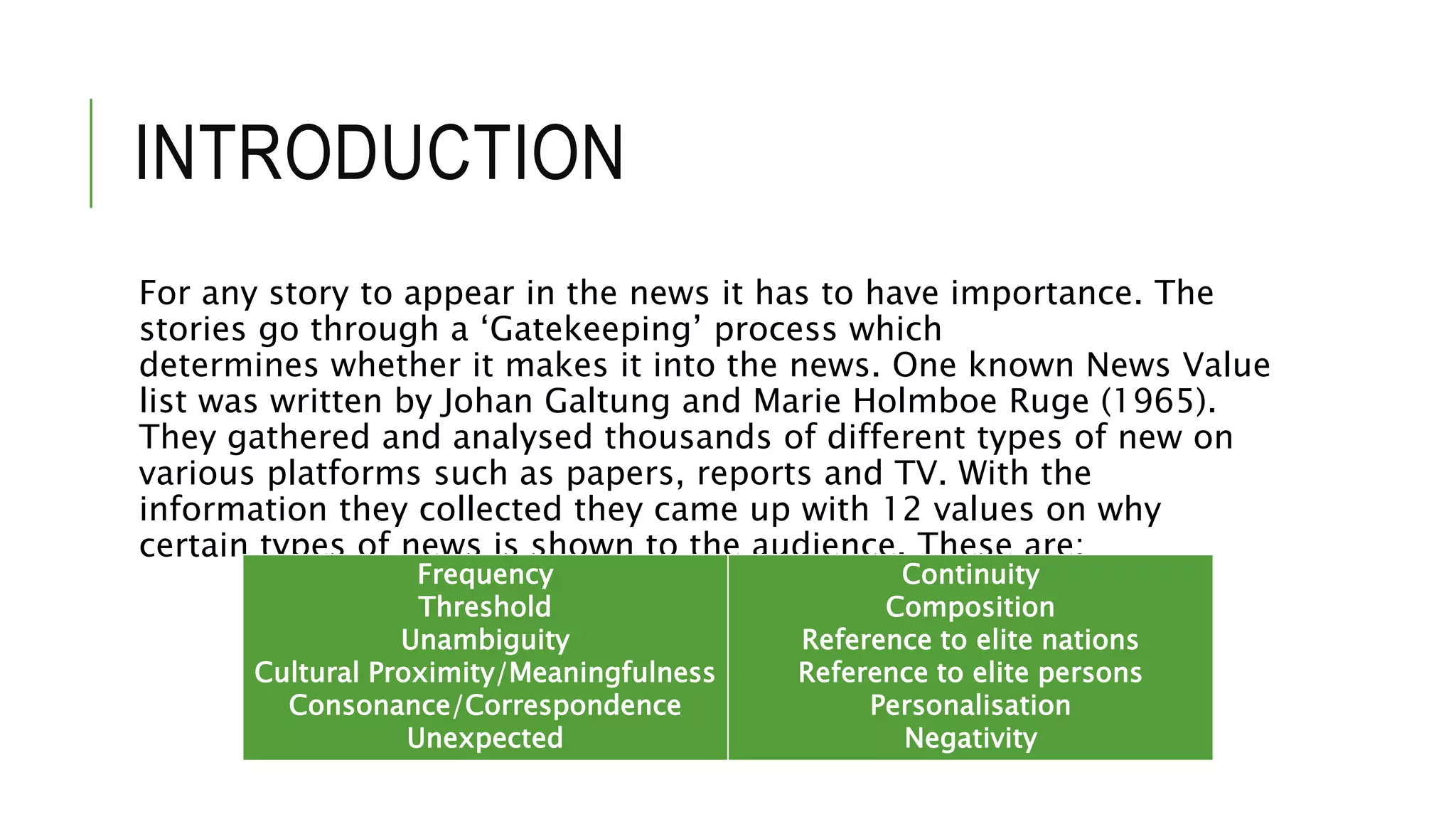
For any story to appear in the news it has to have importance. The
stories go through a ‘Gatekeeping’ process which
determines whether it makes it into the news. One known News Value
list was written by Johan Galtung and Marie Holmboe Ruge (1965).
They gathered and analysed thousands of different types of new on
various platforms such as papers, reports and TV. With the
information they collected they came up with 12 values on why
certain types of news is shown to the audience. These are:
Frequency
Threshold
Unambiguity
Cultural Proximity/Meaningfulness
Consonance/Correspondence
Unexpected
Continuity
Composition
Reference to elite nations
Reference to elite persons
Personalisation
Negativity
NEWS VALUES
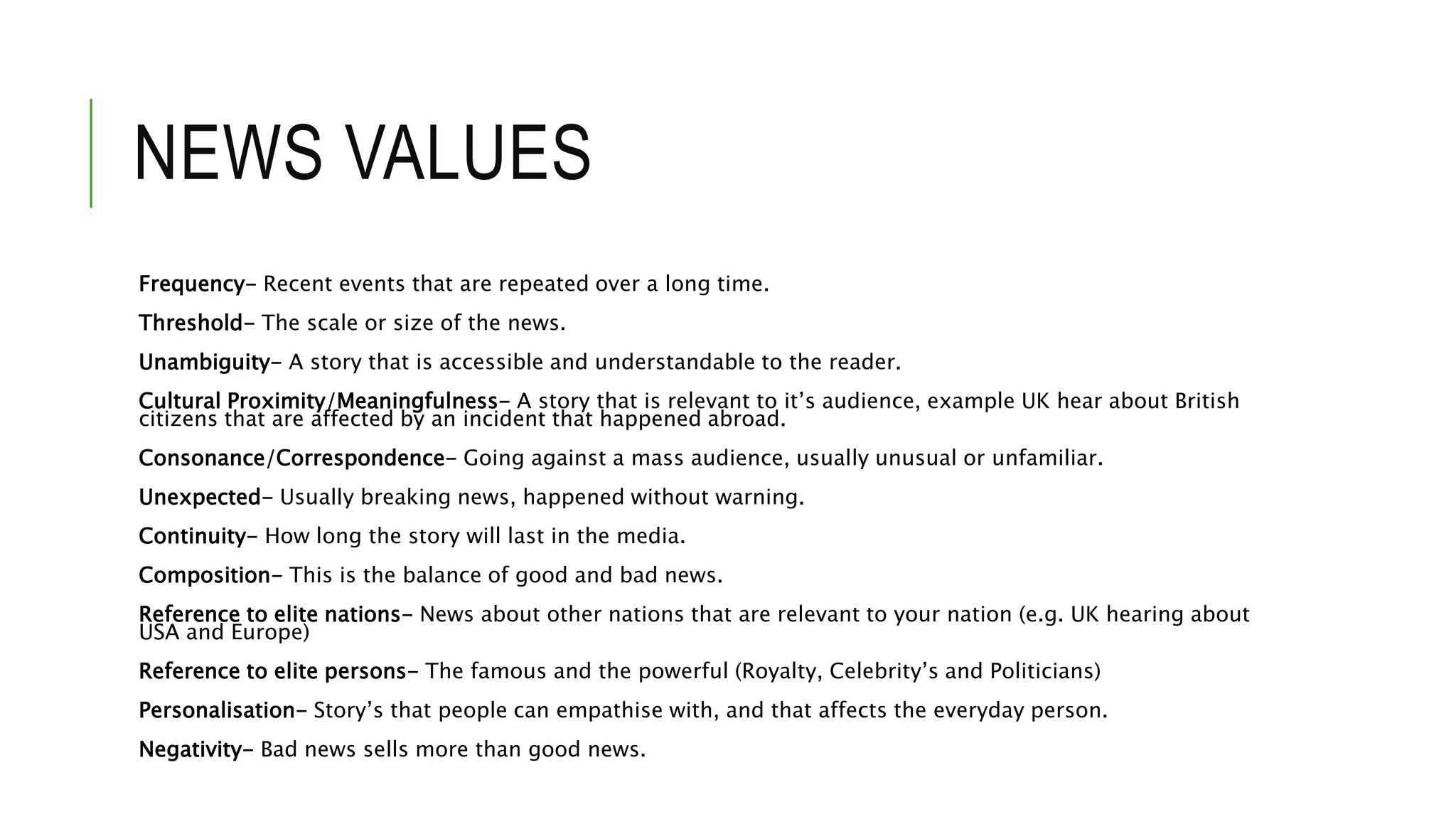
Frequency- Recent events that are repeated over a long time.
Threshold- The scale or size of the news.
Unambiguity- A story that is accessible and understandable to the reader.
Cultural Proximity/Meaningfulness- A story that is relevant to it’s audience, example UK hear about British
citizens that are affected by an incident that happened abroad.
Consonance/Correspondence- Going against a mass audience, usually unusual or unfamiliar.
Unexpected- Usually breaking news, happened without warning.
Continuity- How long the story will last in the media.
Composition- This is the balance of good and bad news.
Reference to elite nations- News about other nations that are relevant to your nation (e.g. UK hearing about
USA and Europe)
Reference to elite persons- The famous and the powerful (Royalty, Celebrity’s and Politicians)
Personalisation- Story’s that people can empathise with, and that affects the everyday person.
Negativity- Bad news sells more than good news.
APPLYING THE THEORY TO MY
WORK
The values that apply to my work the most are Frequency, Threshold,
Unambiguity, Meaningfulness and Personalisation. Firstly Frequency due to
local new usually gets updated and the readers want to keep up to date. e.g.
job losses and when the company is closing and what will happen to the
workers. Threshold is more important as the scale or size of the news is
what will attract the most people, for example the bigger news, the bigger
the audience as it will affect of empathise with everyone. Furthermore
Unambiguity is vital as the audience needs to understand and easily access
the stories that are presented to them, as they want to read a story that’s
too intellectual and not accessible towards them. As I am creating a local
newspaper the Meaningfulness is important as local communities are usually
tight knitted and like to hear about things that are relevant to them and
people around them. Finally Personalisation is the most important to me as
local people like to empathise and be affected by story as this is why they
read newspapers. My local newspaper is aimed at the everyday working
person so a story that can create an emotional response is vital.

Galtung and ruge’s news values

  • 1.
  • 2.
    INTRODUCTION For any storyto appear in the news it has to have importance. The stories go through a ‘Gatekeeping’ process which determines whether it makes it into the news. One known News Value list was written by Johan Galtung and Marie Holmboe Ruge (1965). They gathered and analysed thousands of different types of new on various platforms such as papers, reports and TV. With the information they collected they came up with 12 values on why certain types of news is shown to the audience. These are: Frequency Threshold Unambiguity Cultural Proximity/Meaningfulness Consonance/Correspondence Unexpected Continuity Composition Reference to elite nations Reference to elite persons Personalisation Negativity
  • 3.
    NEWS VALUES Frequency- Recentevents that are repeated over a long time. Threshold- The scale or size of the news. Unambiguity- A story that is accessible and understandable to the reader. Cultural Proximity/Meaningfulness- A story that is relevant to it’s audience, example UK hear about British citizens that are affected by an incident that happened abroad. Consonance/Correspondence- Going against a mass audience, usually unusual or unfamiliar. Unexpected- Usually breaking news, happened without warning. Continuity- How long the story will last in the media. Composition- This is the balance of good and bad news. Reference to elite nations- News about other nations that are relevant to your nation (e.g. UK hearing about USA and Europe) Reference to elite persons- The famous and the powerful (Royalty, Celebrity’s and Politicians) Personalisation- Story’s that people can empathise with, and that affects the everyday person. Negativity- Bad news sells more than good news.
  • 4.
    APPLYING THE THEORYTO MY WORK The values that apply to my work the most are Frequency, Threshold, Unambiguity, Meaningfulness and Personalisation. Firstly Frequency due to local new usually gets updated and the readers want to keep up to date. e.g. job losses and when the company is closing and what will happen to the workers. Threshold is more important as the scale or size of the news is what will attract the most people, for example the bigger news, the bigger the audience as it will affect of empathise with everyone. Furthermore Unambiguity is vital as the audience needs to understand and easily access the stories that are presented to them, as they want to read a story that’s too intellectual and not accessible towards them. As I am creating a local newspaper the Meaningfulness is important as local communities are usually tight knitted and like to hear about things that are relevant to them and people around them. Finally Personalisation is the most important to me as local people like to empathise and be affected by story as this is why they read newspapers. My local newspaper is aimed at the everyday working person so a story that can create an emotional response is vital.