MidtermReview
Theory that explains
the formation of light
elements
Answer: Big BangTheory
Theory that explains
the formation of light
elements
Stage of star after
average yellow star
Stage of star after
average yellow star
Answer: Red Giant
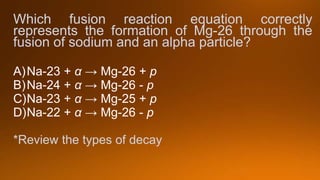
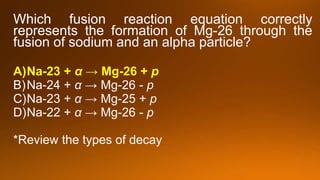
Which fusion reaction equation correctly
represents the formation of Mg-26 through the
fusion of sodium and an alpha particle?
A)Na-23 + α → Mg-26 + p
B)Na-24 + α → Mg-26 - p
C)Na-23 + α → Mg-25 + p
D)Na-22 + α → Mg-26 - p
*Review the types of decay
Which fusion reaction equation correctly
represents the formation of Mg-26 through the
fusion of sodium and an alpha particle?
A)Na-23 + α → Mg-26 + p
B)Na-24 + α → Mg-26 - p
C)Na-23 + α → Mg-25 + p
D)Na-22 + α → Mg-26 - p
*Review the types of decay
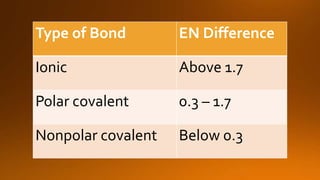
Type of Bond EN Difference
Ionic Above 1.7
Polar covalent 0.3 – 1.7
Nonpolar covalent Below 0.3

G11 Physical Science Midterm Reviewer.pptx

  • 1.
  • 2.
    Theory that explains theformation of light elements
  • 3.
    Answer: Big BangTheory Theorythat explains the formation of light elements
  • 4.
    Stage of starafter average yellow star
  • 5.
    Stage of starafter average yellow star Answer: Red Giant
  • 45.
    Which fusion reactionequation correctly represents the formation of Mg-26 through the fusion of sodium and an alpha particle? A)Na-23 + α → Mg-26 + p B)Na-24 + α → Mg-26 - p C)Na-23 + α → Mg-25 + p D)Na-22 + α → Mg-26 - p *Review the types of decay
  • 46.
    Which fusion reactionequation correctly represents the formation of Mg-26 through the fusion of sodium and an alpha particle? A)Na-23 + α → Mg-26 + p B)Na-24 + α → Mg-26 - p C)Na-23 + α → Mg-25 + p D)Na-22 + α → Mg-26 - p *Review the types of decay
  • 47.
    Type of BondEN Difference Ionic Above 1.7 Polar covalent 0.3 – 1.7 Nonpolar covalent Below 0.3