GROUP
1
236378 PUTERI NUR LIYANA BT MEGAT ZULKEFLI
230685 CHEN MIN SHENG
232703 DEWI SARTIKA JAMALUDIN
236266 CHIN KIEW YEN
236321 KAMELESHWERI
236414 MUHD DANIAL JAMALUDIN
240836 MUHAMAD FIRDAUS MOHMMAD
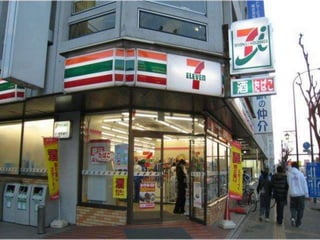
Seven Eleven Japan CO.
• Founded by Masatoshi Ito
• Established by Ito Yokado
• 1972 = approach Southland Corporation
• 1973 = Southland agreed a licensing agreement
• 1974 = First 7-11 Japan in Koto-ku, Tokyo
• 1990 = Southland enter into bankruptcy protection
• 1991 = IYG Holding acquire 70% of Southland common
stock worth $430 million
• 2005 = Seven & i Holding Co. Ltd established through
stock transfer combine 7-11 Japan, Ito Yokado &
Denny’s Japan
Convenient store & Seven Eleven
in Japan
• 7-11 dominate 90% of Japan convenience stores
• Sales per day = 647,000yen
• Others 10% convenient stores
• Sales per day = 484,000yen
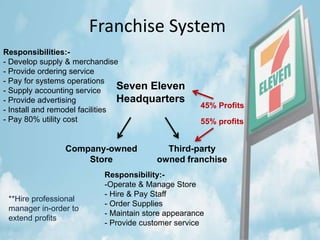
Franchise System
Company-owned
Store
Third-party
owned franchise
Seven Eleven
Headquarters
45% Profits
55% profits
Responsibilities:-
- Develop supply & merchandise
- Provide ordering service
- Pay for systems operations
- Supply accounting service
- Provide advertising
- Install and remodel facilities
- Pay 80% utility cost
Responsibility:-
-Operate & Manage Store
- Hire & Pay Staff
- Order Supplies
- Maintain store appearance
- Provide customer service
**Hire professional
manager in-order to
extend profits
Store Information & content
• Offer product according to local demand
• Emphasize local preference
• Food Item: i) Chilled-temperature items
ii) Warm-temperature items
iii) Frozen Items
iv) Room-temperature items
• Other product : soft drinks, Nutrition drinks
Alcoholics Beverage
Music CD, Magazines
Game software
Private brand products
Store Service
• 1. Payment of Bills
• 2. Accept installments on behalf of credit companies
• 3. Payment for internet shopping
• 4. ATM at most stores
• 5. Meal delivery service for aging population of Japan
• 6. Ticket sales , Photocopying
• 7. Pick up location for parcel delivery
• 8. 7 dream e-commerce
• 9. Home meal delivery especially for women
• 10. Nanaco (electronic money)
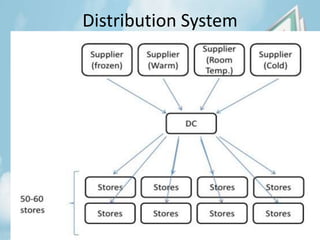
Distribution System
Distribution system
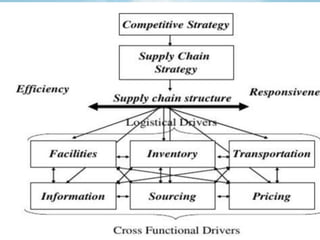
Facility
• 2 levels;-
i) DCs
- Less in number
- Held no inventory
- Served stores in its cluster
- Increase efficiency as opposed to responsiveness
ii) Stores
- More in number
- Kept inventory on shelf
- Located in abundance and dominated the market
- Were more responsive than efficient
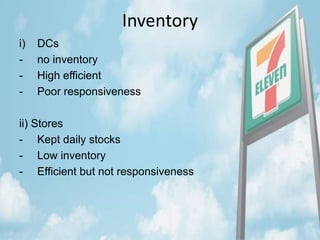
Inventory
i) DCs
- no inventory
- High efficient
- Poor responsiveness
ii) Stores
- Kept daily stocks
- Low inventory
- Efficient but not responsiveness
Transportation
i) Vendor to DC (Vendor delivery)
ii) DC to stores (7-11 delivery)
 Transportation Network design
- Each truck would be stocked at DC
- One truck would deliver supplies to more than one
stores
 Mode of Transportation
- Road (van& truck were use)
 High Frequency
 Provide high responsiveness opposed to efficiency
Integrated Store Information System
i. Graphic Order Terminal
Ii. Scanner Terminal
Iii. Store computer
- linked to 7-11 network
- Tracked inventory levels, place order maintain store
equipment.
Iv. POS register
- data/details will be stored after customer purchase and
then transmit to HQ
 Data relayed to Suppliers, DC and Headquarters
automatically.
 Increase both efficiency & responsiveness.
-GOT
-POS
-ST
Sourcing
 Outsourced transportation
- Transfleet Ltd. Set up by Mitsui and Co.
 To ensured rapid, reliable delivery.
 DC merely transferred inventory carried from
supplier truck to Seven Eleven distribution truck.
Pricing
 Offer reasonable priced product
 Market dominance allowed ease of
access to customer
 Above factors led to stable demand
US MARKET
 Existing system
- Store replenishment through Direct Store Delivery
from Manufacturers
- Remaining products delivered by Wholesalers
 Introducing Combined Distribution Centre concept
- 23 CDC across North America
- Supported 80% of store Network
 Introducing Fresh Food like Japan
7-11 Japan Supply Chain Case Study

7-11 Japan Supply Chain Case Study

  • 1.
    GROUP 1 236378 PUTERI NURLIYANA BT MEGAT ZULKEFLI 230685 CHEN MIN SHENG 232703 DEWI SARTIKA JAMALUDIN 236266 CHIN KIEW YEN 236321 KAMELESHWERI 236414 MUHD DANIAL JAMALUDIN 240836 MUHAMAD FIRDAUS MOHMMAD
  • 3.
    Seven Eleven JapanCO. • Founded by Masatoshi Ito • Established by Ito Yokado • 1972 = approach Southland Corporation • 1973 = Southland agreed a licensing agreement • 1974 = First 7-11 Japan in Koto-ku, Tokyo • 1990 = Southland enter into bankruptcy protection • 1991 = IYG Holding acquire 70% of Southland common stock worth $430 million • 2005 = Seven & i Holding Co. Ltd established through stock transfer combine 7-11 Japan, Ito Yokado & Denny’s Japan
  • 4.
    Convenient store &Seven Eleven in Japan • 7-11 dominate 90% of Japan convenience stores • Sales per day = 647,000yen • Others 10% convenient stores • Sales per day = 484,000yen
  • 5.
    Franchise System Company-owned Store Third-party owned franchise SevenEleven Headquarters 45% Profits 55% profits Responsibilities:- - Develop supply & merchandise - Provide ordering service - Pay for systems operations - Supply accounting service - Provide advertising - Install and remodel facilities - Pay 80% utility cost Responsibility:- -Operate & Manage Store - Hire & Pay Staff - Order Supplies - Maintain store appearance - Provide customer service **Hire professional manager in-order to extend profits
  • 6.
    Store Information &content • Offer product according to local demand • Emphasize local preference • Food Item: i) Chilled-temperature items ii) Warm-temperature items iii) Frozen Items iv) Room-temperature items • Other product : soft drinks, Nutrition drinks Alcoholics Beverage Music CD, Magazines Game software Private brand products
  • 7.
    Store Service • 1.Payment of Bills • 2. Accept installments on behalf of credit companies • 3. Payment for internet shopping • 4. ATM at most stores • 5. Meal delivery service for aging population of Japan • 6. Ticket sales , Photocopying • 7. Pick up location for parcel delivery • 8. 7 dream e-commerce • 9. Home meal delivery especially for women • 10. Nanaco (electronic money)
  • 8.
  • 9.
  • 10.
    Facility • 2 levels;- i)DCs - Less in number - Held no inventory - Served stores in its cluster - Increase efficiency as opposed to responsiveness ii) Stores - More in number - Kept inventory on shelf - Located in abundance and dominated the market - Were more responsive than efficient
  • 11.
    Inventory i) DCs - noinventory - High efficient - Poor responsiveness ii) Stores - Kept daily stocks - Low inventory - Efficient but not responsiveness
  • 12.
    Transportation i) Vendor toDC (Vendor delivery) ii) DC to stores (7-11 delivery)  Transportation Network design - Each truck would be stocked at DC - One truck would deliver supplies to more than one stores  Mode of Transportation - Road (van& truck were use)  High Frequency  Provide high responsiveness opposed to efficiency
  • 13.
    Integrated Store InformationSystem i. Graphic Order Terminal Ii. Scanner Terminal Iii. Store computer - linked to 7-11 network - Tracked inventory levels, place order maintain store equipment. Iv. POS register - data/details will be stored after customer purchase and then transmit to HQ  Data relayed to Suppliers, DC and Headquarters automatically.  Increase both efficiency & responsiveness. -GOT -POS -ST
  • 14.
    Sourcing  Outsourced transportation -Transfleet Ltd. Set up by Mitsui and Co.  To ensured rapid, reliable delivery.  DC merely transferred inventory carried from supplier truck to Seven Eleven distribution truck.
  • 15.
    Pricing  Offer reasonablepriced product  Market dominance allowed ease of access to customer  Above factors led to stable demand
  • 16.
    US MARKET  Existingsystem - Store replenishment through Direct Store Delivery from Manufacturers - Remaining products delivered by Wholesalers  Introducing Combined Distribution Centre concept - 23 CDC across North America - Supported 80% of store Network  Introducing Fresh Food like Japan