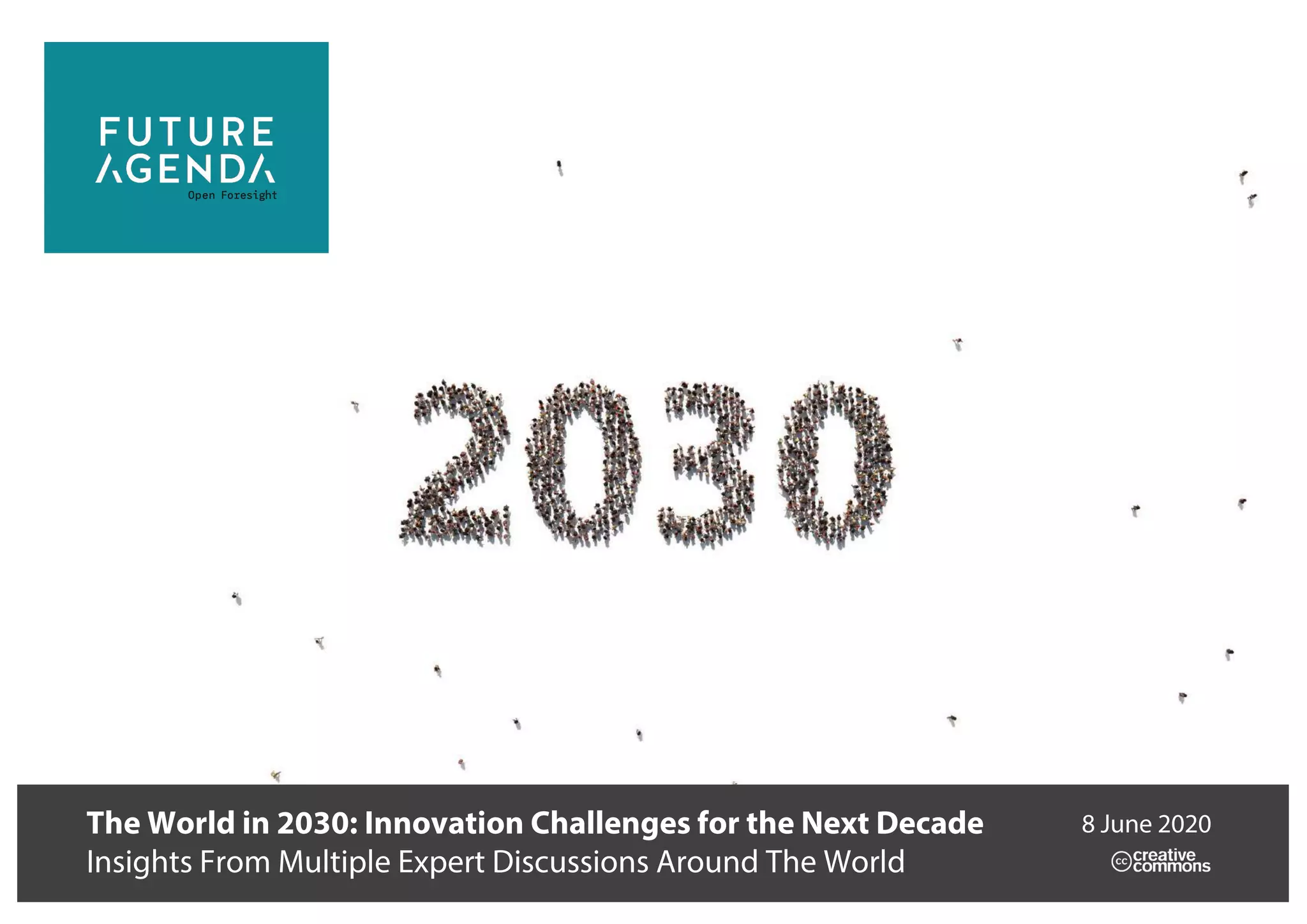
The World in 2030: Innovation Challenges for the Next Decade
Insights From Multiple Expert Discussions Around The World
8 June 2020
Future Agenda
Future Agenda enable organisations to see emerging opportunities, make more
informed decisions and place better, strategic growth bets. We help companies
recognise how changes in the external world may impact them and their sector.
INSIGHT IMPACT
Global
Foresight
Industry
Insight
Bespoke
Research
New
Services
New
Products
New
Strategies
Core Team
Extended
Team
The Global
Network
The World in 2020
The first global Future Agenda programme in 2010 was hosted by Vodafone.
Fifty workshops across 16 topics in 25 locations with 1500 experts identified a
wide range of 10-year shifts, over 80% of which have now come to pass.
Lease Everything Global Pandemics
Active Elderly People TrackingDrone Wars
The World in 2025
A second larger programme in 2015 was supported by 50 organisations.
120 workshops in 45 cities engaged with over 5000 experts across 24 topics.
Issues identified have become a central focus for major innovation globally.
Plastic Oceans Air Quality
Energy Storage Value of DataTruth and Illusion
World in 2030
The third programme is taking place during 2020, engaging more experts on the
pivotal shifts via virtual workshops and wider community discussion / debate.
Here are ten issues so far that provide innovation challenge and opportunity.
Orchestrating Serendipity
With more technology-enabled but physically dispersed working, provoking
moments of creative tension, inspiration and serendipity is a rising challenge.
Organisations seek means to better drive spontaneity and so seed innovation.
Broader Decision Making
As the world faces complex future challenges, multi-party
communities are themselves expanding and fragmenting.
New approaches to broader decision-making gain traction.
Proof of Immunity
Public concerns about health security override worries about privacy.
Governments integrate immunity and health data with national identities.
Insufficient regulatory control risks the possibility of pervasive surveillance.
Sharing Spaces
People are increasingly unwilling to share space with unvalidated strangers.
For automated transport, designing solutions that will provide flexibility and
privacy are pivotal to building user acceptance of new business models.
Resilience by Design
Global supply chains evolve to be more flexible, shared regional supply webs.
Manufacturing shifts from centralised production to a smaller and distributed
approach. Competitors access shared, not proprietary, networks and systems.
Data Sovereignty
Large-population emerging economies see the protection of their data as a
national priority, so they can grow the economy and maintain cultural identity.
Wider sharing and use of data is restricted to be within national borders.
Migrating Diseases
With 2oC of global warming probable and 4oC possible, health systems struggle
to address the growing impact of climate change. The increased spread of
vector borne diseases joins poor air quality as a major public health threat.
Soil Quality
Soil is fundamental, fragile and finite. It impacts everything from food and
health to conflict and migration. Deeper understanding of its degrading quality
raises soil’s significance to equal that of climate change and biodiversity loss.
Carbon Sequestration
Cutting greenhouse-gas emissions won’t be enough to prevent sharp increases
in global temperatures. What we need is a cheap way to permanently store the
billions of tons of carbon dioxide that we need to pull out of the atmosphere.
Electric Aviation
As the pressure to decarbonise aviation builds, using electric planes for short /
medium-haul flights gathers support. There are major technological challenges
to address, but investment and regulation align to accelerate development.
Future Agenda, 84 Brook Street, London W1K 5EH +44 203 0088 141
www.futureagenda.org | @futureagenda

World in 2030 ispim - 8 june 2020

  • 1.
    The World in2030: Innovation Challenges for the Next Decade Insights From Multiple Expert Discussions Around The World 8 June 2020
  • 2.
    Future Agenda Future Agendaenable organisations to see emerging opportunities, make more informed decisions and place better, strategic growth bets. We help companies recognise how changes in the external world may impact them and their sector. INSIGHT IMPACT Global Foresight Industry Insight Bespoke Research New Services New Products New Strategies Core Team Extended Team The Global Network
  • 3.
    The World in2020 The first global Future Agenda programme in 2010 was hosted by Vodafone. Fifty workshops across 16 topics in 25 locations with 1500 experts identified a wide range of 10-year shifts, over 80% of which have now come to pass. Lease Everything Global Pandemics Active Elderly People TrackingDrone Wars
  • 4.
    The World in2025 A second larger programme in 2015 was supported by 50 organisations. 120 workshops in 45 cities engaged with over 5000 experts across 24 topics. Issues identified have become a central focus for major innovation globally. Plastic Oceans Air Quality Energy Storage Value of DataTruth and Illusion
  • 5.
    World in 2030 Thethird programme is taking place during 2020, engaging more experts on the pivotal shifts via virtual workshops and wider community discussion / debate. Here are ten issues so far that provide innovation challenge and opportunity.
  • 6.
    Orchestrating Serendipity With moretechnology-enabled but physically dispersed working, provoking moments of creative tension, inspiration and serendipity is a rising challenge. Organisations seek means to better drive spontaneity and so seed innovation.
  • 7.
    Broader Decision Making Asthe world faces complex future challenges, multi-party communities are themselves expanding and fragmenting. New approaches to broader decision-making gain traction.
  • 8.
    Proof of Immunity Publicconcerns about health security override worries about privacy. Governments integrate immunity and health data with national identities. Insufficient regulatory control risks the possibility of pervasive surveillance.
  • 9.
    Sharing Spaces People areincreasingly unwilling to share space with unvalidated strangers. For automated transport, designing solutions that will provide flexibility and privacy are pivotal to building user acceptance of new business models.
  • 10.
    Resilience by Design Globalsupply chains evolve to be more flexible, shared regional supply webs. Manufacturing shifts from centralised production to a smaller and distributed approach. Competitors access shared, not proprietary, networks and systems.
  • 11.
    Data Sovereignty Large-population emergingeconomies see the protection of their data as a national priority, so they can grow the economy and maintain cultural identity. Wider sharing and use of data is restricted to be within national borders.
  • 12.
    Migrating Diseases With 2oCof global warming probable and 4oC possible, health systems struggle to address the growing impact of climate change. The increased spread of vector borne diseases joins poor air quality as a major public health threat.
  • 13.
    Soil Quality Soil isfundamental, fragile and finite. It impacts everything from food and health to conflict and migration. Deeper understanding of its degrading quality raises soil’s significance to equal that of climate change and biodiversity loss.
  • 14.
    Carbon Sequestration Cutting greenhouse-gasemissions won’t be enough to prevent sharp increases in global temperatures. What we need is a cheap way to permanently store the billions of tons of carbon dioxide that we need to pull out of the atmosphere.
  • 15.
    Electric Aviation As thepressure to decarbonise aviation builds, using electric planes for short / medium-haul flights gathers support. There are major technological challenges to address, but investment and regulation align to accelerate development.
  • 16.
    Future Agenda, 84Brook Street, London W1K 5EH +44 203 0088 141 www.futureagenda.org | @futureagenda