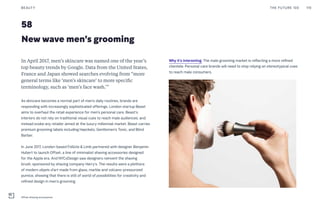
01–10
Tech+Innovation
The Future
4–24 Culture
25–44 Tech & Innovation
45–65 Travel & Hospitality
66–84 Brands & Marketing
85–104 Food & Drink
105–123 Beauty
124–143 Retail
144–161 Luxury
162–181 Health
182–199 Lifestyle
Contents
Another year—and further breathless change. Welcome to
the Future 100 2018, our snapshot of the year ahead and the
most compelling trends, themes and phenomena to keep
on your radar. As ever, the pace of technological change
and the global nature of digital networks are causing
much faster trend evolution. Food, beauty and ingredient
developments—not to mention new challenger companies
and retail models —are scaling more quickly than ever.
2018 looks set to be the year in which 5G and augmented
reality (AR) drive massive change in our interactions

with the internet—we’ll be able to shop from our cars and
visualize furniture in our home before deciding to buy it.
And, rather than being described as “the future” at tech
conferences, this will happen en masse.
Brands and marketing are navigating an increasingly
sophisticated consumer landscape where they are assessed
on the nuances of their visual language, the diversity of
their representation, 360-degree ethics and complete
transparency.
Finally, and rather excitingly (for me, certainly), we are
moving further into a post-hipster world—or at least,
into that world’s grown-up iteration. In 2017 we charted
the Xennials, the 30-45-year-old microgeneration caught
between the core millennial and generation X groups.
Travel, food, drink, beauty and tech brands need to come to
grips with this group’s expectations, as its net worth is set to
more than double over the next 10 years.
This year's report covers all these topics—and more. Enjoy!
Lucie Greene
Worldwide Director, The Innovation Group
JWTIntelligence.com
Introduction
THE FUTURE 100 3
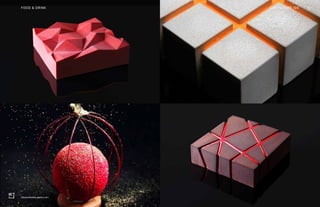
Cover Image: Dinara Kasko pastry art
01–10
Tech+Innovation
Culture
The female gaze
01
In the current feminist moment, people are paying more
attention to women working behind the scenes in film,
media and photography—and how women’s influence
ultimately affects these industries.
Wonder Woman made headlines for taking $103.1 million in its debut weekend
in the United States alone. It was trailblazing not only for being the first DC/
Marvel superhero film to feature a female protagonist (following 19 male-
led films since the movie franchise launched in 2008), but also because its
director, Patty Jenkins, is one of only three women to direct a live-action film
with a budget of over $100 million.
The success of Wonder Woman sparked discussion about the need for more
female directors, writers and producers. Fans and critics widely recognized
how a woman behind the lens affected important choices and nuances in the
movie that were central to its triumph.
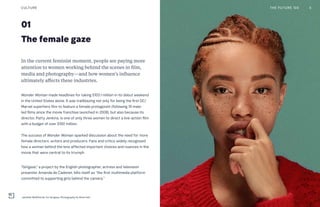
“Girlgaze,” a project by the English photographer, actress and television
presenter Amanda de Cadenet, bills itself as “the first multimedia platform
committed to supporting girls behind the camera.”
CULTURE
Jamillah McWhorter for Girlgaze. Photography by Bree Holt
THE FUTURE 100 5
Why it’s interesting: What’s in a lens? “It’s about representing the nuance
of the female gaze,” explains Pam Grossman, director of visual trends at
Getty Images. The Getty Images Lean In Collection, a collection of realistic,
authentic images of women and the communities that support them,
launched in 2014, and nearly 40,000 images today have been downloaded
through the collection, while Lean In images have been licensed in more than
95 countries.
“A female director will most likely shoot the same scene in an entirely
different way and with a different perspective—one that takes into account
female ambition, desire, fantasy, agency, not to mention realistic physiology,”
says Grossman, noting that academic concepts such as the “male gaze,” once
little discussed outside liberal arts campuses, are now part of mainstream
cultural discourse in a way that seemed unlikely until very recently.
“Everyone likes great storytelling, and we all empathize with nuanced
characters,” she observes. “But we’re more likely to see that sort of work
created about women if it is created by women.”
The project aims to help women break into the photography industry by
raising awareness of how women tell visual stories. In addition to de Cadenet,
it features curators including supermodel Amber Valletta and photographer
Inez van Lamsweerde. Contributors include actress and generation Z idol Yara
Shahidi, dancer Maddie Ziegler, and TV host Alexa Chung, while a roster of
lower-profile but mega-talented female-identifying photographers rounds out
the group.
Thalia Mavros, founder of award-winning media platform The Front, places
female ownership at the core of her business model. “I am proud to say we
are founded and run by women, our investor has a female chief executive at
the helm, and even our board of directors is all-female,” says Mavros.
THE FUTURE 100 6CULTURE
02
Intersectionality
Crenshaw’s influential 2016 TED talk, “The urgency of intersectionality,” has
been viewed nearly a million times. “Many of our social justice problems
like racism and sexism are often overlapping, creating multiple levels of
social injustice,” explained Crenshaw, calling for a more nuanced view of
discrimination.
Why it’s interesting: From tech companies to traditional corporations,
organizations are under pressure to improve diversity and inclusion in their
hiring, but the layered challenges associated with achieving this are coming
to the fore. Meanwhile, thanks to politicized generation Z and the mainstream
feminist movement, lazy, sexist images and limited representation are
increasingly being called out publicly. Media brands hoping to appeal to a
younger audience have to embed values of diversity, intersectionality and
inclusion in their philosophy from the get-go.
Lawyer and feminist Kimberlé Crenshaw coined the term
“intersectionality” in the late 1980s to capture the premise
that when it comes to identity, the overlap of race, gender,
sexuality, and class can contribute to a specific type of
experience in the world—and create unique overlaps in
discrimination or bias.
Now, as dialogue around the importance of diversity reaches a fever pitch, the
term is resurging in popular discourse, conference panels and think pieces—
both in media outlets trying to reach the highly diverse generation Z, and
among diversity chiefs developing employment practices.
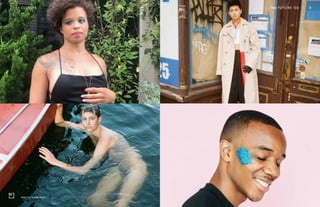
In 2017, Twitter hired Candi Castleberry Singleton as vice president of
intersectionality, culture and diversity. Media company Condé Nast has just
launched teen and millennial LGBTQ-focused publication “them,” which “wants
to make sure that we’re inviting people to participate,” says creator and chief
content officer Phillip Picardi. “Intersectionality and representation are going
to be crucial to the brand’s very success and acceptance.”
THE FUTURE 100 7CULTURE
Post Womens-Interest Media
Post Wo
04
THE FUTURE 100CULTURE 8
them by Condé Nast
03
New millennial careers
Millennial ideals around work are changing. Rejecting
workplace traditions, they are creating careers that
wouldn’t have been possible 10 years ago.
The pervasive culture of social media is creating new potential careers paths
for savvy millennials. Microinfluencers with anywhere between 1,000 and
100,000 followers are not the most “Instafamous,” but they typically carry
more clout among a committed audience.
“We’ve seen a marked shift in the influencer landscape, with microinfluencers
truly on the rise, replacing more traditional and costly methods such
as celebrity-led campaigns,” says Lizzie Drogman, account director at
Hill+Knowlton Strategies. “This form of marketing is answering the consumer’s
need for transparency, a desire to see products and services talked about
and reviewed in a relatable context.”
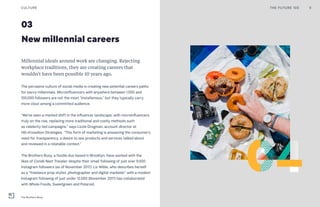
The Brothers Buoy, a foodie duo based in Brooklyn, have worked with the
likes of Condé Nast Traveler despite their small following of just over 9,500
Instagram followers (as of November 2017). Liz Wible, who describes herself
as a “freelance prop stylist, photographer and digital marketer” with a modest
Instagram following of just under 12,000 (November 2017) has collaborated
with Whole Foods, Sweetgreen and Polaroid.
THE FUTURE 100 9CULTURE
The Brothers Buoy
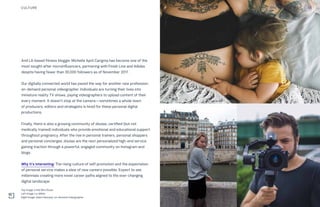
And LA-based fitness blogger Michelle April Carigma has become one of the
most sought-after microinfluencers, partnering with Finish Line and Adidas
despite having fewer than 30,000 followers as of November 2017.
Our digitally connected world has paved the way for another new profession:
on-demand personal videographer. Individuals are turning their lives into
miniature reality TV shows, paying videographers to upload content of their
every moment. It doesn’t stop at the camera—sometimes a whole team
of producers, editors and strategists is hired for these personal digital
productions.
Finally, there is also a growing community of doulas, certified (but not
medically trained) individuals who provide emotional and educational support
throughout pregnancy. After the rise in personal trainers, personal shoppers
and personal concierges, doulas are the next personalized high-end service
gaining traction through a powerful, engaged community on Instagram and
blogs.
Why it’s interesting: The rising culture of self-promotion and the expectation
of personal service makes a slew of new careers possible. Expect to see
millennials creating more novel career paths aligned to the ever-changing
digital landscape.
THE FUTURE 100 10CULTURE
Top Image: Little Bird Doula
Left Image: Liz Wible
Right Image: Adam Hamwey, on-demand videographer
04
Religious resurgence
After years of consumers turning more secular, religion is
making a comeback in some places, following major social
and economic shifts.
This trend is perhaps most surprising in China, where various forms of
religion—Buddhist, Daoist and Christian—are flourishing with the tacit
approval of the government after a century of persecution. Hundreds of
temples, mosques and churches are popping up each year to cater to millions
of new worshipers, fueling pilgrimages, festivals and related businesses.
In many cases, people who benefited from China’s rapid economic growth
and urbanization are now seeking spiritual sustenance. “There’s been a lot of
wrenching social change,” says Ian Johnson, author of The Souls of China: The
Return of Religion after Mao, published in 2017. “It’s almost as if people need
a breathing period—to look around and evaluate who we are and what values
we believe in.” In this scenario, religion offers a “feeling of rules and norms for
a society searching for a sense of stability.”
THE FUTURE 100 11CULTURE
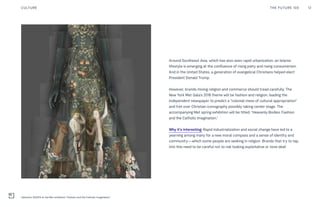
Met exhibition "Fashion and the Catholic Imagination"
Around Southeast Asia, which has also seen rapid urbanization, an Islamic
lifestyle is emerging at the confluence of rising piety and rising consumerism.
And in the United States, a generation of evangelical Christians helped elect
President Donald Trump.
However, brands mixing religion and commerce should tread carefully. The
New York Met Gala’s 2018 theme will be fashion and religion, leading the
Independent newspaper to predict a “colonial mess of cultural appropriation”
and fret over Christian iconography possibly taking center stage. The
accompanying Met spring exhibition will be titled: "Heavenly Bodies: Fashion
and the Catholic Imagination."
Why it’s interesting: Rapid industrialization and social change have led to a
yearning among many for a new moral compass and a sense of identity and
community—which some people are seeking in religion. Brands that try to tap
into this need to be careful not to risk looking exploitative or tone deaf.
THE FUTURE 100 12CULTURE
Valentino SS2014 at the Met exhibition "Fashion and the Catholic Imagination"
05
IRL dating apps
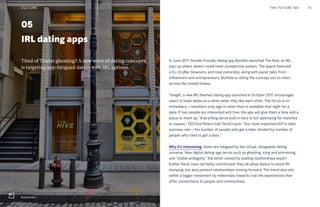
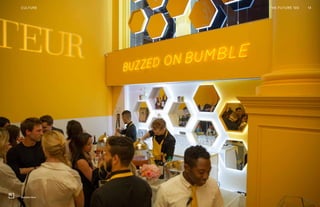
In June 2017, female-friendly dating app Bumble launched The Hive, an IRL
pop-up where daters could meet prospective suitors. The space featured
a DJ, DryBar blowouts, and rosé (naturally), along with panel talks from
influencers and entrepreneurs. Bumble is rolling the concept out to cities
across the United States.
Tonight, a new IRL-themed dating app launched in October 2017, encourages
users to book dates on a whim when they like each other. The focus is on
immediacy—members only sign in when they’re available that night for a
date. If two people are interested and free, the app will give them a time and a
place to meet up. “Everything we’ve built in here is not optimizing for matches
or swipes,” CEO Eve Peters told TechCrunch. “Our most important KPI is date
success rate—the number of people who get a date, divided by number of
people who tried to get a date.”
Why it’s interesting: Users are fatigued by the virtual, shoppable dating
universe. New digital dating-age terms such as ghosting, icing and simmering,
and “stable ambiguity,” the latter coined by leading relationships expert
Esther Perel, have certainly contributed: they all allow daters to avoid IRL
dumping, but also prevent relationships moving forward. The trend also sits
within a bigger movement by millennials towards real-life experiences that
offer connections to people and communities.
Tired of Tinder ghosting? A new wave of dating concepts
is targeting app-fatigued daters with IRL options.
THE FUTURE 100 13
Bumble Hive
CULTURE
14THE FUTURE 100CULTURE
Bumble Hive
06
Streaming wars
Tech companies and startups are disrupting the
entertainment industry, challenging the likes of Netflix,
Hulu and HBO—as well as the entire movie theater
experience.
Netflix was the original disruptor, using its ability to create award-winning
content to wrest viewers away from traditional broadcasters. Now it too
faces competition, as YouTube and Facebook look to join the ranks of original
streaming content producers.
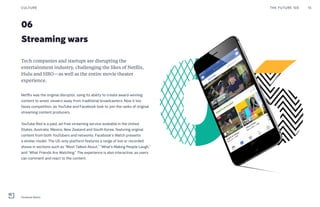
YouTube Red is a paid, ad-free streaming service available in the United
States, Australia, Mexico, New Zealand and South Korea, featuring original
content from both YouTubers and networks. Facebook’s Watch presents
a similar model. The US-only platform features a range of live or recorded
shows in sections such as “Most Talked About,” “What’s Making People Laugh,”
and “What Friends Are Watching.” The experience is also interactive, as users
can comment and react to the content.
THE FUTURE 100 15CULTURE
Facebook Watch
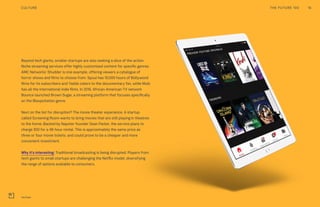
Beyond tech giants, smaller startups are also seeking a slice of the action.
Niche streaming services offer highly customized content for specific genres.
AMC Networks’ Shudder is one example, offering viewers a catalogue of
horror shows and films to choose from. Spuul has 10,000 hours of Bollywood
films for its subscribers and Yaddo caters to the documentary fan, while Mubi
has all the international indie films. In 2016, African-American TV network
Bounce launched Brown Sugar, a streaming platform that focuses specifically
on the Blaxpoitation genre.
Next on the list for disruption? The movie theater experience. A startup
called Screening Room wants to bring movies that are still playing in theatres
to the home. Backed by Napster founder Sean Parker, the service plans to
charge $50 for a 48-hour rental. This is approximately the same price as
three or four movie tickets, and could prove to be a cheaper and more
convenient investment.
Why it’s interesting: Traditional broadcasting is being disrupted. Players from
tech giants to small startups are challenging the Netflix model, diversifying
the range of options available to consumers.
THE FUTURE 100 16CULTURE
YouTube
Post Womens-Interest Media
Post Wo
0407
Interactive storytelling
“Creators have been telling stories in non-linear ways for a
long time,” Carla Engelbrecht Fisher, Netflix’s director of
product innovation, told Rolling Stone in August 2017. “If
they’re telling stories in different ways, what we’re asking
is what kind of stories can Netflix do that no one else can
do? We’re not tied to the formats of cable networks; our
ecosystem is built entirely for interactive devices.”
THE FUTURE 100CULTURE 17
Mosaic by Stephen Soderbergh
Fisher was speaking about Netflix’s new interactive shows, where viewers
can pick their own “branching” narratives. Starting with June’s Puss in Boots,
viewers could answer questions to influence the direction of the story, such
as “Should Puss fight [the strangers] valiantly, or chitchat with them over tea?”
The story feels similar to a choose-your-own-adventure book—or a
video game.
In October 2017, director Steven Soderbergh released the trailer for Mosaic,
an interactive murder mystery show that lets viewers navigate through a
branching storyline, controlling how the homicide investigation unfolds.
Though the show can be navigated through its own app, it will also air as a
linear miniseries on HBO in January 2018.
Why it’s interesting: Media consumption has shifted from a public pastime
(cable TV, movie theaters) to private (Netflix, virtual reality headsets). Will
personalized entertainment keep viewers hooked?
CULTURE 18THE FUTURE 100
Top Image: Mosaic by Stephen Soderbergh
Bottom Image: Puss In Boots
08
Data democracies in
entertainment
New data—and new analytics tools—are shedding light
on under-represented populations.
“Technology advances in data sciences and machine learning give us new ways
of shining light on media content, at scale and with an unprecedented level of
detail and accuracy,” Shri Narayanan, Niki & CL Max Nikias Chair in Engineering,
University of Southern California, told the Innovation Group. “It can give us
novel insights not just by eliminating the mystery about potential unconscious
biases in content, but in offering objective tools to shape content.”
The Geena Davis Institute on Gender in Media partnered with the Signal
Analysis and Interpretation Laboratory at USC to create the Geena Davis
Inclusion Quotient (GD-IQ), a tool that analyzes gender representation in
media. Using the GD-IQ, the Geena Davis Institute (in partnership with J.
Walter Thompson) analyzed more than 2,000 Cannes Lions films from 2006 to
2016, demonstrating that the percentage of women in advertising had barely
changed (33.9% in 2006, 36.9% in 2016).
19THE FUTURE 100CULTURE
Insecure. Courtesy of HBO/Justina Mintz
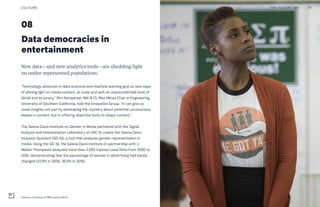
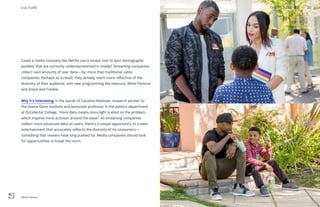
Could a media company like Netflix use a similar tool to spot demographic
pockets that are currently underrepresented in media? Streaming companies
collect vast amounts of user data—far more than traditional cable
companies. Perhaps as a result, they already seem more reflective of the
diversity of their audience, with new programming like Insecure, White Famous
and Grace and Frankie.
Why it’s interesting: In the words of Caroline Heldman, research adviser to
the Geena Davis Institute and associate professor in the politics department
at Occidental College, “more data means more light is shed on the problem,
which inspires more activism around the issue.” As streaming companies
collect more advanced data on users, there’s a unique opportunity to create
entertainment that accurately reflects the diversity of its consumers—
something that viewers have long pushed for. Media companies should look
for opportunities to break the norm.
20THE FUTURE 100CULTURE
White Famous
21THE FUTURE 100CULTURE
White Famous
Creativity meets AI
09
Man and machine are drawing ever closer as artists choose
to work with advancements in science, rather than seeing
these as threatening their oeuvre.
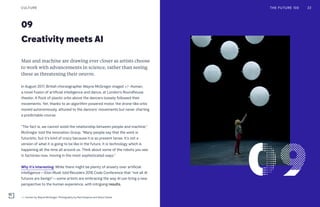
In August 2017, British choreographer Wayne McGregor staged +/- Human,
a novel fusion of artificial intelligence and dance, at London’s Roundhouse
theater. A flock of plastic orbs above the dancers loosely followed their
movements. Yet, thanks to an algorithm-powered motor, the drone-like orbs
moved autonomously, attuned to the dancers’ movements but never charting
a predictable course.
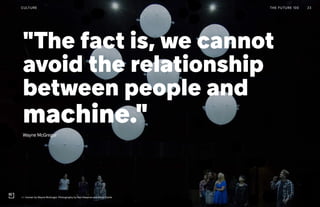
“The fact is, we cannot avoid the relationship between people and machine,”
McGregor told the Innovation Group. “Many people say that the work is
futuristic, but it’s kind of crazy because it is so present tense. It’s not a
version of what it is going to be like in the future. It is technology which is
happening all the time all around us. Think about some of the robots you see
in factories now, moving in the most sophisticated ways.”
Why it’s interesting: While there might be plenty of anxiety over artificial
intelligence—Elon Musk told Recode’s 2016 Code Conference that “not all AI
futures are benign”—some artists are embracing the way AI can bring a new
perspective to the human experience, with intriguing results.
CULTURE
+/- Human by Wayne McGregor. Photography by Ravi Deepres and Alicia Clarke
THE FUTURE 100 22
Post Womens-Interest Media
Post Wo
04
"The fact is, we cannot
avoid the relationship
between people and
machine."
Wayne McGregor
THE FUTURE 100CULTURE 23
+/- Human by Wayne McGregor. Photography by Ravi Deepres and Alicia Clarke
10
Kid influencers
Kids as young as three and four years old are being
groomed as the next influencers.
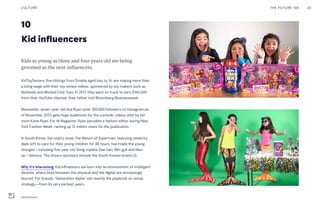
KidToyTesters, five siblings from Omaha aged two to 14, are making more than
a living wage with their toy review videos, sponsored by toy makers such as
Nintendo and Wicked Cool Toys. In 2017, they were on track to earn $140,000
from their YouTube channel, their father told Bloomberg Businessweek.
Meanwhile, seven-year-old Ava Ryan (over 760,000 followers on Instagram as
of November 2017) gets huge audiences for the comedic videos shot by her
mom Katie Ryan. For W Magazine, Ryan parodied a fashion editor during New
York Fashion Week, racking up 13 million views for the publication.
In South Korea, the reality show The Return of Superman, featuring celebrity
dads left to care for their young children for 48 hours, has made the young
charges—including five-year-old Song triplets Dae-han, Min-guk and Man-
se—famous. The show’s sponsors include the South Korean brand LG.
Why it’s interesting: Kid influencers are born into an environment of intelligent
devices, where lines between the physical and the digital are increasingly
blurred. For brands, "Generation Alpha" will rewrite the playbook on social
strategy—from its very earliest years.
THE FUTURE 100 24CULTURE
KidToyTesters
Tech & Innovation
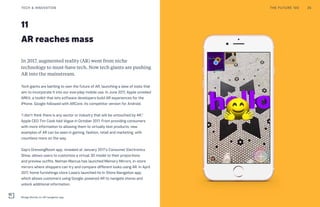
AR reaches mass
In 2017, augmented reality (AR) went from niche
technology to must-have tech. Now tech giants are pushing
AR into the mainstream.
Tech giants are battling to own the future of AR, launching a slew of tools that
aim to incorporate it into our everyday mobile use. In June 2017, Apple unveiled
ARKit, a toolkit that lets software developers build AR experiences for the
iPhone. Google followed with ARCore, its competitor version for Android.
“I don’t think there is any sector or industry that will be untouched by AR,”
Apple CEO Tim Cook told Vogue in October 2017. From providing consumers
with more information to allowing them to virtually test products, new
examples of AR can be seen in gaming, fashion, retail and marketing, with
countless more on the way.
Gap’s DressingRoom app, revealed at January 2017’s Consumer Electronics
Show, allows users to customize a virtual 3D model to their proportions
and preview outfits. Neiman Marcus has launched Memory Mirrors, in-store
mirrors where shoppers can try and compare different looks using AR. In April
2017, home furnishings store Lowe’s launched its In-Store Navigation app,
which allows customers using Google-powered AR to navigate stores and
unlock additional information.
11
THE FUTURE 100 26TECH & INNOVATION
Mirage Worlds, Inc AR navigation app
In July 2017, Japanese footwear brand Onitsuka Tiger partnered with fashion
label Anrealage for the world’s “first augmented reality sneaker.” When
scanned with the Anrealage app, the sneakers’ logo appears in 3D. Although
the experience received mixed reviews, it still shows the possibilities for
unique AR-enabled experiences to be built into everyday objects. For New
York Fashion Week 2017, creative technology studio Superbright even created
an AR catwalk that displayed custom graphics and additional information
when viewed through an app.
Why it’s interesting: Though AR came to prominence through the immensely
popular Pokémon Go, it is no longer a game, but a serious feature poised to
deliver real consumer benefits. “Over time, I think [these features] will be as
key as having a website,” says Apple CEO Tim Cook.
TECH & INNOVATION
Nieman Marcus' Memory Mirrors
THE FUTURE 100 27
12
Internet of Eyes
Smart computing is moving from the Internet of Things to
the Internet of Eyes, as more and more everyday objects
become outfitted with smart cameras and the latest in
visual recognition technology.
“The Internet of Eyes enables all inanimate objects to see by leveraging
computer vision analysis,” says Evan Nisselson, general partner at visual
technology venture fund LDV Capital. “Inanimate objects with cameras enable
companies to own the first step in gathering the data for computer vision
and artificial intelligence algorithms to analyze. Analysis may include object
recognition, sentiment analysis, gesture recognition and many more human
actions which will impact all business sectors and humanity.” LDV Capital
predicts that embedded cameras will grow at least 220% in the next five
years.
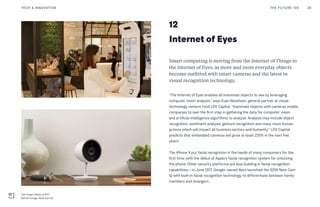
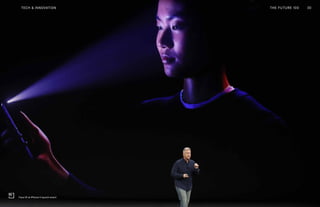
The iPhone X put facial recognition in the hands of many consumers for the
first time, with the debut of Apple’s facial recognition system for unlocking
the phone. Other security platforms are also building in facial recognition
capabilities—in June 2017, Google-owned Nest launched the $299 Nest Cam
IQ with built-in facial recognition technology to differentiate between family
members and strangers.
THE FUTURE 100 28TECH & INNOVATION
Top Image: Alipay at KFC
Bottom Image: Nest Cam IQ
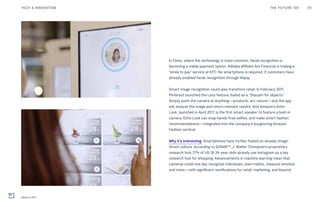
In China, where the technology is more common, facial recognition is
becoming a viable payment option. Alibaba affiliate Ant Financial is trialing a
“smile to pay” service at KFC. No smartphone is required, if customers have
already enabled facial recognition through Alipay.
Smart image recognition could also transform retail. In February 2017,
Pinterest launched the Lens feature, hailed as a “Shazam for objects.”
Simply point the camera at anything—products, art, nature—and the app
will analyze the image and return relevant results. And Amazon’s Echo
Look, launched in April 2017, is the first smart speaker to feature a built-in
camera. Echo Look can snap hands-free selfies, and make smart fashion
recommendations—integrated into the company’s burgeoning Amazon
Fashion vertical.
Why it’s interesting: Smartphones have further fueled an already image-
driven culture. According to SONAR™, J. Walter Thompson’s proprietary
research tool, 27% of US 18-34-year-olds already use Instagram as a key
research tool for shopping. Advancements in machine learning mean that
cameras could one day recognize individuals, learn habits, measure emotion
and more—with significant ramifications for retail, marketing, and beyond.
THE FUTURE 100 29TECH & INNOVATION
Alipay at KFC
THE FUTURE 100 30TECH & INNOVATION
Face ID at iPhone X launch event
13
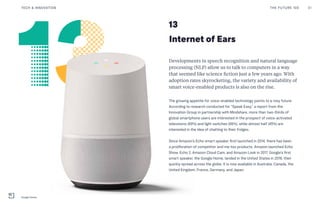
Internet of Ears
Developments in speech recognition and natural language
processing (NLP) allow us to talk to computers in a way
that seemed like science fiction just a few years ago. With
adoption rates skyrocketing, the variety and availability of
smart voice-enabled products is also on the rise.
The growing appetite for voice-enabled technology points to a rosy future.
According to research conducted for “Speak Easy,” a report from the
Innovation Group in partnership with Mindshare, more than two-thirds of
global smartphone users are interested in the prospect of voice-activated
televisions (69%) and light switches (66%), while almost half (45%) are
interested in the idea of chatting to their fridges.
Since Amazon’s Echo smart speaker first launched in 2014, there has been
a proliferation of competitor and me-too products. Amazon launched Echo
Show, Echo 2, Amazon Cloud Cam, and Amazon Look in 2017. Google’s first
smart speaker, the Google Home, landed in the United States in 2016, then
quickly spread across the globe. It is now available in Australia, Canada, the
United Kingdom, France, Germany, and Japan.
THE FUTURE 100 31TECH & INNOVATION
Google Home
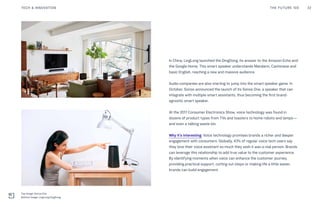
In China, LingLong launched the DingDong, its answer to the Amazon Echo and
the Google Home. This smart speaker understands Mandarin, Cantonese and
basic English, reaching a new and massive audience.
Audio companies are also starting to jump into the smart speaker game. In
October, Sonos announced the launch of its Sonos One, a speaker that can
integrate with multiple smart assistants, thus becoming the first brand-
agnostic smart speaker.
At the 2017 Consumer Electronics Show, voice technology was found in
dozens of product types from TVs and toasters to home robots and lamps—
and even a talking waste bin.
Why it’s interesting: Voice technology promises brands a richer and deeper
engagement with consumers. Globally, 43% of regular voice tech users say
they love their voice assistant so much they wish it was a real person. Brands
can leverage this relationship to add true value to the customer experience.
By identifying moments when voice can enhance the customer journey,
providing practical support, cutting out steps or making life a little easier,
brands can build engagement.
THE FUTURE 100 32TECH & INNOVATION
Top Image: Sonos One
Bottom Image: LingLong DingDong
14
Femtech revolution
Trailblazing female entrepreneurs are leading a new
wave of fem-centric health tech, creating smart products
designed around women’s physical needs.
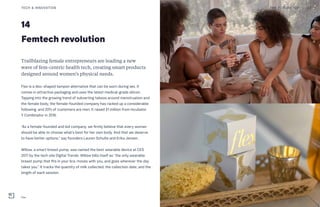
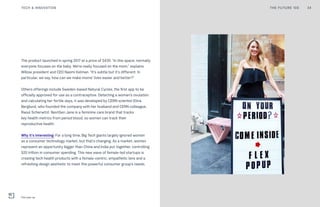
Flex is a disc-shaped tampon alternative that can be worn during sex. It
comes in attractive packaging and uses the latest medical-grade silicon.
Tapping into the growing trend of subverting taboos around menstruation and
the female body, the female-founded company has racked up a considerable
following, and 20% of customers are men. It raised $1 million from incubator
Y Combinator in 2016.
“As a female-founded and led company, we firmly believe that every woman
should be able to choose what’s best for her own body. And that we deserve
to have better options,” say founders Lauren Schulte and Erika Jensen.
Willow, a smart breast pump, was named the best wearable device at CES
2017 by the tech site Digital Trends. Willow bills itself as “the only wearable
breast pump that fits in your bra, moves with you, and goes wherever the day
takes you.” It tracks the quantity of milk collected, the collection date, and the
length of each session. 
THE FUTURE 100 33TECH & INNOVATION
Flex
The product launched in spring 2017 at a price of $430. “In this space, normally
everyone focuses on the baby. We’re really focused on the mom,” explains
Willow president and CEO Naomi Kelman. “It’s subtle but it’s different. In
particular, we say, how can we make moms’ lives easier and better?”
Others offerings include Sweden-based Natural Cycles, the first app to be
officially approved for use as a contraceptive. Detecting a woman’s ovulation
and calculating her fertile days, it was developed by CERN scientist Elina
Berglund, who founded the company with her husband and CERN colleague,
Raoul Scherwitzl. NextGen Jane is a feminine care brand that tracks
key health metrics from period blood, so women can track their
reproductive health.
Why it’s interesting: For a long time, Big Tech giants largely ignored women
as a consumer technology market, but that’s changing. As a market, women
represent an opportunity bigger than China and India put together, controlling
$20 trillion in consumer spending. This new wave of female-led startups is
creating tech health products with a female-centric, empathetic lens and a
refreshing design aesthetic to meet this powerful consumer group’s needs.
THE FUTURE 100 34TECH & INNOVATION
Flex pop-up
15
5G
Fifth-generation mobile phone networks will start to roll
out some time between 2018 and 2020, and every device
maker worth its salt is staking out its turf.
The successor to 4G, which rolled out in 2009, 5G’s technical standards are
not yet finalized, but it is expected to be 100 times faster than 4G, transferring
as much as 10 gigabits of data a second. A full-length HD movie could take
just seconds to download. 5G will revolutionize the Internet of Things by
allowing devices from cars to refrigerators to traffic lights to send and receive
large amounts of data instantaneously.
Brands such as Apple, Nokia, Samsung, Verizon and Ericsson are all deep
in 5G research. Chinese device maker Huawei is in talks with leading
Indian companies to promote 5G innovations jointly. Sweden’s Ericsson, in
partnership with Vietnamese government officials, recently held a showcase
to demonstrate how 5G has the potential to transform sectors such as
energy, manufacturing, healthcare and transport.
Why it’s interesting: The speed and reach of 5G has the potential to make the
world safer and more efficient in dramatic ways. Brands will need to stay on
top of the latest developments as 5G accelerates the speed of innovation.
THE FUTURE 100 35TECH & INNOVATION
Post Womens-Interest Media
Post Wo
0416
Manufacturing 2.0
Hyper-personalized manufacturing is becoming a reality
and is set to transform the way we shop and the prices we
pay for goods.
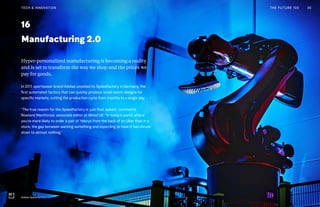
In 2017, sportswear brand Adidas unveiled its Speedfactory in Germany, the
first automated factory that can quickly produce small-batch designs for
specific markets, cutting the production cycle from months to a single day.
“The true reason for the Speedfactory is just that: speed,” comments
Rowland Manthorpe, associate editor at Wired UK. “In today’s world, where
you’re more likely to order a pair of Yeezys from the back of an Uber than in a
store, the gap between wanting something and expecting to have it has shrunk
down to almost nothing.”
THE FUTURE 100 36TECH & INNOVATION
Adidas Speedfactory
Post Womens-Interest Media
Post Wo
04
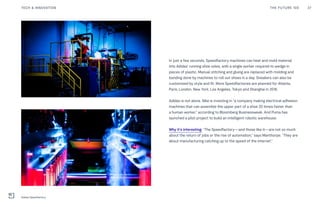
In just a few seconds, Speedfactory machines can heat and mold material
into Adidas' running shoe soles, with a single worker required to wedge in
pieces of plastic. Manual stitching and gluing are replaced with molding and
bonding done by machines to roll out shoes in a day. Sneakers can also be
customized by style and fit. More Speedfactories are planned for Atlanta,
Paris, London, New York, Los Angeles, Tokyo and Shanghai in 2018.
Adidas is not alone. Nike is investing in “a company making electrical adhesion
machines that can assemble the upper part of a shoe 20 times faster than
a human worker,” according to Bloomberg Businessweek. And Puma has
launched a pilot project to build an intelligent robotic warehouse.
Why it’s interesting: “The Speedfactory—and those like it—are not so much
about the return of jobs or the rise of automation,” says Manthorpe. “They are
about manufacturing catching up to the speed of the internet.”
THE FUTURE 100 37TECH & INNOVATION
Adidas Speedfactory
17
The next billion digital
The next billion consumers are coming online.
Thanks to falling smartphone prices, they’re coming
from emerging economies, dislodging the axis of
innovation away from America and Europe to places
such as Israel, India and China.
In many cases, nimble local players have figured out what these new users
need ahead of Silicon Valley stalwarts. Language barriers shift the focus to
voice and video over text. UC Browser, from China’s online services company
Alibaba, requires less data to cater to users with low-speed connections in
locations such as rural Asia. SHAREit, an app from China’s Lenovo, lets users
transfer music and movies to friends’ phones offline, saving data costs.
Emerging leaders are “building apps and services that respond to local needs,
and in doing so, they’re building products for the future of the internet,”
Caesar Sengupta, Google’s vice president of product management, told
the Wall Street Journal. “The next generation of global tech companies are
just as likely to come out of a local coffee shop in Bangalore or Ho Chi Minh
City as they are from Silicon Valley.” Silicon Valley is responding: Facebook
is partnering with telecom companies from Kenya to Myanmar to give
subscribers access to its Free Basics, which give users some internet services
without it counting towards their data plan, the New York Times reported.
Why it’s interesting: The next billion people online could change the way the
internet works, with new apps and new hubs of innovation. Upsides include
smarter grids and greater efficiencies. Downsides include exposing these new
markets to manipulation by the forces that have used Facebook, Twitter and
other social media to spread misinformation.
THE FUTURE 100 38TECH & INNOVATION
18
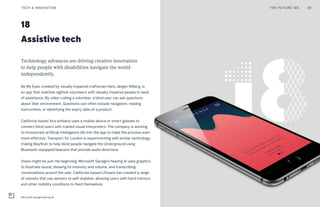
Assistive tech
Technology advances are driving creative innovation
to help people with disabilities navigate the world
independently.
Be My Eyes, created by visually impaired craftsman Hans Jørgen Wiberg, is
an app that matches sighted volunteers with visually impaired people in need
of assistance. By video-calling a volunteer, a blind user can ask questions
about their environment. Questions can often include navigation, reading
instructions, or identifying the expiry date of a product.
California-based Aira similarly uses a mobile device or smart glasses to
connect blind users with trained visual interpreters. The company is working
to incorporate artificial intelligence (AI) into the app to make the process even
more effective. Transport for London is experimenting with similar technology,
trialing Wayfindr to help blind people navigate the Underground using
Bluetooth-equipped beacons that provide audio directions.
Vision might be just the beginning. Microsoft Garage’s hearing AI uses graphics
to illustrate sound, showing its intensity and volume, and transcribing
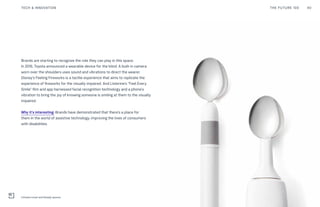
conversations around the user. California-based Liftware has created a range
of utensils that use sensors to self-stabilize, allowing users with hand tremors
and other mobility conditions to feed themselves.
THE FUTURE 100 39TECH & INNOVATION
Microsoft Garage Hearing AI
Brands are starting to recognize the role they can play in this space.
In 2016, Toyota announced a wearable device for the blind. A built-in camera
worn over the shoulders uses sound and vibrations to direct the wearer.
Disney’s Feeling Fireworks is a tactile experience that aims to replicate the
experience of fireworks for the visually impaired. And Listerine’s “Feel Every
Smile” film and app harnessed facial recognition technology and a phone’s
vibration to bring the joy of knowing someone is smiling at them to the visually
impaired.
Why it’s interesting: Brands have demonstrated that there’s a place for
them in the world of assistive technology, improving the lives of consumers
with disabilities.
THE FUTURE 100 40TECH & INNOVATION
Liftware Level and Steady spoons
19
Chinese tech goes global
Chinese tech brands, having grown massive behind
China’s Great Firewall, are venturing out to the rest of
the world.
For Western marketers, Chinese tech companies such as Alibaba or Tencent,
among others, offer the tantalizing prospect of access to Chinese consumers,
particularly the almost 400 million who will have household incomes of
$16,000 to $34,000 by 2020, described as “mainstream consumers” by
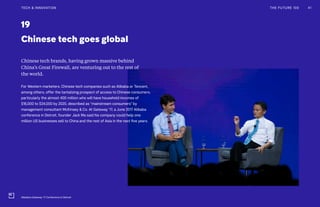
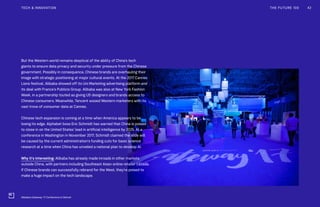
management consultant McKinsey & Co. At Gateway ’17, a June 2017 Alibaba
conference in Detroit, founder Jack Ma said his company could help one
million US businesses sell to China and the rest of Asia in the next five years.
THE FUTURE 100 41TECH & INNOVATION
Alibaba's Gateway '17 Conference in Detroit
But the Western world remains skeptical of the ability of China’s tech
giants to ensure data privacy and security under pressure from the Chinese
government. Possibly in consequence, Chinese brands are overhauling their
image with strategic positioning at major cultural events. At the 2017 Cannes
Lions festival, Alibaba showed off its Uni Marketing advertising platform and
its deal with France’s Publicis Group. Alibaba was also at New York Fashion
Week, in a partnership touted as giving US designers and brands access to
Chinese consumers. Meanwhile, Tencent wooed Western marketers with its
vast trove of consumer data at Cannes.
Chinese tech expansion is coming at a time when America appears to be
losing its edge. Alphabet boss Eric Schmidt has warned that China is poised
to close in on the United States’ lead in artificial intelligence by 2025. At a
conference in Washington in November 2017, Schmidt claimed the slide will
be caused by the current administration’s funding cuts for basic science
research at a time when China has unveiled a national plan to develop AI.
Why it’s interesting: Alibaba has already made inroads in other markets
outside China, with partners including Southeast Asian online retailer Lazada.
If Chinese brands can successfully rebrand for the West, they’re poised to
make a huge impact on the tech landscape.
THE FUTURE 100 42TECH & INNOVATION
Alibaba's Gateway '17 Conference in Detroit
20
Big tech backlash
Following the 2017 election, when Facebook and Twitter
were used to influence voters, many people are calling for
more government regulation of Silicon Valley giants. Is the
stage set for a showdown in 2018?
2017 saw an avalanche of bad PR for the tech sector, from fake news to
allegations of harassment and gender discrimination. Executives from
Facebook, Google and Twitter even appeared before Congress in relation to
alleged Russian use of their platforms to manipulate the US election.
US senators and officials are showing signs of getting tough, claiming tech
giants’ powers have gone unchecked for too long. There have been calls
for tech firms to be regulated like utilities, even nationalized. According
to Strategas Research Partners, the frequency of companies referencing
regulatory issues in their financial filings to the US Securities and Exchange
Commission has more than doubled for the tech sector since 2005. Europe
is already taking a tougher line: Google was fined €2.4 billion in June 2017 for
breaking antitrust rules.
THE FUTURE 100 43TECH & INNOVATION
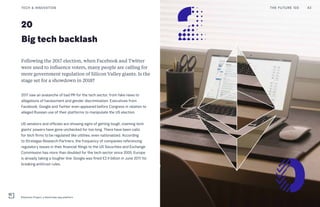
Ethereum Project, a blockchain app platform
StJohn Deakins, founder and CEO of personal data exchange platform
CitizenMe, believes tighter legislation is inevitable. “Similar to the way that
health and safety regulation was introduced at the start of Industrial era,
digital regulation will become more sophisticated, nuanced and universally
applied,” he said, “but it’ll happen in a decade rather than over a century.”
In the meantime, web utopians are seeking to wrest back power and restore
the web to the democratic force it once was. Tim Berners-Lee’s lab at MIT is
working on a project called Solid (from social linked data), which aims to give
people control over their own personal data stores. Other companies are
demonstrating the potential of blockchain technology to build decentralized
systems that could underpin the web, among them Blockstack and Ethereum.
Why it’s interesting: Big technology firms will increasingly come under
scrutiny from governments and regulators in the years to come. Tech giants
are likely to shift to a decentralized web or “be disrupted within a decade or
two,” says Deakins.
"Digital regulation
will become more
sophisticated...
but it’ll happen in a
decade rather than
over a century."
StJohn Deakins, founder, CitizenMe.
THE FUTURE 100 44TECH & INNOVATION
Travel & Hospitality
Global nomads
21
Where is the dividing line between work and travel?
For younger generations, the distinction may not exist.
“My generation aspires to have a life that is very free,” says Angelina Aucello,
a smart-luxury traveler who writes under the banner Angelina Travels. “In my
parents’ generation, the American dream was getting a great job at a bank
on Wall Street, and then you’ve made it in life. My generation is shifting to the
dream being freedom—having the ability to work wherever there is wifi, to
go to another country and connect and create content, to be totally
mobile and remote.”
THE FUTURE 100 46
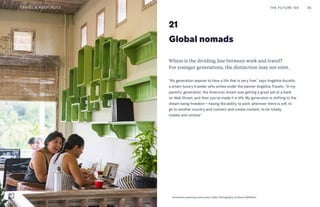
Unsettled coworking community in Bali. Photography by Reece McMillian
TRAVEL & HOSPITALITY
The generation that popularized the gap year is bringing its collective
wanderlust into adulthood. Creating high-powered careers that span the globe
is becoming commonplace, as the ranks of the digital nomads grow—flexible,
international, and able to work from anywhere.
Travel companies are making it easier to ditch the nine-to-five. Unsettled
and Remote Year create temporary communities of entrepreneurs and
creatives abroad, while Habitas specializes in global wellness travel, offering
retreats and eco-chic hotels to members in Tulum, Malibu and Namibia.
Perhaps the greatest game changer is WeWork, which allows members to
choose from more than 200 offices across 20 countries. Massive expansions
planned for China and Latin America will mean remote workers are never far
from the office.
Why it’s interesting: Digital nomads are a new type of global citizen, with a
hunger for community that demands new experiences from travel brands.
THE FUTURE 100 47
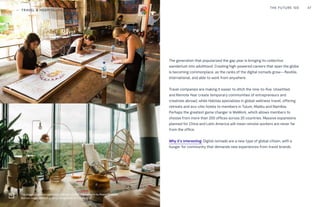
Top Image: Unsettled coworking community in Bali. Photography by Reece McMillian
Bottom Image: WeWork at Sony Center Commons in Berlin
TRAVEL & HOSPITALITY
Post Womens-Interest Media
Post Wo
04
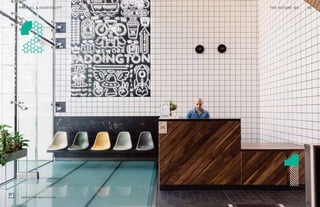
WeWork Paddington in London
THE FUTURE 100TRAVEL & HOSPITALITY 48
22
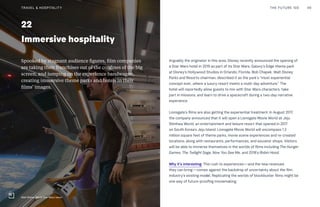
Immersive hospitality
Arguably the originator in this area, Disney recently announced the opening of
a Star Wars hotel in 2019 as part of its Star Wars: Galaxy’s Edge theme park
at Disney’s Hollywood Studios in Orlando, Florida. Bob Chapek, Walt Disney
Parks and Resorts chairman, described it as the park’s “most experiential
concept ever...where a luxury resort meets a multi-day adventure.” The
hotel will reportedly allow guests to mix with Star Wars characters, take
part in missions, and learn to drive a spacecraft during a two-day narrative
experience.
Lionsgate’s films are also getting the experiential treatment. In August 2017,
the company announced that it will open a Lionsgate Movie World at Jeju
Shinhwa World, an entertainment and leisure resort that opened in 2017
on South Korea’s Jeju Island. Lionsgate Movie World will encompass 1.3
million square feet of theme parks, movie scene experiences and re-created
locations, along with restaurants, performances, and souvenir shops. Visitors
will be able to immerse themselves in the worlds of films including The Hunger
Games, The Twilight Saga, Now You See Me, and 2018’s Robin Hood.
Why it’s interesting: This rush to experiences—and the new revenues
they can bring—comes against the backdrop of uncertainty about the film
industry’s existing model. Replicating the worlds of blockbuster films might be
one way of future-proofing moviemaking.
Spooked by stagnant audience figures, film companies
are taking their franchises out of the confines of the big
screen, and jumping on the experience bandwagon,
creating immersive theme parks and hotels in their
films’ images.
THE FUTURE 100 49
Walt Disney World Star Wars resort
TRAVEL & HOSPITALITY
50THE FUTURE 100TRAVEL & HOSPITALITY
Walt Disney World Star Wars Resort
23
Second city renaissance
Xennials and millennials are leapfrogging the suburban
life to reinvent affordable second cities, enjoying the
trappings of groovy and gritty urban lifestyles at an
affordable price.
“In the old days, artists led the charge to revitalize and reclaim old cities or
neighborhoods,” says April Hutchinson, editor of leading travel trade titles TTG
and TTG Luxury. “Now that’s broadened to startups, millennials and middle-
class people who cannot afford to live in major cities and still want to buy
good coffee in an urban setting. The way we work now means we’re not tied
to any one place.”
THE FUTURE 100TRAVEL & HOSPITALITY 51
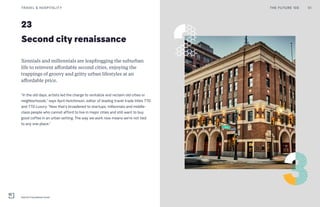
Detroit Foundation hotel
Post Womens-Interest Media
Post Wo
04
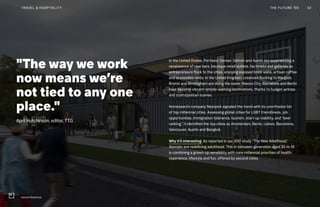
In the United States, Portland, Denver, Detroit and Austin are experiencing a
renaissance of new bars, boutique retail outlets, hip hotels and galleries as
entrepreneurs flock to the cities, enjoying exposed brick walls, artisan coffee
and accessible rents. In the United Kingdom, creatives flocking to Margate,
Bristol and Birmingham are doing the same. Mexico City, Barcelona and Berlin
have become vibrant remote-working destinations, thanks to budget airlines
and cosmopolitan scenes.
Homesearch company Nestpick signaled the trend with its unorthodox list
of top millennial cities. Assessing global cities for LGBT friendliness, job
opportunities, immigration tolerance, tourism, start-up viability, and “beer
ranking,” it identified the top cities as Amsterdam, Berlin, Lisbon, Barcelona,
Vancouver, Austin and Bangkok.
Why it’s interesting: As reported in our 2017 study “The New Adulthood,”
Xennials are redefining adulthood. This in-between generation aged 30 to 45
is combining a grown-up sensibility with core millennial priorities of health,
experience, lifestyle and fun, offered by second cities.
"The way we work
now means we’re
not tied to any one
place."
April Hutchinson, editor, TTG
THE FUTURE 100TRAVEL & HOSPITALITY 52
Detroit ShipYards
TRAVEL & HOSPITALITY
24
New cultural hubs
Locating new cultural hotspots for 2018 is less about
finding undiscovered locales than regarding established
cities through a new lens, thanks to the emergence of
exciting new neighborhoods and cultural institutions.
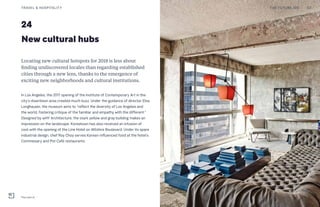
In Los Angeles, the 2017 opening of the Institute of Contemporary Art in the
city’s downtown area created much buzz. Under the guidance of director Elsa
Longhauser, the museum aims to “reflect the diversity of Los Angeles and
the world, fostering critique of the familiar and empathy with the different.”
Designed by wHY Architecture, the stark yellow and gray building makes an
impression on the landscape. Koreatown has also received an infusion of
cool with the opening of the Line Hotel on Wilshire Boulevard. Under its spare
industrial design, chef Roy Choy serves Korean-influenced food at the hotel’s
Commissary and Pot Café restaurants.
THE FUTURE 100TRAVEL & HOSPITALITY 53
The Line LA
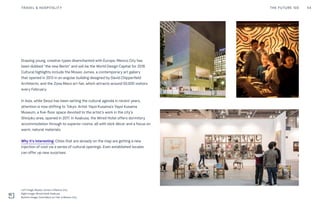
Drawing young, creative types disenchanted with Europe, Mexico City has
been dubbed “the new Berlin” and will be the World Design Capital for 2018.
Cultural highlights include the Museo Jumex, a contemporary art gallery
that opened in 2013 in an angular building designed by David Chipperfield
Architects, and the Zona Maco art fair, which attracts around 50,000 visitors
every February.
In Asia, while Seoul has been setting the cultural agenda in recent years,
attention is now shifting to Tokyo. Artist Yayoi Kusama’s Yayoi Kusama
Museum, a five-floor space devoted to the artist’s work in the city’s
Shinjuku area, opened in 2017. In Asakusa, the Wired Hotel offers dormitory
accommodation through to superior rooms, all with slick décor and a focus on
warm, natural materials.
Why it’s interesting: Cities that are already on the map are getting a new
injection of cool via a series of cultural openings. Even established locales
can offer up new surprises.
THE FUTURE 100TRAVEL & HOSPITALITY 54
Left Image: Museo Jumex in Mexico City
Right Image: Wired Hotel Asakusa
Bottom Image: Zona Maco art fair in Mexico City
Post Womens-Interest Media
Post Wo
0425
Space
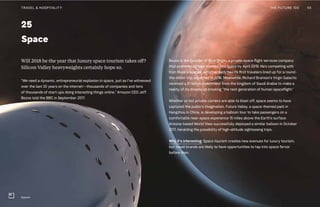
Bezos is the founder of Blue Origin, a private space flight services company
that promises to take tourists into space by April 2019. He’s competing with
Elon Musk’s SpaceX, which already has its first travelers lined up for a round-
the-moon trip, expected in 2018. Meanwhile, Richard Branson’s Virgin Galactic
received a $1 billion investment from the kingdom of Saudi Arabia to make a
reality of its dreams of creating “the next generation of human spaceflight.”
Whether or not private carriers are able to blast off, space seems to have
captured the public’s imagination. Future Valley, a space-themed park in
Hangzhou in China, is developing a balloon tour to take passengers on a
comfortable near-space experience 15 miles above the Earth’s surface.
Arizona-based World View successfully deployed a similar balloon in October
2017, heralding the possibility of high-altitude sightseeing trips.
Why it’s interesting: Space tourism creates new avenues for luxury tourism,
but travel brands are likely to have opportunities to tap into space fervor
before then.
Will 2018 be the year that luxury space tourism takes off?
Silicon Valley heavyweights certainly hope so.
“We need a dynamic, entrepreneurial explosion in space, just as I’ve witnessed
over the last 20 years on the internet—thousands of companies and tens
of thousands of start-ups doing interesting things online,” Amazon CEO Jeff
Bezos told the BBC in September 2017.
THE FUTURE 100TRAVEL & HOSPITALITY 55
SpaceX
TRAVEL & HOSPITALITY
THE FUTURE 100 56
SpaceX
TRAVEL & HOSPITALITY
26
Millennial travel evolved
Though millennials are reputed to be budget-conscious
travelers, this generation is rapidly shedding its gap-year
lifestyle. Will the travel industry grow up with them?
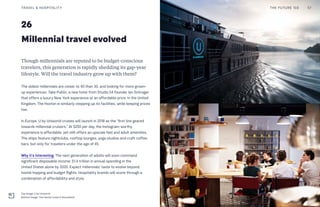
The oldest millennials are closer to 40 than 30, and looking for more grown-
up experiences. Take Public, a new hotel from Studio 54 founder Ian Schrager
that offers a luxury New York experience at an affordable price. In the United
Kingdom, The Hoxton is similarly stepping up its facilities, while keeping prices
low.
In Europe, U by Uniworld cruises will launch in 2018 as the “first line geared
towards millennial cruisers.” At $250 per day, the Instagram-worthy
experience is affordable, yet still offers an upscale feel and adult amenities.
The ships feature nightclubs, rooftop lounges, yoga studios and craft coffee
bars, but only for travelers under the age of 45.
Why it’s interesting: The next generation of adults will soon command
significant disposable income: $1.4 trillion in annual spending in the
United States alone by 2020. Expect millennials’ taste to evolve beyond
hostel hopping and budget flights. Hospitality brands will score through a
combination of affordability and style.
THE FUTURE 100TRAVEL & HOSPITALITY 57
Top Image: U by Uniworld
Bottom Image: The Hoxton hotel in Shoreditch
27
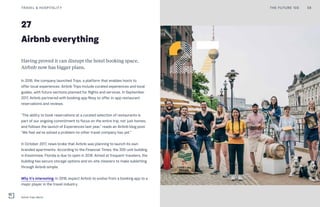
Airbnb everything
Having proved it can disrupt the hotel booking space,
Airbnb now has bigger plans.
In 2016, the company launched Trips, a platform that enables hosts to
offer local experiences. Airbnb Trips include curated experiences and local
guides, with future sections planned for flights and services. In September
2017, Airbnb partnered with booking app Resy to offer in-app restaurant
reservations and reviews.
“The ability to book reservations at a curated selection of restaurants is
part of our ongoing commitment to focus on the entire trip, not just homes,
and follows the launch of Experiences last year,” reads an Airbnb blog post.
“We feel we’ve solved a problem no other travel company has yet.”
In October 2017, news broke that Airbnb was planning to launch its own
branded apartments. According to the Financial Times, the 300-unit building
in Kissimmee, Florida is due to open in 2018. Aimed at frequent travelers, the
building has secure storage options and on-site cleaners to make subletting
through Airbnb simple.
Why it’s interesting: In 2018, expect Airbnb to evolve from a booking app to a
major player in the travel industry.
TRAVEL & HOSPITALITY 58THE FUTURE 100
Airbnb Trips: Berlin
Airbnb Trips
TRAVEL & HOSPITALITY 59THE FUTURE 100
28
New Brexit capitals
Why it’s interesting: As wealth, power and influence move to new capitals,
culture and travel will change in the United Kingdom and the new financial
hubs. London’s luxury real estate market has already flattened, while luxury
flats in Frankfurt have leapt 25% in 2016-2017.
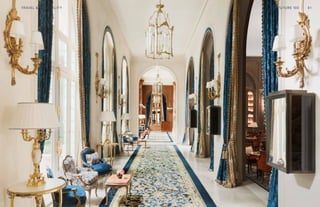
Two top-flight Paris hotels, the Ritz and the Hôtel de Crillon, have recently
received lavish renovations. On the horizon, LVMH and Kering are designing
striking new museum spaces, flagship stores and headquarters. Expect a slew
of luxury retail and hospitality developments to follow, servicing the wave of
well-heeled new residents.
As Brexit proceedings continue, new cities in Europe are
set to gain prominence as financial and cultural capitals.
Frankfurt, Amsterdam, Madrid and Dublin are all vying to become hubs for
financial services ahead of the United Kingdom’s exit from the European Union
in 2019, and its possible demotion from the position of the world’s leading
financial capital.
Frankfurt has emerged as the destination of choice for many London banks
looking to relocate staff in order to continue serving European customers.
Deutsche Bank predicts that 5,000 new residents might settle in Frankfurt as
a result of Brexit-related job moves. Goldman Sachs and Silicon Valley Bank
are both focusing on the German city.
Not to be outdone, Paris is also vying for banks that are relocating. President
Emmanuel Macron has pledged to cut the corporate tax rate by 25% by the
end of his term in 2022. Politico reported in summer 2017 that the European
Union is considering a lavish new multi-million-euro building in Paris.
THE FUTURE 100TRAVEL & HOSPITALITY 60
61
Ritz Paris
THE FUTURE 100TRAVEL & HOSPITALITY
29
Budget wanderlust
It’s no secret that millennials love to travel. MMGY Global’s
“Portrait of American Travelers” study released in summer
2017 found millennial families are driving growth in travel.
This sector is planning to travel 36% more in 2017-2018
than in the previous year.
The millennial generation prefers to spend its money on the memorable el-
ements of travel experiences and save on the more functional aspects of
travel. To appeal to millennials’ appetite for wanderlust on a budget, several
airlines are launching purse-friendly ways to travel the globe.
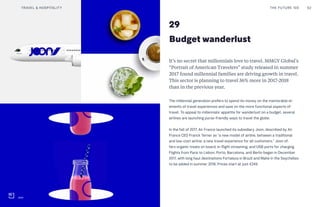
In the fall of 2017, Air France launched its subsidiary Joon, described by Air
France CEO Franck Terner as “a new model of airline, between a traditional
and low-cost airline, a new travel experience for all customers.” Joon of-
fers organic treats on board, in-flight streaming, and USB ports for charging.
Flights from Paris to Lisbon, Porto, Barcelona, and Berlin began in December
2017, with long haul destinations Fortaleza in Brazil and Mahé in the Seychelles
to be added in summer 2018. Prices start at just €249.
THE FUTURE 100TRAVEL & HOSPITALITY 62
Joon
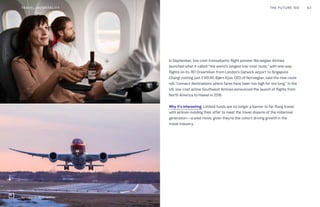
In September, low-cost transatlantic flight pioneer Norwegian Airlines
launched what it called “the world’s longest low-cost route,” with one-way
flights on its 787 Dreamliner from London’s Gatwick airport to Singapore
Changi costing just £149.90. Bjørn Kjos, CEO of Norwegian, said the new route
will “connect destinations where fares have been too high for too long.” In the
US, low-cost airline Southwest Airlines announced the launch of flights from
North America to Hawaii in 2018.
Why it’s interesting: Limited funds are no longer a barrier to far-flung travel,
with airlines molding their offer to meet the travel dreams of the millennial
generation—a wise move, given they’re the cohort driving growth in the
travel industry.
THE FUTURE 100 63
Norwegian Air 787 Dreamliner
TRAVEL+HOSPITALITY
30
Retail residences
Believing a relaxed customer is more likely to make a
purchase, retailers are on a continual quest to make
customers feel at home in their stores.
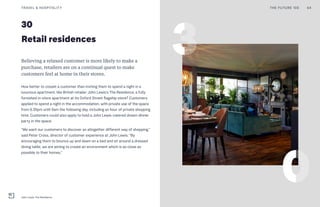
How better to cosset a customer than inviting them to spend a night in a
luxurious apartment, like British retailer John Lewis’s The Residence, a fully
furnished in-store apartment at its Oxford Street flagship store? Customers
applied to spend a night in the accommodation, with private use of the space
from 6.30pm until 9am the following day, including an hour of private shopping
time. Customers could also apply to hold a John Lewis-catered dream dinner
party in the space.
“We want our customers to discover an altogether different way of shopping,”
said Peter Cross, director of customer experience at John Lewis. “By
encouraging them to bounce up and down on a bed and sit around a dressed
dining table, we are aiming to create an environment which is as close as
possible to their homes.”
THE FUTURE 100TRAVEL & HOSPITALITY 64
John Lewis' The Residence
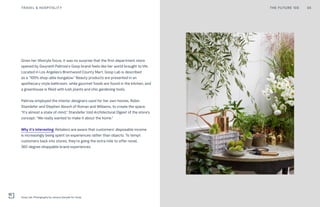
Given her lifestyle focus, it was no surprise that the first department store
opened by Gwyneth Paltrow’s Goop brand feels like her world brought to life.
Located in Los Angeles’s Brentwood County Mart, Goop Lab is described
as a “100% shop-able bungalow.” Beauty products are presented in an
apothecary-style bathroom, while gourmet foods are found in the kitchen, and
a greenhouse is filled with lush plants and chic gardening tools.
Paltrow employed the interior designers used for her own homes, Robin
Standefer and Stephen Alesch of Roman and Williams, to create the space.
“It’s almost a state of mind,” Standefer told Architectural Digest of the store’s
concept. “We really wanted to make it about the home.”
Why it’s interesting: Retailers are aware that customers’ disposable income
is increasingly being spent on experiences rather than objects. To tempt
customers back into stores, they’re going the extra mile to offer novel,
360-degree shoppable brand experiences.
THE FUTURE 100TRAVEL & HOSPITALITY 65
Goop Lab. Photography by Jessica Sample for Goop
Brands & Marketing
Brandlessness
A wave of disruptive new companies is offering premium
beauty, personal care, and groceries at a fraction of the
cost of branded equivalents. These direct-to-consumer
white label goods offer quality of the kind found in Whole
Foods or Sephora, with none of the bells and whistles (and
add-on costs) associated with household labels.
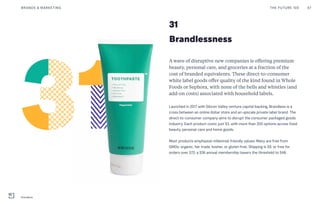
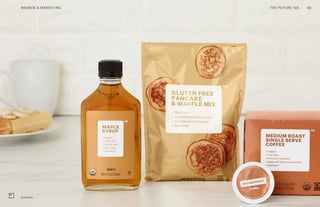
Launched in 2017 with Silicon Valley venture capital backing, Brandless is a
cross between an online dollar store and an upscale private label brand. The
direct-to-consumer company aims to disrupt the consumer packaged goods
industry. Each product costs just $3, with more than 200 options across food,
beauty, personal care and home goods.
Most products emphasize millennial-friendly values: Many are free from
GMOs, organic, fair trade, kosher, or gluten free. Shipping is $9, or free for
orders over $72; a $36 annual membership lowers the threshold to $48.
31
THE FUTURE 100BRANDS & MARKETING 67
Brandless
THE FUTURE 100BRANDS & MARKETING 68
Brandless
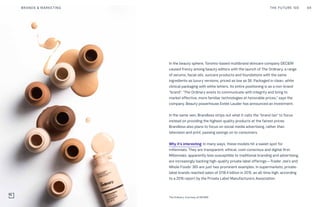
In the beauty sphere, Toronto-based multibrand skincare company DECIEM
caused frenzy among beauty editors with the launch of The Ordinary, a range
of serums, facial oils, suncare products and foundations with the same
ingredients as luxury versions, priced as low as $6. Packaged in clean, white
clinical packaging with white letters, its entire positioning is as a non-brand
“brand”. “The Ordinary exists to communicate with integrity and bring to
market effective, more familiar technologies at honorable prices,” says the
company. Beauty powerhouse Estée Lauder has announced an investment.
In the same vein, Brandless strips out what it calls the “brand tax” to focus
instead on providing the highest-quality products at the fairest prices.
Brandless also plans to focus on social media advertising, rather than
television and print, passing savings on to consumers.
Why it’s interesting: In many ways, these models hit a sweet spot for
millennials. They are transparent, ethical, cost-conscious and digital-first.
Millennials, apparently less susceptible to traditional branding and advertising,
are increasingly backing high-quality private label offerings—Trader Joe’s and
Whole Foods’ 365 are just two prominent examples. In supermarkets, private-
label brands reached sales of $118.4 billion in 2015, an all-time high, according
to a 2016 report by the Private Label Manufacturers Association.
THE FUTURE 100BRANDS & MARKETING 69
The Ordinary. Courtesy of DECIEM
32
Inclusive e-commerce
Retailers—particularly those with online delivery
models—are taking a fresh look at lower-income
consumers, creating innovative business models to meet
the needs of this often-overlooked group.
In summer 2017, Amazon announced that customers in a list of US government
assistance programs would be eligible for discounted Prime membership.
The reduced Prime membership cost $5.99 per month rather than $10.99.
Prime members enjoy free shipping, a selection of e-books through Prime
Reading, and access to unlimited streaming and original shows through
Prime Video.
Another sector drawing success from today’s low-income consumers is
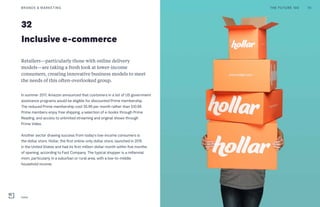
the dollar store. Hollar, the first online-only dollar store, launched in 2015
in the United States and had its first million-dollar month within five months
of opening, according to Fast Company. The typical shopper is a millennial
mom, particularly in a suburban or rural area, with a low-to-middle
household income.
BRANDS & MARKETING 70THE FUTURE 100
Hollar
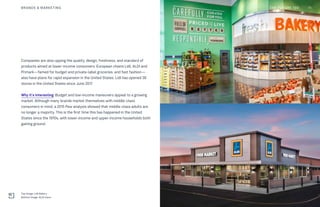
Companies are also upping the quality, design, freshness, and standard of
products aimed at lower-income consumers. European chains Lidl, ALDI and
Primark—famed for budget and private-label groceries, and fast fashion—
also have plans for rapid expansion in the United States. Lidl has opened 38
stores in the United States since June 2017.
Why it’s interesting: Budget and low-income maneuvers appeal to a growing
market. Although many brands market themselves with middle-class
consumers in mind, a 2015 Pew analysis showed that middle-class adults are
no longer a majority. This is the first time this has happened in the United
States since the 1970s, with lower-income and upper-income households both
gaining ground.
BRANDS & MARKETING
Top Image: Lidl Bakery
Bottom Image: ALDI store
71THE FUTURE 100
33
Branded audio
First came branded content, then branded videos.
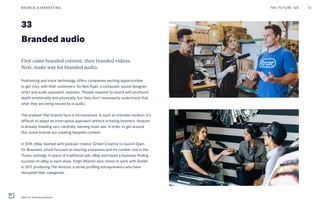
Next, make way for branded audio.
Podcasting and voice technology offers companies exciting opportunities
to get cozy with their customers. As Nick Ryan, a composer, sound designer,
artist and audio specialist, explains, “People respond to sound with profound
depth emotionally and physically, but they don’t necessarily understand that
what they are being moved by is audio.”
The problem that brands face is intrusiveness. In such an intimate medium, it’s
difficult to adopt an interruptive approach without irritating listeners. Amazon
is already treading very carefully, banning most ads. In order to get around
this, some brands are creating bespoke content.
In 2016, eBay teamed with podcast creator Gimlet Creative to launch Open
for Business, which focused on starting a business and hit number one in the
iTunes rankings. In place of traditional ads, eBay portrayed a business finding
success on eBay in each show. Virgin Atlantic also chose to work with Gimlet
in 2017, producing The Venture, a series profiling entrepreneurs who have
disrupted their categories.
THE FUTURE 100BRANDS & MARKETING 72
Open for Business podcast
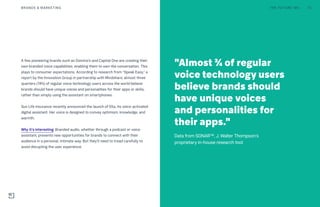
A few pioneering brands such as Domino’s and Capital One are creating their
own branded voice capabilities, enabling them to own the conversation. This
plays to consumer expectations. According to research from “Speak Easy,” a
report by the Innovation Group in partnership with Mindshare, almost three
quarters (74%) of regular voice technology users across the world believe
brands should have unique voices and personalities for their apps or skills,
rather than simply using the assistant on smartphones.
Sun Life Insurance recently announced the launch of Ella, its voice-activated
digital assistant. Her voice is designed to convey optimism, knowledge, and
warmth.
Why it’s interesting: Branded audio, whether through a podcast or voice
assistant, presents new opportunities for brands to connect with their
audience in a personal, intimate way. But they’ll need to tread carefully to
avoid disrupting the user experience.
"Almost ¾ of regular
voice technology users
believe brands should
have unique voices
and personalities for
their apps."
Data from SONAR™, J. Walter Thompson's
proprietary in-house research tool
THE FUTURE 100BRANDS & MARKETING 73
Post Womens-Interest Media
Post Wo
0434
Global trends
Generation Z, the cohort currently aged 12-19, is exhibiting more globally
similar tastes and attributes than previous cohorts. Having grown up with
unparalleled access to social media, smartphones and digital universes, they
are the least bound to regional trends.
Why it’s interesting: At the other end of the scale, trend globalization is driving
mass fragmentation, as consumers can establish networks and discover niche
subjects, products and ideas way beyond their borders. In today’s dispersed
cultural landscape, defined by individuality, we’re unlikely to see mass united
movement around an artistic genre, like punk in the United Kingdom or rock
‘n’ roll in the United States. But a new generation of teenagers appreciates
feminist e-zines from the 1980s, follows Japanese skater culture, and watches
Stranger Things season two (with the rest of the world) in sync.
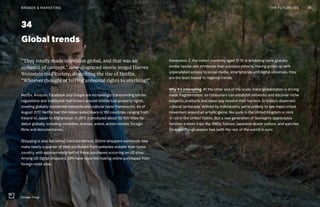
“They totally made television global, and that was an
unheard-of concept,” now-disgraced movie mogul Harvey
Weinstein told Variety, describing the rise of Netflix.
“Whoever thought of buying universal rights to anything?” 
Netflix, Amazon, Facebook and Google are increasingly transcending border
regulations and traditional restrictions around intellectual property rights,
creating globally connected networks and cultural taste frameworks. As of
August 2017, Netflix had 104 million subscribers in 190 countries, ranging from
Ireland to Japan to Afghanistan. In 2017, it produced about 50 film titles for
debut globally, including comedies, dramas, anime, action movies, foreign
films and documentaries.
Shopping is also becoming more borderless. Online shoppers worldwide now
make nearly a quarter of their purchases from websites outside their home
country, with approximately half of these purchases occurring on US sites.
Among US digital shoppers, 54% have reported making online purchases from
foreign retail sites.
THE FUTURE 100BRANDS & MARKETING 74
Stranger Things
Here come the Xennials
What will adulthood look like in 2020? A new generational
cohort is emerging—one that marketers need to heed.
Xennials, also known as New Adults, are a microgeneration aged 30 to 45—
older than typical millennials, but younger than generation X. In advertising's
rush to woo millennial consumers, their older counterparts often feel
overlooked, or alienated.
“It doesn’t benefit anyone to act like a 33-year-old and a 23-year-old came
up in the same general climate, or with access to the same types of world-
altering technology,” griped Jesse Singal in an April 2017 article for New York
Magazine. “No: These are profound differences. For the good of both us old
millennials and our young millennial siblings and friends, let’s stop acting like
we’re all in the same boat.”
Having spent the last decade on the roller coaster started by the financial
crisis, New Adults are now upending all the traditional markers of adulthood.
The generation that popularized much of today’s hipster culture still seeks
brands that are edgy and relevant but, today, they increasingly want a more
refined and “adult” experience. Brands connecting with New Adults include:
35
THE FUTURE 100BRANDS & MARKETING 75
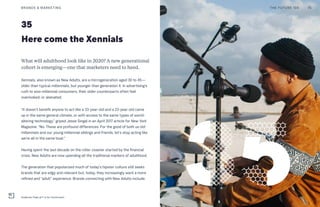
Anderson Paak at F is for Fendi event
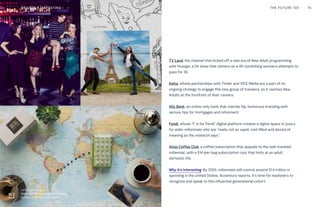
TV Land, the channel that kicked off a new era of New Adult programming
with Younger, a hit show that centers on a 40-something woman’s attempts to
pass for 26.
Delta, whose partnerships with Tinder and VICE Media are a part of its
ongoing strategy to engage this new group of travelers, as it reaches New
Adults at the forefront of their careers.
Ally Bank, an online-only bank that marries hip, humorous branding with
serious tips for mortgages and retirement.
Fendi, whose “F is for Fendi” digital platform creates a digital space in luxury
for older millennials who are “really not as vapid, void-filled and devoid of
meaning as the research says.”
Atlas Coffee Club, a coffee subscription that appeals to the well-traveled
millennial, with a $14-per-bag subscription cost that hints at an adult
domestic life.
Why it’s interesting: By 2020, millennials will control around $1.4 trillion in
spending in the United States, Accenture reports. It’s time for marketers to
recognize and speak to this influential generational cohort.
THE FUTURE 100 76
Left Image: Younger
Right Image:Delta Dating Wall in Brooklyn
Bottom Image: Atlas Coffee Club
BRANDS & MARKETING
36
Girlfriend-to-girlfriend
brands
“Be the CEO your parents always wanted you to marry.”
“Losing weight is not your life’s purpose.” “Life’s short.
Message him first.”
These are the rallying cries of Bumble’s latest ad campaigns. What began as a
female-first dating app has morphed into a women’s empowerment platform,
with extensions into platonic dating app BFF, and Bumble Bizz, a female-
centric LinkedIn equivalent.
Bumble isn’t alone. Brands launched by female founders are using the
intimacy of social media platforms, informal language, and the message of
female empowerment to become your branded best friend. Here, customers
are part of a community that goes beyond retail. Fans of female-founded
empires are not just buying into the product; they are supporting the story of
the CEO, female entrepreneurship and the journey.
“Chatty, inclusive and intimate, this approach—predicated on the notion
that a brand is your friend, thinks you’re special and is designing products
especially for you—is the core narrative behind the rise of some of the
most successful direct-to-consumer womenswear and beauty brands in the
marketplace right now,” wrote Pandora Sykes in “How BFF Marketing Became
the MO for Women’s Direct-to-Consumer Brands” for Business of Fashion.
THE FUTURE 100BRANDS & MARKETING 77
Bumble ad campaign
On cue, Glossier’s makeup features not the customary product blurb but
personal reassurance: “We’re not out to make you into someone else or
complicate your routine.” Other brands, such as Jessica Alba’s The Honest
Company, feature a celebrity entrepreneur whose personal following is
intertwined with the brand.
Why it’s interesting: Entrepreneurs are the new celebrities—and women
are the fastest-growing group. According to a 2016 report by the Kauffman
Foundation, 40.6% of all new businesses are started by women. “BFF
marketing” also speaks to the rising influence of social media’s language, style
and informality on commerce.
THE FUTURE 100BRANDS & MARKETING 78
BumbleBizz
Post Womens-Interest Media
Post Wo
0437
Brand America
The 2016 presidential election raised profound questions
about the United States and its relationship with the
wider world.
“Donald Trump was a master at branding in his business career, but he seems
to have left those skills in New York,” wrote Mark Lagon and Brian McKeon in
the March 2017 edition of Foreign Policy. “In just a month in Washington, the
president has significantly damaged the American brand abroad.” International
visitors to the United States dropped 4.2% in the first three months of 2017
compared to 2016, while a June 2017 Pew Research Center survey showed
global confidence in the US administration fell to just 22%.
Is “Made in America” an asset or a liability? How can American brands
navigate declining international perceptions of “Brand America”? And what
defines American values at a time when its largest brands, such as Apple and
Facebook, are truly global?
THE FUTURE 100BRANDS & MARKETING 79
Budweiser America packaging
In 2017, the concept of an “American brand” is somewhat elusive. In a survey
conducted by SONARTM
, J. Walter Thompson’s proprietary research tool,
respondents listed older American brands (Microsoft, McDonald’s) and named
just one from Silicon Valley: Apple. There was some confusion around tech
brands overall: just over half of Britons thought Amazon was American,
while just 40% of Chinese respondents believed Facebook was an American
company.
Futurist Tom LaForge, who specializes in bringing insights from the social
sciences into the business world, told the Innovation Group that “the notion of
brands having nations is starting to weaken. As companies get more powerful,
their country of origin is harder to identify.”
At the same time, in a survey across six different countries, the approval
ratings of US brands ranged from 78% to 93%, suggesting that consumers at
home and abroad distinguish between “Brand America” and American brands.
While “Made in America” may stir up polarizing sentiments at home, it remains
a safe bet abroad—for now.
Why it’s interesting: Corporations are already balancing a thirst for “locally
sourced” against an international market—not to mention navigating a
polarized American society. But a look at “Brand America” abroad reveals an
interesting truth: internationally, consumers care more about a brand’s values
than those of its home country. “There are 200 countries and maybe the
top 15 or 20 are powerful,” observes LaForge. “A lot of companies are more
powerful. That’s how a US brand will survive—solve a world problem.”
"The notion
of brands
having nations
is starting to
weaken."
Tom LaForge, futurist.
THE FUTURE 100BRANDS & MARKETING 80
38
Civic marketing
In the past, brands chose which versions of masculinity
or femininity they wished to use—Photoshopping and
editing them to become “flawless.” Now governments are
stepping in to force change, as more research comes out
about the damaging effects these unrealistic portrayals
can have on the collective psyche.
The French government has taken a bold stance to enforce transparency in
photography. From October 2017, all commercial photos of models that have
been digitally altered must state that the images have been retouched.
Along with Italy, Spain and Israel, France has also banned unhealthily thin
models from working. Models must provide a doctor’s note which verifies that
they are of a healthy weight, while in Israel, Spain and Italy a model’s BMI is
used to determine health.
THE FUTURE 100BRANDS & MARKETING 81
Christian Siriano NYFW SS2017
In the United Kingdom, the Advertising Standards Authority (ASA) introduced
new standards to eliminate gender stereotypes from advertising that will
come into force in 2018. Applicable to all forms of gender stereotypes, the
announcement chimes with findings from JWT’s “Female Tribes” research:
85% of women globally agree that when it comes to depicting women, the film
and advertising industries must catch up with the real world.
Along with the new guidelines, the ASA released a report entitled “Depictions,
Perceptions and Harm.” Ella Smillie, the report’s project lead, told Britain’s Sky
News, “We know that depicting gender stereotypes in ads has the potential to
reinforce expectations as to how groups or individuals should look or behave
because of their gender—and that can have a potentially harmful effect.”
Why it’s interesting: Brands will need to be mindful of the tougher line taken
by regulators and governments on representations and portrayals of gender.
THE FUTURE 100BRANDS & MARKETING 82
Christian Siriano NYFW SS17
Amazon as advertising
powerhouse
39
Why it’s interesting: The difference between Amazon and other advertising
powerhouses—Facebook and Google included—is that Amazon is built to sell
products, giving it an unparalleled view of what, how and when people buy.
That’s valuable data for advertisers, but whether consumers will be happy to
have their data used by those advertisers is debatable.
After Google and Facebook, could Amazon be the third
ad powerhouse?
“Amazon is becoming a force in advertising,” said Martin Sorrell, CEO of WPP,
the world’s largest advertising group, on his company’s August 2017 earnings
call. “Surrounding all of this for our clients is the question of who controls
the data.”
In September 2017, Amazon announced that a 360,000-square-foot office in
Lower Manhattan’s Financial District would serve as a hub for its advertising
unit. Fortune reported that Amazon would also create 2,000 new jobs in
marketing, design, and product roles as well as data analyst and engineering
teams.
While Amazon does not break out advertising when reporting revenue,
eMarketer estimated that the company will bring in $1.8 billion in digital-
advertising revenue worldwide in 2017—up from $1.4 billion in 2016, but still
lagging Google’s $73.8 billion and Facebook’s $36.3 billion
THE FUTURE 100BRANDS & MARKETING 83
Post Womens-Interest Media
Post Wo
0440
Data donation
Aimia, the loyalty scheme operator, took a different tack, launching a Data
Philanthropy scheme, where its analysts donate their time to help charities
make sense of data to drive fundraising efforts and optimize their operations.
Mastercard was a pioneer in this space, and has shared talent and data
across several initiatives. The company recently collaborated with Unilever
to create proxy credit scores for small businesses and microbusinesses in
Kenya, giving owners vital access to financial institutions.
Other businesses are repurposing existing technologies for use in a
humanitarian context. UPS adapted its Trackpad technology to monitor
packages for the Office of the United Nations High Commissioner for
Refugees (UNHCR). ReliefLink allows volunteers to digitally track distribution
of emergency supplies to refugees, speeding up distribution times and
ensuring that food, blankets and medicines are shared fairly.
Why it’s interesting: The new practice of data philanthropy provides brands
with the means to create a positive data exchange with consumers, as well as
deliver meaningful impact in the world.
Putting analytics skills, technology and datasets to work
for humanitarian and charitable causes could be the future
of corporate social responsibility.
The relationship between companies and consumers can be opaque when
it comes to data exchange. In a survey conducted by SONARTM
, J. Walter
Thompson’s proprietary research tool, 71% of respondents did not understand
why companies needed their data, or what they did with it. Could a new
movement that puts data to practical, benevolent use restore their trust?
In her TED talk, UPS advanced analytics manager Mallory Soldner describes
data philanthropy as “the future of corporate social responsibility.” Take Uber:
its new Movement platform shares anonymized data from over two billion
trips to help urban planners combat congestion, plan infrastructure and make
cities happier places to live.
THE FUTURE 100BRANDS & MARKETING 84
Uber Movement Sydney
Food & Drink
Organic, natural, and sustainable attributes are
increasingly becoming an entry-level expectation for
consumers, rather than a luxury—and retailers are
competing to offer these at knock-down prices.
Nearly half (49%) of US millennials say they now expect all products to
be GMO free, while 43% expect organic, 53% natural, 64% sustainable and
56% recyclable, according to a survey conducted by SONAR™, J. Walter
Thompson’s proprietary market research tool.
Disruptive companies such as Brandless are already disrupting the grocery
space with certified organic, vegan and non-GMO products at $3 each. CVS
is also expanding its mix of private label goods to include probiotic trail mix,
manuka honey adhesive pads, and sweet sriracha-roasted chickpeas—
offering “premium, innovative products without the premium prices,” says Cia
Tucci, vice president of store brands.
In the United Kingdom, Morrisons has started offering affordable, seasonal
vegetable delivery boxes (previously synonymous with affluent urban
foodies) that can feed a family of four for five days, priced between $4 and
$8. Amazon, on its first day of trading after buying natural groceries retailer
Whole Foods, cut prices by as much as 43%.
Why it’s interesting: When it comes to food, drink and personal care,
consumers are prioritizing items that are natural. As values such as organic
and non-GMO become the new normal rather than premium, how can brands
differentiate themselves?
41
New basics
THE FUTURE 100 86
Morrisons' bargain vegetable boxes
FOOD & DRINK
42
Farming 2.0
Vertical farms, a popular experiment in urban agriculture,
may finally be poised for a mainstream breakthrough.
“People are losing trust in the industrial food system and want what we call
‘real food,’” says Tobias Peggs, CEO of urban farming accelerator Square
Roots. “The industrial food system is not going to solve this problem.
Instead, this presents an extraordinary opportunity for a new generation of
entrepreneurs—those who understand urban agriculture, community, and the
power of real, local food.”
In cities that lack access to reliable local food, urban farming presents a
sustainable alternative. New Jersey-based AeroFarms, the largest indoor
vertical farm, recently began selling its greens in local grocery stores at $3.99
per bunch. The company can produce 130 times as much as a traditional farm
per acre, using advanced technology.
THE FUTURE 100FOOD & DRINK 87
Lokal by SPACE10
Post Womens-Interest Media
Post Wo
04
THE FUTURE 100FOOD & DRINK 88
Lokal by SPACE10
Grocery stores are also beginning to experiment with pick-your-own
vegetables grown in indoor store gardens. Delhaize, a leading Belgian retailer,
has launched a vegetable garden and greenhouse on the rooftop of one of
its stores in the Brussels area. Albert Heijn, the largest supermarket chain in
the Netherlands, similarly launched a “Help-yourself Herb Garden” in one of
its shops, where customers can pick fresh plants. Even Target in the United
States is piloting vertical gardens in its stores.
Retailers are even hoping to inspire consumers to take the vertical garden
home. In October 2017, Ikea’s SPACE10 innovation lab debuted the Lokal mini
indoor farm prototype at London Design Week. The hydroponic system can fit
into a kitchen, and can grow greens and herbs.
Why it’s interesting: The rise in urban farming illustrates that the demand for
fresh produce shows no signs of lagging. The global population is expected
to balloon to over 9.5 billion by 2050, according to the United Nations, and
eco-conscious consumers are eager to reduce their footprints—without
sacrificing their health.
THE FUTURE 100 89
Top Image: Lokal by SPACE10
Bottom Image: Albert Heijn supermarket. © studiomfd
FOOD & DRINK
Post Womens-Interest Media
Post Wo
0443
Food tech
Silicon Valley is not only reimagining food, but finally
making its high-tech spin on nutrition accessible.
Food startup Soylent, a powdered drink with enough nutrition to replace
staple meals, started selling in 7-Eleven stores in summer 2017. And Silicon
Valley-based Impossible Burger, a plant-based burger that “bleeds” and
tastes, smells and looks like ground beef is making it onto more menus
across the United States. In July 2016, restaurateur David Chang introduced
Impossible Burger to his New York restaurant Momofuku Nishi.
“The burger is only the beginning,” said Patrick Brown, founder of Impossible
Foods, which makes the Impossible Burger, in a press statement. “With its
introduction at Momofuku Nishi, we have begun the movement to build a
new kind of global food system, one that creates new markets for farmers,
supports a more resilient food supply, and offers consumers new choices for
the meat and dairy products they know and love.”
THE FUTURE 100FOOD & DRINK 90
Soylent
San Francisco-based Kitava, which serves “healthy food without compromise,”
opened its first fast-casual restaurant in November 2017. Kitava, formerly
known as Mealmade, used to be an on-demand delivery startup—popularity
and demand led to the opening of the brick-and-mortar restaurant.
Wine apps and clubs such as Winc use algorithms based on consumer taste
preferences to recommend specific wine options. A study by the Sonoma
State University Wine Business Institute has found that 23% of consumers
already use apps to decide which wine to purchase, so it seems as though the
time is ripe for wine app algorithms.
Why it’s interesting: Silicon Valley food startups are finally being taken
seriously, which could lead them to reshape the wider food and drink market.
THE FUTURE 100FOOD & DRINK 91
Impossible Burger
44
Veganomics
Vegan food is crossing into the mainstream like never
before, popping up on the menus of popular restaurants
and even fast-food chains. As consumers begin to realize
the effects of meat on their health, as well its carbon and
water footprints, they are adapting their diets and seeking
plant-based alternatives.
Major restaurants and food chains are catching on. Pizza Hut is currently
trialing vegan cheese in five of its branches, and McDonald’s has launched its
first McVegan burger, featuring a soy-based patty.
In New York, Tyme is reinventing fast food with its deliverable, on-the-go
vegan dishes. All the meals come in reusable jars and are available online for
$10. Interestingly, the product isn’t marketed as vegan. It aims to target all
foodies with its flavors and healthy ingredients. Beyond Sushi, also based in
New York, proudly wears the vegan label and is pioneering the plant-based
movement in Japanese cuisine.
THE FUTURE 100FOOD & DRINK 92
Tyme Vegan Food Jars
In the UK, Nando’s has launched two vegan burger and wrap options, while
Wagamama has launched a full vegan and vegetarian menu. According to
the Vegan Society, the number of vegans in the UK rose 360% over the past
decade, particularly in urban areas and among people aged between 15 and
34. It’s no surprise, then, that hit American vegan restaurant By Chloe will
shortly open its first overseas outlet in London.
Why it’s interesting: Vegan food is becoming standard, as consumers in urban
areas expect a vegan option on the menu. In many cases vegan food is no
longer being marketed as vegan; it’s targeting all health-conscious and eco-
friendly consumers.
THE FUTURE 100FOOD & DRINK 93
Top Image: Beyond Sushi Live Station
Left Image: McVegan
Right Image: Beyond Sushi Rice Bed Salads
45
Mood food
Larger restaurant franchises are also catching onto this trend. Pizza Hut
launched a mood-enhancing pizza in time for 2017’s Blue Monday in January.
Late-night London bar Barts has also developed mood-boosting cocktails.
Each is named after the feeling it supposedly induces. Options include
Happiness, Focus or Relax, made with ingredients such as cherry tomatoes,
smoked wheat coffee beans, and chamomile elixir.
Scientific research supports the notion that food and mental wellbeing are
linked. A 2017 study published in the BMC Medicine online journal found that
an anti-inflammatory, Mediterranean-style diet high in vegetables, fish, olive
oil and nuts reduced symptoms of depression in 32% of its sample.
Why it’s interesting: Consumers are starting to appreciate the impact that
food can have on their mood and mental health. They will increasingly expect
brands to deliver products that don’t just taste good, but deliver a feel-good
factor too.
As consumers begin to appreciate the effect of diet
on mood, food and drink brands are catching up and
updating their products and services to look beyond
physical fuel.
In August 2017, Monarch Airlines introduced a mood-enhancing food menu
to create a calmer in-flight experience for passengers. The Mood Food box
features Echinacea and licorice ice cream to boost immunity, green tea and
lavender cakes to improve relaxation, and herbal tea to reduce bloating.
Gatwick Airport has also explored the role of food in tackling the stress of
traveling. Several of its restaurants have trialed mood-lifting ingredients,
including Wondertree, Yo! Sushi, Comptoir Libanais and Frankie & Benny’s,
which have experimented with serotonin-packed ingredients such as tuna,
salmon, citrus fruits and banana.
Monarch Airlines' Mood Food box
94THE FUTURE 100FOOD & DRINK
THE FUTURE 100 95
Monarch Airlines' Mood Food box
FOOD & DRINK
Post Womens-Interest Media
Post Wo
04
Algorithmic food design
Pastry chef Dinara Kasko, formerly an architect,
is bringing food design squarely into the 21st century.
For the launch of Barry Callebaut’s Ruby chocolate in Shanghai, Kasko created
an algorithmically generated set of 81 individually modeled cakes, all unique
in shape. The composition was created using a program called Grasshopper,
which builds generative algorithms for visual programming.
“My architectural background has influenced my taste and style,” Kasko told
the Innovation Group. “Besides, it has taught me the right proportions, how to
design and create beautiful objects of the right proportion. A big plus here is
that I can work with different software programs and create 3D models.”
Why it’s interesting: Though algorithms have revolutionized art and sculpture
design, they have yet to reach the world of food and drink. In the era of
Instagram, expect that to change, as creatives bring in new technology to
create ever more unique shapes.
46
THE FUTURE 100FOOD & DRINK 96
Dinara Kasko pastry art
97THE FUTURE 100FOOD & DRINK
Dinara Kasko pastry art
47
Trendy teetotalism
Today’s wellness-focused consumers are turning their
backs on alcohol, but still looking for a premium non-
alcoholic experience.
But what does a wellness bar look like? In June 2017, detox drink company
Dirty Lemon opened a non-alcoholic pop-up bar in New York’s trendy Nolita
neighborhood. The space, themed to look like a vintage drugstore, sold $10
variations on Dirty Lemon’s wellness elixirs, which contain ingredients such as
collagen and activated charcoal.
The brand worked with local mixologists to develop an experience that felt
more “nightlife” than “wellness”—without losing any of its health benefits.
“We’re trying to recreate what people have come to expect with a craft
cocktail bar,” CEO Zak Normandin told AM New York.
FOOD & DRINK
Dirty Lemon pop-up bar
THE FUTURE 100 98
Cocktail bars are also expanding their options to attract trendy teetotalers.
Enter Seedlip, a non-alcoholic “spirit” distilled from herbs. In 2017, Seedlip
was added to the cocktail menu at bars including the NoMad Bar at the
NoMad Hotel in New York, and the American Bar at London’s Savoy. Seedlip
contains no alcohol, but the taste calls to mind a liquor, elevating the mocktail
experience through its flavor profile and artistic branding.
“You’ve got a good, long, grapefruit citrus finish,” founder Ben Branson told
The Challenger Project. “This is something to sip. It’s not something to gulp
down. There’s an adult aspect to this.”
Why it’s interesting: The global alcohol market saw a sluggish 2016, including
the first decline in consumption in the United States since 2011, according
to figures from the International Wine and Spirits Record. By comparison,
the global non-alcoholic beverage market is projected to reach $1.6 trillion
by 2025, up from just over $967 billion in 2016, according to a 2017 report
from Grand View Research. In the future, look for more elevated experiences
geared specifically towards non-alcoholic drinkers.
THE FUTURE 100FOOD & DRINK 99
Seedlip non-alcoholic spirit, branding and design by Pearlfisher
THE FUTURE 100 99
48
AI food
Artificial intelligence (AI) points to
a future of effortless transparency
when it comes to the food on our
plate.
In season four of the HBO TV show Silicon
Valley, two characters created an image-
recognition app that could distinguish different
food types. Now a student at MIT has brought
it to life. Nick Hynes has developed a website
called Pic2Recipe that uses AI to recognize
meals and predict their recipes. In the future,
the website could also provide nutritional
advice by identifying the dish’s ingredients.
“It could allow people to analyze their meals
and determine their nutritional value, or even
to manipulate an existing recipe to be healthier
or to conform to certain dietary restrictions,”
Hynes tells Wired.
Pinterest similarly announced a dish
recognition feature in May 2017 to improve
the user experience for foodies. Users can
take photos of food and find relevant recipes
related to the shot they’ve captured. The
feature has been called “Shazam for food”
and uses machine learning in a similar way to
Pic2Recipe.
Silicon Valley startup Passio also uses image
recognition and machine learning to create
food diagnostic tools that allow users to
swipe their phones over their plate to gather
effortless information on their diet.
Why it’s interesting: In a connected world
obsessed with food photography, image
recognition may well be the easiest route to
calorie counting. AI will become commonplace
in the food and drink industry, enabling
consumers to simply point their phones and
discover all the facts about their food.
FOOD & DRINK
Pinterest Lens dish recognition feature
THE FUTURE 100 100
49
Three experiential
dining trends
Food and drink experiences are becoming a key source
of entertainment for consumers, and are being viewed
as a cultural experience as much as a form of socializing.
1. Extreme immersion: Themed dining is crossing over into immersive
entertainment, for multisensory results that push the limits of both sectors.
At Vespertine restaurant in Los Angeles, chef Jordan Kahn offers a $250
tasting menu combined with an immersive theatrical experience. The avant-
garde menu is served in a futuristic glass-and-steel building and the dining
experience is accompanied by ambient electronic music. The menu bucks all
the current local and organic trends in food design for a conceptual, space-
age experience that aims to be intellectual as well as culinary.
2. Foodie theme parks: Food festivals are becoming more popular and
specialized than ever before, and brands are taking them to the next level.
At the end of 2017, Italian market Eataly opened FICO Eataly World, a 20-
acre park and culinary hub in Bologna, Italy, featuring four acres of farms
showcasing local crops, classroom and event spaces, and a 200-room hotel.
The world’s largest “agri-food park” delivers a unique experience tailored to
today’s obsessive culinary consumers.
FOOD & DRINK
01: Red Spinach at Vespertine LA
02: FICO Eataly World
THE FUTURE 100 101
01
02
THE FUTURE 100 101
3. Cannabis fine dining: Cannabis-laced food and drinks are moving far beyond
“pot brownies.” Creative chefs are staging high-end dining experiences with
the plant, paving new territory for culinary innovation. In Colorado, where
recreational cannabis is legal, the Mason Jar Event Group hosts stylish farm-
to-table dinners complete with cocktail and cannabis pairings; spring 2016’s
event featured Top Chef winner Hosea Rosenberg. Chef Chris Sayegh serves
multi-course, cannabis-infused dinners for $200-$500 per ticket under the
name The Herbal Chef. As legalization expands, look for cannabis to emerge
as the key to a new, elevated dining experience.
Why it’s interesting: Consumers en masse today consider themselves foodies.
Food and drink are now being seen through the lens of experience culture, as
a shared cultural experience and an intellectual pursuit all in one—or, failing
that, another neat thing to share on Instagram.
03
03 03
THE FUTURE 100FOOD & DRINK 102
03: Mason Jar Events
50
Three hot ingredients
Another year, another spate of “it” ingredients in the
constantly evolving world of food trends. What’s next?
1. Pandan: If Nigella Lawson anoints pandan the “next big thing,” it must be so.
“I think it’s going to be the new matcha,” says Lawson of the sweet, pungent
east Asian leaf. In its native Southeast Asia, it is famed for its unusual aroma,
which is compared to nuts and popcorn. In the cocktail bars of New York and
Paris, it’s increasingly becoming a hot ingredient for libations. Nico de Soto at
Mace, Mabel and Sherry Butt all feature pandan concoctions on their menu.
Watch this space.
2. Purple sweet potato: “With their bright violet color and dense nutritional
profile, you're going to want to grab a bag of purple sweet potatoes ASAP,”
declares Shape magazine. The ingredient, already big in Asia, is making its way
stateside. Food bloggers are flocking to Café Bora in Los Angeles, the Seoul
café’s first US outpost, where purple sweet potatoes are the main ingredient
in some highly Instagrammable desserts. The best-known is bingsoo, made
with shaved ice and sweet toppings. In the same camp, ube, the purple yam
popular in Filipino desserts, is rapidly making its way to the United States. In
New York’s Lower East Side, ice cream store Soft Swerve has started serving
ube-colored desserts. OddFellows, also in New York, has collaborated with
Mission Chinese Food on an ube ice cream sandwich.
THE FUTURE 100FOOD & DRINK 103
01: Pandan Ice Cream at Ox Club in Leeds
02: Left Image: Sweet potato desserts at Cafe Bora. Right Image: Ube ice cream at Soft Swerve NYC
01
02 02
3. Sherry: Following craft ales and gins, sherry is the latest beverage to
experience the artisan treatment. British wine merchant Majestic Wine
reports a 46% overall growth in sherry sales since August 2016, with premium
varieties showing growth of 71%. Sherry is starting to feature on cocktail
menus in London, Los Angeles and New York. “Sherry and vermouth are
shedding their stale stigmas and starring in fall cocktails,” declares the
Washington Post’s food and drink columnist M. Carrie Allan. Sager + Wilde,
a restaurant in east London, offers ice cream infused with Pedro Ximenez
sherry, while the Hoppers bar in St Christopher’s Place, London, serves a
signature cocktail made with Amontillado sherry.
Why it’s interesting: Food trends are evolving faster than ever, propelled by
a constant desire for newness, novelty and visually striking attributes for
Instagram. Consumers are also becoming more adventurous, as food culture
becomes a primary lifestyle focus and weekend recreation.
"Sherry and
vermouth are
shedding their
stale stigmas and
starring in fall
cocktails."
M. Carrie Allan, Washington Post
THE FUTURE 100FOOD & DRINK 104
03: Top Image: Sherry at Bar Pepito. Bottom Image: Sherry at Barrafina Soho
03
03
Beauty
51
The axis of influence in beauty is undergoing a dramatic
shift, as blue chip beauty companies’ power gives way to
the rise of rapidly scaling indie beauty brands.
CB Insights reported that deals to beauty and grooming startups were “racing
toward an all-time high in 2017,” with growth in “plant-based ingredients and
customized products” driving momentum—and 78 funding deals already
achieved as of July 2017, up 9% from 2016. It highlighted megadeals such as
naturally inspired skincare brand Yes To’s $56 million in Series B funding, and
personalized shampoo startup Function of Beauty’s $9.5 million in Series A
funding in March.
These deals add to the splashy success of companies like Glossier, which
grew out of Emily Weiss’s Into The Gloss blog, and has raised a total of
$34.4 million for its minimal, millennial-friendly range of beauty and skincare
formulations. Meme Box, which creates US subscription boxes containing cult
Asian beauty products, has raised a total of $156.7 million.
As a result, major beauty companies are snapping up these beauty upstarts.
In 2016 Unilever acquired Dollar Shave Club, a direct-to-consumer razor
business, for a reported $1 billion, while in 2017 it added color cosmetics brand
Hourglass to its portfolio. Hourglass joins earlier acquisitions including Ren,
Dermalogica and Kate Somerville in the consumer goods company’s prestige
family.
Estée Lauder and L’Oréal are getting in on the action, too. In 2016 Estée Lauder
acquired Becca Cosmetics (for a reported $200 million) and Too Faced (for a
reported $1.45 billion), and purchased fragrance house By Kilian in 2017. L’Oréal
acquired IT Cosmetics for $1.2 billion in 2016 after buying social media darling
NYX Cosmetics in 2014.
Why it’s interesting: Blue chip beauty companies are realizing that their legacy
brands can’t always compete with the nimble performance and social media
excitement that startup brands are generating. Their answer? Taking these
new brands into their folds and offering them the scale to develop their niche
offerings on a global level.
Death of the beauty blue chip
THE FUTURE 100BEAUTY 106
THE FUTURE 100BEAUTY 107
Function of Beauty
Celeb-preneurs
52
In today’s climate, it’s not enough for a celebrity to be the
face of a beauty brand. They’re developing, marketing and
retailing the product, too.
Kylie Jenner’s Kylie Cosmetics line, created with California company Seed
Beauty, is a pioneer. Since launching in 2015, the company has achieved $420
million in retail sales, thanks to the popularity of Jenner’s Lip Kits. According
to WWD, Kylie Cosmetics is on track to become a billion-dollar brand by 2022.
The line initially stemmed from Jenner’s experiments in making her lips look
fuller, creating a sense of brand authenticity.
Others are following suit. Jenner’s sister Kim Kardashian has parlayed her
mega-fame into the KKW Beauty cosmetics line, which offers powder contour
and highlight kits to help fans emulate her sculpted facial features. Forbes
estimates that Kardashian sold $14.4 million of the $48 kits on the brand’s
launch day in June 2017. “After 10 years of getting my makeup done every
single day, I’ve really put that knowledge into action and production,” she told
Forbes magazine.
And Rihanna’s Fenty Beauty brand has been a runaway success since its
launch in fall 2017—Newsweek estimated that the social media buzz around
the brand’s launch created the equivalent of $72 million in media value.
The company focuses on foundations and highlighters in a dizzying selection
of skin shades, along with color-drenched eyeshadows and lipsticks.
Madonna’s high-end MDNA Skin line also launched in the United States in fall
2017.
Why it’s interesting: Perhaps inspired by the autonomy that the Kardashian
clan wields over its own beauty lines, more and more celebrities are
choosing to create their own ranges rather than simply produce limited guest
collections for existing brands. Influencers are shifting from being brand
advocates to brand powerhouses, design houses, and overall disruptors.
THE FUTURE 100BEAUTY 108
109THE FUTURE 100BEAUTY
Kim Kardashian for KKW Beauty
53
Legacy skincare brands are repositioning for millennials
seeking honest, transparent marketing, and a break from
the anti-aging narrative.
In August 2017, beauty magazine Allure announced it would no longer use the
term “anti-aging,” choosing instead to embrace the beauty of age. Allure’s
editor in chief Michelle Lee called on all beauty brands to “change the conver-
sation and celebrate the beauty in all ages” as millennials dictate a new lan-
guage for skincare brands.
Emerging US-based beauty brands Glossier and Milk Makeup have both suc-
cessfully captured a millennial audience by opting for an authentic aesthetic
in marketing, and replacing terms such as “anti-aging” with references such as
“age better.” Now legacy skincare brands are following suit.
StriVectin introduced NIA in spring 2017, using real-world Instagram posts as
part of its marketing campaign. NIA stands for Not Into Aging and includes
products such as Tech Neck Line Smoother and Tightening Neck Serum Roller.
Millennial skincare
Millennial-orientated haircare brand Verb started selling in Urban Outfitters
in spring 2017, while makeup brand Urban Decay moved into skincare with the
launch of its Rehab Makeup Prep line.
Why it’s interesting: Wave goodbye to the term “anti-aging” and unrealistic
glossy advertising. Instead, bring on raw, honest, and modern skincare
preventatives.
THE FUTURE 100BEAUTY 110
StriVectin NIA
THE FUTURE 100BEAUTY 111
Glossier
54
DIY beauty
A clutch of beauty stores are becoming more akin to
laboratories, inviting consumers to mix and create their
own concoctions, tailored to their skincare needs or color
whims.
Bleach London, which started out in 2010 offering the palest bleach and
candy-colored hair dyes, has branched out into cool home hair colors and
haircare. In 2017 it added DIY makeup to its repertoire with a collection of BYO
palettes. These empty palettes are sold alongside single pans of makeup,
from eyeshadow to blush, so customers can create their own custom
selection.
In May 2017, German mass beauty brand Essence opened a pop-up Maker
Shop in Berlin. For two months, customers could mix their own lip gloss and
create custom shades of nail polish. They wore white lab coats and safety
goggles while creating their gloss formulations, picking out their color, glitter
and aroma. For nail polish shades, customers could scan images of a color
they liked—from any object, such as a shoe or a garment—and create a
custom polish from a digital color-matching machine in just three minutes.
THE FUTURE 100BEAUTY 112
Essence Maker Shop Berlin
Even major brands are getting in on the action. From June 2017, Unilever-
owned St Ives opened its Mixing Bar for six weeks in New York’s SoHo—
customers could choose from 50 ingredient combinations to make facial
scrubs or body lotions, retailing for $12 each. The bar also served as
something of a testing ground. Customers could try out new ingredients in the
scrubs, such as pink lychee, kale, ginger, and volcanic sand.
Shea Moisture has launched its Beauty Hack line, which allows customers to
pick a base, oil, and fragrance to create their own version of products such as
sugar scrubs, body oils and clay masks.
Why it’s interesting: Brands are picking up on consumers’ appetite for
personalization and experimentation when it comes to beauty products—
and their yen to stamp their identity on their products.
THE FUTURE 100BEAUTY 113
Function of Beauty
55
Gen Z beauty
Both these brands sell direct to consumers only, and have built ardent
followings among teens and tweens online. And, while NYX Cosmetics now
has its own stores (L’Oréal acquired the brand in 2014), it built up the cult
following for its color-saturated products among young consumers via social
media and engaging with bloggers.
Anna-Marie Solowij, CEO and co-founder of BeautyMart, notes that brands
have “very quickly swerved their attention to teens because they realize this
generation doesn’t consume in the way that brands are used to. There’s a bit
of a panic about how to communicate and sell to them when they have such
different values as consumers.”
Why it’s interesting: Teens and tweens don’t necessarily respond to large-
scale ad campaigns, and are instead drawn to brands that meet them in the
spaces they seek out on social media and online. This is also a generation
that’s comfortable talking about mental health and wellness issues as much
as beauty products, and expects brands and media to be just as fluent in
these subjects.
Tween and teen beauty might once have been solely
about anti-acne products, but brands and publications are
increasingly paying attention to the youngest members
of generation Z and addressing their needs in a more
nuanced, complex way.
Fitness guru Tracy Anderson’s Total Teen, published by Rodale Kids in
December 2017, is billed as “Tracy Anderson’s Guide to Health, Happiness,
and Ruling Your World.” The book is filled with strength and cardio workouts
that are safe for teens and tweens, simple, healthy recipes, and motivational
stories that the publisher says “emphasize healthy, active living and positive
self-image.”
Similarly, Teen Vogue has launched a dedicated Wellness section on its site,
spotlighting stories on sexual and mental health, spirituality, fitness, nutrition
and relationships.
And the newest makeup brands for this generation are meeting customers
where they’re most likely to congregate—online. Lime Crime is a vegan,
cruelty-free, affordable color cosmetics brand, while Colour Pop creates
eyeshadows in shades such as DGAF.
THE FUTURE 100BEAUTY 114
THE FUTURE 100BEAUTY 115
01: Tracy Anderson Total Teen Book
02: @colourpopcosmetics
03: @nyxcosmetics
04: @limecrimemakeup
05 - 06: @colourpopcosmetics
07: @limecrimemakeup
08: @colourpopcosmetics
01 02 03 04
05 06 07 08
56
Three hot beauty ingredients
3. Metals: The new crystals? Anna-Marie Solowij, CEO and co-founder
of BeautyMart, points out that a wealth of metals, from manganese and
platinum to gold and silver, are being used as actives in skincare products.
These metals tend to have reparative qualities: La Roche-Posay’s Cicaplast
Baume B5 Soothing Repairing Balm is formulated with manganese and copper
to help heal dry and cracked skin, while Kiehl’s Powerful Wrinkle Reducing
Cream is made with copper PCA, which the company says helps to stabilize
collagen and elastin fibers and maintain the skin’s moisture level.
Why it’s interesting: These ingredients have health benefits when ingested
(albeit in different formats) alongside their topical effects on the skin, showing
new dovetails between health and beauty.
Inner and outer beauty are becoming ever more closely
linked—both in terms of the formulations themselves and
how they’re marketed to consumers.
1. CBD: Cannabidiol, commonly known as CBD, is a non-psychoactive
substance found in hemp plants, and is reputed to have anti-inflammatory,
antioxidant, and anti-aging benefits for the skin. It’s cropping up in a number
of skincare lines, including Herb Essntls, a line of cannabis seed oil-infused
skincare products with crisp, modern packaging. Mainstream brands are also
embracing hemp. Lush’s Jasmine and Henna Fluff-Eaze is blended with hemp
oil, while The Body Shop’s Hemp range also spotlights the ingredient.
2. Vitamin C: Vitamin C has been popping up for a while in skincare ingredients,
prized for its skin brightening, pollution-fighting, and hydrating properties. Now
brands are creating innovative concoctions that claim to capture this very
volatile vitamin in stable formulations. Vitabrid C12 is a Korean skincare and
haircare brand that Barneys has recently launched in New York. And Lixir’s
Vitamin C Paste delivers the benefits of vitamin C to the skin rapidly, as a
rinse-off mask formulation that Lixir says neutralizes oxidized sebum and
boosts collagen production.
THE FUTURE 100BEAUTY 116
Lixir's Vitamin C Paste
THE FUTURE 100 117BEAUTY
Herb Essntls
57
Clean fatigue
Could the fad for all things “clean” be ending? There
certainly seems to be fatigue in some quarters over the
obsession with food and beauty with puritanical appeal.
Take the backlash against some of the more out-there advice published on
Gwyneth Paltrow’s Goop website, a paean to “clean” wellness, beauty, and
nutrition. Addressing a recent Goop story called “The Medical Medium’s
Opinion on the Origins of Thyroid Cancer,” physician Dr Jen Gunter put forward
the pithy response, “This post on thyroid cancer is full of garbage… It is an
obscenity to use a large international platform, like Goop’s, to promote
brazenly false ideas about cancer.”
Nutritionists from King’s College London and the British Dietetic Association
have also rebutted Goop’s advice on the harm allegedly caused by lectins,
found in tomatoes and cucumbers. (For its part, Goop issueda riposte to its
detractors accusing those who publicly criticize its advice of “indiscriminate
attacks” to “bring attention to themselves.”)
Anna-Marie Solowij, CEO and co-founder of BeautyMart, notes that
consumers are currently “obsessed with ‘no nasties’ formulations,” referring
to the concern around ingredients such as parabens. The Environmental
Working Group in the United States has said that these products can “act as
estrogens and disrupt hormone signaling,” suggesting they should “disappear
from cosmetics.”
Solowij notes that, when customers won’t buy products with ingredients
such as parabens, “brands are forced to formulate using alternatives. Once
brands have invested in this, it’s in their own interests to keep perpetuating
the ‘clean’ story.”
Why it’s interesting: There are rumblings among consumers that the current
marketing vogue for labeling a product as “clean” and expecting sales to rise
accordingly might be outmoded. While consumers remain concerned about
the levels of chemicals in products, there’s evidence that they’re growing
weary of some brands’ and products’ more out-there claims when it comes to
“clean” health and wellness.
THE FUTURE 100BEAUTY 118
58
New wave men’s grooming
Why it’s interesting: The male grooming market is reflecting a more refined
clientele. Personal care brands will need to stop relying on stereotypical cues
to reach male consumers.
In April 2017, men’s skincare was named one of the year’s
top beauty trends by Google. Data from the United States,
France and Japan showed searches evolving from “more
general terms like ‘men’s skincare’ to more specific
terminology, such as ‘men’s face wash.’”
As skincare becomes a normal part of men’s daily routines, brands are
responding with increasingly sophisticated offerings. London startup Beast
aims to overhaul the retail experience for men’s personal care. Beast’s
interiors do not rely on traditional visual cues to reach male audiences, and
instead evoke any retailer aimed at the luxury millennial market. Beast carries
premium grooming labels including Haeckels, Gentlemen’s Tonic, and Blind
Barber.
In June 2017, London-based Follicle & Limb partnered with designer Benjamin
Hubert to launch Offset, a line of minimalist shaving accessories designed
for the Apple era. And NYCxDesign saw designers reinvent the shaving
brush, sponsored by shaving company Harry’s. The results were a plethora
of modern objets d’art made from glass, marble and volcano-pressurized
pumice, showing that there is still of world of possibilities for creativity and
refined design in men’s grooming.
THE FUTURE 100BEAUTY 119
Offset shaving accessories
120THE FUTURE 100BEAUTY
Harry's shaving brushes at NYCxDesign
59
AI beauty
Why it’s interesting: As consumers seek more personalized experiences, as
well as tailored services from brands, AI and machine learning are producing
new ways to monitor skin regimes and offering speedy, low-cost services.
Artificial intelligence (AI) and machine learning are
transforming every industry, including beauty.
“Companies are interested in the predictive power of AI, as well as its
wide range of applications, which can span everything from targeted email
campaigns to skin diagnostic mirrors,” writes Naomi Marcoulet, beauty expert
at BW Confidential.
In the consumer space, RYNKL is a mobile app that monitors wrinkles. Like a
personal wrinkle doctor, it evaluates the impact of treatments, and can also
track aging. The app is able to recognize the depth of wrinkles and track tiny
changes in the face using biomarkers.
ModiFace, famed for its augmented reality beauty apps, has also expanded
into AI. Its recent addition Face.AI offers real-time facial analysis and feature
tracking for videos and photos. It is capable of granular 3D facial feature
tracking. Beauty.AI is also new to the fray. The app acts like an algorithmic
beauty pageant judge, using facial recognition to compare users with models,
celebrities and other participants of similar age. L’Oréal has announced a
partnership with Automat Technologies Inc., a Canadian startup. Together,
using AI technology, they will be able to offer automated conversational and
personalized marketing.
THE FUTURE 100BEAUTY 121
Face.AI feature tracking
60
Instagram beauty temples
South Korean eyewear brand Gentle Monster already
has a cult following for its stores that blend theatre with
revolving art installations based on each location. Now the
company is expanding into beauty.
Tamburins, its new beauty brand, has been unveiled in the hip Gangnam
neighborhood in Seoul with a three-story concept store dedicated to the
single hero product. Inside, glowing orb exhibits celebrate the sun. Bathrooms
in millennial pink are stocked with the product, bedecked in designer
furnishings and single jungle leaves in vases. Design objects and furniture
pieces by Thomas Barger, Luiz Philippe, Jongjin Park and Seungjin Yang
feature throughout. On the middle floor, an installation of stacked deep blue
raw paper is used to display the product.
Why it’s interesting: Fashion brands have quickly learned that they need to be
“Instagram-optimized,” using experiences and shows to encourage customers
to snap and share pictures of their wares. Tamburins is novel for its use of art,
culture, experience and Instagram at an unprecedented scale for a beauty
brand. The cerebral presentation is more akin to a fragrance or luxury brand
than a $23-dollar hand cream. Watch and wait.
THE FUTURE 100BEAUTY 122
Tamburins concept store
123THE FUTURE 100BEAUTY
Tamburins concept store
Retail
Transcendent retail
61
Shopping is leaping off the screen and morphing into
a more immersive experience, as voice technology,
augmented reality (AR), and artificial intelligence (AI)
transform the retail industry.
AR’s retail potential is boundless. China’s Alibaba used the technology to
create a Pokémon Go-style game as part of its 11:11 Global Shopping Festival in
late 2016, designed to drive foot traffic into physical stores.
Heidi O’Neill, president of Nike’s direct-to-consumer business, told Recode’s
Code Commerce conference in September 2017 that its SNKRS AR app was
helping to prevent bots buying up limited-edition sneakers online. To buy
certain sneakers via the app, the user has to point their phone at a specific
Nike image, either on a website or on a poster.
Amazon also got into AR in fall 2017, when it launched an AR feature on its iOS
shopping app. The new feature, built using Apple’s ARKit, allows customers to
visualize how a product will look in their home.
Voice tech is on the rise in retail. According to research and advisory firm
Gartner, room-based screenless devices, including Amazon Echo and Google
Home, will be in over 10 million homes by the end of 2017, and will account for
a growing share of commercial traffic. In August 2017, Walmart announced it
would be partnering with Google for voice shopping, via Google Assistant.
Amazon is innovating in this area too, by launching the Echo Look, a voice
assistant with a screen that includes a depth-sensing camera with LED
lighting. Style Check, part of the new range of services offered with the
device, allows a customer to have their outfit evaluated by a combination
of algorithms and fashion specialists—and allows Amazon to build up
knowledge of its customers’ wardrobes.
Why it’s interesting: A streamlined online experience is no longer enough in
retail. Customers are increasingly expecting retailers to link the online and
offline worlds to create a seamless, intuitive customer experience that makes
buying products quicker, easier and more enjoyable.
THE FUTURE 100RETAIL 125
Post Womens-Interest Media
Post Wo
04
THE FUTURE 100RETAIL 126
Nike SNKRS AR app
62
Amazon everything
It’s not all good news. 2018 could prove to be a year of reckoning for Amazon.
Both Wall Street and Washington DC are keeping a close eye on Amazon’s
next move. Is Amazon too big? What should consumers make of President
Trump’s comment that CEO Jeff Bezos has “a huge antitrust problem,
because he’s controlling so much”?
Why it’s interesting: 2018 could be the year when Amazon becomes truly
unstoppable—or gets cut down to size.
2018 might be Amazon’s most interesting year to date.
After its surprise acquisition of Whole Foods in 2017, the
question is: which established industry will it take on
next?
Rumors include a move into the $560 billion pharmaceuticals industry,
becoming a force in banking, or even challenging Starbucks.
Other questions may also be answered in 2018. Will Amazon get the long-
delayed regulatory approval for delivery via drones? Will consumers become
comfortable with Amazon Key, the system where couriers leave packages in
their homes?
Amazon will also reveal which of the 238 North American cities that submitted
proposals will be chosen as home to its second headquarters. The company
has promised to invest over $5 billion in construction and offer well-paid jobs
for up to 50,000 people.
THE FUTURE 100RETAIL 127
Post Womens-Interest Media
Post Wo
04
RETAIL
Amazon Echo Look
THE FUTURE 100 128
63
Hyper-personalized products
The move towards diagnostic, highly personalized health
and beauty goods and services is now being seen in more
general retail.
L’Oréal illustrated this approach in beauty when it launched My UV Patch in
2016, under its La Roche-Posay brand. The patch allows users to measure and
monitor their sun exposure via an app that tells them whether to stay out of
the sun or apply more sunscreen.
Habit applies diagnostic tests to its personalized diet plans. The California
company tests markers in the body for blood sugar levels, metabolism,
cholesterol, and heart health, and devises individual nutrition plans based
on the optimal breakdown of fats, carbs and protein. It also offers a meal
delivery service in the San Francisco Bay area.
Could a retail app provide a similar personalized service that ultimately
recommended products to users? Naveen Jain, founder and CEO of Viome, a
start up that recommends diets based on a user’s gut microbiome, told JWT
Intelligence that he sees a future where humans will monitor themselves
constantly. “Artificial intelligence will start to take decision-making away
from humans, and we are going to start augmenting ourselves with AI and the
cloud,” he says.
RETAIL 129THE FUTURE 100
Habit DNA Nutrition Plans
An integration of tech and the body could potentially apply to payments,
too. At Epicenter in Stockholm, Sweden, a hub for more than 200 companies,
employees can get microchipped in order to open doors in the building or pay
for food and drink sold in the canteen with a swipe of the hand.
German company Digiwell, whose tagline is “upgrading humans,” offers a
variety of microchips that can be implanted in the body. Users can set them
to open car doors, hold travel-pass data, or unlock smartphones.
Why it’s interesting: Consumers are becoming more comfortable with the
idea of giving up personal information and data—and even modifying their
bodies—in exchange for knowledge and convenience. This could influence
retail on a wider level, with customers willing to trade even intimate details for
a more bespoke experience.
RETAIL 130THE FUTURE 100
L'Oréal My UV Patch
64
Wallet wars
In India, Google has launched Tez, a free mobile wallet that links phones to
bank accounts so users can pay for goods in brick-and-mortar stores as well
as online. Tez also allows money transfers by mobile. “Send money home to
your family, split a dinner bill with friends, or pay the neighborhood chaiwala
[tea seller],” Google says on its information portal.
Why it’s interesting: Control over payments gives companies valuable
consumer data and an avenue for promotions that engender loyalty. The more
you sell, the more you sell.
Companies are working to own not just the retail
experience, but the digital wallet as well.
Following the breakout success of branded mobile payment apps from
retailers such as Starbucks, tech giants are scrambling to translate their
e-commerce platforms into real-world payment control.
In China, Alibaba has introduced physical supermarkets called Hema. Products
are scanned on the Hema app, and paid via Alipay. Cash is discouraged and
neither credit cards nor WeChat’s Wallet—owned by rival Tencent—are
accepted.
Amazon has opened more than a dozen brick-and-mortar bookstores in the
United States. Books are selected by algorithm and there is a “highly rated”
table for books that score 4.8 stars and above on Amazon.com. There are
steep discounts for members of Amazon’s Prime loyalty program.
THE FUTURE 100RETAIL 131
Post Womens-Interest Media
Post Wo
04
THE FUTURE 100 132RETAIL
Amazon Go
Open banking
65
Why it’s interesting: Open banking sets the standard for propelling the fintech
industry forward. If it is initially successful, banks will shift to providing more
modular and personalized services tailored to consumers—rather than
serving as a one-stop shop.
From January 2018, open banking will massively disrupt
the United Kingdom’s finance sector, providing a glimpse
of the banking industry’s future.
This new initiative will mean data from the largest UK banks will be shared
openly with third parties for the first time. This opens the door for new apps
and tools that let consumers compare banks and services, or create more
personalized products based on detailed transaction histories.
“Financial services are intrinsically about data, [yet] in the UK, huge quantities
of customer data sit siloed within the handful of banks that provide the
overwhelming majority of consumer and small business current accounts,”
Chris Gorst, leader of innovation foundation Nesta’s Open Up Challenge,
which encouraged fintech companies to experiment with open banking data
sets, told Wired. “This helps explain the paradox that, while finance creates
more customer data than perhaps any other industry, there is relatively
little diversity in product offerings and the industry has little reputation for
customer-focused innovation.”
THE FUTURE 100RETAIL 133
66
URL goes IRL
What happened to the “death of retail”? Far from
annihilating the brick-and-mortar retail sector, major
e-commerce brands are revitalizing it through creative
concepts that merge URL and IRL experiences in
new ways.
Brooklyn-based startup Bulletin rents out temporary physical space to
independent brands that are normally online only. The store has been called a
“WeWork for retail” for its collaborative approach to retail space, and has also
been referred to as “the physical embodiment of a lifestyle blog.”
“We think retail stores need to be reinvented to optimize for experiences
instead of conversion—in other words, creating spaces that deliver
memorable experiences to customers rather than just focusing on increasing
sales,” Alana Branston, CEO and co-founder of Bulletin, told JWT Intelligence.
“If stores are treated as a marketing channel, it won’t matter if the conversion
takes place online or in real life.”
THE FUTURE 100RETAIL 134
Bulletin brick and mortar store
In San Francisco, e-commerce darling Everlane signed a lease on its first
flagship in July 2017. And Amazon and Alibaba are both making forays into
physical retail, with spaces that blend a sophisticated online payment
systems with an offline shopping experience.
Why it’s interesting: Despite the convenience of e-commerce and the vast
number of online purchases made every minute, consumers still enjoy the
thrill of seeing, touching and engaging with a product. E-commerce brands
are leading the way in merging the two in unique ways.
RETAIL
Everlane
THE FUTURE 100 135
67
Southeast Asia’s new
Muslimah
The vast majority of Muslim women in these two countries own at least 10
hijabs, with 85% of younger women and 77% of older women owning 10 or
more. This explosion in so-called “modest fashion” has made fashion moguls
of Noor Neelofa Mohd Noor, the founder of Naelofar Hijab, and Vivy Yusof of
e-commerce site FashionValet, both of whom made the Forbes 2017 30 Under
30 Asia list in the retail and e-commerce category.
This is also a highly connected cohort. Four out of five respondents spend
at least four hours a day online. And they’re traveling more than previous
generations—about a third of women say they travel outside their country at
least once a year.
Why it’s interesting: Global brands are already beginning to cater to
this influential group. Shiseido’s Za line is now halal-certified, Uniqlo has
introduced a range of modest clothing and Taiwan’s Michelin-starred Din Tai
Fung dumpling restaurant chain has replaced pork with chicken at some of its
outlets in Jakarta and Kuala Lumpur. Brands eyeing the Muslim market should
not overlook this connected young cohort.
For some years, marketers have pursued the estimated
$1.9 trillion global Muslim consumer market, including
the growing cohort of young, female hijabistas. Now they
are waking up to young, tech-savvy Muslimah in Southeast
Asia.
This new generation of millennial Muslimah combines a hunger for lifestyle
brands, global cuisines and digital channels with religious observance. These
two trends—more Islamic and more global—are playing out across sectors
such as food, beauty and fashion, technology, and travel, presenting new
opportunities and challenges to brands.
Halal is a top food priority. Nine out of 10 respondents say the halal label
is “very important,” according to a survey of 1,000 women in Malaysia and
Indonesia conducted by SONAR™, J. Walter Thompson’s proprietary
research tool.
THE FUTURE 100RETAIL 136
Post Womens-Interest Media
Post Wo
04
THE FUTURE 100 137RETAIL
Hana Tajima's clothing line with Uniqlo
68
Reuse rebranded
Not to be outdone, in October 2017 eBay launched eBay Authenticate,
which sells authenticated handbags priced at $500 and over by 12 high-end
brands—among them Céline, Hermès and Louis Vuitton. Laura Chambers, vice
president of consumer selling at eBay, says the company plans to expand the
“white-glove service” to other brands and categories in 2018.
At a mass level, California-based ThredUp carries second-hand labels that
range from Forever 21 to Proenza Schouler, on a simple, convenient website.
The company is also branching out into physical stores, using its wealth
of data to stock the stores based on what customers in the area are
searching online.
Why it’s interesting: Second-hand shopping is becoming a seamless, often
luxurious experience. Consumers want to extract value from their designer
purchases, and, on a more mass level, are looking to move away from cheap,
throwaway fast-fashion purchases and extend the life cycle of clothes.
Thrift and consignment shopping is no longer about
trawling musty-smelling stores to unearth rare treasures.
Instead, tech and data-driven businesses are introducing
a new slickness to thrift shopping, using data to make the
process painless for both seller and buyer.
At the luxury end of the spectrum, several players are making buying
consignment designer goods less of a gamble. The RealReal, founded in 2011,
has a luxurious-looking website that connects buyers and sellers of designer
consignment goods. In October 2017, the company announced a partnership
with Stella McCartney, who stated she was keen to promote “a more circular
economy” and conserve natural resources.
Vestiaire Collective operates a similar model, offering pre-authenticated
pieces from Cartier watches to Céline designs and vintage Hermès bags
on its website. In 2013 Condé Nast led a $20 million round of investment in
the business.
THE FUTURE 100RETAIL 138
Post Womens-Interest Media
Post Wo
04
THE FUTURE 100 139
Vestiaire Collective
RETAIL
69
Auto innovation retail
The three-day event explored innovations and stimulated conversation
around a “safer, cleaner, more connected world.” Alongside the requisite car
models, Jaguar used virtual reality, installations and games to bring the future
to life. The company’s commitment to electrification, clever waste-reduction
programs, and a sneak preview of the car of the future took center stage.
Why it’s interesting: Car ownership is expected to experience a long-term
decline, as a majority of auto industry execs concede. Smart automotive
brands such as Ford and BMW Mini are reinventing their business models to
adapt to a world in which personal car ownership gives way to greener, more
efficient, shared mobility solutions.
As driverless cars and green fuel become reality,
automotive brands are creating new ways to stay relevant.
FordHub, which launched in January 2017, doesn’t sell cars or car accessories.
It is a permanent space that shows off Ford’s plans to become a mobility
company as well as an automotive one. “We see this as an actively dynamic
space, featuring innovations we have today and others we are exploring for
tomorrow,” said Elena Ford, the company’s vice president for global dealers
and consumer experience. “We want consumers to join us and be part of
creating the world’s mobility solutions.”
BMW Mini has also launched a new space that has seemingly little to do with
selling cars. The Mini A/D/O space in Greenpoint, Brooklyn is a 23,000-square-
foot creative hub and restaurant. Designed to foster creative exchange, it
houses a special projects gallery and areas open to the public, as well as
dedicated design workspaces. A/D/O is also home to Mini’s Urban-X startup
accelerator, whose mission is “Engineering the City as a Service.” Urban-X is
dedicated to innovative solutions to current and future urban issues.
In September 2017, Jaguar Land Rover hosted its inaugural Tech Fest at
London’s Central Saint Martins College.
THE FUTURE 100RETAIL 140
Post Womens-Interest Media
Post Wo
04
THE FUTURE 100RETAIL 105
Top Image: A/D/O creative workspace in Brooklyn
Right Image: Bureau V and MINI Living's Urban Cabin at A/D/O
The automation of manufacturing and transport jobs may
make headlines, but the retail sector looks set to be the
biggest loser.
In the United Kingdom alone, 62,000 jobs were lost in 2016 due to the growth
in online shopping and the increased use of automated cashiers. According
to the British Retail Consortium another 900,000 retail jobs will cease
to exist over the next decade. In the United States, an estimated 89,000
merchandizing jobs were lost between October 2016 and April 2017 and a
further 7.5 million retail jobs are at “high risk of computerization.”
Retail’s unemployment crisis
70
THE FUTURE 100RETAIL 142
Moby Mart
Innovative staffless store concepts point to yet further disruption. Amazon is
bidding to eradicate the checkout altogether with its concept store Amazon
Go. Technology in the Seattle store, currently in beta, recognizes which
products are being chosen and charges the shopper’s account when they
leave. Chinese startup BingoBox has launched entirely staff-free convenience
stores. According to the company, only four employees are needed to operate
40 stores.
Also in China, Swedish startup Wheelys has teamed up with Hefei University
of Technology and tech firm Himalafy to test the Moby Mart, an autonomous
convenience store that navigates to its customers. In the future, the Moby
Mart could drive through streets autonomously, allowing shoppers to select
and scan items without human assistance.
Why it’s interesting: With the launch of new staffless retail concepts following
on the heels of in-store automation, the retail sector faces further disruption.
For successful retailers, digital technology presents an opportunity to invest
in better customer service, enhancing the customer experience.
THE FUTURE 100RETAIL 143
Moby Mart
Luxury
71
The luxury of lifestyle
Blame it on Gwyneth Paltrow. It’s no longer enough for
luxury brands to tempt customers with a cashmere sweater
or the latest desirable bag. They’ve got to conjure up a
lifestyle behind their products, too.
While brands such as Ralph Lauren and Tommy Hilfiger have long been in the
business of selling their versions of the American dream, the new generation
of lifestyle brands is rooted in a tangible ethos or activity. Consequently,
consumers regard them as altogether more authentic.
Outerknown, the Kering-backed brand built around Kelly Slater’s surfing
lifestyle, has sustainability at its core. Matuse, a California-based wetsuit
and apparel brand with an “art + function” tagline, makes wetsuits from
limestone-derived geoprene, claimed to be 98% water impermeable and more
sustainable than traditional petroleum-based neoprene.
British cycling brand Rapha has evolved into a formidable lifestyle brand
since it was founded in 2004. Rapha has designed its retail spaces to
encourage cyclists to “immerse themselves in the sport”—stores are known
as clubhouses and organize rides, hold events and have buzzing cafés. Rather
than trying to make its stores into hangouts for a nebulous customer group,
as many luxury brands do, Rapha boasts a genuine community of followers
who have a real reason to visit the stores.
Why it’s interesting: Luxury consumers are responding to brands that have
a genuine reason for existing and a solid ethos behind them. These brands
are creating clothes that have a purpose, and are building communities and
loyalty around the values they share with their customers.
145THE FUTURE 100LUXURY
Rapha cycling brand
72
Anti-luxury luxury
A new breed of luxury is emerging, in which
traditional comforts are exchanged for physical
and intellectual challenges.
London-based travel specialists Brown + Hudson create meticulously planned
bespoke “luxpeditions” that promise transformational experiences in remote
destinations, including North Korea, Panama and the Democratic Republic of
Congo.
The Extraordinary Adventure Club invites travelers to test their physical and
mental boundaries in order to build “renewed and lasting self-confidence.”
Founder Calum Morrison draws upon his Royal Marine experiences of
challenging and hostile environments to create itineraries that combine
coaching, mentoring and therapy over a minimum of six months.
Intellectual challenges are offered by Red Savannah’s five-day Eyewitness
Programme trip to Berlin in June 2018, in which visitors will be immersed
in post-war and Cold War-era Germany, including audiences with former
intelligence officers, historians and experts.
LUXURY
Brown + Hudson Luxpeditions
THE FUTURE 100 146
A once-in-a-lifetime voyage to explore the Titanic will be hosted in 2018 by
research company OceanGate and travel company Blue Marble Private, the
first such mission since 2005. The trip redefines exclusivity: fewer people
have seen the wreck than have been into space or climbed Everest. Despite
the $100,000-plus price tag for the eight-day trip, guests are treated as part
of the ship’s crew working on board. Rewards come in the form of a unique
experience, as OceanGate CEO Stockton Rush made clear to the Independent:
“It’s not a chocolate-on-the-pillow job.”
Why it’s interesting: New luxury travel fixers offer unpredictability, extreme
authenticity, and the excitement of a challenge. Comfort takes second
place to an inner journey to self-discovery. The luxury traveler is inspired by
physical and intellectual challenges that deliver personal growth.
LUXURY 147THE FUTURE 100
Dive the Titanic
73
Gourmet babies
Why it’s interesting: When it comes to parenthood, millennials are turning
convention on its head. Members of this generation hope to share their values
and passions equally with their children. According to Google, eight in 10
millennial parents agree their child is one of their best friends. The future of
kiddie luxe will increasingly need to reflect millennial values.
The latest must-have for high-end tots is food that reflects
their millennial parents’ healthy, adventurous values.
In April 2017, the team behind New York’s West Village café Nourish Kitchen
launched Nourish Baby, a subscription service that serves baby foods such
as Korean black rice congee, made with organic, preservative-free, locally
sourced ingredients. The service, which costs up to $475 per month, has
attracted millennial moms such as actress Olivia Wilde.
Dietician and Nourish founder Marissa Lippert says the service appeals
particularly to new parents aged 25 to 40. “That age range is hyper-conscious
of where they’re buying their food, or where they’re ordering from,” she said.
“Health and wellness is everything now.”
Nourish Baby’s Bauhaus-inspired packaging shows the value of design in a
brand that, while for children, is also very much a part of an adult’s life.
Other startups, including California-based Yumi and UK community Young
Gums, also hope to bring millennials’ zeal for clean, unprocessed foods to
their offspring.
THE FUTURE 100LUXURY 148
Nourish Baby food jar
Nourish Baby
149THE FUTURE 100LUXURY
74
Cause luxury
Though retail brands have embraced social causes to
connect with impassioned consumers, luxury brands
have been slow to follow. But in an era with no shortage of
tumultuous social issues, even luxury consumers seek to
affect change through their purchases.
Palestyle, a luxury handbag line from the United Arab Emirates, with
embroidery hand-stitched by female refugees, relaunched in 2017. It donates
a percentage of its sales to development projects in the camps. Sunglasses
brand Dear Leader makes donations to activist groups seeking to bring down
the North Korean regime. And Dior’s spring 2018 line featured a $700 T-shirt
bearing the slogan We Should All Be Feminists to mark the debut of its first
female creative director.
Why it’s interesting: With a mission baked into their business model, luxury
brands are delivering high-end fashion through bold social change—proving
that there is a market for both.
THE FUTURE 100LUXURY 150
Palestyle
75
Lab-grown luxury
Even the diamond industry is rethought. San Francisco-based Diamond
Foundry grows lab-created diamonds from scratch. Unlike uniform synthetic
diamonds, these are real grown diamonds with unique variations, created in a
high-pressure plasma chamber with intense hydrogen and energized gaseous
carbon. The process compresses the time it takes to make a diamond from
millions of years to just two weeks. Once finished, these environmentally
friendly diamonds are indistinguishable from the real thing. Will people use
them for engagement rings? Backers Leonardo DiCaprio and former Twitter
CEO Evan Williams seem to think so.
Why it’s interesting: Sustainability, formerly regarded as antagonistic to
everything luxurious, is now taking on luxury connotations itself. Innovating in
sustainability is becoming viewed as intelligent and aspirational, precisely the
values that luxury brands try to convey in their messaging.
Luxury materials are the new frontier. Disruptive
companies are seeking to create alternatives to
traditional commodities, or innovating to create
sustainable luxurious fabrics.
In 2017, Modern Meadow launched Zoa, a biofabricated leather that is
indistinguishable from real leather, but without the environmental footprint.
Also in 2017, fashion brand Stella McCartney announced a partnership with
San Francisco-based biotech company Bolt Threads to create the next
generation of luxury materials.
“This new collaboration will push boundaries in fabric innovation and usher in
the next generation of cutting-edge textiles,” said Bolt Threads in a statement.
Rather than using petrochemicals, the company engineers fibers from
proteins found in nature. It develops clean, closed-loop processes for
manufacturing, using green chemistry practices, such as vegan-friendly
“silk” made using yeast.
151THE FUTURE 100LUXURY
Modern Meadow Labs
04
THE FUTURE 100LUXURY 152
Stella McCartney partnership with Bolt Threads
76
Plus-sized luxury
Why it’s interesting: Brands, marketers and retailers are increasingly being
held to account for lazy messaging and lack of inclusivity, especially in
campaigns and limited product ranges. The future consumer is diverse,
individual and multifaceted, and is demanding that brands cater to her
needs—or she shops elsewhere.
“Meet the invisible majority. Most American women are
plus-size, but they make up less than 2% of the images we
see. We want to change that.”
So read media platform Refinery29’s statement for the 67% project, a new
project that used Getty-sourced images of women of multiple sizes and
body types. The inspiration? A two-thirds majority of women in the United
States—67%, to be precise—are plus-sized, sparking a campaign with the aim
of “breaking the plus-size woman out of the niche and into the mainstream.”
Refinery29 is onto something. Kathryn Retzer co-founded 11 Honoré in 2017,
a luxury retail site that sells designer clothing, including high-end designers
such as Michael Kors, Prabal Gurung and Marchesa, in sizes 10 to 20.
Nordstrom introduced a size-inclusive way to shop, integrating plus-sized
clothing into the rest of its lines, and Dia&Co has announced a partnership
with Nanette Lepore to launch plus sizes. Increasing numbers of plus-sized
models are appearing on catwalks: 26 models of non-standard size walked in
the autumn/winter 2017/18 shows.
THE FUTURE 100LUXURY 153
Candice Huffine for 11Honoré
THE FUTURE 100LUXURY 154
11 Honoré
77
Hipster luxe
Liberty of London has recently relaunched its homewares offer with a focus
on quirky, affordable pieces, such as a ceramic tiger egg cup by Quail and
Soho Home’s retro crystal Champagne coupes.
Wine’s image is also being updated. Published in 2017, Wine. All the Time is
described by author Marissa Ross as a “casual guide to confident drinking.”
The writer demystifies wine for a new generation, reviewing wines in the book
and on her blog with humor rather than reverence.
Why it’s interesting: Millennials are still interested in luxurious living. After all,
this is the generation accused of prioritizing avocado toast over saving for
a home. But they’re looking for experiences that speak to their very specific
tastes. Established and emerging luxury brands are evolving their aesthetic
and tone of voice to cater to this group.
When it comes to luxury, millennials are eschewing the
stuffy, cloying glamor that their predecessors might have
regarded as the hallmarks of haute living. Instead, they’re
embracing a new form of luxe with a hip design aesthetic
and laid-back attitude.
The Ned Hotel, a joint venture between the Soho House Group and the
Sydell Group that opened in London in April 2017, blends old-school luxe with
elements of cool. Bedrooms in the Grade II-listed 1924 building in London’s
financial district are plush, with their wrought-iron beds and walnut cabinets
offering a nod to 1920s glamor. But there are very modern touches, too,
including a Cowshed spa and Cheeky nail salon that offers Prosecco, fresh
juices and protein shakes to sip while you’re pampered.
Also in London, The Z List is an online homeware store set up by creative
communications agency Zetteler. Billing its offer as “things we like by people
we love,” the company says the site eschews profit in favor of giving 70 %
of proceeds to the maker, 20% to keeping the site running, and 10% to a
charity that changes periodically. Products include chic wooden cutlery and
fragranced candles at accessible prices.
LUXURY 155THE FUTURE 100
Post Womens-Interest Media
Post Wo
04
The Ned
LUXURY 156THE FUTURE 100
78
Remote on demand
For some travel aficionados, going to the latest far-flung
fashionable destination feels a little passé. Instead, they
want an experience that’s all their own.
Cue Blink, the latest service from hip luxury travel company Black Tomato.
Blink offers its customers the chance to design their own temporary
accommodation and experiences in what it describes as “locations so private
and untouched that no one else will have stayed there before and never will
again in the same way.” From trips to the Mergui Archipelago in Myanmar to
remote Bolivian salt flats, these are experiences that aim to propel off-the-
radar travel to another level.
Tom Marchant, co-founder of Black Tomato, says the service was prompted
in part by the rise of the pop-up concept. “We cast our eyes to the world
of accommodation and immersive travel experiences, and started with a
question: could it be possible to create something that can exist and be
enjoyed for a brief, magical moment, but soon after is gone forever and
no-one would ever experience that same moment again?”
LUXURY 157THE FUTURE 100
Blink by Black Tomato. Photography by Stéphane Gautronneau
Since Blink launched in late 2016, Marchant says the response has been
“overwhelming.” For even more adventurous travelers, Black Tomato launched
Get Lost in October 2017, a tailor-made expedition with the destination
unknown, offering intrepid travelers a “transformative adventure.”
Why it’s interesting: The Blink service illustrates that adventurous—and
wealthy—consumers want to raise the idea of uniqueness in travel to a new
level. This nods to a growing trend toward personalization that’s brewing
among a wide group of consumers, who are eschewing cookie-cutter
experiences for trips that reflect their personalities.
THE FUTURE 100LUXURY 158
Blink by Black Tomato
79
Luxury underworlds
Taking underwater experiences a step further, an underwater luxury vessel
resort is planned in Dubai in 2020. Called the Floating Venice, it will have
restaurants, bars, a spa, shops and accommodation on the underwater deck
that will give visitors a clear view of the ocean floor.
The underwater theme extends to transportation. Aston Martin has
collaborated with submersibles manufacturer Triton to create a limited-
edition $4 million submarine. With only 12 submarines to be sold annually,
Aston Martin is hoping to “redefine luxury and performance for a select few.”
Why it’s interesting: Luxury consumers seeking exclusivity and one-off
experiences are embracing the virgin territory of Atlantis-esque worlds..
Luxury is moving from penthouse suites to deep beneath
the sea surface, heralded by a slew of underwater launches
in restaurants, hotels, and travel.
Old luxury is out. The five-star hotel has been done. The luxury jet is so last
year. It’s now about reaching the untamed areas of the world, exploring the
great deep. The ocean is the new fashionable, desirable location. With most
architects unable or unwilling to tackle the technical complexity of creating
structures that can withstand deep-water pressure, the rare venues that are
constructed are inevitably and undeniably exclusive.
In Norway, Europe’s first underwater restaurant opens in 2018. Designed by
architecture firm Snøhetta, it’s called Under, a play on words as under is also
a Norwegian noun that means wonder. Located near the village of Båly on
Norway’s south coast, it will treat diners to a panoramic view of the ocean
floor as they dine. As well as serving Norwegian delicacies, the restaurant will
be a research center for marine life studies.
159THE FUTURE 100LUXURY
Under restaurant
Post Womens-Interest Media
Post Wo
04
160THE FUTURE 100LUXURY
The Floating Venice Ca D'Oro Cabin
80
Generation Z luxury
The youngest generation of consumers is driving the
luxury market.
According to a report by Bain & Company, generation Z and millennials
generated 85% of luxury growth in 2017. Rather than focusing on the millennial
group, luxury brands are turning their marketing to generation Z, adopting new
digital language to reach and resonate with younger audiences.
In March 2017, Gucci released a series of memes for its #TFWGucci (That
Feeling When Gucci) campaign. Comme des Garçons and Chanel have made
bespoke sets of emoji.
Gen Z influencers are also appearing in luxury campaigns. In 2016, Stella
McCartney recruited actress and activist Amandla Stenberg to be the face
of new fragrance POP. Chanel also has campaigns featuring 18-year-old rising
star Lily Depp-Rose and 17-year-old Willow Smith, who is also the luxury
brand’s ambassadress.
Why it’s interesting: As teenagers and consumers, the digital-native
generation is already a big spender within the luxury market. Forward-thinking
brands are getting ahead by hiring young talent because generation Z is known
for looking to its peers for advice and approval.
THE FUTURE 100LUXURY 161
#TFWGucci
Health
Prescription nutrition
81
Food has always been closely tied to the wellness
movement. For today’s wellness-focused consumers,
however, food is becoming the new preventative
health treatment.
As green juices and smoothies pervade consumer palates, brands are shifting
their focus onto the medicinal qualities of food. Subscription service Euphebe
bills itself as a “health company whose prescription is food.” Euphebe’s meals
are plant-based, vegan, and come with nutrition coaching designed to break
what it calls the “Crappy Food Cycle” for good. The month-long program
costs $650.
Such benefits are even available to consumers on the go. Honeybrains,
opened at the tail end of 2016, is a café with a neurologist-designed menu
to promote brain wellness. Ingredients such as avocado, quinoa and raw
honey offer a range of brain-healthy benefits and, the brand says, lower the
risk of Alzheimer’s disease. Dr Smood, a healthy fast-food chain, also plays on
the trend, with an 80% plant-based menu and produce that has
anti-inflammatory properties.
Why it’s interesting: A growing body of research links nutrition to managing
health conditions such as heart disease, diabetes and cancer. As the Centers
for Disease Control and Prevention estimates that nearly half of all adults
have a chronic medical condition (and that chronic disease accounts for 86%
of annual US healthcare costs), expect awareness of nutrition’s role in health
to rise. Prescribing food will create new opportunities for health-driven
food platforms.
THE FUTURE 100HEALTH 163
Honeybrains café
THE FUTURE 100HEALTH 164
Euphebe meals
82
Therapeutic VR
Why it’s interesting: A 2017 survey from Global Web Index found that only 5%
of North Americans own a VR headset. However, as the technology catches
on, it will open new avenues for therapy from the comfort of home.
Virtual therapies are finding their footing
among consumers.
Jacki Morie, founder of virtual reality (VR) company All These Worlds, says
that she finds health and wellness applications “the most fascinating part of
VR. There is potential for VR to help us with physical health and rehabilitation,
in terms of your perception of yourself, and what you can and can’t do in your
body—because it is an embodied medium.”
All These Worlds researches therapeutic VR treatments, even working with
NASA to develop social VR therapy for astronauts on long-duration space
flights. Swiss company MindMaze, recently valued at $1 billion, is also using VR
technology to rehabilitate and improve motor skills in stroke patients.
Soon, consumers will be able to access therapeutic VR through a home
headset. In August, Brooklyn production company m ss ng p eces teamed up
with meditation guru Jack Kornfield for Kindness Meditation, an immersive
experience designed to make mindfulness therapy accessible to anyone.
The five-minute meditation is currently available on Daydream.
THE FUTURE 100HEALTH 165
THE FUTURE 100HEALTH 166
m ss ng p eces Kindness Meditation
83
Trippy wellbeing
Alternatively, some opt for a gradual shift, rather than one massive disruption.
Microdosing LSD—taking extremely low doses of the psychedelic drug—is
catching on among Silicon Valley types seeking mental clarity, or a jolt of
creativity. In January 2017, Ayelet Waldman published A Really Good Day, a
month-long chronicle of her experiment in therapeutic microdosing, which
brought fresh attention to the practice. Today, entrepreneurs, programmers
and even salespeople have turned to the method as a natural focus enhancer.
Why it’s interesting: Nootropics, or natural cognitive enhancers, have
taken Silicon Valley by storm. New interest in hallucinogenic experiences
shows that today’s high performers seek ever more extreme shortcuts to
optimized wellbeing.
Psychedelic drugs are experiencing a popularity not seen
since the 1960s. In keeping with today’s wellness-focused
culture, however, they’re now being explored as gateways
to a more balanced self.
“Ayahuasca is like having a cup of coffee here,” self-help guru Tim Ferriss
told the New Yorker in 2016, referring to his hometown of San Francisco.
Ayahuasca, a hallucinogenic drug from the Amazon, has made headlines
from Brooklyn to Hollywood as globetrotting creatives seek out its
psychological benefits. Though the trip it generates is strong, the life-changing
enhancements it offers, such as increased connection, empathy and a
clarified sense of self, have proved an irresistible draw for even the buttoned-
up business world—a program called Entrepreneurs Awakening takes Bay
Area startup professionals on ayahuasca retreats, complete with executive
coaching, for $11,000.
THE FUTURE 100HEALTH 167
84
Wellness interiors
The latest interior design philosophy is not about how
that sofa makes your apartment look, but how it makes
you feel.
Interiors innovators are designing furniture, interiors, and branded real estate
focused on wellness. New Age wellness guru Deepak Chopra has partnered
with New York-based real estate developer Property Markets Group and real
estate wellness consultancy Delos to create the first ultra-luxury residences
designed entirely around biological wellbeing and preventative health.
“Biological living is the next revolution in real estate,” Chopra told Forbes.
“This has been a long time in coming... The wellness features and technologies
that we are designing will enhance both the physical and emotional
wellbeing of the homeowner.” Starting with Muse in Miami, each residence
incorporates customized circadian lighting systems and state-of-the-art air
and water purification. Mood-aligning paint colors that mimic nature are also
incorporated. Seven more residences are planned.
HEALTH
Re:Charge Café
THE FUTURE 100 168
At the 2017 Salone del Mobile, designers and brands also focused on physical
and mental wellbeing. American office furniture company Humanscale
collaborated with designer Todd Bracher for Re:Charge Café, a pop-up space
that featured biological lighting that followed circadian rhythms, air-purifying
walls, and healthy food and drink options throughout the day.
Japanese designer Yuri Suzuki partnered with Audi for Sonic Pendulum,
a calming installation made of 30 swinging pendulums, set in an outdoor
courtyard. The fluid motion and sounds immersed visitors in a relaxed and
meditative state.
Why it’s interesting: As consumers become more attuned to their own
wellness, they are looking beyond the traditional health sector to solutions
from retailers, designers and more.
HEALTH
Sonic Pendulum installation. Photography by Yuri Suzuki
THE FUTURE 100 169
85
Silicon Valley health
Why it’s interesting: Tech companies are turning their attention to myriad
areas of health care, from diagnosing cancer to shaking up the health
insurance system. As life expectancy in the Western world continues to
increase, these innovative approaches to tackling health problems are
surely set to proliferate, with the relationship between tech and healthcare
providers drawing ever closer.
Having shaken up virtually every area of human existence,
Silicon Valley’s major players are now turning their
attention to health.
As noted in our 2017 report “The Well Economy,” consumer expectations
for the healthcare industry are being set by the expectations that tech has
ushered in, among them intuitive communication, on-demand services and
rapid responses.
In 2016, Google’s AI company DeepMind partnered with the United Kingdom’s
National Health Service to launch Streams. This secure mobile app is intended
to address “failure to rescue,” which DeepMind describes as “when the right
nurse or doctor doesn’t get to the right patient in time.” Nurses at the Royal
Free London hospital say the app is saving them up to two hours a day.
Health insurance is coming under the microscope too, with startups Oscar
Health and Clover Health taking a simple, intuitive approach to this often
Byzantine process. Oscar Health puts an app at the center of its operations
and offers perks such as Amazon gift cards for tracking your steps every day.
THE FUTURE 100HEALTH 170
Post Womens-Interest Media
Post Wo
04
THE FUTURE 100HEALTH 171
Oscar app
86
Rebranding sexual wellness
Brands today are taking design cues from the wellness sector. Sex essentials
brand Maude, which launched in late 2017, offers chic, minimalistic packaging
for products such as lube and condoms. The brand’s design, created with
Standards Manual founder Hamish Smyth, fits with any modern personal
care product.
Why it’s interesting: The tide of sexuality is fundamentally turning and it’s
up to personal care brands to not get left behind. As nearly all aspects of
consumer life get wrapped into wellness—food, beauty, travel—look for sex
brands to be the next to move into this area.
Sex and sexuality are not just losing their taboos, they are
now being aligned with health and wellbeing—particularly
for younger generations.
In September, sex toy brand Hot Octopuss launched a pop-up in New York
called The Changing Room, where women could receive an “orgasm makeover”
courtesy of the brand’s first women’s sex toy, the Queen Bee. They could then
shop the product line in the brand’s temporary storefront. Over a two-day run,
more than 1,000 women attended.
“The level of demand for The Changing Room shows how far attitudes have
come in terms of the acceptability of women’s sex toys and masturbation,”
stated Queen Bee designer Adam Lewis. “With this event we want to remove
the final barrier to talking about this issue—why should it be discussed with
any more embarrassment than any other health and wellbeing activity?”
THE FUTURE 100HEALTH 172
Post Womens-Interest Media
Post Wo
04
THE FUTURE 100HEALTH 173
Maude sex essentials line
87
New visual language of health
From politics to Silicon Valley, disruption is hitting
the healthcare industry from all sides. As competition
increases, healthcare brands are elevating their design
chops—bringing real medicinal benefits as well.
174THE FUTURE 100HEALTH
Ritual vitamins
Pared-down aesthetics
New startups are turning to minimalist design as they embrace a simplified
approach to health. “Everything you need, nothing you don’t,” reads the
packaging on Ritual, a new multivitamin brand that emphasizes clean,
transparent ingredients. PillPack, a streamlined pharmaceutical delivery
service, opts for an ethos of “Pharmacy Simplified.” Both brands also feature
vibrant, millennial-friendly colors.
Biophilic interiors
In New York City, MNDFL is a meditation space with studios that have living
plant walls made of moss, ferns and lichen. The space’s plant design firm,
The Sill, told Architectural Digest that plants “have been shown to boost our
moods and increase our focus, productivity and creativity. They can reduce
the stress of our daily lives and give us a sense of calmness.” In Danang,
Vietnam, Naman Retreat’s Pure Spa features local plants in its design,
which function as part of the healing environment and help maximize
guests’ wellbeing.
New wellness standards
Thanks to the global WELL Building Standard, introduced in 2014, architects
are putting societal wellbeing at the forefront of wellness building design.
In Dublin, architecture firm Urban Agency redesigned a dental practice to
offer a bright and airy space, with curving walls of pale wood paneling and
floor-to-ceiling windows overlooking a verdant garden. The design aims to
allay potential anxiety and evoke a sense of calm. The Hirano Clinic and the
Asahicho Clinic, both in Japan, take the concept a step further, with house-
shaped buildings that offer a home-like setting.
Why it’s interesting: Today’s consumers have high expectations for
healthcare, shaped by their experiences in retail and wellness. New design
standards will pave the way for innovations to come.
THE FUTURE 100HEALTH 175
PillPack package
88
Subscription health
Why it’s interesting: “The consumer experience is broken,” Capsule co-
founder Eric Kinariwala told Fortune. “Going to the pharmacy is a half step
from going to the post office. The average consumer waits for an hour; people
have to go back because their medicine is out of stock; they don’t understand
the medicines because of dense leaflets.” In an on-demand world, consumers
are turning away from the pharmacy. Pharmaceutical brands will need to
evaluate their place in this new pipeline.
The pharmacy of the future will come to the consumer—
not the other way around.
Today, makeup is far from the only drugstore staple adopting the subscription
model. Care/of is a new subscription service that delivers personalized
vitamin packs for roughly $30 per month. Cora, Lola and Tampon Tribe all
deliver monthly supplies of high-quality tampons. Even toothbrushes are
entering the fray, with startups such as electric brush brand Quip that deliver
new brush heads, toothpaste, and even batteries every three months.
Some ambitious companies are aiming to deliver the actual pharmacy next.
Capsule is a digital pharmacy launched in 2016 in New York that delivers
prescriptions with an Uber-like model. Couriers fill standard prescriptions
and deliver to the home or office within two hours. Users can schedule
drop-offs through an app, which also connects them to 24/7 text support
from pharmacists.
THE FUTURE 100HEALTH 176
Care/of
Post Womens-Interest Media
Post Wo
04
THE FUTURE 100HEALTH 177
Capsule digital pharmacy
89
Top three tech trends
Healthcare technology once deemed futuristic is
beginning to find commercial applications.
1. Smart contact lenses: The next generation of wearables will be more useful
than today’s. Verily (formerly Google Life Sciences) is creating a smart contact
lens for people with diabetes that continuously monitors blood sugar levels
by measuring glucose levels in tear fluid. The lenses contain tiny circuits and
wireless antennae.
2. Gene editing therapy: Gene editing has long been the holy grail of
personalized medicine. In August 2017, the Food and Drug Administration (FDA)
approved the first therapy that uses genetically-engineered cells to treat
cancer. Its 79% survival rate ushers in a new era of genetic possibility. “We’re
entering a new frontier in medical innovation with the ability to reprogram a
patient’s own cells to attack a deadly cancer,” said FDA commissioner Scott
Gottlieb in a statement.
THE FUTURE 100 178HEALTH
DNA helix
3. Artificial intelligence: No healthcare technology has been more vaunted
than artificial intelligence (AI)—but no other technology has the same
potential to reshape healthcare. IBM’s supercomputer Watson Oncology
“trained” extensively at New York’s Memorial Sloan Kettering (MSK) Cancer
Center to learn to treat cancer. Watson Oncology draws from more than 300
medical journals and 200 textbooks to suggest treatment plans. Although
not as accurate as human doctors, Watson takes a median of 40 seconds,
compared to a doctor’s 20 minutes. From cancer to personal wellness,
intelligent algorithms will be pivotal to quickly sort through increasing
amounts of data.
Why it’s interesting: In 2017, emerging technologies proved they had serious
applications in health. Healthcare brands need to keep emerging technologies
on their radar—no matter how futuristic they seem.
179THE FUTURE 100HEALTH
Smart Contact Lens by Verily Life Sciences, LLC
90
Destruction therapy
Why it’s interesting: Rage rooms provide an outlet for consumers living in
fast-paced, high-stress times. Now they’re dovetailing with the trend for
immersive entertainment, for a novel release.
Citizens of Hong Kong are famously stressed out. Now they
can let it out by heading to Ikari Area to smash things up.
Participants at Ikari Area, which opened in 2017 in an industrial pocket of
Kowloon, don orange jumpsuits and gas masks, and wield metal pipes at
household appliances and bottles in an abandoned office. To encourage
release, the walls are painted black and splashed with graffiti, according to
the South China Morning Post. The place is particularly popular with students
in the exam-obsessed society, workers told the newspaper.
Founder Isaac Ho Siu-Tung, a 28-year-old musician, said he’s fulfilling a need.
“Hong Kong people have so much anger,” he told the South China Morning Post.
“Although I think they come here more for fun, I still think it helps people if
they have anger issues. We can also put people in touch with counselors to
get psychological support if they want it.”
Destruction therapy is finding applications in other places around the world.
The Anger Room in Dallas originated in founder Donna Alexander’s garage in
2008, with friends coming over to take a baseball bat to accumulated junk.
In late 2017, the Anger Room took its concept on a tour to Los Angeles and
New York.
THE FUTURE 100HEALTH 180
181THE FUTURE 100HEALTH
Anger Room in Dallas
Lifestyle
91
VR theme parks
Forget roller coasters and cotton candy. Virtual reality (VR)
theme parks are popping up around the world, breathing
new life into outdoor entertainment venues.
Since opening its first VR theme park in 2015, the team behind The Void
has added locations in California, New York, Orlando, Toronto and Dubai.
Players wear devices on their heads and walk through interactive sets to
solve puzzles and fight monsters. Games include “Ghostbusters Dimension,”
in which players battle stone gargoyles that come to life, and “Star Wars:
Secrets of the Empire,” which transports players to the molten planet of
Mustafar to recover intelligence. Haptic harnesses track body movements
and link physical sensations to everything seen by players. In a review for
Wired, Gian Volpicelli described the experience as “like being reincarnated as
the characters of a tremendously well-designed video game.”
In Asia in 2017, renowned Chinese film director Zhang Yimou opened a VR
theme park in Beijing called SoReal. In Japan the same year, video arcade
operator Bandai Namco expanded its business with the first VR Zone in its
Shinjuku arcade in Tokyo.
Why it’s interesting: Virtual reality could inject new life into old-fashioned
theme parks, and beyond. Alton Towers, the 37-year-old UK theme park,
has combined VR with a flying roller coaster in Galactica, which gives riders
the sensation they are traveling through space. Meanwhile, Munich-based
VR game developer HolodeckVR is targeting shopping malls, sports halls
and casinos.
183THE FUTURE 100LIFESTYLE
SoReal VR theme park
THE FUTURE 100LIFESTYLE 184
Alton Towers' Galactica
92
Consumer thought leadership
conferences
Dreamforce is a ticketed conference in San Francisco for businesses or
entrepreneurs that use, or may want to use, Salesforce’s cloud computing
product. “Best of all, you’ll have the time of your life,” promises the company.
Tickets are $1,799.
Why it’s interesting: Events like these indicate the increased appetite for
thought leadership and innovation among consumers. Today’s millennials are
trying to launch businesses or work for progressive companies, while also
focusing on being their best selves, from fitness to intellectual prowess to
well-being. These events combine self-improvement with entertainment,
networking and access to today’s influencers, who more often than not are
tech leaders or startup founders, rather than traditional celebrities.
Experience, well-being and self-improvement have
become the three pillars of consumer spending.
Increasingly, these are being blurred by new products,
new services and, more recently, by new experiences.
Airbnb Open, In Goop Health, WeWork Summer Camp, Dreamforce, and
Live Your Best Life by Oprah are among the growing number of experiential,
ticketed events that combine entertainment with mentorship, community
building, discussion panels, retail and more.
WeWork Summer Camp, priced from £350 ($452), is an all-inclusive camping
weekend in the United Kingdom that combines thought leadership with
tie-dye lessons, music and more. Staged in Los Angeles in November 2016,
Airbnb Open was part rally, part festival, and part PR event. Gwyneth Paltrow,
Brian Glazer and Ashton Kutcher were among the speakers. With immersive
installations on the theme of belonging, and home decoration classes, it was
capped by a Maroon 5 concert.
THE FUTURE 100LIFESTYLE 185
THE FUTURE 100LIFESTYLE 186
In Goop Health
93
New political generation
Xennials will also make up the next generation of leaders. Facebook founder
Mark Zuckerberg, 33, is rumored to be considering a run for the US presidency.
Entrepreneur and talent manager Scooter Braun, 36, recently pivoted
from pop culture and managing Justin Bieber to politics. He is reportedly
considering running for California governor. Other emerging political leaders,
such as the Hispanic Castro twins, Joaquín and Julían, 42, reflect growing
racial diversity across the United States and the United Kingdom.
Xennials are also becoming political commentators and influencers.
At the age of 42, comedian Russell Brand, who once bragged about his
partying and never voting, launched Under the Skin in 2017, a podcast in
which he discusses topics such as “the political shock tactics being used to
force through destructive policies, and how resistance and imagination can
lead to radical change.”
Why it’s interesting: Xennials are much more vocal than their millennial
counterparts or slacker generation X. Many emerging adults are realizing that
student debt and precarious work arrangements aren’t temporary difficulties,
but structural issues that need to be addressed.
Having defined politics for decades, baby boomers
are making way for the next generation of political
leaders: Xennials.
Xennials—the generation that bridges younger generation X and older
millennials—are changing the traditional path to political activism. As they
enter adulthood, they are voicing their concerns through unconventional
media and political leaders who look radically different to current figures.
Today’s Xennials will form the core of tomorrow’s voters, carrying significant
influence over national issues. In the 2016 United States election, millennial
and gen X voters outnumbered boomers for the first time, according to the
Pew Research Center. The generation caught between millennials and gen X
leans towards liberal values, but is not quite as liberal as the world’s youth,
according to Pew. As the first generation with political views shaped by
technology, Xennials also value transparency and honesty in their politicians.
187THE FUTURE 100LIFESTYLE
Mark Zuckerberg with Indian Prime Minister Narendra Modi
94
Experiential audio
His creations are unique site-specific works, much like classic art
installations. In a world in which digital has often made music and sound
seem disposable and isolating, this heightens the communal experience and
creates something that can’t simply be downloaded.
Hellier’s latest work, “Sound Systems: Aural tensions and Oppositions,” was
performed at the 2017 Seoul Biennale of Architecture and Urbanism in South
Korea as part of the Musicity programme. Created from field recordings, the
piece evoked a clash between old and new cultures at play in the city. Visitors
could hear the recordings on their smartphones when passing through
geotagged locations.
Future virtual reality experiences will become more compelling thanks
to audio, explains Hellier: “VR was led visually, but the aural side is what
really convinces.”
Why it’s interesting: Experiential audio offers exciting opportunities to create
intimate experiences, create a sense of communing and elevate storytelling.
Watch out for coming developments in VR sound.
Advanced audio technology and a renewed interest
in recording techniques are inspiring a new wave of
immersive sound experiences.
At the Edinburgh Festival, the Darkfield company performed Séance,
presented in the dark and experienced entirely through sound. Recorded in
binaural sound, which gives a sense of space, the experience is reported to
be intense, immediate and disorienting. Glen Neath, co-creator of Séance,
told the Innovation Group, “This binaural technology is really intimate. The way
that the narratives work is all about making each person feel as if they are the
protagonist.”
At the Rubin Museum of Art in New York, the World is Sound exhibition
featured a variety of sound experiences designed by contemporary artists.
The centerpiece is Le Corps Sonore (Sound Body) by Éliane Radigue, Laetitia
Sonami, and Bob Bielecki, created specifically for the Rubin’s iconic spiral
staircase. It features ambient drone sounds that ascend and descend as
visitors move up and down the staircase.
Steve Hellier, a British artist who works in sound, records in binaural and
ambisonic audio to create the impression of depth, height and movement.
THE FUTURE 100LIFESTYLE 188
“This binaural
technology is really
intimate. The way
that the narratives
work is all about
making each person
feel as if they are
the protagonist.”
Glen Neath, co-creator of Séance.
THE FUTURE 100LIFESTYLE 189
Séance sound experience
95
Adult play
In the United States, brands are using summer camps to connect with young-
at-heart consumers. Beer brand Shock Top partnered with a grown-up
sleepover camp to create Camp Shock Top, a nostalgic retreat for adults. The
camp featured typical summer camp activities, such as archery and beach
volleyball, with gourmet meals and nightlife.
Why it’s interesting: Playful feel-good experiences inspired by childhood
nostalgia can engage stressed-out consumers. For millennials, capturing
and posting it all on social media is key. Adult ball pits, immersive theatre,
even summer camps, are tapping into an appetite for simple escapism while
providing perfect backdrops for Instagram posts.
The experience economy is helping to ease the burden
of adult life with a range of novel, playful and immersive
experiences designed for “big kids.”
In 2017, parts of London were turned into adult playgrounds with a host of
pop-up events and spaces created to unleash the child within. For London
Design Festival, artist Camille Walala constructed an inflatable castle behind
Liverpool Street Station to help city workers de-stress. Tate Modern’s Turbine
Hall followed suit with a tranquil haven, with a three-person swing and carpet
comfortable enough for naps and rolling around like a child.
Taking up permanent residency in Shoreditch is BalliBallerson, a giant ball pit
for adults, serving candy-flavored cocktails and unlimited pizza. This concept
comes in the wake of the opening earlier in 2017 in San Francisco of The Color
Factory, which boasted a ball pit, ribbon room and an interactive explosion of
confetti.
“These experiences are fun and, in our fast-paced high-pressure lives,
necessary,” behavioral psychologist Jo Hemmings told Metro UK. “It’s about
release from pressure. Childish pursuits allow us to enjoy a bit of silliness in
the real world. We can let our hair down and feel carefree.”
THE FUTURE 100LIFESTYLE 190
One Two Three Swing! Hyundai Commission Superflex at the Tate Modern
THE FUTURE 100LIFESTYLE 191
Inflatable Castle by Camille Walala at London Design Festival. Photography by Andy Stagg
96
Gen Z Yellow? New zeitgeist
hues for 2018
Why it’s interesting: “Gen Z Yellow is the natural evolution of Millennial Pink.
It maintains that pleasing-to-the-eye softness, but without the over-played
infantilization,” comments Haley Nahman, digital editor at Man Repeller.
“It’s both nostalgic and modern. It has zest, energy, optimism.” From
branding to fashion, 2018’s new shades will make a colorful impact on our
everyday landscape.
Millennial Pink, the soft hue beloved of hipster
20-somethings, was seen on everything from hand creams
and sweaters to interiors in 2017. For 2018, there new “it”
color contenders have emerged.
New for 2018 is bright Generation Z Yellow. Think buttercups, sunshine, and
lemon zest. At the Teen Choice Awards in Los Angeles in summer 2017, Vanity
Fair hailed 13-year-old Millie Bobby Brown, wearing an eye-catching yellow
Kenzo dress, as “the coolest teen” at the event. The color is popular with
other gen Z celebrities, including Zendaya and Rowan Blanchard, and has
found its way into Pantone’s spring 2018 color palette, which includes two
zesty yellows, Meadowlark and Lime Punch. Gen Z Yellow resonates with the
generation’s optimism and affinity for gender neutrality.
Other new colors include Millennial Mint, kicked off by Beyoncé in green
Gucci in Spring 2017. New advertising campaigns for on-demand service Hulu
prominently feature the shade. Meanwhile, Millennial Pink has given way to a
more muted version, seen in the advertisements for the iPhone 8 or Bumble
Bizz—let’s call it Millennial Peach.
192THE FUTURE 100LIFESTYLE
Selena Gomez's Fetish music video
THE FUTURE 100LIFESTYLE 193
Millennial mint Hinge ad
97
Cryptocurrencies
In October 2017, cryptocurrency trading edged closer to the mainstream
financial system when the clearing and trading platform LedgerX opened for
business, opening up the possibility of large-scale trading by traditional banks,
asset managers and others.
Why it’s interesting: Cryptocurrencies are not going away; in fact, they
are starting to be taken seriously by governments. But they need a legal
framework that will protect investors.
Will 2018 be the year that cryptocurrencies enter
the mainstream?
Many countries are already looking to regulate the use of cryptocurrencies
such as bitcoin and Ethereum. Switzerland’s railroad stations sell bitcoins, the
Moscow Stock Exchange is preparing to enable cryptocurrency trading, the
People’s Bank of China has reportedly run trials, and the Danish central bank
is looking at issuing a digital-only e-krone.
The hype over cryptocurrency, which is virtual currency that uses
cryptography for security, has reached fever pitch in recent months.
Proponents think it’s merely a matter of figuring out how to regulate the digital
currencies, which are not backed by any governments.
“It’s still like the wild, wild West,” said Paul Kittiwongsunthorn, co-founder and
COO of TenX, a Singapore company that has made cryptocurrencies easier
to spend. Speaking at Tech in Asia conference in Tokyo in September 2017, he
added: “Going forward, regulation is really needed. You don’t want to stop the
innovation, but you also want to protect people from bad things.”
THE FUTURE 100LIFESTYLE 194
SSB Bitcoin Kiosks
98
Ganjanomics
Cannabis products are visually rebranding to reflect their new market. Hmbldt
employs design cues from the wellness sector in marketing its vape pens
with crisp, minimal, user-friendly instructions and labeling. In partnership with
leading design studios, Tetra’s online shop features design-conscious smoking
accessories. Constellation Brands, the alcohol giant that owns Svedka vodka,
recently bought stake in a Canadian medical marijuana company, indicating
that cannabis could one day be as mainstream as beer.
Why it’s interesting: According to a 2016 survey from the Pew Research
Center, 57% of US adults believe marijuana should be legal, compared to 32%
a decade ago. While marijuana remains illegal in the US at the federal level,
legalization that will come into effect in California and Canada in 2018 opens
two massive new markets. Retailers across sectors will benefit from watching
this shift.
Cannabis is undergoing a massive rebrand, shedding
its stoner image to become part of a chic, wellness-
forward lifestyle.
A recent report from cannabis-focused research firm The Arcview Group
suggests that consumer spending on cannabis could reach $22.6 billion
by 2021, up from $6.7 billion in 2016. The market is changing as well. A June
2017 report from marijuana-delivery startup Eaze found a majority of its
customers were well educated and well paid. The most common income
bracket (16% of respondents) was $100,000 to $149,999.
“This is like fine wine, fine champagnes, fine cigars,” Cheryl Shuman,
founder of high-end marijuana retailer Beverly Hills Cannabis Club, told
Business of Fashion. “It’s becoming more chic to talk about it. Like being
part of a tribe, if you will.”
In Los Angeles, where legalization will come into effect in 2018, users can
take cannabis yoga classes such as Higher Self Yoga, or join the forthcoming
Power Plant Fitness, a cannabis-friendly gym. At Coachella 2017, one of the
most buzzed-about experiences was a Marijuana Oasis several miles from the
festival. In the vein of past years’ fashion pop-ups, it cemented the industry’s
status as hip, upscale, and edgy enough for trendy millennials.
195THE FUTURE 100LIFESTYLE
Marijuana-delivery startup Eaze
Post Womens-Interest Media
Post Wo
04
196THE FUTURE 100LIFESTYLE
Yew Yew smoking accessories, available on Tetra. Photography by Josh Dickinson
99
Pared-back retail
The pared-back mood is also emerging in the beauty world. Targeted at men
and women, Context aims to offer “pure, natural, anti-aging solutions that
work.” Its packaging is no-frills black and white, with functional rather than
flowery descriptions. Its products have names such as White Charcoal Detox
Mask and Oil-Free Daily Moisturizer.
Why it’s interesting: The trend towards a more pared-back approach in retail
and beauty shows the bells and whistles combination isn’t the only direction
for customer experience, particularly in the case of a discerning target
audience. The old saying appears to be true: if you want to be heard in a noisy
room, whisper.
Chalk it up to a reaction against the trend for overblown
experiences, but some brands are choosing to pare it all back.
Arket, part of Sweden’s H&M Group, bills itself as a modern-day market, with
stores that have a simple, functional, highly refined appeal. Its recently opened
store in London has a clean, somewhat industrial appeal, with minimal tones of
gray and products folded neatly on ordered shelves. There’s plenty of space for
the merchandise to breathe, with the store eschewing the piled-high aesthetic
that much of the high street espouses.
Its website is simple and functional. With models silhouetted against a white
background, it allows consumers to search for items according to material,
color palette, or country of origin.
“It’s a beautiful store, highly designed to look simple. I think it has appeal to a lot
of customers who want to live that dream of a simple, clean life,” says George
Wallace, managing director of retail consultancy MHE Retail. He adds that
the new concept shows there is not a single answer to the question of which
experience will “propel you to stardom.” Each experience, he says, “will fire up
different kinds of people.”
THE FUTURE 100LIFESTYLE 197
“It’s a beautiful
store, highly
designed to look
simple. I think it has
appeal to a lot of
customers who want
to live that dream of
a simple, clean life.”
George Wallace, managing director
of retail consultancy MHE Retail.
THE FUTURE 100LIFESTYLE 198
Context skincare
100
Skate culture rising
For hardcore denizens of the scene, skate culture is
nothing new. But there’s no denying that it’s increasingly
breaking into the mainstream.
There are notorious queues at cult skate stores Supreme and Palace when
fresh merchandise drops, with enterprising fans selling the products for
thousands of dollars online. In January 2017, Supreme stepped onto a global
stage when its capsule collection with Louis Vuitton went down the luxury
label’s fall/winter 2017 runway. The collection went on to launch at pop-up
stores across a number of global cities.
In October 2017, the brand opened a store in Brooklyn, complete with a
skateboarding bowl. As the brand’s second New York store, after its original
flagship in SoHo, it joins locations in Japan, Los Angeles, London, and Paris.
The brand’s latest buzzed-about launch is a line of skate decks that feature
images from Cindy Sherman’s Grotesque Series, part of Supreme’s
Artist Series.
British brand Palace Skateboards is also making global waves. In May 2017,
the company opened its first New York store on SoHo’s Howard Street, and
in October debuted its own skate park, MWADLANDS aka Das Palace Park,
in London’s Peckham. Open over the winter, the park is a free, public space.
Where these cult brands lead, more mainstream brands follow. Headphone-
maker Skull Candy has installed a skate ramp at its new headquarters in Park
City, Utah.
Why it’s interesting: The skate world, which has in the past been seen as cool
and impenetrable, is now having a wider impact on contemporary culture.
Young consumers avidly follow Supreme and Palace’s activities on social
media, with larger brands seeking to tap into skate culture, keen to absorb
some of its cult credibility.
199THE FUTURE 100LIFESTYLE
Skullcandy Skate Ramp. Photography by Nicholas Lee Swan
Contact:
Lucie Greene
Worldwide Director of the Innovation Group
J. Walter Thompson Intelligence
lucie.greene@jwt.com
Writer
Mary Cass, the Innovation Group
Visual Editor and Creative Director
Emma Chiu, the Innovation Group
Visual Researcher
Nayantara Dutta, the Innovation Group
Contributors
MayYee Chen, the Innovation Group
Marie Stafford, the Innovation Group
Jade Perry, the Innovation Group
Sarah Tilley, the Innovation Group
Ella Britton, the Innovation Group
About the Innovation Group
The Innovation Group is J. Walter Thompson’s futurism, research and
innovation unit. It charts emerging and future global trends, consumer change,
and innovation patterns—translating these into insight for brands. It offers
a suite of consultancy services, including bespoke research, presentations,
co-branded reports and workshops. It is also active in innovation, partnering
with brands to activate future trends within their framework and execute new
products and concepts. It is led by Lucie Greene, Worldwide Director of the
Innovation Group.
About J. Walter Thompson Intelligence
The Innovation Group is part of J. Walter Thompson Intelligence, a platform
for global research, innovation and data analytics at J. Walter Thompson
Company, housing three key in-house practices: SONAR™, Analytics and
the Innovation Group. SONAR™ is J. Walter Thompson’s research unit that
develops and exploits new quantitative and qualitative research techniques to
understand cultures, brands and consumer motivation around the world. It is
led by Mark Truss, Worldwide Director of Brand Intelligence. Analytics focuses
on the innovative application of data and technology to inform and inspire new
marketing solutions. It offers a suite of bespoke analytics tools and is led by
Will Sandwick, Head of Data & Analytics.

Future 100 jwt

  • 1.
  • 2.
    4–24 Culture 25–44 Tech& Innovation 45–65 Travel & Hospitality 66–84 Brands & Marketing 85–104 Food & Drink 105–123 Beauty 124–143 Retail 144–161 Luxury 162–181 Health 182–199 Lifestyle Contents
  • 3.
    Another year—and furtherbreathless change. Welcome to the Future 100 2018, our snapshot of the year ahead and the most compelling trends, themes and phenomena to keep on your radar. As ever, the pace of technological change and the global nature of digital networks are causing much faster trend evolution. Food, beauty and ingredient developments—not to mention new challenger companies and retail models —are scaling more quickly than ever. 2018 looks set to be the year in which 5G and augmented reality (AR) drive massive change in our interactions with the internet—we’ll be able to shop from our cars and visualize furniture in our home before deciding to buy it. And, rather than being described as “the future” at tech conferences, this will happen en masse. Brands and marketing are navigating an increasingly sophisticated consumer landscape where they are assessed on the nuances of their visual language, the diversity of their representation, 360-degree ethics and complete transparency. Finally, and rather excitingly (for me, certainly), we are moving further into a post-hipster world—or at least, into that world’s grown-up iteration. In 2017 we charted the Xennials, the 30-45-year-old microgeneration caught between the core millennial and generation X groups. Travel, food, drink, beauty and tech brands need to come to grips with this group’s expectations, as its net worth is set to more than double over the next 10 years. This year's report covers all these topics—and more. Enjoy! Lucie Greene Worldwide Director, The Innovation Group JWTIntelligence.com Introduction THE FUTURE 100 3 Cover Image: Dinara Kasko pastry art
  • 4.
  • 5.
    The female gaze 01 Inthe current feminist moment, people are paying more attention to women working behind the scenes in film, media and photography—and how women’s influence ultimately affects these industries. Wonder Woman made headlines for taking $103.1 million in its debut weekend in the United States alone. It was trailblazing not only for being the first DC/ Marvel superhero film to feature a female protagonist (following 19 male- led films since the movie franchise launched in 2008), but also because its director, Patty Jenkins, is one of only three women to direct a live-action film with a budget of over $100 million. The success of Wonder Woman sparked discussion about the need for more female directors, writers and producers. Fans and critics widely recognized how a woman behind the lens affected important choices and nuances in the movie that were central to its triumph. “Girlgaze,” a project by the English photographer, actress and television presenter Amanda de Cadenet, bills itself as “the first multimedia platform committed to supporting girls behind the camera.” CULTURE Jamillah McWhorter for Girlgaze. Photography by Bree Holt THE FUTURE 100 5
  • 6.
    Why it’s interesting:What’s in a lens? “It’s about representing the nuance of the female gaze,” explains Pam Grossman, director of visual trends at Getty Images. The Getty Images Lean In Collection, a collection of realistic, authentic images of women and the communities that support them, launched in 2014, and nearly 40,000 images today have been downloaded through the collection, while Lean In images have been licensed in more than 95 countries. “A female director will most likely shoot the same scene in an entirely different way and with a different perspective—one that takes into account female ambition, desire, fantasy, agency, not to mention realistic physiology,” says Grossman, noting that academic concepts such as the “male gaze,” once little discussed outside liberal arts campuses, are now part of mainstream cultural discourse in a way that seemed unlikely until very recently. “Everyone likes great storytelling, and we all empathize with nuanced characters,” she observes. “But we’re more likely to see that sort of work created about women if it is created by women.” The project aims to help women break into the photography industry by raising awareness of how women tell visual stories. In addition to de Cadenet, it features curators including supermodel Amber Valletta and photographer Inez van Lamsweerde. Contributors include actress and generation Z idol Yara Shahidi, dancer Maddie Ziegler, and TV host Alexa Chung, while a roster of lower-profile but mega-talented female-identifying photographers rounds out the group. Thalia Mavros, founder of award-winning media platform The Front, places female ownership at the core of her business model. “I am proud to say we are founded and run by women, our investor has a female chief executive at the helm, and even our board of directors is all-female,” says Mavros. THE FUTURE 100 6CULTURE
  • 7.
    02 Intersectionality Crenshaw’s influential 2016TED talk, “The urgency of intersectionality,” has been viewed nearly a million times. “Many of our social justice problems like racism and sexism are often overlapping, creating multiple levels of social injustice,” explained Crenshaw, calling for a more nuanced view of discrimination. Why it’s interesting: From tech companies to traditional corporations, organizations are under pressure to improve diversity and inclusion in their hiring, but the layered challenges associated with achieving this are coming to the fore. Meanwhile, thanks to politicized generation Z and the mainstream feminist movement, lazy, sexist images and limited representation are increasingly being called out publicly. Media brands hoping to appeal to a younger audience have to embed values of diversity, intersectionality and inclusion in their philosophy from the get-go. Lawyer and feminist Kimberlé Crenshaw coined the term “intersectionality” in the late 1980s to capture the premise that when it comes to identity, the overlap of race, gender, sexuality, and class can contribute to a specific type of experience in the world—and create unique overlaps in discrimination or bias. Now, as dialogue around the importance of diversity reaches a fever pitch, the term is resurging in popular discourse, conference panels and think pieces— both in media outlets trying to reach the highly diverse generation Z, and among diversity chiefs developing employment practices. In 2017, Twitter hired Candi Castleberry Singleton as vice president of intersectionality, culture and diversity. Media company Condé Nast has just launched teen and millennial LGBTQ-focused publication “them,” which “wants to make sure that we’re inviting people to participate,” says creator and chief content officer Phillip Picardi. “Intersectionality and representation are going to be crucial to the brand’s very success and acceptance.” THE FUTURE 100 7CULTURE
  • 8.
    Post Womens-Interest Media PostWo 04 THE FUTURE 100CULTURE 8 them by Condé Nast
  • 9.
    03 New millennial careers Millennialideals around work are changing. Rejecting workplace traditions, they are creating careers that wouldn’t have been possible 10 years ago. The pervasive culture of social media is creating new potential careers paths for savvy millennials. Microinfluencers with anywhere between 1,000 and 100,000 followers are not the most “Instafamous,” but they typically carry more clout among a committed audience. “We’ve seen a marked shift in the influencer landscape, with microinfluencers truly on the rise, replacing more traditional and costly methods such as celebrity-led campaigns,” says Lizzie Drogman, account director at Hill+Knowlton Strategies. “This form of marketing is answering the consumer’s need for transparency, a desire to see products and services talked about and reviewed in a relatable context.” The Brothers Buoy, a foodie duo based in Brooklyn, have worked with the likes of Condé Nast Traveler despite their small following of just over 9,500 Instagram followers (as of November 2017). Liz Wible, who describes herself as a “freelance prop stylist, photographer and digital marketer” with a modest Instagram following of just under 12,000 (November 2017) has collaborated with Whole Foods, Sweetgreen and Polaroid. THE FUTURE 100 9CULTURE The Brothers Buoy
  • 10.
    And LA-based fitnessblogger Michelle April Carigma has become one of the most sought-after microinfluencers, partnering with Finish Line and Adidas despite having fewer than 30,000 followers as of November 2017. Our digitally connected world has paved the way for another new profession: on-demand personal videographer. Individuals are turning their lives into miniature reality TV shows, paying videographers to upload content of their every moment. It doesn’t stop at the camera—sometimes a whole team of producers, editors and strategists is hired for these personal digital productions. Finally, there is also a growing community of doulas, certified (but not medically trained) individuals who provide emotional and educational support throughout pregnancy. After the rise in personal trainers, personal shoppers and personal concierges, doulas are the next personalized high-end service gaining traction through a powerful, engaged community on Instagram and blogs. Why it’s interesting: The rising culture of self-promotion and the expectation of personal service makes a slew of new careers possible. Expect to see millennials creating more novel career paths aligned to the ever-changing digital landscape. THE FUTURE 100 10CULTURE Top Image: Little Bird Doula Left Image: Liz Wible Right Image: Adam Hamwey, on-demand videographer
  • 11.
    04 Religious resurgence After yearsof consumers turning more secular, religion is making a comeback in some places, following major social and economic shifts. This trend is perhaps most surprising in China, where various forms of religion—Buddhist, Daoist and Christian—are flourishing with the tacit approval of the government after a century of persecution. Hundreds of temples, mosques and churches are popping up each year to cater to millions of new worshipers, fueling pilgrimages, festivals and related businesses. In many cases, people who benefited from China’s rapid economic growth and urbanization are now seeking spiritual sustenance. “There’s been a lot of wrenching social change,” says Ian Johnson, author of The Souls of China: The Return of Religion after Mao, published in 2017. “It’s almost as if people need a breathing period—to look around and evaluate who we are and what values we believe in.” In this scenario, religion offers a “feeling of rules and norms for a society searching for a sense of stability.” THE FUTURE 100 11CULTURE Met exhibition "Fashion and the Catholic Imagination"
  • 12.
    Around Southeast Asia,which has also seen rapid urbanization, an Islamic lifestyle is emerging at the confluence of rising piety and rising consumerism. And in the United States, a generation of evangelical Christians helped elect President Donald Trump. However, brands mixing religion and commerce should tread carefully. The New York Met Gala’s 2018 theme will be fashion and religion, leading the Independent newspaper to predict a “colonial mess of cultural appropriation” and fret over Christian iconography possibly taking center stage. The accompanying Met spring exhibition will be titled: "Heavenly Bodies: Fashion and the Catholic Imagination." Why it’s interesting: Rapid industrialization and social change have led to a yearning among many for a new moral compass and a sense of identity and community—which some people are seeking in religion. Brands that try to tap into this need to be careful not to risk looking exploitative or tone deaf. THE FUTURE 100 12CULTURE Valentino SS2014 at the Met exhibition "Fashion and the Catholic Imagination"
  • 13.
    05 IRL dating apps InJune 2017, female-friendly dating app Bumble launched The Hive, an IRL pop-up where daters could meet prospective suitors. The space featured a DJ, DryBar blowouts, and rosé (naturally), along with panel talks from influencers and entrepreneurs. Bumble is rolling the concept out to cities across the United States. Tonight, a new IRL-themed dating app launched in October 2017, encourages users to book dates on a whim when they like each other. The focus is on immediacy—members only sign in when they’re available that night for a date. If two people are interested and free, the app will give them a time and a place to meet up. “Everything we’ve built in here is not optimizing for matches or swipes,” CEO Eve Peters told TechCrunch. “Our most important KPI is date success rate—the number of people who get a date, divided by number of people who tried to get a date.” Why it’s interesting: Users are fatigued by the virtual, shoppable dating universe. New digital dating-age terms such as ghosting, icing and simmering, and “stable ambiguity,” the latter coined by leading relationships expert Esther Perel, have certainly contributed: they all allow daters to avoid IRL dumping, but also prevent relationships moving forward. The trend also sits within a bigger movement by millennials towards real-life experiences that offer connections to people and communities. Tired of Tinder ghosting? A new wave of dating concepts is targeting app-fatigued daters with IRL options. THE FUTURE 100 13 Bumble Hive CULTURE
  • 14.
  • 15.
    06 Streaming wars Tech companiesand startups are disrupting the entertainment industry, challenging the likes of Netflix, Hulu and HBO—as well as the entire movie theater experience. Netflix was the original disruptor, using its ability to create award-winning content to wrest viewers away from traditional broadcasters. Now it too faces competition, as YouTube and Facebook look to join the ranks of original streaming content producers. YouTube Red is a paid, ad-free streaming service available in the United States, Australia, Mexico, New Zealand and South Korea, featuring original content from both YouTubers and networks. Facebook’s Watch presents a similar model. The US-only platform features a range of live or recorded shows in sections such as “Most Talked About,” “What’s Making People Laugh,” and “What Friends Are Watching.” The experience is also interactive, as users can comment and react to the content. THE FUTURE 100 15CULTURE Facebook Watch
  • 16.
    Beyond tech giants,smaller startups are also seeking a slice of the action. Niche streaming services offer highly customized content for specific genres. AMC Networks’ Shudder is one example, offering viewers a catalogue of horror shows and films to choose from. Spuul has 10,000 hours of Bollywood films for its subscribers and Yaddo caters to the documentary fan, while Mubi has all the international indie films. In 2016, African-American TV network Bounce launched Brown Sugar, a streaming platform that focuses specifically on the Blaxpoitation genre. Next on the list for disruption? The movie theater experience. A startup called Screening Room wants to bring movies that are still playing in theatres to the home. Backed by Napster founder Sean Parker, the service plans to charge $50 for a 48-hour rental. This is approximately the same price as three or four movie tickets, and could prove to be a cheaper and more convenient investment. Why it’s interesting: Traditional broadcasting is being disrupted. Players from tech giants to small startups are challenging the Netflix model, diversifying the range of options available to consumers. THE FUTURE 100 16CULTURE YouTube
  • 17.
    Post Womens-Interest Media PostWo 0407 Interactive storytelling “Creators have been telling stories in non-linear ways for a long time,” Carla Engelbrecht Fisher, Netflix’s director of product innovation, told Rolling Stone in August 2017. “If they’re telling stories in different ways, what we’re asking is what kind of stories can Netflix do that no one else can do? We’re not tied to the formats of cable networks; our ecosystem is built entirely for interactive devices.” THE FUTURE 100CULTURE 17 Mosaic by Stephen Soderbergh
  • 18.
    Fisher was speakingabout Netflix’s new interactive shows, where viewers can pick their own “branching” narratives. Starting with June’s Puss in Boots, viewers could answer questions to influence the direction of the story, such as “Should Puss fight [the strangers] valiantly, or chitchat with them over tea?” The story feels similar to a choose-your-own-adventure book—or a video game. In October 2017, director Steven Soderbergh released the trailer for Mosaic, an interactive murder mystery show that lets viewers navigate through a branching storyline, controlling how the homicide investigation unfolds. Though the show can be navigated through its own app, it will also air as a linear miniseries on HBO in January 2018. Why it’s interesting: Media consumption has shifted from a public pastime (cable TV, movie theaters) to private (Netflix, virtual reality headsets). Will personalized entertainment keep viewers hooked? CULTURE 18THE FUTURE 100 Top Image: Mosaic by Stephen Soderbergh Bottom Image: Puss In Boots
  • 19.
    08 Data democracies in entertainment Newdata—and new analytics tools—are shedding light on under-represented populations. “Technology advances in data sciences and machine learning give us new ways of shining light on media content, at scale and with an unprecedented level of detail and accuracy,” Shri Narayanan, Niki & CL Max Nikias Chair in Engineering, University of Southern California, told the Innovation Group. “It can give us novel insights not just by eliminating the mystery about potential unconscious biases in content, but in offering objective tools to shape content.” The Geena Davis Institute on Gender in Media partnered with the Signal Analysis and Interpretation Laboratory at USC to create the Geena Davis Inclusion Quotient (GD-IQ), a tool that analyzes gender representation in media. Using the GD-IQ, the Geena Davis Institute (in partnership with J. Walter Thompson) analyzed more than 2,000 Cannes Lions films from 2006 to 2016, demonstrating that the percentage of women in advertising had barely changed (33.9% in 2006, 36.9% in 2016). 19THE FUTURE 100CULTURE Insecure. Courtesy of HBO/Justina Mintz
  • 20.
    Could a mediacompany like Netflix use a similar tool to spot demographic pockets that are currently underrepresented in media? Streaming companies collect vast amounts of user data—far more than traditional cable companies. Perhaps as a result, they already seem more reflective of the diversity of their audience, with new programming like Insecure, White Famous and Grace and Frankie. Why it’s interesting: In the words of Caroline Heldman, research adviser to the Geena Davis Institute and associate professor in the politics department at Occidental College, “more data means more light is shed on the problem, which inspires more activism around the issue.” As streaming companies collect more advanced data on users, there’s a unique opportunity to create entertainment that accurately reflects the diversity of its consumers— something that viewers have long pushed for. Media companies should look for opportunities to break the norm. 20THE FUTURE 100CULTURE White Famous
  • 21.
  • 22.
    Creativity meets AI 09 Manand machine are drawing ever closer as artists choose to work with advancements in science, rather than seeing these as threatening their oeuvre. In August 2017, British choreographer Wayne McGregor staged +/- Human, a novel fusion of artificial intelligence and dance, at London’s Roundhouse theater. A flock of plastic orbs above the dancers loosely followed their movements. Yet, thanks to an algorithm-powered motor, the drone-like orbs moved autonomously, attuned to the dancers’ movements but never charting a predictable course. “The fact is, we cannot avoid the relationship between people and machine,” McGregor told the Innovation Group. “Many people say that the work is futuristic, but it’s kind of crazy because it is so present tense. It’s not a version of what it is going to be like in the future. It is technology which is happening all the time all around us. Think about some of the robots you see in factories now, moving in the most sophisticated ways.” Why it’s interesting: While there might be plenty of anxiety over artificial intelligence—Elon Musk told Recode’s 2016 Code Conference that “not all AI futures are benign”—some artists are embracing the way AI can bring a new perspective to the human experience, with intriguing results. CULTURE +/- Human by Wayne McGregor. Photography by Ravi Deepres and Alicia Clarke THE FUTURE 100 22
  • 23.
    Post Womens-Interest Media PostWo 04 "The fact is, we cannot avoid the relationship between people and machine." Wayne McGregor THE FUTURE 100CULTURE 23 +/- Human by Wayne McGregor. Photography by Ravi Deepres and Alicia Clarke
  • 24.
    10 Kid influencers Kids asyoung as three and four years old are being groomed as the next influencers. KidToyTesters, five siblings from Omaha aged two to 14, are making more than a living wage with their toy review videos, sponsored by toy makers such as Nintendo and Wicked Cool Toys. In 2017, they were on track to earn $140,000 from their YouTube channel, their father told Bloomberg Businessweek. Meanwhile, seven-year-old Ava Ryan (over 760,000 followers on Instagram as of November 2017) gets huge audiences for the comedic videos shot by her mom Katie Ryan. For W Magazine, Ryan parodied a fashion editor during New York Fashion Week, racking up 13 million views for the publication. In South Korea, the reality show The Return of Superman, featuring celebrity dads left to care for their young children for 48 hours, has made the young charges—including five-year-old Song triplets Dae-han, Min-guk and Man- se—famous. The show’s sponsors include the South Korean brand LG. Why it’s interesting: Kid influencers are born into an environment of intelligent devices, where lines between the physical and the digital are increasingly blurred. For brands, "Generation Alpha" will rewrite the playbook on social strategy—from its very earliest years. THE FUTURE 100 24CULTURE KidToyTesters
  • 25.
  • 26.
    AR reaches mass In2017, augmented reality (AR) went from niche technology to must-have tech. Now tech giants are pushing AR into the mainstream. Tech giants are battling to own the future of AR, launching a slew of tools that aim to incorporate it into our everyday mobile use. In June 2017, Apple unveiled ARKit, a toolkit that lets software developers build AR experiences for the iPhone. Google followed with ARCore, its competitor version for Android. “I don’t think there is any sector or industry that will be untouched by AR,” Apple CEO Tim Cook told Vogue in October 2017. From providing consumers with more information to allowing them to virtually test products, new examples of AR can be seen in gaming, fashion, retail and marketing, with countless more on the way. Gap’s DressingRoom app, revealed at January 2017’s Consumer Electronics Show, allows users to customize a virtual 3D model to their proportions and preview outfits. Neiman Marcus has launched Memory Mirrors, in-store mirrors where shoppers can try and compare different looks using AR. In April 2017, home furnishings store Lowe’s launched its In-Store Navigation app, which allows customers using Google-powered AR to navigate stores and unlock additional information. 11 THE FUTURE 100 26TECH & INNOVATION Mirage Worlds, Inc AR navigation app
  • 27.
    In July 2017,Japanese footwear brand Onitsuka Tiger partnered with fashion label Anrealage for the world’s “first augmented reality sneaker.” When scanned with the Anrealage app, the sneakers’ logo appears in 3D. Although the experience received mixed reviews, it still shows the possibilities for unique AR-enabled experiences to be built into everyday objects. For New York Fashion Week 2017, creative technology studio Superbright even created an AR catwalk that displayed custom graphics and additional information when viewed through an app. Why it’s interesting: Though AR came to prominence through the immensely popular Pokémon Go, it is no longer a game, but a serious feature poised to deliver real consumer benefits. “Over time, I think [these features] will be as key as having a website,” says Apple CEO Tim Cook. TECH & INNOVATION Nieman Marcus' Memory Mirrors THE FUTURE 100 27
  • 28.
    12 Internet of Eyes Smartcomputing is moving from the Internet of Things to the Internet of Eyes, as more and more everyday objects become outfitted with smart cameras and the latest in visual recognition technology. “The Internet of Eyes enables all inanimate objects to see by leveraging computer vision analysis,” says Evan Nisselson, general partner at visual technology venture fund LDV Capital. “Inanimate objects with cameras enable companies to own the first step in gathering the data for computer vision and artificial intelligence algorithms to analyze. Analysis may include object recognition, sentiment analysis, gesture recognition and many more human actions which will impact all business sectors and humanity.” LDV Capital predicts that embedded cameras will grow at least 220% in the next five years. The iPhone X put facial recognition in the hands of many consumers for the first time, with the debut of Apple’s facial recognition system for unlocking the phone. Other security platforms are also building in facial recognition capabilities—in June 2017, Google-owned Nest launched the $299 Nest Cam IQ with built-in facial recognition technology to differentiate between family members and strangers. THE FUTURE 100 28TECH & INNOVATION Top Image: Alipay at KFC Bottom Image: Nest Cam IQ
  • 29.
    In China, wherethe technology is more common, facial recognition is becoming a viable payment option. Alibaba affiliate Ant Financial is trialing a “smile to pay” service at KFC. No smartphone is required, if customers have already enabled facial recognition through Alipay. Smart image recognition could also transform retail. In February 2017, Pinterest launched the Lens feature, hailed as a “Shazam for objects.” Simply point the camera at anything—products, art, nature—and the app will analyze the image and return relevant results. And Amazon’s Echo Look, launched in April 2017, is the first smart speaker to feature a built-in camera. Echo Look can snap hands-free selfies, and make smart fashion recommendations—integrated into the company’s burgeoning Amazon Fashion vertical. Why it’s interesting: Smartphones have further fueled an already image- driven culture. According to SONAR™, J. Walter Thompson’s proprietary research tool, 27% of US 18-34-year-olds already use Instagram as a key research tool for shopping. Advancements in machine learning mean that cameras could one day recognize individuals, learn habits, measure emotion and more—with significant ramifications for retail, marketing, and beyond. THE FUTURE 100 29TECH & INNOVATION Alipay at KFC
  • 30.
    THE FUTURE 10030TECH & INNOVATION Face ID at iPhone X launch event
  • 31.
    13 Internet of Ears Developmentsin speech recognition and natural language processing (NLP) allow us to talk to computers in a way that seemed like science fiction just a few years ago. With adoption rates skyrocketing, the variety and availability of smart voice-enabled products is also on the rise. The growing appetite for voice-enabled technology points to a rosy future. According to research conducted for “Speak Easy,” a report from the Innovation Group in partnership with Mindshare, more than two-thirds of global smartphone users are interested in the prospect of voice-activated televisions (69%) and light switches (66%), while almost half (45%) are interested in the idea of chatting to their fridges. Since Amazon’s Echo smart speaker first launched in 2014, there has been a proliferation of competitor and me-too products. Amazon launched Echo Show, Echo 2, Amazon Cloud Cam, and Amazon Look in 2017. Google’s first smart speaker, the Google Home, landed in the United States in 2016, then quickly spread across the globe. It is now available in Australia, Canada, the United Kingdom, France, Germany, and Japan. THE FUTURE 100 31TECH & INNOVATION Google Home
  • 32.
    In China, LingLonglaunched the DingDong, its answer to the Amazon Echo and the Google Home. This smart speaker understands Mandarin, Cantonese and basic English, reaching a new and massive audience. Audio companies are also starting to jump into the smart speaker game. In October, Sonos announced the launch of its Sonos One, a speaker that can integrate with multiple smart assistants, thus becoming the first brand- agnostic smart speaker. At the 2017 Consumer Electronics Show, voice technology was found in dozens of product types from TVs and toasters to home robots and lamps— and even a talking waste bin. Why it’s interesting: Voice technology promises brands a richer and deeper engagement with consumers. Globally, 43% of regular voice tech users say they love their voice assistant so much they wish it was a real person. Brands can leverage this relationship to add true value to the customer experience. By identifying moments when voice can enhance the customer journey, providing practical support, cutting out steps or making life a little easier, brands can build engagement. THE FUTURE 100 32TECH & INNOVATION Top Image: Sonos One Bottom Image: LingLong DingDong
  • 33.
    14 Femtech revolution Trailblazing femaleentrepreneurs are leading a new wave of fem-centric health tech, creating smart products designed around women’s physical needs. Flex is a disc-shaped tampon alternative that can be worn during sex. It comes in attractive packaging and uses the latest medical-grade silicon. Tapping into the growing trend of subverting taboos around menstruation and the female body, the female-founded company has racked up a considerable following, and 20% of customers are men. It raised $1 million from incubator Y Combinator in 2016. “As a female-founded and led company, we firmly believe that every woman should be able to choose what’s best for her own body. And that we deserve to have better options,” say founders Lauren Schulte and Erika Jensen. Willow, a smart breast pump, was named the best wearable device at CES 2017 by the tech site Digital Trends. Willow bills itself as “the only wearable breast pump that fits in your bra, moves with you, and goes wherever the day takes you.” It tracks the quantity of milk collected, the collection date, and the length of each session.  THE FUTURE 100 33TECH & INNOVATION Flex
  • 34.
    The product launchedin spring 2017 at a price of $430. “In this space, normally everyone focuses on the baby. We’re really focused on the mom,” explains Willow president and CEO Naomi Kelman. “It’s subtle but it’s different. In particular, we say, how can we make moms’ lives easier and better?” Others offerings include Sweden-based Natural Cycles, the first app to be officially approved for use as a contraceptive. Detecting a woman’s ovulation and calculating her fertile days, it was developed by CERN scientist Elina Berglund, who founded the company with her husband and CERN colleague, Raoul Scherwitzl. NextGen Jane is a feminine care brand that tracks key health metrics from period blood, so women can track their reproductive health. Why it’s interesting: For a long time, Big Tech giants largely ignored women as a consumer technology market, but that’s changing. As a market, women represent an opportunity bigger than China and India put together, controlling $20 trillion in consumer spending. This new wave of female-led startups is creating tech health products with a female-centric, empathetic lens and a refreshing design aesthetic to meet this powerful consumer group’s needs. THE FUTURE 100 34TECH & INNOVATION Flex pop-up
  • 35.
    15 5G Fifth-generation mobile phonenetworks will start to roll out some time between 2018 and 2020, and every device maker worth its salt is staking out its turf. The successor to 4G, which rolled out in 2009, 5G’s technical standards are not yet finalized, but it is expected to be 100 times faster than 4G, transferring as much as 10 gigabits of data a second. A full-length HD movie could take just seconds to download. 5G will revolutionize the Internet of Things by allowing devices from cars to refrigerators to traffic lights to send and receive large amounts of data instantaneously. Brands such as Apple, Nokia, Samsung, Verizon and Ericsson are all deep in 5G research. Chinese device maker Huawei is in talks with leading Indian companies to promote 5G innovations jointly. Sweden’s Ericsson, in partnership with Vietnamese government officials, recently held a showcase to demonstrate how 5G has the potential to transform sectors such as energy, manufacturing, healthcare and transport. Why it’s interesting: The speed and reach of 5G has the potential to make the world safer and more efficient in dramatic ways. Brands will need to stay on top of the latest developments as 5G accelerates the speed of innovation. THE FUTURE 100 35TECH & INNOVATION
  • 36.
    Post Womens-Interest Media PostWo 0416 Manufacturing 2.0 Hyper-personalized manufacturing is becoming a reality and is set to transform the way we shop and the prices we pay for goods. In 2017, sportswear brand Adidas unveiled its Speedfactory in Germany, the first automated factory that can quickly produce small-batch designs for specific markets, cutting the production cycle from months to a single day. “The true reason for the Speedfactory is just that: speed,” comments Rowland Manthorpe, associate editor at Wired UK. “In today’s world, where you’re more likely to order a pair of Yeezys from the back of an Uber than in a store, the gap between wanting something and expecting to have it has shrunk down to almost nothing.” THE FUTURE 100 36TECH & INNOVATION Adidas Speedfactory
  • 37.
    Post Womens-Interest Media PostWo 04 In just a few seconds, Speedfactory machines can heat and mold material into Adidas' running shoe soles, with a single worker required to wedge in pieces of plastic. Manual stitching and gluing are replaced with molding and bonding done by machines to roll out shoes in a day. Sneakers can also be customized by style and fit. More Speedfactories are planned for Atlanta, Paris, London, New York, Los Angeles, Tokyo and Shanghai in 2018. Adidas is not alone. Nike is investing in “a company making electrical adhesion machines that can assemble the upper part of a shoe 20 times faster than a human worker,” according to Bloomberg Businessweek. And Puma has launched a pilot project to build an intelligent robotic warehouse. Why it’s interesting: “The Speedfactory—and those like it—are not so much about the return of jobs or the rise of automation,” says Manthorpe. “They are about manufacturing catching up to the speed of the internet.” THE FUTURE 100 37TECH & INNOVATION Adidas Speedfactory
  • 38.
    17 The next billiondigital The next billion consumers are coming online. Thanks to falling smartphone prices, they’re coming from emerging economies, dislodging the axis of innovation away from America and Europe to places such as Israel, India and China. In many cases, nimble local players have figured out what these new users need ahead of Silicon Valley stalwarts. Language barriers shift the focus to voice and video over text. UC Browser, from China’s online services company Alibaba, requires less data to cater to users with low-speed connections in locations such as rural Asia. SHAREit, an app from China’s Lenovo, lets users transfer music and movies to friends’ phones offline, saving data costs. Emerging leaders are “building apps and services that respond to local needs, and in doing so, they’re building products for the future of the internet,” Caesar Sengupta, Google’s vice president of product management, told the Wall Street Journal. “The next generation of global tech companies are just as likely to come out of a local coffee shop in Bangalore or Ho Chi Minh City as they are from Silicon Valley.” Silicon Valley is responding: Facebook is partnering with telecom companies from Kenya to Myanmar to give subscribers access to its Free Basics, which give users some internet services without it counting towards their data plan, the New York Times reported. Why it’s interesting: The next billion people online could change the way the internet works, with new apps and new hubs of innovation. Upsides include smarter grids and greater efficiencies. Downsides include exposing these new markets to manipulation by the forces that have used Facebook, Twitter and other social media to spread misinformation. THE FUTURE 100 38TECH & INNOVATION
  • 39.
    18 Assistive tech Technology advancesare driving creative innovation to help people with disabilities navigate the world independently. Be My Eyes, created by visually impaired craftsman Hans Jørgen Wiberg, is an app that matches sighted volunteers with visually impaired people in need of assistance. By video-calling a volunteer, a blind user can ask questions about their environment. Questions can often include navigation, reading instructions, or identifying the expiry date of a product. California-based Aira similarly uses a mobile device or smart glasses to connect blind users with trained visual interpreters. The company is working to incorporate artificial intelligence (AI) into the app to make the process even more effective. Transport for London is experimenting with similar technology, trialing Wayfindr to help blind people navigate the Underground using Bluetooth-equipped beacons that provide audio directions. Vision might be just the beginning. Microsoft Garage’s hearing AI uses graphics to illustrate sound, showing its intensity and volume, and transcribing conversations around the user. California-based Liftware has created a range of utensils that use sensors to self-stabilize, allowing users with hand tremors and other mobility conditions to feed themselves. THE FUTURE 100 39TECH & INNOVATION Microsoft Garage Hearing AI
  • 40.
    Brands are startingto recognize the role they can play in this space. In 2016, Toyota announced a wearable device for the blind. A built-in camera worn over the shoulders uses sound and vibrations to direct the wearer. Disney’s Feeling Fireworks is a tactile experience that aims to replicate the experience of fireworks for the visually impaired. And Listerine’s “Feel Every Smile” film and app harnessed facial recognition technology and a phone’s vibration to bring the joy of knowing someone is smiling at them to the visually impaired. Why it’s interesting: Brands have demonstrated that there’s a place for them in the world of assistive technology, improving the lives of consumers with disabilities. THE FUTURE 100 40TECH & INNOVATION Liftware Level and Steady spoons
  • 41.
    19 Chinese tech goesglobal Chinese tech brands, having grown massive behind China’s Great Firewall, are venturing out to the rest of the world. For Western marketers, Chinese tech companies such as Alibaba or Tencent, among others, offer the tantalizing prospect of access to Chinese consumers, particularly the almost 400 million who will have household incomes of $16,000 to $34,000 by 2020, described as “mainstream consumers” by management consultant McKinsey & Co. At Gateway ’17, a June 2017 Alibaba conference in Detroit, founder Jack Ma said his company could help one million US businesses sell to China and the rest of Asia in the next five years. THE FUTURE 100 41TECH & INNOVATION Alibaba's Gateway '17 Conference in Detroit
  • 42.
    But the Westernworld remains skeptical of the ability of China’s tech giants to ensure data privacy and security under pressure from the Chinese government. Possibly in consequence, Chinese brands are overhauling their image with strategic positioning at major cultural events. At the 2017 Cannes Lions festival, Alibaba showed off its Uni Marketing advertising platform and its deal with France’s Publicis Group. Alibaba was also at New York Fashion Week, in a partnership touted as giving US designers and brands access to Chinese consumers. Meanwhile, Tencent wooed Western marketers with its vast trove of consumer data at Cannes. Chinese tech expansion is coming at a time when America appears to be losing its edge. Alphabet boss Eric Schmidt has warned that China is poised to close in on the United States’ lead in artificial intelligence by 2025. At a conference in Washington in November 2017, Schmidt claimed the slide will be caused by the current administration’s funding cuts for basic science research at a time when China has unveiled a national plan to develop AI. Why it’s interesting: Alibaba has already made inroads in other markets outside China, with partners including Southeast Asian online retailer Lazada. If Chinese brands can successfully rebrand for the West, they’re poised to make a huge impact on the tech landscape. THE FUTURE 100 42TECH & INNOVATION Alibaba's Gateway '17 Conference in Detroit
  • 43.
    20 Big tech backlash Followingthe 2017 election, when Facebook and Twitter were used to influence voters, many people are calling for more government regulation of Silicon Valley giants. Is the stage set for a showdown in 2018? 2017 saw an avalanche of bad PR for the tech sector, from fake news to allegations of harassment and gender discrimination. Executives from Facebook, Google and Twitter even appeared before Congress in relation to alleged Russian use of their platforms to manipulate the US election. US senators and officials are showing signs of getting tough, claiming tech giants’ powers have gone unchecked for too long. There have been calls for tech firms to be regulated like utilities, even nationalized. According to Strategas Research Partners, the frequency of companies referencing regulatory issues in their financial filings to the US Securities and Exchange Commission has more than doubled for the tech sector since 2005. Europe is already taking a tougher line: Google was fined €2.4 billion in June 2017 for breaking antitrust rules. THE FUTURE 100 43TECH & INNOVATION Ethereum Project, a blockchain app platform
  • 44.
    StJohn Deakins, founderand CEO of personal data exchange platform CitizenMe, believes tighter legislation is inevitable. “Similar to the way that health and safety regulation was introduced at the start of Industrial era, digital regulation will become more sophisticated, nuanced and universally applied,” he said, “but it’ll happen in a decade rather than over a century.” In the meantime, web utopians are seeking to wrest back power and restore the web to the democratic force it once was. Tim Berners-Lee’s lab at MIT is working on a project called Solid (from social linked data), which aims to give people control over their own personal data stores. Other companies are demonstrating the potential of blockchain technology to build decentralized systems that could underpin the web, among them Blockstack and Ethereum. Why it’s interesting: Big technology firms will increasingly come under scrutiny from governments and regulators in the years to come. Tech giants are likely to shift to a decentralized web or “be disrupted within a decade or two,” says Deakins. "Digital regulation will become more sophisticated... but it’ll happen in a decade rather than over a century." StJohn Deakins, founder, CitizenMe. THE FUTURE 100 44TECH & INNOVATION
  • 45.
  • 46.
    Global nomads 21 Where isthe dividing line between work and travel? For younger generations, the distinction may not exist. “My generation aspires to have a life that is very free,” says Angelina Aucello, a smart-luxury traveler who writes under the banner Angelina Travels. “In my parents’ generation, the American dream was getting a great job at a bank on Wall Street, and then you’ve made it in life. My generation is shifting to the dream being freedom—having the ability to work wherever there is wifi, to go to another country and connect and create content, to be totally mobile and remote.” THE FUTURE 100 46 Unsettled coworking community in Bali. Photography by Reece McMillian TRAVEL & HOSPITALITY
  • 47.
    The generation thatpopularized the gap year is bringing its collective wanderlust into adulthood. Creating high-powered careers that span the globe is becoming commonplace, as the ranks of the digital nomads grow—flexible, international, and able to work from anywhere. Travel companies are making it easier to ditch the nine-to-five. Unsettled and Remote Year create temporary communities of entrepreneurs and creatives abroad, while Habitas specializes in global wellness travel, offering retreats and eco-chic hotels to members in Tulum, Malibu and Namibia. Perhaps the greatest game changer is WeWork, which allows members to choose from more than 200 offices across 20 countries. Massive expansions planned for China and Latin America will mean remote workers are never far from the office. Why it’s interesting: Digital nomads are a new type of global citizen, with a hunger for community that demands new experiences from travel brands. THE FUTURE 100 47 Top Image: Unsettled coworking community in Bali. Photography by Reece McMillian Bottom Image: WeWork at Sony Center Commons in Berlin TRAVEL & HOSPITALITY
  • 48.
    Post Womens-Interest Media PostWo 04 WeWork Paddington in London THE FUTURE 100TRAVEL & HOSPITALITY 48
  • 49.
    22 Immersive hospitality Arguably theoriginator in this area, Disney recently announced the opening of a Star Wars hotel in 2019 as part of its Star Wars: Galaxy’s Edge theme park at Disney’s Hollywood Studios in Orlando, Florida. Bob Chapek, Walt Disney Parks and Resorts chairman, described it as the park’s “most experiential concept ever...where a luxury resort meets a multi-day adventure.” The hotel will reportedly allow guests to mix with Star Wars characters, take part in missions, and learn to drive a spacecraft during a two-day narrative experience. Lionsgate’s films are also getting the experiential treatment. In August 2017, the company announced that it will open a Lionsgate Movie World at Jeju Shinhwa World, an entertainment and leisure resort that opened in 2017 on South Korea’s Jeju Island. Lionsgate Movie World will encompass 1.3 million square feet of theme parks, movie scene experiences and re-created locations, along with restaurants, performances, and souvenir shops. Visitors will be able to immerse themselves in the worlds of films including The Hunger Games, The Twilight Saga, Now You See Me, and 2018’s Robin Hood. Why it’s interesting: This rush to experiences—and the new revenues they can bring—comes against the backdrop of uncertainty about the film industry’s existing model. Replicating the worlds of blockbuster films might be one way of future-proofing moviemaking. Spooked by stagnant audience figures, film companies are taking their franchises out of the confines of the big screen, and jumping on the experience bandwagon, creating immersive theme parks and hotels in their films’ images. THE FUTURE 100 49 Walt Disney World Star Wars resort TRAVEL & HOSPITALITY
  • 50.
    50THE FUTURE 100TRAVEL& HOSPITALITY Walt Disney World Star Wars Resort
  • 51.
    23 Second city renaissance Xennialsand millennials are leapfrogging the suburban life to reinvent affordable second cities, enjoying the trappings of groovy and gritty urban lifestyles at an affordable price. “In the old days, artists led the charge to revitalize and reclaim old cities or neighborhoods,” says April Hutchinson, editor of leading travel trade titles TTG and TTG Luxury. “Now that’s broadened to startups, millennials and middle- class people who cannot afford to live in major cities and still want to buy good coffee in an urban setting. The way we work now means we’re not tied to any one place.” THE FUTURE 100TRAVEL & HOSPITALITY 51 Detroit Foundation hotel
  • 52.
    Post Womens-Interest Media PostWo 04 In the United States, Portland, Denver, Detroit and Austin are experiencing a renaissance of new bars, boutique retail outlets, hip hotels and galleries as entrepreneurs flock to the cities, enjoying exposed brick walls, artisan coffee and accessible rents. In the United Kingdom, creatives flocking to Margate, Bristol and Birmingham are doing the same. Mexico City, Barcelona and Berlin have become vibrant remote-working destinations, thanks to budget airlines and cosmopolitan scenes. Homesearch company Nestpick signaled the trend with its unorthodox list of top millennial cities. Assessing global cities for LGBT friendliness, job opportunities, immigration tolerance, tourism, start-up viability, and “beer ranking,” it identified the top cities as Amsterdam, Berlin, Lisbon, Barcelona, Vancouver, Austin and Bangkok. Why it’s interesting: As reported in our 2017 study “The New Adulthood,” Xennials are redefining adulthood. This in-between generation aged 30 to 45 is combining a grown-up sensibility with core millennial priorities of health, experience, lifestyle and fun, offered by second cities. "The way we work now means we’re not tied to any one place." April Hutchinson, editor, TTG THE FUTURE 100TRAVEL & HOSPITALITY 52 Detroit ShipYards TRAVEL & HOSPITALITY
  • 53.
    24 New cultural hubs Locatingnew cultural hotspots for 2018 is less about finding undiscovered locales than regarding established cities through a new lens, thanks to the emergence of exciting new neighborhoods and cultural institutions. In Los Angeles, the 2017 opening of the Institute of Contemporary Art in the city’s downtown area created much buzz. Under the guidance of director Elsa Longhauser, the museum aims to “reflect the diversity of Los Angeles and the world, fostering critique of the familiar and empathy with the different.” Designed by wHY Architecture, the stark yellow and gray building makes an impression on the landscape. Koreatown has also received an infusion of cool with the opening of the Line Hotel on Wilshire Boulevard. Under its spare industrial design, chef Roy Choy serves Korean-influenced food at the hotel’s Commissary and Pot Café restaurants. THE FUTURE 100TRAVEL & HOSPITALITY 53 The Line LA
  • 54.
    Drawing young, creativetypes disenchanted with Europe, Mexico City has been dubbed “the new Berlin” and will be the World Design Capital for 2018. Cultural highlights include the Museo Jumex, a contemporary art gallery that opened in 2013 in an angular building designed by David Chipperfield Architects, and the Zona Maco art fair, which attracts around 50,000 visitors every February. In Asia, while Seoul has been setting the cultural agenda in recent years, attention is now shifting to Tokyo. Artist Yayoi Kusama’s Yayoi Kusama Museum, a five-floor space devoted to the artist’s work in the city’s Shinjuku area, opened in 2017. In Asakusa, the Wired Hotel offers dormitory accommodation through to superior rooms, all with slick décor and a focus on warm, natural materials. Why it’s interesting: Cities that are already on the map are getting a new injection of cool via a series of cultural openings. Even established locales can offer up new surprises. THE FUTURE 100TRAVEL & HOSPITALITY 54 Left Image: Museo Jumex in Mexico City Right Image: Wired Hotel Asakusa Bottom Image: Zona Maco art fair in Mexico City
  • 55.
    Post Womens-Interest Media PostWo 0425 Space Bezos is the founder of Blue Origin, a private space flight services company that promises to take tourists into space by April 2019. He’s competing with Elon Musk’s SpaceX, which already has its first travelers lined up for a round- the-moon trip, expected in 2018. Meanwhile, Richard Branson’s Virgin Galactic received a $1 billion investment from the kingdom of Saudi Arabia to make a reality of its dreams of creating “the next generation of human spaceflight.” Whether or not private carriers are able to blast off, space seems to have captured the public’s imagination. Future Valley, a space-themed park in Hangzhou in China, is developing a balloon tour to take passengers on a comfortable near-space experience 15 miles above the Earth’s surface. Arizona-based World View successfully deployed a similar balloon in October 2017, heralding the possibility of high-altitude sightseeing trips. Why it’s interesting: Space tourism creates new avenues for luxury tourism, but travel brands are likely to have opportunities to tap into space fervor before then. Will 2018 be the year that luxury space tourism takes off? Silicon Valley heavyweights certainly hope so. “We need a dynamic, entrepreneurial explosion in space, just as I’ve witnessed over the last 20 years on the internet—thousands of companies and tens of thousands of start-ups doing interesting things online,” Amazon CEO Jeff Bezos told the BBC in September 2017. THE FUTURE 100TRAVEL & HOSPITALITY 55 SpaceX TRAVEL & HOSPITALITY
  • 56.
    THE FUTURE 10056 SpaceX TRAVEL & HOSPITALITY
  • 57.
    26 Millennial travel evolved Thoughmillennials are reputed to be budget-conscious travelers, this generation is rapidly shedding its gap-year lifestyle. Will the travel industry grow up with them? The oldest millennials are closer to 40 than 30, and looking for more grown- up experiences. Take Public, a new hotel from Studio 54 founder Ian Schrager that offers a luxury New York experience at an affordable price. In the United Kingdom, The Hoxton is similarly stepping up its facilities, while keeping prices low. In Europe, U by Uniworld cruises will launch in 2018 as the “first line geared towards millennial cruisers.” At $250 per day, the Instagram-worthy experience is affordable, yet still offers an upscale feel and adult amenities. The ships feature nightclubs, rooftop lounges, yoga studios and craft coffee bars, but only for travelers under the age of 45. Why it’s interesting: The next generation of adults will soon command significant disposable income: $1.4 trillion in annual spending in the United States alone by 2020. Expect millennials’ taste to evolve beyond hostel hopping and budget flights. Hospitality brands will score through a combination of affordability and style. THE FUTURE 100TRAVEL & HOSPITALITY 57 Top Image: U by Uniworld Bottom Image: The Hoxton hotel in Shoreditch
  • 58.
    27 Airbnb everything Having provedit can disrupt the hotel booking space, Airbnb now has bigger plans. In 2016, the company launched Trips, a platform that enables hosts to offer local experiences. Airbnb Trips include curated experiences and local guides, with future sections planned for flights and services. In September 2017, Airbnb partnered with booking app Resy to offer in-app restaurant reservations and reviews. “The ability to book reservations at a curated selection of restaurants is part of our ongoing commitment to focus on the entire trip, not just homes, and follows the launch of Experiences last year,” reads an Airbnb blog post. “We feel we’ve solved a problem no other travel company has yet.” In October 2017, news broke that Airbnb was planning to launch its own branded apartments. According to the Financial Times, the 300-unit building in Kissimmee, Florida is due to open in 2018. Aimed at frequent travelers, the building has secure storage options and on-site cleaners to make subletting through Airbnb simple. Why it’s interesting: In 2018, expect Airbnb to evolve from a booking app to a major player in the travel industry. TRAVEL & HOSPITALITY 58THE FUTURE 100 Airbnb Trips: Berlin
  • 59.
    Airbnb Trips TRAVEL &HOSPITALITY 59THE FUTURE 100
  • 60.
    28 New Brexit capitals Whyit’s interesting: As wealth, power and influence move to new capitals, culture and travel will change in the United Kingdom and the new financial hubs. London’s luxury real estate market has already flattened, while luxury flats in Frankfurt have leapt 25% in 2016-2017. Two top-flight Paris hotels, the Ritz and the Hôtel de Crillon, have recently received lavish renovations. On the horizon, LVMH and Kering are designing striking new museum spaces, flagship stores and headquarters. Expect a slew of luxury retail and hospitality developments to follow, servicing the wave of well-heeled new residents. As Brexit proceedings continue, new cities in Europe are set to gain prominence as financial and cultural capitals. Frankfurt, Amsterdam, Madrid and Dublin are all vying to become hubs for financial services ahead of the United Kingdom’s exit from the European Union in 2019, and its possible demotion from the position of the world’s leading financial capital. Frankfurt has emerged as the destination of choice for many London banks looking to relocate staff in order to continue serving European customers. Deutsche Bank predicts that 5,000 new residents might settle in Frankfurt as a result of Brexit-related job moves. Goldman Sachs and Silicon Valley Bank are both focusing on the German city. Not to be outdone, Paris is also vying for banks that are relocating. President Emmanuel Macron has pledged to cut the corporate tax rate by 25% by the end of his term in 2022. Politico reported in summer 2017 that the European Union is considering a lavish new multi-million-euro building in Paris. THE FUTURE 100TRAVEL & HOSPITALITY 60
  • 61.
    61 Ritz Paris THE FUTURE100TRAVEL & HOSPITALITY
  • 62.
    29 Budget wanderlust It’s nosecret that millennials love to travel. MMGY Global’s “Portrait of American Travelers” study released in summer 2017 found millennial families are driving growth in travel. This sector is planning to travel 36% more in 2017-2018 than in the previous year. The millennial generation prefers to spend its money on the memorable el- ements of travel experiences and save on the more functional aspects of travel. To appeal to millennials’ appetite for wanderlust on a budget, several airlines are launching purse-friendly ways to travel the globe. In the fall of 2017, Air France launched its subsidiary Joon, described by Air France CEO Franck Terner as “a new model of airline, between a traditional and low-cost airline, a new travel experience for all customers.” Joon of- fers organic treats on board, in-flight streaming, and USB ports for charging. Flights from Paris to Lisbon, Porto, Barcelona, and Berlin began in December 2017, with long haul destinations Fortaleza in Brazil and Mahé in the Seychelles to be added in summer 2018. Prices start at just €249. THE FUTURE 100TRAVEL & HOSPITALITY 62 Joon
  • 63.
    In September, low-costtransatlantic flight pioneer Norwegian Airlines launched what it called “the world’s longest low-cost route,” with one-way flights on its 787 Dreamliner from London’s Gatwick airport to Singapore Changi costing just £149.90. Bjørn Kjos, CEO of Norwegian, said the new route will “connect destinations where fares have been too high for too long.” In the US, low-cost airline Southwest Airlines announced the launch of flights from North America to Hawaii in 2018. Why it’s interesting: Limited funds are no longer a barrier to far-flung travel, with airlines molding their offer to meet the travel dreams of the millennial generation—a wise move, given they’re the cohort driving growth in the travel industry. THE FUTURE 100 63 Norwegian Air 787 Dreamliner TRAVEL+HOSPITALITY
  • 64.
    30 Retail residences Believing arelaxed customer is more likely to make a purchase, retailers are on a continual quest to make customers feel at home in their stores. How better to cosset a customer than inviting them to spend a night in a luxurious apartment, like British retailer John Lewis’s The Residence, a fully furnished in-store apartment at its Oxford Street flagship store? Customers applied to spend a night in the accommodation, with private use of the space from 6.30pm until 9am the following day, including an hour of private shopping time. Customers could also apply to hold a John Lewis-catered dream dinner party in the space. “We want our customers to discover an altogether different way of shopping,” said Peter Cross, director of customer experience at John Lewis. “By encouraging them to bounce up and down on a bed and sit around a dressed dining table, we are aiming to create an environment which is as close as possible to their homes.” THE FUTURE 100TRAVEL & HOSPITALITY 64 John Lewis' The Residence
  • 65.
    Given her lifestylefocus, it was no surprise that the first department store opened by Gwyneth Paltrow’s Goop brand feels like her world brought to life. Located in Los Angeles’s Brentwood County Mart, Goop Lab is described as a “100% shop-able bungalow.” Beauty products are presented in an apothecary-style bathroom, while gourmet foods are found in the kitchen, and a greenhouse is filled with lush plants and chic gardening tools. Paltrow employed the interior designers used for her own homes, Robin Standefer and Stephen Alesch of Roman and Williams, to create the space. “It’s almost a state of mind,” Standefer told Architectural Digest of the store’s concept. “We really wanted to make it about the home.” Why it’s interesting: Retailers are aware that customers’ disposable income is increasingly being spent on experiences rather than objects. To tempt customers back into stores, they’re going the extra mile to offer novel, 360-degree shoppable brand experiences. THE FUTURE 100TRAVEL & HOSPITALITY 65 Goop Lab. Photography by Jessica Sample for Goop
  • 66.
  • 67.
    Brandlessness A wave ofdisruptive new companies is offering premium beauty, personal care, and groceries at a fraction of the cost of branded equivalents. These direct-to-consumer white label goods offer quality of the kind found in Whole Foods or Sephora, with none of the bells and whistles (and add-on costs) associated with household labels. Launched in 2017 with Silicon Valley venture capital backing, Brandless is a cross between an online dollar store and an upscale private label brand. The direct-to-consumer company aims to disrupt the consumer packaged goods industry. Each product costs just $3, with more than 200 options across food, beauty, personal care and home goods. Most products emphasize millennial-friendly values: Many are free from GMOs, organic, fair trade, kosher, or gluten free. Shipping is $9, or free for orders over $72; a $36 annual membership lowers the threshold to $48. 31 THE FUTURE 100BRANDS & MARKETING 67 Brandless
  • 68.
    THE FUTURE 100BRANDS& MARKETING 68 Brandless
  • 69.
    In the beautysphere, Toronto-based multibrand skincare company DECIEM caused frenzy among beauty editors with the launch of The Ordinary, a range of serums, facial oils, suncare products and foundations with the same ingredients as luxury versions, priced as low as $6. Packaged in clean, white clinical packaging with white letters, its entire positioning is as a non-brand “brand”. “The Ordinary exists to communicate with integrity and bring to market effective, more familiar technologies at honorable prices,” says the company. Beauty powerhouse Estée Lauder has announced an investment. In the same vein, Brandless strips out what it calls the “brand tax” to focus instead on providing the highest-quality products at the fairest prices. Brandless also plans to focus on social media advertising, rather than television and print, passing savings on to consumers. Why it’s interesting: In many ways, these models hit a sweet spot for millennials. They are transparent, ethical, cost-conscious and digital-first. Millennials, apparently less susceptible to traditional branding and advertising, are increasingly backing high-quality private label offerings—Trader Joe’s and Whole Foods’ 365 are just two prominent examples. In supermarkets, private- label brands reached sales of $118.4 billion in 2015, an all-time high, according to a 2016 report by the Private Label Manufacturers Association. THE FUTURE 100BRANDS & MARKETING 69 The Ordinary. Courtesy of DECIEM
  • 70.
    32 Inclusive e-commerce Retailers—particularly thosewith online delivery models—are taking a fresh look at lower-income consumers, creating innovative business models to meet the needs of this often-overlooked group. In summer 2017, Amazon announced that customers in a list of US government assistance programs would be eligible for discounted Prime membership. The reduced Prime membership cost $5.99 per month rather than $10.99. Prime members enjoy free shipping, a selection of e-books through Prime Reading, and access to unlimited streaming and original shows through Prime Video. Another sector drawing success from today’s low-income consumers is the dollar store. Hollar, the first online-only dollar store, launched in 2015 in the United States and had its first million-dollar month within five months of opening, according to Fast Company. The typical shopper is a millennial mom, particularly in a suburban or rural area, with a low-to-middle household income. BRANDS & MARKETING 70THE FUTURE 100 Hollar
  • 71.
    Companies are alsoupping the quality, design, freshness, and standard of products aimed at lower-income consumers. European chains Lidl, ALDI and Primark—famed for budget and private-label groceries, and fast fashion— also have plans for rapid expansion in the United States. Lidl has opened 38 stores in the United States since June 2017. Why it’s interesting: Budget and low-income maneuvers appeal to a growing market. Although many brands market themselves with middle-class consumers in mind, a 2015 Pew analysis showed that middle-class adults are no longer a majority. This is the first time this has happened in the United States since the 1970s, with lower-income and upper-income households both gaining ground. BRANDS & MARKETING Top Image: Lidl Bakery Bottom Image: ALDI store 71THE FUTURE 100
  • 72.
    33 Branded audio First camebranded content, then branded videos. Next, make way for branded audio. Podcasting and voice technology offers companies exciting opportunities to get cozy with their customers. As Nick Ryan, a composer, sound designer, artist and audio specialist, explains, “People respond to sound with profound depth emotionally and physically, but they don’t necessarily understand that what they are being moved by is audio.” The problem that brands face is intrusiveness. In such an intimate medium, it’s difficult to adopt an interruptive approach without irritating listeners. Amazon is already treading very carefully, banning most ads. In order to get around this, some brands are creating bespoke content. In 2016, eBay teamed with podcast creator Gimlet Creative to launch Open for Business, which focused on starting a business and hit number one in the iTunes rankings. In place of traditional ads, eBay portrayed a business finding success on eBay in each show. Virgin Atlantic also chose to work with Gimlet in 2017, producing The Venture, a series profiling entrepreneurs who have disrupted their categories. THE FUTURE 100BRANDS & MARKETING 72 Open for Business podcast
  • 73.
    A few pioneeringbrands such as Domino’s and Capital One are creating their own branded voice capabilities, enabling them to own the conversation. This plays to consumer expectations. According to research from “Speak Easy,” a report by the Innovation Group in partnership with Mindshare, almost three quarters (74%) of regular voice technology users across the world believe brands should have unique voices and personalities for their apps or skills, rather than simply using the assistant on smartphones. Sun Life Insurance recently announced the launch of Ella, its voice-activated digital assistant. Her voice is designed to convey optimism, knowledge, and warmth. Why it’s interesting: Branded audio, whether through a podcast or voice assistant, presents new opportunities for brands to connect with their audience in a personal, intimate way. But they’ll need to tread carefully to avoid disrupting the user experience. "Almost ¾ of regular voice technology users believe brands should have unique voices and personalities for their apps." Data from SONAR™, J. Walter Thompson's proprietary in-house research tool THE FUTURE 100BRANDS & MARKETING 73
  • 74.
    Post Womens-Interest Media PostWo 0434 Global trends Generation Z, the cohort currently aged 12-19, is exhibiting more globally similar tastes and attributes than previous cohorts. Having grown up with unparalleled access to social media, smartphones and digital universes, they are the least bound to regional trends. Why it’s interesting: At the other end of the scale, trend globalization is driving mass fragmentation, as consumers can establish networks and discover niche subjects, products and ideas way beyond their borders. In today’s dispersed cultural landscape, defined by individuality, we’re unlikely to see mass united movement around an artistic genre, like punk in the United Kingdom or rock ‘n’ roll in the United States. But a new generation of teenagers appreciates feminist e-zines from the 1980s, follows Japanese skater culture, and watches Stranger Things season two (with the rest of the world) in sync. “They totally made television global, and that was an unheard-of concept,” now-disgraced movie mogul Harvey Weinstein told Variety, describing the rise of Netflix. “Whoever thought of buying universal rights to anything?”  Netflix, Amazon, Facebook and Google are increasingly transcending border regulations and traditional restrictions around intellectual property rights, creating globally connected networks and cultural taste frameworks. As of August 2017, Netflix had 104 million subscribers in 190 countries, ranging from Ireland to Japan to Afghanistan. In 2017, it produced about 50 film titles for debut globally, including comedies, dramas, anime, action movies, foreign films and documentaries. Shopping is also becoming more borderless. Online shoppers worldwide now make nearly a quarter of their purchases from websites outside their home country, with approximately half of these purchases occurring on US sites. Among US digital shoppers, 54% have reported making online purchases from foreign retail sites. THE FUTURE 100BRANDS & MARKETING 74 Stranger Things
  • 75.
    Here come theXennials What will adulthood look like in 2020? A new generational cohort is emerging—one that marketers need to heed. Xennials, also known as New Adults, are a microgeneration aged 30 to 45— older than typical millennials, but younger than generation X. In advertising's rush to woo millennial consumers, their older counterparts often feel overlooked, or alienated. “It doesn’t benefit anyone to act like a 33-year-old and a 23-year-old came up in the same general climate, or with access to the same types of world- altering technology,” griped Jesse Singal in an April 2017 article for New York Magazine. “No: These are profound differences. For the good of both us old millennials and our young millennial siblings and friends, let’s stop acting like we’re all in the same boat.” Having spent the last decade on the roller coaster started by the financial crisis, New Adults are now upending all the traditional markers of adulthood. The generation that popularized much of today’s hipster culture still seeks brands that are edgy and relevant but, today, they increasingly want a more refined and “adult” experience. Brands connecting with New Adults include: 35 THE FUTURE 100BRANDS & MARKETING 75 Anderson Paak at F is for Fendi event
  • 76.
    TV Land, thechannel that kicked off a new era of New Adult programming with Younger, a hit show that centers on a 40-something woman’s attempts to pass for 26. Delta, whose partnerships with Tinder and VICE Media are a part of its ongoing strategy to engage this new group of travelers, as it reaches New Adults at the forefront of their careers. Ally Bank, an online-only bank that marries hip, humorous branding with serious tips for mortgages and retirement. Fendi, whose “F is for Fendi” digital platform creates a digital space in luxury for older millennials who are “really not as vapid, void-filled and devoid of meaning as the research says.” Atlas Coffee Club, a coffee subscription that appeals to the well-traveled millennial, with a $14-per-bag subscription cost that hints at an adult domestic life. Why it’s interesting: By 2020, millennials will control around $1.4 trillion in spending in the United States, Accenture reports. It’s time for marketers to recognize and speak to this influential generational cohort. THE FUTURE 100 76 Left Image: Younger Right Image:Delta Dating Wall in Brooklyn Bottom Image: Atlas Coffee Club BRANDS & MARKETING
  • 77.
    36 Girlfriend-to-girlfriend brands “Be the CEOyour parents always wanted you to marry.” “Losing weight is not your life’s purpose.” “Life’s short. Message him first.” These are the rallying cries of Bumble’s latest ad campaigns. What began as a female-first dating app has morphed into a women’s empowerment platform, with extensions into platonic dating app BFF, and Bumble Bizz, a female- centric LinkedIn equivalent. Bumble isn’t alone. Brands launched by female founders are using the intimacy of social media platforms, informal language, and the message of female empowerment to become your branded best friend. Here, customers are part of a community that goes beyond retail. Fans of female-founded empires are not just buying into the product; they are supporting the story of the CEO, female entrepreneurship and the journey. “Chatty, inclusive and intimate, this approach—predicated on the notion that a brand is your friend, thinks you’re special and is designing products especially for you—is the core narrative behind the rise of some of the most successful direct-to-consumer womenswear and beauty brands in the marketplace right now,” wrote Pandora Sykes in “How BFF Marketing Became the MO for Women’s Direct-to-Consumer Brands” for Business of Fashion. THE FUTURE 100BRANDS & MARKETING 77 Bumble ad campaign
  • 78.
    On cue, Glossier’smakeup features not the customary product blurb but personal reassurance: “We’re not out to make you into someone else or complicate your routine.” Other brands, such as Jessica Alba’s The Honest Company, feature a celebrity entrepreneur whose personal following is intertwined with the brand. Why it’s interesting: Entrepreneurs are the new celebrities—and women are the fastest-growing group. According to a 2016 report by the Kauffman Foundation, 40.6% of all new businesses are started by women. “BFF marketing” also speaks to the rising influence of social media’s language, style and informality on commerce. THE FUTURE 100BRANDS & MARKETING 78 BumbleBizz
  • 79.
    Post Womens-Interest Media PostWo 0437 Brand America The 2016 presidential election raised profound questions about the United States and its relationship with the wider world. “Donald Trump was a master at branding in his business career, but he seems to have left those skills in New York,” wrote Mark Lagon and Brian McKeon in the March 2017 edition of Foreign Policy. “In just a month in Washington, the president has significantly damaged the American brand abroad.” International visitors to the United States dropped 4.2% in the first three months of 2017 compared to 2016, while a June 2017 Pew Research Center survey showed global confidence in the US administration fell to just 22%. Is “Made in America” an asset or a liability? How can American brands navigate declining international perceptions of “Brand America”? And what defines American values at a time when its largest brands, such as Apple and Facebook, are truly global? THE FUTURE 100BRANDS & MARKETING 79 Budweiser America packaging
  • 80.
    In 2017, theconcept of an “American brand” is somewhat elusive. In a survey conducted by SONARTM , J. Walter Thompson’s proprietary research tool, respondents listed older American brands (Microsoft, McDonald’s) and named just one from Silicon Valley: Apple. There was some confusion around tech brands overall: just over half of Britons thought Amazon was American, while just 40% of Chinese respondents believed Facebook was an American company. Futurist Tom LaForge, who specializes in bringing insights from the social sciences into the business world, told the Innovation Group that “the notion of brands having nations is starting to weaken. As companies get more powerful, their country of origin is harder to identify.” At the same time, in a survey across six different countries, the approval ratings of US brands ranged from 78% to 93%, suggesting that consumers at home and abroad distinguish between “Brand America” and American brands. While “Made in America” may stir up polarizing sentiments at home, it remains a safe bet abroad—for now. Why it’s interesting: Corporations are already balancing a thirst for “locally sourced” against an international market—not to mention navigating a polarized American society. But a look at “Brand America” abroad reveals an interesting truth: internationally, consumers care more about a brand’s values than those of its home country. “There are 200 countries and maybe the top 15 or 20 are powerful,” observes LaForge. “A lot of companies are more powerful. That’s how a US brand will survive—solve a world problem.” "The notion of brands having nations is starting to weaken." Tom LaForge, futurist. THE FUTURE 100BRANDS & MARKETING 80
  • 81.
    38 Civic marketing In thepast, brands chose which versions of masculinity or femininity they wished to use—Photoshopping and editing them to become “flawless.” Now governments are stepping in to force change, as more research comes out about the damaging effects these unrealistic portrayals can have on the collective psyche. The French government has taken a bold stance to enforce transparency in photography. From October 2017, all commercial photos of models that have been digitally altered must state that the images have been retouched. Along with Italy, Spain and Israel, France has also banned unhealthily thin models from working. Models must provide a doctor’s note which verifies that they are of a healthy weight, while in Israel, Spain and Italy a model’s BMI is used to determine health. THE FUTURE 100BRANDS & MARKETING 81 Christian Siriano NYFW SS2017
  • 82.
    In the UnitedKingdom, the Advertising Standards Authority (ASA) introduced new standards to eliminate gender stereotypes from advertising that will come into force in 2018. Applicable to all forms of gender stereotypes, the announcement chimes with findings from JWT’s “Female Tribes” research: 85% of women globally agree that when it comes to depicting women, the film and advertising industries must catch up with the real world. Along with the new guidelines, the ASA released a report entitled “Depictions, Perceptions and Harm.” Ella Smillie, the report’s project lead, told Britain’s Sky News, “We know that depicting gender stereotypes in ads has the potential to reinforce expectations as to how groups or individuals should look or behave because of their gender—and that can have a potentially harmful effect.” Why it’s interesting: Brands will need to be mindful of the tougher line taken by regulators and governments on representations and portrayals of gender. THE FUTURE 100BRANDS & MARKETING 82 Christian Siriano NYFW SS17
  • 83.
    Amazon as advertising powerhouse 39 Whyit’s interesting: The difference between Amazon and other advertising powerhouses—Facebook and Google included—is that Amazon is built to sell products, giving it an unparalleled view of what, how and when people buy. That’s valuable data for advertisers, but whether consumers will be happy to have their data used by those advertisers is debatable. After Google and Facebook, could Amazon be the third ad powerhouse? “Amazon is becoming a force in advertising,” said Martin Sorrell, CEO of WPP, the world’s largest advertising group, on his company’s August 2017 earnings call. “Surrounding all of this for our clients is the question of who controls the data.” In September 2017, Amazon announced that a 360,000-square-foot office in Lower Manhattan’s Financial District would serve as a hub for its advertising unit. Fortune reported that Amazon would also create 2,000 new jobs in marketing, design, and product roles as well as data analyst and engineering teams. While Amazon does not break out advertising when reporting revenue, eMarketer estimated that the company will bring in $1.8 billion in digital- advertising revenue worldwide in 2017—up from $1.4 billion in 2016, but still lagging Google’s $73.8 billion and Facebook’s $36.3 billion THE FUTURE 100BRANDS & MARKETING 83
  • 84.
    Post Womens-Interest Media PostWo 0440 Data donation Aimia, the loyalty scheme operator, took a different tack, launching a Data Philanthropy scheme, where its analysts donate their time to help charities make sense of data to drive fundraising efforts and optimize their operations. Mastercard was a pioneer in this space, and has shared talent and data across several initiatives. The company recently collaborated with Unilever to create proxy credit scores for small businesses and microbusinesses in Kenya, giving owners vital access to financial institutions. Other businesses are repurposing existing technologies for use in a humanitarian context. UPS adapted its Trackpad technology to monitor packages for the Office of the United Nations High Commissioner for Refugees (UNHCR). ReliefLink allows volunteers to digitally track distribution of emergency supplies to refugees, speeding up distribution times and ensuring that food, blankets and medicines are shared fairly. Why it’s interesting: The new practice of data philanthropy provides brands with the means to create a positive data exchange with consumers, as well as deliver meaningful impact in the world. Putting analytics skills, technology and datasets to work for humanitarian and charitable causes could be the future of corporate social responsibility. The relationship between companies and consumers can be opaque when it comes to data exchange. In a survey conducted by SONARTM , J. Walter Thompson’s proprietary research tool, 71% of respondents did not understand why companies needed their data, or what they did with it. Could a new movement that puts data to practical, benevolent use restore their trust? In her TED talk, UPS advanced analytics manager Mallory Soldner describes data philanthropy as “the future of corporate social responsibility.” Take Uber: its new Movement platform shares anonymized data from over two billion trips to help urban planners combat congestion, plan infrastructure and make cities happier places to live. THE FUTURE 100BRANDS & MARKETING 84 Uber Movement Sydney
  • 85.
  • 86.
    Organic, natural, andsustainable attributes are increasingly becoming an entry-level expectation for consumers, rather than a luxury—and retailers are competing to offer these at knock-down prices. Nearly half (49%) of US millennials say they now expect all products to be GMO free, while 43% expect organic, 53% natural, 64% sustainable and 56% recyclable, according to a survey conducted by SONAR™, J. Walter Thompson’s proprietary market research tool. Disruptive companies such as Brandless are already disrupting the grocery space with certified organic, vegan and non-GMO products at $3 each. CVS is also expanding its mix of private label goods to include probiotic trail mix, manuka honey adhesive pads, and sweet sriracha-roasted chickpeas— offering “premium, innovative products without the premium prices,” says Cia Tucci, vice president of store brands. In the United Kingdom, Morrisons has started offering affordable, seasonal vegetable delivery boxes (previously synonymous with affluent urban foodies) that can feed a family of four for five days, priced between $4 and $8. Amazon, on its first day of trading after buying natural groceries retailer Whole Foods, cut prices by as much as 43%. Why it’s interesting: When it comes to food, drink and personal care, consumers are prioritizing items that are natural. As values such as organic and non-GMO become the new normal rather than premium, how can brands differentiate themselves? 41 New basics THE FUTURE 100 86 Morrisons' bargain vegetable boxes FOOD & DRINK
  • 87.
    42 Farming 2.0 Vertical farms,a popular experiment in urban agriculture, may finally be poised for a mainstream breakthrough. “People are losing trust in the industrial food system and want what we call ‘real food,’” says Tobias Peggs, CEO of urban farming accelerator Square Roots. “The industrial food system is not going to solve this problem. Instead, this presents an extraordinary opportunity for a new generation of entrepreneurs—those who understand urban agriculture, community, and the power of real, local food.” In cities that lack access to reliable local food, urban farming presents a sustainable alternative. New Jersey-based AeroFarms, the largest indoor vertical farm, recently began selling its greens in local grocery stores at $3.99 per bunch. The company can produce 130 times as much as a traditional farm per acre, using advanced technology. THE FUTURE 100FOOD & DRINK 87 Lokal by SPACE10
  • 88.
    Post Womens-Interest Media PostWo 04 THE FUTURE 100FOOD & DRINK 88 Lokal by SPACE10
  • 89.
    Grocery stores arealso beginning to experiment with pick-your-own vegetables grown in indoor store gardens. Delhaize, a leading Belgian retailer, has launched a vegetable garden and greenhouse on the rooftop of one of its stores in the Brussels area. Albert Heijn, the largest supermarket chain in the Netherlands, similarly launched a “Help-yourself Herb Garden” in one of its shops, where customers can pick fresh plants. Even Target in the United States is piloting vertical gardens in its stores. Retailers are even hoping to inspire consumers to take the vertical garden home. In October 2017, Ikea’s SPACE10 innovation lab debuted the Lokal mini indoor farm prototype at London Design Week. The hydroponic system can fit into a kitchen, and can grow greens and herbs. Why it’s interesting: The rise in urban farming illustrates that the demand for fresh produce shows no signs of lagging. The global population is expected to balloon to over 9.5 billion by 2050, according to the United Nations, and eco-conscious consumers are eager to reduce their footprints—without sacrificing their health. THE FUTURE 100 89 Top Image: Lokal by SPACE10 Bottom Image: Albert Heijn supermarket. © studiomfd FOOD & DRINK
  • 90.
    Post Womens-Interest Media PostWo 0443 Food tech Silicon Valley is not only reimagining food, but finally making its high-tech spin on nutrition accessible. Food startup Soylent, a powdered drink with enough nutrition to replace staple meals, started selling in 7-Eleven stores in summer 2017. And Silicon Valley-based Impossible Burger, a plant-based burger that “bleeds” and tastes, smells and looks like ground beef is making it onto more menus across the United States. In July 2016, restaurateur David Chang introduced Impossible Burger to his New York restaurant Momofuku Nishi. “The burger is only the beginning,” said Patrick Brown, founder of Impossible Foods, which makes the Impossible Burger, in a press statement. “With its introduction at Momofuku Nishi, we have begun the movement to build a new kind of global food system, one that creates new markets for farmers, supports a more resilient food supply, and offers consumers new choices for the meat and dairy products they know and love.” THE FUTURE 100FOOD & DRINK 90 Soylent
  • 91.
    San Francisco-based Kitava,which serves “healthy food without compromise,” opened its first fast-casual restaurant in November 2017. Kitava, formerly known as Mealmade, used to be an on-demand delivery startup—popularity and demand led to the opening of the brick-and-mortar restaurant. Wine apps and clubs such as Winc use algorithms based on consumer taste preferences to recommend specific wine options. A study by the Sonoma State University Wine Business Institute has found that 23% of consumers already use apps to decide which wine to purchase, so it seems as though the time is ripe for wine app algorithms. Why it’s interesting: Silicon Valley food startups are finally being taken seriously, which could lead them to reshape the wider food and drink market. THE FUTURE 100FOOD & DRINK 91 Impossible Burger
  • 92.
    44 Veganomics Vegan food iscrossing into the mainstream like never before, popping up on the menus of popular restaurants and even fast-food chains. As consumers begin to realize the effects of meat on their health, as well its carbon and water footprints, they are adapting their diets and seeking plant-based alternatives. Major restaurants and food chains are catching on. Pizza Hut is currently trialing vegan cheese in five of its branches, and McDonald’s has launched its first McVegan burger, featuring a soy-based patty. In New York, Tyme is reinventing fast food with its deliverable, on-the-go vegan dishes. All the meals come in reusable jars and are available online for $10. Interestingly, the product isn’t marketed as vegan. It aims to target all foodies with its flavors and healthy ingredients. Beyond Sushi, also based in New York, proudly wears the vegan label and is pioneering the plant-based movement in Japanese cuisine. THE FUTURE 100FOOD & DRINK 92 Tyme Vegan Food Jars
  • 93.
    In the UK,Nando’s has launched two vegan burger and wrap options, while Wagamama has launched a full vegan and vegetarian menu. According to the Vegan Society, the number of vegans in the UK rose 360% over the past decade, particularly in urban areas and among people aged between 15 and 34. It’s no surprise, then, that hit American vegan restaurant By Chloe will shortly open its first overseas outlet in London. Why it’s interesting: Vegan food is becoming standard, as consumers in urban areas expect a vegan option on the menu. In many cases vegan food is no longer being marketed as vegan; it’s targeting all health-conscious and eco- friendly consumers. THE FUTURE 100FOOD & DRINK 93 Top Image: Beyond Sushi Live Station Left Image: McVegan Right Image: Beyond Sushi Rice Bed Salads
  • 94.
    45 Mood food Larger restaurantfranchises are also catching onto this trend. Pizza Hut launched a mood-enhancing pizza in time for 2017’s Blue Monday in January. Late-night London bar Barts has also developed mood-boosting cocktails. Each is named after the feeling it supposedly induces. Options include Happiness, Focus or Relax, made with ingredients such as cherry tomatoes, smoked wheat coffee beans, and chamomile elixir. Scientific research supports the notion that food and mental wellbeing are linked. A 2017 study published in the BMC Medicine online journal found that an anti-inflammatory, Mediterranean-style diet high in vegetables, fish, olive oil and nuts reduced symptoms of depression in 32% of its sample. Why it’s interesting: Consumers are starting to appreciate the impact that food can have on their mood and mental health. They will increasingly expect brands to deliver products that don’t just taste good, but deliver a feel-good factor too. As consumers begin to appreciate the effect of diet on mood, food and drink brands are catching up and updating their products and services to look beyond physical fuel. In August 2017, Monarch Airlines introduced a mood-enhancing food menu to create a calmer in-flight experience for passengers. The Mood Food box features Echinacea and licorice ice cream to boost immunity, green tea and lavender cakes to improve relaxation, and herbal tea to reduce bloating. Gatwick Airport has also explored the role of food in tackling the stress of traveling. Several of its restaurants have trialed mood-lifting ingredients, including Wondertree, Yo! Sushi, Comptoir Libanais and Frankie & Benny’s, which have experimented with serotonin-packed ingredients such as tuna, salmon, citrus fruits and banana. Monarch Airlines' Mood Food box 94THE FUTURE 100FOOD & DRINK
  • 95.
    THE FUTURE 10095 Monarch Airlines' Mood Food box FOOD & DRINK
  • 96.
    Post Womens-Interest Media PostWo 04 Algorithmic food design Pastry chef Dinara Kasko, formerly an architect, is bringing food design squarely into the 21st century. For the launch of Barry Callebaut’s Ruby chocolate in Shanghai, Kasko created an algorithmically generated set of 81 individually modeled cakes, all unique in shape. The composition was created using a program called Grasshopper, which builds generative algorithms for visual programming. “My architectural background has influenced my taste and style,” Kasko told the Innovation Group. “Besides, it has taught me the right proportions, how to design and create beautiful objects of the right proportion. A big plus here is that I can work with different software programs and create 3D models.” Why it’s interesting: Though algorithms have revolutionized art and sculpture design, they have yet to reach the world of food and drink. In the era of Instagram, expect that to change, as creatives bring in new technology to create ever more unique shapes. 46 THE FUTURE 100FOOD & DRINK 96 Dinara Kasko pastry art
  • 97.
    97THE FUTURE 100FOOD& DRINK Dinara Kasko pastry art
  • 98.
    47 Trendy teetotalism Today’s wellness-focusedconsumers are turning their backs on alcohol, but still looking for a premium non- alcoholic experience. But what does a wellness bar look like? In June 2017, detox drink company Dirty Lemon opened a non-alcoholic pop-up bar in New York’s trendy Nolita neighborhood. The space, themed to look like a vintage drugstore, sold $10 variations on Dirty Lemon’s wellness elixirs, which contain ingredients such as collagen and activated charcoal. The brand worked with local mixologists to develop an experience that felt more “nightlife” than “wellness”—without losing any of its health benefits. “We’re trying to recreate what people have come to expect with a craft cocktail bar,” CEO Zak Normandin told AM New York. FOOD & DRINK Dirty Lemon pop-up bar THE FUTURE 100 98
  • 99.
    Cocktail bars arealso expanding their options to attract trendy teetotalers. Enter Seedlip, a non-alcoholic “spirit” distilled from herbs. In 2017, Seedlip was added to the cocktail menu at bars including the NoMad Bar at the NoMad Hotel in New York, and the American Bar at London’s Savoy. Seedlip contains no alcohol, but the taste calls to mind a liquor, elevating the mocktail experience through its flavor profile and artistic branding. “You’ve got a good, long, grapefruit citrus finish,” founder Ben Branson told The Challenger Project. “This is something to sip. It’s not something to gulp down. There’s an adult aspect to this.” Why it’s interesting: The global alcohol market saw a sluggish 2016, including the first decline in consumption in the United States since 2011, according to figures from the International Wine and Spirits Record. By comparison, the global non-alcoholic beverage market is projected to reach $1.6 trillion by 2025, up from just over $967 billion in 2016, according to a 2017 report from Grand View Research. In the future, look for more elevated experiences geared specifically towards non-alcoholic drinkers. THE FUTURE 100FOOD & DRINK 99 Seedlip non-alcoholic spirit, branding and design by Pearlfisher THE FUTURE 100 99
  • 100.
    48 AI food Artificial intelligence(AI) points to a future of effortless transparency when it comes to the food on our plate. In season four of the HBO TV show Silicon Valley, two characters created an image- recognition app that could distinguish different food types. Now a student at MIT has brought it to life. Nick Hynes has developed a website called Pic2Recipe that uses AI to recognize meals and predict their recipes. In the future, the website could also provide nutritional advice by identifying the dish’s ingredients. “It could allow people to analyze their meals and determine their nutritional value, or even to manipulate an existing recipe to be healthier or to conform to certain dietary restrictions,” Hynes tells Wired. Pinterest similarly announced a dish recognition feature in May 2017 to improve the user experience for foodies. Users can take photos of food and find relevant recipes related to the shot they’ve captured. The feature has been called “Shazam for food” and uses machine learning in a similar way to Pic2Recipe. Silicon Valley startup Passio also uses image recognition and machine learning to create food diagnostic tools that allow users to swipe their phones over their plate to gather effortless information on their diet. Why it’s interesting: In a connected world obsessed with food photography, image recognition may well be the easiest route to calorie counting. AI will become commonplace in the food and drink industry, enabling consumers to simply point their phones and discover all the facts about their food. FOOD & DRINK Pinterest Lens dish recognition feature THE FUTURE 100 100
  • 101.
    49 Three experiential dining trends Foodand drink experiences are becoming a key source of entertainment for consumers, and are being viewed as a cultural experience as much as a form of socializing. 1. Extreme immersion: Themed dining is crossing over into immersive entertainment, for multisensory results that push the limits of both sectors. At Vespertine restaurant in Los Angeles, chef Jordan Kahn offers a $250 tasting menu combined with an immersive theatrical experience. The avant- garde menu is served in a futuristic glass-and-steel building and the dining experience is accompanied by ambient electronic music. The menu bucks all the current local and organic trends in food design for a conceptual, space- age experience that aims to be intellectual as well as culinary. 2. Foodie theme parks: Food festivals are becoming more popular and specialized than ever before, and brands are taking them to the next level. At the end of 2017, Italian market Eataly opened FICO Eataly World, a 20- acre park and culinary hub in Bologna, Italy, featuring four acres of farms showcasing local crops, classroom and event spaces, and a 200-room hotel. The world’s largest “agri-food park” delivers a unique experience tailored to today’s obsessive culinary consumers. FOOD & DRINK 01: Red Spinach at Vespertine LA 02: FICO Eataly World THE FUTURE 100 101 01 02 THE FUTURE 100 101
  • 102.
    3. Cannabis finedining: Cannabis-laced food and drinks are moving far beyond “pot brownies.” Creative chefs are staging high-end dining experiences with the plant, paving new territory for culinary innovation. In Colorado, where recreational cannabis is legal, the Mason Jar Event Group hosts stylish farm- to-table dinners complete with cocktail and cannabis pairings; spring 2016’s event featured Top Chef winner Hosea Rosenberg. Chef Chris Sayegh serves multi-course, cannabis-infused dinners for $200-$500 per ticket under the name The Herbal Chef. As legalization expands, look for cannabis to emerge as the key to a new, elevated dining experience. Why it’s interesting: Consumers en masse today consider themselves foodies. Food and drink are now being seen through the lens of experience culture, as a shared cultural experience and an intellectual pursuit all in one—or, failing that, another neat thing to share on Instagram. 03 03 03 THE FUTURE 100FOOD & DRINK 102 03: Mason Jar Events
  • 103.
    50 Three hot ingredients Anotheryear, another spate of “it” ingredients in the constantly evolving world of food trends. What’s next? 1. Pandan: If Nigella Lawson anoints pandan the “next big thing,” it must be so. “I think it’s going to be the new matcha,” says Lawson of the sweet, pungent east Asian leaf. In its native Southeast Asia, it is famed for its unusual aroma, which is compared to nuts and popcorn. In the cocktail bars of New York and Paris, it’s increasingly becoming a hot ingredient for libations. Nico de Soto at Mace, Mabel and Sherry Butt all feature pandan concoctions on their menu. Watch this space. 2. Purple sweet potato: “With their bright violet color and dense nutritional profile, you're going to want to grab a bag of purple sweet potatoes ASAP,” declares Shape magazine. The ingredient, already big in Asia, is making its way stateside. Food bloggers are flocking to Café Bora in Los Angeles, the Seoul café’s first US outpost, where purple sweet potatoes are the main ingredient in some highly Instagrammable desserts. The best-known is bingsoo, made with shaved ice and sweet toppings. In the same camp, ube, the purple yam popular in Filipino desserts, is rapidly making its way to the United States. In New York’s Lower East Side, ice cream store Soft Swerve has started serving ube-colored desserts. OddFellows, also in New York, has collaborated with Mission Chinese Food on an ube ice cream sandwich. THE FUTURE 100FOOD & DRINK 103 01: Pandan Ice Cream at Ox Club in Leeds 02: Left Image: Sweet potato desserts at Cafe Bora. Right Image: Ube ice cream at Soft Swerve NYC 01 02 02
  • 104.
    3. Sherry: Followingcraft ales and gins, sherry is the latest beverage to experience the artisan treatment. British wine merchant Majestic Wine reports a 46% overall growth in sherry sales since August 2016, with premium varieties showing growth of 71%. Sherry is starting to feature on cocktail menus in London, Los Angeles and New York. “Sherry and vermouth are shedding their stale stigmas and starring in fall cocktails,” declares the Washington Post’s food and drink columnist M. Carrie Allan. Sager + Wilde, a restaurant in east London, offers ice cream infused with Pedro Ximenez sherry, while the Hoppers bar in St Christopher’s Place, London, serves a signature cocktail made with Amontillado sherry. Why it’s interesting: Food trends are evolving faster than ever, propelled by a constant desire for newness, novelty and visually striking attributes for Instagram. Consumers are also becoming more adventurous, as food culture becomes a primary lifestyle focus and weekend recreation. "Sherry and vermouth are shedding their stale stigmas and starring in fall cocktails." M. Carrie Allan, Washington Post THE FUTURE 100FOOD & DRINK 104 03: Top Image: Sherry at Bar Pepito. Bottom Image: Sherry at Barrafina Soho 03 03
  • 105.
  • 106.
    51 The axis ofinfluence in beauty is undergoing a dramatic shift, as blue chip beauty companies’ power gives way to the rise of rapidly scaling indie beauty brands. CB Insights reported that deals to beauty and grooming startups were “racing toward an all-time high in 2017,” with growth in “plant-based ingredients and customized products” driving momentum—and 78 funding deals already achieved as of July 2017, up 9% from 2016. It highlighted megadeals such as naturally inspired skincare brand Yes To’s $56 million in Series B funding, and personalized shampoo startup Function of Beauty’s $9.5 million in Series A funding in March. These deals add to the splashy success of companies like Glossier, which grew out of Emily Weiss’s Into The Gloss blog, and has raised a total of $34.4 million for its minimal, millennial-friendly range of beauty and skincare formulations. Meme Box, which creates US subscription boxes containing cult Asian beauty products, has raised a total of $156.7 million. As a result, major beauty companies are snapping up these beauty upstarts. In 2016 Unilever acquired Dollar Shave Club, a direct-to-consumer razor business, for a reported $1 billion, while in 2017 it added color cosmetics brand Hourglass to its portfolio. Hourglass joins earlier acquisitions including Ren, Dermalogica and Kate Somerville in the consumer goods company’s prestige family. Estée Lauder and L’Oréal are getting in on the action, too. In 2016 Estée Lauder acquired Becca Cosmetics (for a reported $200 million) and Too Faced (for a reported $1.45 billion), and purchased fragrance house By Kilian in 2017. L’Oréal acquired IT Cosmetics for $1.2 billion in 2016 after buying social media darling NYX Cosmetics in 2014. Why it’s interesting: Blue chip beauty companies are realizing that their legacy brands can’t always compete with the nimble performance and social media excitement that startup brands are generating. Their answer? Taking these new brands into their folds and offering them the scale to develop their niche offerings on a global level. Death of the beauty blue chip THE FUTURE 100BEAUTY 106
  • 107.
    THE FUTURE 100BEAUTY107 Function of Beauty
  • 108.
    Celeb-preneurs 52 In today’s climate,it’s not enough for a celebrity to be the face of a beauty brand. They’re developing, marketing and retailing the product, too. Kylie Jenner’s Kylie Cosmetics line, created with California company Seed Beauty, is a pioneer. Since launching in 2015, the company has achieved $420 million in retail sales, thanks to the popularity of Jenner’s Lip Kits. According to WWD, Kylie Cosmetics is on track to become a billion-dollar brand by 2022. The line initially stemmed from Jenner’s experiments in making her lips look fuller, creating a sense of brand authenticity. Others are following suit. Jenner’s sister Kim Kardashian has parlayed her mega-fame into the KKW Beauty cosmetics line, which offers powder contour and highlight kits to help fans emulate her sculpted facial features. Forbes estimates that Kardashian sold $14.4 million of the $48 kits on the brand’s launch day in June 2017. “After 10 years of getting my makeup done every single day, I’ve really put that knowledge into action and production,” she told Forbes magazine. And Rihanna’s Fenty Beauty brand has been a runaway success since its launch in fall 2017—Newsweek estimated that the social media buzz around the brand’s launch created the equivalent of $72 million in media value. The company focuses on foundations and highlighters in a dizzying selection of skin shades, along with color-drenched eyeshadows and lipsticks. Madonna’s high-end MDNA Skin line also launched in the United States in fall 2017. Why it’s interesting: Perhaps inspired by the autonomy that the Kardashian clan wields over its own beauty lines, more and more celebrities are choosing to create their own ranges rather than simply produce limited guest collections for existing brands. Influencers are shifting from being brand advocates to brand powerhouses, design houses, and overall disruptors. THE FUTURE 100BEAUTY 108
  • 109.
    109THE FUTURE 100BEAUTY KimKardashian for KKW Beauty
  • 110.
    53 Legacy skincare brandsare repositioning for millennials seeking honest, transparent marketing, and a break from the anti-aging narrative. In August 2017, beauty magazine Allure announced it would no longer use the term “anti-aging,” choosing instead to embrace the beauty of age. Allure’s editor in chief Michelle Lee called on all beauty brands to “change the conver- sation and celebrate the beauty in all ages” as millennials dictate a new lan- guage for skincare brands. Emerging US-based beauty brands Glossier and Milk Makeup have both suc- cessfully captured a millennial audience by opting for an authentic aesthetic in marketing, and replacing terms such as “anti-aging” with references such as “age better.” Now legacy skincare brands are following suit. StriVectin introduced NIA in spring 2017, using real-world Instagram posts as part of its marketing campaign. NIA stands for Not Into Aging and includes products such as Tech Neck Line Smoother and Tightening Neck Serum Roller. Millennial skincare Millennial-orientated haircare brand Verb started selling in Urban Outfitters in spring 2017, while makeup brand Urban Decay moved into skincare with the launch of its Rehab Makeup Prep line. Why it’s interesting: Wave goodbye to the term “anti-aging” and unrealistic glossy advertising. Instead, bring on raw, honest, and modern skincare preventatives. THE FUTURE 100BEAUTY 110 StriVectin NIA
  • 111.
  • 112.
    54 DIY beauty A clutchof beauty stores are becoming more akin to laboratories, inviting consumers to mix and create their own concoctions, tailored to their skincare needs or color whims. Bleach London, which started out in 2010 offering the palest bleach and candy-colored hair dyes, has branched out into cool home hair colors and haircare. In 2017 it added DIY makeup to its repertoire with a collection of BYO palettes. These empty palettes are sold alongside single pans of makeup, from eyeshadow to blush, so customers can create their own custom selection. In May 2017, German mass beauty brand Essence opened a pop-up Maker Shop in Berlin. For two months, customers could mix their own lip gloss and create custom shades of nail polish. They wore white lab coats and safety goggles while creating their gloss formulations, picking out their color, glitter and aroma. For nail polish shades, customers could scan images of a color they liked—from any object, such as a shoe or a garment—and create a custom polish from a digital color-matching machine in just three minutes. THE FUTURE 100BEAUTY 112 Essence Maker Shop Berlin
  • 113.
    Even major brandsare getting in on the action. From June 2017, Unilever- owned St Ives opened its Mixing Bar for six weeks in New York’s SoHo— customers could choose from 50 ingredient combinations to make facial scrubs or body lotions, retailing for $12 each. The bar also served as something of a testing ground. Customers could try out new ingredients in the scrubs, such as pink lychee, kale, ginger, and volcanic sand. Shea Moisture has launched its Beauty Hack line, which allows customers to pick a base, oil, and fragrance to create their own version of products such as sugar scrubs, body oils and clay masks. Why it’s interesting: Brands are picking up on consumers’ appetite for personalization and experimentation when it comes to beauty products— and their yen to stamp their identity on their products. THE FUTURE 100BEAUTY 113 Function of Beauty
  • 114.
    55 Gen Z beauty Boththese brands sell direct to consumers only, and have built ardent followings among teens and tweens online. And, while NYX Cosmetics now has its own stores (L’Oréal acquired the brand in 2014), it built up the cult following for its color-saturated products among young consumers via social media and engaging with bloggers. Anna-Marie Solowij, CEO and co-founder of BeautyMart, notes that brands have “very quickly swerved their attention to teens because they realize this generation doesn’t consume in the way that brands are used to. There’s a bit of a panic about how to communicate and sell to them when they have such different values as consumers.” Why it’s interesting: Teens and tweens don’t necessarily respond to large- scale ad campaigns, and are instead drawn to brands that meet them in the spaces they seek out on social media and online. This is also a generation that’s comfortable talking about mental health and wellness issues as much as beauty products, and expects brands and media to be just as fluent in these subjects. Tween and teen beauty might once have been solely about anti-acne products, but brands and publications are increasingly paying attention to the youngest members of generation Z and addressing their needs in a more nuanced, complex way. Fitness guru Tracy Anderson’s Total Teen, published by Rodale Kids in December 2017, is billed as “Tracy Anderson’s Guide to Health, Happiness, and Ruling Your World.” The book is filled with strength and cardio workouts that are safe for teens and tweens, simple, healthy recipes, and motivational stories that the publisher says “emphasize healthy, active living and positive self-image.” Similarly, Teen Vogue has launched a dedicated Wellness section on its site, spotlighting stories on sexual and mental health, spirituality, fitness, nutrition and relationships. And the newest makeup brands for this generation are meeting customers where they’re most likely to congregate—online. Lime Crime is a vegan, cruelty-free, affordable color cosmetics brand, while Colour Pop creates eyeshadows in shades such as DGAF. THE FUTURE 100BEAUTY 114
  • 115.
    THE FUTURE 100BEAUTY115 01: Tracy Anderson Total Teen Book 02: @colourpopcosmetics 03: @nyxcosmetics 04: @limecrimemakeup 05 - 06: @colourpopcosmetics 07: @limecrimemakeup 08: @colourpopcosmetics 01 02 03 04 05 06 07 08
  • 116.
    56 Three hot beautyingredients 3. Metals: The new crystals? Anna-Marie Solowij, CEO and co-founder of BeautyMart, points out that a wealth of metals, from manganese and platinum to gold and silver, are being used as actives in skincare products. These metals tend to have reparative qualities: La Roche-Posay’s Cicaplast Baume B5 Soothing Repairing Balm is formulated with manganese and copper to help heal dry and cracked skin, while Kiehl’s Powerful Wrinkle Reducing Cream is made with copper PCA, which the company says helps to stabilize collagen and elastin fibers and maintain the skin’s moisture level. Why it’s interesting: These ingredients have health benefits when ingested (albeit in different formats) alongside their topical effects on the skin, showing new dovetails between health and beauty. Inner and outer beauty are becoming ever more closely linked—both in terms of the formulations themselves and how they’re marketed to consumers. 1. CBD: Cannabidiol, commonly known as CBD, is a non-psychoactive substance found in hemp plants, and is reputed to have anti-inflammatory, antioxidant, and anti-aging benefits for the skin. It’s cropping up in a number of skincare lines, including Herb Essntls, a line of cannabis seed oil-infused skincare products with crisp, modern packaging. Mainstream brands are also embracing hemp. Lush’s Jasmine and Henna Fluff-Eaze is blended with hemp oil, while The Body Shop’s Hemp range also spotlights the ingredient. 2. Vitamin C: Vitamin C has been popping up for a while in skincare ingredients, prized for its skin brightening, pollution-fighting, and hydrating properties. Now brands are creating innovative concoctions that claim to capture this very volatile vitamin in stable formulations. Vitabrid C12 is a Korean skincare and haircare brand that Barneys has recently launched in New York. And Lixir’s Vitamin C Paste delivers the benefits of vitamin C to the skin rapidly, as a rinse-off mask formulation that Lixir says neutralizes oxidized sebum and boosts collagen production. THE FUTURE 100BEAUTY 116 Lixir's Vitamin C Paste
  • 117.
    THE FUTURE 100117BEAUTY Herb Essntls
  • 118.
    57 Clean fatigue Could thefad for all things “clean” be ending? There certainly seems to be fatigue in some quarters over the obsession with food and beauty with puritanical appeal. Take the backlash against some of the more out-there advice published on Gwyneth Paltrow’s Goop website, a paean to “clean” wellness, beauty, and nutrition. Addressing a recent Goop story called “The Medical Medium’s Opinion on the Origins of Thyroid Cancer,” physician Dr Jen Gunter put forward the pithy response, “This post on thyroid cancer is full of garbage… It is an obscenity to use a large international platform, like Goop’s, to promote brazenly false ideas about cancer.” Nutritionists from King’s College London and the British Dietetic Association have also rebutted Goop’s advice on the harm allegedly caused by lectins, found in tomatoes and cucumbers. (For its part, Goop issueda riposte to its detractors accusing those who publicly criticize its advice of “indiscriminate attacks” to “bring attention to themselves.”) Anna-Marie Solowij, CEO and co-founder of BeautyMart, notes that consumers are currently “obsessed with ‘no nasties’ formulations,” referring to the concern around ingredients such as parabens. The Environmental Working Group in the United States has said that these products can “act as estrogens and disrupt hormone signaling,” suggesting they should “disappear from cosmetics.” Solowij notes that, when customers won’t buy products with ingredients such as parabens, “brands are forced to formulate using alternatives. Once brands have invested in this, it’s in their own interests to keep perpetuating the ‘clean’ story.” Why it’s interesting: There are rumblings among consumers that the current marketing vogue for labeling a product as “clean” and expecting sales to rise accordingly might be outmoded. While consumers remain concerned about the levels of chemicals in products, there’s evidence that they’re growing weary of some brands’ and products’ more out-there claims when it comes to “clean” health and wellness. THE FUTURE 100BEAUTY 118
  • 119.
    58 New wave men’sgrooming Why it’s interesting: The male grooming market is reflecting a more refined clientele. Personal care brands will need to stop relying on stereotypical cues to reach male consumers. In April 2017, men’s skincare was named one of the year’s top beauty trends by Google. Data from the United States, France and Japan showed searches evolving from “more general terms like ‘men’s skincare’ to more specific terminology, such as ‘men’s face wash.’” As skincare becomes a normal part of men’s daily routines, brands are responding with increasingly sophisticated offerings. London startup Beast aims to overhaul the retail experience for men’s personal care. Beast’s interiors do not rely on traditional visual cues to reach male audiences, and instead evoke any retailer aimed at the luxury millennial market. Beast carries premium grooming labels including Haeckels, Gentlemen’s Tonic, and Blind Barber. In June 2017, London-based Follicle & Limb partnered with designer Benjamin Hubert to launch Offset, a line of minimalist shaving accessories designed for the Apple era. And NYCxDesign saw designers reinvent the shaving brush, sponsored by shaving company Harry’s. The results were a plethora of modern objets d’art made from glass, marble and volcano-pressurized pumice, showing that there is still of world of possibilities for creativity and refined design in men’s grooming. THE FUTURE 100BEAUTY 119 Offset shaving accessories
  • 120.
    120THE FUTURE 100BEAUTY Harry'sshaving brushes at NYCxDesign
  • 121.
    59 AI beauty Why it’sinteresting: As consumers seek more personalized experiences, as well as tailored services from brands, AI and machine learning are producing new ways to monitor skin regimes and offering speedy, low-cost services. Artificial intelligence (AI) and machine learning are transforming every industry, including beauty. “Companies are interested in the predictive power of AI, as well as its wide range of applications, which can span everything from targeted email campaigns to skin diagnostic mirrors,” writes Naomi Marcoulet, beauty expert at BW Confidential. In the consumer space, RYNKL is a mobile app that monitors wrinkles. Like a personal wrinkle doctor, it evaluates the impact of treatments, and can also track aging. The app is able to recognize the depth of wrinkles and track tiny changes in the face using biomarkers. ModiFace, famed for its augmented reality beauty apps, has also expanded into AI. Its recent addition Face.AI offers real-time facial analysis and feature tracking for videos and photos. It is capable of granular 3D facial feature tracking. Beauty.AI is also new to the fray. The app acts like an algorithmic beauty pageant judge, using facial recognition to compare users with models, celebrities and other participants of similar age. L’Oréal has announced a partnership with Automat Technologies Inc., a Canadian startup. Together, using AI technology, they will be able to offer automated conversational and personalized marketing. THE FUTURE 100BEAUTY 121 Face.AI feature tracking
  • 122.
    60 Instagram beauty temples SouthKorean eyewear brand Gentle Monster already has a cult following for its stores that blend theatre with revolving art installations based on each location. Now the company is expanding into beauty. Tamburins, its new beauty brand, has been unveiled in the hip Gangnam neighborhood in Seoul with a three-story concept store dedicated to the single hero product. Inside, glowing orb exhibits celebrate the sun. Bathrooms in millennial pink are stocked with the product, bedecked in designer furnishings and single jungle leaves in vases. Design objects and furniture pieces by Thomas Barger, Luiz Philippe, Jongjin Park and Seungjin Yang feature throughout. On the middle floor, an installation of stacked deep blue raw paper is used to display the product. Why it’s interesting: Fashion brands have quickly learned that they need to be “Instagram-optimized,” using experiences and shows to encourage customers to snap and share pictures of their wares. Tamburins is novel for its use of art, culture, experience and Instagram at an unprecedented scale for a beauty brand. The cerebral presentation is more akin to a fragrance or luxury brand than a $23-dollar hand cream. Watch and wait. THE FUTURE 100BEAUTY 122 Tamburins concept store
  • 123.
  • 124.
  • 125.
    Transcendent retail 61 Shopping isleaping off the screen and morphing into a more immersive experience, as voice technology, augmented reality (AR), and artificial intelligence (AI) transform the retail industry. AR’s retail potential is boundless. China’s Alibaba used the technology to create a Pokémon Go-style game as part of its 11:11 Global Shopping Festival in late 2016, designed to drive foot traffic into physical stores. Heidi O’Neill, president of Nike’s direct-to-consumer business, told Recode’s Code Commerce conference in September 2017 that its SNKRS AR app was helping to prevent bots buying up limited-edition sneakers online. To buy certain sneakers via the app, the user has to point their phone at a specific Nike image, either on a website or on a poster. Amazon also got into AR in fall 2017, when it launched an AR feature on its iOS shopping app. The new feature, built using Apple’s ARKit, allows customers to visualize how a product will look in their home. Voice tech is on the rise in retail. According to research and advisory firm Gartner, room-based screenless devices, including Amazon Echo and Google Home, will be in over 10 million homes by the end of 2017, and will account for a growing share of commercial traffic. In August 2017, Walmart announced it would be partnering with Google for voice shopping, via Google Assistant. Amazon is innovating in this area too, by launching the Echo Look, a voice assistant with a screen that includes a depth-sensing camera with LED lighting. Style Check, part of the new range of services offered with the device, allows a customer to have their outfit evaluated by a combination of algorithms and fashion specialists—and allows Amazon to build up knowledge of its customers’ wardrobes. Why it’s interesting: A streamlined online experience is no longer enough in retail. Customers are increasingly expecting retailers to link the online and offline worlds to create a seamless, intuitive customer experience that makes buying products quicker, easier and more enjoyable. THE FUTURE 100RETAIL 125
  • 126.
    Post Womens-Interest Media PostWo 04 THE FUTURE 100RETAIL 126 Nike SNKRS AR app
  • 127.
    62 Amazon everything It’s notall good news. 2018 could prove to be a year of reckoning for Amazon. Both Wall Street and Washington DC are keeping a close eye on Amazon’s next move. Is Amazon too big? What should consumers make of President Trump’s comment that CEO Jeff Bezos has “a huge antitrust problem, because he’s controlling so much”? Why it’s interesting: 2018 could be the year when Amazon becomes truly unstoppable—or gets cut down to size. 2018 might be Amazon’s most interesting year to date. After its surprise acquisition of Whole Foods in 2017, the question is: which established industry will it take on next? Rumors include a move into the $560 billion pharmaceuticals industry, becoming a force in banking, or even challenging Starbucks. Other questions may also be answered in 2018. Will Amazon get the long- delayed regulatory approval for delivery via drones? Will consumers become comfortable with Amazon Key, the system where couriers leave packages in their homes? Amazon will also reveal which of the 238 North American cities that submitted proposals will be chosen as home to its second headquarters. The company has promised to invest over $5 billion in construction and offer well-paid jobs for up to 50,000 people. THE FUTURE 100RETAIL 127
  • 128.
    Post Womens-Interest Media PostWo 04 RETAIL Amazon Echo Look THE FUTURE 100 128
  • 129.
    63 Hyper-personalized products The movetowards diagnostic, highly personalized health and beauty goods and services is now being seen in more general retail. L’Oréal illustrated this approach in beauty when it launched My UV Patch in 2016, under its La Roche-Posay brand. The patch allows users to measure and monitor their sun exposure via an app that tells them whether to stay out of the sun or apply more sunscreen. Habit applies diagnostic tests to its personalized diet plans. The California company tests markers in the body for blood sugar levels, metabolism, cholesterol, and heart health, and devises individual nutrition plans based on the optimal breakdown of fats, carbs and protein. It also offers a meal delivery service in the San Francisco Bay area. Could a retail app provide a similar personalized service that ultimately recommended products to users? Naveen Jain, founder and CEO of Viome, a start up that recommends diets based on a user’s gut microbiome, told JWT Intelligence that he sees a future where humans will monitor themselves constantly. “Artificial intelligence will start to take decision-making away from humans, and we are going to start augmenting ourselves with AI and the cloud,” he says. RETAIL 129THE FUTURE 100 Habit DNA Nutrition Plans
  • 130.
    An integration oftech and the body could potentially apply to payments, too. At Epicenter in Stockholm, Sweden, a hub for more than 200 companies, employees can get microchipped in order to open doors in the building or pay for food and drink sold in the canteen with a swipe of the hand. German company Digiwell, whose tagline is “upgrading humans,” offers a variety of microchips that can be implanted in the body. Users can set them to open car doors, hold travel-pass data, or unlock smartphones. Why it’s interesting: Consumers are becoming more comfortable with the idea of giving up personal information and data—and even modifying their bodies—in exchange for knowledge and convenience. This could influence retail on a wider level, with customers willing to trade even intimate details for a more bespoke experience. RETAIL 130THE FUTURE 100 L'Oréal My UV Patch
  • 131.
    64 Wallet wars In India,Google has launched Tez, a free mobile wallet that links phones to bank accounts so users can pay for goods in brick-and-mortar stores as well as online. Tez also allows money transfers by mobile. “Send money home to your family, split a dinner bill with friends, or pay the neighborhood chaiwala [tea seller],” Google says on its information portal. Why it’s interesting: Control over payments gives companies valuable consumer data and an avenue for promotions that engender loyalty. The more you sell, the more you sell. Companies are working to own not just the retail experience, but the digital wallet as well. Following the breakout success of branded mobile payment apps from retailers such as Starbucks, tech giants are scrambling to translate their e-commerce platforms into real-world payment control. In China, Alibaba has introduced physical supermarkets called Hema. Products are scanned on the Hema app, and paid via Alipay. Cash is discouraged and neither credit cards nor WeChat’s Wallet—owned by rival Tencent—are accepted. Amazon has opened more than a dozen brick-and-mortar bookstores in the United States. Books are selected by algorithm and there is a “highly rated” table for books that score 4.8 stars and above on Amazon.com. There are steep discounts for members of Amazon’s Prime loyalty program. THE FUTURE 100RETAIL 131
  • 132.
    Post Womens-Interest Media PostWo 04 THE FUTURE 100 132RETAIL Amazon Go
  • 133.
    Open banking 65 Why it’sinteresting: Open banking sets the standard for propelling the fintech industry forward. If it is initially successful, banks will shift to providing more modular and personalized services tailored to consumers—rather than serving as a one-stop shop. From January 2018, open banking will massively disrupt the United Kingdom’s finance sector, providing a glimpse of the banking industry’s future. This new initiative will mean data from the largest UK banks will be shared openly with third parties for the first time. This opens the door for new apps and tools that let consumers compare banks and services, or create more personalized products based on detailed transaction histories. “Financial services are intrinsically about data, [yet] in the UK, huge quantities of customer data sit siloed within the handful of banks that provide the overwhelming majority of consumer and small business current accounts,” Chris Gorst, leader of innovation foundation Nesta’s Open Up Challenge, which encouraged fintech companies to experiment with open banking data sets, told Wired. “This helps explain the paradox that, while finance creates more customer data than perhaps any other industry, there is relatively little diversity in product offerings and the industry has little reputation for customer-focused innovation.” THE FUTURE 100RETAIL 133
  • 134.
    66 URL goes IRL Whathappened to the “death of retail”? Far from annihilating the brick-and-mortar retail sector, major e-commerce brands are revitalizing it through creative concepts that merge URL and IRL experiences in new ways. Brooklyn-based startup Bulletin rents out temporary physical space to independent brands that are normally online only. The store has been called a “WeWork for retail” for its collaborative approach to retail space, and has also been referred to as “the physical embodiment of a lifestyle blog.” “We think retail stores need to be reinvented to optimize for experiences instead of conversion—in other words, creating spaces that deliver memorable experiences to customers rather than just focusing on increasing sales,” Alana Branston, CEO and co-founder of Bulletin, told JWT Intelligence. “If stores are treated as a marketing channel, it won’t matter if the conversion takes place online or in real life.” THE FUTURE 100RETAIL 134 Bulletin brick and mortar store
  • 135.
    In San Francisco,e-commerce darling Everlane signed a lease on its first flagship in July 2017. And Amazon and Alibaba are both making forays into physical retail, with spaces that blend a sophisticated online payment systems with an offline shopping experience. Why it’s interesting: Despite the convenience of e-commerce and the vast number of online purchases made every minute, consumers still enjoy the thrill of seeing, touching and engaging with a product. E-commerce brands are leading the way in merging the two in unique ways. RETAIL Everlane THE FUTURE 100 135
  • 136.
    67 Southeast Asia’s new Muslimah Thevast majority of Muslim women in these two countries own at least 10 hijabs, with 85% of younger women and 77% of older women owning 10 or more. This explosion in so-called “modest fashion” has made fashion moguls of Noor Neelofa Mohd Noor, the founder of Naelofar Hijab, and Vivy Yusof of e-commerce site FashionValet, both of whom made the Forbes 2017 30 Under 30 Asia list in the retail and e-commerce category. This is also a highly connected cohort. Four out of five respondents spend at least four hours a day online. And they’re traveling more than previous generations—about a third of women say they travel outside their country at least once a year. Why it’s interesting: Global brands are already beginning to cater to this influential group. Shiseido’s Za line is now halal-certified, Uniqlo has introduced a range of modest clothing and Taiwan’s Michelin-starred Din Tai Fung dumpling restaurant chain has replaced pork with chicken at some of its outlets in Jakarta and Kuala Lumpur. Brands eyeing the Muslim market should not overlook this connected young cohort. For some years, marketers have pursued the estimated $1.9 trillion global Muslim consumer market, including the growing cohort of young, female hijabistas. Now they are waking up to young, tech-savvy Muslimah in Southeast Asia. This new generation of millennial Muslimah combines a hunger for lifestyle brands, global cuisines and digital channels with religious observance. These two trends—more Islamic and more global—are playing out across sectors such as food, beauty and fashion, technology, and travel, presenting new opportunities and challenges to brands. Halal is a top food priority. Nine out of 10 respondents say the halal label is “very important,” according to a survey of 1,000 women in Malaysia and Indonesia conducted by SONAR™, J. Walter Thompson’s proprietary research tool. THE FUTURE 100RETAIL 136
  • 137.
    Post Womens-Interest Media PostWo 04 THE FUTURE 100 137RETAIL Hana Tajima's clothing line with Uniqlo
  • 138.
    68 Reuse rebranded Not tobe outdone, in October 2017 eBay launched eBay Authenticate, which sells authenticated handbags priced at $500 and over by 12 high-end brands—among them Céline, Hermès and Louis Vuitton. Laura Chambers, vice president of consumer selling at eBay, says the company plans to expand the “white-glove service” to other brands and categories in 2018. At a mass level, California-based ThredUp carries second-hand labels that range from Forever 21 to Proenza Schouler, on a simple, convenient website. The company is also branching out into physical stores, using its wealth of data to stock the stores based on what customers in the area are searching online. Why it’s interesting: Second-hand shopping is becoming a seamless, often luxurious experience. Consumers want to extract value from their designer purchases, and, on a more mass level, are looking to move away from cheap, throwaway fast-fashion purchases and extend the life cycle of clothes. Thrift and consignment shopping is no longer about trawling musty-smelling stores to unearth rare treasures. Instead, tech and data-driven businesses are introducing a new slickness to thrift shopping, using data to make the process painless for both seller and buyer. At the luxury end of the spectrum, several players are making buying consignment designer goods less of a gamble. The RealReal, founded in 2011, has a luxurious-looking website that connects buyers and sellers of designer consignment goods. In October 2017, the company announced a partnership with Stella McCartney, who stated she was keen to promote “a more circular economy” and conserve natural resources. Vestiaire Collective operates a similar model, offering pre-authenticated pieces from Cartier watches to Céline designs and vintage Hermès bags on its website. In 2013 Condé Nast led a $20 million round of investment in the business. THE FUTURE 100RETAIL 138
  • 139.
    Post Womens-Interest Media PostWo 04 THE FUTURE 100 139 Vestiaire Collective RETAIL
  • 140.
    69 Auto innovation retail Thethree-day event explored innovations and stimulated conversation around a “safer, cleaner, more connected world.” Alongside the requisite car models, Jaguar used virtual reality, installations and games to bring the future to life. The company’s commitment to electrification, clever waste-reduction programs, and a sneak preview of the car of the future took center stage. Why it’s interesting: Car ownership is expected to experience a long-term decline, as a majority of auto industry execs concede. Smart automotive brands such as Ford and BMW Mini are reinventing their business models to adapt to a world in which personal car ownership gives way to greener, more efficient, shared mobility solutions. As driverless cars and green fuel become reality, automotive brands are creating new ways to stay relevant. FordHub, which launched in January 2017, doesn’t sell cars or car accessories. It is a permanent space that shows off Ford’s plans to become a mobility company as well as an automotive one. “We see this as an actively dynamic space, featuring innovations we have today and others we are exploring for tomorrow,” said Elena Ford, the company’s vice president for global dealers and consumer experience. “We want consumers to join us and be part of creating the world’s mobility solutions.” BMW Mini has also launched a new space that has seemingly little to do with selling cars. The Mini A/D/O space in Greenpoint, Brooklyn is a 23,000-square- foot creative hub and restaurant. Designed to foster creative exchange, it houses a special projects gallery and areas open to the public, as well as dedicated design workspaces. A/D/O is also home to Mini’s Urban-X startup accelerator, whose mission is “Engineering the City as a Service.” Urban-X is dedicated to innovative solutions to current and future urban issues. In September 2017, Jaguar Land Rover hosted its inaugural Tech Fest at London’s Central Saint Martins College. THE FUTURE 100RETAIL 140
  • 141.
    Post Womens-Interest Media PostWo 04 THE FUTURE 100RETAIL 105 Top Image: A/D/O creative workspace in Brooklyn Right Image: Bureau V and MINI Living's Urban Cabin at A/D/O
  • 142.
    The automation ofmanufacturing and transport jobs may make headlines, but the retail sector looks set to be the biggest loser. In the United Kingdom alone, 62,000 jobs were lost in 2016 due to the growth in online shopping and the increased use of automated cashiers. According to the British Retail Consortium another 900,000 retail jobs will cease to exist over the next decade. In the United States, an estimated 89,000 merchandizing jobs were lost between October 2016 and April 2017 and a further 7.5 million retail jobs are at “high risk of computerization.” Retail’s unemployment crisis 70 THE FUTURE 100RETAIL 142 Moby Mart
  • 143.
    Innovative staffless storeconcepts point to yet further disruption. Amazon is bidding to eradicate the checkout altogether with its concept store Amazon Go. Technology in the Seattle store, currently in beta, recognizes which products are being chosen and charges the shopper’s account when they leave. Chinese startup BingoBox has launched entirely staff-free convenience stores. According to the company, only four employees are needed to operate 40 stores. Also in China, Swedish startup Wheelys has teamed up with Hefei University of Technology and tech firm Himalafy to test the Moby Mart, an autonomous convenience store that navigates to its customers. In the future, the Moby Mart could drive through streets autonomously, allowing shoppers to select and scan items without human assistance. Why it’s interesting: With the launch of new staffless retail concepts following on the heels of in-store automation, the retail sector faces further disruption. For successful retailers, digital technology presents an opportunity to invest in better customer service, enhancing the customer experience. THE FUTURE 100RETAIL 143 Moby Mart
  • 144.
  • 145.
    71 The luxury oflifestyle Blame it on Gwyneth Paltrow. It’s no longer enough for luxury brands to tempt customers with a cashmere sweater or the latest desirable bag. They’ve got to conjure up a lifestyle behind their products, too. While brands such as Ralph Lauren and Tommy Hilfiger have long been in the business of selling their versions of the American dream, the new generation of lifestyle brands is rooted in a tangible ethos or activity. Consequently, consumers regard them as altogether more authentic. Outerknown, the Kering-backed brand built around Kelly Slater’s surfing lifestyle, has sustainability at its core. Matuse, a California-based wetsuit and apparel brand with an “art + function” tagline, makes wetsuits from limestone-derived geoprene, claimed to be 98% water impermeable and more sustainable than traditional petroleum-based neoprene. British cycling brand Rapha has evolved into a formidable lifestyle brand since it was founded in 2004. Rapha has designed its retail spaces to encourage cyclists to “immerse themselves in the sport”—stores are known as clubhouses and organize rides, hold events and have buzzing cafés. Rather than trying to make its stores into hangouts for a nebulous customer group, as many luxury brands do, Rapha boasts a genuine community of followers who have a real reason to visit the stores. Why it’s interesting: Luxury consumers are responding to brands that have a genuine reason for existing and a solid ethos behind them. These brands are creating clothes that have a purpose, and are building communities and loyalty around the values they share with their customers. 145THE FUTURE 100LUXURY Rapha cycling brand
  • 146.
    72 Anti-luxury luxury A newbreed of luxury is emerging, in which traditional comforts are exchanged for physical and intellectual challenges. London-based travel specialists Brown + Hudson create meticulously planned bespoke “luxpeditions” that promise transformational experiences in remote destinations, including North Korea, Panama and the Democratic Republic of Congo. The Extraordinary Adventure Club invites travelers to test their physical and mental boundaries in order to build “renewed and lasting self-confidence.” Founder Calum Morrison draws upon his Royal Marine experiences of challenging and hostile environments to create itineraries that combine coaching, mentoring and therapy over a minimum of six months. Intellectual challenges are offered by Red Savannah’s five-day Eyewitness Programme trip to Berlin in June 2018, in which visitors will be immersed in post-war and Cold War-era Germany, including audiences with former intelligence officers, historians and experts. LUXURY Brown + Hudson Luxpeditions THE FUTURE 100 146
  • 147.
    A once-in-a-lifetime voyageto explore the Titanic will be hosted in 2018 by research company OceanGate and travel company Blue Marble Private, the first such mission since 2005. The trip redefines exclusivity: fewer people have seen the wreck than have been into space or climbed Everest. Despite the $100,000-plus price tag for the eight-day trip, guests are treated as part of the ship’s crew working on board. Rewards come in the form of a unique experience, as OceanGate CEO Stockton Rush made clear to the Independent: “It’s not a chocolate-on-the-pillow job.” Why it’s interesting: New luxury travel fixers offer unpredictability, extreme authenticity, and the excitement of a challenge. Comfort takes second place to an inner journey to self-discovery. The luxury traveler is inspired by physical and intellectual challenges that deliver personal growth. LUXURY 147THE FUTURE 100 Dive the Titanic
  • 148.
    73 Gourmet babies Why it’sinteresting: When it comes to parenthood, millennials are turning convention on its head. Members of this generation hope to share their values and passions equally with their children. According to Google, eight in 10 millennial parents agree their child is one of their best friends. The future of kiddie luxe will increasingly need to reflect millennial values. The latest must-have for high-end tots is food that reflects their millennial parents’ healthy, adventurous values. In April 2017, the team behind New York’s West Village café Nourish Kitchen launched Nourish Baby, a subscription service that serves baby foods such as Korean black rice congee, made with organic, preservative-free, locally sourced ingredients. The service, which costs up to $475 per month, has attracted millennial moms such as actress Olivia Wilde. Dietician and Nourish founder Marissa Lippert says the service appeals particularly to new parents aged 25 to 40. “That age range is hyper-conscious of where they’re buying their food, or where they’re ordering from,” she said. “Health and wellness is everything now.” Nourish Baby’s Bauhaus-inspired packaging shows the value of design in a brand that, while for children, is also very much a part of an adult’s life. Other startups, including California-based Yumi and UK community Young Gums, also hope to bring millennials’ zeal for clean, unprocessed foods to their offspring. THE FUTURE 100LUXURY 148 Nourish Baby food jar
  • 149.
  • 150.
    74 Cause luxury Though retailbrands have embraced social causes to connect with impassioned consumers, luxury brands have been slow to follow. But in an era with no shortage of tumultuous social issues, even luxury consumers seek to affect change through their purchases. Palestyle, a luxury handbag line from the United Arab Emirates, with embroidery hand-stitched by female refugees, relaunched in 2017. It donates a percentage of its sales to development projects in the camps. Sunglasses brand Dear Leader makes donations to activist groups seeking to bring down the North Korean regime. And Dior’s spring 2018 line featured a $700 T-shirt bearing the slogan We Should All Be Feminists to mark the debut of its first female creative director. Why it’s interesting: With a mission baked into their business model, luxury brands are delivering high-end fashion through bold social change—proving that there is a market for both. THE FUTURE 100LUXURY 150 Palestyle
  • 151.
    75 Lab-grown luxury Even thediamond industry is rethought. San Francisco-based Diamond Foundry grows lab-created diamonds from scratch. Unlike uniform synthetic diamonds, these are real grown diamonds with unique variations, created in a high-pressure plasma chamber with intense hydrogen and energized gaseous carbon. The process compresses the time it takes to make a diamond from millions of years to just two weeks. Once finished, these environmentally friendly diamonds are indistinguishable from the real thing. Will people use them for engagement rings? Backers Leonardo DiCaprio and former Twitter CEO Evan Williams seem to think so. Why it’s interesting: Sustainability, formerly regarded as antagonistic to everything luxurious, is now taking on luxury connotations itself. Innovating in sustainability is becoming viewed as intelligent and aspirational, precisely the values that luxury brands try to convey in their messaging. Luxury materials are the new frontier. Disruptive companies are seeking to create alternatives to traditional commodities, or innovating to create sustainable luxurious fabrics. In 2017, Modern Meadow launched Zoa, a biofabricated leather that is indistinguishable from real leather, but without the environmental footprint. Also in 2017, fashion brand Stella McCartney announced a partnership with San Francisco-based biotech company Bolt Threads to create the next generation of luxury materials. “This new collaboration will push boundaries in fabric innovation and usher in the next generation of cutting-edge textiles,” said Bolt Threads in a statement. Rather than using petrochemicals, the company engineers fibers from proteins found in nature. It develops clean, closed-loop processes for manufacturing, using green chemistry practices, such as vegan-friendly “silk” made using yeast. 151THE FUTURE 100LUXURY Modern Meadow Labs
  • 152.
    04 THE FUTURE 100LUXURY152 Stella McCartney partnership with Bolt Threads
  • 153.
    76 Plus-sized luxury Why it’sinteresting: Brands, marketers and retailers are increasingly being held to account for lazy messaging and lack of inclusivity, especially in campaigns and limited product ranges. The future consumer is diverse, individual and multifaceted, and is demanding that brands cater to her needs—or she shops elsewhere. “Meet the invisible majority. Most American women are plus-size, but they make up less than 2% of the images we see. We want to change that.” So read media platform Refinery29’s statement for the 67% project, a new project that used Getty-sourced images of women of multiple sizes and body types. The inspiration? A two-thirds majority of women in the United States—67%, to be precise—are plus-sized, sparking a campaign with the aim of “breaking the plus-size woman out of the niche and into the mainstream.” Refinery29 is onto something. Kathryn Retzer co-founded 11 Honoré in 2017, a luxury retail site that sells designer clothing, including high-end designers such as Michael Kors, Prabal Gurung and Marchesa, in sizes 10 to 20. Nordstrom introduced a size-inclusive way to shop, integrating plus-sized clothing into the rest of its lines, and Dia&Co has announced a partnership with Nanette Lepore to launch plus sizes. Increasing numbers of plus-sized models are appearing on catwalks: 26 models of non-standard size walked in the autumn/winter 2017/18 shows. THE FUTURE 100LUXURY 153 Candice Huffine for 11Honoré
  • 154.
    THE FUTURE 100LUXURY154 11 Honoré
  • 155.
    77 Hipster luxe Liberty ofLondon has recently relaunched its homewares offer with a focus on quirky, affordable pieces, such as a ceramic tiger egg cup by Quail and Soho Home’s retro crystal Champagne coupes. Wine’s image is also being updated. Published in 2017, Wine. All the Time is described by author Marissa Ross as a “casual guide to confident drinking.” The writer demystifies wine for a new generation, reviewing wines in the book and on her blog with humor rather than reverence. Why it’s interesting: Millennials are still interested in luxurious living. After all, this is the generation accused of prioritizing avocado toast over saving for a home. But they’re looking for experiences that speak to their very specific tastes. Established and emerging luxury brands are evolving their aesthetic and tone of voice to cater to this group. When it comes to luxury, millennials are eschewing the stuffy, cloying glamor that their predecessors might have regarded as the hallmarks of haute living. Instead, they’re embracing a new form of luxe with a hip design aesthetic and laid-back attitude. The Ned Hotel, a joint venture between the Soho House Group and the Sydell Group that opened in London in April 2017, blends old-school luxe with elements of cool. Bedrooms in the Grade II-listed 1924 building in London’s financial district are plush, with their wrought-iron beds and walnut cabinets offering a nod to 1920s glamor. But there are very modern touches, too, including a Cowshed spa and Cheeky nail salon that offers Prosecco, fresh juices and protein shakes to sip while you’re pampered. Also in London, The Z List is an online homeware store set up by creative communications agency Zetteler. Billing its offer as “things we like by people we love,” the company says the site eschews profit in favor of giving 70 % of proceeds to the maker, 20% to keeping the site running, and 10% to a charity that changes periodically. Products include chic wooden cutlery and fragranced candles at accessible prices. LUXURY 155THE FUTURE 100
  • 156.
    Post Womens-Interest Media PostWo 04 The Ned LUXURY 156THE FUTURE 100
  • 157.
    78 Remote on demand Forsome travel aficionados, going to the latest far-flung fashionable destination feels a little passé. Instead, they want an experience that’s all their own. Cue Blink, the latest service from hip luxury travel company Black Tomato. Blink offers its customers the chance to design their own temporary accommodation and experiences in what it describes as “locations so private and untouched that no one else will have stayed there before and never will again in the same way.” From trips to the Mergui Archipelago in Myanmar to remote Bolivian salt flats, these are experiences that aim to propel off-the- radar travel to another level. Tom Marchant, co-founder of Black Tomato, says the service was prompted in part by the rise of the pop-up concept. “We cast our eyes to the world of accommodation and immersive travel experiences, and started with a question: could it be possible to create something that can exist and be enjoyed for a brief, magical moment, but soon after is gone forever and no-one would ever experience that same moment again?” LUXURY 157THE FUTURE 100 Blink by Black Tomato. Photography by Stéphane Gautronneau
  • 158.
    Since Blink launchedin late 2016, Marchant says the response has been “overwhelming.” For even more adventurous travelers, Black Tomato launched Get Lost in October 2017, a tailor-made expedition with the destination unknown, offering intrepid travelers a “transformative adventure.” Why it’s interesting: The Blink service illustrates that adventurous—and wealthy—consumers want to raise the idea of uniqueness in travel to a new level. This nods to a growing trend toward personalization that’s brewing among a wide group of consumers, who are eschewing cookie-cutter experiences for trips that reflect their personalities. THE FUTURE 100LUXURY 158 Blink by Black Tomato
  • 159.
    79 Luxury underworlds Taking underwaterexperiences a step further, an underwater luxury vessel resort is planned in Dubai in 2020. Called the Floating Venice, it will have restaurants, bars, a spa, shops and accommodation on the underwater deck that will give visitors a clear view of the ocean floor. The underwater theme extends to transportation. Aston Martin has collaborated with submersibles manufacturer Triton to create a limited- edition $4 million submarine. With only 12 submarines to be sold annually, Aston Martin is hoping to “redefine luxury and performance for a select few.” Why it’s interesting: Luxury consumers seeking exclusivity and one-off experiences are embracing the virgin territory of Atlantis-esque worlds.. Luxury is moving from penthouse suites to deep beneath the sea surface, heralded by a slew of underwater launches in restaurants, hotels, and travel. Old luxury is out. The five-star hotel has been done. The luxury jet is so last year. It’s now about reaching the untamed areas of the world, exploring the great deep. The ocean is the new fashionable, desirable location. With most architects unable or unwilling to tackle the technical complexity of creating structures that can withstand deep-water pressure, the rare venues that are constructed are inevitably and undeniably exclusive. In Norway, Europe’s first underwater restaurant opens in 2018. Designed by architecture firm Snøhetta, it’s called Under, a play on words as under is also a Norwegian noun that means wonder. Located near the village of Båly on Norway’s south coast, it will treat diners to a panoramic view of the ocean floor as they dine. As well as serving Norwegian delicacies, the restaurant will be a research center for marine life studies. 159THE FUTURE 100LUXURY Under restaurant
  • 160.
    Post Womens-Interest Media PostWo 04 160THE FUTURE 100LUXURY The Floating Venice Ca D'Oro Cabin
  • 161.
    80 Generation Z luxury Theyoungest generation of consumers is driving the luxury market. According to a report by Bain & Company, generation Z and millennials generated 85% of luxury growth in 2017. Rather than focusing on the millennial group, luxury brands are turning their marketing to generation Z, adopting new digital language to reach and resonate with younger audiences. In March 2017, Gucci released a series of memes for its #TFWGucci (That Feeling When Gucci) campaign. Comme des Garçons and Chanel have made bespoke sets of emoji. Gen Z influencers are also appearing in luxury campaigns. In 2016, Stella McCartney recruited actress and activist Amandla Stenberg to be the face of new fragrance POP. Chanel also has campaigns featuring 18-year-old rising star Lily Depp-Rose and 17-year-old Willow Smith, who is also the luxury brand’s ambassadress. Why it’s interesting: As teenagers and consumers, the digital-native generation is already a big spender within the luxury market. Forward-thinking brands are getting ahead by hiring young talent because generation Z is known for looking to its peers for advice and approval. THE FUTURE 100LUXURY 161 #TFWGucci
  • 162.
  • 163.
    Prescription nutrition 81 Food hasalways been closely tied to the wellness movement. For today’s wellness-focused consumers, however, food is becoming the new preventative health treatment. As green juices and smoothies pervade consumer palates, brands are shifting their focus onto the medicinal qualities of food. Subscription service Euphebe bills itself as a “health company whose prescription is food.” Euphebe’s meals are plant-based, vegan, and come with nutrition coaching designed to break what it calls the “Crappy Food Cycle” for good. The month-long program costs $650. Such benefits are even available to consumers on the go. Honeybrains, opened at the tail end of 2016, is a café with a neurologist-designed menu to promote brain wellness. Ingredients such as avocado, quinoa and raw honey offer a range of brain-healthy benefits and, the brand says, lower the risk of Alzheimer’s disease. Dr Smood, a healthy fast-food chain, also plays on the trend, with an 80% plant-based menu and produce that has anti-inflammatory properties. Why it’s interesting: A growing body of research links nutrition to managing health conditions such as heart disease, diabetes and cancer. As the Centers for Disease Control and Prevention estimates that nearly half of all adults have a chronic medical condition (and that chronic disease accounts for 86% of annual US healthcare costs), expect awareness of nutrition’s role in health to rise. Prescribing food will create new opportunities for health-driven food platforms. THE FUTURE 100HEALTH 163 Honeybrains café
  • 164.
    THE FUTURE 100HEALTH164 Euphebe meals
  • 165.
    82 Therapeutic VR Why it’sinteresting: A 2017 survey from Global Web Index found that only 5% of North Americans own a VR headset. However, as the technology catches on, it will open new avenues for therapy from the comfort of home. Virtual therapies are finding their footing among consumers. Jacki Morie, founder of virtual reality (VR) company All These Worlds, says that she finds health and wellness applications “the most fascinating part of VR. There is potential for VR to help us with physical health and rehabilitation, in terms of your perception of yourself, and what you can and can’t do in your body—because it is an embodied medium.” All These Worlds researches therapeutic VR treatments, even working with NASA to develop social VR therapy for astronauts on long-duration space flights. Swiss company MindMaze, recently valued at $1 billion, is also using VR technology to rehabilitate and improve motor skills in stroke patients. Soon, consumers will be able to access therapeutic VR through a home headset. In August, Brooklyn production company m ss ng p eces teamed up with meditation guru Jack Kornfield for Kindness Meditation, an immersive experience designed to make mindfulness therapy accessible to anyone. The five-minute meditation is currently available on Daydream. THE FUTURE 100HEALTH 165
  • 166.
    THE FUTURE 100HEALTH166 m ss ng p eces Kindness Meditation
  • 167.
    83 Trippy wellbeing Alternatively, someopt for a gradual shift, rather than one massive disruption. Microdosing LSD—taking extremely low doses of the psychedelic drug—is catching on among Silicon Valley types seeking mental clarity, or a jolt of creativity. In January 2017, Ayelet Waldman published A Really Good Day, a month-long chronicle of her experiment in therapeutic microdosing, which brought fresh attention to the practice. Today, entrepreneurs, programmers and even salespeople have turned to the method as a natural focus enhancer. Why it’s interesting: Nootropics, or natural cognitive enhancers, have taken Silicon Valley by storm. New interest in hallucinogenic experiences shows that today’s high performers seek ever more extreme shortcuts to optimized wellbeing. Psychedelic drugs are experiencing a popularity not seen since the 1960s. In keeping with today’s wellness-focused culture, however, they’re now being explored as gateways to a more balanced self. “Ayahuasca is like having a cup of coffee here,” self-help guru Tim Ferriss told the New Yorker in 2016, referring to his hometown of San Francisco. Ayahuasca, a hallucinogenic drug from the Amazon, has made headlines from Brooklyn to Hollywood as globetrotting creatives seek out its psychological benefits. Though the trip it generates is strong, the life-changing enhancements it offers, such as increased connection, empathy and a clarified sense of self, have proved an irresistible draw for even the buttoned- up business world—a program called Entrepreneurs Awakening takes Bay Area startup professionals on ayahuasca retreats, complete with executive coaching, for $11,000. THE FUTURE 100HEALTH 167
  • 168.
    84 Wellness interiors The latestinterior design philosophy is not about how that sofa makes your apartment look, but how it makes you feel. Interiors innovators are designing furniture, interiors, and branded real estate focused on wellness. New Age wellness guru Deepak Chopra has partnered with New York-based real estate developer Property Markets Group and real estate wellness consultancy Delos to create the first ultra-luxury residences designed entirely around biological wellbeing and preventative health. “Biological living is the next revolution in real estate,” Chopra told Forbes. “This has been a long time in coming... The wellness features and technologies that we are designing will enhance both the physical and emotional wellbeing of the homeowner.” Starting with Muse in Miami, each residence incorporates customized circadian lighting systems and state-of-the-art air and water purification. Mood-aligning paint colors that mimic nature are also incorporated. Seven more residences are planned. HEALTH Re:Charge Café THE FUTURE 100 168
  • 169.
    At the 2017Salone del Mobile, designers and brands also focused on physical and mental wellbeing. American office furniture company Humanscale collaborated with designer Todd Bracher for Re:Charge Café, a pop-up space that featured biological lighting that followed circadian rhythms, air-purifying walls, and healthy food and drink options throughout the day. Japanese designer Yuri Suzuki partnered with Audi for Sonic Pendulum, a calming installation made of 30 swinging pendulums, set in an outdoor courtyard. The fluid motion and sounds immersed visitors in a relaxed and meditative state. Why it’s interesting: As consumers become more attuned to their own wellness, they are looking beyond the traditional health sector to solutions from retailers, designers and more. HEALTH Sonic Pendulum installation. Photography by Yuri Suzuki THE FUTURE 100 169
  • 170.
    85 Silicon Valley health Whyit’s interesting: Tech companies are turning their attention to myriad areas of health care, from diagnosing cancer to shaking up the health insurance system. As life expectancy in the Western world continues to increase, these innovative approaches to tackling health problems are surely set to proliferate, with the relationship between tech and healthcare providers drawing ever closer. Having shaken up virtually every area of human existence, Silicon Valley’s major players are now turning their attention to health. As noted in our 2017 report “The Well Economy,” consumer expectations for the healthcare industry are being set by the expectations that tech has ushered in, among them intuitive communication, on-demand services and rapid responses. In 2016, Google’s AI company DeepMind partnered with the United Kingdom’s National Health Service to launch Streams. This secure mobile app is intended to address “failure to rescue,” which DeepMind describes as “when the right nurse or doctor doesn’t get to the right patient in time.” Nurses at the Royal Free London hospital say the app is saving them up to two hours a day. Health insurance is coming under the microscope too, with startups Oscar Health and Clover Health taking a simple, intuitive approach to this often Byzantine process. Oscar Health puts an app at the center of its operations and offers perks such as Amazon gift cards for tracking your steps every day. THE FUTURE 100HEALTH 170
  • 171.
    Post Womens-Interest Media PostWo 04 THE FUTURE 100HEALTH 171 Oscar app
  • 172.
    86 Rebranding sexual wellness Brandstoday are taking design cues from the wellness sector. Sex essentials brand Maude, which launched in late 2017, offers chic, minimalistic packaging for products such as lube and condoms. The brand’s design, created with Standards Manual founder Hamish Smyth, fits with any modern personal care product. Why it’s interesting: The tide of sexuality is fundamentally turning and it’s up to personal care brands to not get left behind. As nearly all aspects of consumer life get wrapped into wellness—food, beauty, travel—look for sex brands to be the next to move into this area. Sex and sexuality are not just losing their taboos, they are now being aligned with health and wellbeing—particularly for younger generations. In September, sex toy brand Hot Octopuss launched a pop-up in New York called The Changing Room, where women could receive an “orgasm makeover” courtesy of the brand’s first women’s sex toy, the Queen Bee. They could then shop the product line in the brand’s temporary storefront. Over a two-day run, more than 1,000 women attended. “The level of demand for The Changing Room shows how far attitudes have come in terms of the acceptability of women’s sex toys and masturbation,” stated Queen Bee designer Adam Lewis. “With this event we want to remove the final barrier to talking about this issue—why should it be discussed with any more embarrassment than any other health and wellbeing activity?” THE FUTURE 100HEALTH 172
  • 173.
    Post Womens-Interest Media PostWo 04 THE FUTURE 100HEALTH 173 Maude sex essentials line
  • 174.
    87 New visual languageof health From politics to Silicon Valley, disruption is hitting the healthcare industry from all sides. As competition increases, healthcare brands are elevating their design chops—bringing real medicinal benefits as well. 174THE FUTURE 100HEALTH Ritual vitamins
  • 175.
    Pared-down aesthetics New startupsare turning to minimalist design as they embrace a simplified approach to health. “Everything you need, nothing you don’t,” reads the packaging on Ritual, a new multivitamin brand that emphasizes clean, transparent ingredients. PillPack, a streamlined pharmaceutical delivery service, opts for an ethos of “Pharmacy Simplified.” Both brands also feature vibrant, millennial-friendly colors. Biophilic interiors In New York City, MNDFL is a meditation space with studios that have living plant walls made of moss, ferns and lichen. The space’s plant design firm, The Sill, told Architectural Digest that plants “have been shown to boost our moods and increase our focus, productivity and creativity. They can reduce the stress of our daily lives and give us a sense of calmness.” In Danang, Vietnam, Naman Retreat’s Pure Spa features local plants in its design, which function as part of the healing environment and help maximize guests’ wellbeing. New wellness standards Thanks to the global WELL Building Standard, introduced in 2014, architects are putting societal wellbeing at the forefront of wellness building design. In Dublin, architecture firm Urban Agency redesigned a dental practice to offer a bright and airy space, with curving walls of pale wood paneling and floor-to-ceiling windows overlooking a verdant garden. The design aims to allay potential anxiety and evoke a sense of calm. The Hirano Clinic and the Asahicho Clinic, both in Japan, take the concept a step further, with house- shaped buildings that offer a home-like setting. Why it’s interesting: Today’s consumers have high expectations for healthcare, shaped by their experiences in retail and wellness. New design standards will pave the way for innovations to come. THE FUTURE 100HEALTH 175 PillPack package
  • 176.
    88 Subscription health Why it’sinteresting: “The consumer experience is broken,” Capsule co- founder Eric Kinariwala told Fortune. “Going to the pharmacy is a half step from going to the post office. The average consumer waits for an hour; people have to go back because their medicine is out of stock; they don’t understand the medicines because of dense leaflets.” In an on-demand world, consumers are turning away from the pharmacy. Pharmaceutical brands will need to evaluate their place in this new pipeline. The pharmacy of the future will come to the consumer— not the other way around. Today, makeup is far from the only drugstore staple adopting the subscription model. Care/of is a new subscription service that delivers personalized vitamin packs for roughly $30 per month. Cora, Lola and Tampon Tribe all deliver monthly supplies of high-quality tampons. Even toothbrushes are entering the fray, with startups such as electric brush brand Quip that deliver new brush heads, toothpaste, and even batteries every three months. Some ambitious companies are aiming to deliver the actual pharmacy next. Capsule is a digital pharmacy launched in 2016 in New York that delivers prescriptions with an Uber-like model. Couriers fill standard prescriptions and deliver to the home or office within two hours. Users can schedule drop-offs through an app, which also connects them to 24/7 text support from pharmacists. THE FUTURE 100HEALTH 176 Care/of
  • 177.
    Post Womens-Interest Media PostWo 04 THE FUTURE 100HEALTH 177 Capsule digital pharmacy
  • 178.
    89 Top three techtrends Healthcare technology once deemed futuristic is beginning to find commercial applications. 1. Smart contact lenses: The next generation of wearables will be more useful than today’s. Verily (formerly Google Life Sciences) is creating a smart contact lens for people with diabetes that continuously monitors blood sugar levels by measuring glucose levels in tear fluid. The lenses contain tiny circuits and wireless antennae. 2. Gene editing therapy: Gene editing has long been the holy grail of personalized medicine. In August 2017, the Food and Drug Administration (FDA) approved the first therapy that uses genetically-engineered cells to treat cancer. Its 79% survival rate ushers in a new era of genetic possibility. “We’re entering a new frontier in medical innovation with the ability to reprogram a patient’s own cells to attack a deadly cancer,” said FDA commissioner Scott Gottlieb in a statement. THE FUTURE 100 178HEALTH DNA helix
  • 179.
    3. Artificial intelligence:No healthcare technology has been more vaunted than artificial intelligence (AI)—but no other technology has the same potential to reshape healthcare. IBM’s supercomputer Watson Oncology “trained” extensively at New York’s Memorial Sloan Kettering (MSK) Cancer Center to learn to treat cancer. Watson Oncology draws from more than 300 medical journals and 200 textbooks to suggest treatment plans. Although not as accurate as human doctors, Watson takes a median of 40 seconds, compared to a doctor’s 20 minutes. From cancer to personal wellness, intelligent algorithms will be pivotal to quickly sort through increasing amounts of data. Why it’s interesting: In 2017, emerging technologies proved they had serious applications in health. Healthcare brands need to keep emerging technologies on their radar—no matter how futuristic they seem. 179THE FUTURE 100HEALTH Smart Contact Lens by Verily Life Sciences, LLC
  • 180.
    90 Destruction therapy Why it’sinteresting: Rage rooms provide an outlet for consumers living in fast-paced, high-stress times. Now they’re dovetailing with the trend for immersive entertainment, for a novel release. Citizens of Hong Kong are famously stressed out. Now they can let it out by heading to Ikari Area to smash things up. Participants at Ikari Area, which opened in 2017 in an industrial pocket of Kowloon, don orange jumpsuits and gas masks, and wield metal pipes at household appliances and bottles in an abandoned office. To encourage release, the walls are painted black and splashed with graffiti, according to the South China Morning Post. The place is particularly popular with students in the exam-obsessed society, workers told the newspaper. Founder Isaac Ho Siu-Tung, a 28-year-old musician, said he’s fulfilling a need. “Hong Kong people have so much anger,” he told the South China Morning Post. “Although I think they come here more for fun, I still think it helps people if they have anger issues. We can also put people in touch with counselors to get psychological support if they want it.” Destruction therapy is finding applications in other places around the world. The Anger Room in Dallas originated in founder Donna Alexander’s garage in 2008, with friends coming over to take a baseball bat to accumulated junk. In late 2017, the Anger Room took its concept on a tour to Los Angeles and New York. THE FUTURE 100HEALTH 180
  • 181.
  • 182.
  • 183.
    91 VR theme parks Forgetroller coasters and cotton candy. Virtual reality (VR) theme parks are popping up around the world, breathing new life into outdoor entertainment venues. Since opening its first VR theme park in 2015, the team behind The Void has added locations in California, New York, Orlando, Toronto and Dubai. Players wear devices on their heads and walk through interactive sets to solve puzzles and fight monsters. Games include “Ghostbusters Dimension,” in which players battle stone gargoyles that come to life, and “Star Wars: Secrets of the Empire,” which transports players to the molten planet of Mustafar to recover intelligence. Haptic harnesses track body movements and link physical sensations to everything seen by players. In a review for Wired, Gian Volpicelli described the experience as “like being reincarnated as the characters of a tremendously well-designed video game.” In Asia in 2017, renowned Chinese film director Zhang Yimou opened a VR theme park in Beijing called SoReal. In Japan the same year, video arcade operator Bandai Namco expanded its business with the first VR Zone in its Shinjuku arcade in Tokyo. Why it’s interesting: Virtual reality could inject new life into old-fashioned theme parks, and beyond. Alton Towers, the 37-year-old UK theme park, has combined VR with a flying roller coaster in Galactica, which gives riders the sensation they are traveling through space. Meanwhile, Munich-based VR game developer HolodeckVR is targeting shopping malls, sports halls and casinos. 183THE FUTURE 100LIFESTYLE SoReal VR theme park
  • 184.
    THE FUTURE 100LIFESTYLE184 Alton Towers' Galactica
  • 185.
    92 Consumer thought leadership conferences Dreamforceis a ticketed conference in San Francisco for businesses or entrepreneurs that use, or may want to use, Salesforce’s cloud computing product. “Best of all, you’ll have the time of your life,” promises the company. Tickets are $1,799. Why it’s interesting: Events like these indicate the increased appetite for thought leadership and innovation among consumers. Today’s millennials are trying to launch businesses or work for progressive companies, while also focusing on being their best selves, from fitness to intellectual prowess to well-being. These events combine self-improvement with entertainment, networking and access to today’s influencers, who more often than not are tech leaders or startup founders, rather than traditional celebrities. Experience, well-being and self-improvement have become the three pillars of consumer spending. Increasingly, these are being blurred by new products, new services and, more recently, by new experiences. Airbnb Open, In Goop Health, WeWork Summer Camp, Dreamforce, and Live Your Best Life by Oprah are among the growing number of experiential, ticketed events that combine entertainment with mentorship, community building, discussion panels, retail and more. WeWork Summer Camp, priced from £350 ($452), is an all-inclusive camping weekend in the United Kingdom that combines thought leadership with tie-dye lessons, music and more. Staged in Los Angeles in November 2016, Airbnb Open was part rally, part festival, and part PR event. Gwyneth Paltrow, Brian Glazer and Ashton Kutcher were among the speakers. With immersive installations on the theme of belonging, and home decoration classes, it was capped by a Maroon 5 concert. THE FUTURE 100LIFESTYLE 185
  • 186.
    THE FUTURE 100LIFESTYLE186 In Goop Health
  • 187.
    93 New political generation Xennialswill also make up the next generation of leaders. Facebook founder Mark Zuckerberg, 33, is rumored to be considering a run for the US presidency. Entrepreneur and talent manager Scooter Braun, 36, recently pivoted from pop culture and managing Justin Bieber to politics. He is reportedly considering running for California governor. Other emerging political leaders, such as the Hispanic Castro twins, Joaquín and Julían, 42, reflect growing racial diversity across the United States and the United Kingdom. Xennials are also becoming political commentators and influencers. At the age of 42, comedian Russell Brand, who once bragged about his partying and never voting, launched Under the Skin in 2017, a podcast in which he discusses topics such as “the political shock tactics being used to force through destructive policies, and how resistance and imagination can lead to radical change.” Why it’s interesting: Xennials are much more vocal than their millennial counterparts or slacker generation X. Many emerging adults are realizing that student debt and precarious work arrangements aren’t temporary difficulties, but structural issues that need to be addressed. Having defined politics for decades, baby boomers are making way for the next generation of political leaders: Xennials. Xennials—the generation that bridges younger generation X and older millennials—are changing the traditional path to political activism. As they enter adulthood, they are voicing their concerns through unconventional media and political leaders who look radically different to current figures. Today’s Xennials will form the core of tomorrow’s voters, carrying significant influence over national issues. In the 2016 United States election, millennial and gen X voters outnumbered boomers for the first time, according to the Pew Research Center. The generation caught between millennials and gen X leans towards liberal values, but is not quite as liberal as the world’s youth, according to Pew. As the first generation with political views shaped by technology, Xennials also value transparency and honesty in their politicians. 187THE FUTURE 100LIFESTYLE Mark Zuckerberg with Indian Prime Minister Narendra Modi
  • 188.
    94 Experiential audio His creationsare unique site-specific works, much like classic art installations. In a world in which digital has often made music and sound seem disposable and isolating, this heightens the communal experience and creates something that can’t simply be downloaded. Hellier’s latest work, “Sound Systems: Aural tensions and Oppositions,” was performed at the 2017 Seoul Biennale of Architecture and Urbanism in South Korea as part of the Musicity programme. Created from field recordings, the piece evoked a clash between old and new cultures at play in the city. Visitors could hear the recordings on their smartphones when passing through geotagged locations. Future virtual reality experiences will become more compelling thanks to audio, explains Hellier: “VR was led visually, but the aural side is what really convinces.” Why it’s interesting: Experiential audio offers exciting opportunities to create intimate experiences, create a sense of communing and elevate storytelling. Watch out for coming developments in VR sound. Advanced audio technology and a renewed interest in recording techniques are inspiring a new wave of immersive sound experiences. At the Edinburgh Festival, the Darkfield company performed Séance, presented in the dark and experienced entirely through sound. Recorded in binaural sound, which gives a sense of space, the experience is reported to be intense, immediate and disorienting. Glen Neath, co-creator of Séance, told the Innovation Group, “This binaural technology is really intimate. The way that the narratives work is all about making each person feel as if they are the protagonist.” At the Rubin Museum of Art in New York, the World is Sound exhibition featured a variety of sound experiences designed by contemporary artists. The centerpiece is Le Corps Sonore (Sound Body) by Éliane Radigue, Laetitia Sonami, and Bob Bielecki, created specifically for the Rubin’s iconic spiral staircase. It features ambient drone sounds that ascend and descend as visitors move up and down the staircase. Steve Hellier, a British artist who works in sound, records in binaural and ambisonic audio to create the impression of depth, height and movement. THE FUTURE 100LIFESTYLE 188
  • 189.
    “This binaural technology isreally intimate. The way that the narratives work is all about making each person feel as if they are the protagonist.” Glen Neath, co-creator of Séance. THE FUTURE 100LIFESTYLE 189 Séance sound experience
  • 190.
    95 Adult play In theUnited States, brands are using summer camps to connect with young- at-heart consumers. Beer brand Shock Top partnered with a grown-up sleepover camp to create Camp Shock Top, a nostalgic retreat for adults. The camp featured typical summer camp activities, such as archery and beach volleyball, with gourmet meals and nightlife. Why it’s interesting: Playful feel-good experiences inspired by childhood nostalgia can engage stressed-out consumers. For millennials, capturing and posting it all on social media is key. Adult ball pits, immersive theatre, even summer camps, are tapping into an appetite for simple escapism while providing perfect backdrops for Instagram posts. The experience economy is helping to ease the burden of adult life with a range of novel, playful and immersive experiences designed for “big kids.” In 2017, parts of London were turned into adult playgrounds with a host of pop-up events and spaces created to unleash the child within. For London Design Festival, artist Camille Walala constructed an inflatable castle behind Liverpool Street Station to help city workers de-stress. Tate Modern’s Turbine Hall followed suit with a tranquil haven, with a three-person swing and carpet comfortable enough for naps and rolling around like a child. Taking up permanent residency in Shoreditch is BalliBallerson, a giant ball pit for adults, serving candy-flavored cocktails and unlimited pizza. This concept comes in the wake of the opening earlier in 2017 in San Francisco of The Color Factory, which boasted a ball pit, ribbon room and an interactive explosion of confetti. “These experiences are fun and, in our fast-paced high-pressure lives, necessary,” behavioral psychologist Jo Hemmings told Metro UK. “It’s about release from pressure. Childish pursuits allow us to enjoy a bit of silliness in the real world. We can let our hair down and feel carefree.” THE FUTURE 100LIFESTYLE 190 One Two Three Swing! Hyundai Commission Superflex at the Tate Modern
  • 191.
    THE FUTURE 100LIFESTYLE191 Inflatable Castle by Camille Walala at London Design Festival. Photography by Andy Stagg
  • 192.
    96 Gen Z Yellow?New zeitgeist hues for 2018 Why it’s interesting: “Gen Z Yellow is the natural evolution of Millennial Pink. It maintains that pleasing-to-the-eye softness, but without the over-played infantilization,” comments Haley Nahman, digital editor at Man Repeller. “It’s both nostalgic and modern. It has zest, energy, optimism.” From branding to fashion, 2018’s new shades will make a colorful impact on our everyday landscape. Millennial Pink, the soft hue beloved of hipster 20-somethings, was seen on everything from hand creams and sweaters to interiors in 2017. For 2018, there new “it” color contenders have emerged. New for 2018 is bright Generation Z Yellow. Think buttercups, sunshine, and lemon zest. At the Teen Choice Awards in Los Angeles in summer 2017, Vanity Fair hailed 13-year-old Millie Bobby Brown, wearing an eye-catching yellow Kenzo dress, as “the coolest teen” at the event. The color is popular with other gen Z celebrities, including Zendaya and Rowan Blanchard, and has found its way into Pantone’s spring 2018 color palette, which includes two zesty yellows, Meadowlark and Lime Punch. Gen Z Yellow resonates with the generation’s optimism and affinity for gender neutrality. Other new colors include Millennial Mint, kicked off by Beyoncé in green Gucci in Spring 2017. New advertising campaigns for on-demand service Hulu prominently feature the shade. Meanwhile, Millennial Pink has given way to a more muted version, seen in the advertisements for the iPhone 8 or Bumble Bizz—let’s call it Millennial Peach. 192THE FUTURE 100LIFESTYLE Selena Gomez's Fetish music video
  • 193.
    THE FUTURE 100LIFESTYLE193 Millennial mint Hinge ad
  • 194.
    97 Cryptocurrencies In October 2017,cryptocurrency trading edged closer to the mainstream financial system when the clearing and trading platform LedgerX opened for business, opening up the possibility of large-scale trading by traditional banks, asset managers and others. Why it’s interesting: Cryptocurrencies are not going away; in fact, they are starting to be taken seriously by governments. But they need a legal framework that will protect investors. Will 2018 be the year that cryptocurrencies enter the mainstream? Many countries are already looking to regulate the use of cryptocurrencies such as bitcoin and Ethereum. Switzerland’s railroad stations sell bitcoins, the Moscow Stock Exchange is preparing to enable cryptocurrency trading, the People’s Bank of China has reportedly run trials, and the Danish central bank is looking at issuing a digital-only e-krone. The hype over cryptocurrency, which is virtual currency that uses cryptography for security, has reached fever pitch in recent months. Proponents think it’s merely a matter of figuring out how to regulate the digital currencies, which are not backed by any governments. “It’s still like the wild, wild West,” said Paul Kittiwongsunthorn, co-founder and COO of TenX, a Singapore company that has made cryptocurrencies easier to spend. Speaking at Tech in Asia conference in Tokyo in September 2017, he added: “Going forward, regulation is really needed. You don’t want to stop the innovation, but you also want to protect people from bad things.” THE FUTURE 100LIFESTYLE 194 SSB Bitcoin Kiosks
  • 195.
    98 Ganjanomics Cannabis products arevisually rebranding to reflect their new market. Hmbldt employs design cues from the wellness sector in marketing its vape pens with crisp, minimal, user-friendly instructions and labeling. In partnership with leading design studios, Tetra’s online shop features design-conscious smoking accessories. Constellation Brands, the alcohol giant that owns Svedka vodka, recently bought stake in a Canadian medical marijuana company, indicating that cannabis could one day be as mainstream as beer. Why it’s interesting: According to a 2016 survey from the Pew Research Center, 57% of US adults believe marijuana should be legal, compared to 32% a decade ago. While marijuana remains illegal in the US at the federal level, legalization that will come into effect in California and Canada in 2018 opens two massive new markets. Retailers across sectors will benefit from watching this shift. Cannabis is undergoing a massive rebrand, shedding its stoner image to become part of a chic, wellness- forward lifestyle. A recent report from cannabis-focused research firm The Arcview Group suggests that consumer spending on cannabis could reach $22.6 billion by 2021, up from $6.7 billion in 2016. The market is changing as well. A June 2017 report from marijuana-delivery startup Eaze found a majority of its customers were well educated and well paid. The most common income bracket (16% of respondents) was $100,000 to $149,999. “This is like fine wine, fine champagnes, fine cigars,” Cheryl Shuman, founder of high-end marijuana retailer Beverly Hills Cannabis Club, told Business of Fashion. “It’s becoming more chic to talk about it. Like being part of a tribe, if you will.” In Los Angeles, where legalization will come into effect in 2018, users can take cannabis yoga classes such as Higher Self Yoga, or join the forthcoming Power Plant Fitness, a cannabis-friendly gym. At Coachella 2017, one of the most buzzed-about experiences was a Marijuana Oasis several miles from the festival. In the vein of past years’ fashion pop-ups, it cemented the industry’s status as hip, upscale, and edgy enough for trendy millennials. 195THE FUTURE 100LIFESTYLE Marijuana-delivery startup Eaze
  • 196.
    Post Womens-Interest Media PostWo 04 196THE FUTURE 100LIFESTYLE Yew Yew smoking accessories, available on Tetra. Photography by Josh Dickinson
  • 197.
    99 Pared-back retail The pared-backmood is also emerging in the beauty world. Targeted at men and women, Context aims to offer “pure, natural, anti-aging solutions that work.” Its packaging is no-frills black and white, with functional rather than flowery descriptions. Its products have names such as White Charcoal Detox Mask and Oil-Free Daily Moisturizer. Why it’s interesting: The trend towards a more pared-back approach in retail and beauty shows the bells and whistles combination isn’t the only direction for customer experience, particularly in the case of a discerning target audience. The old saying appears to be true: if you want to be heard in a noisy room, whisper. Chalk it up to a reaction against the trend for overblown experiences, but some brands are choosing to pare it all back. Arket, part of Sweden’s H&M Group, bills itself as a modern-day market, with stores that have a simple, functional, highly refined appeal. Its recently opened store in London has a clean, somewhat industrial appeal, with minimal tones of gray and products folded neatly on ordered shelves. There’s plenty of space for the merchandise to breathe, with the store eschewing the piled-high aesthetic that much of the high street espouses. Its website is simple and functional. With models silhouetted against a white background, it allows consumers to search for items according to material, color palette, or country of origin. “It’s a beautiful store, highly designed to look simple. I think it has appeal to a lot of customers who want to live that dream of a simple, clean life,” says George Wallace, managing director of retail consultancy MHE Retail. He adds that the new concept shows there is not a single answer to the question of which experience will “propel you to stardom.” Each experience, he says, “will fire up different kinds of people.” THE FUTURE 100LIFESTYLE 197
  • 198.
    “It’s a beautiful store,highly designed to look simple. I think it has appeal to a lot of customers who want to live that dream of a simple, clean life.” George Wallace, managing director of retail consultancy MHE Retail. THE FUTURE 100LIFESTYLE 198 Context skincare
  • 199.
    100 Skate culture rising Forhardcore denizens of the scene, skate culture is nothing new. But there’s no denying that it’s increasingly breaking into the mainstream. There are notorious queues at cult skate stores Supreme and Palace when fresh merchandise drops, with enterprising fans selling the products for thousands of dollars online. In January 2017, Supreme stepped onto a global stage when its capsule collection with Louis Vuitton went down the luxury label’s fall/winter 2017 runway. The collection went on to launch at pop-up stores across a number of global cities. In October 2017, the brand opened a store in Brooklyn, complete with a skateboarding bowl. As the brand’s second New York store, after its original flagship in SoHo, it joins locations in Japan, Los Angeles, London, and Paris. The brand’s latest buzzed-about launch is a line of skate decks that feature images from Cindy Sherman’s Grotesque Series, part of Supreme’s Artist Series. British brand Palace Skateboards is also making global waves. In May 2017, the company opened its first New York store on SoHo’s Howard Street, and in October debuted its own skate park, MWADLANDS aka Das Palace Park, in London’s Peckham. Open over the winter, the park is a free, public space. Where these cult brands lead, more mainstream brands follow. Headphone- maker Skull Candy has installed a skate ramp at its new headquarters in Park City, Utah. Why it’s interesting: The skate world, which has in the past been seen as cool and impenetrable, is now having a wider impact on contemporary culture. Young consumers avidly follow Supreme and Palace’s activities on social media, with larger brands seeking to tap into skate culture, keen to absorb some of its cult credibility. 199THE FUTURE 100LIFESTYLE Skullcandy Skate Ramp. Photography by Nicholas Lee Swan
  • 200.
    Contact: Lucie Greene Worldwide Directorof the Innovation Group J. Walter Thompson Intelligence lucie.greene@jwt.com Writer Mary Cass, the Innovation Group Visual Editor and Creative Director Emma Chiu, the Innovation Group Visual Researcher Nayantara Dutta, the Innovation Group Contributors MayYee Chen, the Innovation Group Marie Stafford, the Innovation Group Jade Perry, the Innovation Group Sarah Tilley, the Innovation Group Ella Britton, the Innovation Group About the Innovation Group The Innovation Group is J. Walter Thompson’s futurism, research and innovation unit. It charts emerging and future global trends, consumer change, and innovation patterns—translating these into insight for brands. It offers a suite of consultancy services, including bespoke research, presentations, co-branded reports and workshops. It is also active in innovation, partnering with brands to activate future trends within their framework and execute new products and concepts. It is led by Lucie Greene, Worldwide Director of the Innovation Group. About J. Walter Thompson Intelligence The Innovation Group is part of J. Walter Thompson Intelligence, a platform for global research, innovation and data analytics at J. Walter Thompson Company, housing three key in-house practices: SONAR™, Analytics and the Innovation Group. SONAR™ is J. Walter Thompson’s research unit that develops and exploits new quantitative and qualitative research techniques to understand cultures, brands and consumer motivation around the world. It is led by Mark Truss, Worldwide Director of Brand Intelligence. Analytics focuses on the innovative application of data and technology to inform and inspire new marketing solutions. It offers a suite of bespoke analytics tools and is led by Will Sandwick, Head of Data & Analytics.