Software Testing Strategies
A Strategic Approach to Testing
• To perform effective testing, a software team should
conduct effective formal technical reviews
• Testing begins at the component level and work outward
toward the integration of the entire computer based system
• Different testing techniques are appropriate at different
points in time
• Testing is conducted by the developer of the software and
(for large projects) by an independent test group
Verification and Validation
• Verification (Are the algorithms coded correctly?)
– The set of activities that ensure that software correctly
implements a specific function or algorithm
• Validation (Does it meet user requirements?)
– The set of activities that ensure that the software that has
been built is traceable to customer requirements.
• Verification: “Are we building the product right?”
• Validation: “Are we building the right product?”
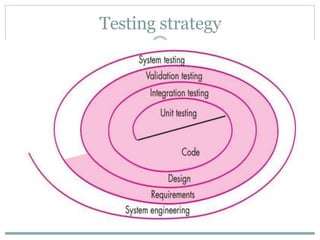
Software testing strategy
• Unit testing
– Concentrates on each component/function of the
software as implemented in the source code
• Integration testing
– Focuses on the design and construction of the software
architecture
• Validation testing
– Requirements are validated against the constructed
software
• System testing
– The software and other system elements are tested as a
whole
Testing strategy
Test Strategies for Conventional Software
Unit testing :
• Focuses testing on the function or software
module
• Concentrates on the internal processing logic and
data structures
• Concentrates on modules and those with high
cyclomatic complexity when testing resources are
limited.
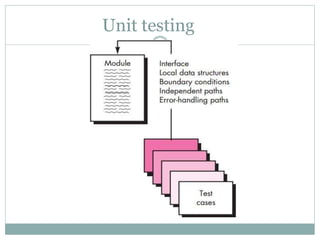
Unit testing
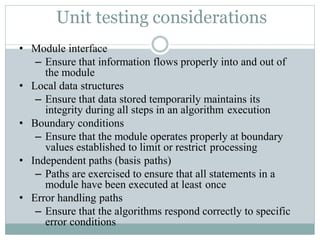
Unit testing considerations
• Module interface
– Ensure that information flows properly into and out of
the module
• Local data structures
– Ensure that data stored temporarily maintains its
integrity during all steps in an algorithm execution
• Boundary conditions
– Ensure that the module operates properly at boundary
values established to limit or restrict processing
• Independent paths (basis paths)
– Paths are exercised to ensure that all statements in a
module have been executed at least once
• Error handling paths
– Ensure that the algorithms respond correctly to specific
error conditions
Unit test procedures
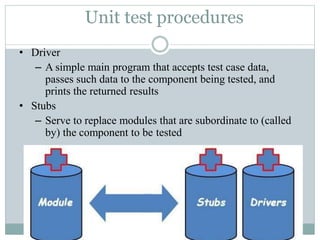
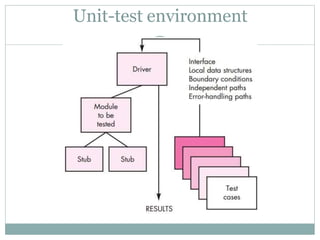
• Driver
– A simple main program that accepts test case data,
passes such data to the component being tested, and
prints the returned results
• Stubs
– Serve to replace modules that are subordinate to (called
by) the component to be tested
Unit-test environment
Integration testing
• Defined as a systematic technique for constructing the
software architecture
• Objective is to take unit tested modules and build a program
structure based on the prescribed design
• TwoApproaches
– Non-incremental Integration Testing
– Incremental Integration Testing
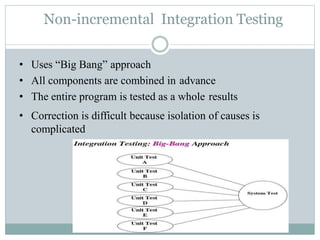
Non-incremental Integration Testing
• Uses “Big Bang” approach
• All components are combined in advance
• The entire program is tested as a whole results
• Correction is difficult because isolation of causes is
complicated
Incremental Integration Testing
• The program is constructed and tested in small increments
• Errors are easier to isolate and correct
• Interfaces are more likely to be tested completely
• A systematic test approach is applied
• Different incremental integration strategies
– Top-down integration
– Bottom-up integration
– Regression testing
– Smoke testing
Top-down Integration
• Modules are integrated by moving downward through the
control hierarchy, beginning with the main module
• Subordinate modules are incorporated in two ways :
– depth-first : All modules on a major control path are
integrated
– breadth-first : All modules directly subordinate at each
level are integrated
• Advantages
– This approach verifies major control or decision points
early in the test process
• Disadvantages
– Stubs need to be created to substitute for modules that
have not been built or tested yet; this code is later
discarded
Bottom-up Integration
• Integration and testing starts with the most atomic
modules in the control hierarchy
• Advantages
– This approach verifies low-level data processing
early in the testing process
– Need for stubs is eliminated
• Disadvantages
– Driver modules need to be built to test the lower-
level modules; this code is later discarded or
expanded into a full-featured version
Regression Testing
• Each new addition or modification of data may cause
problems with functions that previously worked flawlessly
• Regression testing re-executes a small subset of tests that
have
already been conducted
– Ensures that changes have not propagated unintended
side effects
– Helps to ensure that changes do not introduce
unintended behavior or additional errors
• Regression test suite contains three different classes
of test cases
– A representative sample of tests that will exercise all
software functions
– Additional tests that focus on software functions that
are likely to be affected by the change
– Tests that focus on the actual software components
that have been changed
Smoke testing
• Designedfor time-critical projects– Allows the
software team to assess its project on a frequent
basis
• Includes the following activities
– The software components that have been translated
into code and linked into a build
– A series of breadth tests is designed to expose
errors that will keep the build from properly
performing its function
– The build is integrated with other builds and the
entire product is smoke tested daily
• Integration risk is minimized
– Daily testing uncovers incompatibilities and show-
stoppers early in the testing process, thereby
reducing schedule impact
• The quality of the end-product is improved
– Smoke testing is likely to uncover both
functional errors and architectural and
component-level design errors
• Error diagnosis and correction are simplified
– Smoke testing will probably uncover errors in
the newest components that were integrated
• Progress is easier to assess
– As integration testing progresses, more software
has been integrated and more has been
demonstrated to work
– Managers get a good indication that progress is
Benefits of Smoke Testing
THANKYOU

Software testing strategies And its types

  • 1.
  • 2.
    A Strategic Approachto Testing • To perform effective testing, a software team should conduct effective formal technical reviews • Testing begins at the component level and work outward toward the integration of the entire computer based system • Different testing techniques are appropriate at different points in time • Testing is conducted by the developer of the software and (for large projects) by an independent test group
  • 3.
    Verification and Validation •Verification (Are the algorithms coded correctly?) – The set of activities that ensure that software correctly implements a specific function or algorithm • Validation (Does it meet user requirements?) – The set of activities that ensure that the software that has been built is traceable to customer requirements. • Verification: “Are we building the product right?” • Validation: “Are we building the right product?”
  • 4.
    Software testing strategy •Unit testing – Concentrates on each component/function of the software as implemented in the source code • Integration testing – Focuses on the design and construction of the software architecture • Validation testing – Requirements are validated against the constructed software • System testing – The software and other system elements are tested as a whole
  • 5.
  • 6.
    Test Strategies forConventional Software Unit testing : • Focuses testing on the function or software module • Concentrates on the internal processing logic and data structures • Concentrates on modules and those with high cyclomatic complexity when testing resources are limited.
  • 7.
  • 8.
    Unit testing considerations •Module interface – Ensure that information flows properly into and out of the module • Local data structures – Ensure that data stored temporarily maintains its integrity during all steps in an algorithm execution • Boundary conditions – Ensure that the module operates properly at boundary values established to limit or restrict processing • Independent paths (basis paths) – Paths are exercised to ensure that all statements in a module have been executed at least once • Error handling paths – Ensure that the algorithms respond correctly to specific error conditions
  • 9.
    Unit test procedures •Driver – A simple main program that accepts test case data, passes such data to the component being tested, and prints the returned results • Stubs – Serve to replace modules that are subordinate to (called by) the component to be tested
  • 10.
  • 11.
    Integration testing • Definedas a systematic technique for constructing the software architecture • Objective is to take unit tested modules and build a program structure based on the prescribed design • TwoApproaches – Non-incremental Integration Testing – Incremental Integration Testing
  • 12.
    Non-incremental Integration Testing •Uses “Big Bang” approach • All components are combined in advance • The entire program is tested as a whole results • Correction is difficult because isolation of causes is complicated
  • 13.
    Incremental Integration Testing •The program is constructed and tested in small increments • Errors are easier to isolate and correct • Interfaces are more likely to be tested completely • A systematic test approach is applied • Different incremental integration strategies – Top-down integration – Bottom-up integration – Regression testing – Smoke testing
  • 14.
    Top-down Integration • Modulesare integrated by moving downward through the control hierarchy, beginning with the main module • Subordinate modules are incorporated in two ways : – depth-first : All modules on a major control path are integrated – breadth-first : All modules directly subordinate at each level are integrated • Advantages – This approach verifies major control or decision points early in the test process • Disadvantages – Stubs need to be created to substitute for modules that have not been built or tested yet; this code is later discarded
  • 15.
    Bottom-up Integration • Integrationand testing starts with the most atomic modules in the control hierarchy • Advantages – This approach verifies low-level data processing early in the testing process – Need for stubs is eliminated • Disadvantages – Driver modules need to be built to test the lower- level modules; this code is later discarded or expanded into a full-featured version
  • 16.
    Regression Testing • Eachnew addition or modification of data may cause problems with functions that previously worked flawlessly • Regression testing re-executes a small subset of tests that have already been conducted – Ensures that changes have not propagated unintended side effects – Helps to ensure that changes do not introduce unintended behavior or additional errors • Regression test suite contains three different classes of test cases – A representative sample of tests that will exercise all software functions – Additional tests that focus on software functions that are likely to be affected by the change – Tests that focus on the actual software components that have been changed
  • 17.
    Smoke testing • Designedfortime-critical projects– Allows the software team to assess its project on a frequent basis • Includes the following activities – The software components that have been translated into code and linked into a build – A series of breadth tests is designed to expose errors that will keep the build from properly performing its function – The build is integrated with other builds and the entire product is smoke tested daily
  • 18.
    • Integration riskis minimized – Daily testing uncovers incompatibilities and show- stoppers early in the testing process, thereby reducing schedule impact • The quality of the end-product is improved – Smoke testing is likely to uncover both functional errors and architectural and component-level design errors • Error diagnosis and correction are simplified – Smoke testing will probably uncover errors in the newest components that were integrated • Progress is easier to assess – As integration testing progresses, more software has been integrated and more has been demonstrated to work – Managers get a good indication that progress is Benefits of Smoke Testing
  • 19.