Software Testing Strategies
1
●The strategy provides a road map that describes the steps
to be conducted as part of testing, when these steps are
planned and then undertaken, and how much
effort, time, and resources will be required.
●Testing strategy must incorporate
● test planning,
● test case design,
● test execution,
● resultant data collection and evaluation.
Software Testing Strategies
2
Software Testing Strategies
3
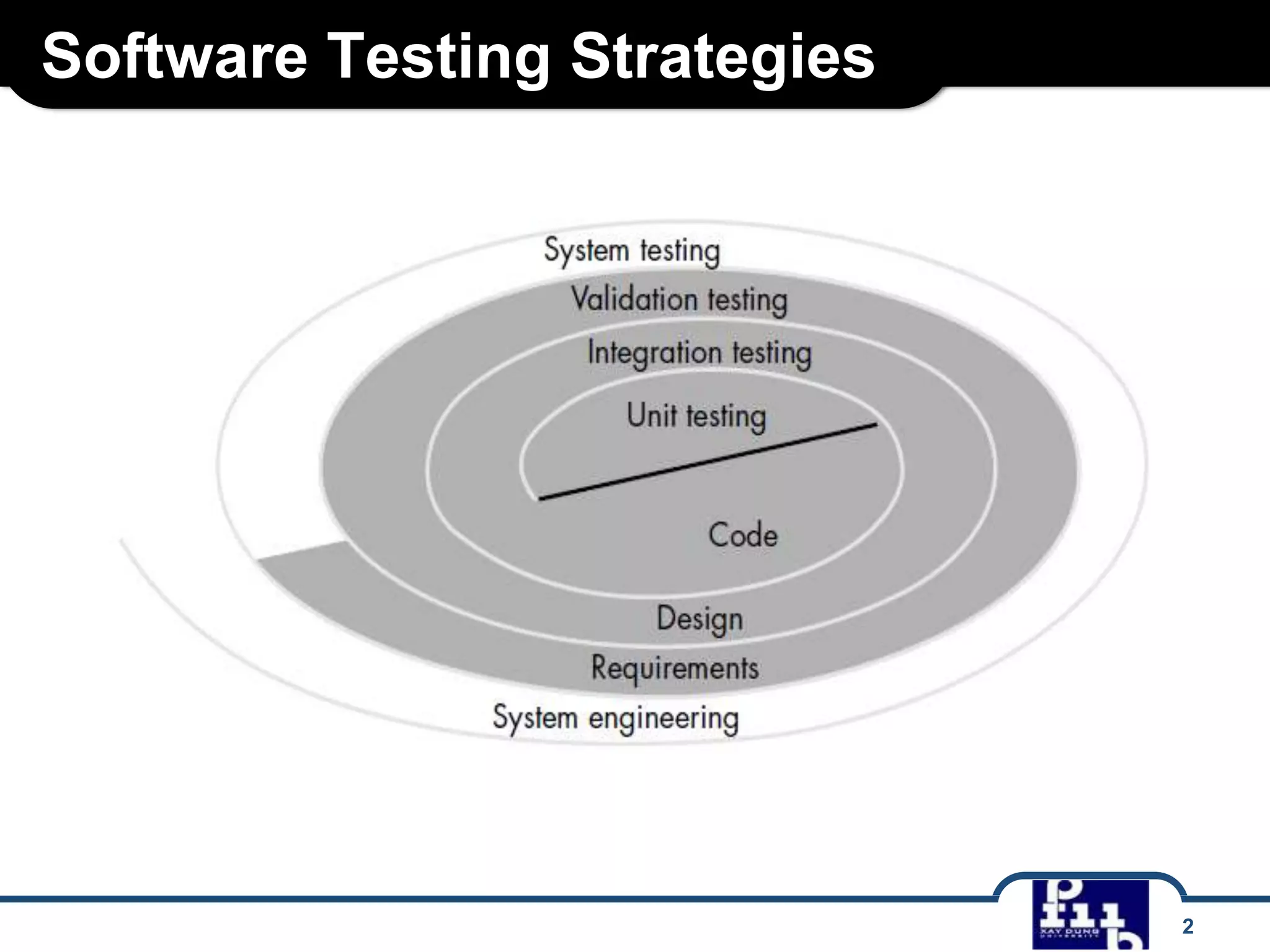
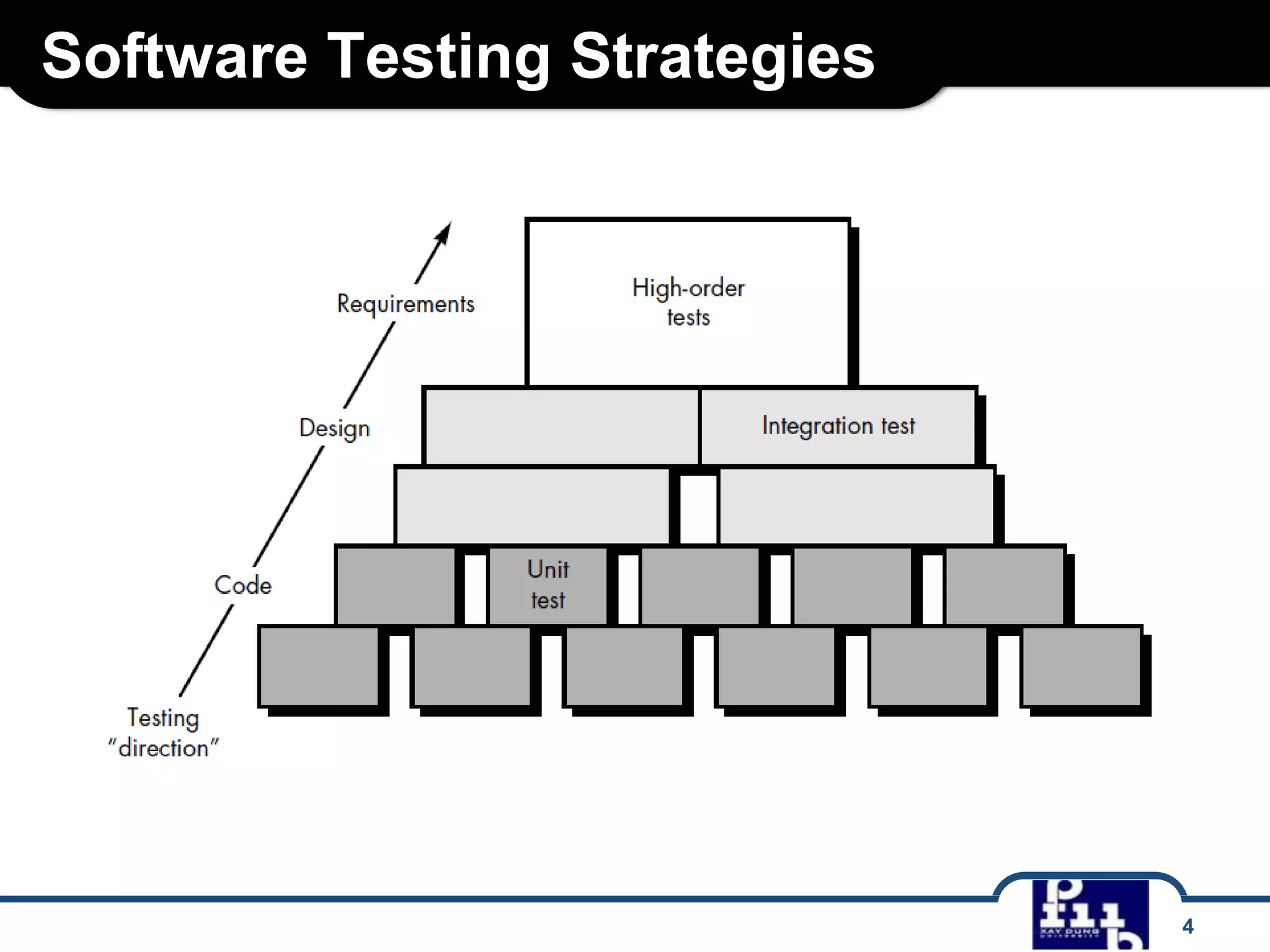
●Unit testing concentrates on each unit (i.e., component) of
the software as implemented in source code.
●Integration testing focuses on design and the construction
of the software architecture.
●Validation testing, where requirements established as part
of software requirements analysis are validated against
the software that has been constructed.
●System testing, where the software and other system
elements are tested as a whole.
Software Testing Strategies
4
Software Testing Strategies
5
●Unit Testing
● Unit testing focuses on the smallest unit of software
design, i.e. the software component or module.
● The unit test is white-box oriented, and the step can be
conducted in parallel for multiple components
Software Testing Strategies
6
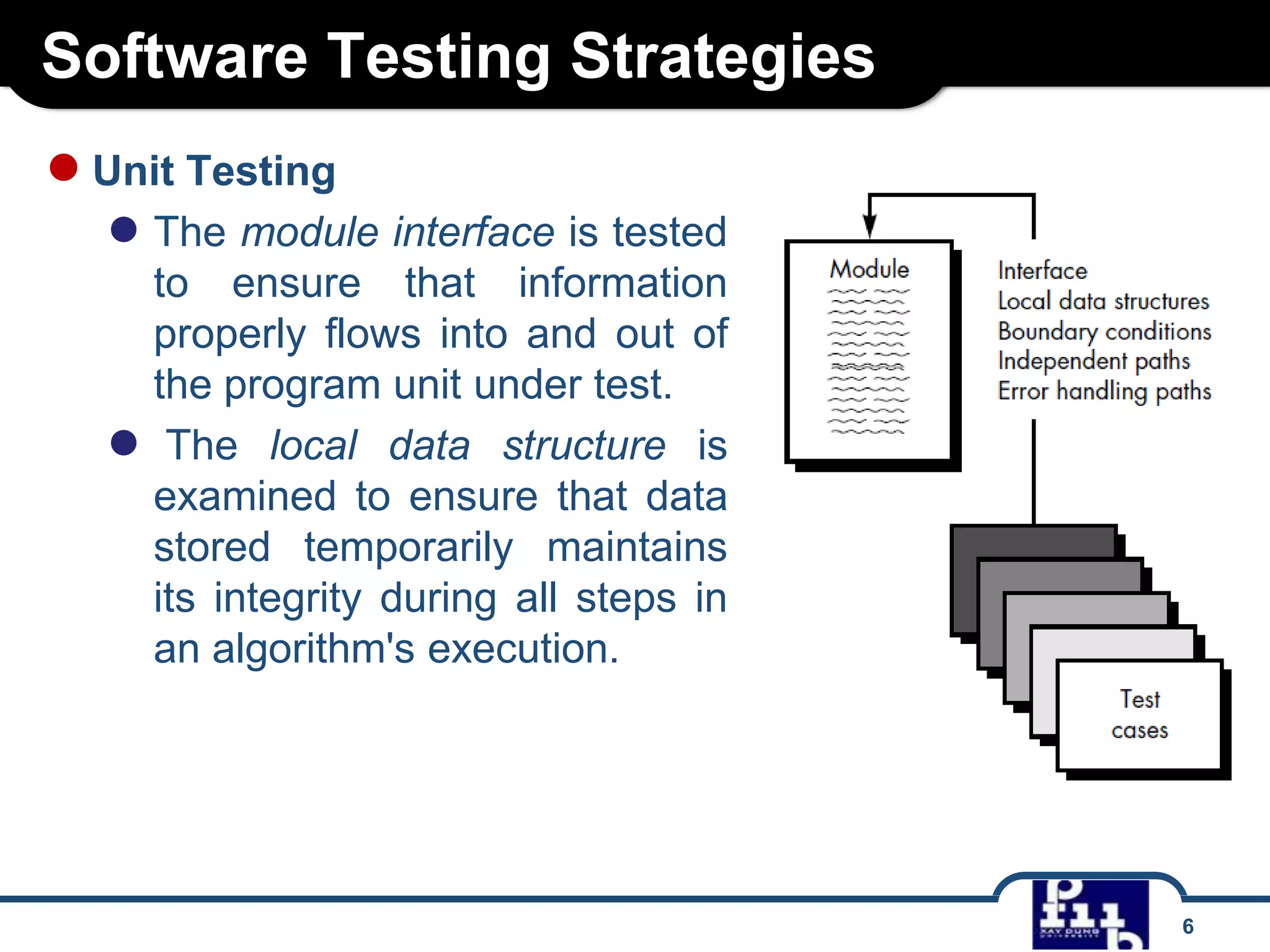
●Unit Testing
● The module interface is tested
to ensure that information
properly flows into and out of
the program unit under test.
● The local data structure is
examined to ensure that data
stored temporarily maintains
its integrity during all steps in
an algorithm's execution.
Software Testing Strategies
7
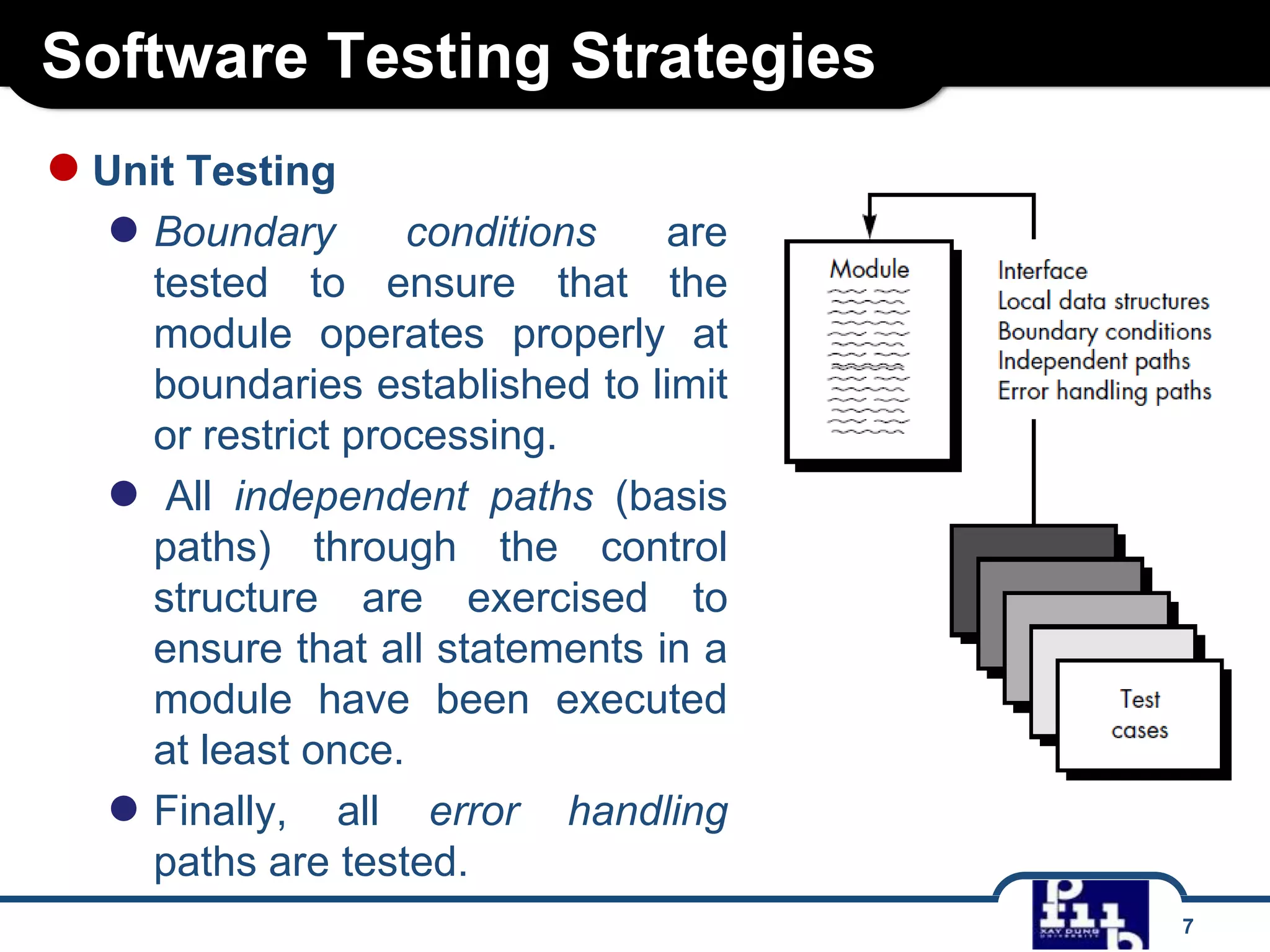
●Unit Testing
● Boundary conditions are
tested to ensure that the
module operates properly at
boundaries established to limit
or restrict processing.
● All independent paths (basis
paths) through the control
structure are exercised to
ensure that all statements in a
module have been executed
at least once.
● Finally, all error handling
paths are tested.
Software Testing Strategies
8
●Integration Testing
● Integration testing is a systematic technique for
constructing the program structure while at the same
time conducting tests to uncover errors associated with
interfacing.
● The objective is to take unit tested components and
build a program structure that has been dictated by
design.
● Two approaches: Top-down & Bottom-up
Software Testing Strategies
9
●Integration Testing
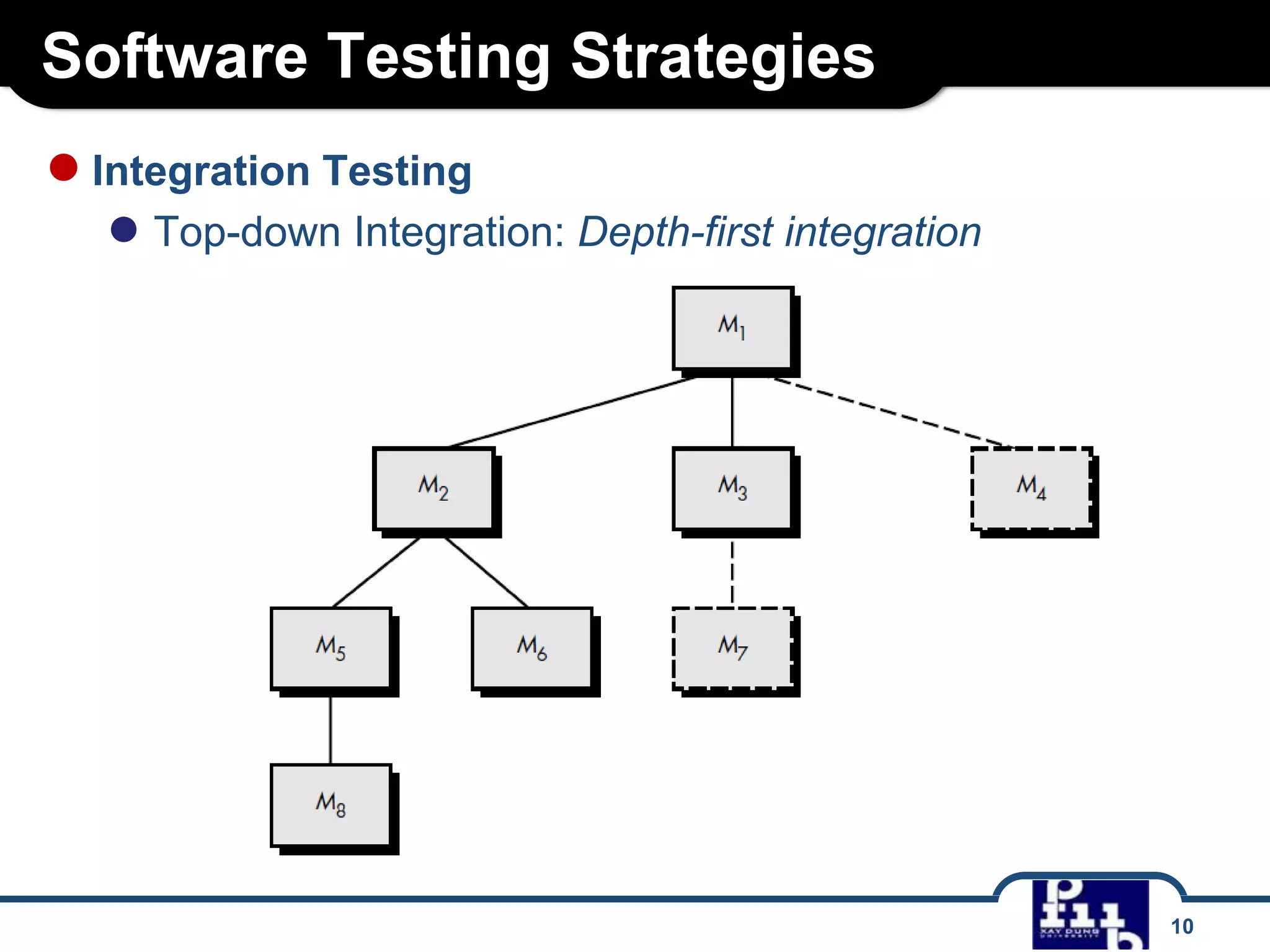
● Top-down integration testing is an incremental
approach to construction of program structure.
● Modules are integrated by moving downward through
the control hierarchy, beginning with the main control
module (main program). Modules subordinate (and
ultimately subordinate) to the main control module are
incorporated into the structure in either a depth-first or
breadth-first manner.
Software Testing Strategies
10
●Integration Testing
● Top-down Integration: Depth-first integration
Software Testing Strategies
11
●Integration Testing
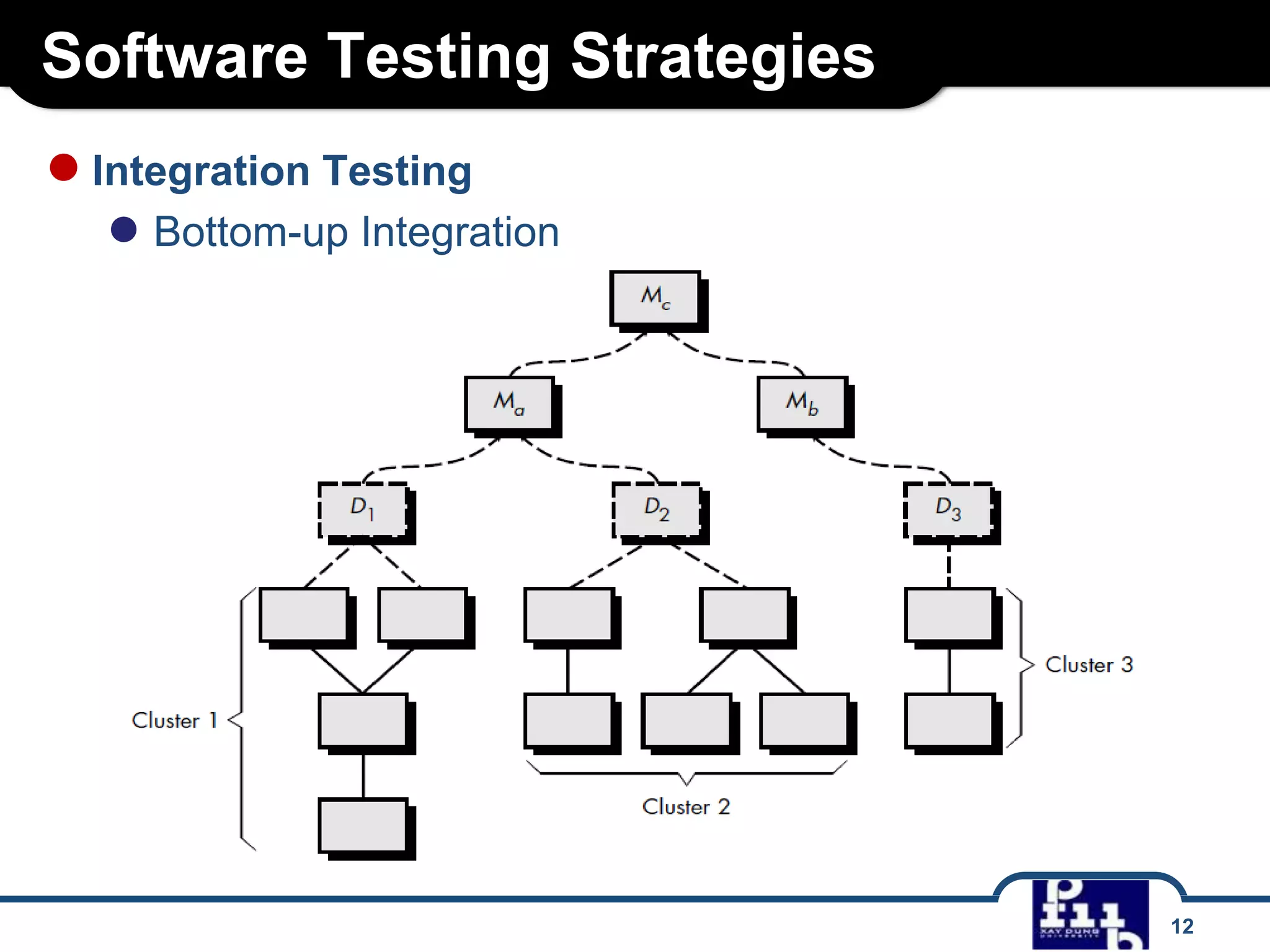
● Bottom-up Integration Testing begins construction and
testing with atomic modules (i.e., components at the
lowest levels in the program structure).
● Components are integrated from the bottom
up, therefore processing required for components
subordinate to a given level is always available and the
need for stubs is eliminated.
Software Testing Strategies
12
●Integration Testing
● Bottom-up Integration
Software Testing Strategies
13
●Validation Testing
● Validation succeeds when software functions in a
manner that can be reasonably expected by the
customer
Software Testing Strategies
14
●Validation Testing
● Alpha Testing is conducted at the developer's site by a
customer. The software is used in a natural setting with
the developer "looking over the shoulder" of the user
and recording errors and usage problems. Alpha tests
are conducted in a controlled environment.
● Beta Testing is conducted at one or more customer
sites by the end-user of the software. The developer is
generally not present. The beta test is a "live"
application of the software in an environment that
cannot be controlled by the developer. The customer
records all problems that are encountered during beta
testing and reports these to the developer at regular
intervals.
Software Testing Strategies
15
●System Testing
● Recovery testing forces the software to fail in a variety
of ways and verifies that recovery is properly
performed.
● Security testing attempts to verify that protection
mechanisms built into a system will, in fact, protect it
from improper penetration.
● Stress testing executes a system in a manner that
demands resources in abnormal quantity, frequency, or
volume.
● Performance testing is designed to test the run-time
performance of software within the context of an
integrated system. Performance testing occurs
throughout all steps in the testing process.
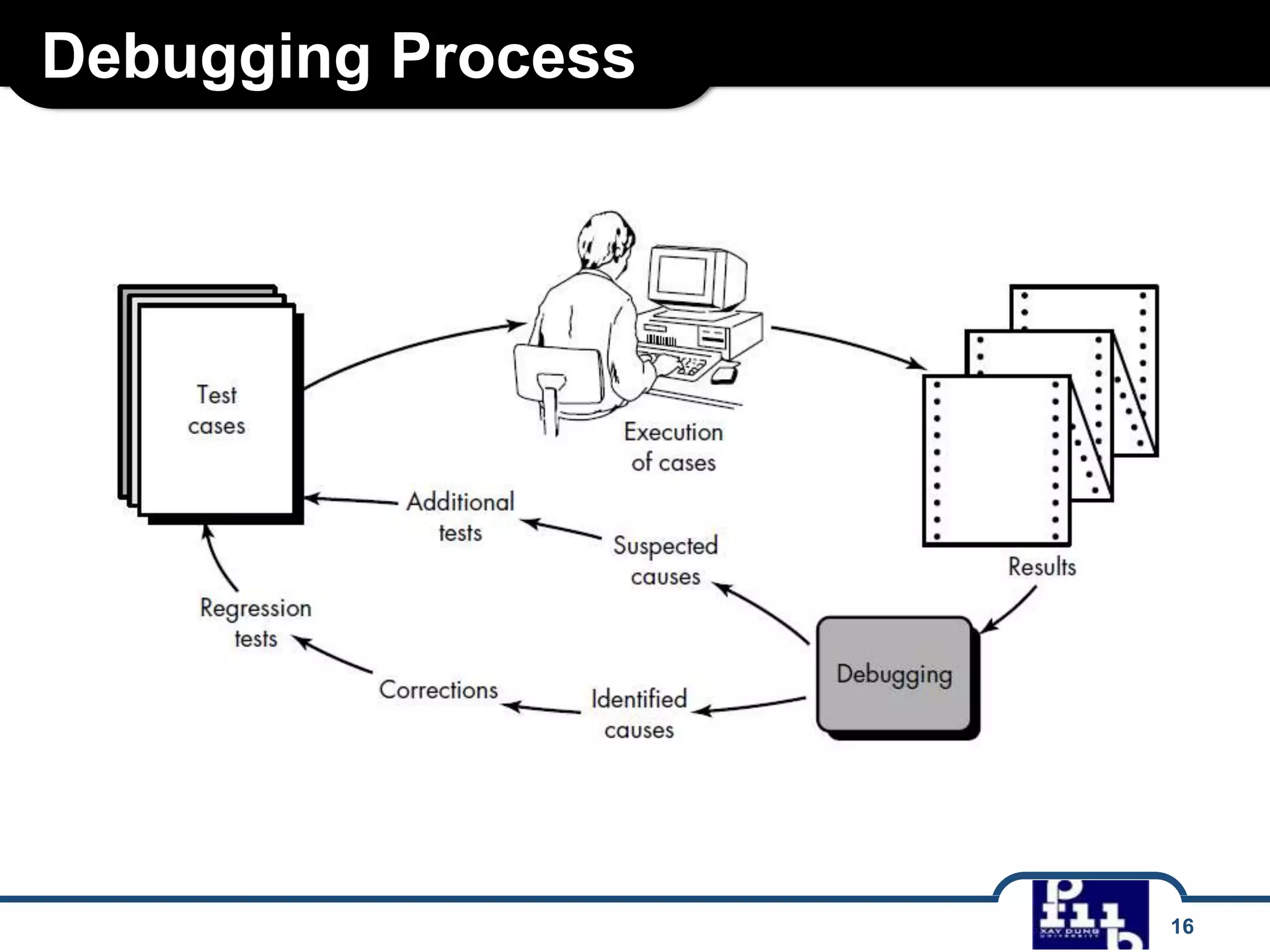
Debugging Process
16

Bai giang-se-06mar14

  • 1.
    Software Testing Strategies 1 ●Thestrategy provides a road map that describes the steps to be conducted as part of testing, when these steps are planned and then undertaken, and how much effort, time, and resources will be required. ●Testing strategy must incorporate ● test planning, ● test case design, ● test execution, ● resultant data collection and evaluation.
  • 2.
  • 3.
    Software Testing Strategies 3 ●Unittesting concentrates on each unit (i.e., component) of the software as implemented in source code. ●Integration testing focuses on design and the construction of the software architecture. ●Validation testing, where requirements established as part of software requirements analysis are validated against the software that has been constructed. ●System testing, where the software and other system elements are tested as a whole.
  • 4.
  • 5.
    Software Testing Strategies 5 ●UnitTesting ● Unit testing focuses on the smallest unit of software design, i.e. the software component or module. ● The unit test is white-box oriented, and the step can be conducted in parallel for multiple components
  • 6.
    Software Testing Strategies 6 ●UnitTesting ● The module interface is tested to ensure that information properly flows into and out of the program unit under test. ● The local data structure is examined to ensure that data stored temporarily maintains its integrity during all steps in an algorithm's execution.
  • 7.
    Software Testing Strategies 7 ●UnitTesting ● Boundary conditions are tested to ensure that the module operates properly at boundaries established to limit or restrict processing. ● All independent paths (basis paths) through the control structure are exercised to ensure that all statements in a module have been executed at least once. ● Finally, all error handling paths are tested.
  • 8.
    Software Testing Strategies 8 ●IntegrationTesting ● Integration testing is a systematic technique for constructing the program structure while at the same time conducting tests to uncover errors associated with interfacing. ● The objective is to take unit tested components and build a program structure that has been dictated by design. ● Two approaches: Top-down & Bottom-up
  • 9.
    Software Testing Strategies 9 ●IntegrationTesting ● Top-down integration testing is an incremental approach to construction of program structure. ● Modules are integrated by moving downward through the control hierarchy, beginning with the main control module (main program). Modules subordinate (and ultimately subordinate) to the main control module are incorporated into the structure in either a depth-first or breadth-first manner.
  • 10.
    Software Testing Strategies 10 ●IntegrationTesting ● Top-down Integration: Depth-first integration
  • 11.
    Software Testing Strategies 11 ●IntegrationTesting ● Bottom-up Integration Testing begins construction and testing with atomic modules (i.e., components at the lowest levels in the program structure). ● Components are integrated from the bottom up, therefore processing required for components subordinate to a given level is always available and the need for stubs is eliminated.
  • 12.
    Software Testing Strategies 12 ●IntegrationTesting ● Bottom-up Integration
  • 13.
    Software Testing Strategies 13 ●ValidationTesting ● Validation succeeds when software functions in a manner that can be reasonably expected by the customer
  • 14.
    Software Testing Strategies 14 ●ValidationTesting ● Alpha Testing is conducted at the developer's site by a customer. The software is used in a natural setting with the developer "looking over the shoulder" of the user and recording errors and usage problems. Alpha tests are conducted in a controlled environment. ● Beta Testing is conducted at one or more customer sites by the end-user of the software. The developer is generally not present. The beta test is a "live" application of the software in an environment that cannot be controlled by the developer. The customer records all problems that are encountered during beta testing and reports these to the developer at regular intervals.
  • 15.
    Software Testing Strategies 15 ●SystemTesting ● Recovery testing forces the software to fail in a variety of ways and verifies that recovery is properly performed. ● Security testing attempts to verify that protection mechanisms built into a system will, in fact, protect it from improper penetration. ● Stress testing executes a system in a manner that demands resources in abnormal quantity, frequency, or volume. ● Performance testing is designed to test the run-time performance of software within the context of an integrated system. Performance testing occurs throughout all steps in the testing process.
  • 16.