Chapter 6
Learning Objectives
What is mobile computing mean.
Discuss the application of mobile computing within
organizations and across the supply chain.
What is location based service mean in mobile
computing.
What is the challenge of mobile computing.
1/16/2023 Debre Berhan University 2
Content
• Introduction to mobile computing
• Mobile Computing Components and Infrastructure
• Mobile Computing Functions
• Location management schemes
• Application of Mobile Computing
• Challenges
• Future of mobile computing
1/16/2023 Debre Berhan University 3
Introduction to mobile computing
 The ability to use technology in remote or mobile (non static) environments.
 The technology is based on the use of battery powered, portable, and
wireless computing and communication devices, like smart mobile phones,
wearable computers and personal digital assistants (PDAs).
 Mobile Computing is a technical field that covers the design, development
and evaluation of mobile applications using appropriate solutions that meet
user requirements.
 This includes learning the technology that is used to perform a wide variety of
tasks on devices that are portable.
 Portable devices include Smart Phones, Tablets, Laptops, wearable devices,
vehicles etc.
1/16/2023 Debre Berhan University 4
Introduction to mobile computing…..
What is computing?
 Operation of computers (according to oxfords advance learner’s dictionary)
What is the mobile?
 That someone /something can move or be moved easily and quickly from
place to place
What is mobile computing?
 Users with portable computers still have network connections while they
move
 Mobile Computing is an umbrella term used to describe technologies
that enable people to access network services anyplace, anytime, and
anywhere.
1/16/2023 Debre Berhan University 5
Mobile Computing Components and Infrastructure….
 Wireless mobile computing (mobile computing)
 Computing that connects a mobile device to a network or another
computing device, anytime, anywhere.
 MOBILE DEVICES
 personal digital assistant (PDA)
 A stand-alone handheld computer principally used for personal information
management.
 smartphone
 A mobile phone with PC-like capabilities
 MOBILE COMPUTING SOFTWARE
 Mobile Operating System
 Mobile Application User Interface
 Micro browser
 Wireless Web browser designed to operate with small screens and
limited bandwidth and memory requirements.
1/16/2023 Debre Berhan University 6
Mobile Computing Components and Infrastructure …..
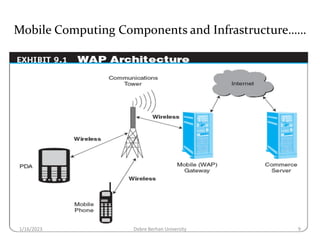
 Wireless Application Protocol (WAP)
 A scripting language used to create content in the WAP environment;
based on SML, minus unnecessary content to increase speed.
 Markup Languages
 Wireless Markup Language (WML)
 A scripting language used to create content in the WAP environment;
based on XML, minus unnecessary content to increase speed.
 Extensible Hypertext Markup Language (xHTML)
 A general scripting language; compatible with HTML; a standard set by
W3Consortium
1/16/2023 Debre Berhan University 7
What is WAP?
 Is an application communication protocol.
 Is used to access services and information.
 ls inherited from Internet standards.
 Is for handheld devices such as mobile phones.
 Is device independent, network independent.
 Is the leading standard for information services on wireless terminals like
digital mobile phones.
 Is a protocol designed for micro browsers.
 Enables the creating of web applications for mobile devices.
 Uses the mark-up language WML (not HTML).
C:UsershunyaDesktopfdocuments.in_mobile-computing-seminar.ppt
1/16/2023 Debre Berhan University 8
Mobile Computing Components and Infrastructure……
1/16/2023 Debre Berhan University 9
Mobile Computing Components and Infrastructure…
 MOBILE COMPUTING SERVICES
 Short Message Service (SMS)
 A service that supports the sending and receiving of short text messages on
mobile phones.
 Enhanced Messaging Service (EMS)
 An extension of SMS that can send simple animation, tiny pictures, sounds,
and formatted text.
 Multimedia Messaging Service (MMS)
 The emerging generation of wireless messaging; MMS is able to deliver rich
media.
.
1/16/2023 Debre Berhan University 10
Mobile Computing Components and Infrastructure…..
 Location-Based Services
 global positioning system (GPS)
A worldwide satellite-based tracking system that enables users to
determine their position anywhere on the earth
 Voice-Support Services
 interactive voice response (IVR)
A voice system that enables users to request and receive information
and to enter and change data through a telephone to a computerized
system.
 voice portal
A Web site with an audio interface that can be accessed through a
telephone call.
1/16/2023 Debre Berhan University 11
Mobile Computing Functions
 A computing environment is defined as mobile if it supports one or more of
these characteristics:
 User mobility: User should be able to move from one physical location to
another location and use same service
 Network mobility: User should be able to move from one network to
another network and use same service
 Device mobility: User should be able to move from one device to another
and use same service
 Session mobility: A user session should be able to move from one user-agent
environment to another.
 Service mobility: User should be able to move from one service to another
 Host mobility: The user should can be either a client or server.
1/16/2023 Debre Berhan University 12
Advantages of Mobile Computing
 Increase in Productivity - Mobile devices can be used out in the field of
various companies, therefore reducing the time and cost for clients and
themselves.
 Entertainment - Mobile devices can be used for entertainment purposes, for
personal and even for presentations to people and clients.
 Portability - This would be one of the main advantages of mobile
computing, you are not restricted to one location in order for you to get jobs
done or even access email on the go.
 Cloud Computing - This service is available for saving documents on a
online server and being able to access them anytime and anywhere when
you have a connection to the internet and can access these files on several
mobile devices or even PCs at home.
1/16/2023 Debre Berhan University 13
Disadvantages of Mobile Computing
 Quality of connectivity - mobile devices will need either Wi-Fi connectivity
or mobile network connectivity such as GPRS, 3G and in some countries
even 4G connectivity because if you are not near any of these connections
your access to the internet is very limited.
 Security concerns - Mobile VPNs are unsafe to connect to, and also syncing
devices might also lead to security concerns. accessing a Wi-Fi network can
also be risky because WPA and WEP security can be by passed easily
 Power Consumption - due to the use of batteries in these devices, these do
not tend to last long, if in a situation where there is no source of power for
charging then that will certainly be a let down.
1/16/2023 Debre Berhan University 14
Applications of mobile computing
• In many fields of work, the ability to keep on the move is vital
in order to utilize time efficiently.
 Vehicles
 Emergencies
 Business
 Credit Card Verification
 Replacement of Wired Networks
 Infotainment
1/16/2023 Debre Berhan University 15
Applications of mobile computing…..
 Mobile Financial Applications
 mobile banking and financial services
 wireless electronic payment systems
 Wireless Bill Payments
 Closing the Digital Divide
 Mobile Shopping, Advertising, and Content Provision
 wireless shopping
 mobile and targeted advertising
 mobile portal
 A customer interaction channel that aggregates content and services for
mobile users.
1/16/2023 Debre Berhan University 16
Applications of mobile computing…….
 Mobile Enterprise and Supply Chain
 Support of mobile employees
 Mobile Office
 Sales Force Mobilization and Automation
 Worker Support in Retailing
 Support in Operations
 Job Dispatch
 Maintenance and Repair at Remote Sites
 Mobile Consumer Services
 Mobile entertainment
 Music and Video
 Mobile Games
 Mobile Gambling
1/16/2023 Debre Berhan University 17
Applications of mobile computing…..
 Location-Based Mobile Commerce
 Location-based m-commerce
Delivery of m-commerce transactions to individuals in a specific
location, at a specific time.
 Five key factors for services provided :
1. Location
2. Navigation
3. Tracking
4. Mapping
5. Timing
1/16/2023 Debre Berhan University 18
Applications of mobile computing……
Location-Based Mobile Commerce
 The technology for L-commerce
Global Positioning System
 Geographical information system and GPS
Geographical Information System (GIS)
 A computer system capable of integrating, storing, editing,
analyzing, sharing, and displaying geographically referenced
(spatial) information.
 GPS/GIS Applications
1/16/2023 Debre Berhan University 19
Location management schemes
 Location Management (LM) will be an important issue in these
situations because wireless devices can change location while
connected to a wireless network.
 New strategies must be introduced to deal with the dynamic
changes of a mobile device’s network address.
 The ability to change locations while connected to the network
creates a dynamic environment.
 This means that data, which is static for stationary computing,
becomes dynamic for mobile computing.
1/16/2023 Debre Berhan University 20
Location management schemes……..
 There are a few questions that must be answered when looking
at a LM scheme.
What happens when a mobile user changes location?
Who should know about the change?
How can you contact a mobile host?
Should you search the whole network or does anyone know
about the mobile users moves?
1/16/2023 Debre Berhan University 21
Location management schemes……..
 LM schemes are essentially based on users’ mobility and incoming call
rate characteristics.
 The main task of LM is to keep track of a users’ location all the time
while operating and on the move so that incoming messages (calls) can
be routed to the intended recipient.
 LM consists mainly of:
 Location Tracking and Updating (Registration): A process in which
an end-point initiates a change in the Location Database according
to its new location.
– This procedure allows the main system to keep track of a user’s
location
1/16/2023 Debre Berhan University 22
Location management schemes…..
 Location Finding (Paging): The process of which the network initiates a
query for an endpoint’s location.
– This process is implemented by the system sending beacons to all cells so
that one of the cells could locate the user.
 the main difference between location tracking and paging is in who
initiates the change.
 While location tracking is initiated by a mobile host, paging is
initiated by the base system.
 Most LM techniques use a combination of location tracking and
location finding to select the best trade-off between the update
overhead and the paging delay.
1/16/2023 Debre Berhan University 23
Location management schemes…….
 LM methods are classified into two groups:
 Group one includes methods based on network architecture and algorithms,
mainly on processing capabilities of the system.
 Group two includes methods based on learning processes (i.e. which require the
collection of statistics on subscribers’ mobility behavior). This method emphasizes
the information capabilities of the network.
 For LM purposes, a wireless network usually consists of Location Areas (LAs)
and Paging Areas (PAs).
 While LAs are a set of areas over which location updates take place, PAs are a
set of areas over which paging updates take place. Usually, LAs and PAs are
contiguous, but that’s not the case always.
1/16/2023 Debre Berhan University 24
Limitations of Mobile Computing
 Resource constraints: Battery
Interference:
Bandwidth:
Dynamic changes in communication environment:
 Network Issues:
Interoperability issues:
Security constraints:.
1/16/2023 Debre Berhan University 25
Challenge of mobile computing
o Disconnection
o Low bandwidth
o High bandwidth variability
o Low power and resources
o Security risks
o Wide variety terminals and devices with different
capabilities
o Device attributes
o Fit more functionality into single, smaller device
1/16/2023 Debre Berhan University 26
Future of Mobile Computing
• Use of Artificial Intelligence
• Integrated Circuitry -> Compact Size
• Increases in Computer Processor speeds
• Increase Storage Capacity
• Enhanced Performance of Internet
• Modular Software Will Be Priority
• Security
• Internet of Things Along With Cloud Computing
1/16/2023 Debre Berhan University 27
1/16/2023 Debre Berhan University 28

fundamental of mobile computingChapter 6.pdf

  • 1.
  • 2.
    Learning Objectives What ismobile computing mean. Discuss the application of mobile computing within organizations and across the supply chain. What is location based service mean in mobile computing. What is the challenge of mobile computing. 1/16/2023 Debre Berhan University 2
  • 3.
    Content • Introduction tomobile computing • Mobile Computing Components and Infrastructure • Mobile Computing Functions • Location management schemes • Application of Mobile Computing • Challenges • Future of mobile computing 1/16/2023 Debre Berhan University 3
  • 4.
    Introduction to mobilecomputing  The ability to use technology in remote or mobile (non static) environments.  The technology is based on the use of battery powered, portable, and wireless computing and communication devices, like smart mobile phones, wearable computers and personal digital assistants (PDAs).  Mobile Computing is a technical field that covers the design, development and evaluation of mobile applications using appropriate solutions that meet user requirements.  This includes learning the technology that is used to perform a wide variety of tasks on devices that are portable.  Portable devices include Smart Phones, Tablets, Laptops, wearable devices, vehicles etc. 1/16/2023 Debre Berhan University 4
  • 5.
    Introduction to mobilecomputing….. What is computing?  Operation of computers (according to oxfords advance learner’s dictionary) What is the mobile?  That someone /something can move or be moved easily and quickly from place to place What is mobile computing?  Users with portable computers still have network connections while they move  Mobile Computing is an umbrella term used to describe technologies that enable people to access network services anyplace, anytime, and anywhere. 1/16/2023 Debre Berhan University 5
  • 6.
    Mobile Computing Componentsand Infrastructure….  Wireless mobile computing (mobile computing)  Computing that connects a mobile device to a network or another computing device, anytime, anywhere.  MOBILE DEVICES  personal digital assistant (PDA)  A stand-alone handheld computer principally used for personal information management.  smartphone  A mobile phone with PC-like capabilities  MOBILE COMPUTING SOFTWARE  Mobile Operating System  Mobile Application User Interface  Micro browser  Wireless Web browser designed to operate with small screens and limited bandwidth and memory requirements. 1/16/2023 Debre Berhan University 6
  • 7.
    Mobile Computing Componentsand Infrastructure …..  Wireless Application Protocol (WAP)  A scripting language used to create content in the WAP environment; based on SML, minus unnecessary content to increase speed.  Markup Languages  Wireless Markup Language (WML)  A scripting language used to create content in the WAP environment; based on XML, minus unnecessary content to increase speed.  Extensible Hypertext Markup Language (xHTML)  A general scripting language; compatible with HTML; a standard set by W3Consortium 1/16/2023 Debre Berhan University 7
  • 8.
    What is WAP? Is an application communication protocol.  Is used to access services and information.  ls inherited from Internet standards.  Is for handheld devices such as mobile phones.  Is device independent, network independent.  Is the leading standard for information services on wireless terminals like digital mobile phones.  Is a protocol designed for micro browsers.  Enables the creating of web applications for mobile devices.  Uses the mark-up language WML (not HTML). C:UsershunyaDesktopfdocuments.in_mobile-computing-seminar.ppt 1/16/2023 Debre Berhan University 8
  • 9.
    Mobile Computing Componentsand Infrastructure…… 1/16/2023 Debre Berhan University 9
  • 10.
    Mobile Computing Componentsand Infrastructure…  MOBILE COMPUTING SERVICES  Short Message Service (SMS)  A service that supports the sending and receiving of short text messages on mobile phones.  Enhanced Messaging Service (EMS)  An extension of SMS that can send simple animation, tiny pictures, sounds, and formatted text.  Multimedia Messaging Service (MMS)  The emerging generation of wireless messaging; MMS is able to deliver rich media. . 1/16/2023 Debre Berhan University 10
  • 11.
    Mobile Computing Componentsand Infrastructure…..  Location-Based Services  global positioning system (GPS) A worldwide satellite-based tracking system that enables users to determine their position anywhere on the earth  Voice-Support Services  interactive voice response (IVR) A voice system that enables users to request and receive information and to enter and change data through a telephone to a computerized system.  voice portal A Web site with an audio interface that can be accessed through a telephone call. 1/16/2023 Debre Berhan University 11
  • 12.
    Mobile Computing Functions A computing environment is defined as mobile if it supports one or more of these characteristics:  User mobility: User should be able to move from one physical location to another location and use same service  Network mobility: User should be able to move from one network to another network and use same service  Device mobility: User should be able to move from one device to another and use same service  Session mobility: A user session should be able to move from one user-agent environment to another.  Service mobility: User should be able to move from one service to another  Host mobility: The user should can be either a client or server. 1/16/2023 Debre Berhan University 12
  • 13.
    Advantages of MobileComputing  Increase in Productivity - Mobile devices can be used out in the field of various companies, therefore reducing the time and cost for clients and themselves.  Entertainment - Mobile devices can be used for entertainment purposes, for personal and even for presentations to people and clients.  Portability - This would be one of the main advantages of mobile computing, you are not restricted to one location in order for you to get jobs done or even access email on the go.  Cloud Computing - This service is available for saving documents on a online server and being able to access them anytime and anywhere when you have a connection to the internet and can access these files on several mobile devices or even PCs at home. 1/16/2023 Debre Berhan University 13
  • 14.
    Disadvantages of MobileComputing  Quality of connectivity - mobile devices will need either Wi-Fi connectivity or mobile network connectivity such as GPRS, 3G and in some countries even 4G connectivity because if you are not near any of these connections your access to the internet is very limited.  Security concerns - Mobile VPNs are unsafe to connect to, and also syncing devices might also lead to security concerns. accessing a Wi-Fi network can also be risky because WPA and WEP security can be by passed easily  Power Consumption - due to the use of batteries in these devices, these do not tend to last long, if in a situation where there is no source of power for charging then that will certainly be a let down. 1/16/2023 Debre Berhan University 14
  • 15.
    Applications of mobilecomputing • In many fields of work, the ability to keep on the move is vital in order to utilize time efficiently.  Vehicles  Emergencies  Business  Credit Card Verification  Replacement of Wired Networks  Infotainment 1/16/2023 Debre Berhan University 15
  • 16.
    Applications of mobilecomputing…..  Mobile Financial Applications  mobile banking and financial services  wireless electronic payment systems  Wireless Bill Payments  Closing the Digital Divide  Mobile Shopping, Advertising, and Content Provision  wireless shopping  mobile and targeted advertising  mobile portal  A customer interaction channel that aggregates content and services for mobile users. 1/16/2023 Debre Berhan University 16
  • 17.
    Applications of mobilecomputing…….  Mobile Enterprise and Supply Chain  Support of mobile employees  Mobile Office  Sales Force Mobilization and Automation  Worker Support in Retailing  Support in Operations  Job Dispatch  Maintenance and Repair at Remote Sites  Mobile Consumer Services  Mobile entertainment  Music and Video  Mobile Games  Mobile Gambling 1/16/2023 Debre Berhan University 17
  • 18.
    Applications of mobilecomputing…..  Location-Based Mobile Commerce  Location-based m-commerce Delivery of m-commerce transactions to individuals in a specific location, at a specific time.  Five key factors for services provided : 1. Location 2. Navigation 3. Tracking 4. Mapping 5. Timing 1/16/2023 Debre Berhan University 18
  • 19.
    Applications of mobilecomputing…… Location-Based Mobile Commerce  The technology for L-commerce Global Positioning System  Geographical information system and GPS Geographical Information System (GIS)  A computer system capable of integrating, storing, editing, analyzing, sharing, and displaying geographically referenced (spatial) information.  GPS/GIS Applications 1/16/2023 Debre Berhan University 19
  • 20.
    Location management schemes Location Management (LM) will be an important issue in these situations because wireless devices can change location while connected to a wireless network.  New strategies must be introduced to deal with the dynamic changes of a mobile device’s network address.  The ability to change locations while connected to the network creates a dynamic environment.  This means that data, which is static for stationary computing, becomes dynamic for mobile computing. 1/16/2023 Debre Berhan University 20
  • 21.
    Location management schemes…….. There are a few questions that must be answered when looking at a LM scheme. What happens when a mobile user changes location? Who should know about the change? How can you contact a mobile host? Should you search the whole network or does anyone know about the mobile users moves? 1/16/2023 Debre Berhan University 21
  • 22.
    Location management schemes…….. LM schemes are essentially based on users’ mobility and incoming call rate characteristics.  The main task of LM is to keep track of a users’ location all the time while operating and on the move so that incoming messages (calls) can be routed to the intended recipient.  LM consists mainly of:  Location Tracking and Updating (Registration): A process in which an end-point initiates a change in the Location Database according to its new location. – This procedure allows the main system to keep track of a user’s location 1/16/2023 Debre Berhan University 22
  • 23.
    Location management schemes….. Location Finding (Paging): The process of which the network initiates a query for an endpoint’s location. – This process is implemented by the system sending beacons to all cells so that one of the cells could locate the user.  the main difference between location tracking and paging is in who initiates the change.  While location tracking is initiated by a mobile host, paging is initiated by the base system.  Most LM techniques use a combination of location tracking and location finding to select the best trade-off between the update overhead and the paging delay. 1/16/2023 Debre Berhan University 23
  • 24.
    Location management schemes……. LM methods are classified into two groups:  Group one includes methods based on network architecture and algorithms, mainly on processing capabilities of the system.  Group two includes methods based on learning processes (i.e. which require the collection of statistics on subscribers’ mobility behavior). This method emphasizes the information capabilities of the network.  For LM purposes, a wireless network usually consists of Location Areas (LAs) and Paging Areas (PAs).  While LAs are a set of areas over which location updates take place, PAs are a set of areas over which paging updates take place. Usually, LAs and PAs are contiguous, but that’s not the case always. 1/16/2023 Debre Berhan University 24
  • 25.
    Limitations of MobileComputing  Resource constraints: Battery Interference: Bandwidth: Dynamic changes in communication environment:  Network Issues: Interoperability issues: Security constraints:. 1/16/2023 Debre Berhan University 25
  • 26.
    Challenge of mobilecomputing o Disconnection o Low bandwidth o High bandwidth variability o Low power and resources o Security risks o Wide variety terminals and devices with different capabilities o Device attributes o Fit more functionality into single, smaller device 1/16/2023 Debre Berhan University 26
  • 27.
    Future of MobileComputing • Use of Artificial Intelligence • Integrated Circuitry -> Compact Size • Increases in Computer Processor speeds • Increase Storage Capacity • Enhanced Performance of Internet • Modular Software Will Be Priority • Security • Internet of Things Along With Cloud Computing 1/16/2023 Debre Berhan University 27
  • 28.