

Sreyachandran.v
Sreya.chandran31@gmail.com
www.facebook.com/sreya
twitter.com/username
in.linkedin.com/in/profilename
Stack and Heap
Disclaimer: This presentation is prepared by trainees of
baabtra as a part of mentoring program. This is not
official document of baabtra –Mentoring Partner
Baabtra-Mentoring Partner is the mentoring division of baabte System Technologies Pvt .
Ltd
Stack
• Stack is a linear data structure in which a data item is
inserted and deleted at one record.
• A stack is called LIFO(Last In First Out) or
FILO(First In Last Out) structure.
• The first item added to a stack is the last item
removed from a stack.
• Compiler store the local variable inside the stack.
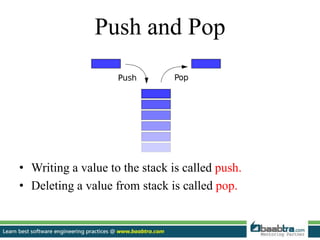
Push and Pop
• Writing a value to the stack is called push.
• Deleting a value from stack is called pop.
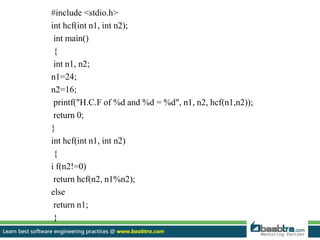
#include <stdio.h>
int hcf(int n1, int n2);
int main()
{
int n1, n2;
n1=24;
n2=16;
printf("H.C.F of %d and %d = %d", n1, n2, hcf(n1,n2));
return 0;
}
int hcf(int n1, int n2)
{
i f(n2!=0)
return hcf(n2, n1%n2);
else
return n1;
}
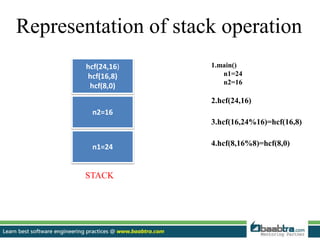
1.main()
n1=24
n2=16
2.hcf(24,16)
3.hcf(16,24%16)=hcf(16,8)
4.hcf(8,16%8)=hcf(8,0)n1=24
n2=16
hcf(24,16)
hcf(16,8)
hcf(8,0)
STACK
Representation of stack operation
Heap
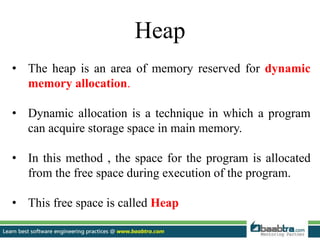
• The heap is an area of memory reserved for dynamic
memory allocation.
• Dynamic allocation is a technique in which a program
can acquire storage space in main memory.
• In this method , the space for the program is allocated
from the free space during execution of the program.
• This free space is called Heap
Memory allocation functions
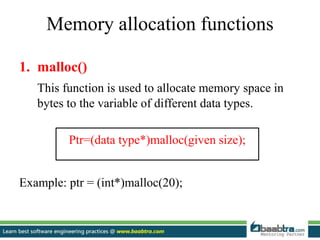
1. malloc()
This function is used to allocate memory space in
bytes to the variable of different data types.
Example: ptr = (int*)malloc(20);
Ptr=(data type*)malloc(given size);
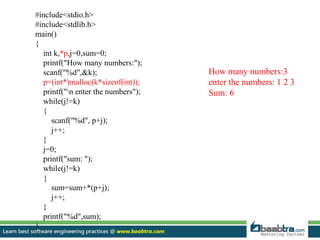
#include<stdio.h>
#include<stdlib.h>
main()
{
int k,*p,j=0,sum=0;
printf("How many numbers:");
scanf("%d",&k);
p=(int*)malloc(k*sizeof(int));
printf("n enter the numbers");
while(j!=k)
{
scanf("%d", p+j);
j++;
}
j=0;
printf("sum: ");
while(j!=k)
{
sum=sum+*(p+j);
j++;
}
printf("%d",sum);
}
How many numbers:3
enter the numbers: 1 2 3
Sum: 6
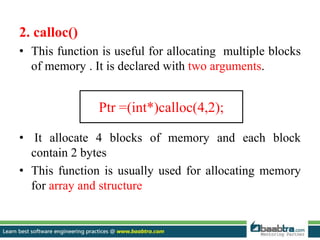
2. calloc()
• This function is useful for allocating multiple blocks
of memory . It is declared with two arguments.
• It allocate 4 blocks of memory and each block
contain 2 bytes
• This function is usually used for allocating memory
for array and structure
Ptr =(int*)calloc(4,2);
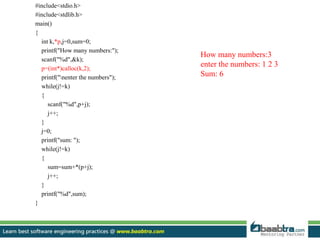
#include<stdio.h>
#include<stdlib.h>
main()
{
int k,*p,j=0,sum=0;
printf("How many numbers:");
scanf("%d",&k);
p=(int*)calloc(k,2);
printf("nenter the numbers");
while(j!=k)
{
scanf("%d",p+j);
j++;
}
j=0;
printf("sum: ");
while(j!=k)
{
sum=sum+*(p+j);
j++;
}
printf("%d",sum);
}
How many numbers:3
enter the numbers: 1 2 3
Sum: 6
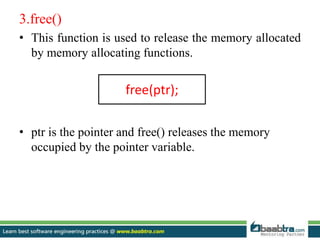
3.free()
• This function is used to release the memory allocated
by memory allocating functions.
• ptr is the pointer and free() releases the memory
occupied by the pointer variable.
free(ptr);
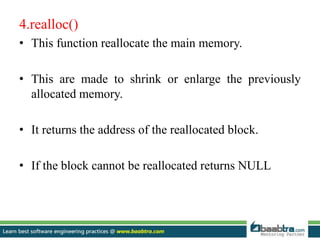
4.realloc()
• This function reallocate the main memory.
• This are made to shrink or enlarge the previously
allocated memory.
• It returns the address of the reallocated block.
• If the block cannot be reallocated returns NULL
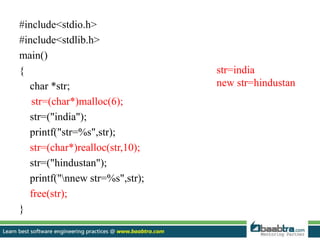
#include<stdio.h>
#include<stdlib.h>
main()
{
char *str;
str=(char*)malloc(6);
str=("india");
printf("str=%s",str);
str=(char*)realloc(str,10);
str=("hindustan");
printf("nnew str=%s",str);
free(str);
}
str=india
new str=hindustan
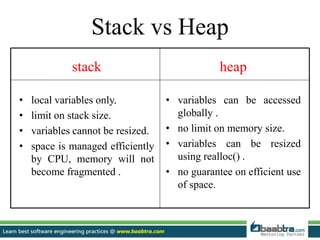
Stack vs Heap
stack
• local variables only.
• limit on stack size.
• variables cannot be resized.
• space is managed efficiently
by CPU, memory will not
become fragmented .
heap
• variables can be accessed
globally .
• no limit on memory size.
• variables can be resized
using realloc() .
• no guarantee on efficient use
of space.
Want to learn more about programming or Looking to become a good programmer?
Are you wasting time on searching so many contents online?
Do you want to learn things quickly?
Tired of spending huge amount of money to become a Software professional?
Do an online course
@ baabtra.com
We put industry standards to practice. Our structured, activity based courses are so designed
to make a quick, good software professional out of anybody who holds a passion for coding.
Follow us @ twitter.com/baabtra
Like us @ facebook.com/baabtra
Subscribe to us @ youtube.com/baabtra
Become a follower @ slideshare.net/BaabtraMentoringPartner
Connect to us @ in.linkedin.com/in/baabtra
Give a feedback @ massbaab.com/baabtra
Thanks in advance
www.baabtra.com | www.massbaab.com |www.baabte.com
Emarald Mall (Big Bazar Building)
Mavoor Road, Kozhikode,
Kerala, India.
Ph: + 91 – 495 40 25 550
NC Complex, Near Bus Stand
Mukkam, Kozhikode,
Kerala, India.
Ph: + 91 – 495 40 25 550
Cafit Square,
Hilite Business Park,
Near Pantheerankavu,
Kozhikode
Start up Village
Eranakulam,
Kerala, India.
Email: info@baabtra.com
Contact Us

Functions using stack and heap

  • 2.
  • 3.
    Disclaimer: This presentationis prepared by trainees of baabtra as a part of mentoring program. This is not official document of baabtra –Mentoring Partner Baabtra-Mentoring Partner is the mentoring division of baabte System Technologies Pvt . Ltd
  • 4.
    Stack • Stack isa linear data structure in which a data item is inserted and deleted at one record. • A stack is called LIFO(Last In First Out) or FILO(First In Last Out) structure. • The first item added to a stack is the last item removed from a stack. • Compiler store the local variable inside the stack.
  • 5.
    Push and Pop •Writing a value to the stack is called push. • Deleting a value from stack is called pop.
  • 6.
    #include <stdio.h> int hcf(intn1, int n2); int main() { int n1, n2; n1=24; n2=16; printf("H.C.F of %d and %d = %d", n1, n2, hcf(n1,n2)); return 0; } int hcf(int n1, int n2) { i f(n2!=0) return hcf(n2, n1%n2); else return n1; }
  • 7.
  • 8.
    Heap • The heapis an area of memory reserved for dynamic memory allocation. • Dynamic allocation is a technique in which a program can acquire storage space in main memory. • In this method , the space for the program is allocated from the free space during execution of the program. • This free space is called Heap
  • 9.
    Memory allocation functions 1.malloc() This function is used to allocate memory space in bytes to the variable of different data types. Example: ptr = (int*)malloc(20); Ptr=(data type*)malloc(given size);
  • 10.
    #include<stdio.h> #include<stdlib.h> main() { int k,*p,j=0,sum=0; printf("How manynumbers:"); scanf("%d",&k); p=(int*)malloc(k*sizeof(int)); printf("n enter the numbers"); while(j!=k) { scanf("%d", p+j); j++; } j=0; printf("sum: "); while(j!=k) { sum=sum+*(p+j); j++; } printf("%d",sum); } How many numbers:3 enter the numbers: 1 2 3 Sum: 6
  • 11.
    2. calloc() • Thisfunction is useful for allocating multiple blocks of memory . It is declared with two arguments. • It allocate 4 blocks of memory and each block contain 2 bytes • This function is usually used for allocating memory for array and structure Ptr =(int*)calloc(4,2);
  • 12.
    #include<stdio.h> #include<stdlib.h> main() { int k,*p,j=0,sum=0; printf("How manynumbers:"); scanf("%d",&k); p=(int*)calloc(k,2); printf("nenter the numbers"); while(j!=k) { scanf("%d",p+j); j++; } j=0; printf("sum: "); while(j!=k) { sum=sum+*(p+j); j++; } printf("%d",sum); } How many numbers:3 enter the numbers: 1 2 3 Sum: 6
  • 13.
    3.free() • This functionis used to release the memory allocated by memory allocating functions. • ptr is the pointer and free() releases the memory occupied by the pointer variable. free(ptr);
  • 14.
    4.realloc() • This functionreallocate the main memory. • This are made to shrink or enlarge the previously allocated memory. • It returns the address of the reallocated block. • If the block cannot be reallocated returns NULL
  • 15.
  • 16.
    Stack vs Heap stack •local variables only. • limit on stack size. • variables cannot be resized. • space is managed efficiently by CPU, memory will not become fragmented . heap • variables can be accessed globally . • no limit on memory size. • variables can be resized using realloc() . • no guarantee on efficient use of space.
  • 18.
    Want to learnmore about programming or Looking to become a good programmer? Are you wasting time on searching so many contents online? Do you want to learn things quickly? Tired of spending huge amount of money to become a Software professional? Do an online course @ baabtra.com We put industry standards to practice. Our structured, activity based courses are so designed to make a quick, good software professional out of anybody who holds a passion for coding.
  • 19.
    Follow us @twitter.com/baabtra Like us @ facebook.com/baabtra Subscribe to us @ youtube.com/baabtra Become a follower @ slideshare.net/BaabtraMentoringPartner Connect to us @ in.linkedin.com/in/baabtra Give a feedback @ massbaab.com/baabtra Thanks in advance www.baabtra.com | www.massbaab.com |www.baabte.com
  • 20.
    Emarald Mall (BigBazar Building) Mavoor Road, Kozhikode, Kerala, India. Ph: + 91 – 495 40 25 550 NC Complex, Near Bus Stand Mukkam, Kozhikode, Kerala, India. Ph: + 91 – 495 40 25 550 Cafit Square, Hilite Business Park, Near Pantheerankavu, Kozhikode Start up Village Eranakulam, Kerala, India. Email: info@baabtra.com Contact Us