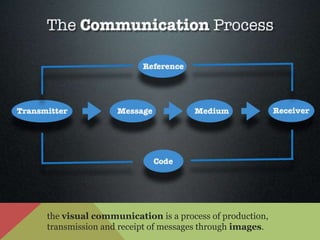
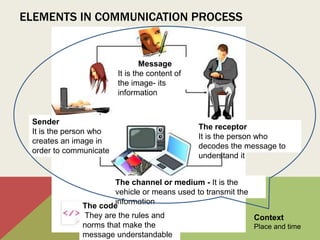









the visual communication is a process of production,
transmission and receipt of messages through images.
Context
Place and time
Sender
It is the person who
creates an image in
order to communicate
Message
It is the content of
the image- its
information
The receptor
It is the person who
decodes the message to
understand it
The code
They are the rules and
norms that make the
message understandable
The channel or medium - It is the
vehicle or means used to transmit the
information
ELEMENTS IN COMMUNICATION PROCESS
IMAGE IS THE MAIN ACTRESS IN VISUAL
COMMUNICATION,
BUT, HOW DOES IT DEVELOPEP ITS
FUNCTION…?
The image’s SIGNIFIER
• It is the visual content of the image.
• Simply what exists in it or we perceive in it.
The image’s signified or meaning
• It is the sense that wants to be given to a
visual message.
• It depends on the context of the
communication.
" Context is a particular situation defined by geographical,
temporary, psychological and social indicators. "
• The message is always influenced by our
perception.
" Perception is a process for which visual sensaciones that
the eye receives are processed by the brain. "
SUMMING UP
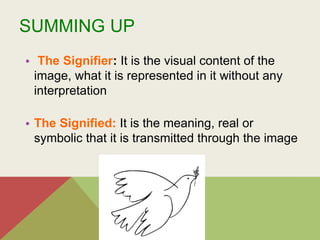
• The Signifier: It is the visual content of the
image, what it is represented in it without any
interpretation
• The Signified: It is the meaning, real or
symbolic that it is transmitted through the image
:
es el sentido, real o simbólico,
ensaje visual
es el contenido visual de la
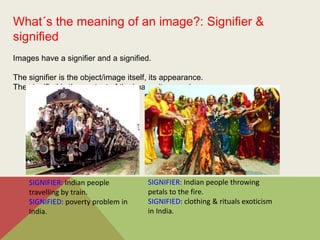
What´s the meaning of an image?: Signifier &
signified
Images have a signifier and a signified.
The signifier is the object/image itself, its appearance.
The signified is the content of the image, its meaning.
SIGNIFIER: Indian people
travelling by train.
SIGNIFIED: poverty problem in
India.
SIGNIFIER: Indian people throwing
petals to the fire.
SIGNIFIED: clothing & rituals exoticism
in India.
Functions of Visual Language
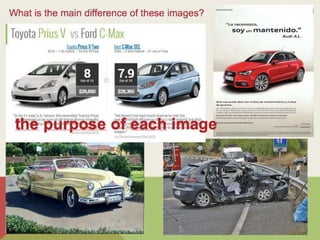
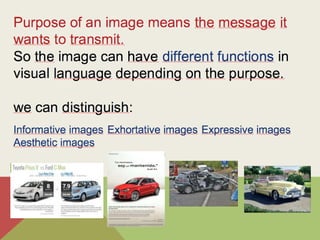
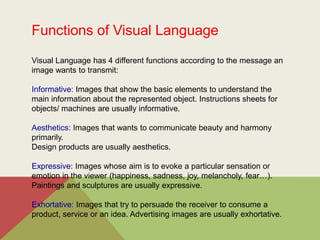
Visual Language has 4 different functions according to the message an
image wants to transmit:
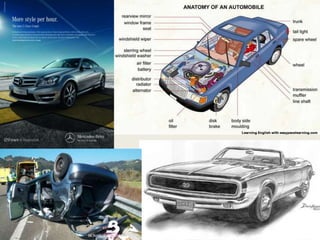
Informative: Images that show the basic elements to understand the
main information about the represented object. Instructions sheets for
objects/ machines are usually informative.
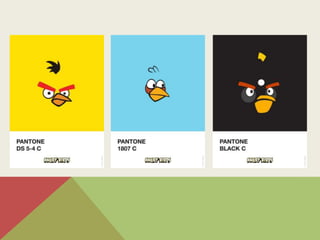
Aesthetics: Images that wants to communicate beauty and harmony
primarily.
Design products are usually aesthetics.
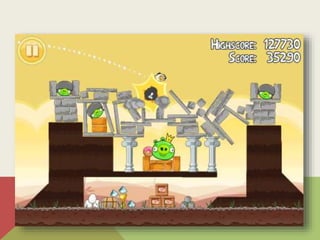
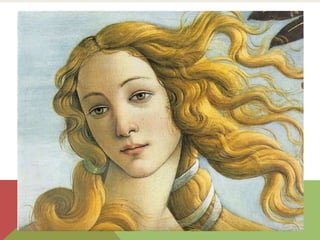
Expressive: Images whose aim is to evoke a particular sensation or
emotion in the viewer (happiness, sadness, joy, melancholy, fear…).
Paintings and sculptures are usually expressive.
Exhortative: Images that try to persuade the receiver to consume a
product, service or an idea. Advertising images are usually exhortative.
What can be the images´s purposes?
FOUR MAIN FUNCTIONS
•Informative.
•Exhortative.
•Expressive.
•Aesthetics.
Content is transmitted in an
objective way.
They are clear, direct and
objective.
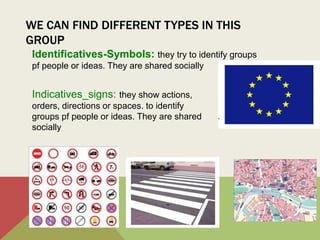
WE CAN FIND DIFFERENT TYPES IN THIS
GROUP
Identificatives-Symbols: they try to identify groups
pf people or ideas. They are shared socially
Indicatives_signs: they show actions,
orders, directions or spaces. to identify
groups pf people or ideas. They are shared
socially
• IDENTIFICATIVAS - SÍMBOLOS
▫ Tratan(de(identificar(grupos(de(personas(o(ideas.
▫ Son(compartidos(culturalmente.
(
(
• INDICATIVAS - SIGNOS
▫ Indican acciones,órdenes, direcciones o espacios.
• IDENTIFICATIVAS - SÍMBOLOS
▫ Tratan(de(identificar(grupos(de(personas(o(ideas.
▫ Son(compartidos(culturalmente.
(
(
• INDICATIVAS - SIGNOS
▫ Indican acciones,órdenes, direcciones o espacios.
MARCAS
Son señales visuales que tienen como finalidad la
diferenciación.
DESCRIPTIVAS.
Describen hechos, situaciones u objetos.
#
uales que tienen como finalidad la
S.
hos, situaciones u objetos.
#
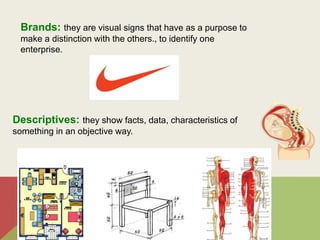
Brands: they are visual signs that have as a purpose to
make a distinction with the others., to identify one
enterprise.
Descriptives: they show facts, data, characteristics of
something in an objective way.
http://www.cuartoderecha.com/2526/
We are going to see a short film where all the images that it
contains have the descriptive function …
IN WHAT DO YOU THINK THAT IT IS BASED?
Most advertising images are
exhortative.
They try to persuade the receiver
to consume a product, a service
or an idea
Exhortative function
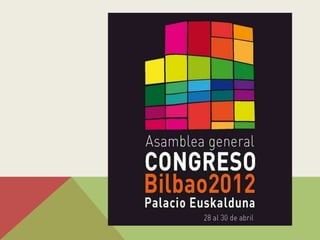
They try to persuade the receiver to consume a
product, a service or an idea
o#sólo#se#encuadran#aquí#las#imágenes#publicitarios,#también#los#carteles
ubernamentales,#de#la#DGT;#los#folletos#de#cursos,#universidades….
We can find in this group, not only Publicity, but
some govern campaigns (as DGT ones), some courses
brochures, ads from universities…
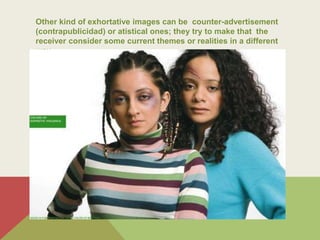
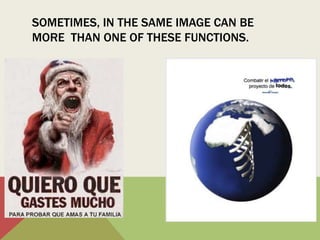
Other kind of exhortative images can be counter-advertisement
(contrapublicidad) or atistical ones; they try to make that the
receiver consider some current themes or realities in a different
way.
Images communicate mainly
beauty and harmony.
They are created for us to enjoy.
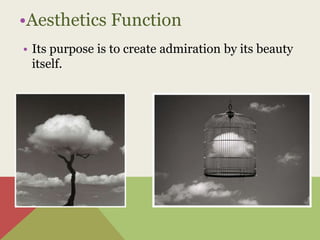
•Aesthetics Function
• Its purpose is to create admiration by its beauty
itself.
Images stimulate the receiver's
feeling.
The point is not what we see in the
image, but the emotions we feel
when we look at it.
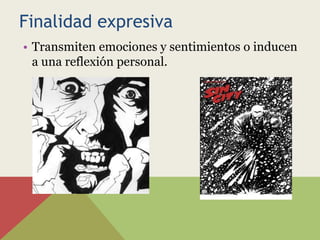
Finalidad expresiva
• Transmiten emociones y sentimientos o inducen
a una reflexión personal.
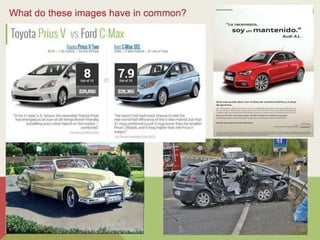
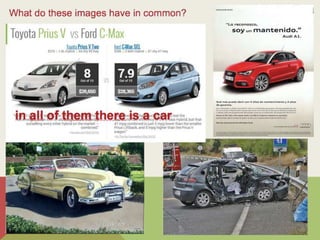
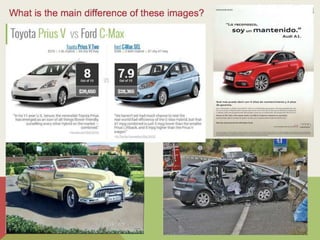
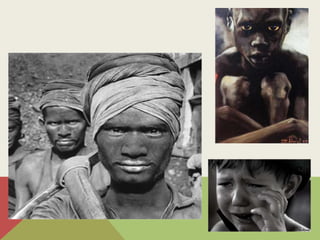
• WHICH IS THE MAIN FUNCTION IN THESE
IMAGES?
WHAT IS THE MESSAGE?
EJERCICIO'1
Lee#las#siguientes#imágenes#y#deduce#la#finalidad#principal.
AVERIGUA#y#CONTESTA:
)Lo'que'dice'la'imagen.
)La'finalidad'principal.
IMAGEN#1 IMAGEN#2
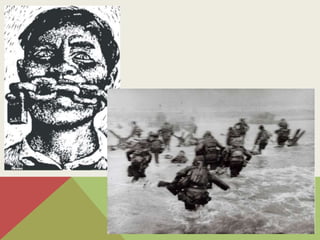
EJERCICIO'1
Lee#las#siguientes#imágenes#y#deduce#la#finalidad#principal.
AVERIGUA#y#CONTESTA:
)Lo'que'dice'la'imagen.
)La'finalidad'principal.
IMAGEN#1 IMAGEN#2
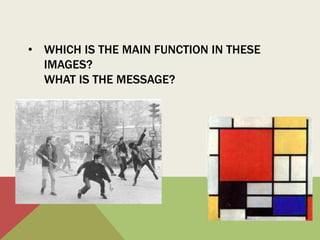
WHICH IS THE MAIN FUNCTION IN THESE
IMAGES?
WHAT IS THE MESSAGE?
EJERCICIO'2
Lee#las#siguientes#imágenes#y#deduce#la#finalidad#principal.
AVERIGUA#y#CONTESTA:
)Lo'que'dice'la'imagen.
)La'finalidad'principal.IMAGEN#3
IMAGE
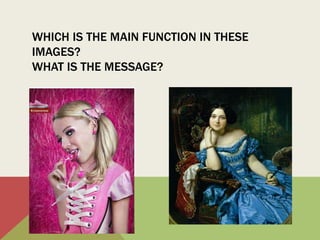
EJERCICIO'2
Lee#las#siguientes#imágenes#y#deduce#la#finalidad#principal.
AVERIGUA#y#CONTESTA:
)Lo'que'dice'la'imagen.
)La'finalidad'principal.MAGEN#3
IMAGEN#4
SOMETIMES, IN THE SAME IMAGE CAN BE
MORE THAN ONE OF THESE FUNCTIONS.
pictograms are images which
represents an object or idea reducing it
to its simpler form, but containing all of
its meaning.
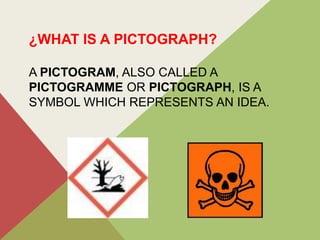
¿WHAT IS A PICTOGRAPH?
A PICTOGRAM, ALSO CALLED A
PICTOGRAMME OR PICTOGRAPH, IS A
SYMBOL WHICH REPRESENTS AN IDEA.
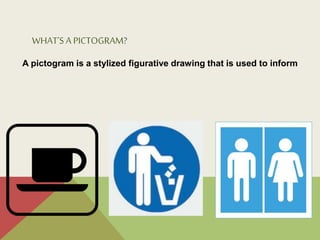
WHAT’S A PICTOGRAM?
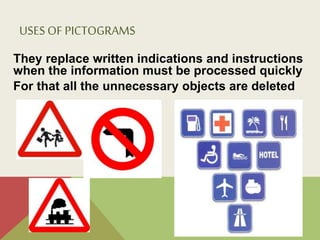
A pictogram is a stylized figurative drawing that is used to inform
USESOF PICTOGRAMS
They replace written indications and instructions
when the information must be processed quickly
For that all the unnecessary objects are deleted
!
!Un#pictograma#debe#ser
enteramente#comprensible#con#sólo
tres#miradas
!!En#el#diseño#de#un#pictograma
deberían#suprimirse#todos#los
detalles#superfluos
!
!!En!la!actualidad!es!entendido!como
un!signo!claro!y!esquemático!que
sintetiza!un!mensaje!sobrepasando
la!barrera!del!lenguaje;!con!el
objetivo!de!informar!y/o!señalizar.
!
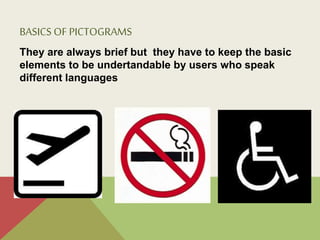
BASICS OF PICTOGRAMS
They are always brief but they have to keep the basic
elements to be undertandable by users who speak
different languages
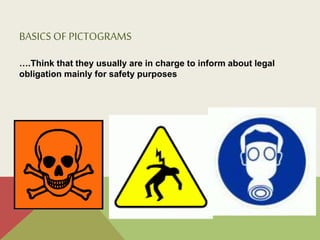
BASICS OF PICTOGRAMS
….Think that they usually are in charge to inform about legal
obligation mainly for safety purposes
!
!
OUR NEXT TASK
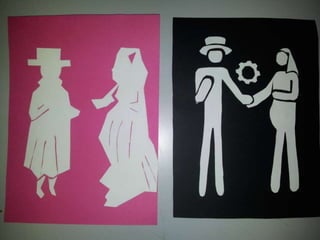
• To create a pictograph
Theme: any figurative artwork.
• Material needed:
Impressed image of the artwork selected (A5)
White and black cardboards (A4)
Scissers
Artist scalpel (cutter)
Glue
Rulers
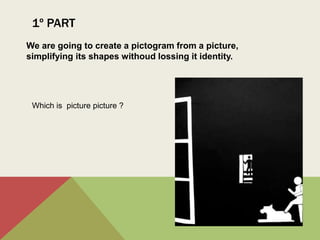
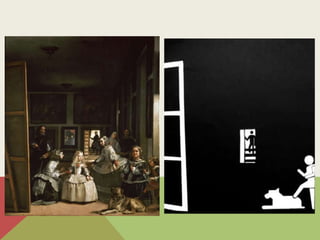
1º PART
We are going to create a pictogram from a picture,
simplifying its shapes withoud lossing it identity.
Which is picture picture ?
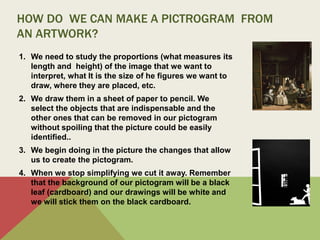
HOW DO WE CAN MAKE A PICTROGRAM FROM
AN ARTWORK?
1. We need to study the proportions (what measures its
length and height) of the image that we want to
interpret, what It is the size of he figures we want to
draw, where they are placed, etc.
2. We draw them in a sheet of paper to pencil. We
select the objects that are indispensable and the
other ones that can be removed in our pictogram
without spoiling that the picture could be easily
identified..
3. We begin doing in the picture the changes that allow
us to create the pictogram.
4. When we stop simplifying we cut it away. Remember
that the background of our pictogram will be a black
leaf (cardboard) and our drawings will be white and
we will stick them on the black cardboard.
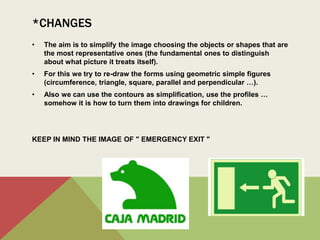
*CHANGES
• The aim is to simplify the image choosing the objects or shapes that are
the most representative ones (the fundamental ones to distinguish
about what picture it treats itself).
• For this we try to re-draw the forms using geometric simple figures
(circumference, triangle, square, parallel and perpendicular …).
• Also we can use the contours as simplification, use the profiles …
somehow it is how to turn them into drawings for children.
KEEP IN MIND THE IMAGE OF " EMERGENCY EXIT "
• Modificaciones:
El objetivo es simplificar la imagen eligiendo los objetos o formas
representativas (las que sean fundamentales para distinguir de
cuadro se trata).
Para esto intentamos redibujar las formas utilizando formas
geométricas (recordad el muñeco de salida de emergencia); con
líneas paralelas, círculos, triángulos…
También podemos utilizar los contornos de formas como
simplificación de las mismas.
Wednesday 11-
02-2015
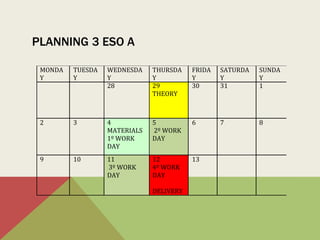
PLANNING 3 ESO A
MONDA
Y
TUESDA
Y
WEDNESDA
Y
THURSDA
Y
FRIDA
Y
SATURDA
Y
SUNDA
Y
28 29
THEORY
30 31 1
2 3 4
MATERIALS
1º WORK
DAY
5
2º WORK
DAY
6 7 8
9 10 11
3º WORK
DAY
12
4º WORK
DAY
DELIVERY
13
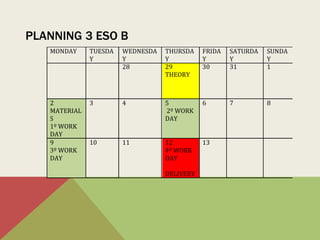
PLANNING 3 ESO B
MONDAY TUESDA
Y
WEDNESDA
Y
THURSDA
Y
FRIDA
Y
SATURDA
Y
SUNDA
Y
28 29
THEORY
30 31 1
2
MATERIAL
S
1º WORK
DAY
3 4 5
2º WORK
DAY
6 7 8
9
3º WORK
DAY
10 11 12
4º WORK
DAY
DELIVERY
13
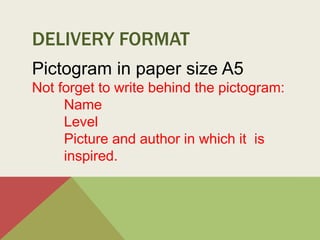
DELIVERY FORMAT
Pictogram in paper size A5
Not forget to write behind the pictogram:
Name
Level
Picture and author in which it is
inspired.
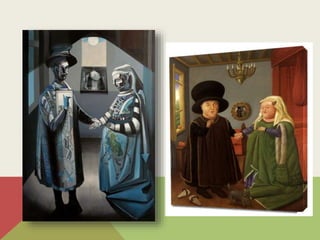
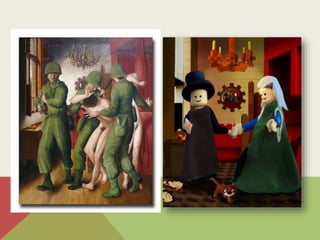
Some pictures as
inspiration…
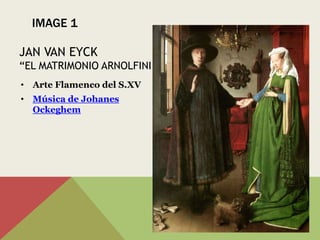
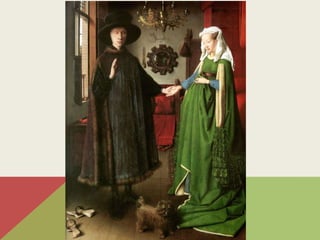
IMAGE 1
JAN VAN EYCK
“EL MATRIMONIO ARNOLFINI”
• Arte Flamenco del S.XV
• Música de Johanes
Ockeghem
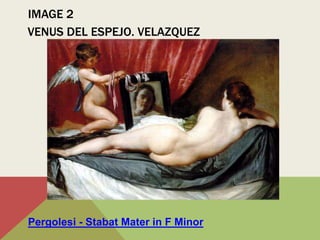
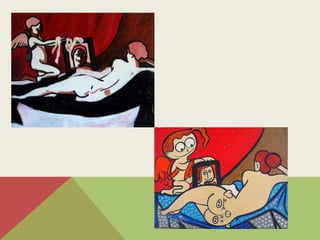
VENUS DEL ESPEJO. VELAZQUEZ
IMAGE 2
Pergolesi - Stabat Mater in F Minor
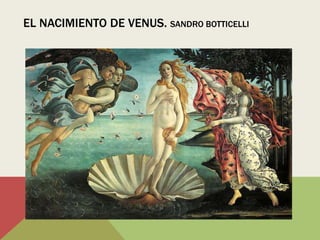
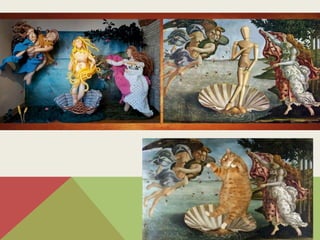
EL NACIMIENTO DE VENUS. SANDRO BOTTICELLI
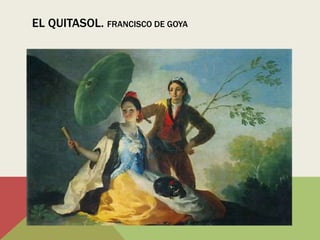
EL QUITASOL. FRANCISCO DE GOYA
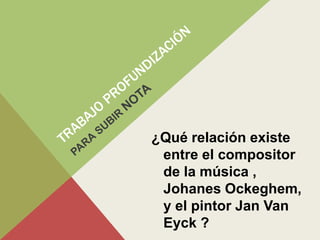
¿Qué relación existe
entre el compositor
de la música ,
Johanes Ockeghem,
y el pintor Jan Van
Eyck ?
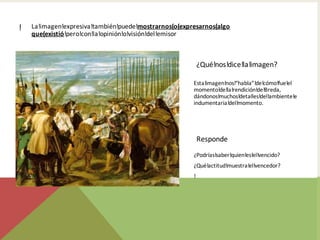
! La!imagen!expresiva!también!puede!mostrarnos(o(expresarnos(algo
que(existió!pero!con!la!opinión!o!visión!del!emisor
Esta!imagen!nos!“habla”!de!cómo!fue!el
momento!de!la!rendición!de!Breda,
dándonos!muchos!detalles!del!ambiente!e
indumentaria!del!momento.
¿Qué!nos!dice!la!imagen?
¿Podrías!saber!quien!es!el!vencido?
¿Qué!actitud!muestra!el!vencedor?
!
Responde

Functions of visual_language

  • 3.
    the visual communicationis a process of production, transmission and receipt of messages through images.
  • 4.
    Context Place and time Sender Itis the person who creates an image in order to communicate Message It is the content of the image- its information The receptor It is the person who decodes the message to understand it The code They are the rules and norms that make the message understandable The channel or medium - It is the vehicle or means used to transmit the information ELEMENTS IN COMMUNICATION PROCESS
  • 5.
    IMAGE IS THEMAIN ACTRESS IN VISUAL COMMUNICATION, BUT, HOW DOES IT DEVELOPEP ITS FUNCTION…?
  • 7.
    The image’s SIGNIFIER •It is the visual content of the image. • Simply what exists in it or we perceive in it.
  • 8.
    The image’s signifiedor meaning • It is the sense that wants to be given to a visual message. • It depends on the context of the communication. " Context is a particular situation defined by geographical, temporary, psychological and social indicators. " • The message is always influenced by our perception. " Perception is a process for which visual sensaciones that the eye receives are processed by the brain. "
  • 10.
    SUMMING UP • TheSignifier: It is the visual content of the image, what it is represented in it without any interpretation • The Signified: It is the meaning, real or symbolic that it is transmitted through the image : es el sentido, real o simbólico, ensaje visual es el contenido visual de la
  • 11.
    What´s the meaningof an image?: Signifier & signified Images have a signifier and a signified. The signifier is the object/image itself, its appearance. The signified is the content of the image, its meaning. SIGNIFIER: Indian people travelling by train. SIGNIFIED: poverty problem in India. SIGNIFIER: Indian people throwing petals to the fire. SIGNIFIED: clothing & rituals exoticism in India.
  • 19.
    Functions of VisualLanguage Visual Language has 4 different functions according to the message an image wants to transmit: Informative: Images that show the basic elements to understand the main information about the represented object. Instructions sheets for objects/ machines are usually informative. Aesthetics: Images that wants to communicate beauty and harmony primarily. Design products are usually aesthetics. Expressive: Images whose aim is to evoke a particular sensation or emotion in the viewer (happiness, sadness, joy, melancholy, fear…). Paintings and sculptures are usually expressive. Exhortative: Images that try to persuade the receiver to consume a product, service or an idea. Advertising images are usually exhortative.
  • 20.
    What can bethe images´s purposes?
  • 21.
  • 22.
    Content is transmittedin an objective way. They are clear, direct and objective.
  • 23.
    WE CAN FINDDIFFERENT TYPES IN THIS GROUP Identificatives-Symbols: they try to identify groups pf people or ideas. They are shared socially Indicatives_signs: they show actions, orders, directions or spaces. to identify groups pf people or ideas. They are shared socially • IDENTIFICATIVAS - SÍMBOLOS ▫ Tratan(de(identificar(grupos(de(personas(o(ideas. ▫ Son(compartidos(culturalmente. ( ( • INDICATIVAS - SIGNOS ▫ Indican acciones,órdenes, direcciones o espacios. • IDENTIFICATIVAS - SÍMBOLOS ▫ Tratan(de(identificar(grupos(de(personas(o(ideas. ▫ Son(compartidos(culturalmente. ( ( • INDICATIVAS - SIGNOS ▫ Indican acciones,órdenes, direcciones o espacios.
  • 24.
    MARCAS Son señales visualesque tienen como finalidad la diferenciación. DESCRIPTIVAS. Describen hechos, situaciones u objetos. # uales que tienen como finalidad la S. hos, situaciones u objetos. # Brands: they are visual signs that have as a purpose to make a distinction with the others., to identify one enterprise. Descriptives: they show facts, data, characteristics of something in an objective way.
  • 26.
    http://www.cuartoderecha.com/2526/ We are goingto see a short film where all the images that it contains have the descriptive function … IN WHAT DO YOU THINK THAT IT IS BASED?
  • 27.
    Most advertising imagesare exhortative. They try to persuade the receiver to consume a product, a service or an idea
  • 28.
    Exhortative function They tryto persuade the receiver to consume a product, a service or an idea
  • 30.
    o#sólo#se#encuadran#aquí#las#imágenes#publicitarios,#también#los#carteles ubernamentales,#de#la#DGT;#los#folletos#de#cursos,#universidades…. We can findin this group, not only Publicity, but some govern campaigns (as DGT ones), some courses brochures, ads from universities…
  • 32.
    Other kind ofexhortative images can be counter-advertisement (contrapublicidad) or atistical ones; they try to make that the receiver consider some current themes or realities in a different way.
  • 33.
    Images communicate mainly beautyand harmony. They are created for us to enjoy.
  • 34.
    •Aesthetics Function • Itspurpose is to create admiration by its beauty itself.
  • 39.
    Images stimulate thereceiver's feeling. The point is not what we see in the image, but the emotions we feel when we look at it.
  • 40.
    Finalidad expresiva • Transmitenemociones y sentimientos o inducen a una reflexión personal.
  • 43.
    • WHICH ISTHE MAIN FUNCTION IN THESE IMAGES? WHAT IS THE MESSAGE? EJERCICIO'1 Lee#las#siguientes#imágenes#y#deduce#la#finalidad#principal. AVERIGUA#y#CONTESTA: )Lo'que'dice'la'imagen. )La'finalidad'principal. IMAGEN#1 IMAGEN#2 EJERCICIO'1 Lee#las#siguientes#imágenes#y#deduce#la#finalidad#principal. AVERIGUA#y#CONTESTA: )Lo'que'dice'la'imagen. )La'finalidad'principal. IMAGEN#1 IMAGEN#2
  • 44.
    WHICH IS THEMAIN FUNCTION IN THESE IMAGES? WHAT IS THE MESSAGE? EJERCICIO'2 Lee#las#siguientes#imágenes#y#deduce#la#finalidad#principal. AVERIGUA#y#CONTESTA: )Lo'que'dice'la'imagen. )La'finalidad'principal.IMAGEN#3 IMAGE EJERCICIO'2 Lee#las#siguientes#imágenes#y#deduce#la#finalidad#principal. AVERIGUA#y#CONTESTA: )Lo'que'dice'la'imagen. )La'finalidad'principal.MAGEN#3 IMAGEN#4
  • 45.
    SOMETIMES, IN THESAME IMAGE CAN BE MORE THAN ONE OF THESE FUNCTIONS.
  • 46.
    pictograms are imageswhich represents an object or idea reducing it to its simpler form, but containing all of its meaning.
  • 47.
    ¿WHAT IS APICTOGRAPH? A PICTOGRAM, ALSO CALLED A PICTOGRAMME OR PICTOGRAPH, IS A SYMBOL WHICH REPRESENTS AN IDEA.
  • 48.
    WHAT’S A PICTOGRAM? Apictogram is a stylized figurative drawing that is used to inform
  • 49.
    USESOF PICTOGRAMS They replacewritten indications and instructions when the information must be processed quickly For that all the unnecessary objects are deleted ! !Un#pictograma#debe#ser enteramente#comprensible#con#sólo tres#miradas !!En#el#diseño#de#un#pictograma deberían#suprimirse#todos#los detalles#superfluos ! !!En!la!actualidad!es!entendido!como un!signo!claro!y!esquemático!que sintetiza!un!mensaje!sobrepasando la!barrera!del!lenguaje;!con!el objetivo!de!informar!y/o!señalizar. !
  • 50.
    BASICS OF PICTOGRAMS Theyare always brief but they have to keep the basic elements to be undertandable by users who speak different languages
  • 51.
    BASICS OF PICTOGRAMS ….Thinkthat they usually are in charge to inform about legal obligation mainly for safety purposes
  • 52.
  • 54.
    OUR NEXT TASK •To create a pictograph Theme: any figurative artwork. • Material needed: Impressed image of the artwork selected (A5) White and black cardboards (A4) Scissers Artist scalpel (cutter) Glue Rulers
  • 55.
    1º PART We aregoing to create a pictogram from a picture, simplifying its shapes withoud lossing it identity. Which is picture picture ?
  • 57.
    HOW DO WECAN MAKE A PICTROGRAM FROM AN ARTWORK? 1. We need to study the proportions (what measures its length and height) of the image that we want to interpret, what It is the size of he figures we want to draw, where they are placed, etc. 2. We draw them in a sheet of paper to pencil. We select the objects that are indispensable and the other ones that can be removed in our pictogram without spoiling that the picture could be easily identified.. 3. We begin doing in the picture the changes that allow us to create the pictogram. 4. When we stop simplifying we cut it away. Remember that the background of our pictogram will be a black leaf (cardboard) and our drawings will be white and we will stick them on the black cardboard.
  • 58.
    *CHANGES • The aimis to simplify the image choosing the objects or shapes that are the most representative ones (the fundamental ones to distinguish about what picture it treats itself). • For this we try to re-draw the forms using geometric simple figures (circumference, triangle, square, parallel and perpendicular …). • Also we can use the contours as simplification, use the profiles … somehow it is how to turn them into drawings for children. KEEP IN MIND THE IMAGE OF " EMERGENCY EXIT " • Modificaciones: El objetivo es simplificar la imagen eligiendo los objetos o formas representativas (las que sean fundamentales para distinguir de cuadro se trata). Para esto intentamos redibujar las formas utilizando formas geométricas (recordad el muñeco de salida de emergencia); con líneas paralelas, círculos, triángulos… También podemos utilizar los contornos de formas como simplificación de las mismas.
  • 59.
  • 60.
    PLANNING 3 ESOA MONDA Y TUESDA Y WEDNESDA Y THURSDA Y FRIDA Y SATURDA Y SUNDA Y 28 29 THEORY 30 31 1 2 3 4 MATERIALS 1º WORK DAY 5 2º WORK DAY 6 7 8 9 10 11 3º WORK DAY 12 4º WORK DAY DELIVERY 13
  • 61.
    PLANNING 3 ESOB MONDAY TUESDA Y WEDNESDA Y THURSDA Y FRIDA Y SATURDA Y SUNDA Y 28 29 THEORY 30 31 1 2 MATERIAL S 1º WORK DAY 3 4 5 2º WORK DAY 6 7 8 9 3º WORK DAY 10 11 12 4º WORK DAY DELIVERY 13
  • 62.
    DELIVERY FORMAT Pictogram inpaper size A5 Not forget to write behind the pictogram: Name Level Picture and author in which it is inspired.
  • 63.
  • 64.
    IMAGE 1 JAN VANEYCK “EL MATRIMONIO ARNOLFINI” • Arte Flamenco del S.XV • Música de Johanes Ockeghem
  • 67.
    VENUS DEL ESPEJO.VELAZQUEZ IMAGE 2 Pergolesi - Stabat Mater in F Minor
  • 69.
    EL NACIMIENTO DEVENUS. SANDRO BOTTICELLI
  • 71.
  • 75.
    ¿Qué relación existe entreel compositor de la música , Johanes Ockeghem, y el pintor Jan Van Eyck ?
  • 76.