Needs of Clientele and
Audiences in Social
Work
MODULE 8
LESSON 2
Lesson II. Needs of Clientele and Audiences of
Social Work
Need is commonly defined as a motivating force that compels
action for its satisfaction. Needs range from basic survival needs
(common to all human beings) satisfied by necessities, with cultural,
intellectual, and social needs (varying from place to place and age
group to age group) satisfied by necessaries.
Need is something that can be addressed by service providers (or
community members in a community development initiative). In
social services, most needs are value-driven and there can be
differences of opinion about the ideal condition (Altschuld & Kumar,
2005).
Generally, as mentioned by Sampa (2017) in his book entitled
Disciplines and Ideas in the Applied Social Sciences, needs include
wanting to be empowered, to be socially included by way of
insuring that one receives what is legally due to him/her, and that
one receives the necessary care he/she deserves. Some need their
rights to be respected, some need justice, and others need social
welfare help to put them on their feet.
Lesson II. Needs of Clientele and
Audiences of Social Work
The Canadian Association of Social Workers defines
social work as “a profession concerned with helping
individuals, families, groups and communities to
enhance their individual and collective well-being. It
aims to help people develop their skills and their ability
to use their own resources and those of the community
to resolve problems (https://fsw.ucalgary.ca/home/why-
social-work-career). Social workers typically work with
people who are (a) vulnerable in some way (e.g. street
children, grease people, older people, PWD); (b)
excluded from what society usually gives (e.g.
discriminated, marginalized, the minority); (c) cannot
participate fully in components of society (e.g. some
women, human beings living in poverty); and (d) go
through from stigma & discrimination (e.g. HIV/AIDS,
intercourse workers, drug addicts).
Lesson II. Needs of Clientele and Audiences
of Social Work
The responsibilities carried
out through social workers
range relies on the settings
in which they work and on
the needs of their clientele
and audiences.
The Individual as Client of Social
Work
As a client of social work, an individual is assisted to
fit in a larger environment. He/she is someone who
has been deprived of space by the larger
environment and someone who needs assistance to
improve his/her ability to cope with his/her larger
community (Sampa, 2017). In health and
community service centers, for example, individuals
are provided with counseling. Social workers
contribute to the care, treatment and rehabilitation
of the aged and of physically or mentally ill
individuals, as well as the care of disabled persons
The Group or
Organization as Client
of Social Work
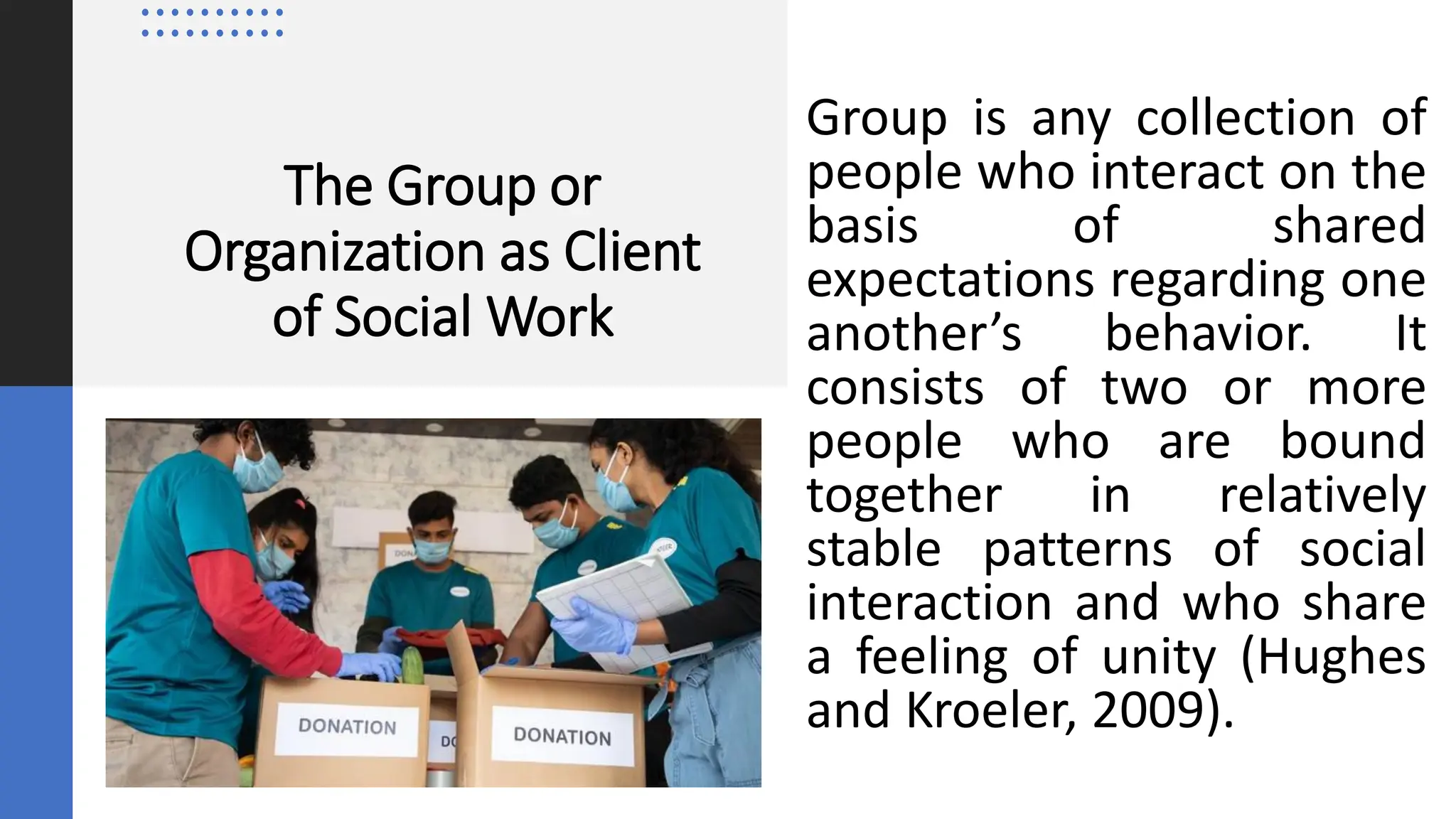
Group is any collection of
people who interact on the
basis of shared
expectations regarding one
another’s behavior. It
consists of two or more
people who are bound
together in relatively
stable patterns of social
interaction and who share
a feeling of unity (Hughes
and Kroeler, 2009).
The Group or
Organization as Client
of Social Work
Organization on the other hand, is a
human grouping or social unit
deliberately constructed and
reconstructed to meet specific
goals (Parsons, 1960).
Gay men and lesbians, migrants,
women, abused or neglected
children, elderly, pensioners,
veterans, military service men and
women, people in conflict with the
law, unemployed, people with
substance abuse and addiction, and
people with disability represent
groups that social work may focus
on its services.
The Group or
Organization as Client
of Social Work
Groups such as those
whose members belong to
an organization or place of
employment, pupils and
students in school set up
and those from
marginalized sectors are
classified as groups because
they form collectivities in
terms of level of services
they have to receive.
The Group or Organization as
Client of Social Work Some social workers work as
community developers helping
citizens to identify their needs and
proposing ways of meeting these
needs. Others may assist with
parent-child relationships and
marriage counselling. The services
may be offered on an individual
basis or in groups. To help students
adjust to the school environment,
many school boards hire social
workers. They help students,
parents and teachers deal with
problems such as aggressive
behaviour, truancy and family
problems, which affect the
students’ performance.
The Group or Organization as
Client of Social Work In the correctional field, social
workers may be part of a team
concerned with the social
rehabilitation of young or
adult offenders. They may
work as classification officers.
Others work as probation
officers or as parole officers.
Parole officers help ex-
prisoners adjust to life in the
community while conforming
to the conditions of their
parole
The Community as Client of
Social Work A community may exist as a
marginalized sector, and in
which case, the social work
services may gear toward their
emancipation and
empowerment. Social work
may focus on community
transformation to cause
environmental change so as to
make it possible for individuals
and groups to achieve social
well-being or social justice and
respect for their rights (Sampa,
2017).
The Community as Client of
Social Work Social work is concerned with
individual and personal problems
but also with broader social issues
such as poverty, unemployment
and domestic violence). Social
workers employed by child welfare
agencies (public and private)
investigate cases of family violence,
child abuse and neglect and take
protective action as required. They
may recruit foster parents or
supervise the placement of children
in protective care. Others work on
adoption cases

Clientele and Audiences in Social Work Lesson 2 Modul 8.pdf

  • 1.
    Needs of Clienteleand Audiences in Social Work MODULE 8 LESSON 2
  • 2.
    Lesson II. Needsof Clientele and Audiences of Social Work Need is commonly defined as a motivating force that compels action for its satisfaction. Needs range from basic survival needs (common to all human beings) satisfied by necessities, with cultural, intellectual, and social needs (varying from place to place and age group to age group) satisfied by necessaries. Need is something that can be addressed by service providers (or community members in a community development initiative). In social services, most needs are value-driven and there can be differences of opinion about the ideal condition (Altschuld & Kumar, 2005). Generally, as mentioned by Sampa (2017) in his book entitled Disciplines and Ideas in the Applied Social Sciences, needs include wanting to be empowered, to be socially included by way of insuring that one receives what is legally due to him/her, and that one receives the necessary care he/she deserves. Some need their rights to be respected, some need justice, and others need social welfare help to put them on their feet.
  • 3.
    Lesson II. Needsof Clientele and Audiences of Social Work The Canadian Association of Social Workers defines social work as “a profession concerned with helping individuals, families, groups and communities to enhance their individual and collective well-being. It aims to help people develop their skills and their ability to use their own resources and those of the community to resolve problems (https://fsw.ucalgary.ca/home/why- social-work-career). Social workers typically work with people who are (a) vulnerable in some way (e.g. street children, grease people, older people, PWD); (b) excluded from what society usually gives (e.g. discriminated, marginalized, the minority); (c) cannot participate fully in components of society (e.g. some women, human beings living in poverty); and (d) go through from stigma & discrimination (e.g. HIV/AIDS, intercourse workers, drug addicts).
  • 4.
    Lesson II. Needsof Clientele and Audiences of Social Work The responsibilities carried out through social workers range relies on the settings in which they work and on the needs of their clientele and audiences.
  • 5.
    The Individual asClient of Social Work As a client of social work, an individual is assisted to fit in a larger environment. He/she is someone who has been deprived of space by the larger environment and someone who needs assistance to improve his/her ability to cope with his/her larger community (Sampa, 2017). In health and community service centers, for example, individuals are provided with counseling. Social workers contribute to the care, treatment and rehabilitation of the aged and of physically or mentally ill individuals, as well as the care of disabled persons
  • 6.
    The Group or Organizationas Client of Social Work Group is any collection of people who interact on the basis of shared expectations regarding one another’s behavior. It consists of two or more people who are bound together in relatively stable patterns of social interaction and who share a feeling of unity (Hughes and Kroeler, 2009).
  • 7.
    The Group or Organizationas Client of Social Work Organization on the other hand, is a human grouping or social unit deliberately constructed and reconstructed to meet specific goals (Parsons, 1960). Gay men and lesbians, migrants, women, abused or neglected children, elderly, pensioners, veterans, military service men and women, people in conflict with the law, unemployed, people with substance abuse and addiction, and people with disability represent groups that social work may focus on its services.
  • 8.
    The Group or Organizationas Client of Social Work Groups such as those whose members belong to an organization or place of employment, pupils and students in school set up and those from marginalized sectors are classified as groups because they form collectivities in terms of level of services they have to receive.
  • 9.
    The Group orOrganization as Client of Social Work Some social workers work as community developers helping citizens to identify their needs and proposing ways of meeting these needs. Others may assist with parent-child relationships and marriage counselling. The services may be offered on an individual basis or in groups. To help students adjust to the school environment, many school boards hire social workers. They help students, parents and teachers deal with problems such as aggressive behaviour, truancy and family problems, which affect the students’ performance.
  • 10.
    The Group orOrganization as Client of Social Work In the correctional field, social workers may be part of a team concerned with the social rehabilitation of young or adult offenders. They may work as classification officers. Others work as probation officers or as parole officers. Parole officers help ex- prisoners adjust to life in the community while conforming to the conditions of their parole
  • 11.
    The Community asClient of Social Work A community may exist as a marginalized sector, and in which case, the social work services may gear toward their emancipation and empowerment. Social work may focus on community transformation to cause environmental change so as to make it possible for individuals and groups to achieve social well-being or social justice and respect for their rights (Sampa, 2017).
  • 12.
    The Community asClient of Social Work Social work is concerned with individual and personal problems but also with broader social issues such as poverty, unemployment and domestic violence). Social workers employed by child welfare agencies (public and private) investigate cases of family violence, child abuse and neglect and take protective action as required. They may recruit foster parents or supervise the placement of children in protective care. Others work on adoption cases