An entrepreneur performs a series of functions
necessary right from the genesis of an idea up to
the establishment and effective operation of an
enterprise. He carries out the whole set of activities
of the business for its success. He recognises the
commercial potential of a product or a service,
formulates operating policies for production, product
design, marketing and organisational structure. He
is thus a nucleus of high growth of the enterprise.
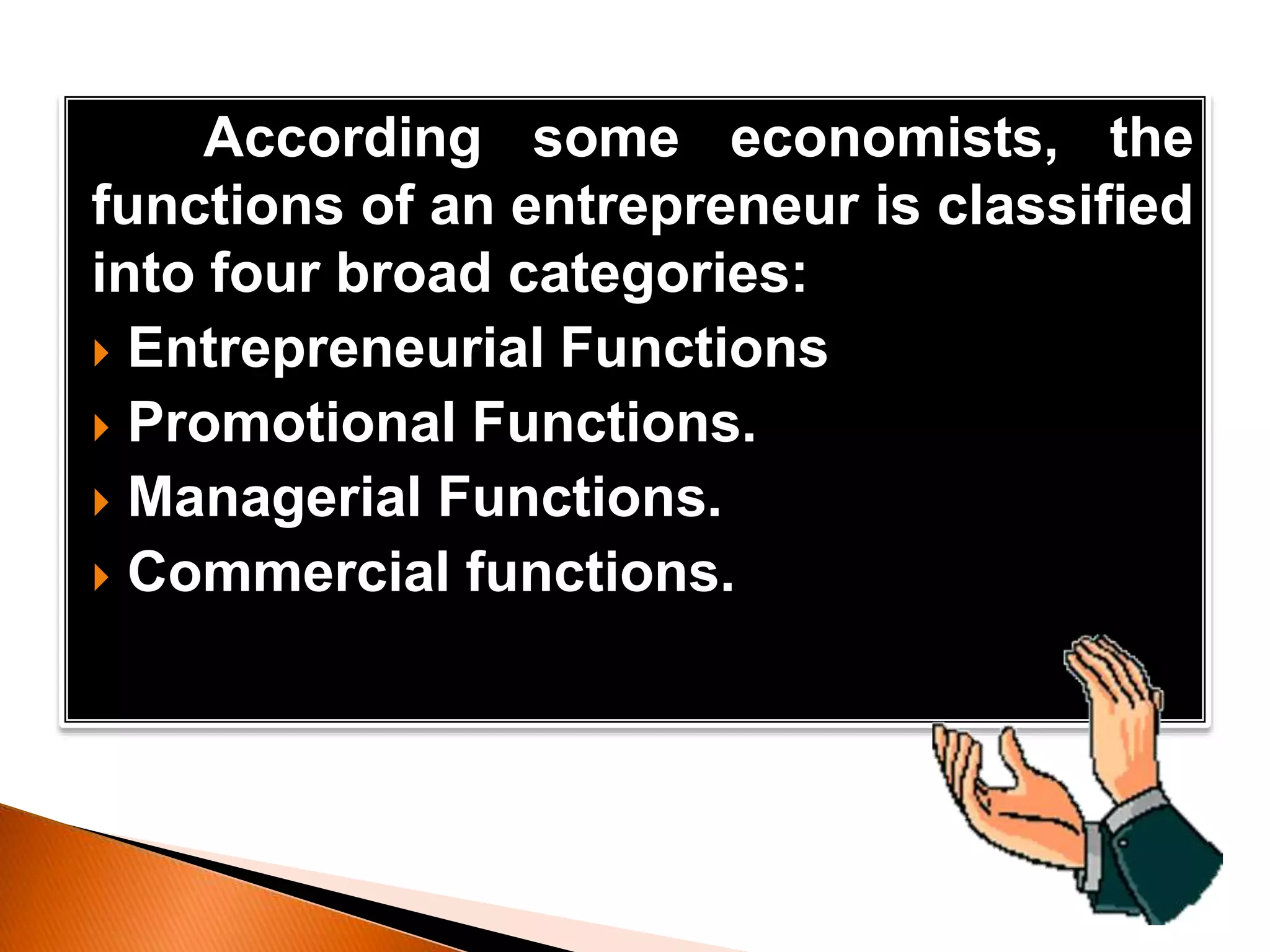
According some economists, the
functions of an entrepreneur is classified
into four broad categories:
 Entrepreneurial Functions
 Promotional Functions.
 Managerial Functions.
 Commercial functions.
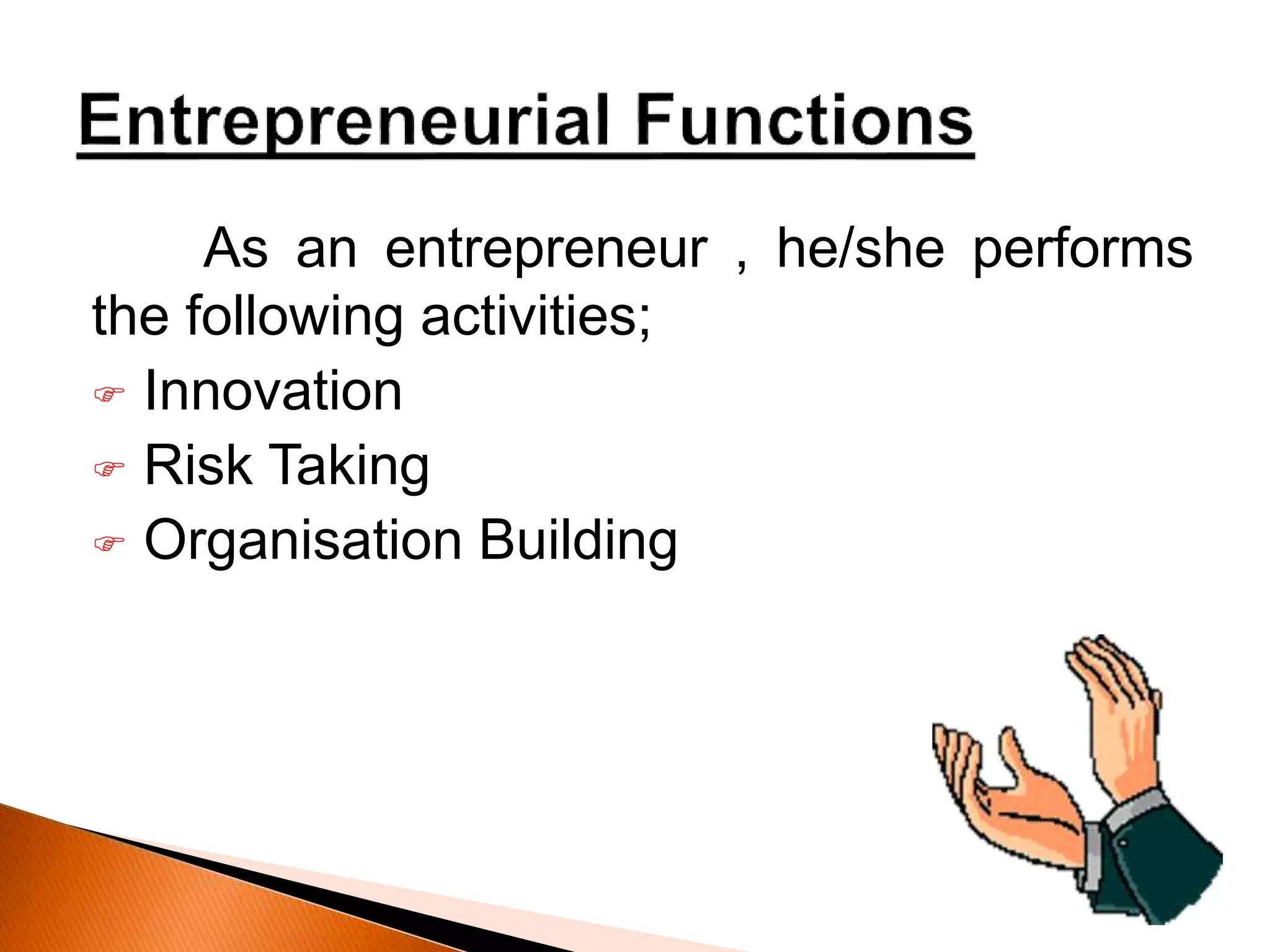
As an entrepreneur , he/she performs
the following activities;
 Innovation
 Risk Taking
 Organisation Building
It is the basic function of an
entrepreneur. As an innovator he has to
bring new product, new market, new
source of raw materials ,etc. He foresees
a potentially profitable opportunity and
tries to exploit it.
Risk taking refers to taking
responsibility for a loss . A good
entrepreneur reduces the risk in his
business. He is a self-confident and highly
optimistic person and willing to assume the
risk involved in his enterprise.
Organization and management are the main
functions of an entrepreneur. He brings together
the various factors of production. It helps to
allocate the productive resources in order to
minimize losses and reduce cost in production.
He takes the entire decisions like expansion of
business , amount of capital ,etc. of his business.
Thus he is the final judge of his business.
 Investigation / Discovery of An Idea
 Detailed Investigation
 Assembling The Requirements.
 Financing the Proposition.
There are lots of opportunities / ideas
available in our world to set up an enterprise. But
it is the ability of a good entrepreneur to discover
a suitable idea that helps to develop profitable
ventures. He / she has to develop the discovered
idea with the support of experts in the field.
The entrepreneur will conduct a
detailed analysis about the demand for his
product in the market. There after he will
analyse the availability of finance, power,
labour, raw materials and machinery, etc.
After making sure that the idea is practical
and profitable one, he will acquire some patent
rights , if he has invented something. Then the
entrepreneur selects the factory site, decides
about plant and machinery, contacts suppliers of
raw materials. Preliminary contracts are finalized
and projects set to begin.
The entrepreneur decides about the
capital structure of the enterprise. Estimating
the required finance and analyzing the
sources for its collection. Long term and short
term financial requirements are estimated first
and the type of source of funds is also
decided share, debenture, loan , etc.
 Planning
 Organising
 Staffing
 Directing
 Leadership
 communication
 Motivation
 Supervision
 co-ordination
 controlling
It is the basic and foremost managerial
function of an entrepreneur . It helps in
determining the course of action to be followed to
achieve various entrepreneurial objectives. It is
decision making in advance , what to do, when to
do it, how to do it and who will do a particular
task.
The entrepreneur sets up the
objectives or goals to be achieved by its
personnel. The function of organising is to
arrange, guide, co-ordinate, direct and
control the activities or the factors of
production.
It is concerned with the human
resources of an enterprise. It consist of
manpower planning, recruitment, selection ,
placement, human resource development,
promotion, transfer, appraisal and
determination of employee’s remuneration.
It is concerned with carrying out the
desired plans with the support of proper
instructions. It ensures effective
performance of planned activities by the
subordinates,
It is the process of inspiring or
influencing the workers by satisfying their
needs for the fulfillment of organisational
objectives.
It refers to the exchange of ideas ,
feelings, emotions, knowledge and
information between two or more persons.
For effective running and accomplishment
of organisational goals , proper
communication at all levels is a necessary
one.
The performance of an employee depends
upon the monetary and non-monetary benefits got
from the Organisation. A sound motivational
system must be productive, competitive,
comprehensive and flexible, and it must consider
psychological, social safety, ego and economic
needs of the worker.
Supervision refers to the job of overseeing ,
subordinates at work. It ensures maximum
utilization of resources, to the proper and timely
completion of work, and to correct the workers
whenever they go wrong.
It is the channelization of activities of all
individuals in the organization , for the
achievement of common goals. The entrepreneur
must check the work of different segments based
on the predetermined objectives and make
correction , if any deviations occurred.
The controlling process begins with
establishing standards of performance, measuring
actual performance, comparing actual with
standard performance, finding variations and
taking corrective actions.
 Production
 Finance
 Marketing
 Personnel
 Accounting
It is the key function of an entrepreneur. It is
the creation of goods and services. It consists of
manufacturing, ancillary and advisory activities. In a
small organisation it will be undertaken by an
individual, but in a large concern, it may be
undertaken by various individuals or a separate
team.
Money is the life blood of every business
organisation. The need for money is continuous. It
starts with the setting up of an organisation and
remains at all time. It is the duty of an
entrepreneur, to find out various sources of
finance and appropriately arrange them as and
when required.
It involves the process of movement of
goods and services from the producer to
the consumer. It plays a significant role in
promoting the successful running of
business enterprise.
This function is concerned with
employment, development, and
compensation for the personnel, the
provisions of working conditions, and
welfare measures to maintain a good work
force in the organisation.
It is the process of systematic recording of
entrepreneurial transactions of an enterprise and
the financial position of the enterprise. The
entrepreneur should look thoroughly the record
keeping of transactions and should aware about
the financial position of the firm.

Functions of an entrepreneur

  • 2.
    An entrepreneur performsa series of functions necessary right from the genesis of an idea up to the establishment and effective operation of an enterprise. He carries out the whole set of activities of the business for its success. He recognises the commercial potential of a product or a service, formulates operating policies for production, product design, marketing and organisational structure. He is thus a nucleus of high growth of the enterprise.
  • 3.
    According some economists,the functions of an entrepreneur is classified into four broad categories:  Entrepreneurial Functions  Promotional Functions.  Managerial Functions.  Commercial functions.
  • 4.
    As an entrepreneur, he/she performs the following activities;  Innovation  Risk Taking  Organisation Building
  • 5.
    It is thebasic function of an entrepreneur. As an innovator he has to bring new product, new market, new source of raw materials ,etc. He foresees a potentially profitable opportunity and tries to exploit it.
  • 6.
    Risk taking refersto taking responsibility for a loss . A good entrepreneur reduces the risk in his business. He is a self-confident and highly optimistic person and willing to assume the risk involved in his enterprise.
  • 7.
    Organization and managementare the main functions of an entrepreneur. He brings together the various factors of production. It helps to allocate the productive resources in order to minimize losses and reduce cost in production. He takes the entire decisions like expansion of business , amount of capital ,etc. of his business. Thus he is the final judge of his business.
  • 8.
     Investigation /Discovery of An Idea  Detailed Investigation  Assembling The Requirements.  Financing the Proposition.
  • 9.
    There are lotsof opportunities / ideas available in our world to set up an enterprise. But it is the ability of a good entrepreneur to discover a suitable idea that helps to develop profitable ventures. He / she has to develop the discovered idea with the support of experts in the field.
  • 10.
    The entrepreneur willconduct a detailed analysis about the demand for his product in the market. There after he will analyse the availability of finance, power, labour, raw materials and machinery, etc.
  • 11.
    After making surethat the idea is practical and profitable one, he will acquire some patent rights , if he has invented something. Then the entrepreneur selects the factory site, decides about plant and machinery, contacts suppliers of raw materials. Preliminary contracts are finalized and projects set to begin.
  • 12.
    The entrepreneur decidesabout the capital structure of the enterprise. Estimating the required finance and analyzing the sources for its collection. Long term and short term financial requirements are estimated first and the type of source of funds is also decided share, debenture, loan , etc.
  • 13.
     Planning  Organising Staffing  Directing  Leadership  communication  Motivation  Supervision  co-ordination  controlling
  • 14.
    It is thebasic and foremost managerial function of an entrepreneur . It helps in determining the course of action to be followed to achieve various entrepreneurial objectives. It is decision making in advance , what to do, when to do it, how to do it and who will do a particular task.
  • 15.
    The entrepreneur setsup the objectives or goals to be achieved by its personnel. The function of organising is to arrange, guide, co-ordinate, direct and control the activities or the factors of production.
  • 16.
    It is concernedwith the human resources of an enterprise. It consist of manpower planning, recruitment, selection , placement, human resource development, promotion, transfer, appraisal and determination of employee’s remuneration.
  • 17.
    It is concernedwith carrying out the desired plans with the support of proper instructions. It ensures effective performance of planned activities by the subordinates,
  • 18.
    It is theprocess of inspiring or influencing the workers by satisfying their needs for the fulfillment of organisational objectives.
  • 19.
    It refers tothe exchange of ideas , feelings, emotions, knowledge and information between two or more persons. For effective running and accomplishment of organisational goals , proper communication at all levels is a necessary one.
  • 20.
    The performance ofan employee depends upon the monetary and non-monetary benefits got from the Organisation. A sound motivational system must be productive, competitive, comprehensive and flexible, and it must consider psychological, social safety, ego and economic needs of the worker.
  • 21.
    Supervision refers tothe job of overseeing , subordinates at work. It ensures maximum utilization of resources, to the proper and timely completion of work, and to correct the workers whenever they go wrong.
  • 22.
    It is thechannelization of activities of all individuals in the organization , for the achievement of common goals. The entrepreneur must check the work of different segments based on the predetermined objectives and make correction , if any deviations occurred.
  • 23.
    The controlling processbegins with establishing standards of performance, measuring actual performance, comparing actual with standard performance, finding variations and taking corrective actions.
  • 24.
     Production  Finance Marketing  Personnel  Accounting
  • 25.
    It is thekey function of an entrepreneur. It is the creation of goods and services. It consists of manufacturing, ancillary and advisory activities. In a small organisation it will be undertaken by an individual, but in a large concern, it may be undertaken by various individuals or a separate team.
  • 26.
    Money is thelife blood of every business organisation. The need for money is continuous. It starts with the setting up of an organisation and remains at all time. It is the duty of an entrepreneur, to find out various sources of finance and appropriately arrange them as and when required.
  • 27.
    It involves theprocess of movement of goods and services from the producer to the consumer. It plays a significant role in promoting the successful running of business enterprise.
  • 28.
    This function isconcerned with employment, development, and compensation for the personnel, the provisions of working conditions, and welfare measures to maintain a good work force in the organisation.
  • 29.
    It is theprocess of systematic recording of entrepreneurial transactions of an enterprise and the financial position of the enterprise. The entrepreneur should look thoroughly the record keeping of transactions and should aware about the financial position of the firm.