Lambda Calculus
Mahsa Seifikar
Winter 94
• History
• Definition
• Syntax λ calculus
• Function in Lambda Calculus
• Reduction
• Encoding data type in λ calculus
• Order of Evaluation
• Functional Programming
2
History
It was introduced in 1930s by Alonzo Church
as a way of formalizing the concept of
effective computability.
 λ calculus is a universal model of
computation equivalent to a Turing machine.
It also can be called the smallest universal
programming language of the world.
3
History
All function programming language can be
viewed as syncretic variation of λ calculus.
Functional languages such as Lisp, Scheme, FP,
ML, Miranda, and Haskell are an attempt to
realize Church's lambda calculus in practical
form as a programming language.
4
Definition
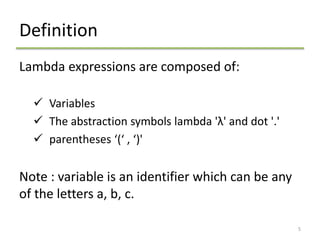
Lambda expressions are composed of:
 Variables
 The abstraction symbols lambda 'λ' and dot '.'
 parentheses ‘(‘ , ‘)'
Note : variable is an identifier which can be any
of the letters a, b, c.
5
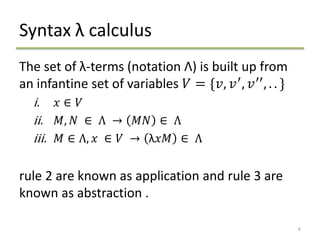
Syntax λ calculus
The set of λ-terms (notation Λ) is built up from
an infantine set of variables 𝑉 = {𝑣, 𝑣′
, 𝑣′′
, . . }
i. 𝑥 ∈ 𝑉
ii. 𝑀, 𝑁 ∈ Λ → 𝑀𝑁 ∈ Λ
iii. 𝑀 ∈ Λ, 𝑥 ∈ 𝑉 → λ𝑥𝑀 ∈ Λ
rule 2 are known as application and rule 3 are
known as abstraction .
6
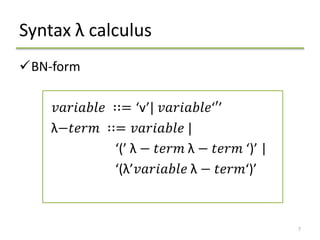
Syntax λ calculus
BN-form
𝑣𝑎𝑟𝑖𝑎𝑏𝑙𝑒 ∷= ‘v’| 𝑣𝑎𝑟𝑖𝑎𝑏𝑙𝑒‘′’
λ−𝑡𝑒𝑟𝑚 ∷= 𝑣𝑎𝑟𝑖𝑎𝑏𝑙𝑒 |
‘(’ λ − 𝑡𝑒𝑟𝑚 λ − 𝑡𝑒𝑟𝑚 ‘)’ |
‘(λ’𝑣𝑎𝑟𝑖𝑎𝑏𝑙𝑒 λ − 𝑡𝑒𝑟𝑚‘)’
7
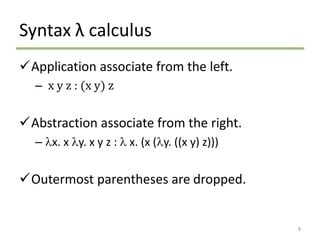
Syntax λ calculus
Application associate from the left.
– x y z : (x y) z
Abstraction associate from the right.
– lx. x ly. x y z : l x. (x (ly. ((x y) z)))
Outermost parentheses are dropped.
8
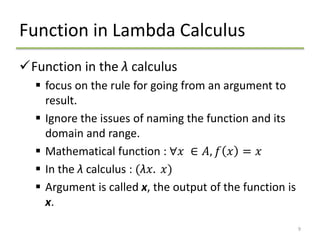
Function in Lambda Calculus
Function in the λ calculus
 focus on the rule for going from an argument to
result.
 Ignore the issues of naming the function and its
domain and range.
 Mathematical function : ∀𝑥 ∈ 𝐴, 𝑓 𝑥 = 𝑥
 In the λ calculus : (λ𝑥. 𝑥)
 Argument is called x, the output of the function is
x.
9
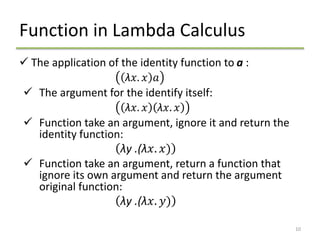
Function in Lambda Calculus
 The application of the identity function to a :
λ𝑥. 𝑥 𝑎
 The argument for the identify itself:
λ𝑥. 𝑥 λ𝑥. 𝑥
 Function take an argument, ignore it and return the
identity function:
λy .(λ𝑥. 𝑥)
 Function take an argument, return a function that
ignore its own argument and return the argument
original function:
λy .(λ𝑥. 𝑦)
10
Free Variables
The set of free variables M denoted by 𝐹𝑉 𝑀
𝐹𝑉 𝑥 = 𝑥
𝐹𝑉 λ𝑥. 𝑀 = 𝐹𝑉 𝑀 𝑥
𝐹𝑉 𝑀 𝑁 = 𝐹𝑉 𝑀 ∪ 𝐹𝑉 𝑁
Note : Variables that fall within the scope of an
abstraction are said to be bound. All other
variables are called free.
11
Substitution
Substituting N for the free occurrences of x in M
Denoted by M[x := N]
x[x := N] ≡ N
y[x := N] ≡ y, if x ≠ y
(M1 M2)[x := N] ≡ (M1[x := N]) (M2[x := N])
(λx.M)[x := N] ≡ λx.M(λy.M)[x := N] ≡ λy.(M[x := N]), if x ≠ y, provided y ∉ FV(N)
12
Lambda Reduction
𝛼 − 𝑟𝑒𝑑𝑢𝑐𝑡𝑖𝑜𝑛
 allows bound variable names to be changed.
 if x and y is variable and M is a λ expression:
λx . M → 𝛼 λy . M[x → 𝑦]
 Example :
λ𝑦 . λ𝑓 . 𝑓 𝑥 𝑦 → 𝛼 λ𝑧 . λ𝑓 . 𝑓 𝑥 𝑧
λ𝑧 . λ𝑓 . 𝑓 𝑥 𝑧 → 𝛼 λ𝑧 . λ𝑔 . 𝑔 𝑥 𝑧
13
Lambda Reduction
𝛽 − 𝑟𝑒𝑑𝑢𝑐𝑡𝑖𝑜𝑛
 applying functions to their arguments.
 If x is variable and M and N are λ expression:
( λ𝑥. 𝑀 ) 𝑁 → 𝛽 𝑀[ 𝑥 → 𝑁]
 Example:
( ( λn . n∗x ) y) → y∗x
14
Lambda Reduction
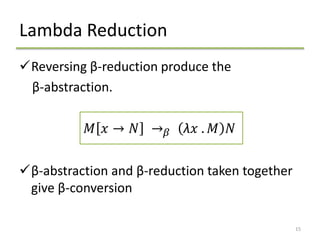
Reversing β-reduction produce the
β-abstraction.
𝑀 𝑥 → 𝑁 → 𝛽 λ𝑥 . 𝑀 𝑁
β-abstraction and β-reduction taken together
give β-conversion
15
Lambda Reduction
ɳ − 𝑟𝑒𝑑𝑢𝑐𝑡𝑖𝑜𝑛
 which captures a notion of extensionality.
 If x is variables and M is a λ expression , and x has
no free occurrence in M :
λ𝑥 . 𝐸 𝑥 →ɳ 𝐸
 Example:
λ𝑥 . 𝑠𝑞𝑟 𝑥 →ɳ 𝑠𝑞𝑟
16
Lambda Reduction
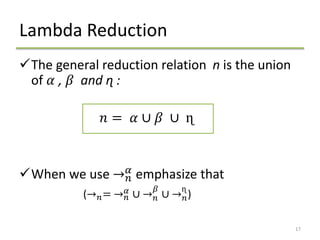
The general reduction relation n is the union
of 𝛼 , 𝛽 and ɳ :
𝑛 = 𝛼 ∪ 𝛽 ∪ ɳ
When we use → 𝑛
𝛼
emphasize that
(→ 𝑛= → 𝑛
𝛼 ∪ → 𝑛
𝛽
∪ → 𝑛
ɳ
)
17
Encoding data type in λ calculus
Booleans
 Boolean is a function that give two choices selects
one of them.
𝑡𝑟𝑢𝑒 = l 𝑥. l 𝑦. 𝑥
𝑓𝑎𝑙𝑠𝑒 = l 𝑥. l 𝑦. 𝑦
18
Encoding data type in λ calculus
Logic Operator
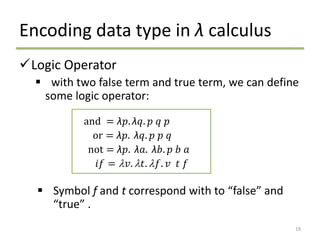
 with two false term and true term, we can define
some logic operator:
and = λ𝑝. λ𝑞. 𝑝 𝑞 𝑝
or = λ𝑝. λ𝑞. 𝑝 𝑝 𝑞
not = λ𝑝. λ𝑎. λ𝑏. 𝑝 𝑏 𝑎
𝑖𝑓 = l 𝑣. l 𝑡. l 𝑓. 𝑣 𝑡 𝑓
 Symbol f and t correspond with to “false” and
“true” .
19
Encoding data type in λ calculus
Logic Operator
 For example :
𝑖𝑓 𝑡𝑟𝑢𝑒 𝑀 𝑁 = 𝑛 𝑀
𝑖𝑓 𝑡𝑟𝑢𝑒 𝑀 𝑁 = l 𝑣. l 𝑡. l 𝑓. 𝑣 𝑡 𝑓 l 𝑥. l 𝑦. 𝑥 𝑀 𝑁
→ 𝑛
𝑏 l 𝑡. l 𝑓. l 𝑥. l 𝑦. 𝑥 𝑡 𝑓 𝑀 𝑁
→ 𝑛
𝑏 l 𝑓. l 𝑥. l 𝑦. 𝑥 𝑀 𝑓 𝑁
→ 𝑛
𝑏
l 𝑥. l 𝑦. 𝑥 𝑀 𝑁
→ 𝑛
𝑏 l 𝑦. 𝑀 𝑁
→ 𝑛
𝑏 𝑀
20
Encoding data type in λ calculus
Natural Number
 A natural number n is encoded by a function of
two arguments, f and x, where the function
applies f to x, n times.
0 ≔ λ𝑓. λ𝑥. 𝑥
1 ≔ λ𝑓. λ𝑥. 𝑓 𝑥
2 ≔ λ𝑓. λ𝑥. 𝑓 𝑓 𝑥
3 ≔ λ𝑓. λ𝑥. 𝑓 (𝑓 (𝑓 𝑥))
21
Encoding data type in λ calculus
Natural Number
 the function add1 represent a number n and
produce a number n+1.
𝑎𝑑𝑑1 = λ𝑛. λ𝑓. λ𝑥. 𝑓 (𝑛 𝑓 𝑥 )
 The function applies first argument to second
argument n+1.
22
Encoding data type in λ calculus
Natural Number
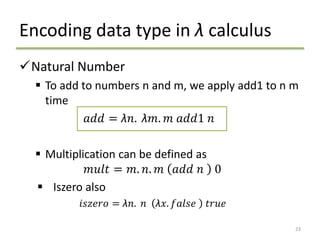
 To add to numbers n and m, we apply add1 to n m
time
𝑎𝑑𝑑 = λ𝑛. λ𝑚. 𝑚 𝑎𝑑𝑑1 𝑛
 Multiplication can be defined as
𝑚𝑢𝑙𝑡 = 𝑚. 𝑛. 𝑚 𝑎𝑑𝑑 𝑛 0
 Iszero also
𝑖𝑠𝑧𝑒𝑟𝑜 = λ𝑛. 𝑛 λ𝑥. 𝑓𝑎𝑙𝑠𝑒 𝑡𝑟𝑢𝑒
23
Encoding data type in λ calculus
 Pair
< 𝑀, 𝑁 > = λ𝑠. 𝑠 𝑀 𝑁
𝑚𝑘𝑝𝑎𝑖𝑟 = λ𝑥. λ𝑦. λ𝑠. 𝑠 𝑥 𝑦
𝑓𝑠𝑡 = λ𝑝. 𝑝 𝑡𝑟𝑢𝑒
𝑠𝑐𝑛𝑑 = λ𝑝. 𝑝 𝑓𝑎𝑙𝑠𝑒
 A linked list can be defined as either NIL for the empty list, or
the pair of an element and a smaller list.
 The predicate NULL tests for the value NIL.
𝑛𝑢𝑙𝑙 = λ𝑝. 𝑝 (λ𝑥. 𝑦. 𝑓𝑎𝑙𝑠𝑒)
𝑛𝑖𝑙𝑙 = λ𝑥. 𝑡𝑟𝑢𝑒
24
Encoding data type in λ calculus
Recursive Function
 Is the definition of a function using the function itself.
𝐹 𝑛 = 1, 𝑖𝑓 𝑛 = 0; 𝑒𝑙𝑠𝑒 𝑛 ∗ 𝐹 𝑛 − 1
 Can be defined in the λ calculus using a function
which calls a function y and generates itself.
𝑌 = (λ 𝑓. λ 𝑥. 𝑓 𝑥𝑥 λ 𝑥. 𝑓 (𝑥𝑥) )
25
Encoding data type in λ calculus
Recursive Function
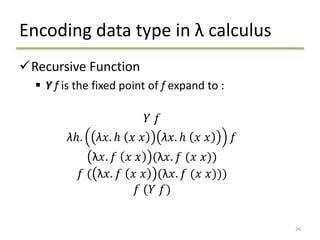
 Y f is the fixed point of f expand to :
𝑌 𝑓
λℎ. λ𝑥. ℎ 𝑥 𝑥 λ𝑥. ℎ 𝑥 𝑥 𝑓
λ𝑥. 𝑓 𝑥 𝑥 (λ𝑥. 𝑓 (𝑥 𝑥))
𝑓 ( λ𝑥. 𝑓 𝑥 𝑥 (λ𝑥. 𝑓 (𝑥 𝑥)))
𝑓 (𝑌 𝑓)
26
Encoding data type in λ calculus
Recursive Function
 For example, given n=4 to factorial function:
(Y F) 4
F (Y F) 4
(λr.λn.(1, if n = 0; else n × (r (n−1)))) (Y F) 4
(λn.(1, if n = 0; else n × ((Y F) (n−1)))) 4
1, if 4 = 0; else 4 × ((Y F) (4−1))
4 × (F (Y F) (4−1))
4 × ((λn.(1, if n = 0; else n × ((Y F) (n−1)))) (4−1))
4 × (1, if 3 = 0; else 3 × ((Y F) (3−1)))
4 × (3 × (F (Y F) (3−1)))
27
Encoding data type in λ calculus
Recursive Function
4 × (3 × ((λn.(1, if n = 0; else n × ((Y F) (n−1)))) (3−1)))
4 × (3 × (1, if 2 = 0; else 2 × ((Y F) (2−1))))
4 × (3 × (2 × (F (Y F) (2−1))))
4 × (3 × (2 × ((λn.(1, if n = 0; else n × ((Y F) (n−1)))) (2−1))))
4 × (3 × (2 × (1, if 1 = 0; else 1 × ((Y F) (1−1)))))
4 × (3 × (2 × (1 × (F (Y F) (1−1)))))
4 × (3 × (2 × (1 × ((λn.(1, if n = 0; else n × ((Y F) (n−1)))) (1−1)))))
4 × (3 × (2 × (1 × (1, if 0 = 0; else 0 × ((Y F) (0−1))))))
4 × (3 × (2 × (1 × (1))))
24
28
Normal Form
An expression is a normal form if it can’t be
reduced by → 𝑛
𝛽
or → 𝑛
ɳ
.
 M has normal form 𝑀 = 𝑛 𝑁 and N is a
normal form.
If 𝐿 = 𝑛 𝑀, 𝐿 = 𝑛 𝑁, and both M and N are
normal form, then 𝑀 = 𝛼 𝑁.
If an expression has a normal form, then may
be an infinite reduction sequence for the
expression that never reaches normal form.
29
Church-Rosser Theorem
Reduction in any way can eventually produce
the same result.
If 𝐸1 ↔ 𝐸2, then there exist an E such that
𝐸1 → 𝐸 and 𝐸2 → 𝐸.
If 𝐸1 → 𝐸2, and is a normal form, then there is
a normal-order reduction of 𝐸1to 𝐸2.
Normal-order reduction will always produce a
normal form, if one exists.
30
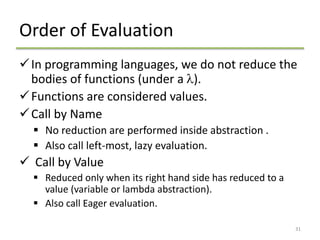
Order of Evaluation
In programming languages, we do not reduce the
bodies of functions (under a l).
Functions are considered values.
Call by Name
 No reduction are performed inside abstraction .
 Also call left-most, lazy evaluation.
 Call by Value
 Reduced only when its right hand side has reduced to a
value (variable or lambda abstraction).
 Also call Eager evaluation.
31
Order of Evaluation
Call by Name
– Difficult to implement.
– Order of side effects not predictable.
Call by Value
– Easy to implement efficiently.
– Might not terminate even if CBN might terminate.
– Example: (lx. l z.z) ((ly. yy) (lu. uu))
Outside the functional programming language
community, only CBV is used.
32
Functional Programming
• The lambda calculus is a prototypical
functional programming language.
– Higher order function
– No side-effect
• In practice, many functional programming
language are not “pure”, they permit.
– Supposed to avoid them
33
Functional Programming
Two main camps
– Haskell - Pure, lazy function language , no side-
effects
– ml (SML-OCaml) call- by- value with side-effects
Old still around : lisp scheme
– Disadvantage : no static typing
34
Functional Programming
• Functional ideas move to other languages.
• Garbage collection was designed for lisp ,now no
mast new languages us GC.
• Generics in C++/Java com from ML polymorphism
,or Haskell type classes
• Higher-order function and closures (used in Ruby,
exist in C# proposed to be in java soon) are
everywhere in function languages.
• Many object-oriented abstraction principles
come from ML’s module system.
35
References
Matthias Felleisen, “Programming Language
AND Lambda Calculus”.
Raul Rojas, “A Tutorial Introduction to the
Lambda Calculus”.
36

Lambda Calculus

  • 1.
  • 2.
    • History • Definition •Syntax λ calculus • Function in Lambda Calculus • Reduction • Encoding data type in λ calculus • Order of Evaluation • Functional Programming 2
  • 3.
    History It was introducedin 1930s by Alonzo Church as a way of formalizing the concept of effective computability.  λ calculus is a universal model of computation equivalent to a Turing machine. It also can be called the smallest universal programming language of the world. 3
  • 4.
    History All function programminglanguage can be viewed as syncretic variation of λ calculus. Functional languages such as Lisp, Scheme, FP, ML, Miranda, and Haskell are an attempt to realize Church's lambda calculus in practical form as a programming language. 4
  • 5.
    Definition Lambda expressions arecomposed of:  Variables  The abstraction symbols lambda 'λ' and dot '.'  parentheses ‘(‘ , ‘)' Note : variable is an identifier which can be any of the letters a, b, c. 5
  • 6.
    Syntax λ calculus Theset of λ-terms (notation Λ) is built up from an infantine set of variables 𝑉 = {𝑣, 𝑣′ , 𝑣′′ , . . } i. 𝑥 ∈ 𝑉 ii. 𝑀, 𝑁 ∈ Λ → 𝑀𝑁 ∈ Λ iii. 𝑀 ∈ Λ, 𝑥 ∈ 𝑉 → λ𝑥𝑀 ∈ Λ rule 2 are known as application and rule 3 are known as abstraction . 6
  • 7.
    Syntax λ calculus BN-form 𝑣𝑎𝑟𝑖𝑎𝑏𝑙𝑒∷= ‘v’| 𝑣𝑎𝑟𝑖𝑎𝑏𝑙𝑒‘′’ λ−𝑡𝑒𝑟𝑚 ∷= 𝑣𝑎𝑟𝑖𝑎𝑏𝑙𝑒 | ‘(’ λ − 𝑡𝑒𝑟𝑚 λ − 𝑡𝑒𝑟𝑚 ‘)’ | ‘(λ’𝑣𝑎𝑟𝑖𝑎𝑏𝑙𝑒 λ − 𝑡𝑒𝑟𝑚‘)’ 7
  • 8.
    Syntax λ calculus Applicationassociate from the left. – x y z : (x y) z Abstraction associate from the right. – lx. x ly. x y z : l x. (x (ly. ((x y) z))) Outermost parentheses are dropped. 8
  • 9.
    Function in LambdaCalculus Function in the λ calculus  focus on the rule for going from an argument to result.  Ignore the issues of naming the function and its domain and range.  Mathematical function : ∀𝑥 ∈ 𝐴, 𝑓 𝑥 = 𝑥  In the λ calculus : (λ𝑥. 𝑥)  Argument is called x, the output of the function is x. 9
  • 10.
    Function in LambdaCalculus  The application of the identity function to a : λ𝑥. 𝑥 𝑎  The argument for the identify itself: λ𝑥. 𝑥 λ𝑥. 𝑥  Function take an argument, ignore it and return the identity function: λy .(λ𝑥. 𝑥)  Function take an argument, return a function that ignore its own argument and return the argument original function: λy .(λ𝑥. 𝑦) 10
  • 11.
    Free Variables The setof free variables M denoted by 𝐹𝑉 𝑀 𝐹𝑉 𝑥 = 𝑥 𝐹𝑉 λ𝑥. 𝑀 = 𝐹𝑉 𝑀 𝑥 𝐹𝑉 𝑀 𝑁 = 𝐹𝑉 𝑀 ∪ 𝐹𝑉 𝑁 Note : Variables that fall within the scope of an abstraction are said to be bound. All other variables are called free. 11
  • 12.
    Substitution Substituting N forthe free occurrences of x in M Denoted by M[x := N] x[x := N] ≡ N y[x := N] ≡ y, if x ≠ y (M1 M2)[x := N] ≡ (M1[x := N]) (M2[x := N]) (λx.M)[x := N] ≡ λx.M(λy.M)[x := N] ≡ λy.(M[x := N]), if x ≠ y, provided y ∉ FV(N) 12
  • 13.
    Lambda Reduction 𝛼 −𝑟𝑒𝑑𝑢𝑐𝑡𝑖𝑜𝑛  allows bound variable names to be changed.  if x and y is variable and M is a λ expression: λx . M → 𝛼 λy . M[x → 𝑦]  Example : λ𝑦 . λ𝑓 . 𝑓 𝑥 𝑦 → 𝛼 λ𝑧 . λ𝑓 . 𝑓 𝑥 𝑧 λ𝑧 . λ𝑓 . 𝑓 𝑥 𝑧 → 𝛼 λ𝑧 . λ𝑔 . 𝑔 𝑥 𝑧 13
  • 14.
    Lambda Reduction 𝛽 −𝑟𝑒𝑑𝑢𝑐𝑡𝑖𝑜𝑛  applying functions to their arguments.  If x is variable and M and N are λ expression: ( λ𝑥. 𝑀 ) 𝑁 → 𝛽 𝑀[ 𝑥 → 𝑁]  Example: ( ( λn . n∗x ) y) → y∗x 14
  • 15.
    Lambda Reduction Reversing β-reductionproduce the β-abstraction. 𝑀 𝑥 → 𝑁 → 𝛽 λ𝑥 . 𝑀 𝑁 β-abstraction and β-reduction taken together give β-conversion 15
  • 16.
    Lambda Reduction ɳ −𝑟𝑒𝑑𝑢𝑐𝑡𝑖𝑜𝑛  which captures a notion of extensionality.  If x is variables and M is a λ expression , and x has no free occurrence in M : λ𝑥 . 𝐸 𝑥 →ɳ 𝐸  Example: λ𝑥 . 𝑠𝑞𝑟 𝑥 →ɳ 𝑠𝑞𝑟 16
  • 17.
    Lambda Reduction The generalreduction relation n is the union of 𝛼 , 𝛽 and ɳ : 𝑛 = 𝛼 ∪ 𝛽 ∪ ɳ When we use → 𝑛 𝛼 emphasize that (→ 𝑛= → 𝑛 𝛼 ∪ → 𝑛 𝛽 ∪ → 𝑛 ɳ ) 17
  • 18.
    Encoding data typein λ calculus Booleans  Boolean is a function that give two choices selects one of them. 𝑡𝑟𝑢𝑒 = l 𝑥. l 𝑦. 𝑥 𝑓𝑎𝑙𝑠𝑒 = l 𝑥. l 𝑦. 𝑦 18
  • 19.
    Encoding data typein λ calculus Logic Operator  with two false term and true term, we can define some logic operator: and = λ𝑝. λ𝑞. 𝑝 𝑞 𝑝 or = λ𝑝. λ𝑞. 𝑝 𝑝 𝑞 not = λ𝑝. λ𝑎. λ𝑏. 𝑝 𝑏 𝑎 𝑖𝑓 = l 𝑣. l 𝑡. l 𝑓. 𝑣 𝑡 𝑓  Symbol f and t correspond with to “false” and “true” . 19
  • 20.
    Encoding data typein λ calculus Logic Operator  For example : 𝑖𝑓 𝑡𝑟𝑢𝑒 𝑀 𝑁 = 𝑛 𝑀 𝑖𝑓 𝑡𝑟𝑢𝑒 𝑀 𝑁 = l 𝑣. l 𝑡. l 𝑓. 𝑣 𝑡 𝑓 l 𝑥. l 𝑦. 𝑥 𝑀 𝑁 → 𝑛 𝑏 l 𝑡. l 𝑓. l 𝑥. l 𝑦. 𝑥 𝑡 𝑓 𝑀 𝑁 → 𝑛 𝑏 l 𝑓. l 𝑥. l 𝑦. 𝑥 𝑀 𝑓 𝑁 → 𝑛 𝑏 l 𝑥. l 𝑦. 𝑥 𝑀 𝑁 → 𝑛 𝑏 l 𝑦. 𝑀 𝑁 → 𝑛 𝑏 𝑀 20
  • 21.
    Encoding data typein λ calculus Natural Number  A natural number n is encoded by a function of two arguments, f and x, where the function applies f to x, n times. 0 ≔ λ𝑓. λ𝑥. 𝑥 1 ≔ λ𝑓. λ𝑥. 𝑓 𝑥 2 ≔ λ𝑓. λ𝑥. 𝑓 𝑓 𝑥 3 ≔ λ𝑓. λ𝑥. 𝑓 (𝑓 (𝑓 𝑥)) 21
  • 22.
    Encoding data typein λ calculus Natural Number  the function add1 represent a number n and produce a number n+1. 𝑎𝑑𝑑1 = λ𝑛. λ𝑓. λ𝑥. 𝑓 (𝑛 𝑓 𝑥 )  The function applies first argument to second argument n+1. 22
  • 23.
    Encoding data typein λ calculus Natural Number  To add to numbers n and m, we apply add1 to n m time 𝑎𝑑𝑑 = λ𝑛. λ𝑚. 𝑚 𝑎𝑑𝑑1 𝑛  Multiplication can be defined as 𝑚𝑢𝑙𝑡 = 𝑚. 𝑛. 𝑚 𝑎𝑑𝑑 𝑛 0  Iszero also 𝑖𝑠𝑧𝑒𝑟𝑜 = λ𝑛. 𝑛 λ𝑥. 𝑓𝑎𝑙𝑠𝑒 𝑡𝑟𝑢𝑒 23
  • 24.
    Encoding data typein λ calculus  Pair < 𝑀, 𝑁 > = λ𝑠. 𝑠 𝑀 𝑁 𝑚𝑘𝑝𝑎𝑖𝑟 = λ𝑥. λ𝑦. λ𝑠. 𝑠 𝑥 𝑦 𝑓𝑠𝑡 = λ𝑝. 𝑝 𝑡𝑟𝑢𝑒 𝑠𝑐𝑛𝑑 = λ𝑝. 𝑝 𝑓𝑎𝑙𝑠𝑒  A linked list can be defined as either NIL for the empty list, or the pair of an element and a smaller list.  The predicate NULL tests for the value NIL. 𝑛𝑢𝑙𝑙 = λ𝑝. 𝑝 (λ𝑥. 𝑦. 𝑓𝑎𝑙𝑠𝑒) 𝑛𝑖𝑙𝑙 = λ𝑥. 𝑡𝑟𝑢𝑒 24
  • 25.
    Encoding data typein λ calculus Recursive Function  Is the definition of a function using the function itself. 𝐹 𝑛 = 1, 𝑖𝑓 𝑛 = 0; 𝑒𝑙𝑠𝑒 𝑛 ∗ 𝐹 𝑛 − 1  Can be defined in the λ calculus using a function which calls a function y and generates itself. 𝑌 = (λ 𝑓. λ 𝑥. 𝑓 𝑥𝑥 λ 𝑥. 𝑓 (𝑥𝑥) ) 25
  • 26.
    Encoding data typein λ calculus Recursive Function  Y f is the fixed point of f expand to : 𝑌 𝑓 λℎ. λ𝑥. ℎ 𝑥 𝑥 λ𝑥. ℎ 𝑥 𝑥 𝑓 λ𝑥. 𝑓 𝑥 𝑥 (λ𝑥. 𝑓 (𝑥 𝑥)) 𝑓 ( λ𝑥. 𝑓 𝑥 𝑥 (λ𝑥. 𝑓 (𝑥 𝑥))) 𝑓 (𝑌 𝑓) 26
  • 27.
    Encoding data typein λ calculus Recursive Function  For example, given n=4 to factorial function: (Y F) 4 F (Y F) 4 (λr.λn.(1, if n = 0; else n × (r (n−1)))) (Y F) 4 (λn.(1, if n = 0; else n × ((Y F) (n−1)))) 4 1, if 4 = 0; else 4 × ((Y F) (4−1)) 4 × (F (Y F) (4−1)) 4 × ((λn.(1, if n = 0; else n × ((Y F) (n−1)))) (4−1)) 4 × (1, if 3 = 0; else 3 × ((Y F) (3−1))) 4 × (3 × (F (Y F) (3−1))) 27
  • 28.
    Encoding data typein λ calculus Recursive Function 4 × (3 × ((λn.(1, if n = 0; else n × ((Y F) (n−1)))) (3−1))) 4 × (3 × (1, if 2 = 0; else 2 × ((Y F) (2−1)))) 4 × (3 × (2 × (F (Y F) (2−1)))) 4 × (3 × (2 × ((λn.(1, if n = 0; else n × ((Y F) (n−1)))) (2−1)))) 4 × (3 × (2 × (1, if 1 = 0; else 1 × ((Y F) (1−1))))) 4 × (3 × (2 × (1 × (F (Y F) (1−1))))) 4 × (3 × (2 × (1 × ((λn.(1, if n = 0; else n × ((Y F) (n−1)))) (1−1))))) 4 × (3 × (2 × (1 × (1, if 0 = 0; else 0 × ((Y F) (0−1)))))) 4 × (3 × (2 × (1 × (1)))) 24 28
  • 29.
    Normal Form An expressionis a normal form if it can’t be reduced by → 𝑛 𝛽 or → 𝑛 ɳ .  M has normal form 𝑀 = 𝑛 𝑁 and N is a normal form. If 𝐿 = 𝑛 𝑀, 𝐿 = 𝑛 𝑁, and both M and N are normal form, then 𝑀 = 𝛼 𝑁. If an expression has a normal form, then may be an infinite reduction sequence for the expression that never reaches normal form. 29
  • 30.
    Church-Rosser Theorem Reduction inany way can eventually produce the same result. If 𝐸1 ↔ 𝐸2, then there exist an E such that 𝐸1 → 𝐸 and 𝐸2 → 𝐸. If 𝐸1 → 𝐸2, and is a normal form, then there is a normal-order reduction of 𝐸1to 𝐸2. Normal-order reduction will always produce a normal form, if one exists. 30
  • 31.
    Order of Evaluation Inprogramming languages, we do not reduce the bodies of functions (under a l). Functions are considered values. Call by Name  No reduction are performed inside abstraction .  Also call left-most, lazy evaluation.  Call by Value  Reduced only when its right hand side has reduced to a value (variable or lambda abstraction).  Also call Eager evaluation. 31
  • 32.
    Order of Evaluation Callby Name – Difficult to implement. – Order of side effects not predictable. Call by Value – Easy to implement efficiently. – Might not terminate even if CBN might terminate. – Example: (lx. l z.z) ((ly. yy) (lu. uu)) Outside the functional programming language community, only CBV is used. 32
  • 33.
    Functional Programming • Thelambda calculus is a prototypical functional programming language. – Higher order function – No side-effect • In practice, many functional programming language are not “pure”, they permit. – Supposed to avoid them 33
  • 34.
    Functional Programming Two maincamps – Haskell - Pure, lazy function language , no side- effects – ml (SML-OCaml) call- by- value with side-effects Old still around : lisp scheme – Disadvantage : no static typing 34
  • 35.
    Functional Programming • Functionalideas move to other languages. • Garbage collection was designed for lisp ,now no mast new languages us GC. • Generics in C++/Java com from ML polymorphism ,or Haskell type classes • Higher-order function and closures (used in Ruby, exist in C# proposed to be in java soon) are everywhere in function languages. • Many object-oriented abstraction principles come from ML’s module system. 35
  • 36.
    References Matthias Felleisen, “ProgrammingLanguage AND Lambda Calculus”. Raul Rojas, “A Tutorial Introduction to the Lambda Calculus”. 36

Editor's Notes

  • #9 Baraye hazf noghte o parantez miain az ghanonaye bala estefade mikonim k estedafe azashono b hadeaqal bresoim. Tozihaye bishtar bde
  • #10 Barreeesi halat haye khase function abstarct
  • #14 Inja bgo k to zaban haye static scope alph conv mitone baraye name resolution estefade bshe