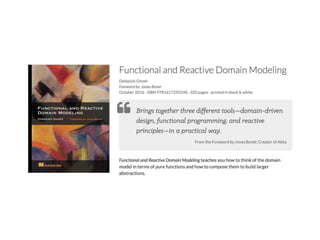
Functional and
Algebraic Domain
Modeling
Debasish Ghosh
@debasishg
Functional and
Algebraic Domain
Modeling
Debasish Ghosh
@debasishg
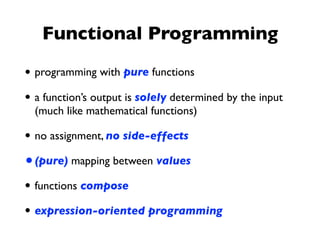
Functional Programming
• programming with pure functions
• a function’s output is solely determined by the input
(much like mathematical functions)
• no assignment, no side-effects
•(pure) mapping between values
• functions compose
• expression-oriented programming
Functional and
Algebraic Domain
Modeling
Debasish Ghosh
@debasishg
What is an Algebra ?
Algebra is the study of algebraic structures
In mathematics, and more specifically in abstract
algebra, an algebraic structure is
a set (called carrier set or underlying set)
with one or more finitary operations defined on it
that satisfies a list of axioms
-Wikipedia
(https://en.wikipedia.org/wiki/Algebraic_structure)
Set A
ϕ : A × A → A
fo r (a, b) ∈ A
ϕ(a, b)
a ϕ b
given
a binary operation
for specific a, b
or
The Algebra of Sets
Algebraic Thinking
• Thinking and reasoning about code in terms of the
data types and the operations they support
without considering a bit about the underlying
implementations
• f: A => B and g: B => C, we should be able to
reason that we can compose f and g algebraically
to build a larger function h: A => C
•algebraic composition
Functional and
Algebraic Domain
Modeling
Debasish Ghosh
@debasishg
Domain Modeling
Domain Modeling
(Functional)
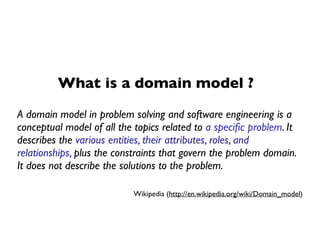
What is a domain model ?
A domain model in problem solving and software engineering is a
conceptual model of all the topics related to a specific problem. It
describes the various entities, their attributes, roles, and
relationships, plus the constraints that govern the problem domain.
It does not describe the solutions to the problem.
Wikipedia (http://en.wikipedia.org/wiki/Domain_model)
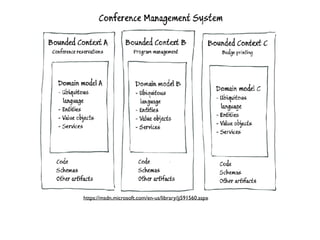
https://msdn.microsoft.com/en-us/library/jj591560.aspx
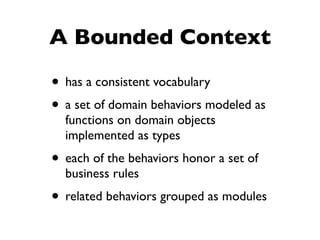
A Bounded Context
• has a consistent vocabulary
• a set of domain behaviors modeled as
functions on domain objects
implemented as types
• each of the behaviors honor a set of
business rules
• related behaviors grouped as modules
Domain Model = ∪(i) Bounded Context(i)
Bounded Context = { m[T1,T2,..] | T(i) ∈ Types }
Module = { f(x,y,..) | p(x,y) ∈ Domain Rules }
• domain function
• on an object of types x, y, ..
• composes with other functions
• closed under composition
• business rules
• Functions / Morphisms
• Types / Sets
• Composition
• Rules / Laws
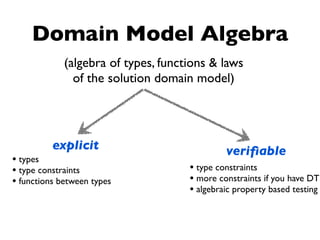
algebra
explicit verifiable
• types
• type constraints
• functions between types
• type constraints
• more constraints if you have DT
• algebraic property based testing
(algebra of types, functions & laws
of the solution domain model)
Domain Model Algebra
What is meant by the
algebra of a type ?
•Nothing
•Unit
•Boolean
•Byte
•String
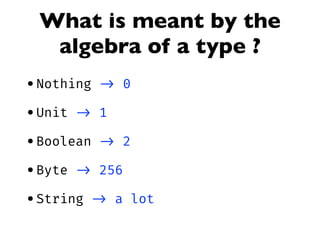
What is meant by the
algebra of a type ?
•Nothing -> 0
•Unit -> 1
•Boolean -> 2
•Byte -> 256
•String -> a lot
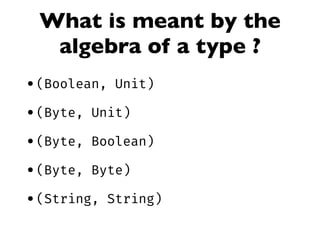
What is meant by the
algebra of a type ?
•(Boolean, Unit)
•(Byte, Unit)
•(Byte, Boolean)
•(Byte, Byte)
•(String, String)
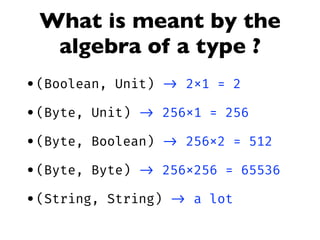
What is meant by the
algebra of a type ?
•(Boolean, Unit) -> 2x1 = 2
•(Byte, Unit) -> 256x1 = 256
•(Byte, Boolean) -> 256x2 = 512
•(Byte, Byte) -> 256x256 = 65536
•(String, String) -> a lot
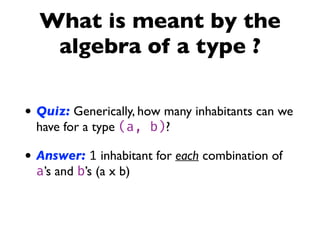
What is meant by the
algebra of a type ?
• Quiz: Generically, how many inhabitants can we
have for a type (a, b)?
• Answer: 1 inhabitant for each combination of
a’s and b’s (a x b)
Product Types
• Ordered pairs of values one from each type in
the order specified - this and that
• Can be generalized to a finite product indexed by
a finite set of indices
Product Types in Scala
type Point = (Int, Int)
val p = (10, 12)
case class Account(no: String,
name: String,
address: String,
dateOfOpening: Date,
dateOfClosing: Option[Date]
)
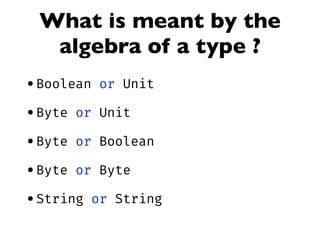
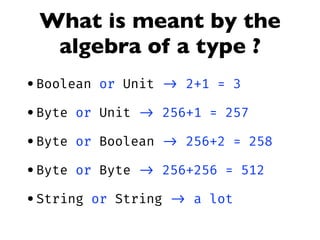
What is meant by the
algebra of a type ?
•Boolean or Unit
•Byte or Unit
•Byte or Boolean
•Byte or Byte
•String or String
What is meant by the
algebra of a type ?
•Boolean or Unit -> 2+1 = 3
•Byte or Unit -> 256+1 = 257
•Byte or Boolean -> 256+2 = 258
•Byte or Byte -> 256+256 = 512
•String or String -> a lot
Sum Types
• Model data structures involving alternatives -
this or that
• A tree can have a leaf or an internal node which,
is again a tree
• In Scala, a sum type is usually referred to as an
Algebraic DataType (ADT)
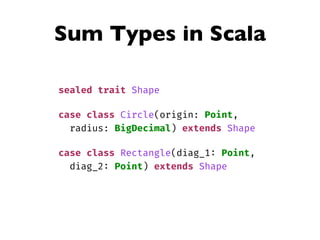
Sum Types in Scala
sealed trait Shape
case class Circle(origin: Point,
radius: BigDecimal) extends Shape
case class Rectangle(diag_1: Point,
diag_2: Point) extends Shape
Sum Types are
Expressive
• Booleans - true or false
• Enumerations - sum types may be used to define finite
enumeration types, whose values are one of an explicitly
specified finite set
• Optionality - the Option data type in Scala is encoded using a
sum type
• Disjunction - this or that, the Either data type in Scala
• Failure encoding - the Try data type in Scala to indicate that
the computation may raise an exception
sealed trait InstrumentType
case object CCY extends InstrumentType
case object EQ extends InstrumentType
case object FI extends InstrumentType
sealed trait Instrument {
def instrumentType: InstrumentType
}
case class Equity(isin: String, name: String, issueDate: Date,
faceValue: Amount) extends Instrument {
final val instrumentType = EQ
}
case class FixedIncome(isin: String, name: String, issueDate: Date,
maturityDate: Option[Date], nominal: Amount) extends Instrument {
final val instrumentType = FI
}
case class Currency(isin: String) extends Instrument {
final val instrumentType = CCY
}
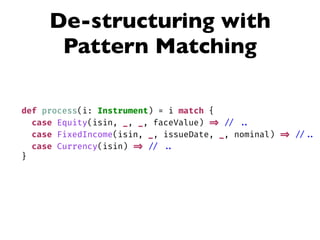
De-structuring with
Pattern Matching
def process(i: Instrument) = i match {
case Equity(isin, _, _, faceValue) => // ..
case FixedIncome(isin, _, issueDate, _, nominal) => // ..
case Currency(isin) => // ..
}
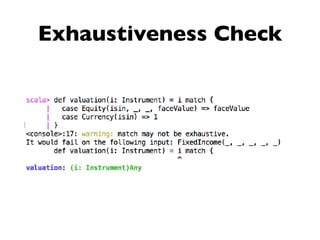
Exhaustiveness Check
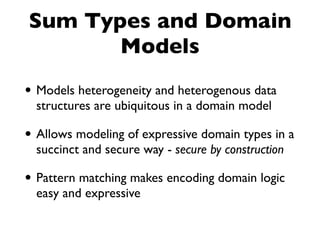
Sum Types and Domain
Models
• Models heterogeneity and heterogenous data
structures are ubiquitous in a domain model
• Allows modeling of expressive domain types in a
succinct and secure way - secure by construction
• Pattern matching makes encoding domain logic
easy and expressive
– Robert Harper in Practical Foundations of Programming Languages
“The absence of sums is the origin of C. A. R.
Hoare’s self-described ‘billion dollar mistake,’
the null pointer”
More algebra of types
• Exponentiation - f: A => B has b^a
inhabitants
• Taylor Series - Recursive Data Types
• Derivatives - Zippers
• …
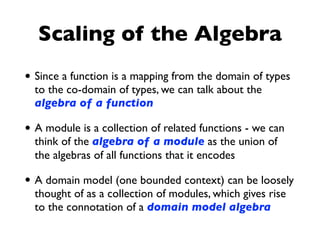
Scaling of the Algebra
• Since a function is a mapping from the domain of types
to the co-domain of types, we can talk about the
algebra of a function
• A module is a collection of related functions - we can
think of the algebra of a module as the union of
the algebras of all functions that it encodes
• A domain model (one bounded context) can be loosely
thought of as a collection of modules, which gives rise
to the connotation of a domain model algebra
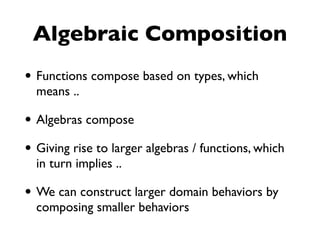
Algebraic Composition
• Functions compose based on types, which
means ..
• Algebras compose
• Giving rise to larger algebras / functions, which
in turn implies ..
• We can construct larger domain behaviors by
composing smaller behaviors
Algebras are Ubiquitous
• Generic, parametric and hence usable on an
infinite set of data types, including your domain
model’s types
Algebras are Ubiquitous
• Generic, parametric and hence usable on an
infinite set of data types, including your domain
model’s types
• Clear separation between the contract (the
algebra) and its implementations
(interpreters)
Algebras are Ubiquitous
• Generic, parametric and hence usable on an
infinite set of data types, including your domain
model’s types
• Clear separation between the contract (the
algebra) and its implementations
(interpreters)
• Standard vocabulary (like design patterns)
Algebras are Ubiquitous
• Generic, parametric and hence usable on an
infinite set of data types, including your domain
model’s types
• Clear separation between the contract (the
algebra) and its implementations (interpreters)
• Standard vocabulary (like design patterns)
• Existing set of reusable algebras offered by the
standard libraries
Roadmap to a Functional
and Algebraic Model
1. Identify domain behaviors
2. Identify the algebras of functions (not implementation)
3. Compose algebras to form larger behaviors - follow
the types depending on the semantics of
compositionality.We call this behavior a program that
models the use case
4. Plug in concrete types to complete the
implementation
Domain Model = ∪(i) Bounded Context(i)
Bounded Context = { m[T1,T2,..] | T(i) ∈ Types }
Module = { f(x,y,..) | p(x,y) ∈ Domain Rules }
• domain function
• on an object of types x, y
• composes with other functions
• closed under composition
• business rules
Domain Model = ∪(i) Bounded Context(i)
Bounded Context = { m[T1,T2,..] | T(i) ∈ Types }
Module = { f(x,y,..) | p(x,y) ∈ Domain Rules }
• domain function
• on an object of types x, y
• composes with other functions
• closed under composition
• business rules
Domain Algebra
Domain Algebra
Given all the properties of algebra, can we
consider algebraic composition to be the
basis of designing, implementing and modularizing
domain models ?
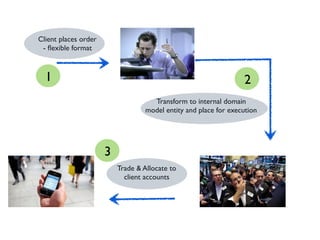
Client places order
- flexible format
1
Client places order
- flexible format
Transform to internal domain
model entity and place for execution
1 2
Client places order
- flexible format
Transform to internal domain
model entity and place for execution
Trade & Allocate to
client accounts
1 2
3
def fromClientOrder: ClientOrder => Order
def execute(market: Market, brokerAccount: Account)
: Order => List[Execution]
def allocate(accounts: List[Account])
: List[Execution] => List[Trade]
trait Trading {
}
trait TradeComponent extends Trading
with Logging with Auditing
algebra of domain
behaviors / functions
functions aggregate
upwards into modules
modules aggregate
into larger modules
.. so we have a decent algebra of our module, the
names reflect the appropriate artifacts from the
domain (ubiquitous language), the types are
well published and we are quite explicit in what
the behaviors do ..
1. Compositionality - How do we compose
the 3 behaviors that we published to
generate trade in the market and allocate
to client accounts ?
2. Side-effects - We need to compose them
alongside all side-effects that form a core
part of all non trivial domain model
implementations
• Error handling ?
• throw / catch exceptions is not RT
• Partiality ?
• partial functions can report runtime exceptions if invoked
with unhandled arguments (violates RT)
• Reading configuration information from environment ?
• may result in code repetition if not properly handled
• Logging ?
• side-effects
Side-effects
Side-effects
• Database writes
• Writing to a message queue
• Reading from stdin / files
• Interacting with any external resource
• Changing state in place
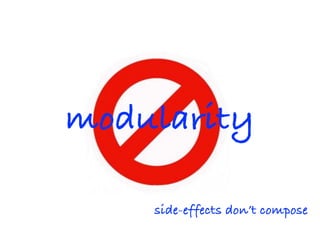
modularity
side-effects don’t compose
.. the semantics of compositionality ..
in the presence of side-effects
Algebra to the rescue ..
of types
Abstract side-effects into
data type constructors
Abstract side-effects into
data type constructors,
which we call Effects ..
Option[A]
Either[A,B]
(partiality)
(disjunction)
List[A]
(non-determinism)
Reader[E,A]
(read from environment aka dependency Injection)
Writer[W,A]
(logging)
State[S,A]
(state management)
IO[A]
(external side-effects)
.. and there are many many more ..
F[A]
The answer that the
effect computesThe additional stuff
modeling the computation
• The F[_] that we saw is an opaque type - it
has no denotation till we give it one
• The denotation that we give to F[_] depends
on the semantics of compositionality that we
would like to have for our domain model
behaviors
def fromClientOrder: ClientOrder => F[Order]
def execute(market: Market, brokerAccount: Account)
: Order => F[List[Execution]]
def allocate(accounts: List[Account])
: List[Execution] => F[List[Trade]]
trait Trading[F[_]] {
}
Effect Type
• Just the Algebra

• No denotation, no
concrete type

• Explicitly stating that we
have effectful functions
here
def fromClientOrder: ClientOrder => F[Order]
def execute(market: Market, brokerAccount: Account)
: Order => F[List[Execution]]
def allocate(accounts: List[Account])
: List[Execution] => F[List[Trade]]
trait Trading[F[_]] {
}
Effect Type
• .. we have intentionally kept the algebra open
for interpretation ..
• .. there are use cases where you would like to
have multiple interpreters for the same
algebra ..
The Program
def tradeGeneration[M[_]: Monad](T: Trading[M]) = for {
order <- T.fromClientOrder(cor)
executions <- T.execute(m1, ba, order)
trades <- T.allocate(List(ca1, ca2, ca3), executions)
} yield trades
class TradingInterpreter[F[_]]
(implicit me: MonadError[F, Throwable])
extends Trading[F] {
def fromClientOrder: ClientOrder => F[Order] = makeOrder(_) match {
case Left(dv) => me.raiseError(new Exception(dv.message))
case Right(o) => o.pure[F]
}
def execute(market: Market, brokerAccount: Account)
: Order => F[List[Execution]] = ...
def allocate(accounts: List[Account])
: List[Execution] => F[List[Trade]] = ...
}
One Sample Interpreter
• .. one lesson in modularity - commit to a
concrete implementation as late as
possible in the design ..
• .. we have just indicated that we want a
monadic effect - we haven’t committed to
any concrete monad type even in the
interpreter ..
The Program
def tradeGeneration[M[_]: Monad](T: Trading[M]) = for {
order <- T.fromClientOrder(cor)
executions <- T.execute(m1, ba, order)
trades <- T.allocate(List(ca1, ca2, ca3), executions)
} yield trades
import cats.effect.IO
object TradingComponent extends TradingInterpreter[IO]
tradeGeneration(TradingComponent).unsafeRunSync
The Program
def tradeGeneration[M[_]: Monad](T: Trading[M]) = for {
order <- T.fromClientOrder(cor)
executions <- T.execute(m1, ba, order)
trades <- T.allocate(List(ca1, ca2, ca3), executions)
} yield trades
import monix.eval.Task
object TradingComponent extends TradingInterpreter[Task]
tradeGeneration(TradingComponent)
The Program
def tradeGenerationLoggable[M[_]: Monad]
(T: Trading[M], L: Logging[M]) = for {
_ <- L.info("starting order processing")
order <- T.fromClientOrder(cor)
executions <- T.execute(m1, ba, order)
trades <- T.allocate(List(ca1, ca2, ca3), executions)
_ <- L.info("allocation done")
} yield trades
object TradingComponent extends TradingInterpreter[IO]
object LoggingComponent extends LoggingInterpreter[IO]
tradeGenerationLoggable(TradingComponent, LoggingComponent).unsafeRunSync
Raise the level of
abstraction
trait Trading[F[_]] {
def fromClientOrder
: Kleisli[F, ClientOrder, Order]
def execute(market: Market, brokerAccount: Account)
: Kleisli[F, Order, List[Execution]]
def allocate(accounts: List[Account])
: Kleisli[F, List[Execution], List[Trade]]
}
The Program
def tradeGeneration[M[_]: Monad](T: Trading[M])
: Kleisli[M, ClientOrder, List[Trade]] = {
T.fromClientOrder andThen
T.execute(m1, ba) andThen
T.allocate(List(ca1, ca2, ca3))
}
object TradingComponent extends TradingInterpreter[IO]
val tk = tradeGeneration(TradingComponent)
tk(cor).unsafeRunSync
Effects
Side-effects
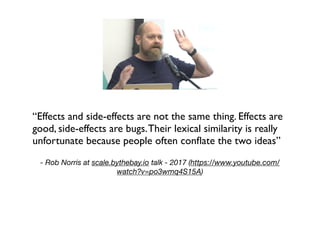
- Rob Norris at scale.bythebay.io talk - 2017 (https://www.youtube.com/
watch?v=po3wmq4S15A)
“Effects and side-effects are not the same thing. Effects are
good, side-effects are bugs.Their lexical similarity is really
unfortunate because people often conflate the two ideas”
Takeaways
• Algebra scales from that of one single data type to
an entire bounded context
• Algebras compose enabling composition of
domain behaviors
• Algebras let you focus on the compositionality
without any context of implementation
• Statically typed functional programming is
programming with algebras
Takeaways
• Abstract early, interpret as late as possible
• Abstractions / functions compose only when they are
abstract and parametric
• Modularity in the presence of side-effects is a challenge
• Effects as algebras are pure values that can compose based
on laws
• Honor the law of using the least powerful abstraction
that works
From the Bible
“Name classes and operations to describe their effect and purpose,
without reference to the means by which they do what they
promise.This relieves the client developer of the need to understand
the internals.These names should conform to the UBIQUITOUS
LANGUAGE so that team members can quickly infer their meaning.
Write a test for a behavior before creating it, to force your thinking
into client developer mode.”
- Eric Evans (Domain Driven Design)
in the chapter on Supple Design, while discussing
Intention Revealing Interfaces
• All names are from the domain vocabulary

• Just the algebra describing the promise, no
implementation details

• Purpose and effect explicit - yes, literally
explicit with effects
def fromClientOrder: ClientOrder => F[Order]
def execute(market: Market, brokerAccount: Account)
: Order => F[List[Execution]]
def allocate(accounts: List[Account])
: List[Execution] => F[List[Trade]]
trait Trading[F[_]] {
}
From the Bible
“Place as much of the logic of the program as possible into
functions, operations that return results with no observable side-
effects.”
- Eric Evans (Domain Driven Design)
in the chapter on Supple Design, while discussing
Side-Effect-Free Functions
def tradeGeneration[M[_]: Monad](T: Trading[M]) = for {
order <- T.fromClientOrder(cor)
executions <- T.execute(m1, ba, order)
trades <- T.allocate(List(ca1, ca2, ca3), executions)
} yield trades
• The program tradeGeneration is completely side-effect free. It
generates a pure value.

• Since the program is pure, you can interpret it in many ways (as we saw
earlier).

• The side-effects occur only when you submit the program to the run time
system.

• This is also an example where using algebraic & functional approach we
get a clear separation between the building of an abstraction and
executing it.
From the Bible
“When it fits, define an operation whose return type is the same as
the type of its argument(s). If the implementer has state that is
used in the computation, then the implementer is effectively an
argument of the operation, so the argument(s) and return value
should be of the same type as the implementer. Such an operation
is closed under the set of instances of that type.A closed operation
provides a high-level interface without introducing any dependency
on other concepts.”
- Eric Evans (Domain Driven Design)
in the chapter on Supple Design, while discussing
Closure of Operations
trait Semigroup[A] {
def combine(x: A, y: A): A
}
trait Monoid[A] extends Semigroup[A] {
def empty: A
}
• With algebraic modeling, you can encode the closure of operations
through the algebra of a Monoid.

★ parametric

★ define the algebra once, implement it as many times based on the
context

★ compositionality at the algebra level

• For stateful computation, use the algebra of the State Monad and
manipulate state as a Monoid
Questions?

Functional and Algebraic Domain Modeling

  • 1.
  • 2.
  • 3.
    Functional Programming • programmingwith pure functions • a function’s output is solely determined by the input (much like mathematical functions) • no assignment, no side-effects •(pure) mapping between values • functions compose • expression-oriented programming
  • 6.
  • 7.
    What is anAlgebra ? Algebra is the study of algebraic structures In mathematics, and more specifically in abstract algebra, an algebraic structure is a set (called carrier set or underlying set) with one or more finitary operations defined on it that satisfies a list of axioms -Wikipedia (https://en.wikipedia.org/wiki/Algebraic_structure)
  • 8.
    Set A ϕ :A × A → A fo r (a, b) ∈ A ϕ(a, b) a ϕ b given a binary operation for specific a, b or The Algebra of Sets
  • 9.
    Algebraic Thinking • Thinkingand reasoning about code in terms of the data types and the operations they support without considering a bit about the underlying implementations • f: A => B and g: B => C, we should be able to reason that we can compose f and g algebraically to build a larger function h: A => C •algebraic composition
  • 10.
  • 11.
  • 12.
  • 13.
    What is adomain model ? A domain model in problem solving and software engineering is a conceptual model of all the topics related to a specific problem. It describes the various entities, their attributes, roles, and relationships, plus the constraints that govern the problem domain. It does not describe the solutions to the problem. Wikipedia (http://en.wikipedia.org/wiki/Domain_model)
  • 19.
  • 20.
    A Bounded Context •has a consistent vocabulary • a set of domain behaviors modeled as functions on domain objects implemented as types • each of the behaviors honor a set of business rules • related behaviors grouped as modules
  • 21.
    Domain Model =∪(i) Bounded Context(i) Bounded Context = { m[T1,T2,..] | T(i) ∈ Types } Module = { f(x,y,..) | p(x,y) ∈ Domain Rules } • domain function • on an object of types x, y, .. • composes with other functions • closed under composition • business rules
  • 22.
    • Functions /Morphisms • Types / Sets • Composition • Rules / Laws algebra
  • 23.
    explicit verifiable • types •type constraints • functions between types • type constraints • more constraints if you have DT • algebraic property based testing (algebra of types, functions & laws of the solution domain model) Domain Model Algebra
  • 24.
    What is meantby the algebra of a type ? •Nothing •Unit •Boolean •Byte •String
  • 25.
    What is meantby the algebra of a type ? •Nothing -> 0 •Unit -> 1 •Boolean -> 2 •Byte -> 256 •String -> a lot
  • 26.
    What is meantby the algebra of a type ? •(Boolean, Unit) •(Byte, Unit) •(Byte, Boolean) •(Byte, Byte) •(String, String)
  • 27.
    What is meantby the algebra of a type ? •(Boolean, Unit) -> 2x1 = 2 •(Byte, Unit) -> 256x1 = 256 •(Byte, Boolean) -> 256x2 = 512 •(Byte, Byte) -> 256x256 = 65536 •(String, String) -> a lot
  • 28.
    What is meantby the algebra of a type ? • Quiz: Generically, how many inhabitants can we have for a type (a, b)? • Answer: 1 inhabitant for each combination of a’s and b’s (a x b)
  • 29.
    Product Types • Orderedpairs of values one from each type in the order specified - this and that • Can be generalized to a finite product indexed by a finite set of indices
  • 30.
    Product Types inScala type Point = (Int, Int) val p = (10, 12) case class Account(no: String, name: String, address: String, dateOfOpening: Date, dateOfClosing: Option[Date] )
  • 31.
    What is meantby the algebra of a type ? •Boolean or Unit •Byte or Unit •Byte or Boolean •Byte or Byte •String or String
  • 32.
    What is meantby the algebra of a type ? •Boolean or Unit -> 2+1 = 3 •Byte or Unit -> 256+1 = 257 •Byte or Boolean -> 256+2 = 258 •Byte or Byte -> 256+256 = 512 •String or String -> a lot
  • 33.
    Sum Types • Modeldata structures involving alternatives - this or that • A tree can have a leaf or an internal node which, is again a tree • In Scala, a sum type is usually referred to as an Algebraic DataType (ADT)
  • 34.
    Sum Types inScala sealed trait Shape case class Circle(origin: Point, radius: BigDecimal) extends Shape case class Rectangle(diag_1: Point, diag_2: Point) extends Shape
  • 35.
    Sum Types are Expressive •Booleans - true or false • Enumerations - sum types may be used to define finite enumeration types, whose values are one of an explicitly specified finite set • Optionality - the Option data type in Scala is encoded using a sum type • Disjunction - this or that, the Either data type in Scala • Failure encoding - the Try data type in Scala to indicate that the computation may raise an exception
  • 36.
    sealed trait InstrumentType caseobject CCY extends InstrumentType case object EQ extends InstrumentType case object FI extends InstrumentType sealed trait Instrument { def instrumentType: InstrumentType } case class Equity(isin: String, name: String, issueDate: Date, faceValue: Amount) extends Instrument { final val instrumentType = EQ } case class FixedIncome(isin: String, name: String, issueDate: Date, maturityDate: Option[Date], nominal: Amount) extends Instrument { final val instrumentType = FI } case class Currency(isin: String) extends Instrument { final val instrumentType = CCY }
  • 37.
    De-structuring with Pattern Matching defprocess(i: Instrument) = i match { case Equity(isin, _, _, faceValue) => // .. case FixedIncome(isin, _, issueDate, _, nominal) => // .. case Currency(isin) => // .. }
  • 38.
  • 39.
    Sum Types andDomain Models • Models heterogeneity and heterogenous data structures are ubiquitous in a domain model • Allows modeling of expressive domain types in a succinct and secure way - secure by construction • Pattern matching makes encoding domain logic easy and expressive
  • 40.
    – Robert Harperin Practical Foundations of Programming Languages “The absence of sums is the origin of C. A. R. Hoare’s self-described ‘billion dollar mistake,’ the null pointer”
  • 41.
    More algebra oftypes • Exponentiation - f: A => B has b^a inhabitants • Taylor Series - Recursive Data Types • Derivatives - Zippers • …
  • 42.
    Scaling of theAlgebra • Since a function is a mapping from the domain of types to the co-domain of types, we can talk about the algebra of a function • A module is a collection of related functions - we can think of the algebra of a module as the union of the algebras of all functions that it encodes • A domain model (one bounded context) can be loosely thought of as a collection of modules, which gives rise to the connotation of a domain model algebra
  • 43.
    Algebraic Composition • Functionscompose based on types, which means .. • Algebras compose • Giving rise to larger algebras / functions, which in turn implies .. • We can construct larger domain behaviors by composing smaller behaviors
  • 44.
    Algebras are Ubiquitous •Generic, parametric and hence usable on an infinite set of data types, including your domain model’s types
  • 45.
    Algebras are Ubiquitous •Generic, parametric and hence usable on an infinite set of data types, including your domain model’s types • Clear separation between the contract (the algebra) and its implementations (interpreters)
  • 46.
    Algebras are Ubiquitous •Generic, parametric and hence usable on an infinite set of data types, including your domain model’s types • Clear separation between the contract (the algebra) and its implementations (interpreters) • Standard vocabulary (like design patterns)
  • 47.
    Algebras are Ubiquitous •Generic, parametric and hence usable on an infinite set of data types, including your domain model’s types • Clear separation between the contract (the algebra) and its implementations (interpreters) • Standard vocabulary (like design patterns) • Existing set of reusable algebras offered by the standard libraries
  • 48.
    Roadmap to aFunctional and Algebraic Model 1. Identify domain behaviors 2. Identify the algebras of functions (not implementation) 3. Compose algebras to form larger behaviors - follow the types depending on the semantics of compositionality.We call this behavior a program that models the use case 4. Plug in concrete types to complete the implementation
  • 49.
    Domain Model =∪(i) Bounded Context(i) Bounded Context = { m[T1,T2,..] | T(i) ∈ Types } Module = { f(x,y,..) | p(x,y) ∈ Domain Rules } • domain function • on an object of types x, y • composes with other functions • closed under composition • business rules
  • 50.
    Domain Model =∪(i) Bounded Context(i) Bounded Context = { m[T1,T2,..] | T(i) ∈ Types } Module = { f(x,y,..) | p(x,y) ∈ Domain Rules } • domain function • on an object of types x, y • composes with other functions • closed under composition • business rules Domain Algebra Domain Algebra
  • 51.
    Given all theproperties of algebra, can we consider algebraic composition to be the basis of designing, implementing and modularizing domain models ?
  • 52.
    Client places order -flexible format 1
  • 53.
    Client places order -flexible format Transform to internal domain model entity and place for execution 1 2
  • 54.
    Client places order -flexible format Transform to internal domain model entity and place for execution Trade & Allocate to client accounts 1 2 3
  • 55.
    def fromClientOrder: ClientOrder=> Order def execute(market: Market, brokerAccount: Account) : Order => List[Execution] def allocate(accounts: List[Account]) : List[Execution] => List[Trade] trait Trading { } trait TradeComponent extends Trading with Logging with Auditing algebra of domain behaviors / functions functions aggregate upwards into modules modules aggregate into larger modules
  • 56.
    .. so wehave a decent algebra of our module, the names reflect the appropriate artifacts from the domain (ubiquitous language), the types are well published and we are quite explicit in what the behaviors do ..
  • 57.
    1. Compositionality -How do we compose the 3 behaviors that we published to generate trade in the market and allocate to client accounts ? 2. Side-effects - We need to compose them alongside all side-effects that form a core part of all non trivial domain model implementations
  • 58.
    • Error handling? • throw / catch exceptions is not RT • Partiality ? • partial functions can report runtime exceptions if invoked with unhandled arguments (violates RT) • Reading configuration information from environment ? • may result in code repetition if not properly handled • Logging ? • side-effects Side-effects
  • 59.
    Side-effects • Database writes •Writing to a message queue • Reading from stdin / files • Interacting with any external resource • Changing state in place
  • 60.
  • 61.
    .. the semanticsof compositionality .. in the presence of side-effects
  • 62.
    Algebra to therescue ..
  • 63.
    Algebra to therescue .. of types
  • 64.
  • 65.
    Abstract side-effects into datatype constructors, which we call Effects ..
  • 66.
    Option[A] Either[A,B] (partiality) (disjunction) List[A] (non-determinism) Reader[E,A] (read from environmentaka dependency Injection) Writer[W,A] (logging) State[S,A] (state management) IO[A] (external side-effects) .. and there are many many more ..
  • 67.
    F[A] The answer thatthe effect computesThe additional stuff modeling the computation
  • 68.
    • The F[_]that we saw is an opaque type - it has no denotation till we give it one • The denotation that we give to F[_] depends on the semantics of compositionality that we would like to have for our domain model behaviors
  • 69.
    def fromClientOrder: ClientOrder=> F[Order] def execute(market: Market, brokerAccount: Account) : Order => F[List[Execution]] def allocate(accounts: List[Account]) : List[Execution] => F[List[Trade]] trait Trading[F[_]] { } Effect Type
  • 70.
    • Just theAlgebra • No denotation, no concrete type • Explicitly stating that we have effectful functions here def fromClientOrder: ClientOrder => F[Order] def execute(market: Market, brokerAccount: Account) : Order => F[List[Execution]] def allocate(accounts: List[Account]) : List[Execution] => F[List[Trade]] trait Trading[F[_]] { } Effect Type
  • 71.
    • .. wehave intentionally kept the algebra open for interpretation .. • .. there are use cases where you would like to have multiple interpreters for the same algebra ..
  • 72.
    The Program def tradeGeneration[M[_]:Monad](T: Trading[M]) = for { order <- T.fromClientOrder(cor) executions <- T.execute(m1, ba, order) trades <- T.allocate(List(ca1, ca2, ca3), executions) } yield trades
  • 73.
    class TradingInterpreter[F[_]] (implicit me:MonadError[F, Throwable]) extends Trading[F] { def fromClientOrder: ClientOrder => F[Order] = makeOrder(_) match { case Left(dv) => me.raiseError(new Exception(dv.message)) case Right(o) => o.pure[F] } def execute(market: Market, brokerAccount: Account) : Order => F[List[Execution]] = ... def allocate(accounts: List[Account]) : List[Execution] => F[List[Trade]] = ... } One Sample Interpreter
  • 74.
    • .. onelesson in modularity - commit to a concrete implementation as late as possible in the design .. • .. we have just indicated that we want a monadic effect - we haven’t committed to any concrete monad type even in the interpreter ..
  • 75.
    The Program def tradeGeneration[M[_]:Monad](T: Trading[M]) = for { order <- T.fromClientOrder(cor) executions <- T.execute(m1, ba, order) trades <- T.allocate(List(ca1, ca2, ca3), executions) } yield trades import cats.effect.IO object TradingComponent extends TradingInterpreter[IO] tradeGeneration(TradingComponent).unsafeRunSync
  • 76.
    The Program def tradeGeneration[M[_]:Monad](T: Trading[M]) = for { order <- T.fromClientOrder(cor) executions <- T.execute(m1, ba, order) trades <- T.allocate(List(ca1, ca2, ca3), executions) } yield trades import monix.eval.Task object TradingComponent extends TradingInterpreter[Task] tradeGeneration(TradingComponent)
  • 77.
    The Program def tradeGenerationLoggable[M[_]:Monad] (T: Trading[M], L: Logging[M]) = for { _ <- L.info("starting order processing") order <- T.fromClientOrder(cor) executions <- T.execute(m1, ba, order) trades <- T.allocate(List(ca1, ca2, ca3), executions) _ <- L.info("allocation done") } yield trades object TradingComponent extends TradingInterpreter[IO] object LoggingComponent extends LoggingInterpreter[IO] tradeGenerationLoggable(TradingComponent, LoggingComponent).unsafeRunSync
  • 78.
    Raise the levelof abstraction trait Trading[F[_]] { def fromClientOrder : Kleisli[F, ClientOrder, Order] def execute(market: Market, brokerAccount: Account) : Kleisli[F, Order, List[Execution]] def allocate(accounts: List[Account]) : Kleisli[F, List[Execution], List[Trade]] }
  • 79.
    The Program def tradeGeneration[M[_]:Monad](T: Trading[M]) : Kleisli[M, ClientOrder, List[Trade]] = { T.fromClientOrder andThen T.execute(m1, ba) andThen T.allocate(List(ca1, ca2, ca3)) } object TradingComponent extends TradingInterpreter[IO] val tk = tradeGeneration(TradingComponent) tk(cor).unsafeRunSync
  • 80.
  • 81.
    - Rob Norrisat scale.bythebay.io talk - 2017 (https://www.youtube.com/ watch?v=po3wmq4S15A) “Effects and side-effects are not the same thing. Effects are good, side-effects are bugs.Their lexical similarity is really unfortunate because people often conflate the two ideas”
  • 85.
    Takeaways • Algebra scalesfrom that of one single data type to an entire bounded context • Algebras compose enabling composition of domain behaviors • Algebras let you focus on the compositionality without any context of implementation • Statically typed functional programming is programming with algebras
  • 86.
    Takeaways • Abstract early,interpret as late as possible • Abstractions / functions compose only when they are abstract and parametric • Modularity in the presence of side-effects is a challenge • Effects as algebras are pure values that can compose based on laws • Honor the law of using the least powerful abstraction that works
  • 87.
    From the Bible “Nameclasses and operations to describe their effect and purpose, without reference to the means by which they do what they promise.This relieves the client developer of the need to understand the internals.These names should conform to the UBIQUITOUS LANGUAGE so that team members can quickly infer their meaning. Write a test for a behavior before creating it, to force your thinking into client developer mode.” - Eric Evans (Domain Driven Design) in the chapter on Supple Design, while discussing Intention Revealing Interfaces
  • 88.
    • All namesare from the domain vocabulary • Just the algebra describing the promise, no implementation details • Purpose and effect explicit - yes, literally explicit with effects def fromClientOrder: ClientOrder => F[Order] def execute(market: Market, brokerAccount: Account) : Order => F[List[Execution]] def allocate(accounts: List[Account]) : List[Execution] => F[List[Trade]] trait Trading[F[_]] { }
  • 89.
    From the Bible “Placeas much of the logic of the program as possible into functions, operations that return results with no observable side- effects.” - Eric Evans (Domain Driven Design) in the chapter on Supple Design, while discussing Side-Effect-Free Functions
  • 90.
    def tradeGeneration[M[_]: Monad](T:Trading[M]) = for { order <- T.fromClientOrder(cor) executions <- T.execute(m1, ba, order) trades <- T.allocate(List(ca1, ca2, ca3), executions) } yield trades • The program tradeGeneration is completely side-effect free. It generates a pure value. • Since the program is pure, you can interpret it in many ways (as we saw earlier). • The side-effects occur only when you submit the program to the run time system. • This is also an example where using algebraic & functional approach we get a clear separation between the building of an abstraction and executing it.
  • 91.
    From the Bible “Whenit fits, define an operation whose return type is the same as the type of its argument(s). If the implementer has state that is used in the computation, then the implementer is effectively an argument of the operation, so the argument(s) and return value should be of the same type as the implementer. Such an operation is closed under the set of instances of that type.A closed operation provides a high-level interface without introducing any dependency on other concepts.” - Eric Evans (Domain Driven Design) in the chapter on Supple Design, while discussing Closure of Operations
  • 92.
    trait Semigroup[A] { defcombine(x: A, y: A): A } trait Monoid[A] extends Semigroup[A] { def empty: A } • With algebraic modeling, you can encode the closure of operations through the algebra of a Monoid. ★ parametric ★ define the algebra once, implement it as many times based on the context ★ compositionality at the algebra level • For stateful computation, use the algebra of the State Monad and manipulate state as a Monoid
  • 94.