DepartmentofComputerApplications
I BCA S-I
2023-2024 Even sem
23CAp01 – data structures and lab
UNIT I
• Introduction: Definition, Structure and properties of algorithms,
Development of an algorithm, Data structures and Algorithms, Data
Structure-Definition and Classification.
• Arrays: Introduction, Array operations, Number of elements in an
array, Representations of arrays in memory, Applications
Introduction
• Technological advancements of this world—
both within and without,
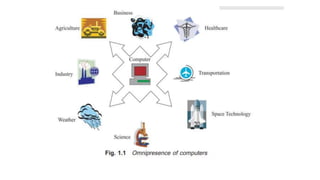
one cannot but perceive the intense and intrinsic association of the
disciplines of Science and Engineering and their allied and hybrid
counterparts, with the ubiquitous machines called computers.
• To quote a few, be it a medical surgery or diagnosis performed by
robots or doctors on patients half way across the globe, or the
launching of space crafts and satellites into outer space, or
forecasting tornadoes and cyclones, or the more mundane needs of
online reservations of tickets or billing at the food store, or control of
washing machines etc. one cannot but deem computers to be
omnipresent, omnipotent, why even omniscient
• Any discipline that calls for problem-solving using computers, looks
up to the discipline of computer science for efficient and effective
methods and techniques of solutions to the problems in their
respective fields.
• Machines What machines are appropriate or available for the
solution of a problem? What is the machine configuration –its
processing power, memory capacity etc., that would be required for
the efficient execution of the solution?
• Languages What is the language or software with which the solution
of the problem needs to be coded? What are the software constraints
that would hamper the efficient implementation of the solution?
• Foundations What is the model of a problem and its solution? What
methods need to be employed for the efficient design and
implementation of the solution? What is its performance measure?
• Technologies What are the technologies that need to be incorporated
for the solution of the problem? For example, does the solution call
for a web based implementation or needs activation from mobile
devices or calls for hand shaking broadcasting devices or merely
needs to interact with high end or low end peripheral devices?
• One of the core fields that belongs to the foundations of computer
science deals with the design, analysis and implementation of
algorithms for the efficient solution of the problems concerned.
• An algorithm may be loosely defined as a process, or procedure or
method or recipe. It is a specific set of rules to obtain a definite
output from specific inputs provided to the problem
• The subject of data structures is intrinsically connected with the
design and implementation of efficient algorithms. Data structures
deals with the study of methods, techniques and tools to organize or
structure data.
Definition, Structure and Properties of
Algorithms
Definition
• An algorithm may be defined as a finite sequence of instructions each
of which has a clear meaning and can be performed with a finite
amount of effort in a finite length of time.
Structure and properties
• An algorithm has the following structure:
• (i) Input step
• (ii) Assignment step
• (iii) Decision step
• (iv) Repetitive step
• (v) Output step
An algorithm is endowed with the following
properties
• Finiteness - an algorithm must terminate after a finite number of
steps.
• Definiteness - the steps of the algorithm must be precisely defined or
unambiguously specified.
• Generality - an algorithm must be generic enough to solve all
problems of a particular class.
• Effectiveness - the operations of the algorithm must be basic enough
to be put down on pencil and paper. They should not be too complex
to warrant writing another algorithm for the operation!
• Input-Output - the algorithm must have certain initial and precise
inputs, and outputs that may be generated both at its intermediate
and final steps.
Development of an Algorithm
• The steps involved in the development of an algorithm are as follows:
(i) Problem statement
(ii) Model formulation
(iii) Algorithm design
(iv) Algorithm correctness
(v) Implementation
(vi) Algorithm analysis
(vii) Program testing
(viii) Documentation
• Once a clear statement of the problem is done, the model for the
solution of the problem is to be formulated. The next step is to design
the algorithm based on the solution model that is formulated.
• It is here that one sees the role of data structures. The right choice of
the data structure needs to be made at the design stage itself since
data structures influence the efficiency of the algorithm
• Once the correctness of the algorithm is checked and the algorithm
implemented, the most important step of measuring the
performance of the algorithm is done. This is what is termed as
algorithm analysis.
• It can be seen how the use of appropriate data structures results in a
better performance of the algorithm. Finally the program is tested
and the development ends with proper documentation
Data Structures and Algorithms
• let us consider the problem of searching for a telephone number of a
person, in the telephone directory. It is well known that searching for
the telephone number in the directory is an easy task since the data is
sorted according to the alphabetical order of the subscribers’names
Data Structure —
Definition and Classification
• Abstract data types
• A data type refers to the type of values that variables in a
programming language hold. Thus the data types of integer, real,
character, Boolean which are inherently provided in programming
languages are referred to as primitive data types.
• A list of elements is called as a data object. For example, we could
have a list of integers or list of alphabetical strings as data objects.
The data objects which comprise the data structure, and their
fundamental operations are known as Abstract Data Type (ADT). In
other words, an ADT is defined as a set of data objects D defined over
a domain L and supporting a list of operations O
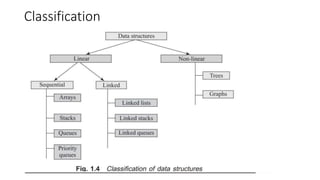
Classification
Arrays
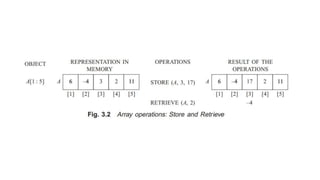
• an array is an ADT whose objects are sequence of elements of the
same type and the two operations performed on it are store and
retrieve.
• Thus if a is an array the operations can be represented as STORE (a, i,
e) and RETRIEVE (a, i) where i is termed as the index and e is the
element that is to be stored in the array.
• These functions are equivalent to the programming language
statements a[i ]: = e and a[i ] where i is termed subscript and a the
array variable name in programming language parlance.
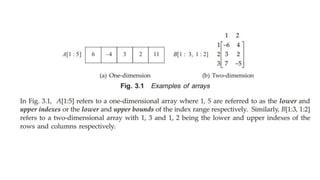
• Arrays could be of one-dimension, two dimension, three-dimension or in
general multi-dimension. Figure 3.1 illustrates a one and two dimensional
array. It may be observed that while one-dimensional arrays are
mathematically likened to vectors, two-dimensional arrays are likened to
matrices.
• In this regard, two-dimensional arrays also have the terminologies of rows
and columns associated with them.
Array Operations
• An array when viewed as a data structure supports only two
operations viz.,
• (i) storage of values (i.e.) writing into an array (STORE (a, i, e) ) and,
• (ii) retrieval of values (i.e.) reading from an array ( RETRIEVE (a, i) )
Number of Elements in an Array
• One-dimensional array:
Let A[1:u] be a one-dimensional array. The size of the array, as is
evident is u and the elements are A[1], A[2], …
A[u –
1], A[u]. In the case
of the array A[l : u] where l is the lower bound and u is the upper
bound of the index range, the number of elements is given by u-l+1
Example - u-l+1
• The number of elements in
• (i) A[1:26] = 26
• (ii) A[5:53] = 49 (53 -5 + 1)
• (iii) A[-1:26] = 28
Two-dimensional array
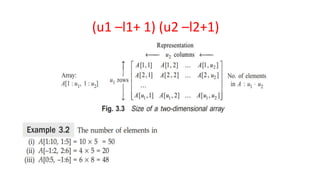
• Let A[1 : u1, 1 : u2] be a two-dimensional array where u1 indicates
the number of rows and u2 the number of columns in the array.
• Then the number of elements in A is u1.u2
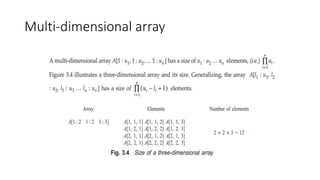
• Generalizing, A[l1 : u1, l2 : u2] has a size of (u1 –l1+ 1) (u2 –l2+1)
elements. Figure 3.3 illustrates a two dimensional array and its size.
(u1 –l1+ 1) (u2 –l2+1)
Multi-dimensional array
Representation of Arrays in Memory
• How are arrays represented in memory? This is an important question
at least from the compiler’
s point of view. In many programming
languages the name of the array is associated with the address of the
starting memory location so as to facilitate efficient storage and
retrieval.
• Also it is to be remembered that while the computer memory is
considered one-dimensional (linear) it has to accommodate arrays
which are multi-dimensional. Hence address calculation to determine
the appropriate locations in the memory becomes important.
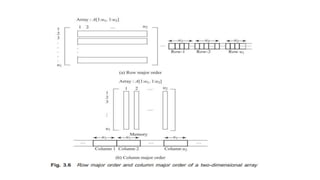
• The arrays are stored in the memory in one of the two ways, viz., row
major order or lexicographic order or column major order. In the
ensuing discussion we assume a row major order representation.
Figure 3.6 distinguishes between the two methods of representation.
One-dimensional array
• Consider the array A(1 : u1) and let a be the address of the starting
memory location referred to as the base address of the array. Here as
is evident, A[1] occupies the memory location whose address is a,
A(2) occupies a + 1 and so on. In general, the address of A[i] is given
by a + (i +1).
• In general, for a one-dimensional array A(l1 : u1) the address of A[i] is
given by α + (i –l1)where a is the base address
Applications
• Sparse matrix
• Ordered lists
Sparse matrix
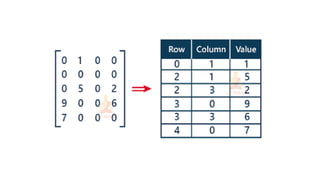
• A matrix is an arrangement of m.n elements arranged as m rows and
n columns. The Sparse matrix is a matrix with zeros as the dominating
elements. There is no precise definition for a sparse matrix. In other
words, the “
sparseness”is relatively defined
Ordered lists
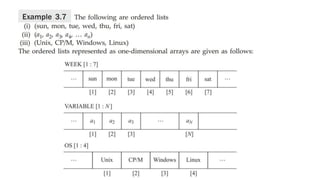
• One of the simplest and useful data objects in computer science is an
ordered list or linear list. An ordered list can be either empty or non
empty. In the latter case, the elements of the list are known as atoms,
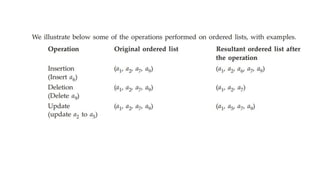
chosen from a set D. The ordered lists provide a variety of operations
such as retrieval, insertion, deletion, update etc
• The most common way to represent an ordered list is by using a one-
dimensional array. Such a representation is termed sequential
mapping though better forms of representation have been presented
in the literature
Data Structures  - Lecture 1 - Unit 1.pptx

Data Structures - Lecture 1 - Unit 1.pptx

  • 1.
    DepartmentofComputerApplications I BCA S-I 2023-2024Even sem 23CAp01 – data structures and lab
  • 2.
    UNIT I • Introduction:Definition, Structure and properties of algorithms, Development of an algorithm, Data structures and Algorithms, Data Structure-Definition and Classification. • Arrays: Introduction, Array operations, Number of elements in an array, Representations of arrays in memory, Applications
  • 3.
    Introduction • Technological advancementsof this world— both within and without, one cannot but perceive the intense and intrinsic association of the disciplines of Science and Engineering and their allied and hybrid counterparts, with the ubiquitous machines called computers.
  • 4.
    • To quotea few, be it a medical surgery or diagnosis performed by robots or doctors on patients half way across the globe, or the launching of space crafts and satellites into outer space, or forecasting tornadoes and cyclones, or the more mundane needs of online reservations of tickets or billing at the food store, or control of washing machines etc. one cannot but deem computers to be omnipresent, omnipotent, why even omniscient
  • 6.
    • Any disciplinethat calls for problem-solving using computers, looks up to the discipline of computer science for efficient and effective methods and techniques of solutions to the problems in their respective fields. • Machines What machines are appropriate or available for the solution of a problem? What is the machine configuration –its processing power, memory capacity etc., that would be required for the efficient execution of the solution?
  • 7.
    • Languages Whatis the language or software with which the solution of the problem needs to be coded? What are the software constraints that would hamper the efficient implementation of the solution? • Foundations What is the model of a problem and its solution? What methods need to be employed for the efficient design and implementation of the solution? What is its performance measure?
  • 8.
    • Technologies Whatare the technologies that need to be incorporated for the solution of the problem? For example, does the solution call for a web based implementation or needs activation from mobile devices or calls for hand shaking broadcasting devices or merely needs to interact with high end or low end peripheral devices?
  • 9.
    • One ofthe core fields that belongs to the foundations of computer science deals with the design, analysis and implementation of algorithms for the efficient solution of the problems concerned. • An algorithm may be loosely defined as a process, or procedure or method or recipe. It is a specific set of rules to obtain a definite output from specific inputs provided to the problem
  • 10.
    • The subjectof data structures is intrinsically connected with the design and implementation of efficient algorithms. Data structures deals with the study of methods, techniques and tools to organize or structure data.
  • 11.
    Definition, Structure andProperties of Algorithms Definition • An algorithm may be defined as a finite sequence of instructions each of which has a clear meaning and can be performed with a finite amount of effort in a finite length of time.
  • 12.
    Structure and properties •An algorithm has the following structure: • (i) Input step • (ii) Assignment step • (iii) Decision step • (iv) Repetitive step • (v) Output step
  • 14.
    An algorithm isendowed with the following properties • Finiteness - an algorithm must terminate after a finite number of steps. • Definiteness - the steps of the algorithm must be precisely defined or unambiguously specified. • Generality - an algorithm must be generic enough to solve all problems of a particular class.
  • 15.
    • Effectiveness -the operations of the algorithm must be basic enough to be put down on pencil and paper. They should not be too complex to warrant writing another algorithm for the operation! • Input-Output - the algorithm must have certain initial and precise inputs, and outputs that may be generated both at its intermediate and final steps.
  • 16.
    Development of anAlgorithm • The steps involved in the development of an algorithm are as follows: (i) Problem statement (ii) Model formulation (iii) Algorithm design (iv) Algorithm correctness (v) Implementation (vi) Algorithm analysis (vii) Program testing (viii) Documentation
  • 17.
    • Once aclear statement of the problem is done, the model for the solution of the problem is to be formulated. The next step is to design the algorithm based on the solution model that is formulated. • It is here that one sees the role of data structures. The right choice of the data structure needs to be made at the design stage itself since data structures influence the efficiency of the algorithm
  • 18.
    • Once thecorrectness of the algorithm is checked and the algorithm implemented, the most important step of measuring the performance of the algorithm is done. This is what is termed as algorithm analysis. • It can be seen how the use of appropriate data structures results in a better performance of the algorithm. Finally the program is tested and the development ends with proper documentation
  • 19.
    Data Structures andAlgorithms • let us consider the problem of searching for a telephone number of a person, in the telephone directory. It is well known that searching for the telephone number in the directory is an easy task since the data is sorted according to the alphabetical order of the subscribers’names
  • 20.
    Data Structure — Definitionand Classification • Abstract data types • A data type refers to the type of values that variables in a programming language hold. Thus the data types of integer, real, character, Boolean which are inherently provided in programming languages are referred to as primitive data types.
  • 21.
    • A listof elements is called as a data object. For example, we could have a list of integers or list of alphabetical strings as data objects. The data objects which comprise the data structure, and their fundamental operations are known as Abstract Data Type (ADT). In other words, an ADT is defined as a set of data objects D defined over a domain L and supporting a list of operations O
  • 22.
  • 23.
    Arrays • an arrayis an ADT whose objects are sequence of elements of the same type and the two operations performed on it are store and retrieve. • Thus if a is an array the operations can be represented as STORE (a, i, e) and RETRIEVE (a, i) where i is termed as the index and e is the element that is to be stored in the array.
  • 24.
    • These functionsare equivalent to the programming language statements a[i ]: = e and a[i ] where i is termed subscript and a the array variable name in programming language parlance.
  • 25.
    • Arrays couldbe of one-dimension, two dimension, three-dimension or in general multi-dimension. Figure 3.1 illustrates a one and two dimensional array. It may be observed that while one-dimensional arrays are mathematically likened to vectors, two-dimensional arrays are likened to matrices. • In this regard, two-dimensional arrays also have the terminologies of rows and columns associated with them.
  • 27.
    Array Operations • Anarray when viewed as a data structure supports only two operations viz., • (i) storage of values (i.e.) writing into an array (STORE (a, i, e) ) and, • (ii) retrieval of values (i.e.) reading from an array ( RETRIEVE (a, i) )
  • 29.
    Number of Elementsin an Array • One-dimensional array: Let A[1:u] be a one-dimensional array. The size of the array, as is evident is u and the elements are A[1], A[2], … A[u – 1], A[u]. In the case of the array A[l : u] where l is the lower bound and u is the upper bound of the index range, the number of elements is given by u-l+1
  • 30.
    Example - u-l+1 •The number of elements in • (i) A[1:26] = 26 • (ii) A[5:53] = 49 (53 -5 + 1) • (iii) A[-1:26] = 28
  • 31.
    Two-dimensional array • LetA[1 : u1, 1 : u2] be a two-dimensional array where u1 indicates the number of rows and u2 the number of columns in the array. • Then the number of elements in A is u1.u2 • Generalizing, A[l1 : u1, l2 : u2] has a size of (u1 –l1+ 1) (u2 –l2+1) elements. Figure 3.3 illustrates a two dimensional array and its size.
  • 32.
    (u1 –l1+ 1)(u2 –l2+1)
  • 33.
  • 34.
    Representation of Arraysin Memory • How are arrays represented in memory? This is an important question at least from the compiler’ s point of view. In many programming languages the name of the array is associated with the address of the starting memory location so as to facilitate efficient storage and retrieval.
  • 35.
    • Also itis to be remembered that while the computer memory is considered one-dimensional (linear) it has to accommodate arrays which are multi-dimensional. Hence address calculation to determine the appropriate locations in the memory becomes important.
  • 36.
    • The arraysare stored in the memory in one of the two ways, viz., row major order or lexicographic order or column major order. In the ensuing discussion we assume a row major order representation. Figure 3.6 distinguishes between the two methods of representation.
  • 38.
    One-dimensional array • Considerthe array A(1 : u1) and let a be the address of the starting memory location referred to as the base address of the array. Here as is evident, A[1] occupies the memory location whose address is a, A(2) occupies a + 1 and so on. In general, the address of A[i] is given by a + (i +1).
  • 39.
    • In general,for a one-dimensional array A(l1 : u1) the address of A[i] is given by α + (i –l1)where a is the base address
  • 40.
  • 41.
    Sparse matrix • Amatrix is an arrangement of m.n elements arranged as m rows and n columns. The Sparse matrix is a matrix with zeros as the dominating elements. There is no precise definition for a sparse matrix. In other words, the “ sparseness”is relatively defined
  • 43.
    Ordered lists • Oneof the simplest and useful data objects in computer science is an ordered list or linear list. An ordered list can be either empty or non empty. In the latter case, the elements of the list are known as atoms, chosen from a set D. The ordered lists provide a variety of operations such as retrieval, insertion, deletion, update etc
  • 44.
    • The mostcommon way to represent an ordered list is by using a one- dimensional array. Such a representation is termed sequential mapping though better forms of representation have been presented in the literature