Functional Patterns in 
Domain Modeling 
with examples from the Financial Domain 
@debasishg 
https://github.com/debasishg 
http://debasishg.blogspot.com 
Wednesday, 5 November 14
What is a domain model ? 
A domain model in problem solving and software engineering is a 
conceptual model of all the topics related to a specific problem. It 
describes the various entities, their attributes, roles, and 
relationships, plus the constraints that govern the problem domain. 
It does not describe the solutions to the problem. 
Wikipedia (http://en.wikipedia.org/wiki/Domain_model) 
Wednesday, 5 November 14
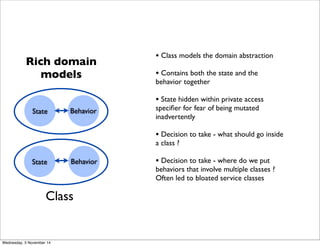
Rich domain 
models 
State Behavior 
Class 
• Class models the domain abstraction 
• Contains both the state and the 
behavior together 
• State hidden within private access 
specifier for fear of being mutated 
inadvertently 
• Decision to take - what should go inside 
a class ? 
• Decision to take - where do we put 
behaviors that involve multiple classes ? 
Often led to bloated service classes 
State Behavior 
Wednesday, 5 November 14
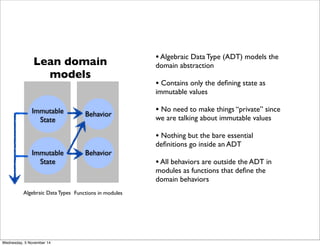
• Algebraic Data Type (ADT) models the 
domain abstraction 
• Contains only the defining state as 
immutable values 
• No need to make things “private” since 
we are talking about immutable values 
• Nothing but the bare essential 
definitions go inside an ADT 
• All behaviors are outside the ADT in 
modules as functions that define the 
domain behaviors 
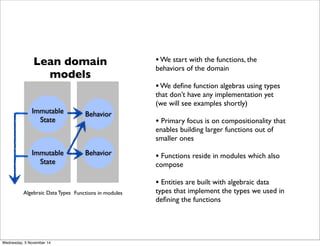
Lean domain 
models 
Immutable 
State 
Behavior 
Immutable 
State 
Behavior 
Algebraic Data Types Functions in modules 
Wednesday, 5 November 14
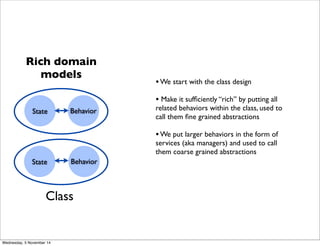
Rich domain 
models 
State Behavior 
Class 
• We start with the class design 
• Make it sufficiently “rich” by putting all 
related behaviors within the class, used to 
call them fine grained abstractions 
• We put larger behaviors in the form of 
services (aka managers) and used to call 
them coarse grained abstractions 
State Behavior 
Wednesday, 5 November 14
Lean domain 
models 
Immutable 
State 
Behavior 
• We start with the functions, the 
behaviors of the domain 
• We define function algebras using types 
that don’t have any implementation yet 
(we will see examples shortly) 
• Primary focus is on compositionality that 
enables building larger functions out of 
smaller ones 
• Functions reside in modules which also 
compose 
• Entities are built with algebraic data 
types that implement the types we used in 
defining the functions 
Immutable 
State 
Behavior 
Algebraic Data Types Functions in modules 
Wednesday, 5 November 14
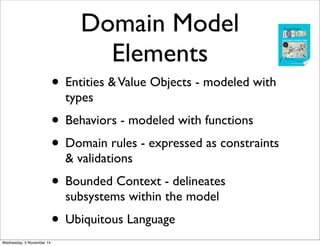
Domain Model 
Elements 
• Entities & Value Objects - modeled with 
types 
• Behaviors - modeled with functions 
• Domain rules - expressed as constraints 
& validations 
• Bounded Context - delineates 
subsystems within the model 
• Ubiquitous Language 
Wednesday, 5 November 14
.. and some Patterns 
• Domain object lifecycle patterns 
Aggregates - encapsulate object 
references 
Factories - abstract object creation & 
management 
Repositories - manage object persistence 
& queries 
Wednesday, 5 November 14
.. some more Patterns 
• Refactoring patterns 
Making implicit concepts explicit 
Intention revealing interfaces 
Side-effect free functions 
Declarative design 
Specification for validation 
Wednesday, 5 November 14
The Functional Lens .. 
Wednesday, 5 November 14
Why Functional ? 
• Ability to reason about your code - virtues 
of being pure & referentially transparent 
• Increased modularity - clean separation of 
state and behavior 
• Immutable data structures 
• Concurrency 
Wednesday, 5 November 14
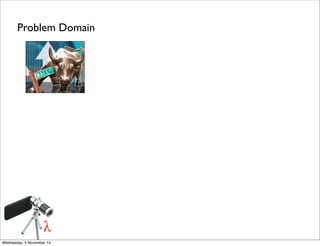
Problem Domain 
Wednesday, 5 November 14
Bank 
Account 
Trade 
Customer 
... 
... 
... 
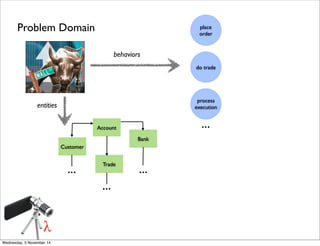
Problem Domain 
... 
entities 
Wednesday, 5 November 14
place 
order Problem Domain 
Bank 
Account 
Trade 
Customer 
... 
... 
... 
do trade 
process 
execution 
... 
entities 
behaviors 
Wednesday, 5 November 14
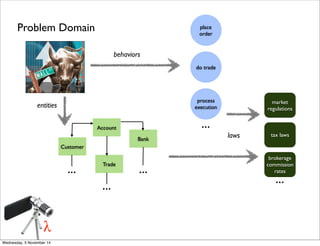
place 
order Problem Domain 
Bank 
Account 
Trade 
Customer 
... 
... 
... 
do trade 
process 
execution 
... 
market 
regulations 
tax laws 
brokerage 
commission 
rates ... 
entities 
behaviors 
laws 
Wednesday, 5 November 14
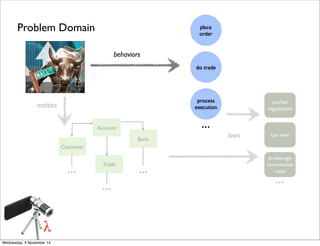
place 
order Problem Domain 
Bank 
Account 
Trade 
Customer 
... 
... 
... 
do trade 
process 
execution 
... 
market 
regulations 
tax laws 
brokerage 
commission 
rates ... 
entities 
behaviors 
laws 
Wednesday, 5 November 14
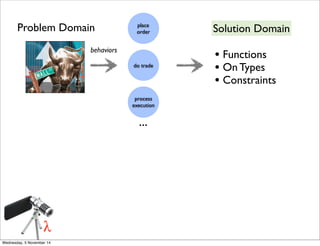
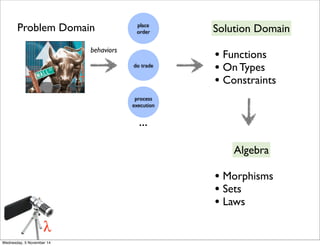
place 
order Problem Domain 
Solution Domain 
behaviors • Functions 
do trade 
process 
execution 
... 
• On Types 
• Constraints 
Wednesday, 5 November 14
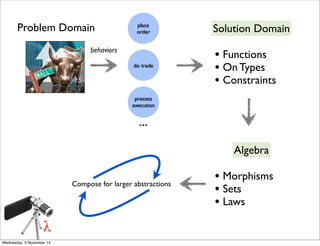
place 
order Problem Domain 
Solution Domain 
behaviors • Functions 
do trade 
process 
execution 
... 
• On Types 
• Constraints 
Algebra 
• Morphisms 
• Sets 
• Laws 
Wednesday, 5 November 14
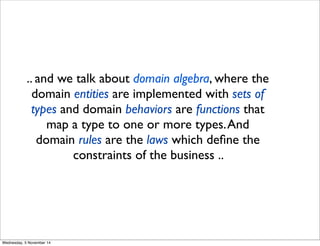
place 
order Problem Domain 
Solution Domain 
behaviors • Functions 
do trade 
process 
execution 
... 
• On Types 
• Constraints 
Algebra 
• Morphisms 
• Sets 
• Laws 
Compose for larger abstractions 
Wednesday, 5 November 14
A Monoid 
An algebraic structure 
having 
• an identity element 
• a binary associative 
operation 
trait Monoid[A] { 
def zero: A 
def op(l: A, r: => A): A 
} 
object MonoidLaws { 
def associative[A: Equal: Monoid] 
(a1: A, a2: A, a3: A): Boolean = //.. 
def rightIdentity[A: Equal: Monoid] 
(a: A) = //.. 
def leftIdentity[A: Equal: Monoid] 
(a: A) = //.. 
} 
Wednesday, 5 November 14
Monoid Laws 
An algebraic structure 
havingsa 
• an identity element 
• a binary associative 
operation 
trait Monoid[A] { 
def zero: A 
def op(l: A, r: => A): A 
} 
object MonoidLaws { 
def associative[A: Equal: Monoid] 
(a1: A, a2: A, a3: A): Boolean = //.. 
def rightIdentity[A: Equal: Monoid] 
(a: A) = //.. 
def leftIdentity[A: Equal: Monoid] 
(a: A) = //.. 
} 
satisfies 
op(x, zero) == x and op(zero, x) == x 
satisfies 
op(op(x, y), z) == op(x, op(y, z)) 
Wednesday, 5 November 14
.. and we talk about domain algebra, where the 
domain entities are implemented with sets of 
types and domain behaviors are functions that 
map a type to one or more types. And 
domain rules are the laws which define the 
constraints of the business .. 
Wednesday, 5 November 14
Pattern #1: Functional Modeling encourages Algebraic API 
Design which leads to organic evolution of domain 
models 
Wednesday, 5 November 14
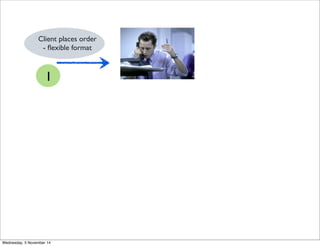
Client places order 
- flexible format 
1 
Wednesday, 5 November 14
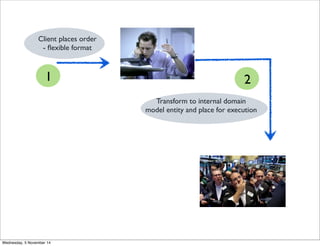
Client places order 
- flexible format 
1 2 
Transform to internal domain 
model entity and place for execution 
Wednesday, 5 November 14
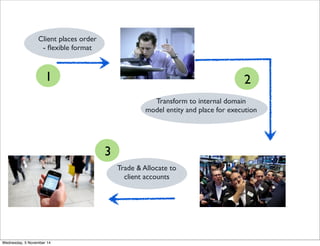
Client places order 
- flexible format 
1 2 
Transform to internal domain 
model entity and place for execution 
Trade & Allocate to 
client accounts 
3 
Wednesday, 5 November 14
def clientOrders: ClientOrderSheet => List[Order] 
def execute: Market => Account => Order => List[Execution] 
def allocate: List[Account] => Execution => List[Trade] 
Wednesday, 5 November 14
Types out of thin air No implementation till now 
def clientOrders: ClientOrderSheet => List[Order] 
def execute: Market => Account => Order => List[Execution] 
def allocate: List[Account] => Execution => List[Trade] 
Wednesday, 5 November 14
Types out of thin air No implementation till now 
def clientOrders: ClientOrderSheet => List[Order] 
def execute: Market => Account => Order => List[Execution] 
def allocate: List[Account] => Execution => List[Trade] 
Just some types & operations on those types 
+ 
some laws governing those operations 
Wednesday, 5 November 14
Types out of thin air No implementation till now 
def clientOrders: ClientOrderSheet => List[Order] 
Algebra of the API 
def execute: Market => Account => Order => List[Execution] 
def allocate: List[Account] => Execution => List[Trade] 
Just some types & operations on those types 
+ 
some laws governing those operations 
Wednesday, 5 November 14
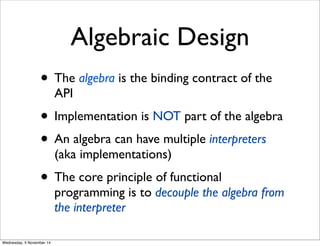
Algebraic Design 
• The algebra is the binding contract of the 
API 
• Implementation is NOT part of the algebra 
• An algebra can have multiple interpreters 
(aka implementations) 
• The core principle of functional 
programming is to decouple the algebra from 
the interpreter 
Wednesday, 5 November 14
let’s mine some 
patterns .. 
def clientOrders: ClientOrderSheet => List[Order] 
def execute: Market => Account => Order => List[Execution] 
def allocate: List[Account] => Execution => List[Trade] 
Wednesday, 5 November 14
let’s mine some 
patterns .. 
def clientOrders: ClientOrderSheet => List[Order] 
def execute(m: Market, broker: Account): Order => List[Execution] 
def allocate(accounts: List[Account]): Execution => List[Trade] 
Wednesday, 5 November 14
let’s mine some 
patterns .. 
def clientOrders: ClientOrderSheet => List[Order] 
def execute(m: Market, broker: Account): Order => List[Execution] 
def allocate(accounts: List[Account]): Execution => List[Trade] 
Wednesday, 5 November 14
let’s mine some 
patterns .. 
def clientOrders: ClientOrderSheet => List[Order] 
def execute(m: Market, broker: Account): Order => List[Execution] 
def allocate(accounts: List[Account]): Execution => List[Trade] 
Wednesday, 5 November 14
let’s mine some 
patterns .. 
def clientOrders: ClientOrderSheet => List[Order] 
def execute(m: Market, broker: Account): Order => List[Execution] 
def allocate(accounts: List[Account]): Execution => List[Trade] 
Wednesday, 5 November 14
let’s mine some 
patterns .. 
def clientOrders: ClientOrderSheet => List[Order] 
def execute(m: Market, broker: Account): Order => List[Execution] 
def allocate(accounts: List[Account]): Execution => List[Trade] 
Wednesday, 5 November 14
let’s mine some 
patterns .. 
def clientOrders: ClientOrderSheet => List[Order] 
def execute(m: Market, broker: Account): Order => List[Execution] 
def allocate(accounts: List[Account]): Execution => List[Trade] 
Function Composition with Effects 
Wednesday, 5 November 14
let’s mine some 
def clientOrders: ClientOrderSheet => List[Order] 
def execute(m: Market, broker: Account): Order => List[Execution] 
def allocate(accounts: List[Account]): Execution => List[Trade] 
It’s a Kleisli ! 
patterns .. 
Wednesday, 5 November 14
let’s mine some 
patterns .. 
def clientOrders: Kleisli[List, ClientOrderSheet, Order] 
def execute(m: Market, b: Account): Kleisli[List, Order, Execution] 
def allocate(acts: List[Account]): Kleisli[List, Execution, Trade] 
Follow the types 
Wednesday, 5 November 14
let’s mine some 
patterns .. 
def tradeGeneration( 
market: Market, 
broker: Account, 
clientAccounts: List[Account]) = { 
clientOrders andThen 
execute(market, broker) andThen 
allocate(clientAccounts) 
} 
Implementation follows the specification 
Wednesday, 5 November 14
def tradeGeneration( 
market: Market, 
broker: Account, 
clientAccounts: List[Account]) = { 
clientOrders andThen 
execute(market, broker) andThen 
allocate(clientAccounts) 
} 
Implementation follows the specification 
and we get the Ubiquitous Language for 
free :-) 
let’s mine some 
patterns .. 
Wednesday, 5 November 14
Nouns first ? Really ? 
Wednesday, 5 November 14
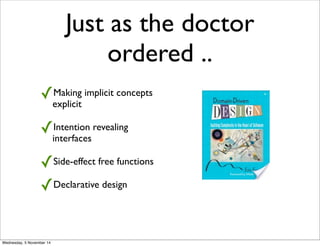
Just as the doctor 
ordered .. 
✓Making implicit concepts 
explicit 
✓Intention revealing 
interfaces 
✓Side-effect free functions 
✓Declarative design 
Wednesday, 5 November 14
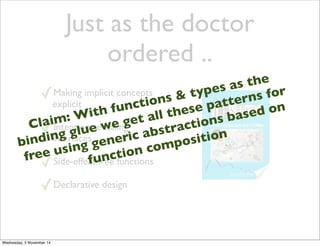
Just as the doctor 
ordered .. 
✓types as the 
Making implicit functions concepts 
& explicit 
patterns for 
on 
Claim: With these ✓glue we get all based binding Intention generic revealing 
abstractions free using function composition 
interfaces 
✓Side-effect free functions 
✓Declarative design 
Wednesday, 5 November 14
Pattern #2: DDD patterns like Factories & Specification 
are part of the normal idioms of functional programming 
Wednesday, 5 November 14
/** 
* allocates an execution to a List of client accounts 
* generates a List of trades 
*/ 
def allocate(accounts: List[Account]): Kleisli[List, Execution, Trade] = 
kleisli { execution => 
accounts.map { account => 
makeTrade(account, 
execution.instrument, 
genRef(), 
execution.market, 
execution.unitPrice, 
execution.quantity / accounts.size 
) 
} 
} 
Wednesday, 5 November 14
/** 
* allocates an execution to a List of client accounts 
* generates a List of trades 
*/ 
def allocate(accounts: List[Account]): Kleisli[List, Execution, Trade] = 
kleisli { execution => 
accounts.map { account => 
makeTrade(account, 
execution.instrument, 
genRef(), 
execution.market, 
execution.unitPrice, 
execution.quantity / accounts.size 
) 
} 
} 
Wednesday, 5 November 14
/** 
* allocates an execution to a List of client accounts 
* generates a List of trades 
*/ 
def allocate(accounts: List[Account]): Kleisli[List, Execution, Trade] = 
kleisli { execution => 
accounts.map { account => 
makeTrade(account, 
execution.instrument, 
genRef(), 
execution.market, 
execution.unitPrice, 
execution.quantity / accounts.size 
) 
} 
} 
Makes a Trade out of the 
parameters passed 
What about validations ? 
How do we handle failures ? 
Wednesday, 5 November 14
case class Trade (account: Account, 
instrument: Instrument, 
refNo: String, 
market: Market, 
unitPrice: BigDecimal, 
quantity: BigDecimal, 
tradeDate: Date = today, 
valueDate: Option[Date] = None, 
taxFees: Option[List[(TaxFeeId, BigDecimal)]] = None, 
netAmount: Option[BigDecimal] = None 
) 
Wednesday, 5 November 14
must be > 0 
case class Trade (account: Account, 
instrument: Instrument, 
refNo: String, 
market: Market, 
unitPrice: BigDecimal, 
quantity: BigDecimal, 
tradeDate: Date = today, 
valueDate: Option[Date] = None, 
taxFees: Option[List[(TaxFeeId, BigDecimal)]] = None, 
netAmount: Option[BigDecimal] = None 
) 
must be > trade date 
Wednesday, 5 November 14
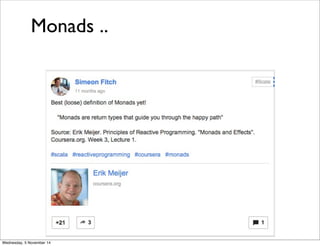
Monads .. 
Wednesday, 5 November 14
monadic validation pattern 
def makeTrade(account: Account, 
instrument: Instrument, 
refNo: String, 
market: Market, 
unitPrice: BigDecimal, 
quantity: BigDecimal, 
td: Date = today, 
vd: Option[Date] = None): ValidationStatus[Trade] = { 
val trd = Trade(account, instrument, refNo, 
market, unitPrice, quantity, td, vd) 
val s = for { 
_ <- validQuantity 
_ <- validValueDate 
t <- validUnitPrice 
} yield t 
s(trd) 
} 
Wednesday, 5 November 14
monadic validation pattern 
def makeTrade(account: Account, 
instrument: Instrument, 
refNo: String, 
market: Market, 
unitPrice: BigDecimal, 
quantity: BigDecimal, 
td: Date = today, 
vd: Option[Date] = None): ValidationStatus[Trade] = { 
val trd = Trade(account, instrument, refNo, 
market, unitPrice, quantity, td, vd) 
val s = for { 
_ <- validQuantity 
_ <- validValueDate 
t <- validUnitPrice 
} yield t 
s(trd) 
} 
(monad 
comprehension) 
Wednesday, 5 November 14
monadic validation pattern 
Smart Constructor : The 
def makeTrade(account: Account, 
instrument: Instrument, 
refNo: String, 
market: Market, 
unitPrice: BigDecimal, 
quantity: BigDecimal, 
td: Date = today, 
vd: Option[Date] = None): ValidationStatus[Trade] = { 
val trd = Trade(account, instrument, refNo, 
Factory Pattern 
(Chapter 6) 
market, unitPrice, quantity, td, vd) 
val s = for { 
_ <- validQuantity 
_ <- validValueDate 
t <- validUnitPrice 
} yield t 
s(trd) 
} 
The Specification 
Pattern 
(Chapter 9) 
Wednesday, 5 November 14
let’s mine some more 
patterns (with types) .. disjunction type (a sum 
type ValidationStatus[S] = /[String, S] 
type ReaderTStatus[A, S] = ReaderT[ValidationStatus, A, S] 
object ReaderTStatus extends KleisliInstances with KleisliFunctions { 
def apply[A, S](f: A => ValidationStatus[S]): ReaderTStatus[A, S] 
= kleisli(f) 
} 
type) : either a valid object or a 
failure message 
monad transformer 
Wednesday, 5 November 14
monadic validation 
pattern .. 
def validQuantity = ReaderTStatus[Trade, Trade] { trade => 
if (trade.quantity < 0) 
left(s"Quantity needs to be > 0 for $trade") 
else right(trade) 
} 
def validUnitPrice = ReaderTStatus[Trade, Trade] { trade => 
if (trade.unitPrice < 0) 
left(s"Unit Price needs to be > 0 for $trade") 
else right(trade) 
} 
def validValueDate = ReaderTStatus[Trade, Trade] { trade => 
trade.valueDate.map(vd => 
if (trade.tradeDate after vd) 
left(s"Trade Date ${trade.tradeDate} must be before value date $vd") 
else right(trade) 
).getOrElse(right(trade)) 
} 
Wednesday, 5 November 14
With Functional 
Programming 
• we implement all specific patterns in terms 
of generic abstractions 
• all these generic abstractions are based on 
function composition 
• and encourage immutability & referential 
transparency 
Wednesday, 5 November 14
Pattern #3: Functional Modeling encourages 
parametricity, i.e. abstract logic from specific types to 
generic ones 
Wednesday, 5 November 14
case class Trade( 
refNo: String, 
instrument: Instrument, 
tradeDate: Date, 
valueDate: Date, 
principal: Money, 
taxes: List[Tax], 
... 
) 
Wednesday, 5 November 14
case class Trade( 
refNo: String, 
instrument: Instrument, 
tradeDate: Date, 
valueDate: Date, 
principal: Money, 
taxes: List[Tax], 
... 
) 
case class Money(amount: BigDecimal, ccy: Currency) { 
def +(m: Money) = { 
sealed trait Currency 
case object USD extends Currency 
case object AUD extends Currency 
case object SGD extends Currency 
case object INR extends Currency 
require(m.ccy == ccy) 
Money(amount + m.amount, ccy) 
} 
def >(m: Money) = { 
require(m.ccy == ccy) 
if (amount > m.amount) this else m 
} 
} 
Wednesday, 5 November 14
case class Trade( 
refNo: String, 
instrument: Instrument, 
tradeDate: Date, 
valueDate: Date, 
principal: Money, 
taxes: List[Tax], 
... 
) 
def netValue: Trade => Money = //.. 
Given a list of trades, find the total net valuation of all trades 
in base currency 
Wednesday, 5 November 14
def inBaseCcy: Money => Money = //.. 
def valueTradesInBaseCcy(ts: List[Trade]) = { 
ts.foldLeft(Money(0, baseCcy)) { (acc, e) => 
acc + inBaseCcy(netValue(e)) 
} 
} 
Wednesday, 5 November 14
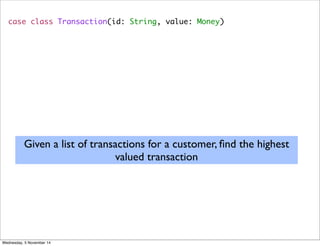
case class Transaction(id: String, value: Money) 
Given a list of transactions for a customer, find the highest 
valued transaction 
Wednesday, 5 November 14
case class Transaction(id: String, value: Money) 
def highestValueTxn(txns: List[Transaction]) = { 
txns.foldLeft(Money(0, baseCcy)) { (acc, e) => 
Given a list of transactions for a customer, find the highest 
valued transaction 
acc > e.value 
} 
} 
Wednesday, 5 November 14
fold on the collection 
def valueTradesInBaseCcy(ts: List[Trade]) = { 
ts.foldLeft(Money(0, baseCcy)) { (acc, e) => 
acc + inBaseCcy(netValue(e)) 
} 
} 
def highestValueTxn(txns: List[Transaction]) = { 
txns.foldLeft(Money(0, baseCcy)) { (acc, e) => 
acc > e.value 
} 
} 
Wednesday, 5 November 14
zero on Money 
associative binary 
operation on Money 
def valueTradesInBaseCcy(ts: List[Trade]) = { 
ts.foldLeft(Money(0, baseCcy)) { (acc, e) => 
acc + inBaseCcy(netValue(e)) 
} 
} 
def highestValueTxn(txns: List[Transaction]) = { 
txns.foldLeft(Money(0, baseCcy)) { (acc, e) => 
acc > e.value 
} 
} 
Wednesday, 5 November 14
Instead of the specific collection type (List), we 
can abstract over the type constructor using 
the more general Foldable 
def valueTradesInBaseCcy(ts: List[Trade]) = { 
ts.foldLeft(Money(0, baseCcy)) { (acc, e) => 
acc + inBaseCcy(netValue(e)) 
} 
} 
def highestValueTxn(txns: List[Transaction]) = { 
txns.foldLeft(Money(0, baseCcy)) { (acc, e) => 
acc > e.value 
} 
} 
Wednesday, 5 November 14
look ma .. Monoid for Money ! 
def valueTradesInBaseCcy(ts: List[Trade]) = { 
ts.foldLeft(Money(0, baseCcy)) { (acc, e) => 
acc + inBaseCcy(netValue(e)) 
} 
} 
def highestValueTxn(txns: List[Transaction]) = { 
txns.foldLeft(Money(0, baseCcy)) { (acc, e) => 
acc > e.value 
} 
} 
Wednesday, 5 November 14
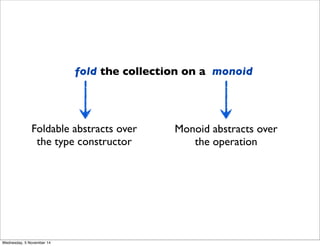
fold the collection on a monoid 
Foldable abstracts over 
the type constructor 
Monoid abstracts over 
the operation 
Wednesday, 5 November 14
def mapReduce[F[_], A, B](as: F[A])(f: A => B) 
(implicit fd: Foldable[F], m: Monoid[B]) = fd.foldMap(as)(f) 
Wednesday, 5 November 14
def mapReduce[F[_], A, B](as: F[A])(f: A => B) 
(implicit fd: Foldable[F], m: Monoid[B]) = fd.foldMap(as)(f) 
def valueTradesInBaseCcy(ts: List[Trade]) = 
mapReduce(ts)(netValue andThen inBaseCcy) 
def highestValueTxn(txns: List[Transaction]) = 
mapReduce(txns)(_.value) 
Wednesday, 5 November 14
trait Foldable[F[_]] { 
def foldl[A, B](as: F[A], z: B, f: (B, A) => B): B 
def foldMap[A, B](as: F[A], f: A => B)(implicit m: Monoid[B]): B = 
foldl(as, m.zero, (b: B, a: A) => m.add(b, f(a))) 
} 
implicit val listFoldable = new Foldable[List] { 
def foldl[A, B](as: List[A], z: B, f: (B, A) => B) = as.foldLeft(z)(f) 
} 
Wednesday, 5 November 14
implicit def MoneyMonoid(implicit c: Currency) = 
new Monoid[Money] { 
def zero: Money = Money(BigDecimal(0), c) 
def append(m1: Money, m2: => Money) = m1 + m2 
} 
implicit def MaxMoneyMonoid(implicit c: Currency) = 
new Monoid[Money] { 
def zero: Money = Money(BigDecimal(0), c) 
def append(m1: Money, m2: => Money) = m1 > m2 
} 
Wednesday, 5 November 14
def mapReduce[F[_], A, B](as: F[A])(f: A => B) 
(implicit fd: Foldable[F], m: Monoid[B]) = fd.foldMap(as)(f) 
def valueTradesInBaseCcy(ts: List[Trade]) = 
mapReduce(ts)(netValue andThen inBaseCcy) 
def highestValueTxn(txns: List[Transaction]) = 
mapReduce(txns)(_.value) 
This last pattern is inspired from Runar’s response on this SoF thread http://stackoverflow.com/questions/4765532/what-does-abstract-over-mean 
Wednesday, 5 November 14
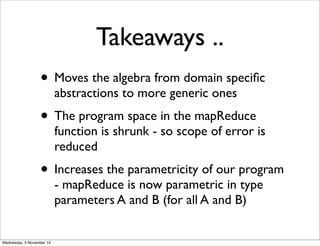
Takeaways .. 
• Moves the algebra from domain specific 
abstractions to more generic ones 
• The program space in the mapReduce 
function is shrunk - so scope of error is 
reduced 
• Increases the parametricity of our program 
- mapReduce is now parametric in type 
parameters A and B (for all A and B) 
Wednesday, 5 November 14
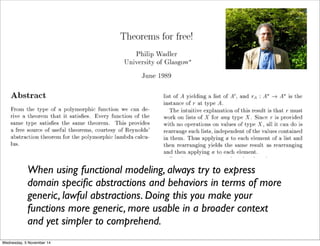
When using functional modeling, always try to express 
domain specific abstractions and behaviors in terms of more 
generic, lawful abstractions. Doing this you make your 
functions more generic, more usable in a broader context 
and yet simpler to comprehend. 
This is the concept of parametricity and is one of the 
Wednesday, 5 November 14
Use code “mlghosh2” for a 50% discount 
Wednesday, 5 November 14
Image 
acknowledgements 
• www.valuewalk.com 
• http://bienabee.com 
• http://www.ownta.com 
• http://ebay.in 
• http://www.clker.com 
• http://homepages.inf.ed.ac.uk/wadler/ 
• http://en.wikipedia.org 
Wednesday, 5 November 14
Thank You! 
Wednesday, 5 November 14

Functional Patterns in Domain Modeling

  • 1.
    Functional Patterns in Domain Modeling with examples from the Financial Domain @debasishg https://github.com/debasishg http://debasishg.blogspot.com Wednesday, 5 November 14
  • 2.
    What is adomain model ? A domain model in problem solving and software engineering is a conceptual model of all the topics related to a specific problem. It describes the various entities, their attributes, roles, and relationships, plus the constraints that govern the problem domain. It does not describe the solutions to the problem. Wikipedia (http://en.wikipedia.org/wiki/Domain_model) Wednesday, 5 November 14
  • 3.
    Rich domain models State Behavior Class • Class models the domain abstraction • Contains both the state and the behavior together • State hidden within private access specifier for fear of being mutated inadvertently • Decision to take - what should go inside a class ? • Decision to take - where do we put behaviors that involve multiple classes ? Often led to bloated service classes State Behavior Wednesday, 5 November 14
  • 4.
    • Algebraic DataType (ADT) models the domain abstraction • Contains only the defining state as immutable values • No need to make things “private” since we are talking about immutable values • Nothing but the bare essential definitions go inside an ADT • All behaviors are outside the ADT in modules as functions that define the domain behaviors Lean domain models Immutable State Behavior Immutable State Behavior Algebraic Data Types Functions in modules Wednesday, 5 November 14
  • 5.
    Rich domain models State Behavior Class • We start with the class design • Make it sufficiently “rich” by putting all related behaviors within the class, used to call them fine grained abstractions • We put larger behaviors in the form of services (aka managers) and used to call them coarse grained abstractions State Behavior Wednesday, 5 November 14
  • 6.
    Lean domain models Immutable State Behavior • We start with the functions, the behaviors of the domain • We define function algebras using types that don’t have any implementation yet (we will see examples shortly) • Primary focus is on compositionality that enables building larger functions out of smaller ones • Functions reside in modules which also compose • Entities are built with algebraic data types that implement the types we used in defining the functions Immutable State Behavior Algebraic Data Types Functions in modules Wednesday, 5 November 14
  • 7.
  • 8.
    Domain Model Elements • Entities & Value Objects - modeled with types • Behaviors - modeled with functions • Domain rules - expressed as constraints & validations • Bounded Context - delineates subsystems within the model • Ubiquitous Language Wednesday, 5 November 14
  • 9.
    .. and somePatterns • Domain object lifecycle patterns Aggregates - encapsulate object references Factories - abstract object creation & management Repositories - manage object persistence & queries Wednesday, 5 November 14
  • 10.
    .. some morePatterns • Refactoring patterns Making implicit concepts explicit Intention revealing interfaces Side-effect free functions Declarative design Specification for validation Wednesday, 5 November 14
  • 11.
    The Functional Lens.. Wednesday, 5 November 14
  • 12.
    Why Functional ? • Ability to reason about your code - virtues of being pure & referentially transparent • Increased modularity - clean separation of state and behavior • Immutable data structures • Concurrency Wednesday, 5 November 14
  • 13.
  • 14.
    Bank Account Trade Customer ... ... ... Problem Domain ... entities Wednesday, 5 November 14
  • 15.
    place order ProblemDomain Bank Account Trade Customer ... ... ... do trade process execution ... entities behaviors Wednesday, 5 November 14
  • 16.
    place order ProblemDomain Bank Account Trade Customer ... ... ... do trade process execution ... market regulations tax laws brokerage commission rates ... entities behaviors laws Wednesday, 5 November 14
  • 17.
    place order ProblemDomain Bank Account Trade Customer ... ... ... do trade process execution ... market regulations tax laws brokerage commission rates ... entities behaviors laws Wednesday, 5 November 14
  • 18.
    place order ProblemDomain Solution Domain behaviors • Functions do trade process execution ... • On Types • Constraints Wednesday, 5 November 14
  • 19.
    place order ProblemDomain Solution Domain behaviors • Functions do trade process execution ... • On Types • Constraints Algebra • Morphisms • Sets • Laws Wednesday, 5 November 14
  • 20.
    place order ProblemDomain Solution Domain behaviors • Functions do trade process execution ... • On Types • Constraints Algebra • Morphisms • Sets • Laws Compose for larger abstractions Wednesday, 5 November 14
  • 21.
    A Monoid Analgebraic structure having • an identity element • a binary associative operation trait Monoid[A] { def zero: A def op(l: A, r: => A): A } object MonoidLaws { def associative[A: Equal: Monoid] (a1: A, a2: A, a3: A): Boolean = //.. def rightIdentity[A: Equal: Monoid] (a: A) = //.. def leftIdentity[A: Equal: Monoid] (a: A) = //.. } Wednesday, 5 November 14
  • 22.
    Monoid Laws Analgebraic structure havingsa • an identity element • a binary associative operation trait Monoid[A] { def zero: A def op(l: A, r: => A): A } object MonoidLaws { def associative[A: Equal: Monoid] (a1: A, a2: A, a3: A): Boolean = //.. def rightIdentity[A: Equal: Monoid] (a: A) = //.. def leftIdentity[A: Equal: Monoid] (a: A) = //.. } satisfies op(x, zero) == x and op(zero, x) == x satisfies op(op(x, y), z) == op(x, op(y, z)) Wednesday, 5 November 14
  • 23.
    .. and wetalk about domain algebra, where the domain entities are implemented with sets of types and domain behaviors are functions that map a type to one or more types. And domain rules are the laws which define the constraints of the business .. Wednesday, 5 November 14
  • 24.
    Pattern #1: FunctionalModeling encourages Algebraic API Design which leads to organic evolution of domain models Wednesday, 5 November 14
  • 25.
    Client places order - flexible format 1 Wednesday, 5 November 14
  • 26.
    Client places order - flexible format 1 2 Transform to internal domain model entity and place for execution Wednesday, 5 November 14
  • 27.
    Client places order - flexible format 1 2 Transform to internal domain model entity and place for execution Trade & Allocate to client accounts 3 Wednesday, 5 November 14
  • 28.
    def clientOrders: ClientOrderSheet=> List[Order] def execute: Market => Account => Order => List[Execution] def allocate: List[Account] => Execution => List[Trade] Wednesday, 5 November 14
  • 29.
    Types out ofthin air No implementation till now def clientOrders: ClientOrderSheet => List[Order] def execute: Market => Account => Order => List[Execution] def allocate: List[Account] => Execution => List[Trade] Wednesday, 5 November 14
  • 30.
    Types out ofthin air No implementation till now def clientOrders: ClientOrderSheet => List[Order] def execute: Market => Account => Order => List[Execution] def allocate: List[Account] => Execution => List[Trade] Just some types & operations on those types + some laws governing those operations Wednesday, 5 November 14
  • 31.
    Types out ofthin air No implementation till now def clientOrders: ClientOrderSheet => List[Order] Algebra of the API def execute: Market => Account => Order => List[Execution] def allocate: List[Account] => Execution => List[Trade] Just some types & operations on those types + some laws governing those operations Wednesday, 5 November 14
  • 32.
    Algebraic Design •The algebra is the binding contract of the API • Implementation is NOT part of the algebra • An algebra can have multiple interpreters (aka implementations) • The core principle of functional programming is to decouple the algebra from the interpreter Wednesday, 5 November 14
  • 33.
    let’s mine some patterns .. def clientOrders: ClientOrderSheet => List[Order] def execute: Market => Account => Order => List[Execution] def allocate: List[Account] => Execution => List[Trade] Wednesday, 5 November 14
  • 34.
    let’s mine some patterns .. def clientOrders: ClientOrderSheet => List[Order] def execute(m: Market, broker: Account): Order => List[Execution] def allocate(accounts: List[Account]): Execution => List[Trade] Wednesday, 5 November 14
  • 35.
    let’s mine some patterns .. def clientOrders: ClientOrderSheet => List[Order] def execute(m: Market, broker: Account): Order => List[Execution] def allocate(accounts: List[Account]): Execution => List[Trade] Wednesday, 5 November 14
  • 36.
    let’s mine some patterns .. def clientOrders: ClientOrderSheet => List[Order] def execute(m: Market, broker: Account): Order => List[Execution] def allocate(accounts: List[Account]): Execution => List[Trade] Wednesday, 5 November 14
  • 37.
    let’s mine some patterns .. def clientOrders: ClientOrderSheet => List[Order] def execute(m: Market, broker: Account): Order => List[Execution] def allocate(accounts: List[Account]): Execution => List[Trade] Wednesday, 5 November 14
  • 38.
    let’s mine some patterns .. def clientOrders: ClientOrderSheet => List[Order] def execute(m: Market, broker: Account): Order => List[Execution] def allocate(accounts: List[Account]): Execution => List[Trade] Wednesday, 5 November 14
  • 39.
    let’s mine some patterns .. def clientOrders: ClientOrderSheet => List[Order] def execute(m: Market, broker: Account): Order => List[Execution] def allocate(accounts: List[Account]): Execution => List[Trade] Function Composition with Effects Wednesday, 5 November 14
  • 40.
    let’s mine some def clientOrders: ClientOrderSheet => List[Order] def execute(m: Market, broker: Account): Order => List[Execution] def allocate(accounts: List[Account]): Execution => List[Trade] It’s a Kleisli ! patterns .. Wednesday, 5 November 14
  • 41.
    let’s mine some patterns .. def clientOrders: Kleisli[List, ClientOrderSheet, Order] def execute(m: Market, b: Account): Kleisli[List, Order, Execution] def allocate(acts: List[Account]): Kleisli[List, Execution, Trade] Follow the types Wednesday, 5 November 14
  • 42.
    let’s mine some patterns .. def tradeGeneration( market: Market, broker: Account, clientAccounts: List[Account]) = { clientOrders andThen execute(market, broker) andThen allocate(clientAccounts) } Implementation follows the specification Wednesday, 5 November 14
  • 43.
    def tradeGeneration( market:Market, broker: Account, clientAccounts: List[Account]) = { clientOrders andThen execute(market, broker) andThen allocate(clientAccounts) } Implementation follows the specification and we get the Ubiquitous Language for free :-) let’s mine some patterns .. Wednesday, 5 November 14
  • 44.
    Nouns first ?Really ? Wednesday, 5 November 14
  • 45.
    Just as thedoctor ordered .. ✓Making implicit concepts explicit ✓Intention revealing interfaces ✓Side-effect free functions ✓Declarative design Wednesday, 5 November 14
  • 46.
    Just as thedoctor ordered .. ✓types as the Making implicit functions concepts & explicit patterns for on Claim: With these ✓glue we get all based binding Intention generic revealing abstractions free using function composition interfaces ✓Side-effect free functions ✓Declarative design Wednesday, 5 November 14
  • 47.
    Pattern #2: DDDpatterns like Factories & Specification are part of the normal idioms of functional programming Wednesday, 5 November 14
  • 48.
    /** * allocatesan execution to a List of client accounts * generates a List of trades */ def allocate(accounts: List[Account]): Kleisli[List, Execution, Trade] = kleisli { execution => accounts.map { account => makeTrade(account, execution.instrument, genRef(), execution.market, execution.unitPrice, execution.quantity / accounts.size ) } } Wednesday, 5 November 14
  • 49.
    /** * allocatesan execution to a List of client accounts * generates a List of trades */ def allocate(accounts: List[Account]): Kleisli[List, Execution, Trade] = kleisli { execution => accounts.map { account => makeTrade(account, execution.instrument, genRef(), execution.market, execution.unitPrice, execution.quantity / accounts.size ) } } Wednesday, 5 November 14
  • 50.
    /** * allocatesan execution to a List of client accounts * generates a List of trades */ def allocate(accounts: List[Account]): Kleisli[List, Execution, Trade] = kleisli { execution => accounts.map { account => makeTrade(account, execution.instrument, genRef(), execution.market, execution.unitPrice, execution.quantity / accounts.size ) } } Makes a Trade out of the parameters passed What about validations ? How do we handle failures ? Wednesday, 5 November 14
  • 51.
    case class Trade(account: Account, instrument: Instrument, refNo: String, market: Market, unitPrice: BigDecimal, quantity: BigDecimal, tradeDate: Date = today, valueDate: Option[Date] = None, taxFees: Option[List[(TaxFeeId, BigDecimal)]] = None, netAmount: Option[BigDecimal] = None ) Wednesday, 5 November 14
  • 52.
    must be >0 case class Trade (account: Account, instrument: Instrument, refNo: String, market: Market, unitPrice: BigDecimal, quantity: BigDecimal, tradeDate: Date = today, valueDate: Option[Date] = None, taxFees: Option[List[(TaxFeeId, BigDecimal)]] = None, netAmount: Option[BigDecimal] = None ) must be > trade date Wednesday, 5 November 14
  • 53.
    Monads .. Wednesday,5 November 14
  • 54.
    monadic validation pattern def makeTrade(account: Account, instrument: Instrument, refNo: String, market: Market, unitPrice: BigDecimal, quantity: BigDecimal, td: Date = today, vd: Option[Date] = None): ValidationStatus[Trade] = { val trd = Trade(account, instrument, refNo, market, unitPrice, quantity, td, vd) val s = for { _ <- validQuantity _ <- validValueDate t <- validUnitPrice } yield t s(trd) } Wednesday, 5 November 14
  • 55.
    monadic validation pattern def makeTrade(account: Account, instrument: Instrument, refNo: String, market: Market, unitPrice: BigDecimal, quantity: BigDecimal, td: Date = today, vd: Option[Date] = None): ValidationStatus[Trade] = { val trd = Trade(account, instrument, refNo, market, unitPrice, quantity, td, vd) val s = for { _ <- validQuantity _ <- validValueDate t <- validUnitPrice } yield t s(trd) } (monad comprehension) Wednesday, 5 November 14
  • 56.
    monadic validation pattern Smart Constructor : The def makeTrade(account: Account, instrument: Instrument, refNo: String, market: Market, unitPrice: BigDecimal, quantity: BigDecimal, td: Date = today, vd: Option[Date] = None): ValidationStatus[Trade] = { val trd = Trade(account, instrument, refNo, Factory Pattern (Chapter 6) market, unitPrice, quantity, td, vd) val s = for { _ <- validQuantity _ <- validValueDate t <- validUnitPrice } yield t s(trd) } The Specification Pattern (Chapter 9) Wednesday, 5 November 14
  • 57.
    let’s mine somemore patterns (with types) .. disjunction type (a sum type ValidationStatus[S] = /[String, S] type ReaderTStatus[A, S] = ReaderT[ValidationStatus, A, S] object ReaderTStatus extends KleisliInstances with KleisliFunctions { def apply[A, S](f: A => ValidationStatus[S]): ReaderTStatus[A, S] = kleisli(f) } type) : either a valid object or a failure message monad transformer Wednesday, 5 November 14
  • 58.
    monadic validation pattern.. def validQuantity = ReaderTStatus[Trade, Trade] { trade => if (trade.quantity < 0) left(s"Quantity needs to be > 0 for $trade") else right(trade) } def validUnitPrice = ReaderTStatus[Trade, Trade] { trade => if (trade.unitPrice < 0) left(s"Unit Price needs to be > 0 for $trade") else right(trade) } def validValueDate = ReaderTStatus[Trade, Trade] { trade => trade.valueDate.map(vd => if (trade.tradeDate after vd) left(s"Trade Date ${trade.tradeDate} must be before value date $vd") else right(trade) ).getOrElse(right(trade)) } Wednesday, 5 November 14
  • 59.
    With Functional Programming • we implement all specific patterns in terms of generic abstractions • all these generic abstractions are based on function composition • and encourage immutability & referential transparency Wednesday, 5 November 14
  • 60.
    Pattern #3: FunctionalModeling encourages parametricity, i.e. abstract logic from specific types to generic ones Wednesday, 5 November 14
  • 61.
    case class Trade( refNo: String, instrument: Instrument, tradeDate: Date, valueDate: Date, principal: Money, taxes: List[Tax], ... ) Wednesday, 5 November 14
  • 62.
    case class Trade( refNo: String, instrument: Instrument, tradeDate: Date, valueDate: Date, principal: Money, taxes: List[Tax], ... ) case class Money(amount: BigDecimal, ccy: Currency) { def +(m: Money) = { sealed trait Currency case object USD extends Currency case object AUD extends Currency case object SGD extends Currency case object INR extends Currency require(m.ccy == ccy) Money(amount + m.amount, ccy) } def >(m: Money) = { require(m.ccy == ccy) if (amount > m.amount) this else m } } Wednesday, 5 November 14
  • 63.
    case class Trade( refNo: String, instrument: Instrument, tradeDate: Date, valueDate: Date, principal: Money, taxes: List[Tax], ... ) def netValue: Trade => Money = //.. Given a list of trades, find the total net valuation of all trades in base currency Wednesday, 5 November 14
  • 64.
    def inBaseCcy: Money=> Money = //.. def valueTradesInBaseCcy(ts: List[Trade]) = { ts.foldLeft(Money(0, baseCcy)) { (acc, e) => acc + inBaseCcy(netValue(e)) } } Wednesday, 5 November 14
  • 65.
    case class Transaction(id:String, value: Money) Given a list of transactions for a customer, find the highest valued transaction Wednesday, 5 November 14
  • 66.
    case class Transaction(id:String, value: Money) def highestValueTxn(txns: List[Transaction]) = { txns.foldLeft(Money(0, baseCcy)) { (acc, e) => Given a list of transactions for a customer, find the highest valued transaction acc > e.value } } Wednesday, 5 November 14
  • 67.
    fold on thecollection def valueTradesInBaseCcy(ts: List[Trade]) = { ts.foldLeft(Money(0, baseCcy)) { (acc, e) => acc + inBaseCcy(netValue(e)) } } def highestValueTxn(txns: List[Transaction]) = { txns.foldLeft(Money(0, baseCcy)) { (acc, e) => acc > e.value } } Wednesday, 5 November 14
  • 68.
    zero on Money associative binary operation on Money def valueTradesInBaseCcy(ts: List[Trade]) = { ts.foldLeft(Money(0, baseCcy)) { (acc, e) => acc + inBaseCcy(netValue(e)) } } def highestValueTxn(txns: List[Transaction]) = { txns.foldLeft(Money(0, baseCcy)) { (acc, e) => acc > e.value } } Wednesday, 5 November 14
  • 69.
    Instead of thespecific collection type (List), we can abstract over the type constructor using the more general Foldable def valueTradesInBaseCcy(ts: List[Trade]) = { ts.foldLeft(Money(0, baseCcy)) { (acc, e) => acc + inBaseCcy(netValue(e)) } } def highestValueTxn(txns: List[Transaction]) = { txns.foldLeft(Money(0, baseCcy)) { (acc, e) => acc > e.value } } Wednesday, 5 November 14
  • 70.
    look ma ..Monoid for Money ! def valueTradesInBaseCcy(ts: List[Trade]) = { ts.foldLeft(Money(0, baseCcy)) { (acc, e) => acc + inBaseCcy(netValue(e)) } } def highestValueTxn(txns: List[Transaction]) = { txns.foldLeft(Money(0, baseCcy)) { (acc, e) => acc > e.value } } Wednesday, 5 November 14
  • 71.
    fold the collectionon a monoid Foldable abstracts over the type constructor Monoid abstracts over the operation Wednesday, 5 November 14
  • 72.
    def mapReduce[F[_], A,B](as: F[A])(f: A => B) (implicit fd: Foldable[F], m: Monoid[B]) = fd.foldMap(as)(f) Wednesday, 5 November 14
  • 73.
    def mapReduce[F[_], A,B](as: F[A])(f: A => B) (implicit fd: Foldable[F], m: Monoid[B]) = fd.foldMap(as)(f) def valueTradesInBaseCcy(ts: List[Trade]) = mapReduce(ts)(netValue andThen inBaseCcy) def highestValueTxn(txns: List[Transaction]) = mapReduce(txns)(_.value) Wednesday, 5 November 14
  • 74.
    trait Foldable[F[_]] { def foldl[A, B](as: F[A], z: B, f: (B, A) => B): B def foldMap[A, B](as: F[A], f: A => B)(implicit m: Monoid[B]): B = foldl(as, m.zero, (b: B, a: A) => m.add(b, f(a))) } implicit val listFoldable = new Foldable[List] { def foldl[A, B](as: List[A], z: B, f: (B, A) => B) = as.foldLeft(z)(f) } Wednesday, 5 November 14
  • 75.
    implicit def MoneyMonoid(implicitc: Currency) = new Monoid[Money] { def zero: Money = Money(BigDecimal(0), c) def append(m1: Money, m2: => Money) = m1 + m2 } implicit def MaxMoneyMonoid(implicit c: Currency) = new Monoid[Money] { def zero: Money = Money(BigDecimal(0), c) def append(m1: Money, m2: => Money) = m1 > m2 } Wednesday, 5 November 14
  • 76.
    def mapReduce[F[_], A,B](as: F[A])(f: A => B) (implicit fd: Foldable[F], m: Monoid[B]) = fd.foldMap(as)(f) def valueTradesInBaseCcy(ts: List[Trade]) = mapReduce(ts)(netValue andThen inBaseCcy) def highestValueTxn(txns: List[Transaction]) = mapReduce(txns)(_.value) This last pattern is inspired from Runar’s response on this SoF thread http://stackoverflow.com/questions/4765532/what-does-abstract-over-mean Wednesday, 5 November 14
  • 77.
    Takeaways .. •Moves the algebra from domain specific abstractions to more generic ones • The program space in the mapReduce function is shrunk - so scope of error is reduced • Increases the parametricity of our program - mapReduce is now parametric in type parameters A and B (for all A and B) Wednesday, 5 November 14
  • 78.
    When using functionalmodeling, always try to express domain specific abstractions and behaviors in terms of more generic, lawful abstractions. Doing this you make your functions more generic, more usable in a broader context and yet simpler to comprehend. This is the concept of parametricity and is one of the Wednesday, 5 November 14
  • 79.
    Use code “mlghosh2”for a 50% discount Wednesday, 5 November 14
  • 80.
    Image acknowledgements •www.valuewalk.com • http://bienabee.com • http://www.ownta.com • http://ebay.in • http://www.clker.com • http://homepages.inf.ed.ac.uk/wadler/ • http://en.wikipedia.org Wednesday, 5 November 14
  • 81.
    Thank You! Wednesday,5 November 14