What's new in Java EE 6 ?

Antonio Goncalves
Overall presentation


Focuses on news features of Java EE 6
     You must know Java EE 5

         28 specifications
        Thousands of pages
        Tough presentation
Agenda
●   Quick overview
●   New concepts
●   New features on existing specifications
●   New specifications
●   Summary
Antonio Goncalves
●   Freelance software architect
●   Former BEA consultant
●   Author (Java EE 5 and Java EE 6)
●   JCP expert member
●   Co-leader of the Paris JUG
●   Les Cast Codeurs podcast
●   Java Champion
●   antonio dot goncalves at gmail dot com
Agenda
●   Quick overview
●   New concepts
●   New features on existing specifications
●   New specifications
●   Summary
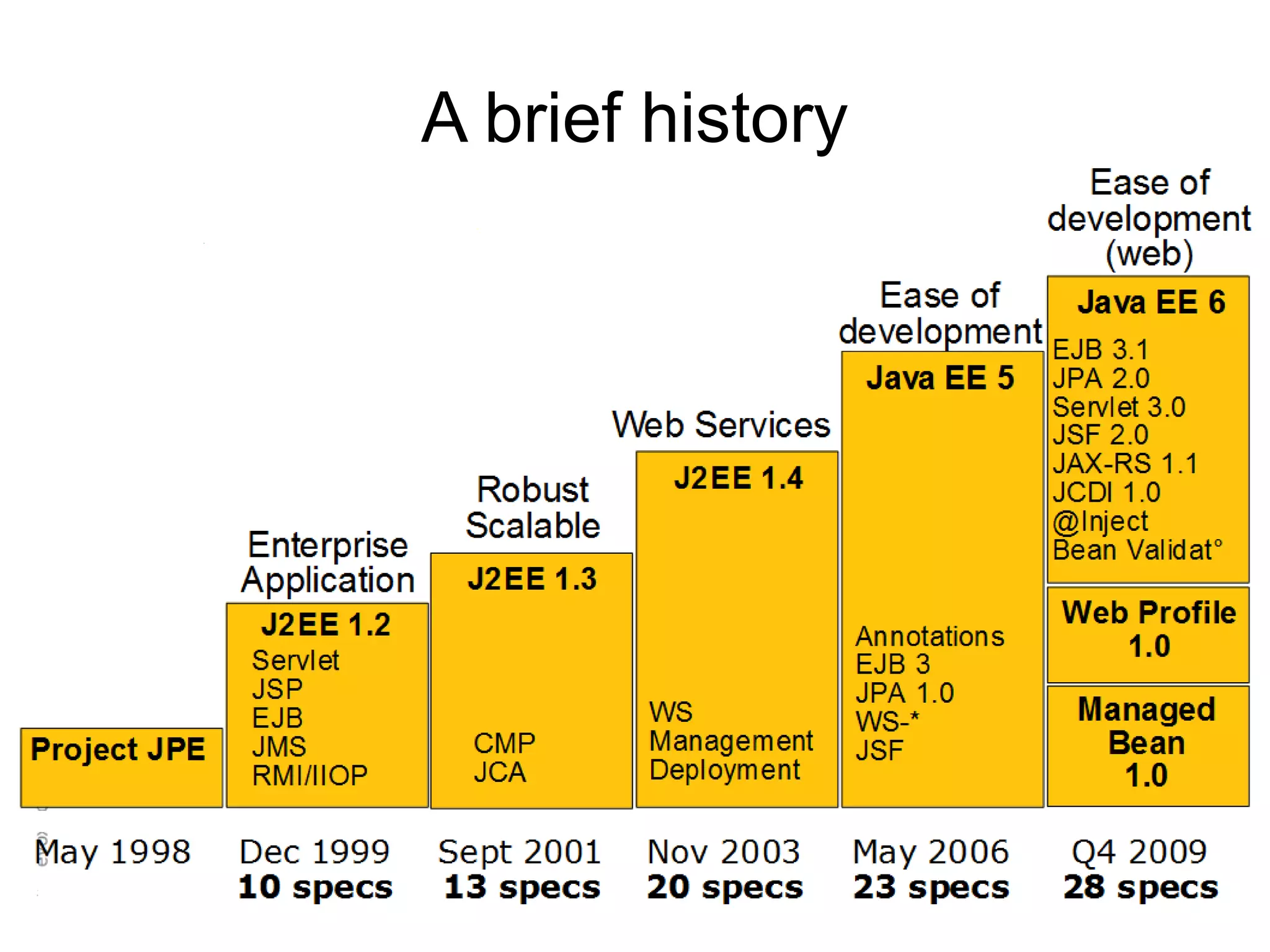
A brief history
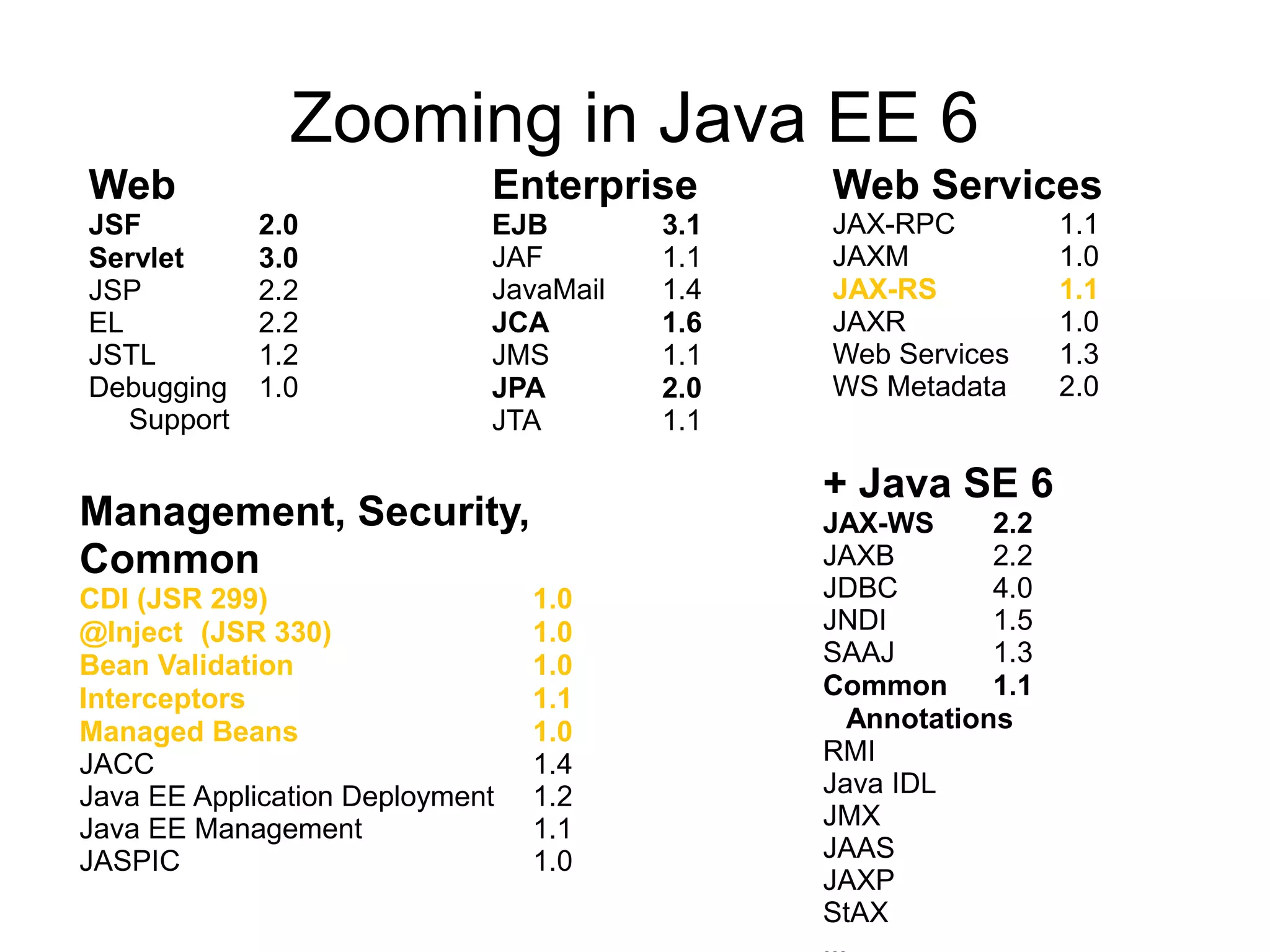
Zooming in Java EE 6
Web                          Enterprise       Web Services
JSF          2.0             EJB        3.1   JAX-RPC           1.1
Servlet      3.0             JAF        1.1   JAXM              1.0
JSP          2.2             JavaMail   1.4   JAX-RS            1.1
EL           2.2             JCA        1.6   JAXR              1.0
JSTL         1.2             JMS        1.1   Web Services      1.3
Debugging    1.0             JPA        2.0   WS Metadata       2.0
   Support                   JTA        1.1

                                              + Java SE 6
Management, Security,                         JAX-WS      2.2
Common                                        JAXB        2.2
CDI (JSR 299)                    1.0          JDBC        4.0
@Inject (JSR 330)                1.0          JNDI        1.5
Bean Validation                  1.0          SAAJ        1.3
Interceptors                     1.1          Common      1.1
Managed Beans                    1.0            Annotations
JACC                             1.4          RMI
Java EE Application Deployment   1.2          Java IDL
Java EE Management               1.1          JMX
JASPIC                           1.0          JAAS
                                              JAXP
                                              StAX
Agenda
●   Quick overview
●   New concepts
    ●   Pruning, Profiles, EJB Lite, Portable JNDI names,
        Managed Beans, Interceptors 1.1
●   New features on existing specifications
●   New specifications
●   Summary
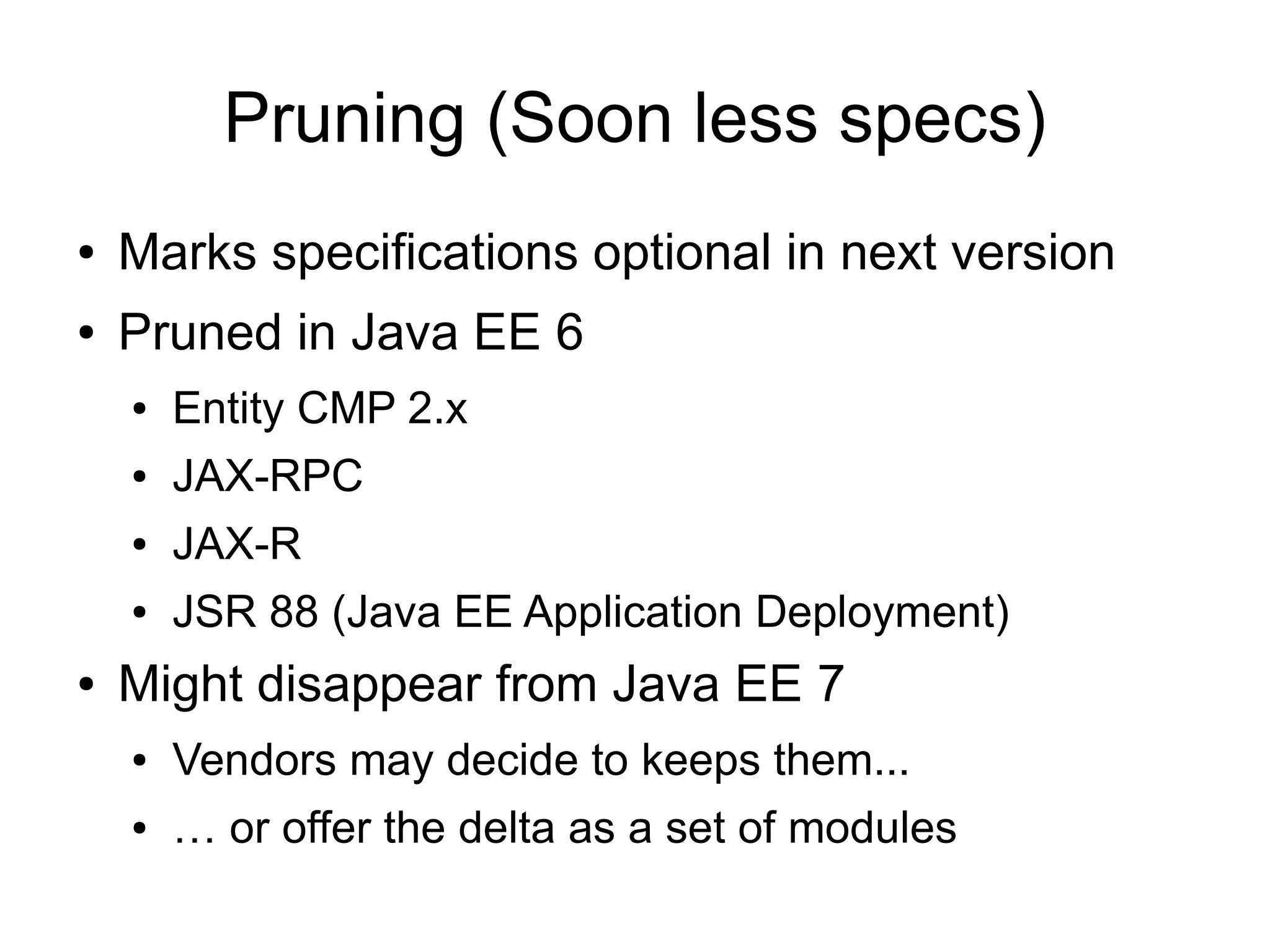
Pruning (Soon less specs)
●   Marks specifications optional in next version
●   Pruned in Java EE 6
    ●   Entity CMP 2.x
    ●   JAX-RPC
    ●   JAX-R
    ●   JSR 88 (Java EE Application Deployment)
●   Might disappear from Java EE 7
    ●   Vendors may decide to keeps them...
    ●   … or offer the delta as a set of modules
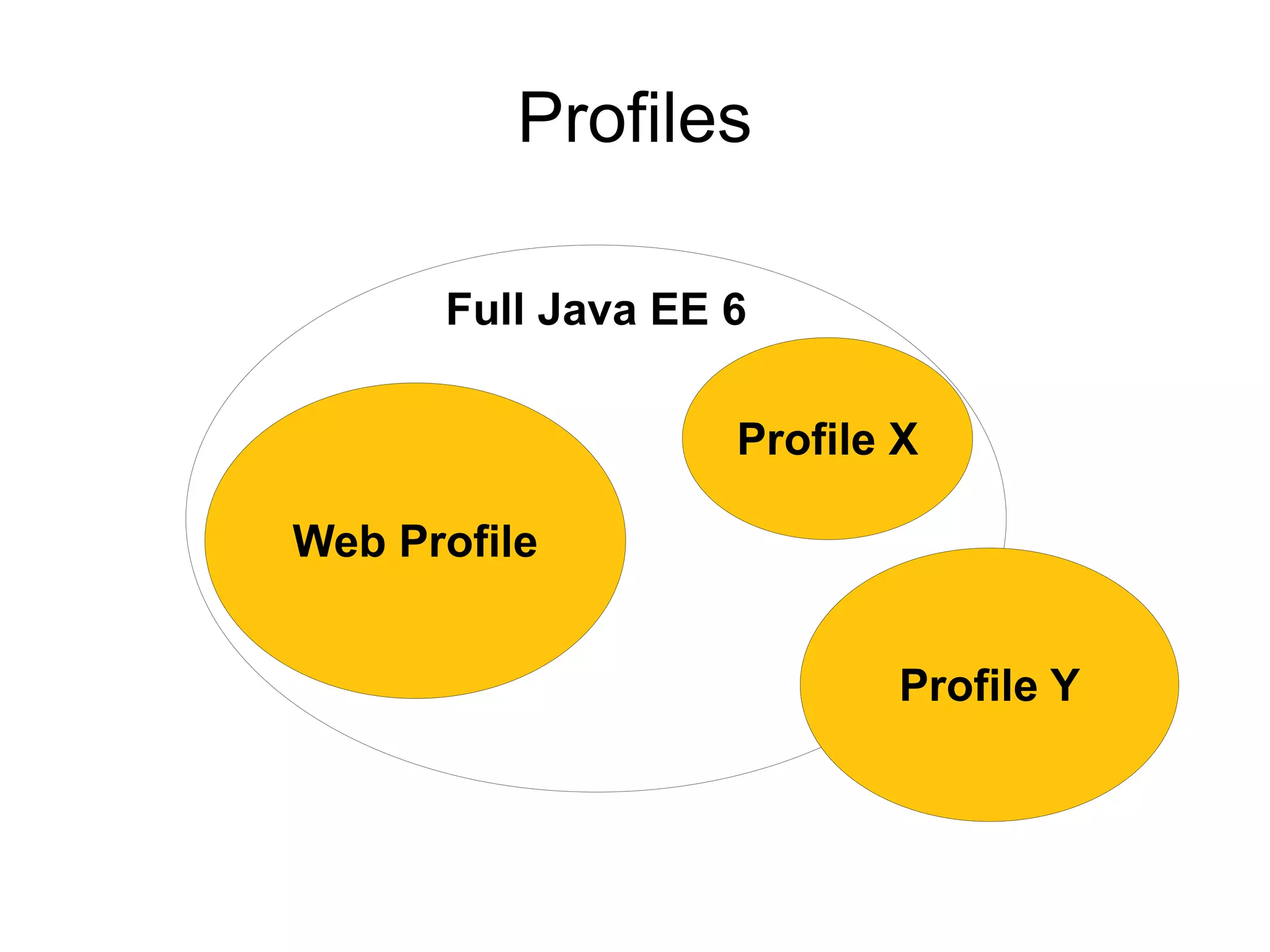
Profiles

      Full Java EE 6

                   Profile X

Web Profile


                           Profile Y
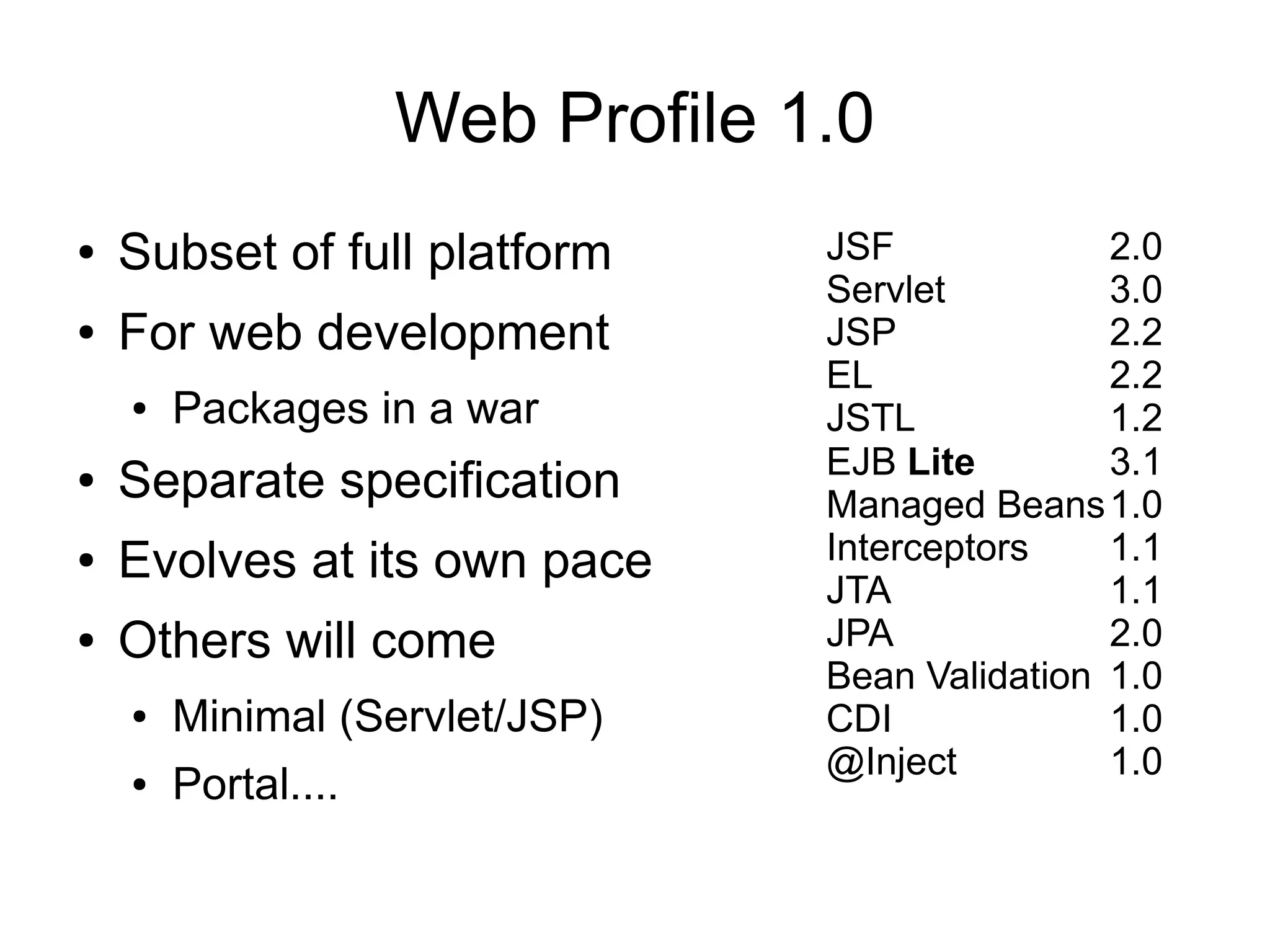
Web Profile 1.0
●   Subset of full platform       JSF             2.0
                                  Servlet         3.0
●   For web development           JSP             2.2
                                  EL              2.2
    ●   Packages in a war         JSTL            1.2
                                  EJB Lite        3.1
●   Separate specification        Managed Beans 1.0
●   Evolves at its own pace       Interceptors    1.1
                                  JTA             1.1
●   Others will come              JPA             2.0
                                  Bean Validation 1.0
    ●   Minimal (Servlet/JSP)     CDI             1.0
                                  @Inject         1.0
    ●   Portal....
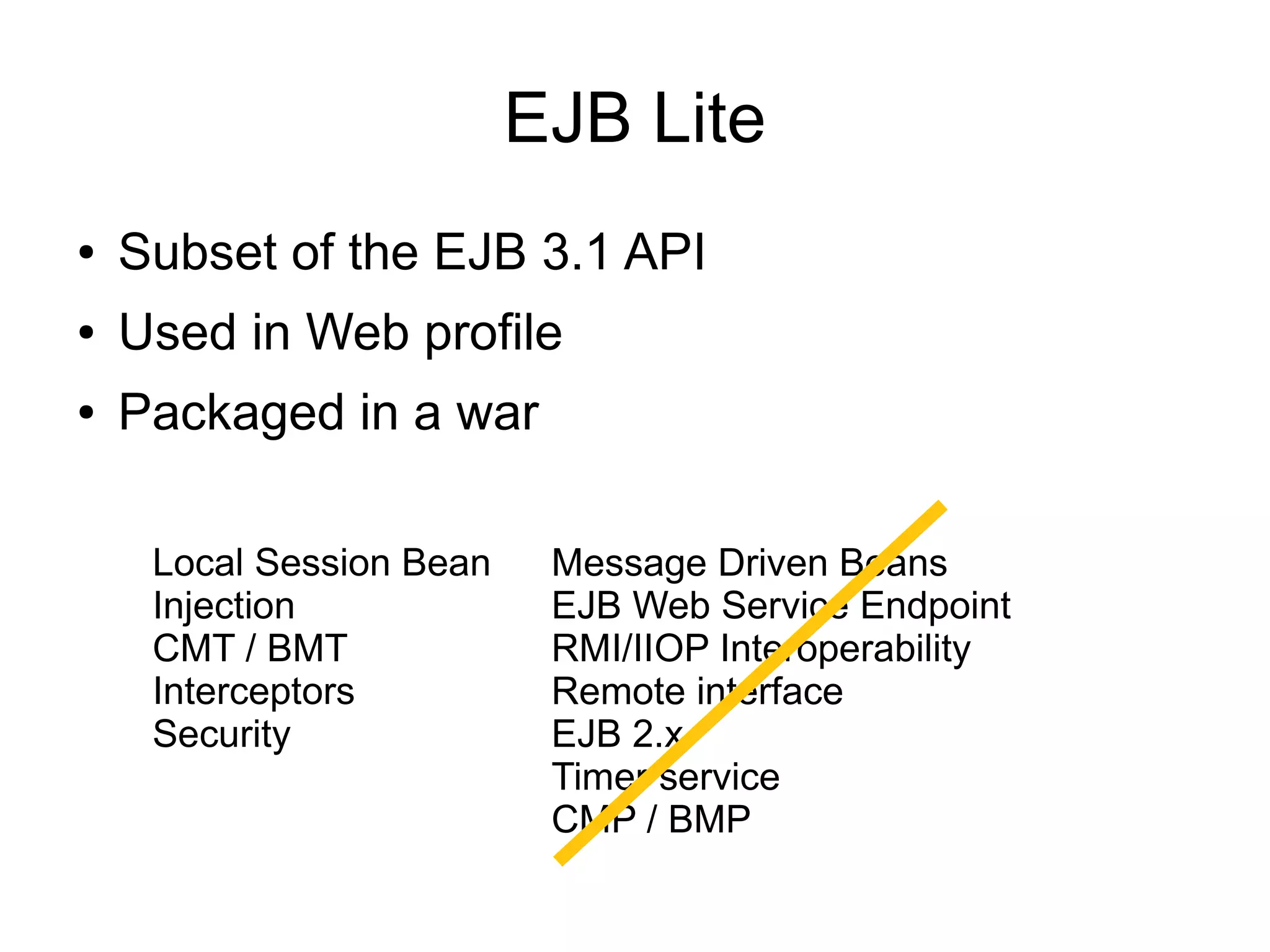
EJB Lite
●   Subset of the EJB 3.1 API
●   Used in Web profile
●   Packaged in a war

     Local Session Bean    Message Driven Beans
     Injection             EJB Web Service Endpoint
     CMT / BMT             RMI/IIOP Interoperability
     Interceptors          Remote interface
     Security              EJB 2.x
                           Timer service
                           CMP / BMP
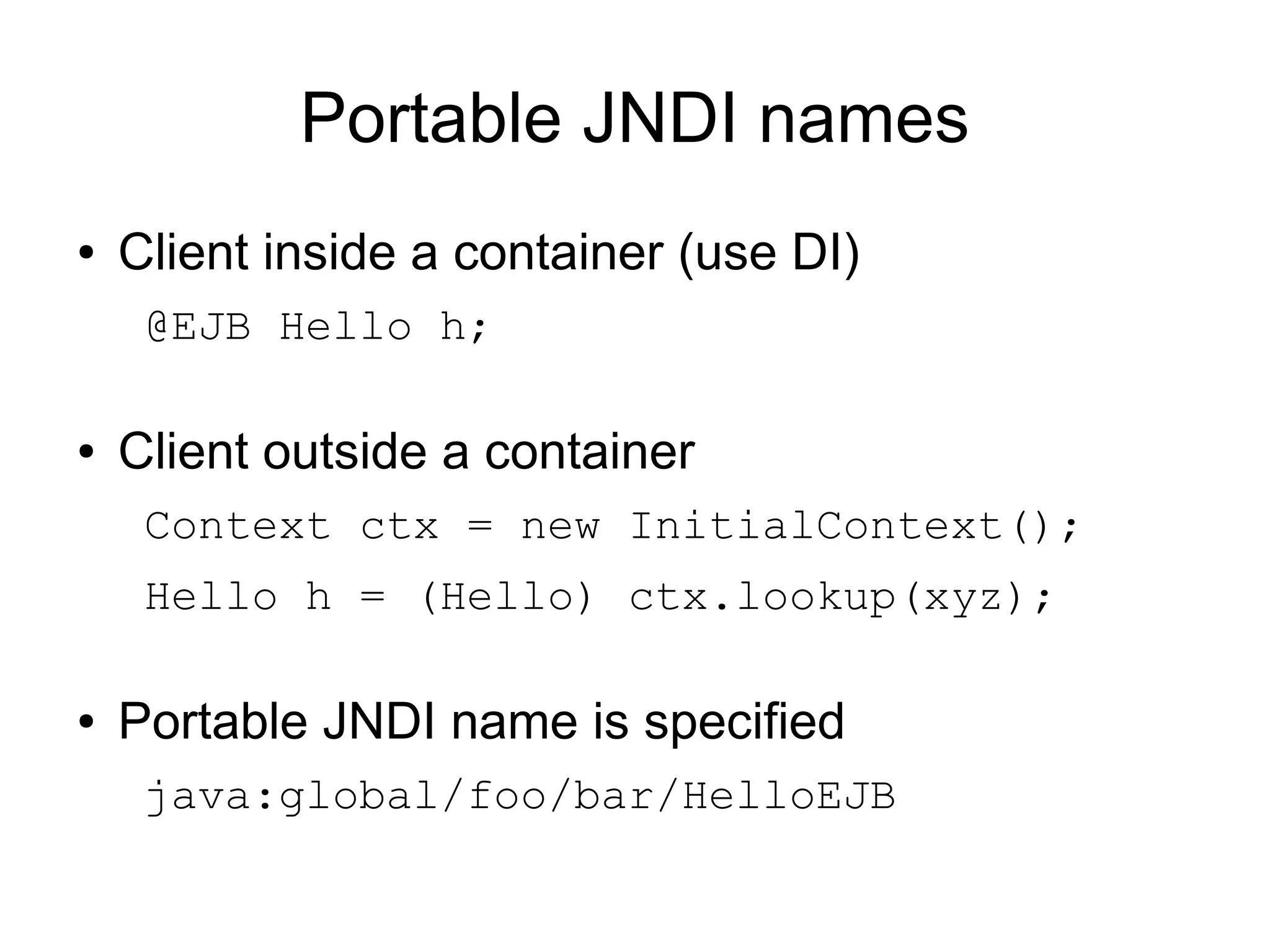
Portable JNDI names
●   Client inside a container (use DI)
     @EJB Hello h;

●   Client outside a container
     Context ctx = new InitialContext();
     Hello h = (Hello) ctx.lookup(xyz);

●   Portable JNDI name is specified
     java:global/foo/bar/HelloEJB
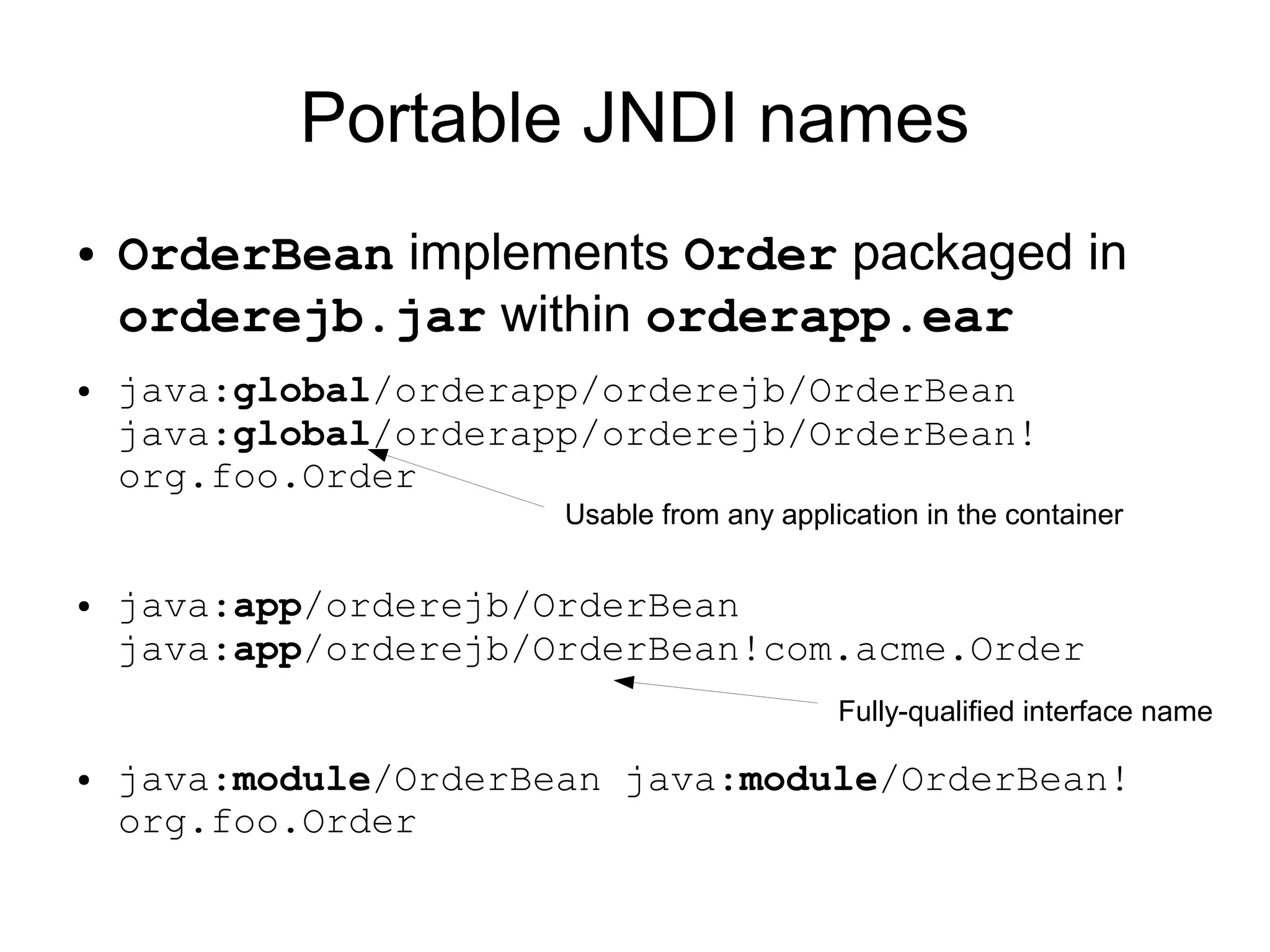
Portable JNDI names
●   OrderBean implements Order packaged in
    orderejb.jar within orderapp.ear
●   java:global/orderapp/orderejb/OrderBean
    java:global/orderapp/orderejb/OrderBean!
    org.foo.Order
                       Usable from any application in the container


●   java:app/orderejb/OrderBean
    java:app/orderejb/OrderBean!com.acme.Order
                                            Fully-qualified interface name

●   java:module/OrderBean java:module/OrderBean!
    org.foo.Order
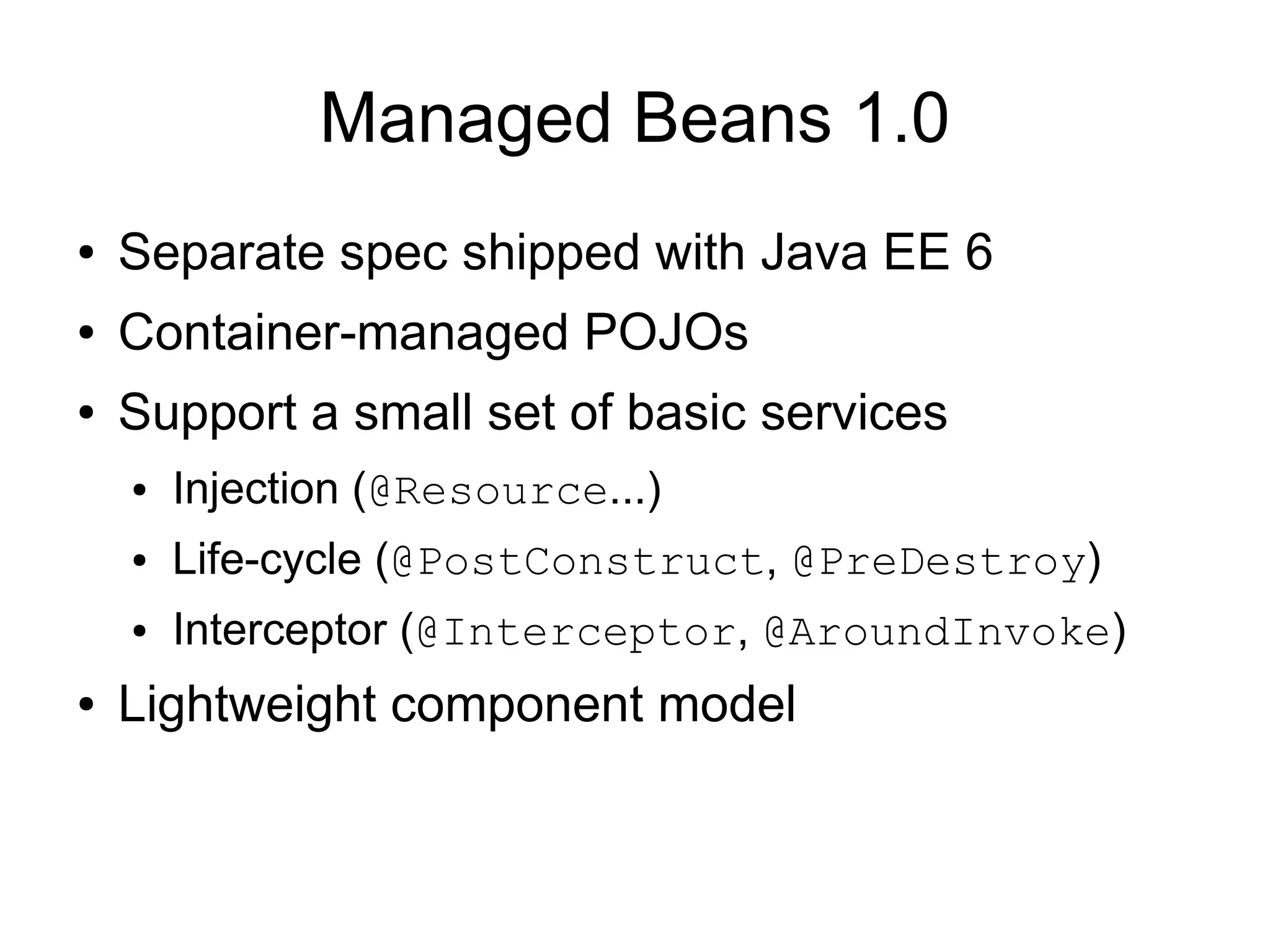
Managed Beans 1.0
●   Separate spec shipped with Java EE 6
●   Container-managed POJOs
●   Support a small set of basic services
    ●   Injection (@Resource...)
    ●   Life-cycle (@PostConstruct, @PreDestroy)
    ●   Interceptor (@Interceptor, @AroundInvoke)
●   Lightweight component model
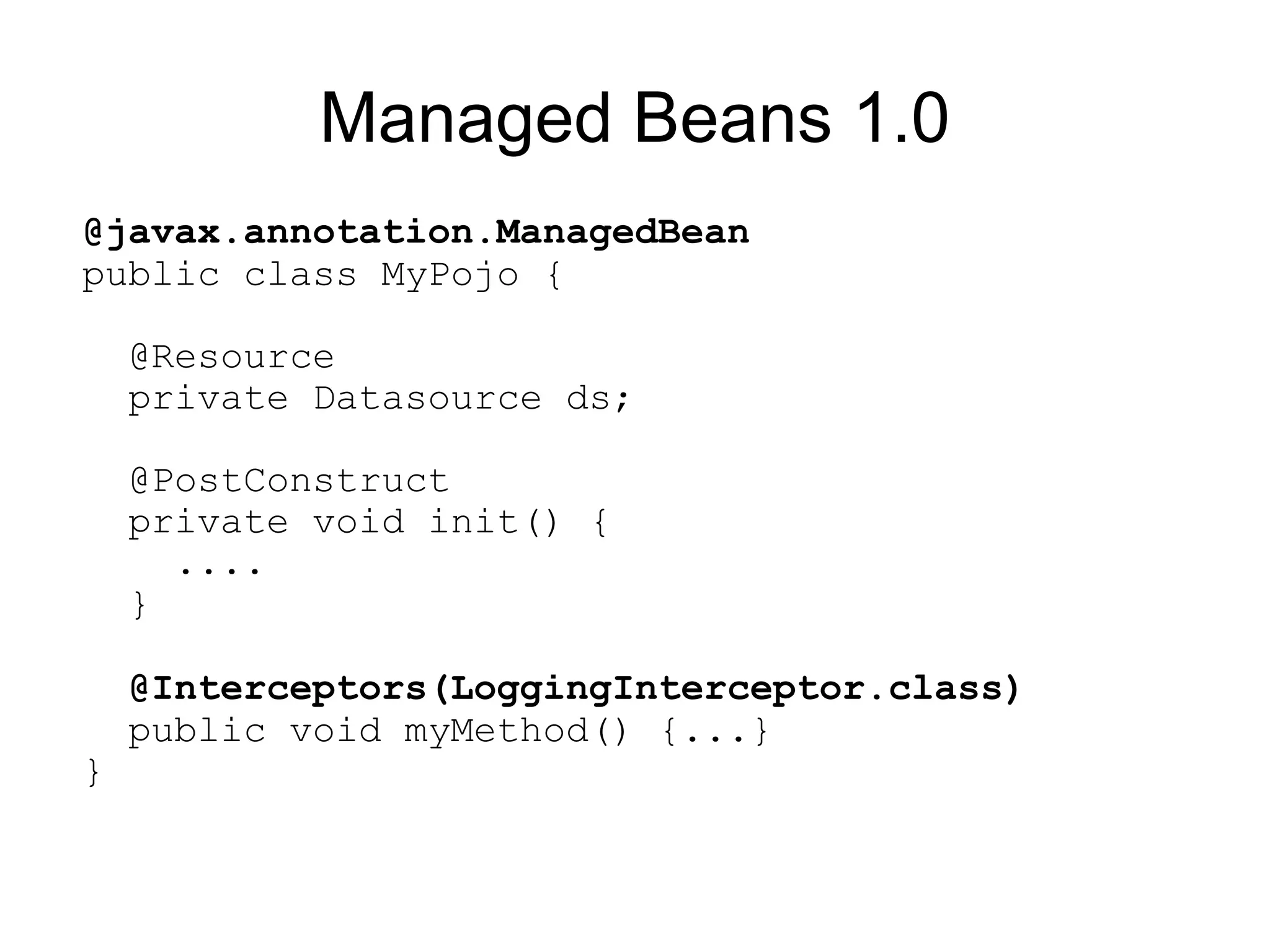
Managed Beans 1.0
@javax.annotation.ManagedBean
public class MyPojo {

    @Resource
    private Datasource ds;

    @PostConstruct
    private void init() {
      ....
    }

    @Interceptors(LoggingInterceptor.class)
    public void myMethod() {...}
}
Interceptors 1.1
●   Address cross-cutting concerns in Java EE
●   Were part of the EJB 3.0 spec
●   Now a seperate spec shipped with EJB 3.1
●   Can be uses in EJBs...
●   … as well as ManagedBeans
●   @AroundInvoke
●   @AroundTimeout for EJB timers
Agenda
●   Quick overview
●   New concepts
●   New features on existing specifications
    ●   JPA 2.0, EJB 3.1, Servlet 3.0, JSF 2.0
●   New specifications
●   Summary
JPA 2.0
●   Evolves separately from EJB now
    ●     JSR 317
●   Richer mappings
●   Richer JPQL
●   Standard config options
●   Criteria API
●   ...
Richer mapping
●   Collection of embeddables and basic types
    ●   Not just collection of JPA entities
    ●   Multiple levels of embeddables
●   More flexible support for Maps
    ●   Keys, values can be one of : entities, embeddables
          or basic types
●   More relationship mapping options
    ●   Unidirectional 1-many foreign key mappings
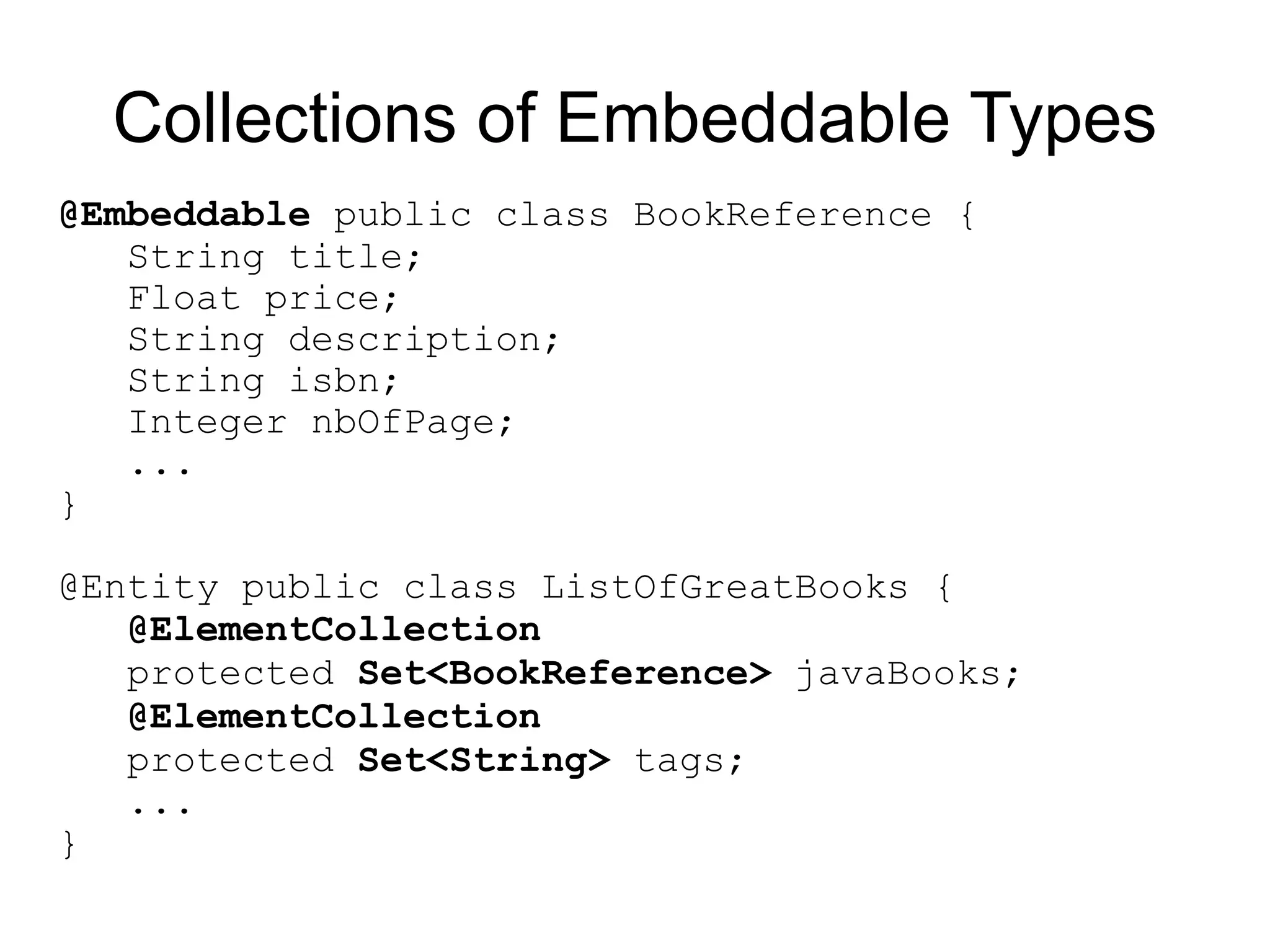
Collections of Embeddable Types
@Embeddable public class BookReference {
   String title;
   Float price;
   String description;
   String isbn;
   Integer nbOfPage;
   ...
}

@Entity public class ListOfGreatBooks {
   @ElementCollection
   protected Set<BookReference> javaBooks;
   @ElementCollection
   protected Set<String> tags;
   ...
}
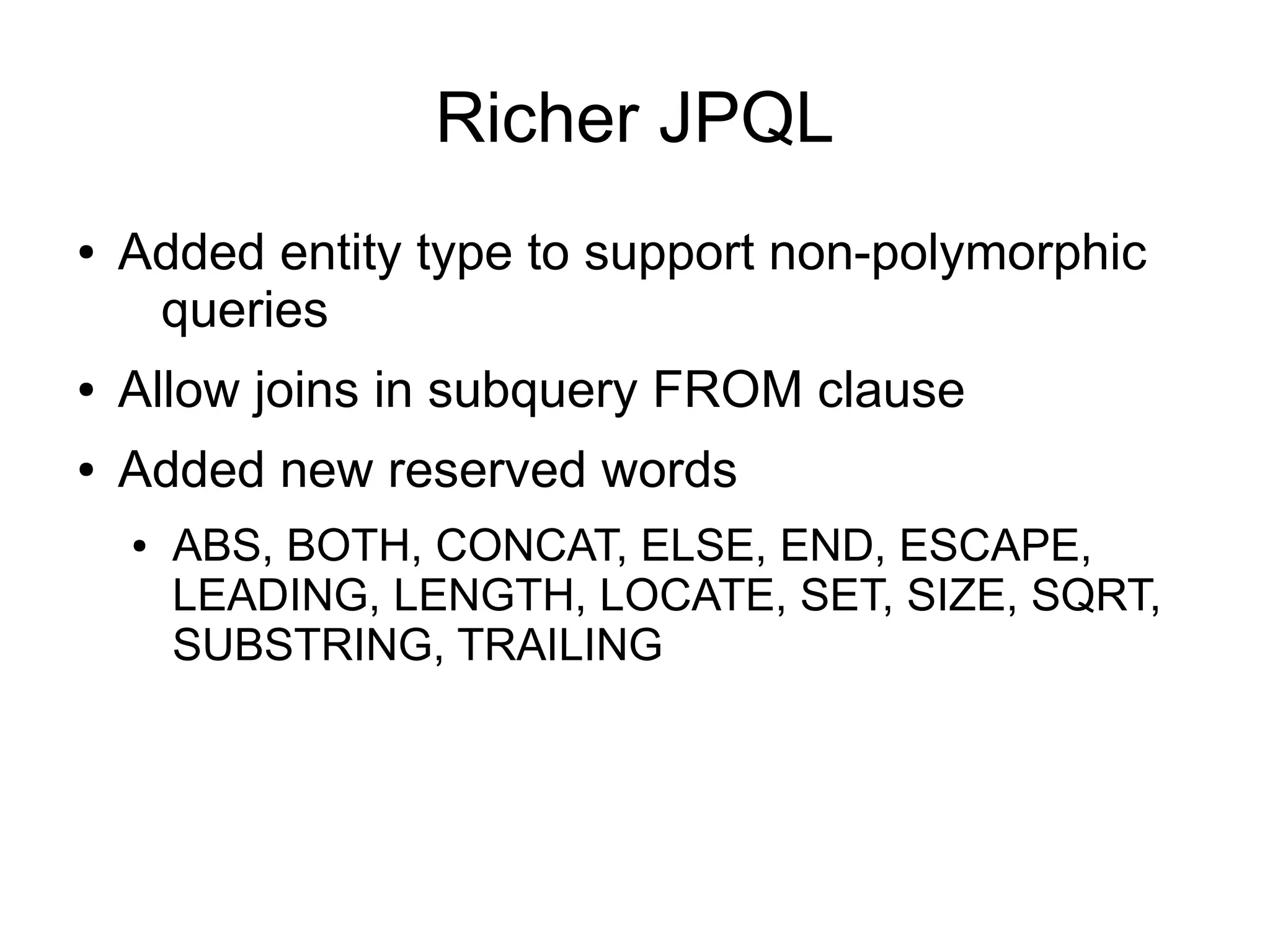
Richer JPQL
●   Added entity type to support non-polymorphic
     queries
●   Allow joins in subquery FROM clause
●   Added new reserved words
    ●   ABS, BOTH, CONCAT, ELSE, END, ESCAPE,
        LEADING, LENGTH, LOCATE, SET, SIZE, SQRT,
        SUBSTRING, TRAILING
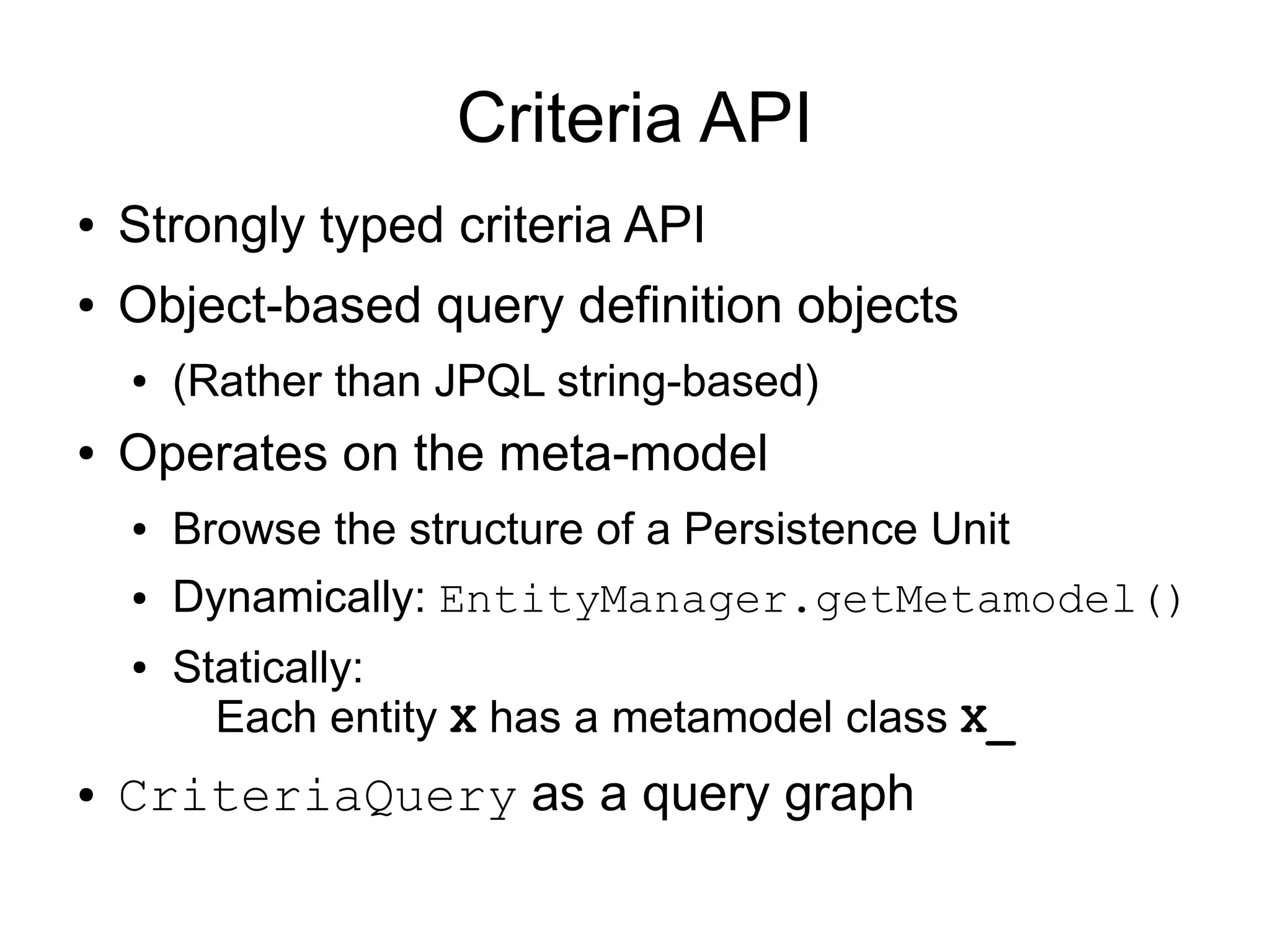
Criteria API
●   Strongly typed criteria API
●   Object-based query definition objects
    ●   (Rather than JPQL string-based)
●   Operates on the meta-model
    ●   Browse the structure of a Persistence Unit
    ●   Dynamically: EntityManager.getMetamodel()
    ●   Statically:
          Each entity X has a metamodel class X_
●   CriteriaQuery as a query graph
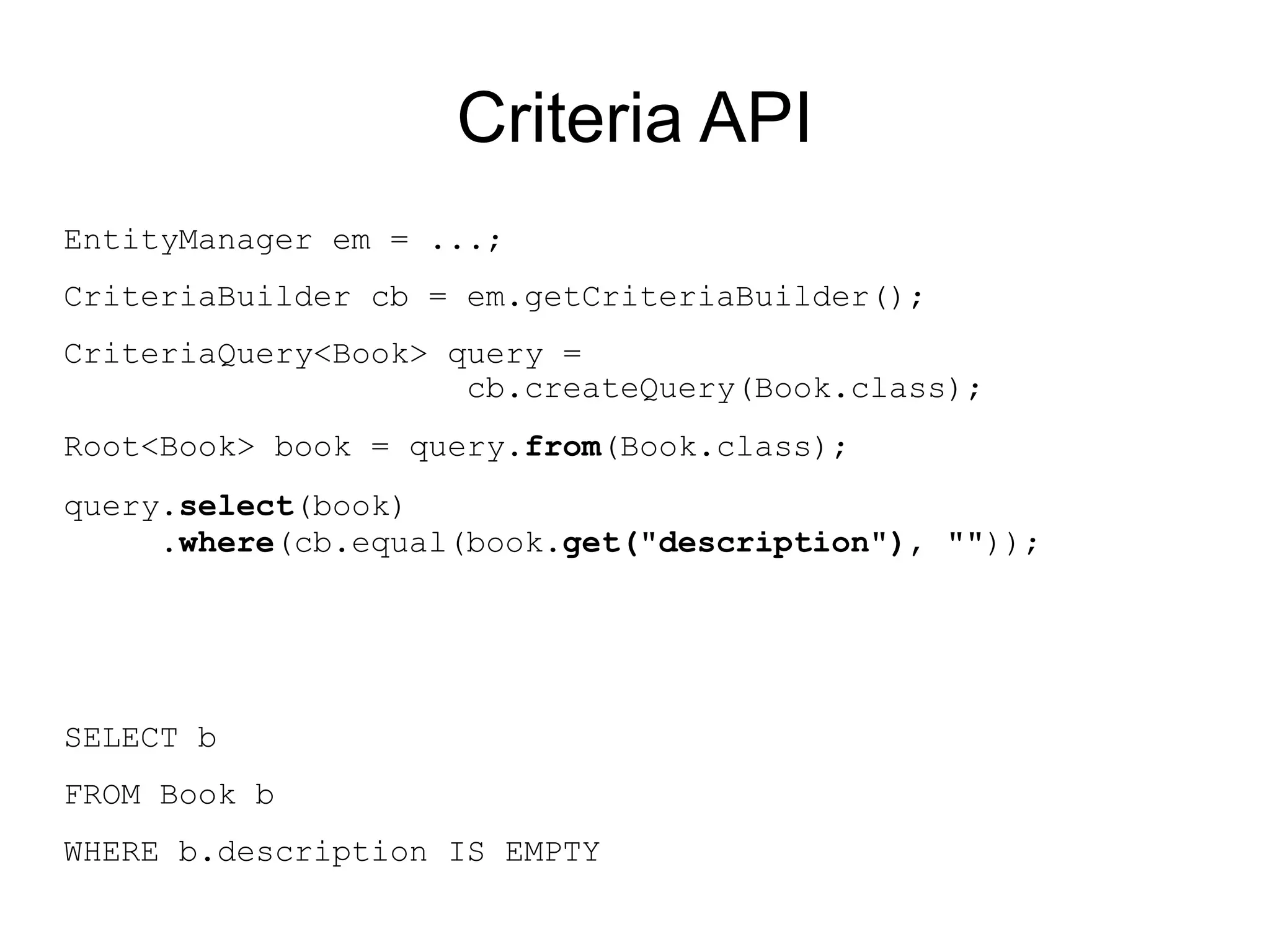
Criteria API
EntityManager em = ...;
CriteriaBuilder cb = em.getCriteriaBuilder();
CriteriaQuery<Book> query =
                     cb.createQuery(Book.class);
Root<Book> book = query.from(Book.class);
query.select(book)
     .where(cb.equal(book.get("description"), ""));


SELECT b
FROM Book b
WHERE b.description IS EMPTY
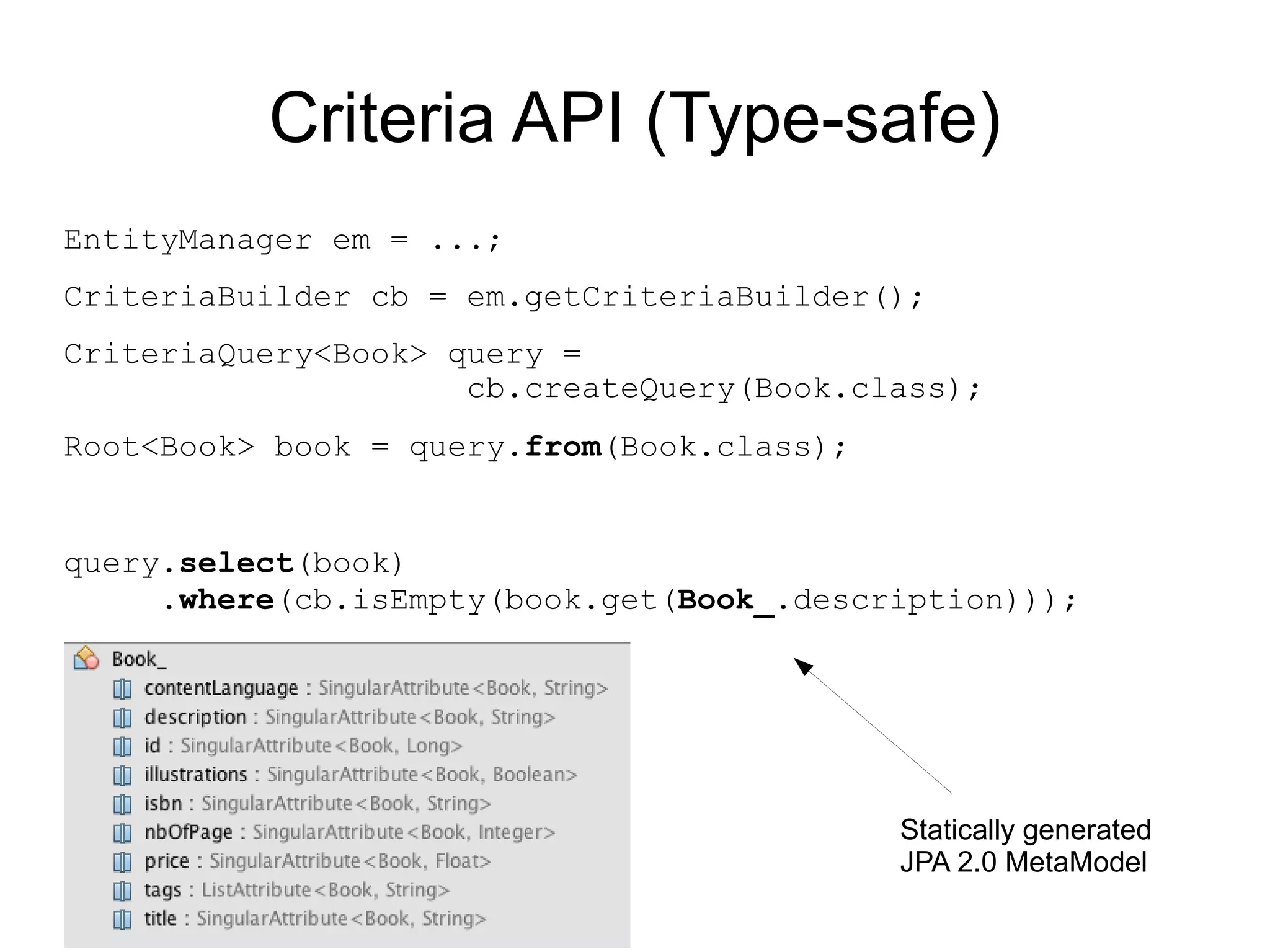
Criteria API (Type-safe)
EntityManager em = ...;
CriteriaBuilder cb = em.getCriteriaBuilder();
CriteriaQuery<Book> query =
                     cb.createQuery(Book.class);
Root<Book> book = query.from(Book.class);


query.select(book)
     .where(cb.isEmpty(book.get(Book_.description)));


                                            Statically generated
                                            JPA 2.0 MetaModel
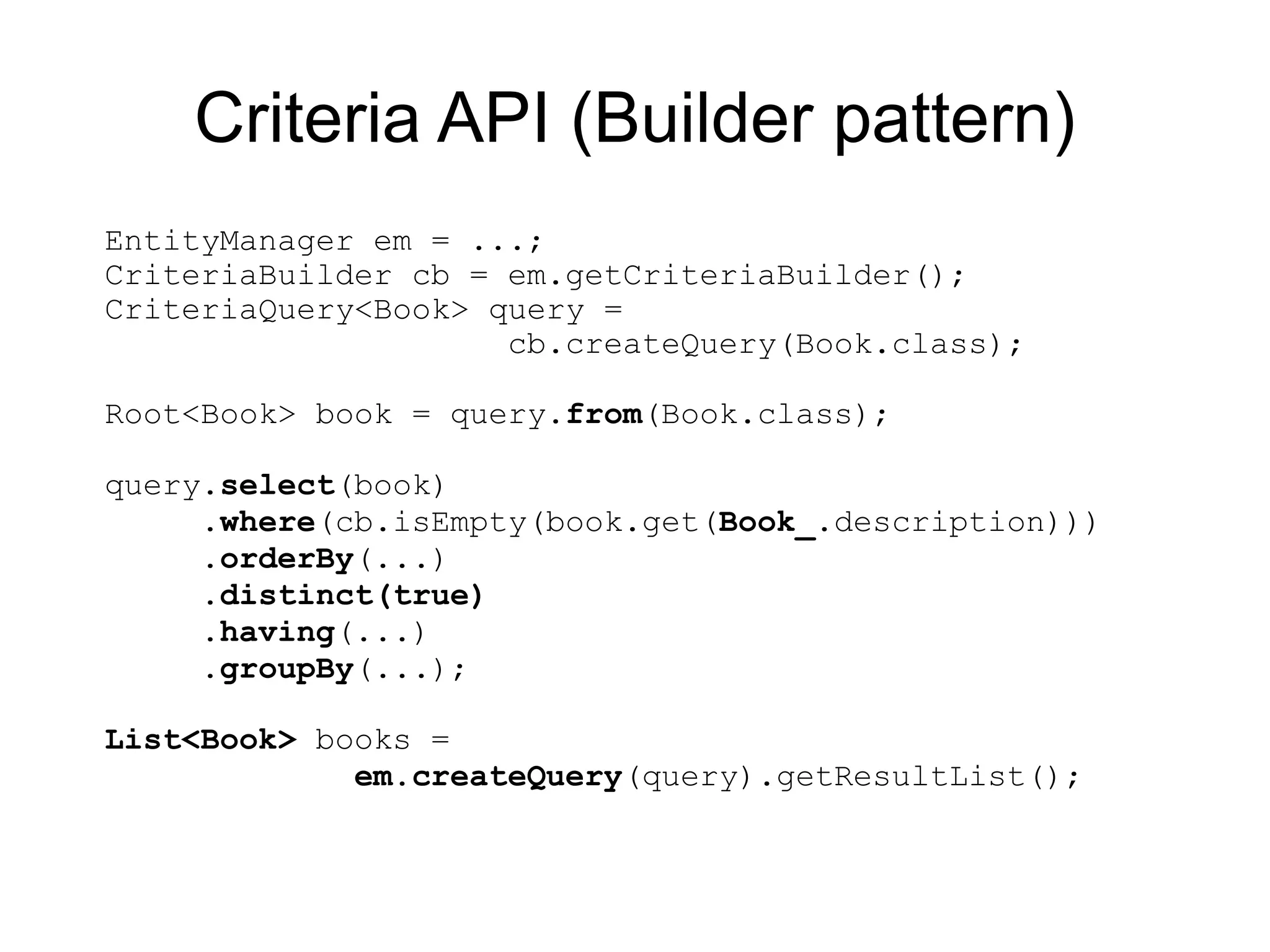
Criteria API (Builder pattern)
EntityManager em = ...;
CriteriaBuilder cb = em.getCriteriaBuilder();
CriteriaQuery<Book> query =
                     cb.createQuery(Book.class);

Root<Book> book = query.from(Book.class);

query.select(book)
     .where(cb.isEmpty(book.get(Book_.description)))
     .orderBy(...)
     .distinct(true)
     .having(...)
     .groupBy(...);

List<Book> books =
             em.createQuery(query).getResultList();
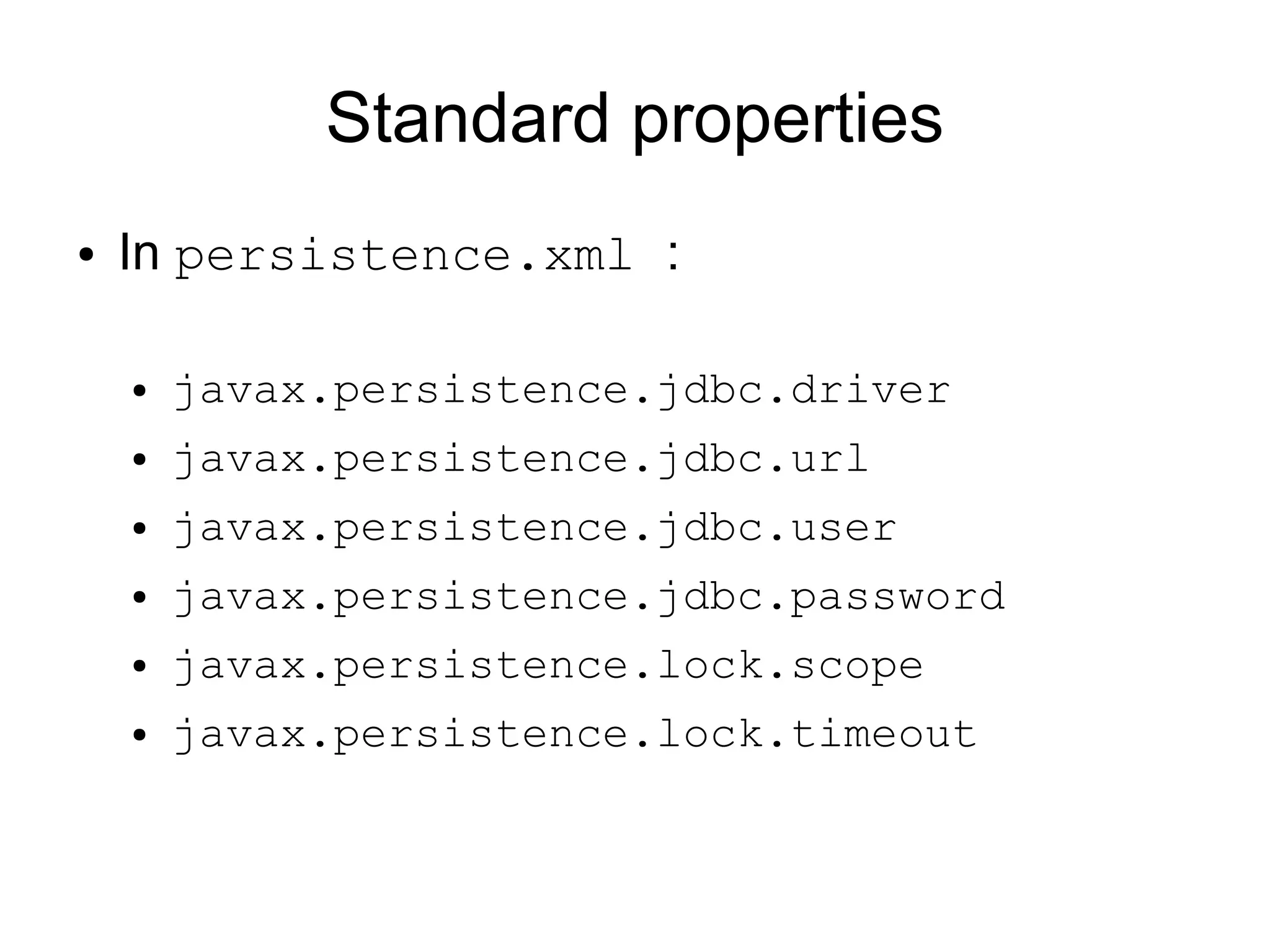
Standard properties
●   In persistence.xml :

    ●   javax.persistence.jdbc.driver
    ●   javax.persistence.jdbc.url
    ●   javax.persistence.jdbc.user
    ●   javax.persistence.jdbc.password
    ●   javax.persistence.lock.scope
    ●   javax.persistence.lock.timeout
And more...
●   detach()
●   Join<X,Y>, ListJoin, MapJoin
●   Orphan removal functionality
    ●   @OneToMany(orphanRemoval=true)
●   BeanValidation integration on lifecycle
●   Second-level cache API
    ●   @Cacheable annotation on entities
    ●   contain(Class,PK), evict(Class,PK), ...
●   Pessimistic locking
Servlet 3.0
●   Ease of development
●   Pluggability
●   Asynchronous support
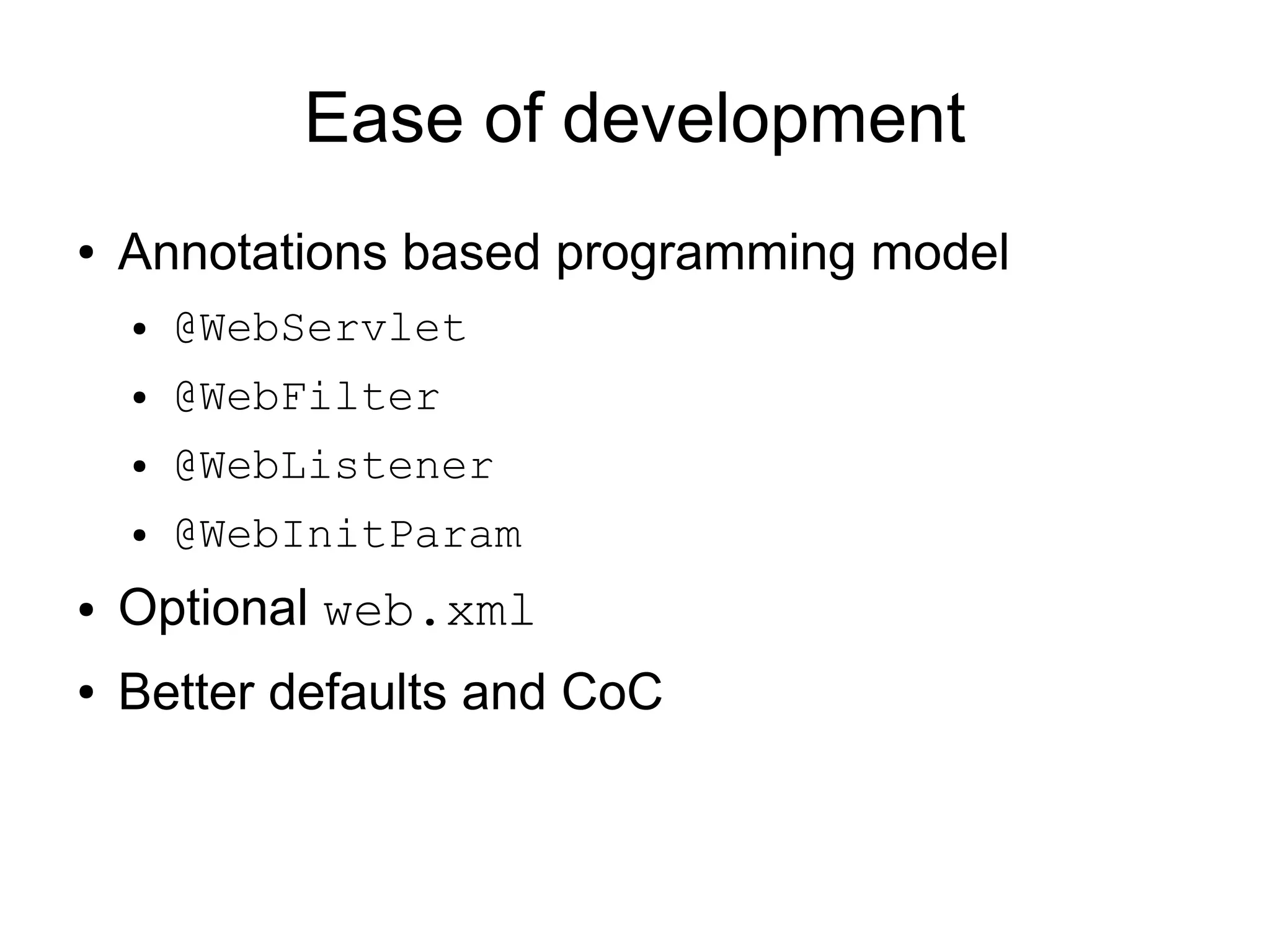
Ease of development
●   Annotations based programming model
    ●   @WebServlet
    ●   @WebFilter
    ●   @WebListener
    ●   @WebInitParam
●   Optional web.xml
●   Better defaults and CoC
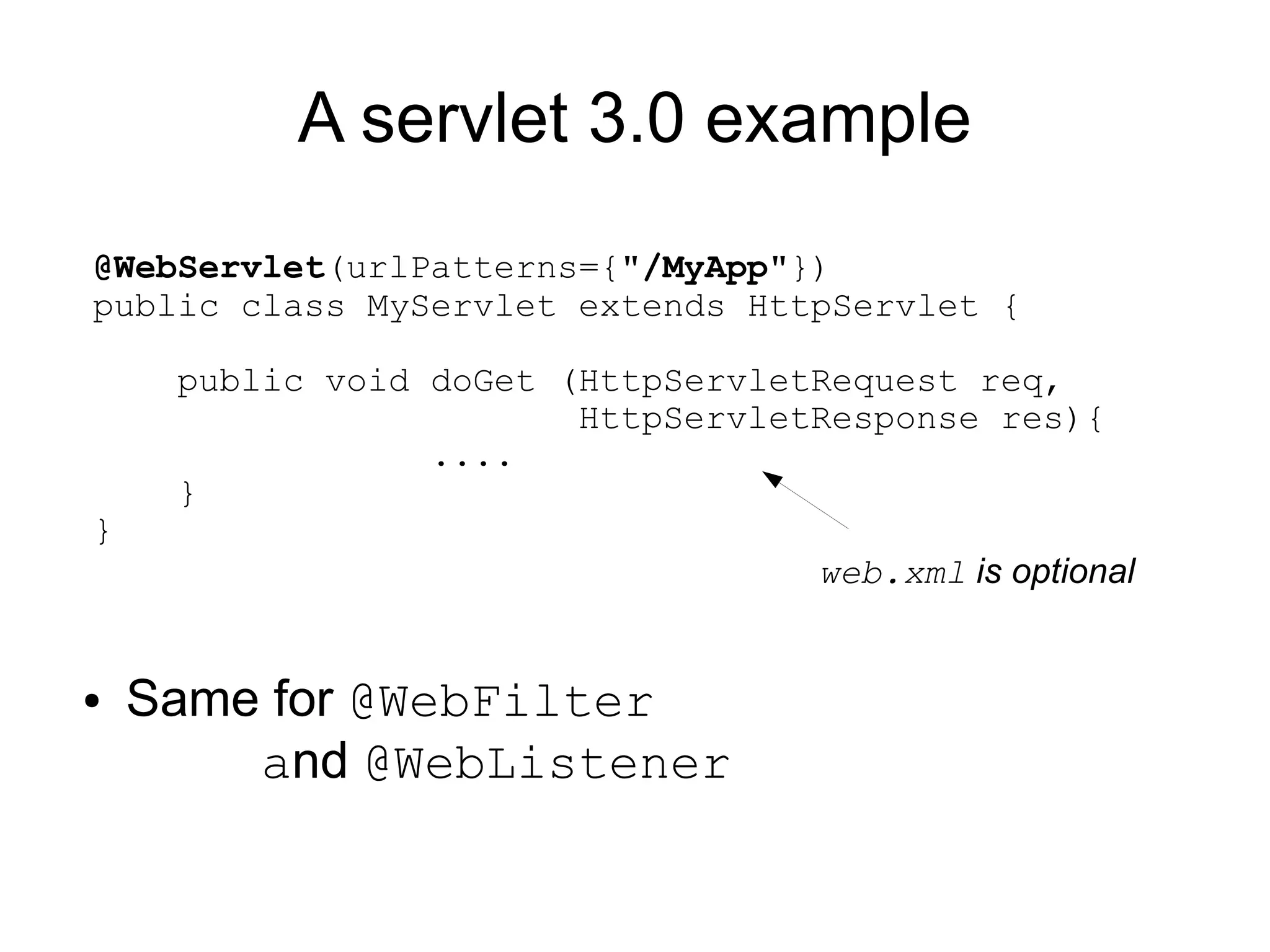
A servlet 3.0 example
@WebServlet(urlPatterns={"/MyApp"})
public class MyServlet extends HttpServlet {

     public void doGet (HttpServletRequest req,
                        HttpServletResponse res){
                 ....
     }
}
                                   web.xml is optional


●   Same for @WebFilter
        and @WebListener
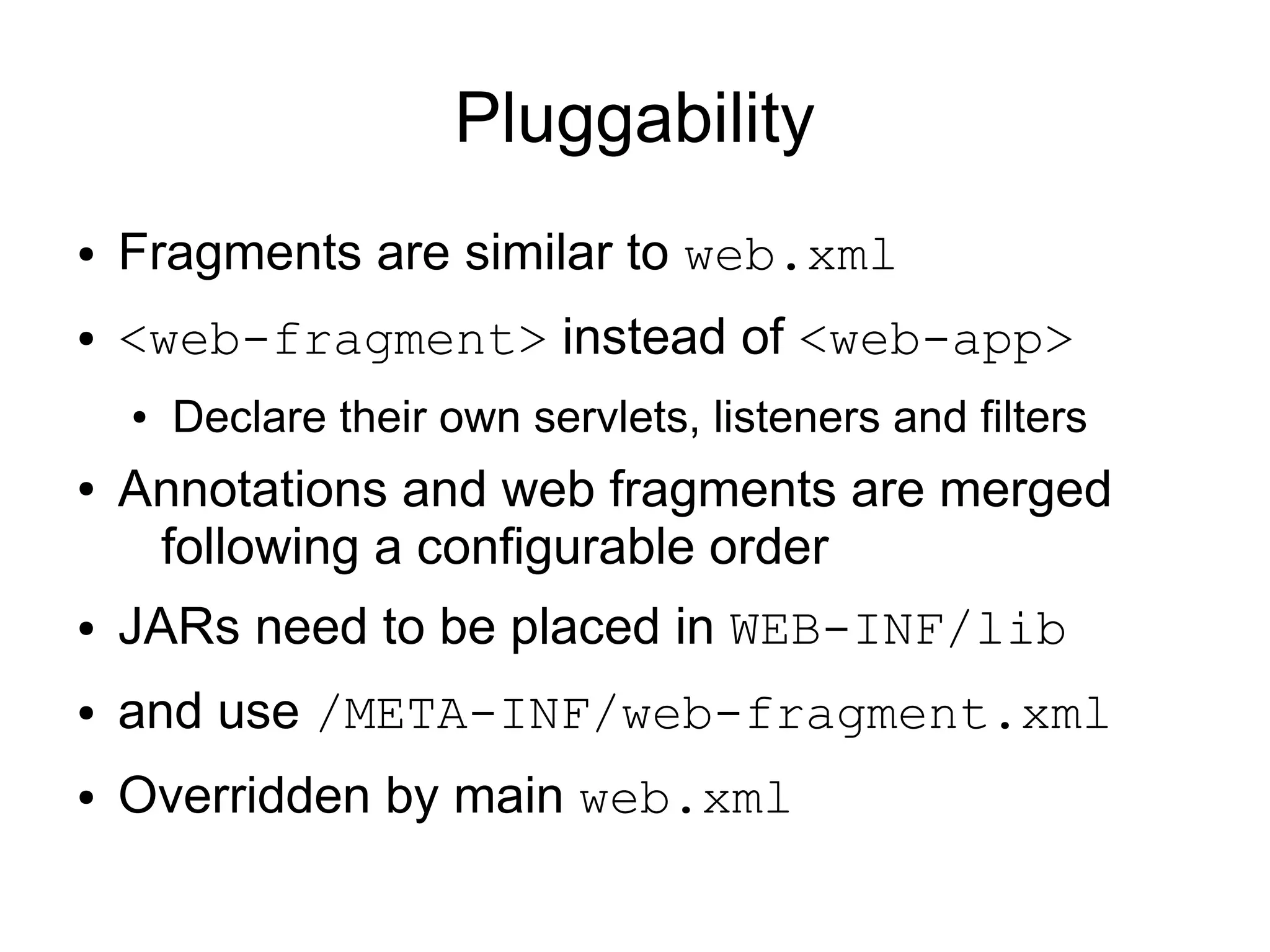
Pluggability
●   Fragments are similar to web.xml
●   <web-fragment> instead of <web-app>
    ●   Declare their own servlets, listeners and filters
●   Annotations and web fragments are merged
     following a configurable order
●   JARs need to be placed in WEB-INF/lib
●   and use /META-INF/web-fragment.xml
●   Overridden by main web.xml
And more...
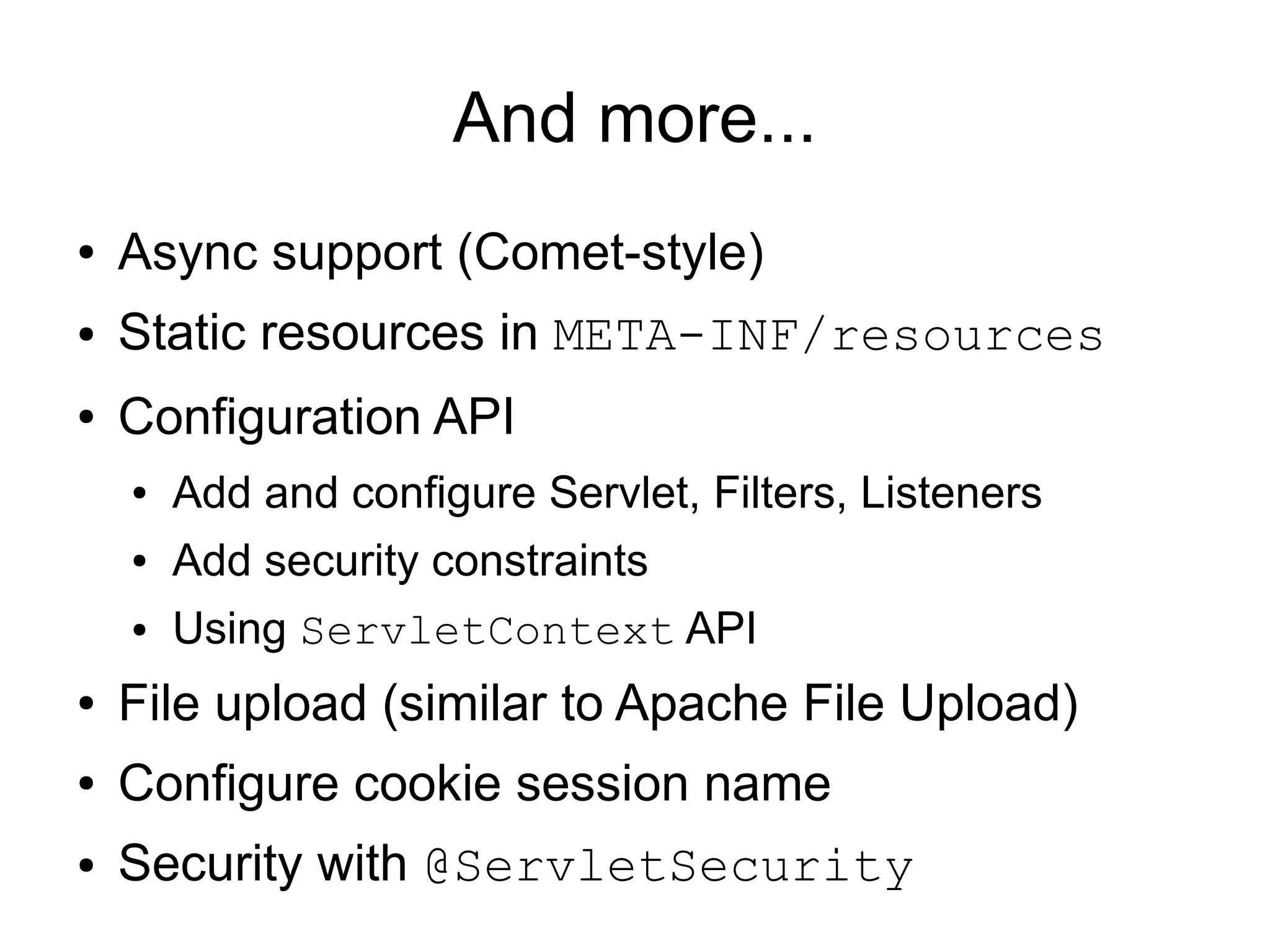
●   Async support (Comet-style)
●   Static resources in META-INF/resources
●   Configuration API
    ●   Add and configure Servlet, Filters, Listeners
    ●   Add security constraints
    ●   Using ServletContext API
●   File upload (similar to Apache File Upload)
●   Configure cookie session name
●   Security with @ServletSecurity
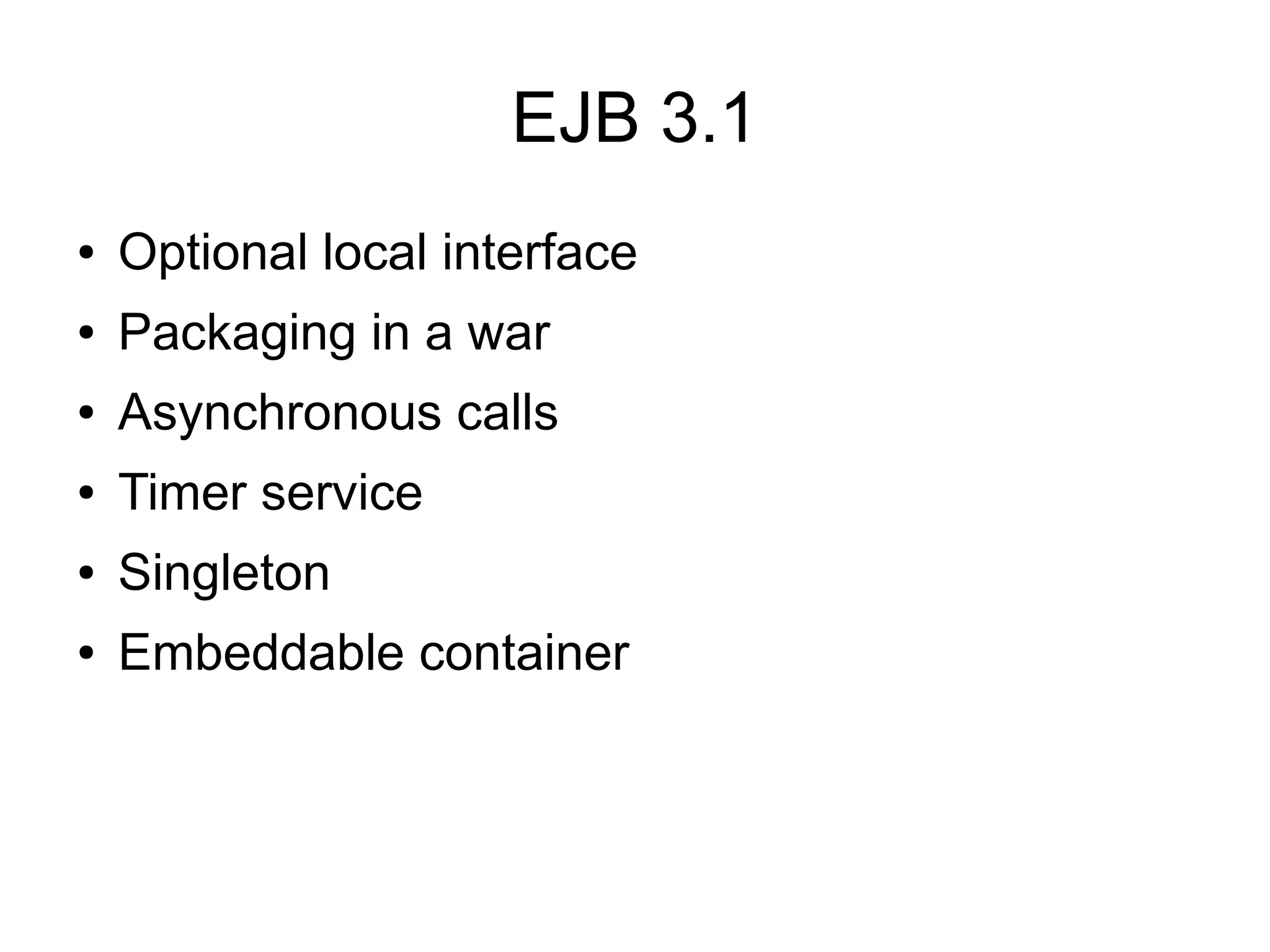
EJB 3.1
●   Optional local interface
●   Packaging in a war
●   Asynchronous calls
●   Timer service
●   Singleton
●   Embeddable container
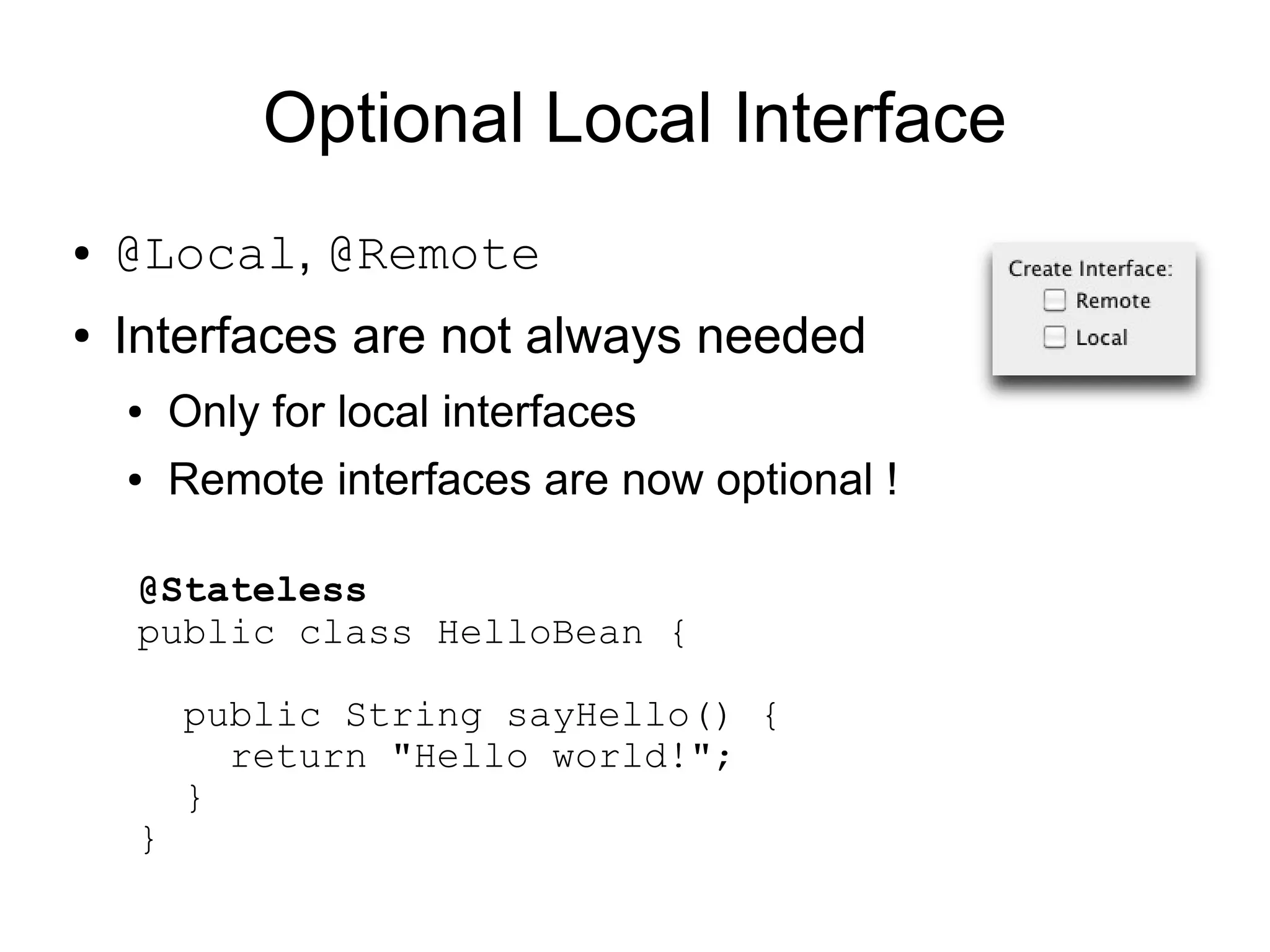
Optional Local Interface
●   @Local, @Remote
●   Interfaces are not always needed
    ●    Only for local interfaces
    ●    Remote interfaces are now optional !

     @Stateless
     public class HelloBean {

         public String sayHello() {
           return "Hello world!";
         }
     }
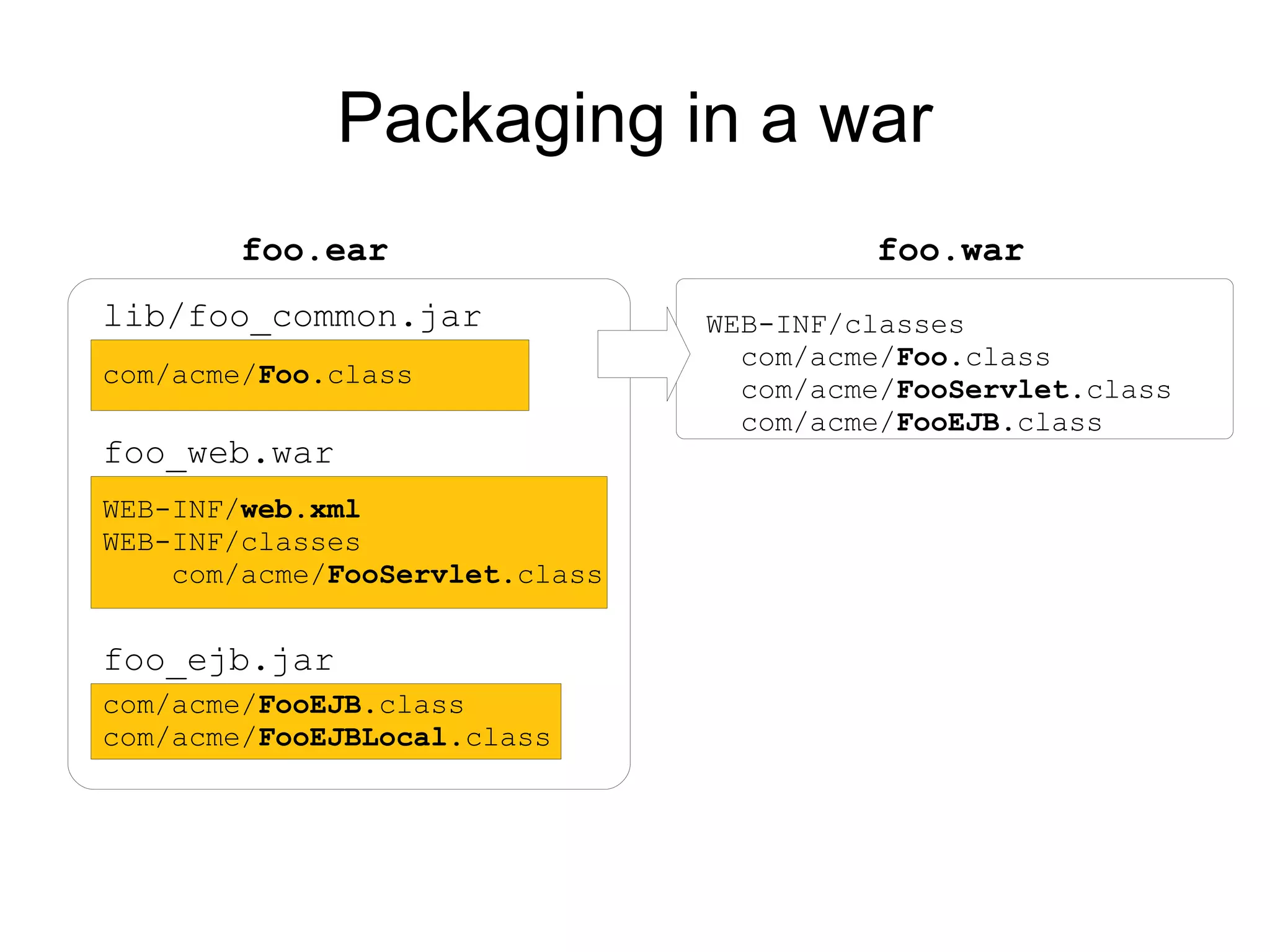
Packaging in a war
        foo.ear                          foo.war
lib/foo_common.jar              WEB-INF/classes
                                  com/acme/Foo.class
com/acme/Foo.class
                                  com/acme/FooServlet.class
                                  com/acme/FooEJB.class
foo_web.war
WEB-INF/web.xml
WEB-INF/classes
    com/acme/FooServlet.class


foo_ejb.jar
com/acme/FooEJB.class
com/acme/FooEJBLocal.class
Asynchronous calls
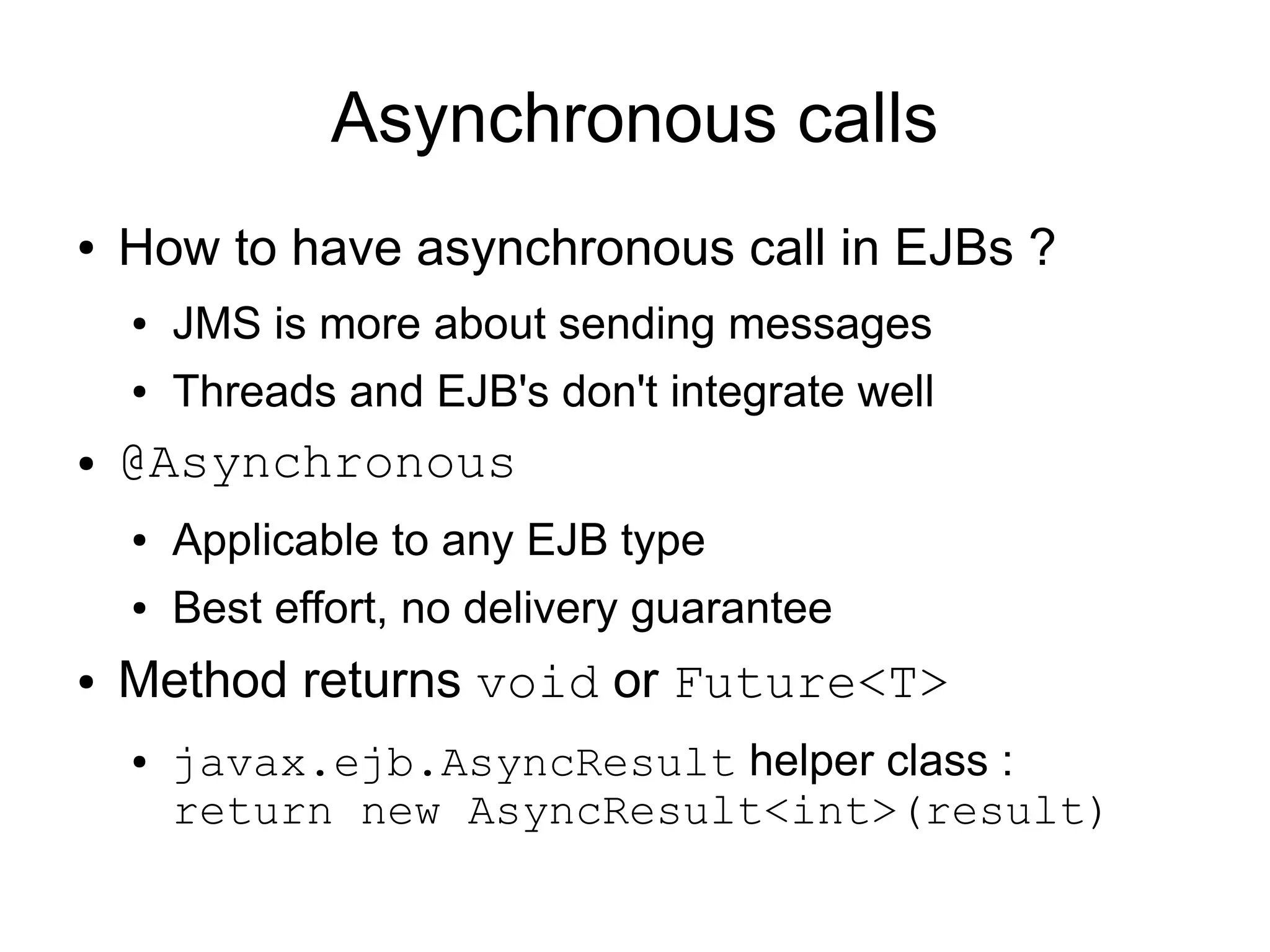
●   How to have asynchronous call in EJBs ?
    ●   JMS is more about sending messages
    ●   Threads and EJB's don't integrate well
●   @Asynchronous
    ●   Applicable to any EJB type
    ●   Best effort, no delivery guarantee
●   Method returns void or Future<T>
    ●   javax.ejb.AsyncResult helper class :
        return new AsyncResult<int>(result)
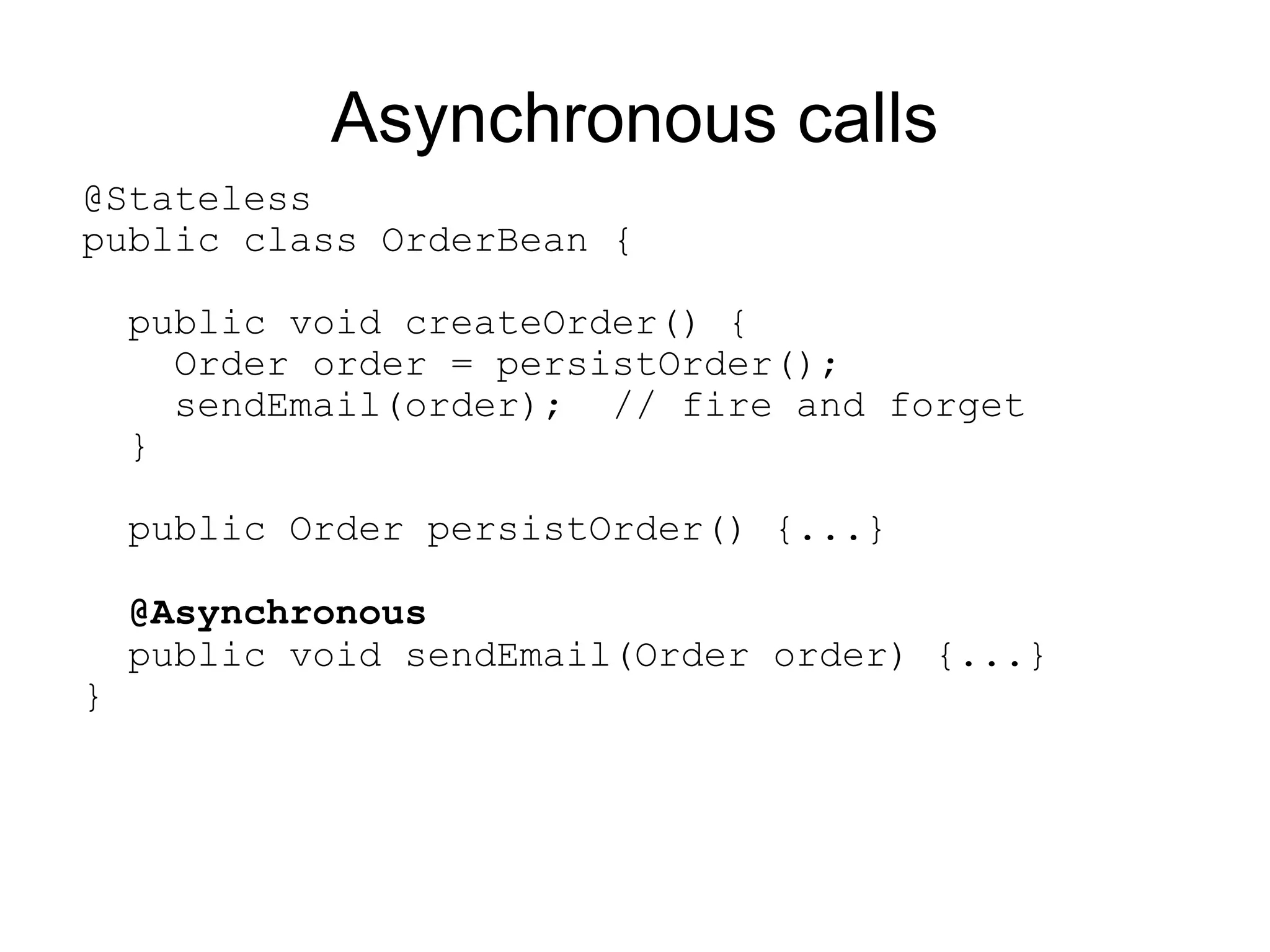
Asynchronous calls
@Stateless
public class OrderBean {

    public void createOrder() {
      Order order = persistOrder();
      sendEmail(order); // fire and forget
    }

    public Order persistOrder() {...}

    @Asynchronous
    public void sendEmail(Order order) {...}
}
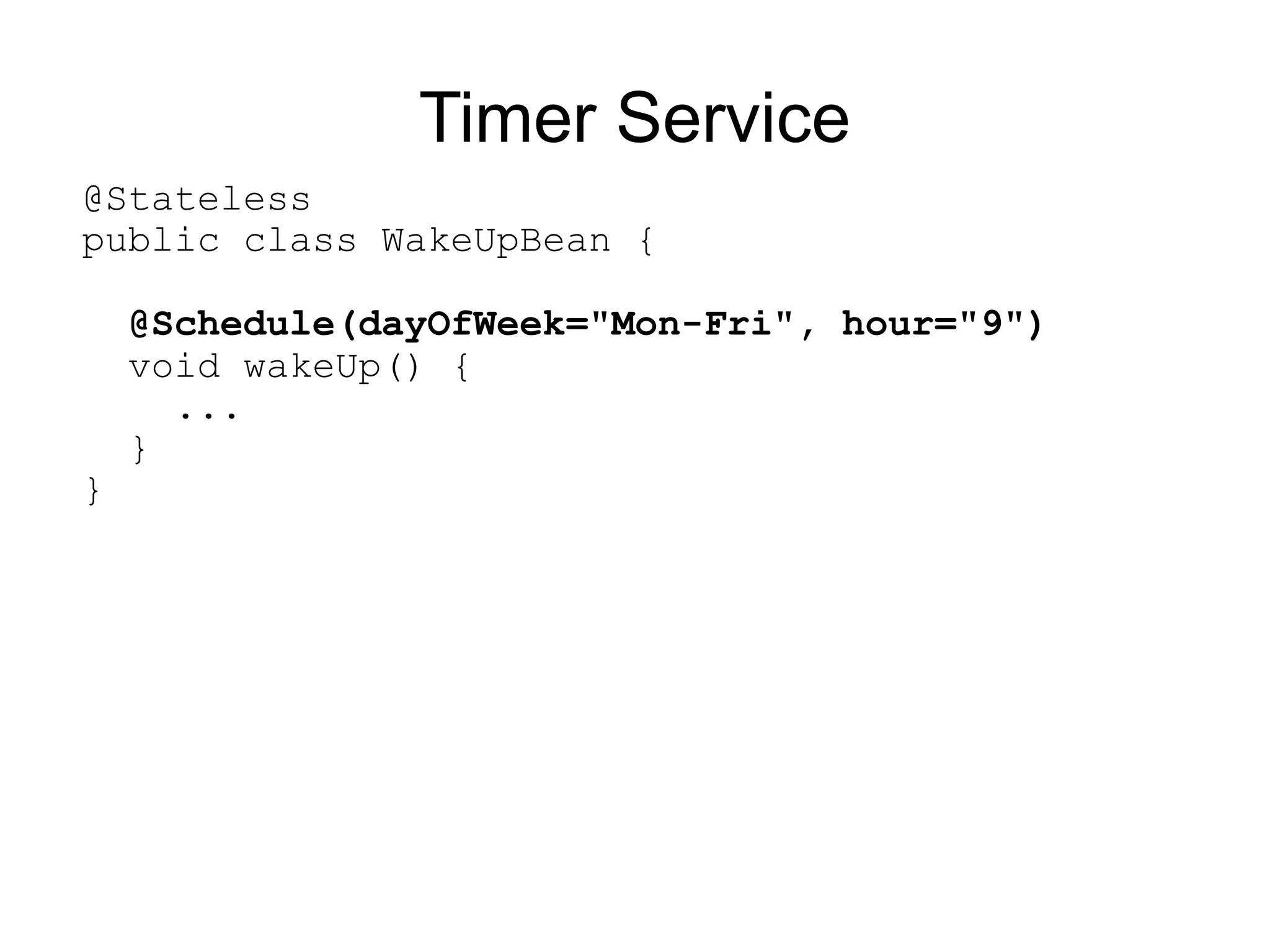
Timer Service
●   Programmatic and Calendar based scheduling
    ●   « Last day of the month »
    ●   « Every five minutes on Monday and Friday »

●   Cron-like syntax
    ●   second [0..59], minute[0..59], hour[0..23]...
    ●   dayOfMonth[1..31]
    ●   dayOfWeek[0..7] or [sun, mon, tue..]
    ●   Month[0..12] or [jan,feb..]
Timer Service
@Stateless
public class WakeUpBean {

    @Schedule(dayOfWeek="Mon-Fri", hour="9")
    void wakeUp() {
      ...
    }
}
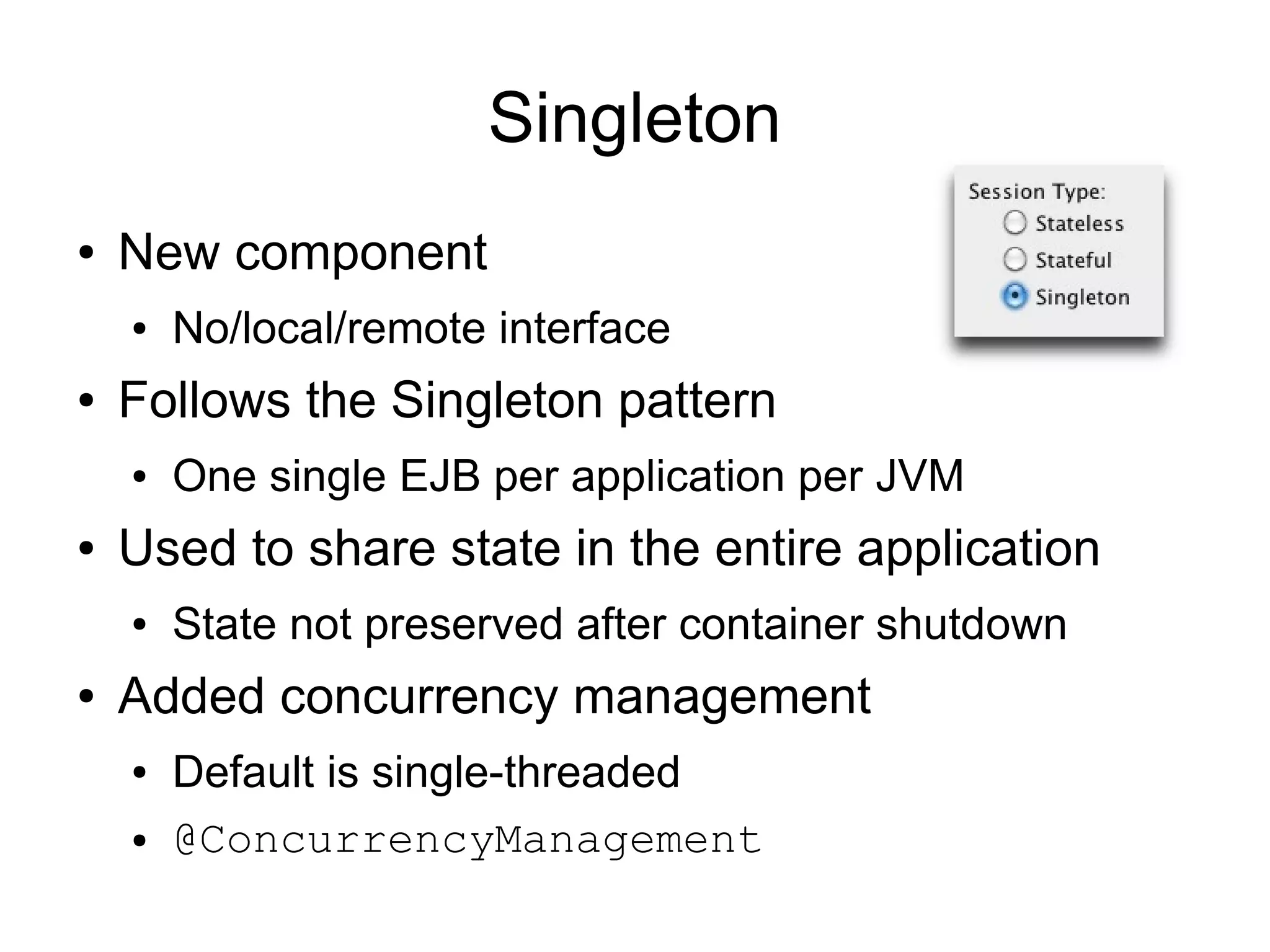
Singleton
●   New component
    ●   No/local/remote interface
●   Follows the Singleton pattern
    ●   One single EJB per application per JVM
●   Used to share state in the entire application
    ●   State not preserved after container shutdown
●   Added concurrency management
    ●   Default is single-threaded
    ●   @ConcurrencyManagement
Singleton
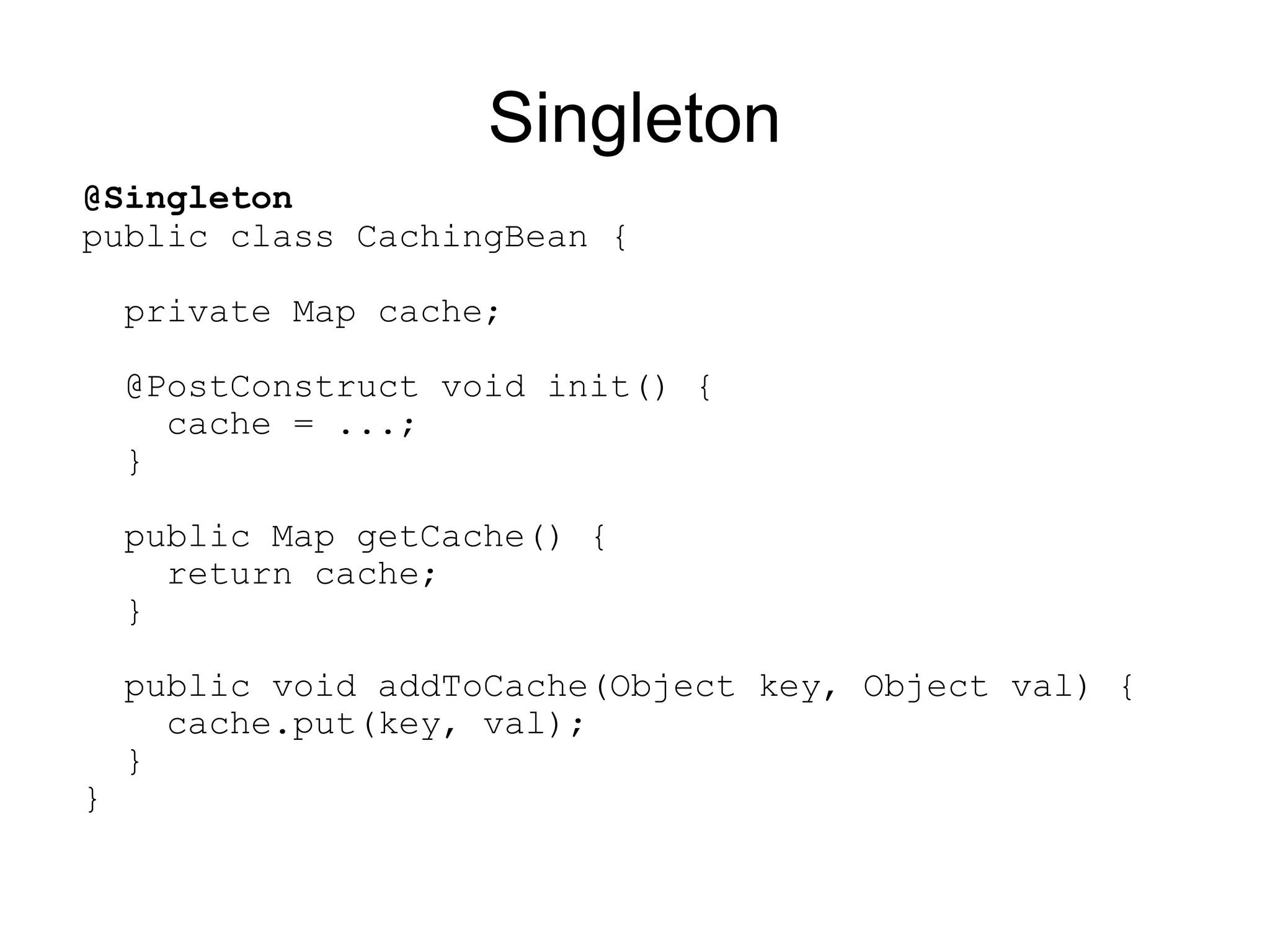
@Singleton
public class CachingBean {

    private Map cache;

    @PostConstruct void init() {
      cache = ...;
    }

    public Map getCache() {
      return cache;
    }

    public void addToCache(Object key, Object val) {
      cache.put(key, val);
    }
}
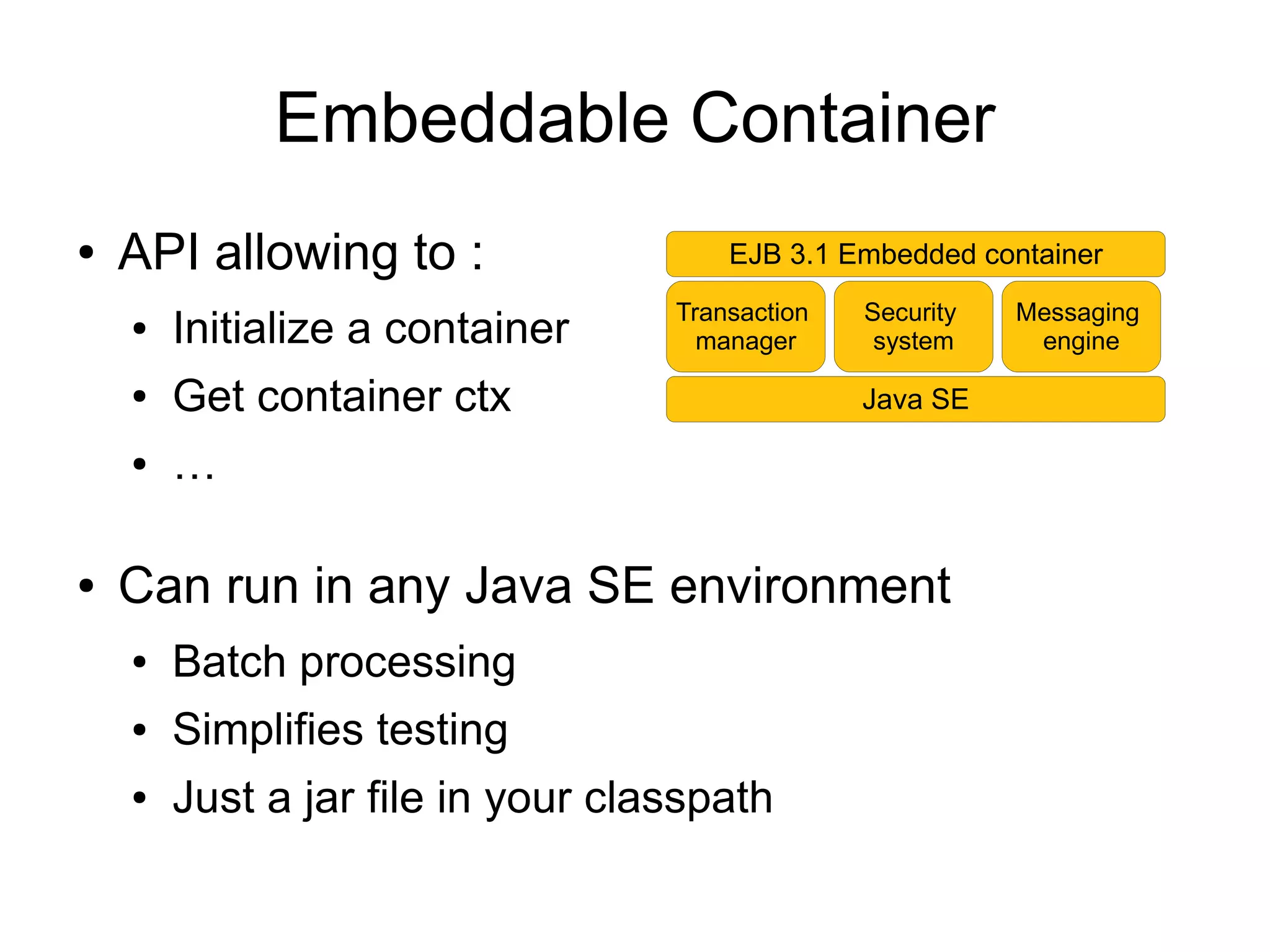
Embeddable Container
●   API allowing to :                  EJB 3.1 Embedded container
                                   Transaction   Security   Messaging
    ●   Initialize a container       manager      system     engine

    ●   Get container ctx                        Java SE

    ●   …

●   Can run in any Java SE environment
    ●   Batch processing
    ●   Simplifies testing
    ●   Just a jar file in your classpath
Embeddable Container
public static void main(String[] args){

    EJBContainer container =
          EJBContainer.createEJBContainer();

    Context context = container.getContext();

    Hello h = (Hello)context.lookup("Global_JNDI_Name");

    h.sayHello();

    container.close();
}
And more...
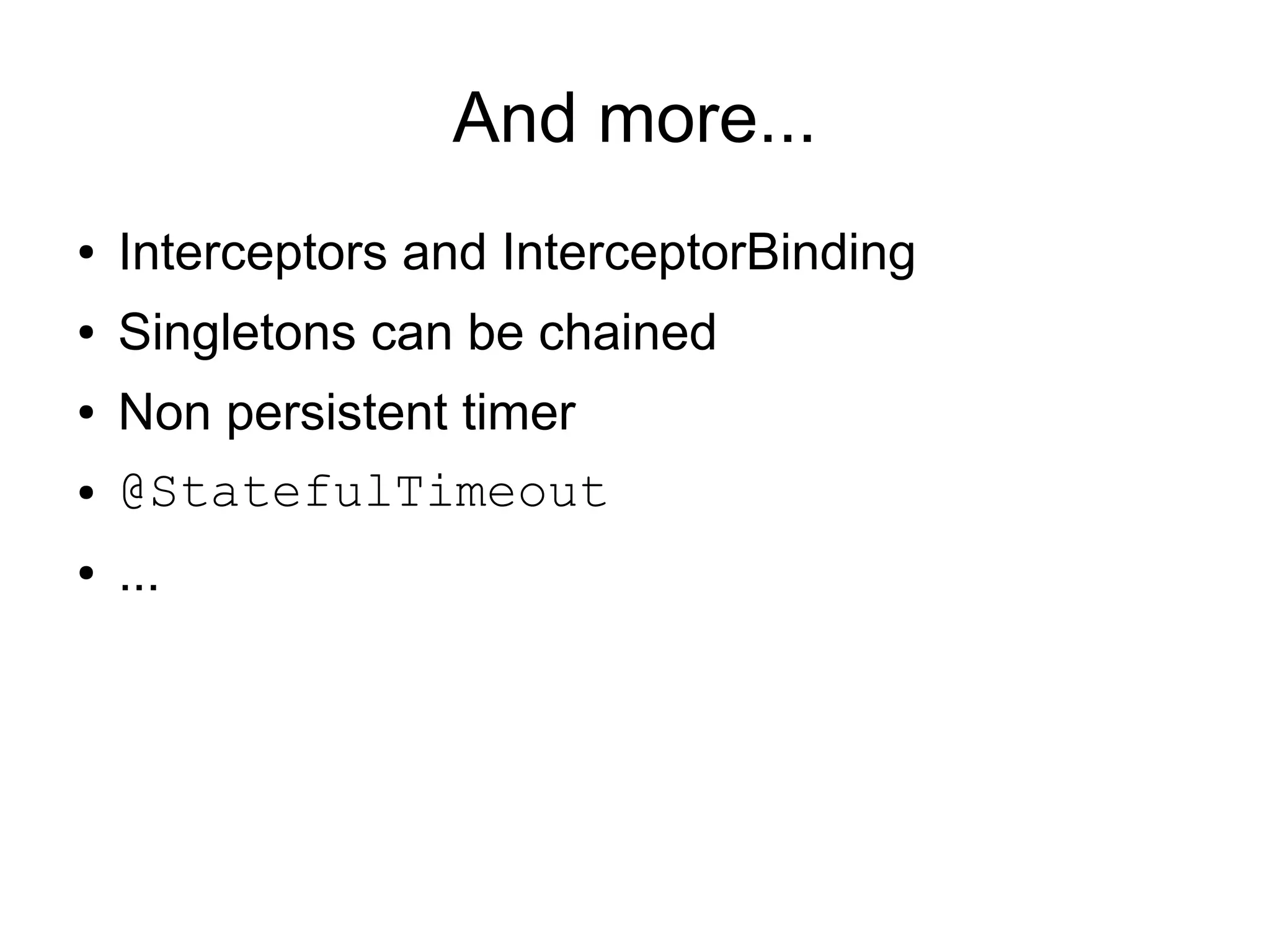
●   Interceptors and InterceptorBinding
●   Singletons can be chained
●   Non persistent timer
●   @StatefulTimeout
●   ...
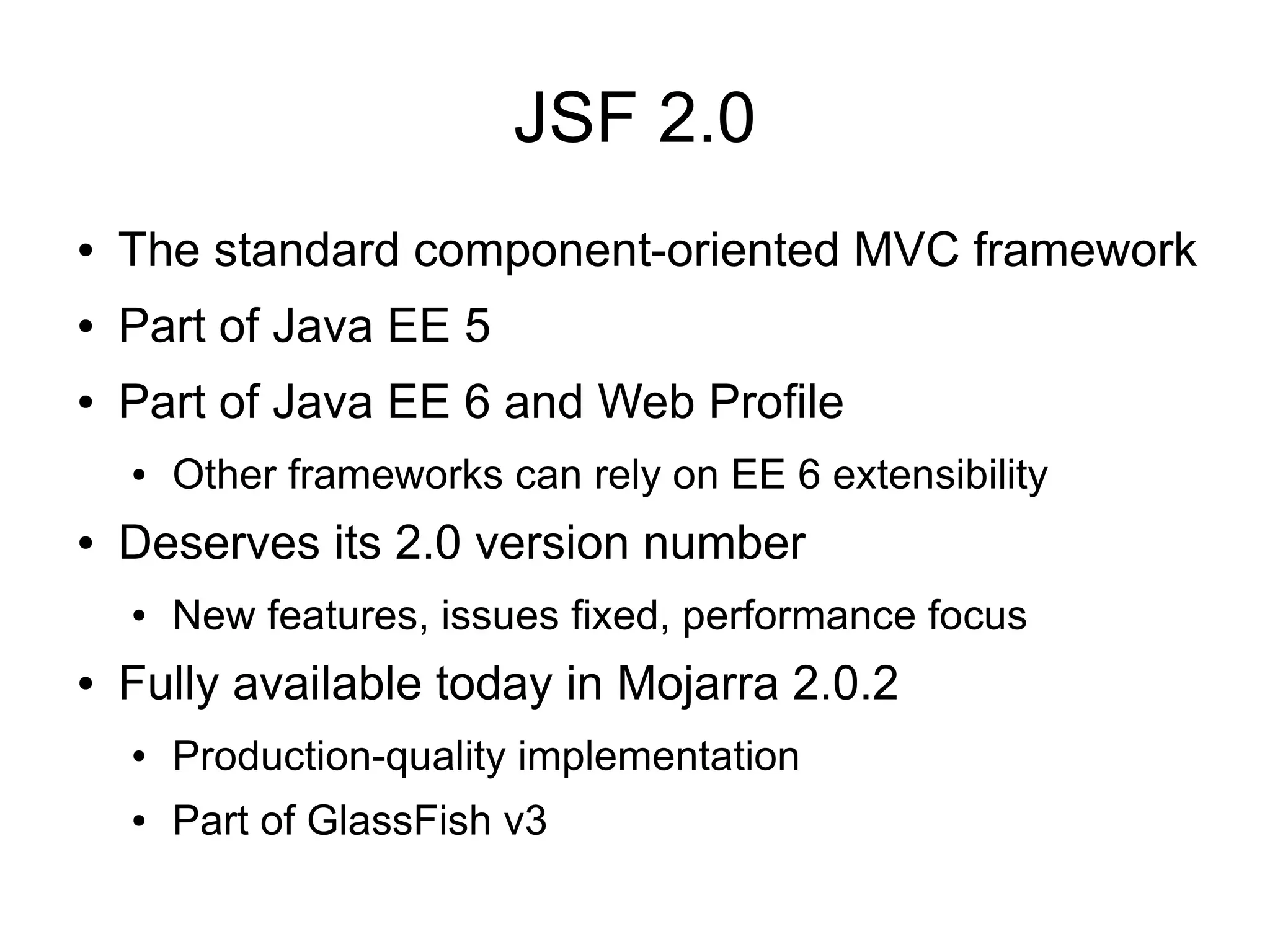
JSF 2.0
●   The standard component-oriented MVC framework
●   Part of Java EE 5
●   Part of Java EE 6 and Web Profile
    ●   Other frameworks can rely on EE 6 extensibility
●   Deserves its 2.0 version number
    ●   New features, issues fixed, performance focus
●   Fully available today in Mojarra 2.0.2
    ●   Production-quality implementation
    ●   Part of GlassFish v3
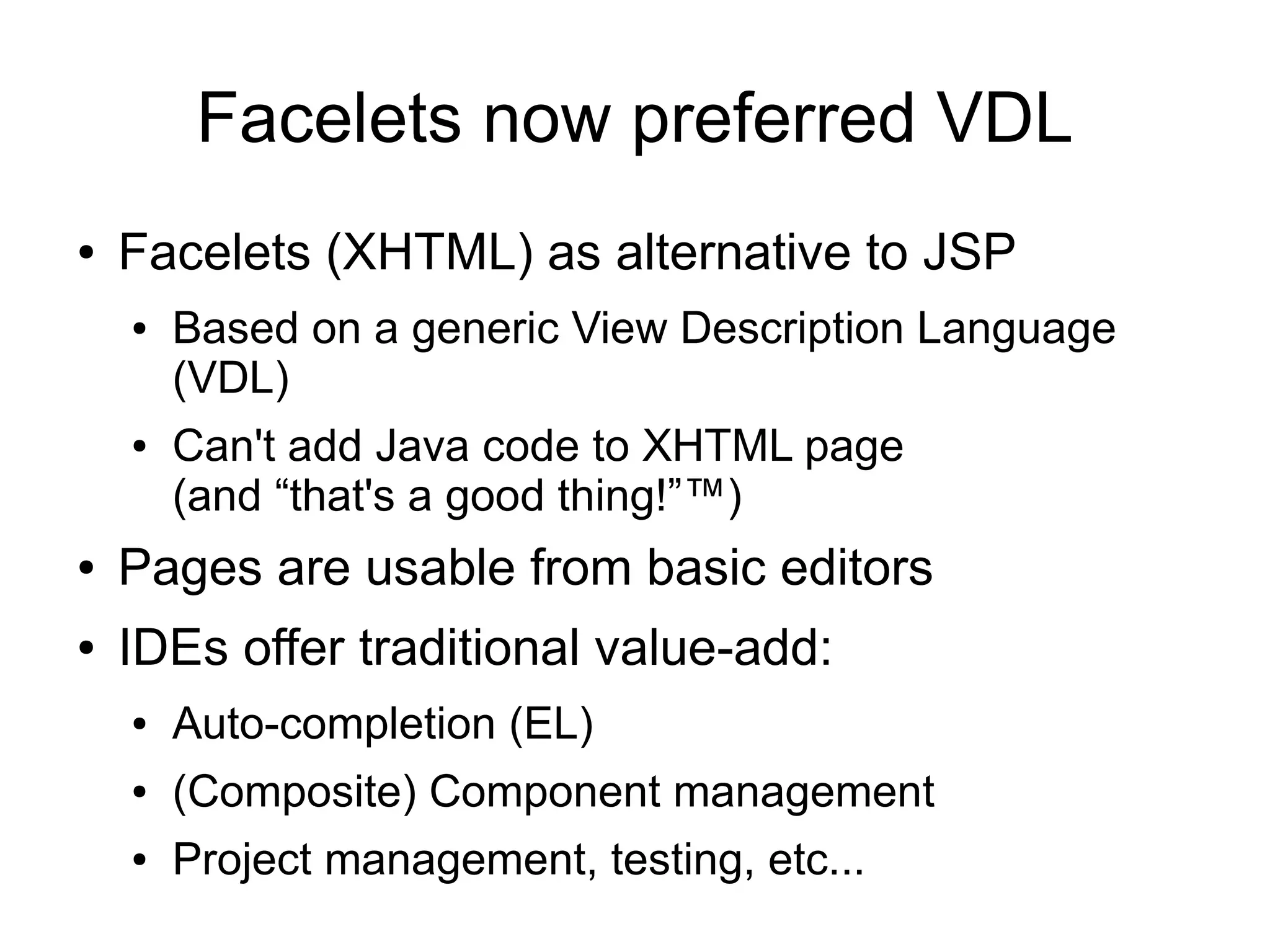
Facelets now preferred VDL
●   Facelets (XHTML) as alternative to JSP
    ●   Based on a generic View Description Language
        (VDL)
    ●   Can't add Java code to XHTML page
        (and “that's a good thing!”™)
●   Pages are usable from basic editors
●   IDEs offer traditional value-add:
    ●   Auto-completion (EL)
    ●   (Composite) Component management
    ●   Project management, testing, etc...
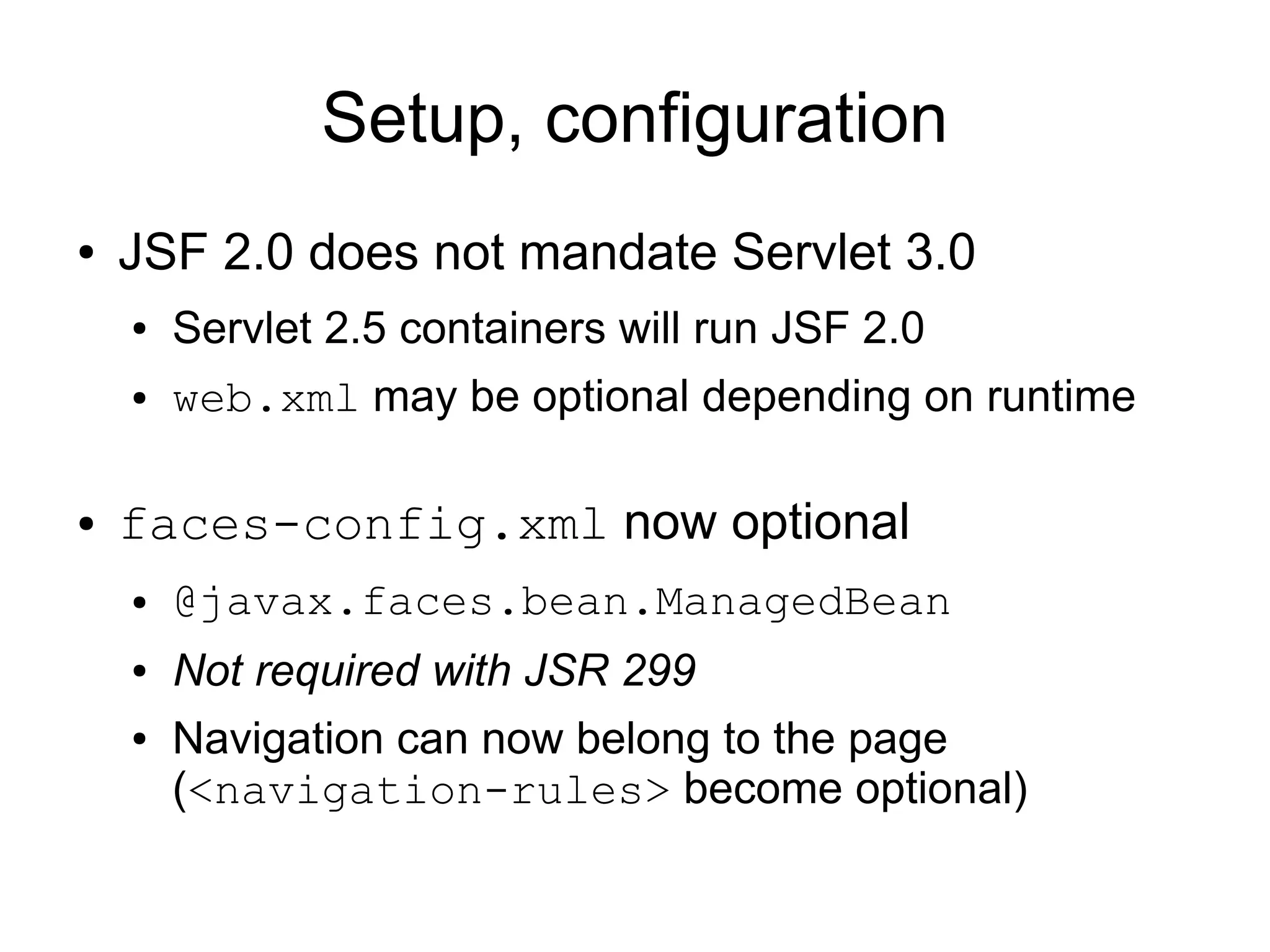
Setup, configuration
●   JSF 2.0 does not mandate Servlet 3.0
    ●   Servlet 2.5 containers will run JSF 2.0
    ●   web.xml may be optional depending on runtime

●   faces-config.xml now optional
    ●   @javax.faces.bean.ManagedBean
    ●   Not required with JSR 299
    ●   Navigation can now belong to the page
        (<navigation-rules> become optional)
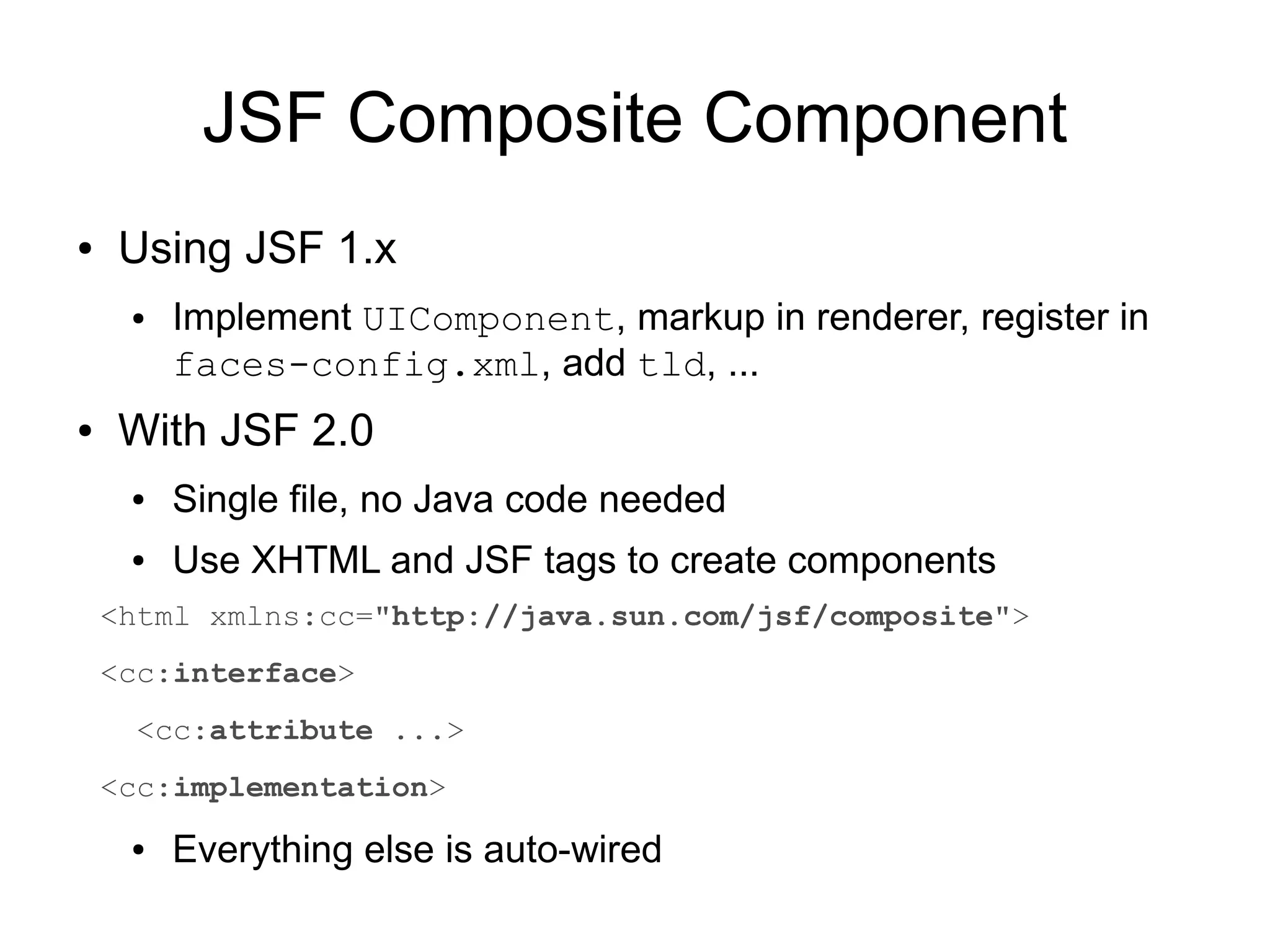
JSF Composite Component
●   Using JSF 1.x
     ●   Implement UIComponent, markup in renderer, register in
         faces-config.xml, add tld, ...
●   With JSF 2.0
     ●   Single file, no Java code needed
     ●   Use XHTML and JSF tags to create components
    <html xmlns:cc="http://java.sun.com/jsf/composite">
    <cc:interface>
      <cc:attribute ...>
    <cc:implementation>
     ●   Everything else is auto-wired
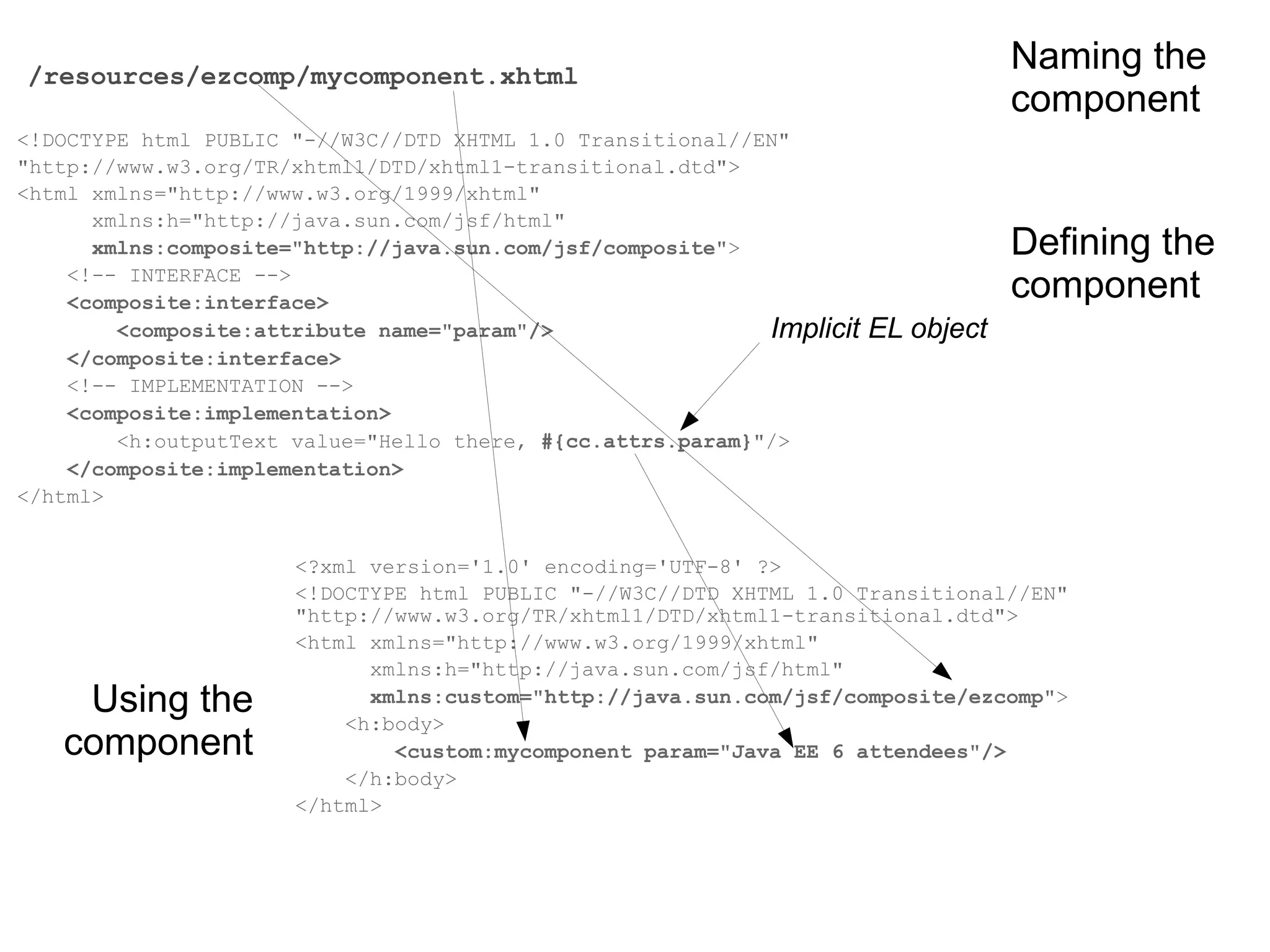
/resources/ezcomp/mycomponent.xhtml
                                                                                   Naming the
                                                                                   component
<!DOCTYPE html PUBLIC "-//W3C//DTD XHTML 1.0 Transitional//EN"
"http://www.w3.org/TR/xhtml1/DTD/xhtml1-transitional.dtd">
<html xmlns="http://www.w3.org/1999/xhtml"
      xmlns:h="http://java.sun.com/jsf/html"
      xmlns:composite="http://java.sun.com/jsf/composite">                         Defining the
    <!-- INTERFACE -->
    <composite:interface>
                                                                                   component
        <composite:attribute name="param"/>                 Implicit   EL object
    </composite:interface>
    <!-- IMPLEMENTATION -->
    <composite:implementation>
        <h:outputText value="Hello there, #{cc.attrs.param}"/>
    </composite:implementation>
</html>


                      <?xml version='1.0' encoding='UTF-8' ?>
                      <!DOCTYPE html PUBLIC "-//W3C//DTD XHTML 1.0 Transitional//EN"
                      "http://www.w3.org/TR/xhtml1/DTD/xhtml1-transitional.dtd">
                      <html xmlns="http://www.w3.org/1999/xhtml"
                            xmlns:h="http://java.sun.com/jsf/html"
    Using the               xmlns:custom="http://java.sun.com/jsf/composite/ezcomp">
                          <h:body>
   component                  <custom:mycomponent param="Java EE 6 attendees"/>
                          </h:body>
                      </html>
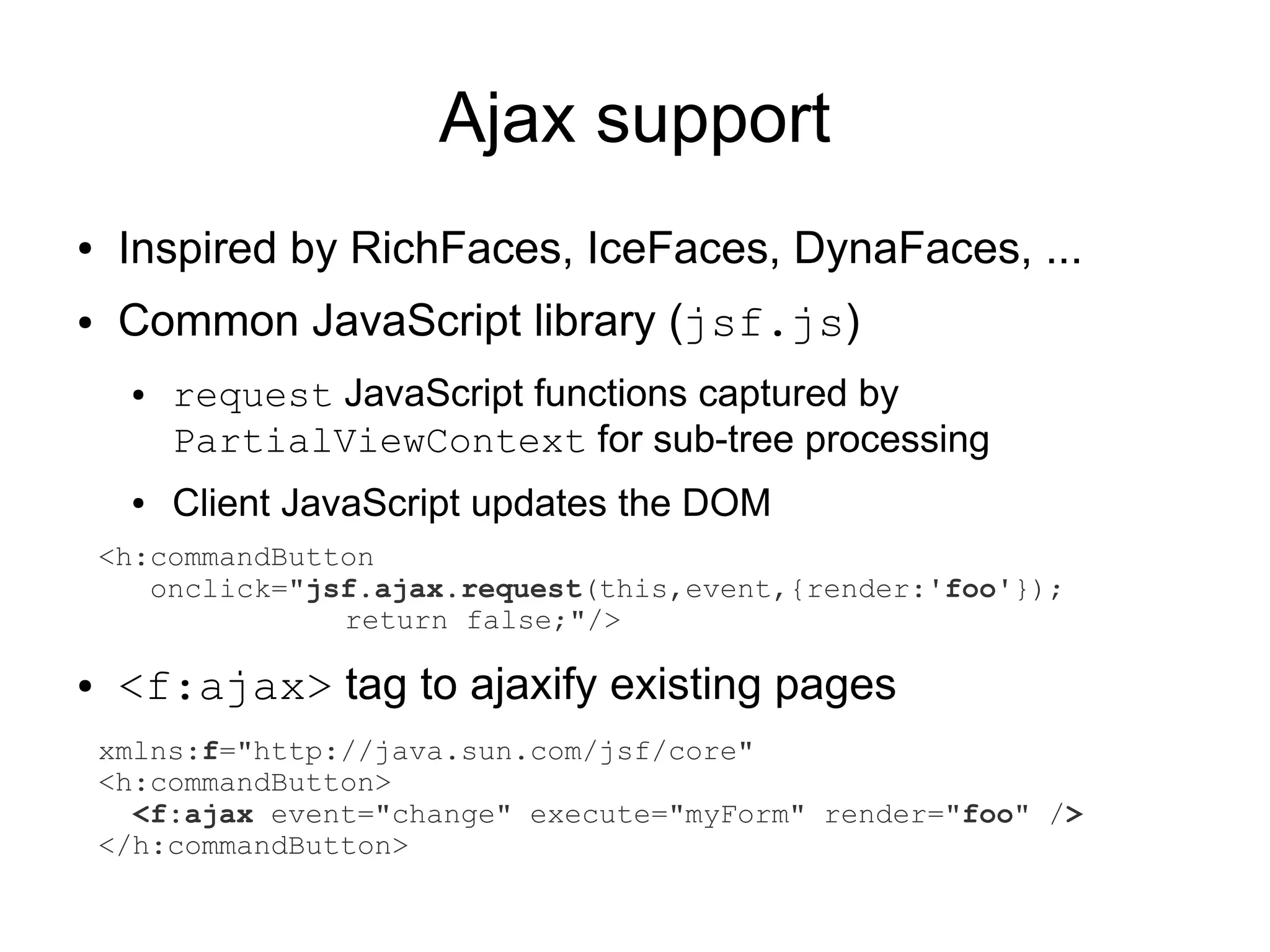
Ajax support
●    Inspired by RichFaces, IceFaces, DynaFaces, ...
●    Common JavaScript library (jsf.js)
     ●   request JavaScript functions captured by
         PartialViewContext for sub-tree processing
     ●   Client JavaScript updates the DOM
    <h:commandButton
       onclick="jsf.ajax.request(this,event,{render:'foo'});
                  return false;"/>

●    <f:ajax> tag to ajaxify existing pages
    xmlns:f="http://java.sun.com/jsf/core"
    <h:commandButton>
      <f:ajax event="change" execute="myForm" render="foo" />
    </h:commandButton>
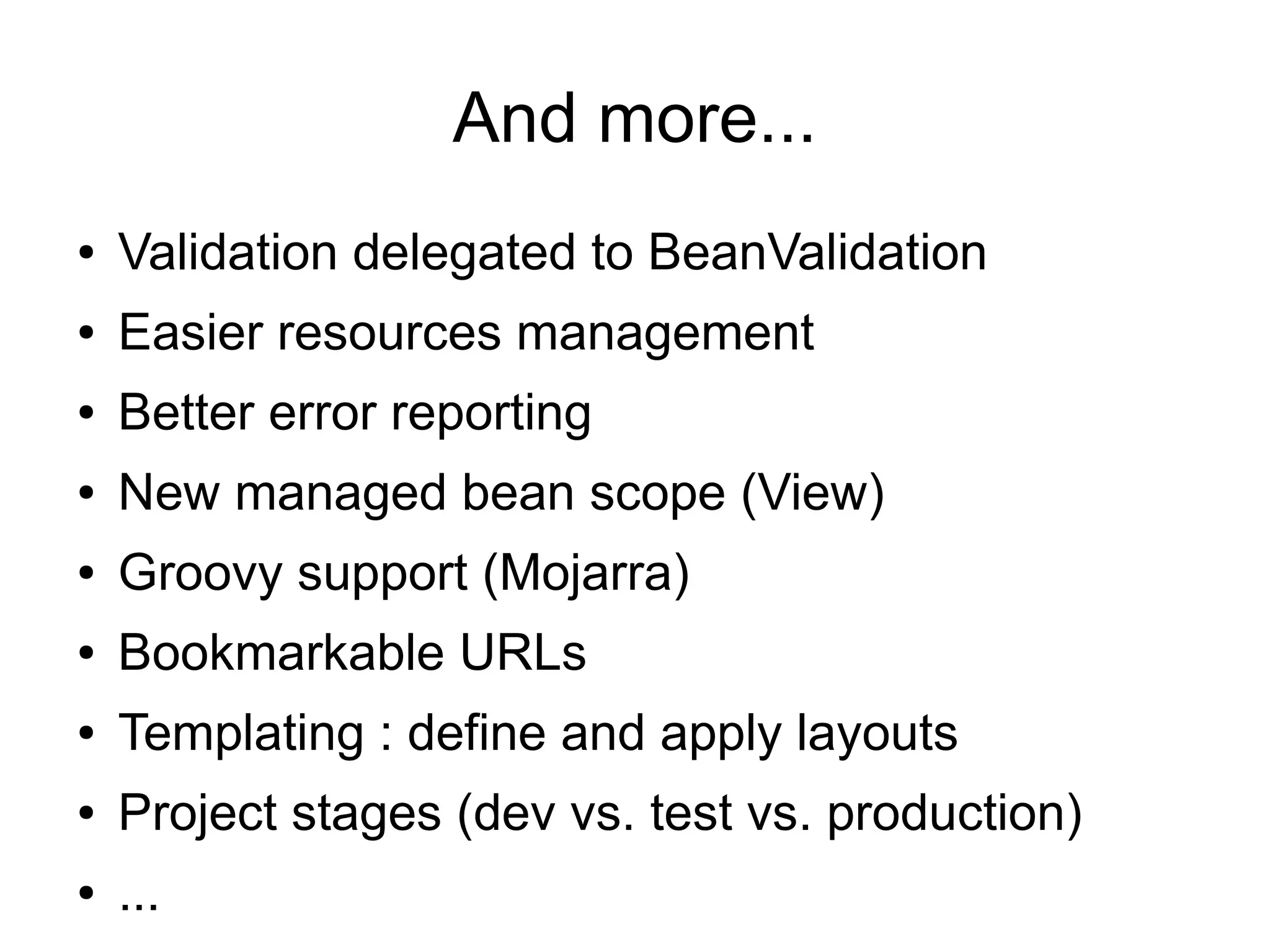
And more...
●   Validation delegated to BeanValidation
●   Easier resources management
●   Better error reporting
●   New managed bean scope (View)
●   Groovy support (Mojarra)
●   Bookmarkable URLs
●   Templating : define and apply layouts
●   Project stages (dev vs. test vs. production)
●   ...
Agenda
●   Quick overview
●   New concepts
●   New features on existing specifications
●   New specifications
    ●   Bean Validation, JAX-RS, @Inject, CDI
●   Summary
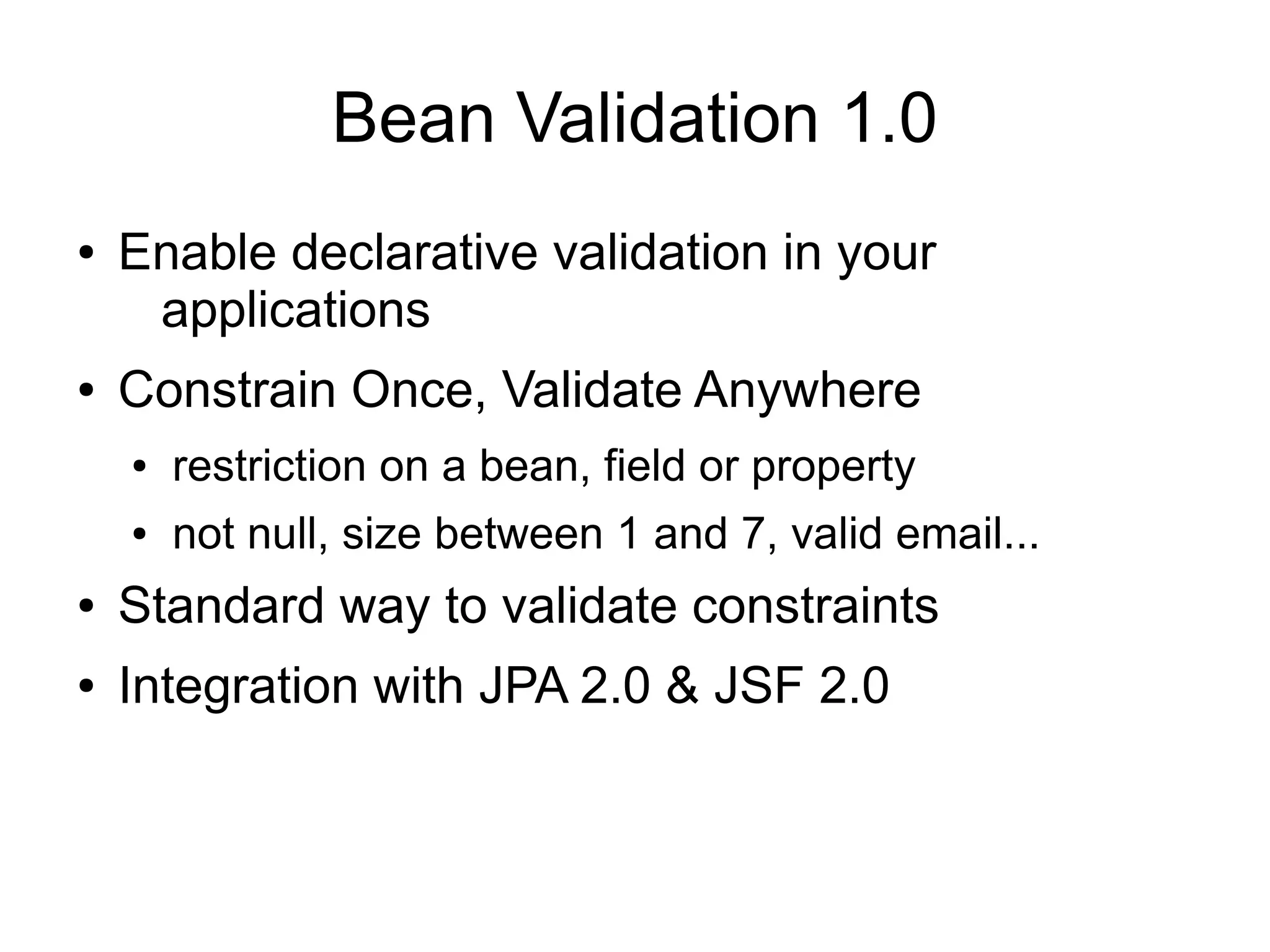
Bean Validation 1.0
●   Enable declarative validation in your
     applications
●   Constrain Once, Validate Anywhere
    ●   restriction on a bean, field or property
    ●   not null, size between 1 and 7, valid email...
●   Standard way to validate constraints
●   Integration with JPA 2.0 & JSF 2.0
Bean Validation 1.0
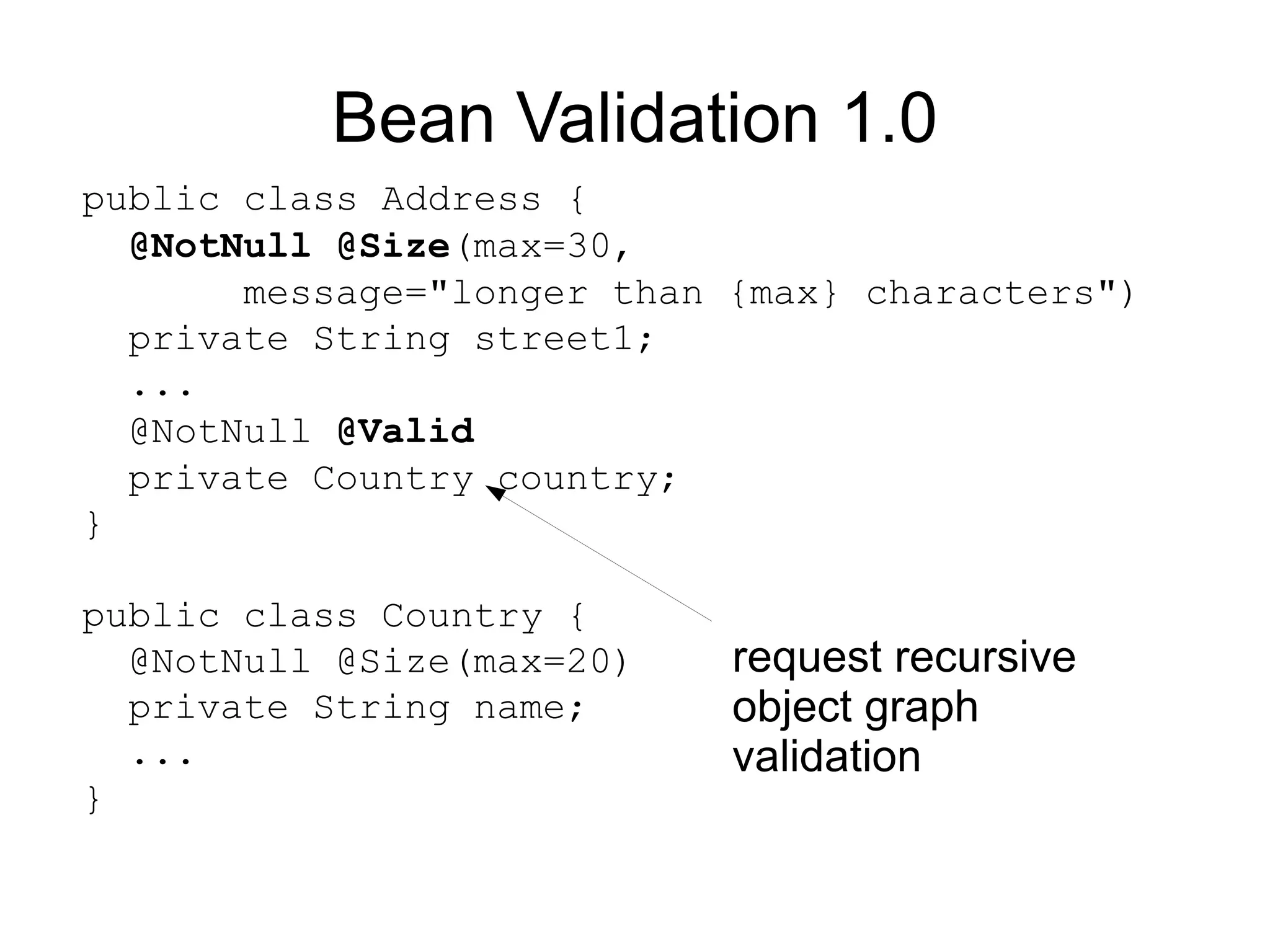
public class Address {
  @NotNull @Size(max=30,
       message="longer than {max} characters")
  private String street1;
  ...
  @NotNull @Valid
  private Country country;
}

public class Country {
  @NotNull @Size(max=20)    request recursive
  private String name;      object graph
  ...                       validation
}
Build your own!
@Size(min=5, max=5)
@ConstraintValidator(ZipcodeValidator.class)
@Documented
@Target({ANNOTATION_TYPE, METHOD, FIELD})
@Retention(RUNTIME)
public @interface ZipCode {
    String message() default "Wrong zipcode";
    String[] groups() default {};
}
Integration with JPA 2.0 and JSF 2.0
●   Automatic
●   No extra code
●   Happens during @PrePersist, @PreUpdate,
    @PreRemove
●   Shows how well integrated EE can be
And more...
●   Group subsets of constraints
●   Partial validation
●   Order constraint validations
●   Create your own
●   Bootstrap API
●   Messages can be i18n
●   ...
JAX-RS 1.1
●   High-level HTTP API for RESTful Services
●   POJO and Annotations Based
    ●   API also available
●   Maps HTTP verbs (Get, Post, Put, Delete...)
●   JAX-RS 1.0 has been released in 2008
●   JAX-RS 1.1 integrates with EJBs
      (and more generally with Java EE 6)
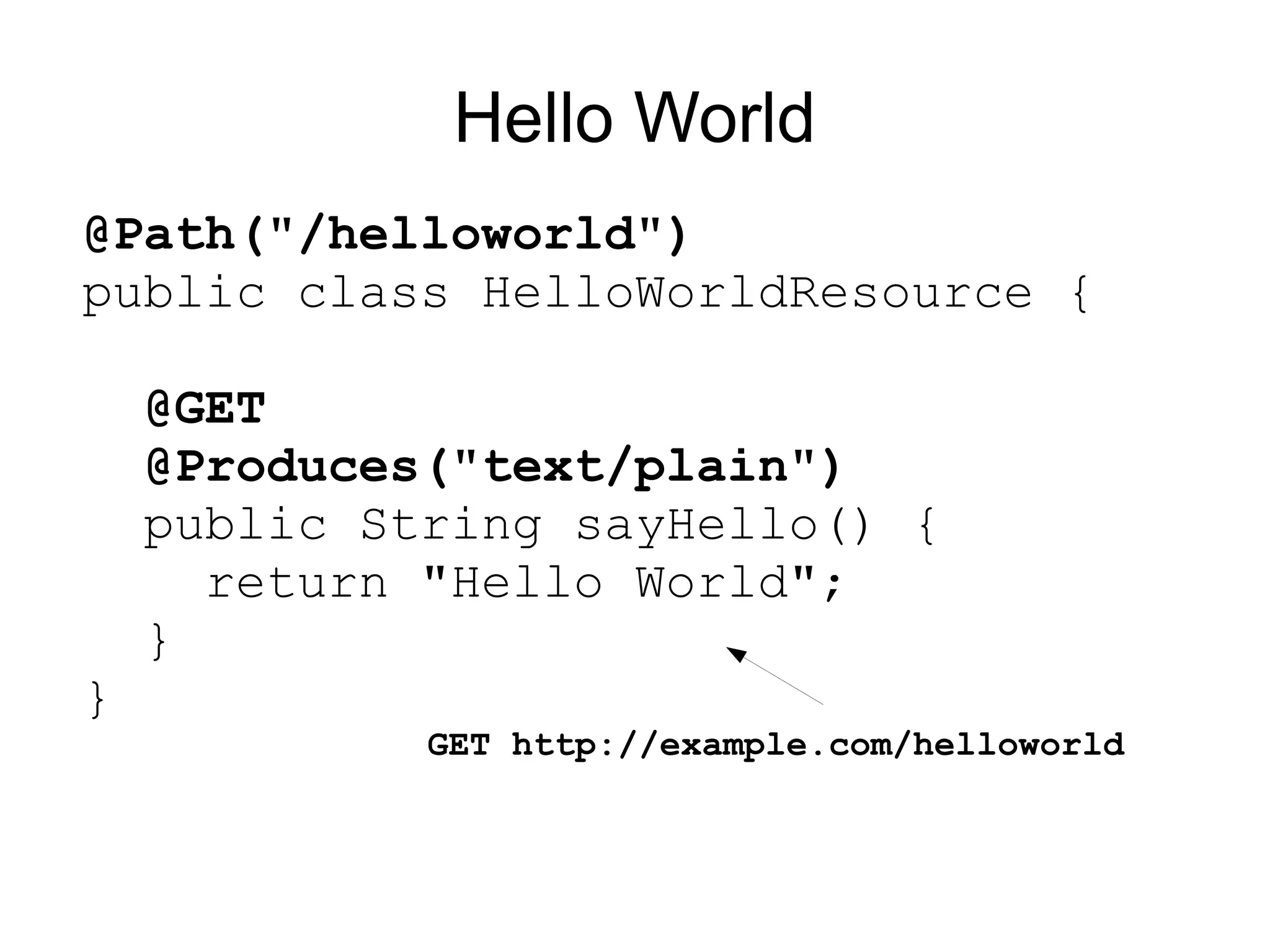
Hello World
@Path("/helloworld")
public class HelloWorldResource {

    @GET
    @Produces("text/plain")
    public String sayHello() {
      return "Hello World";
    }
}
             GET http://example.com/helloworld
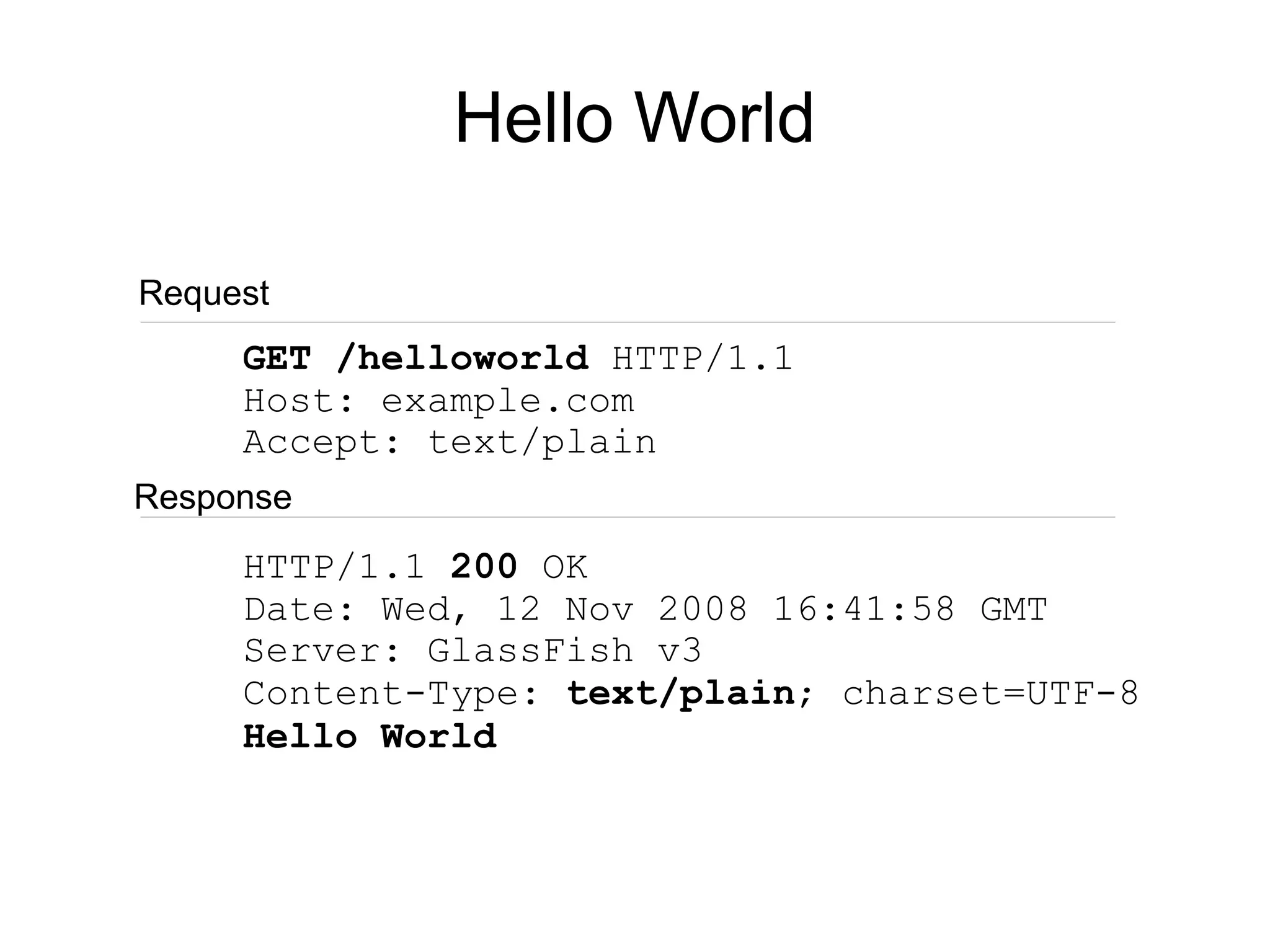
Hello World

Request
     GET /helloworld HTTP/1.1
     Host: example.com
     Accept: text/plain
Response
     HTTP/1.1 200 OK
     Date: Wed, 12 Nov 2008 16:41:58 GMT
     Server: GlassFish v3
     Content-Type: text/plain; charset=UTF-8
     Hello World
Different Mime Types
@Path("/helloworld")
public class HelloWorldResource {

    @GET @Produces("image/jpeg")
    public byte[] paintHello() {
    ...
    @GET @Produces("text/plain")
    public String displayHello() {
    ...
    @POST @Consumes("text/xml")
    public void updateHello(String xml) {
    ...
}
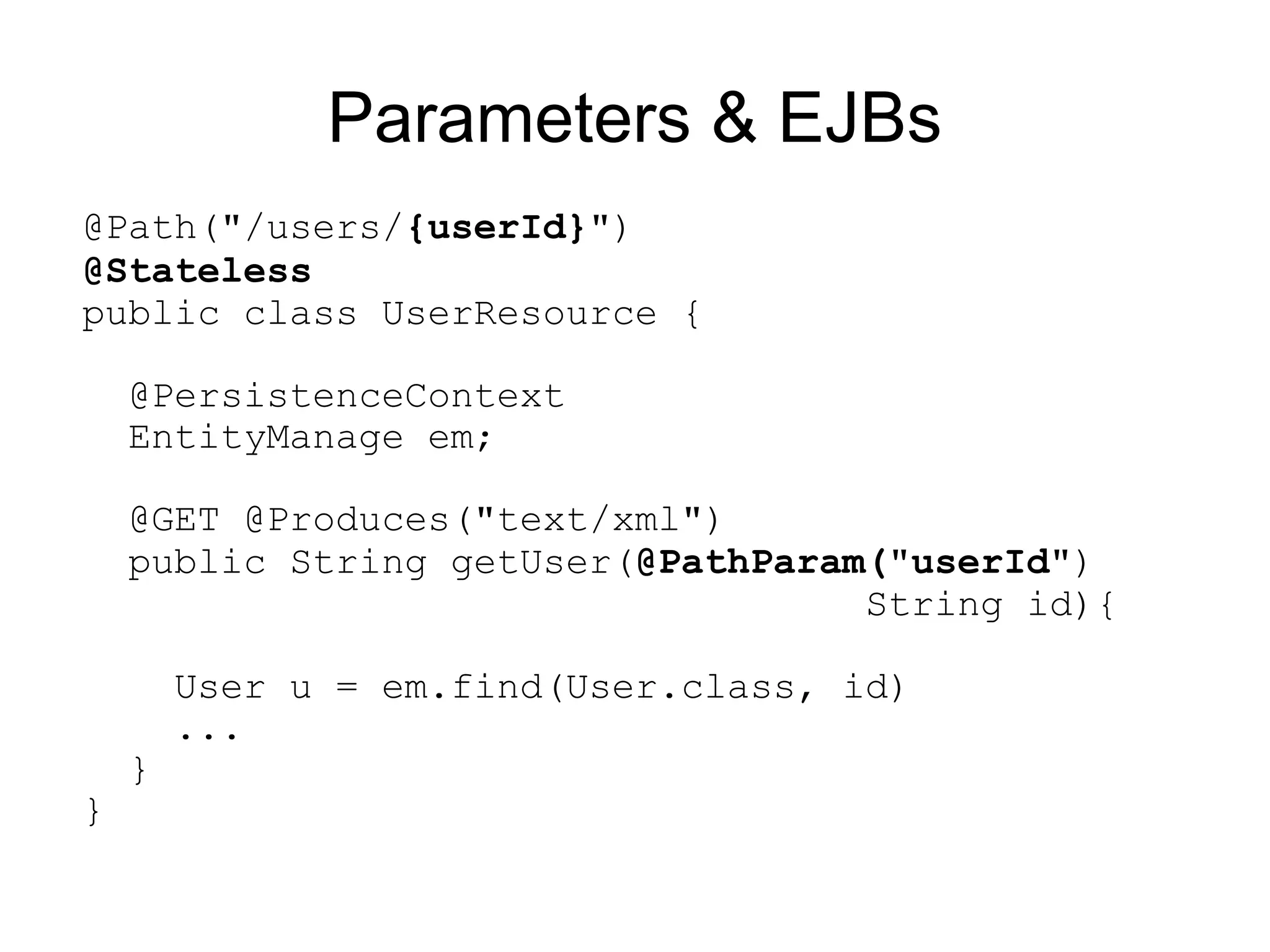
Parameters & EJBs
@Path("/users/{userId}")
@Stateless
public class UserResource {

    @PersistenceContext
    EntityManage em;

    @GET @Produces("text/xml")
    public String getUser(@PathParam("userId")
                                    String id){

        User u = em.find(User.class, id)
        ...
    }
}
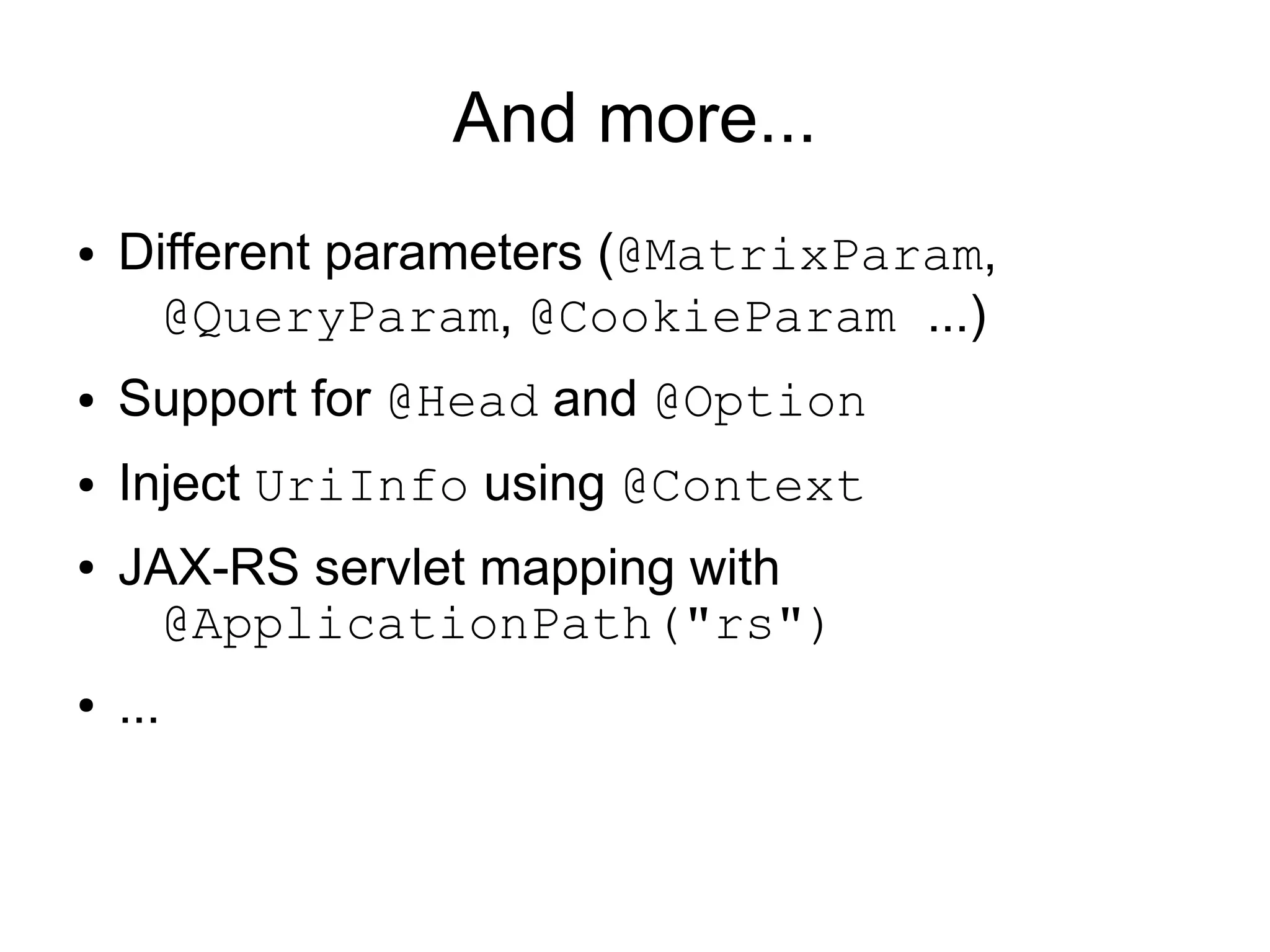
And more...
●   Different parameters (@MatrixParam,
      @QueryParam, @CookieParam ...)
●   Support for @Head and @Option
●   Inject UriInfo using @Context
●   JAX-RS servlet mapping with
      @ApplicationPath("rs")
●   ...
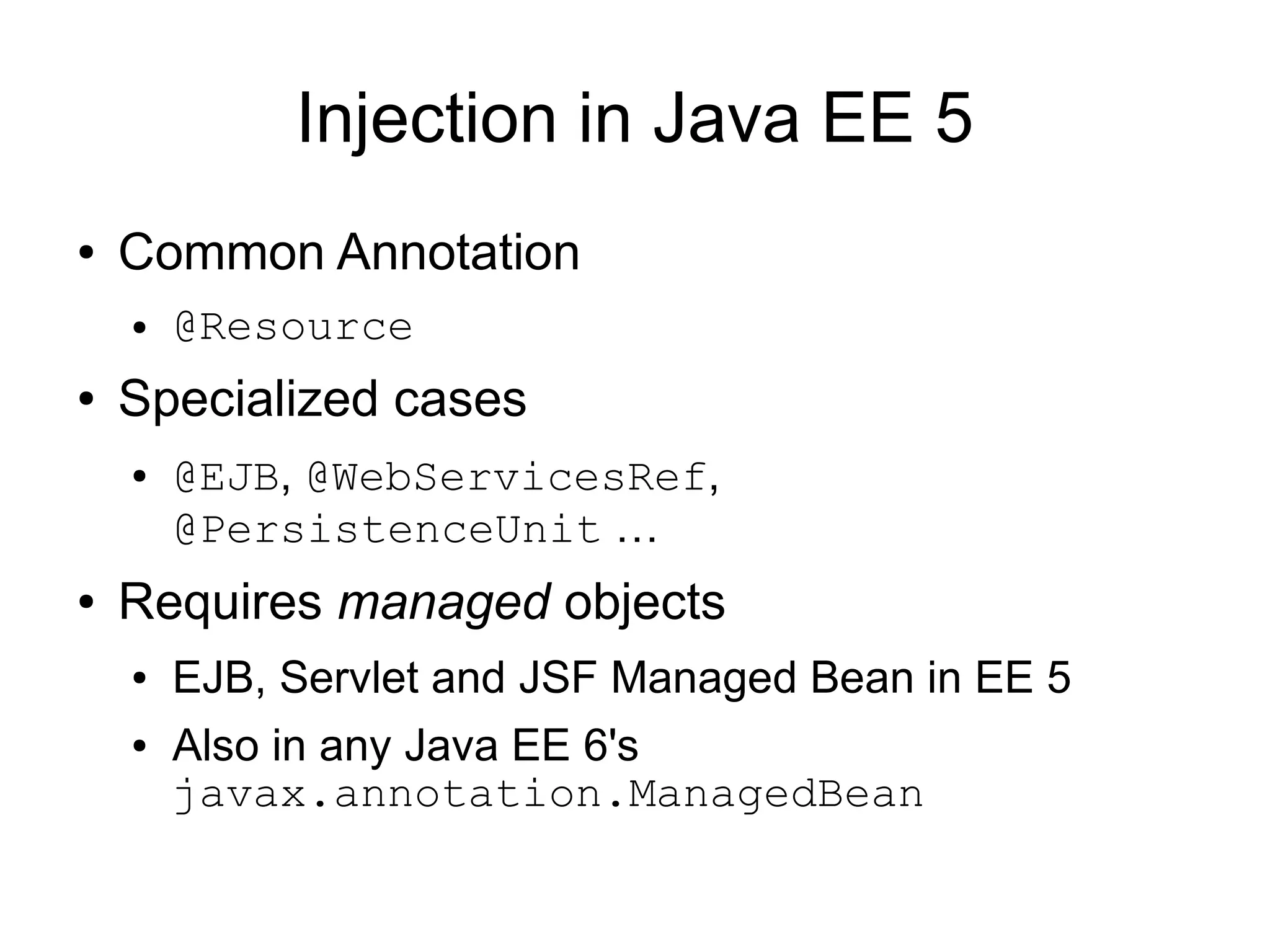
Injection in Java EE 5
●   Common Annotation
    ●   @Resource
●   Specialized cases
    ●   @EJB, @WebServicesRef,
        @PersistenceUnit …
●   Requires managed objects
    ●   EJB, Servlet and JSF Managed Bean in EE 5
    ●   Also in any Java EE 6's
        javax.annotation.ManagedBean
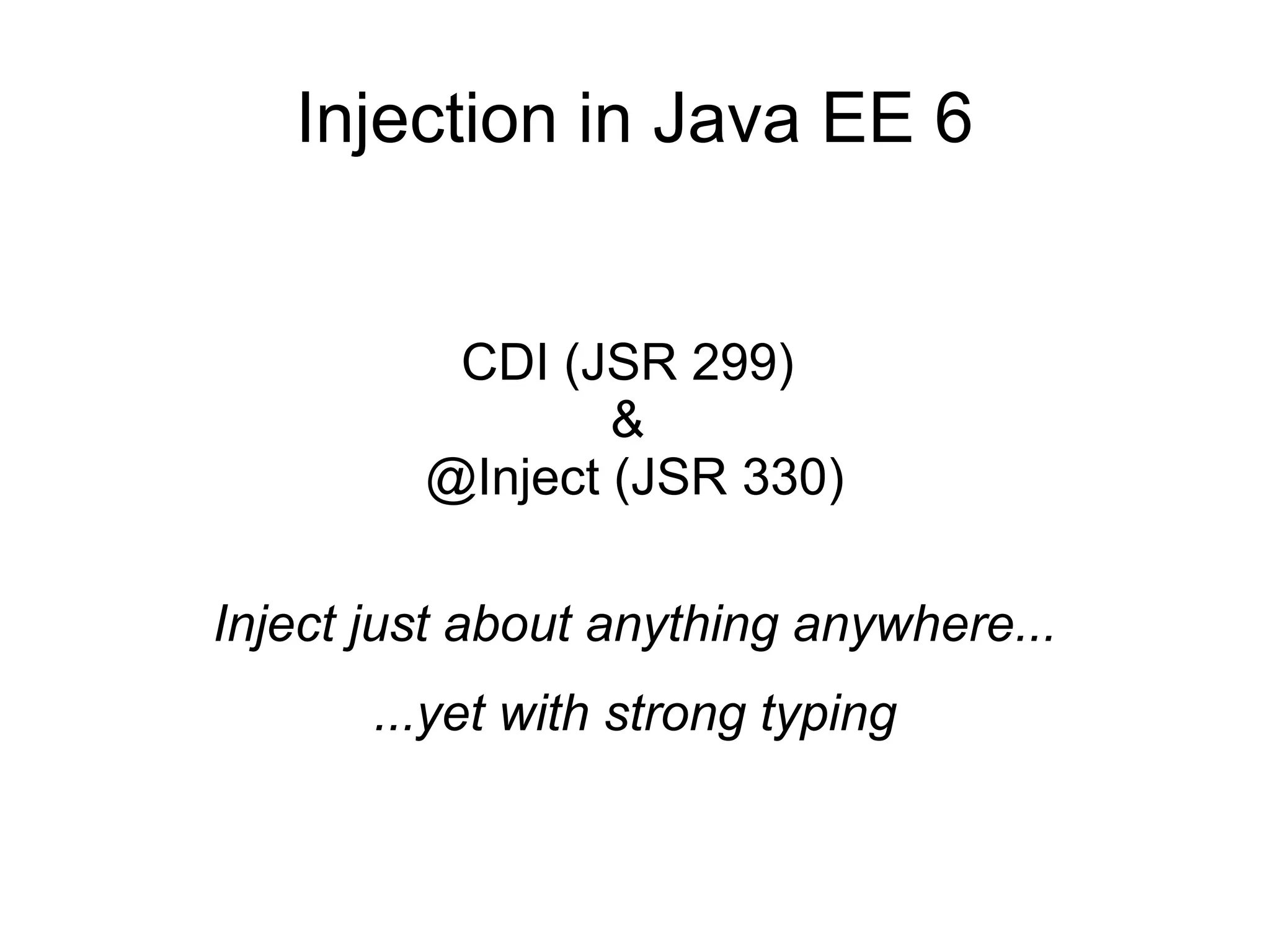
Injection in Java EE 6


          CDI (JSR 299)
                 &
         @Inject (JSR 330)

Inject just about anything anywhere...
       ...yet with strong typing
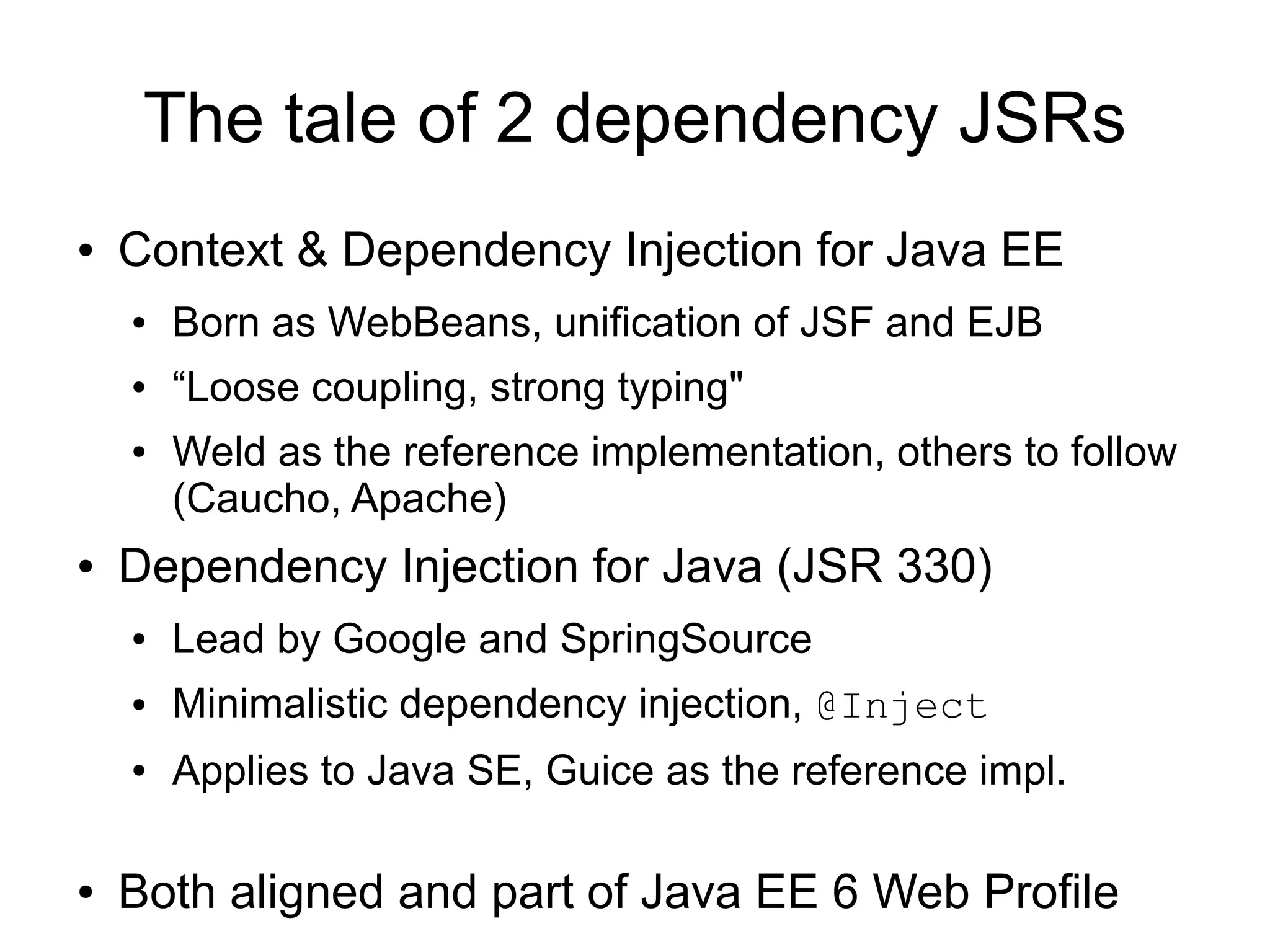
The tale of 2 dependency JSRs
●   Context & Dependency Injection for Java EE
    ●   Born as WebBeans, unification of JSF and EJB
    ●   “Loose coupling, strong typing"
    ●   Weld as the reference implementation, others to follow
        (Caucho, Apache)
●   Dependency Injection for Java (JSR 330)
    ●   Lead by Google and SpringSource
    ●   Minimalistic dependency injection, @Inject
    ●   Applies to Java SE, Guice as the reference impl.

●   Both aligned and part of Java EE 6 Web Profile
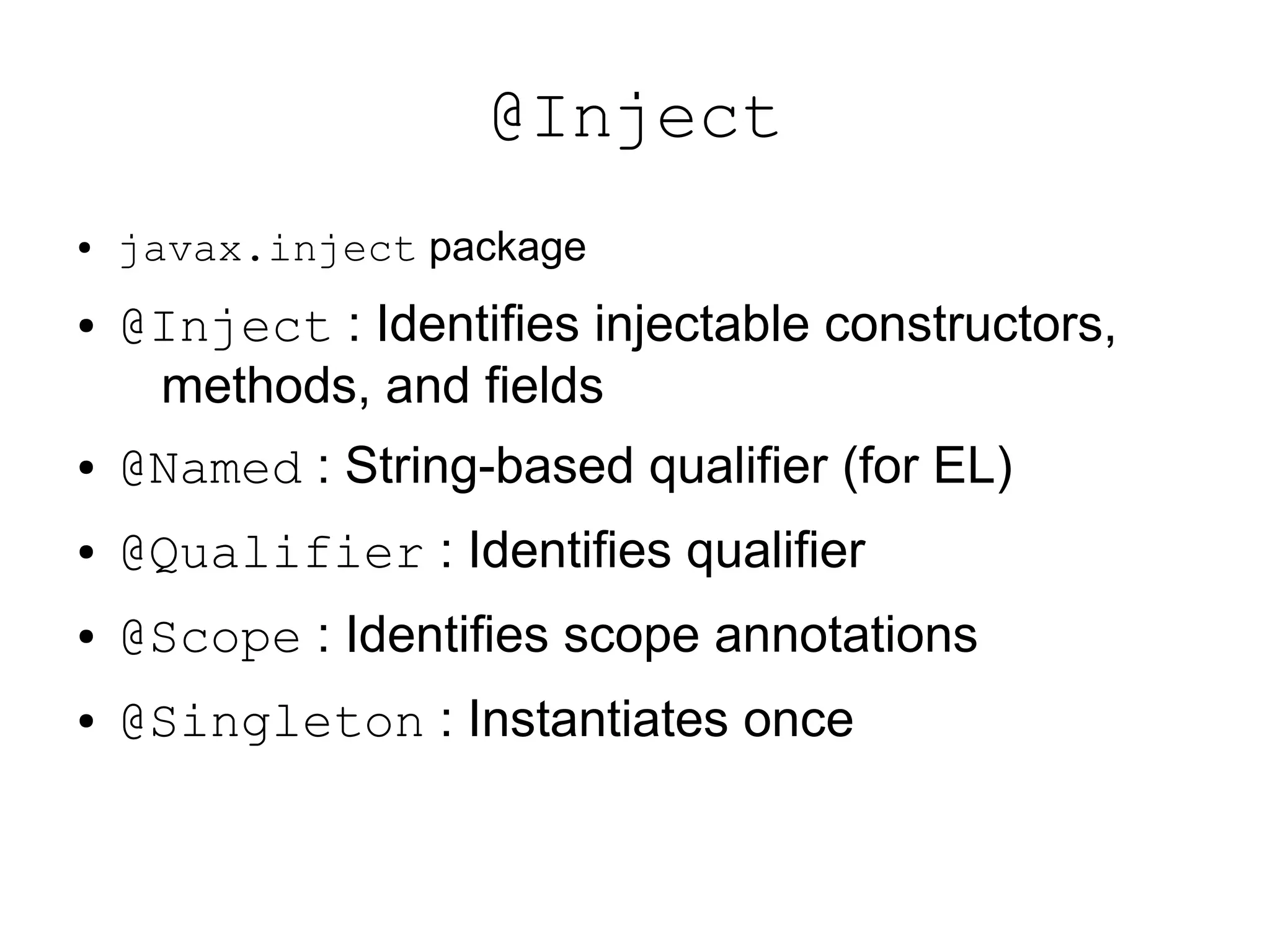
@Inject
●   javax.inject package
●   @Inject : Identifies injectable constructors,
     methods, and fields
●   @Named : String-based qualifier (for EL)
●   @Qualifier : Identifies qualifier
●   @Scope : Identifies scope annotations
●   @Singleton : Instantiates once
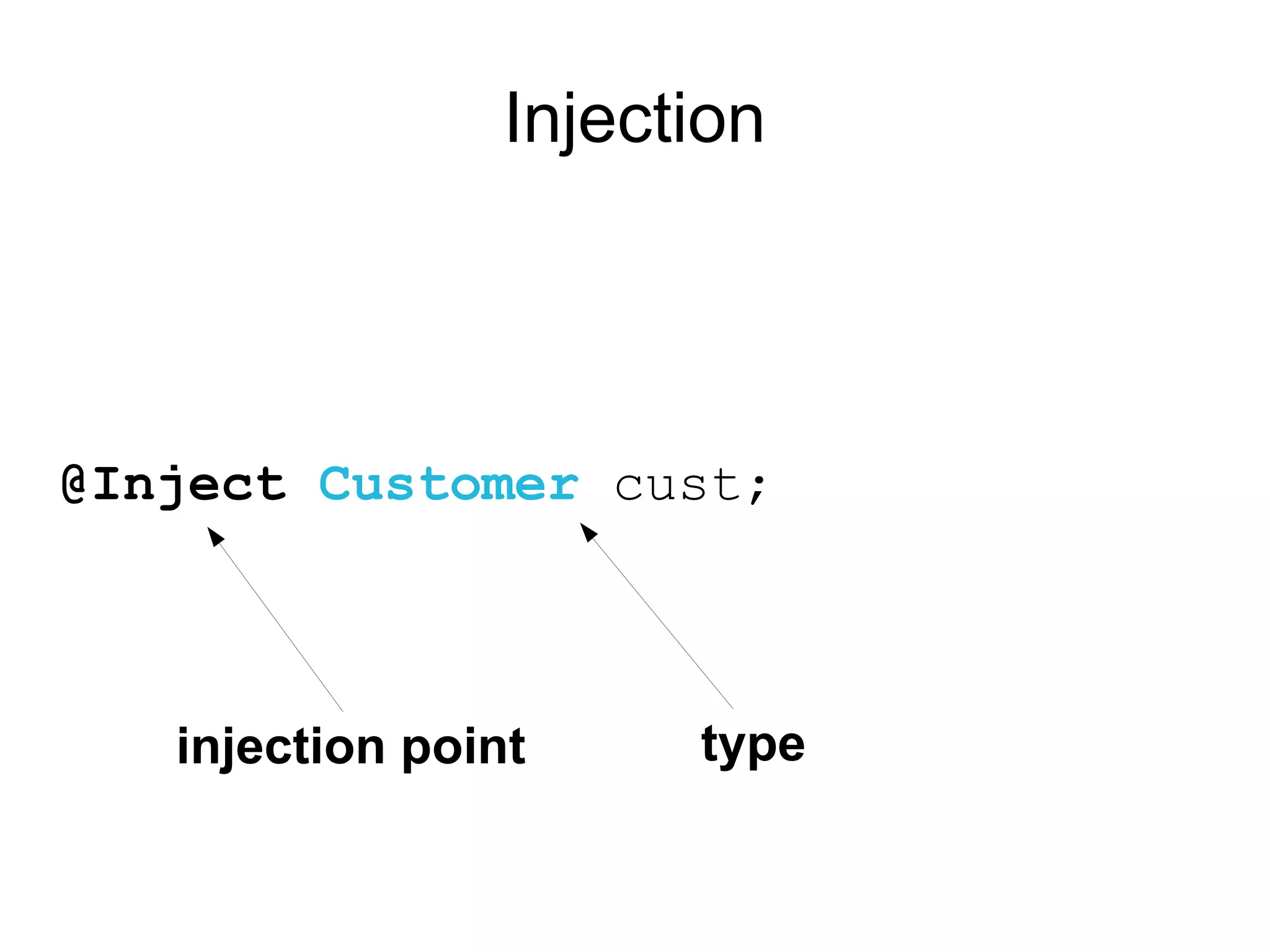
Injection


@Inject Customer cust;


   injection point     type
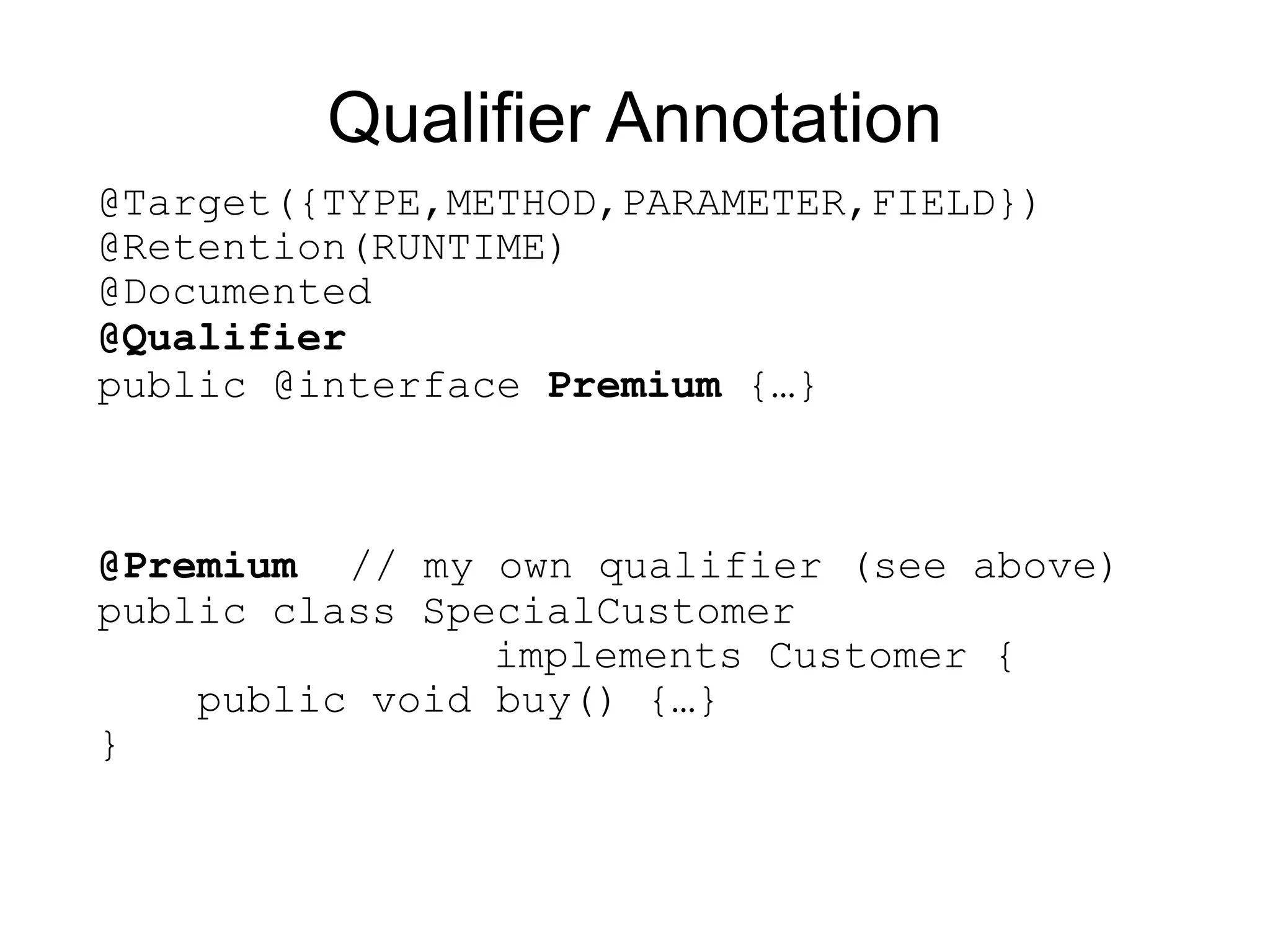
Qualifier Annotation
@Target({TYPE,METHOD,PARAMETER,FIELD})
@Retention(RUNTIME)
@Documented
@Qualifier
public @interface Premium {…}


@Premium // my own qualifier (see above)
public class SpecialCustomer
                implements Customer {
    public void buy() {…}
}
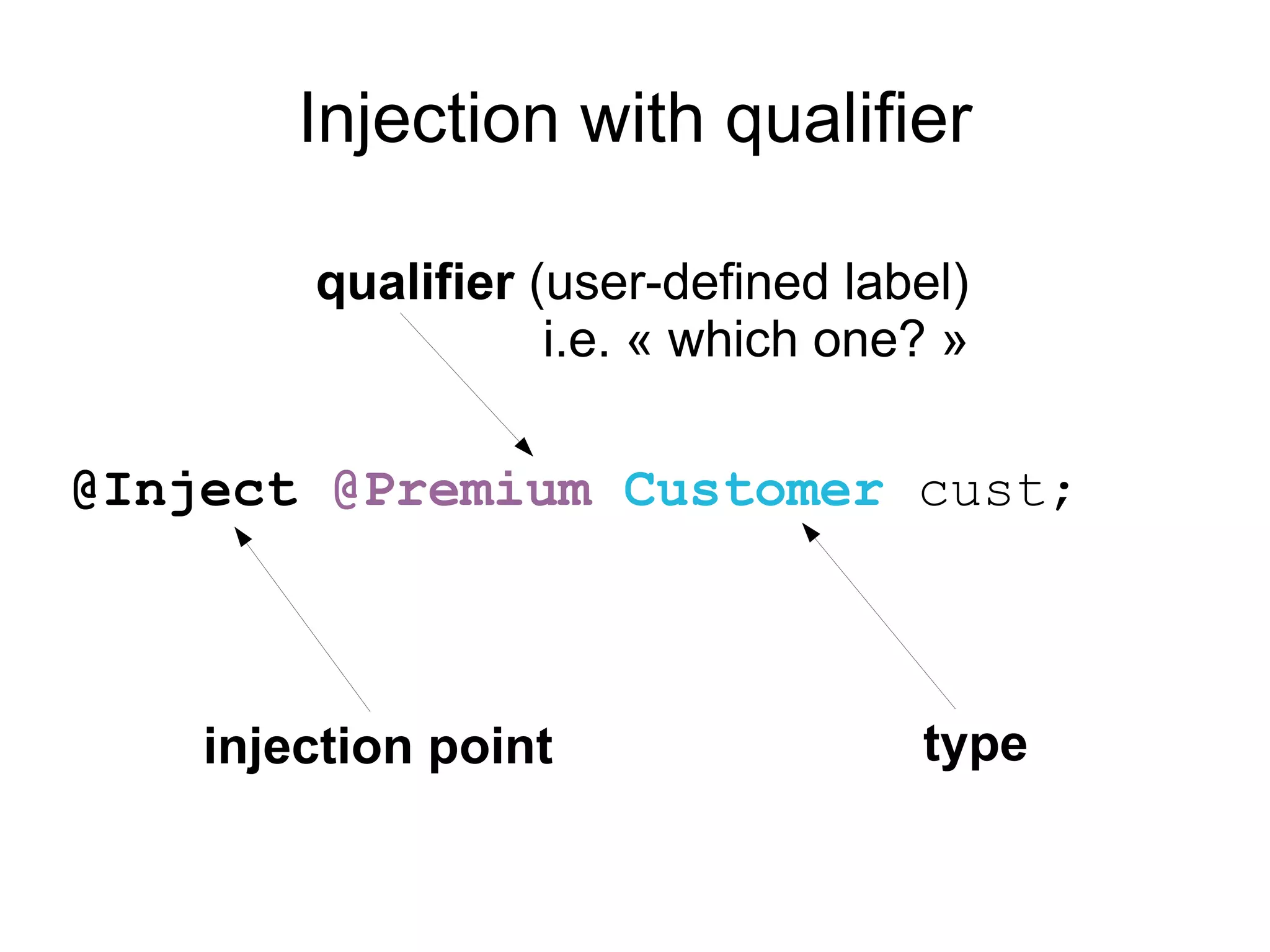
Injection with qualifier

        qualifier (user-defined label)
                   i.e. « which one? »

@Inject @Premium Customer cust;


    injection point                type
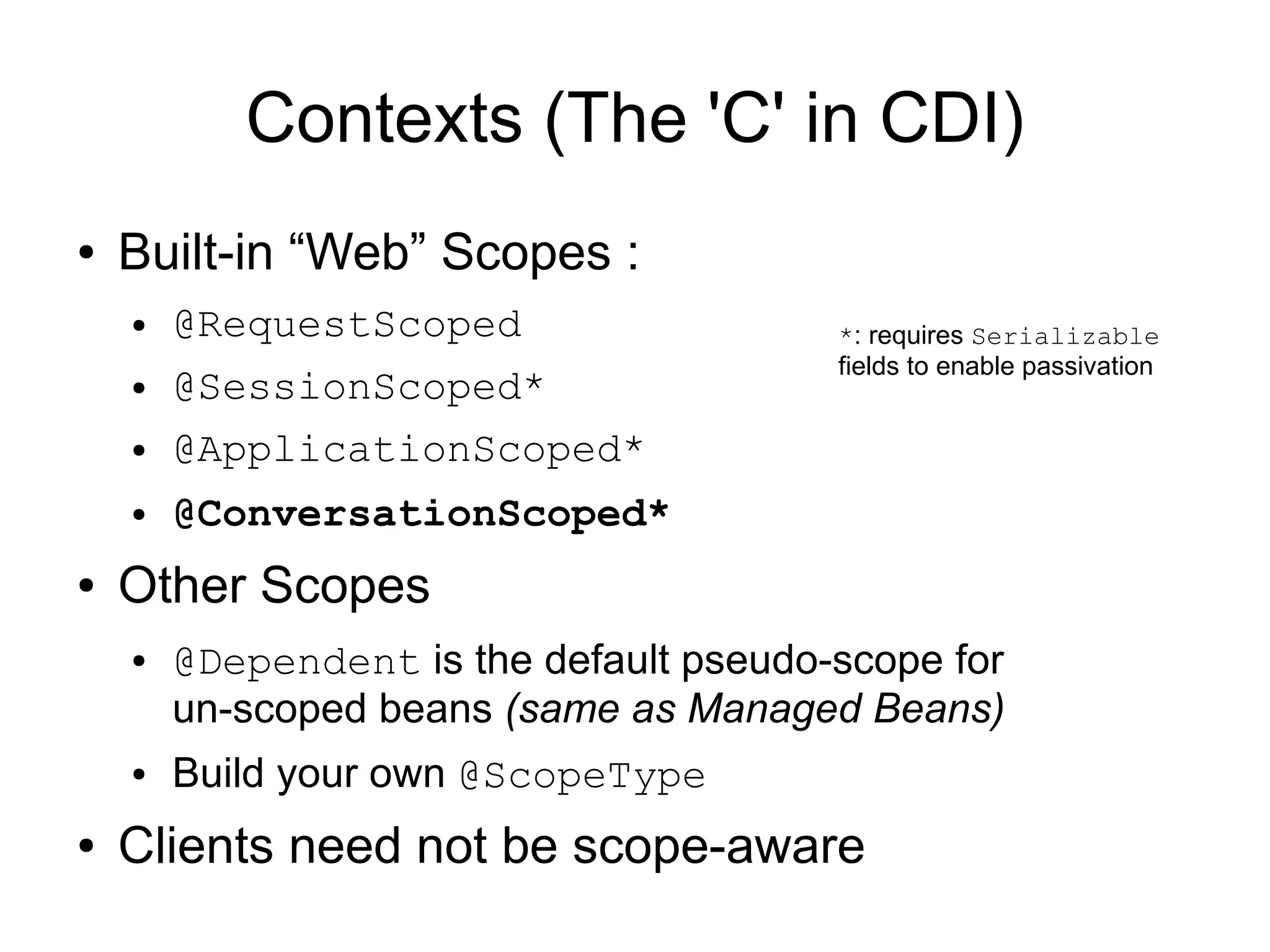
Contexts (The 'C' in CDI)
●   Built-in “Web” Scopes :
    ●   @RequestScoped                   *: requires Serializable
                                         fields to enable passivation
    ●   @SessionScoped*
    ●   @ApplicationScoped*
    ●   @ConversationScoped*
●   Other Scopes
    ●   @Dependent is the default pseudo-scope for
        un-scoped beans (same as Managed Beans)
    ●   Build your own @ScopeType
●   Clients need not be scope-aware
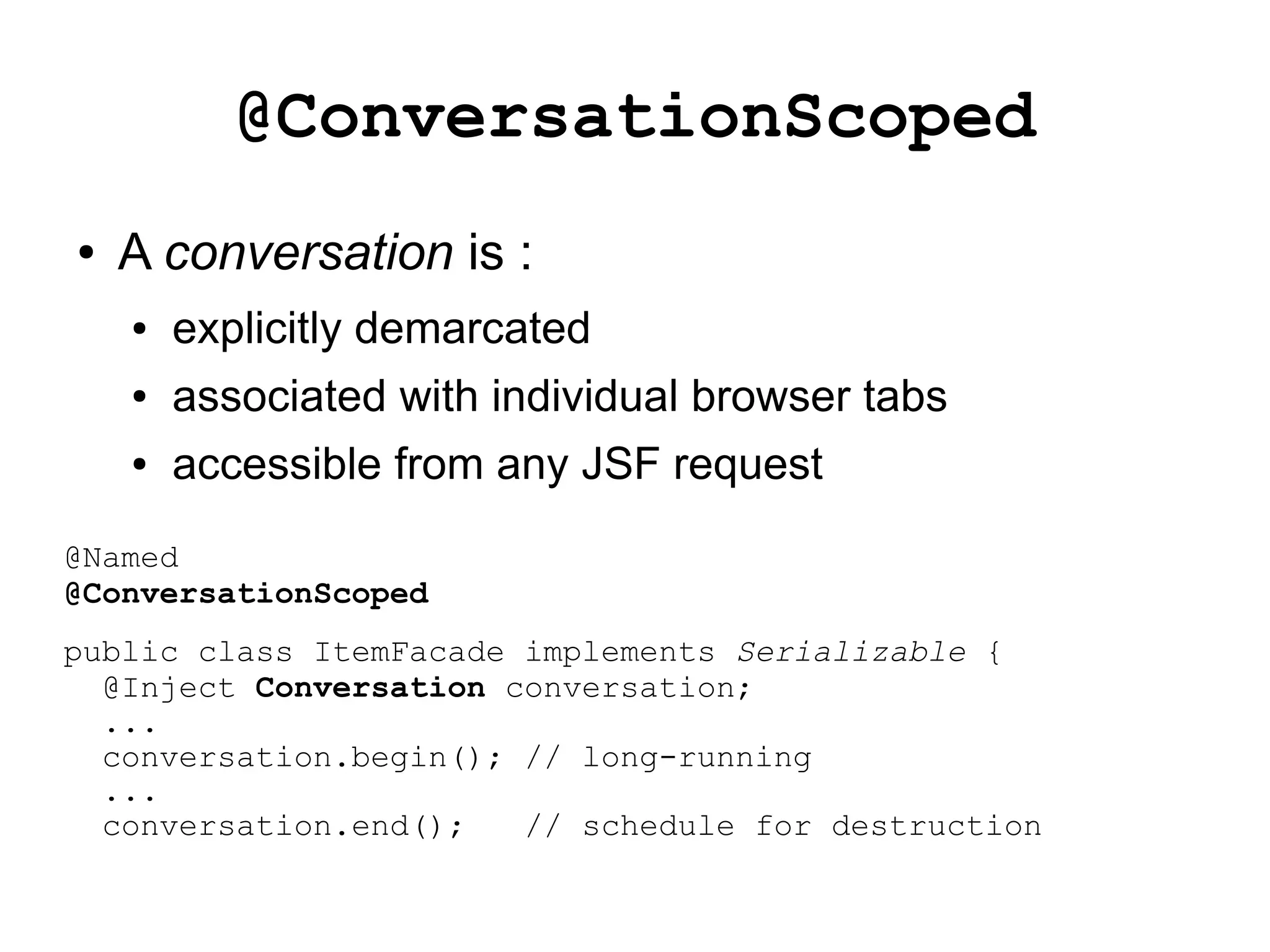
@ConversationScoped
●   A conversation is :
    ●   explicitly demarcated
    ●   associated with individual browser tabs
    ●   accessible from any JSF request
@Named
@ConversationScoped
public class ItemFacade implements Serializable {
  @Inject Conversation conversation;
  ...
  conversation.begin(); // long-running
  ...
  conversation.end();   // schedule for destruction
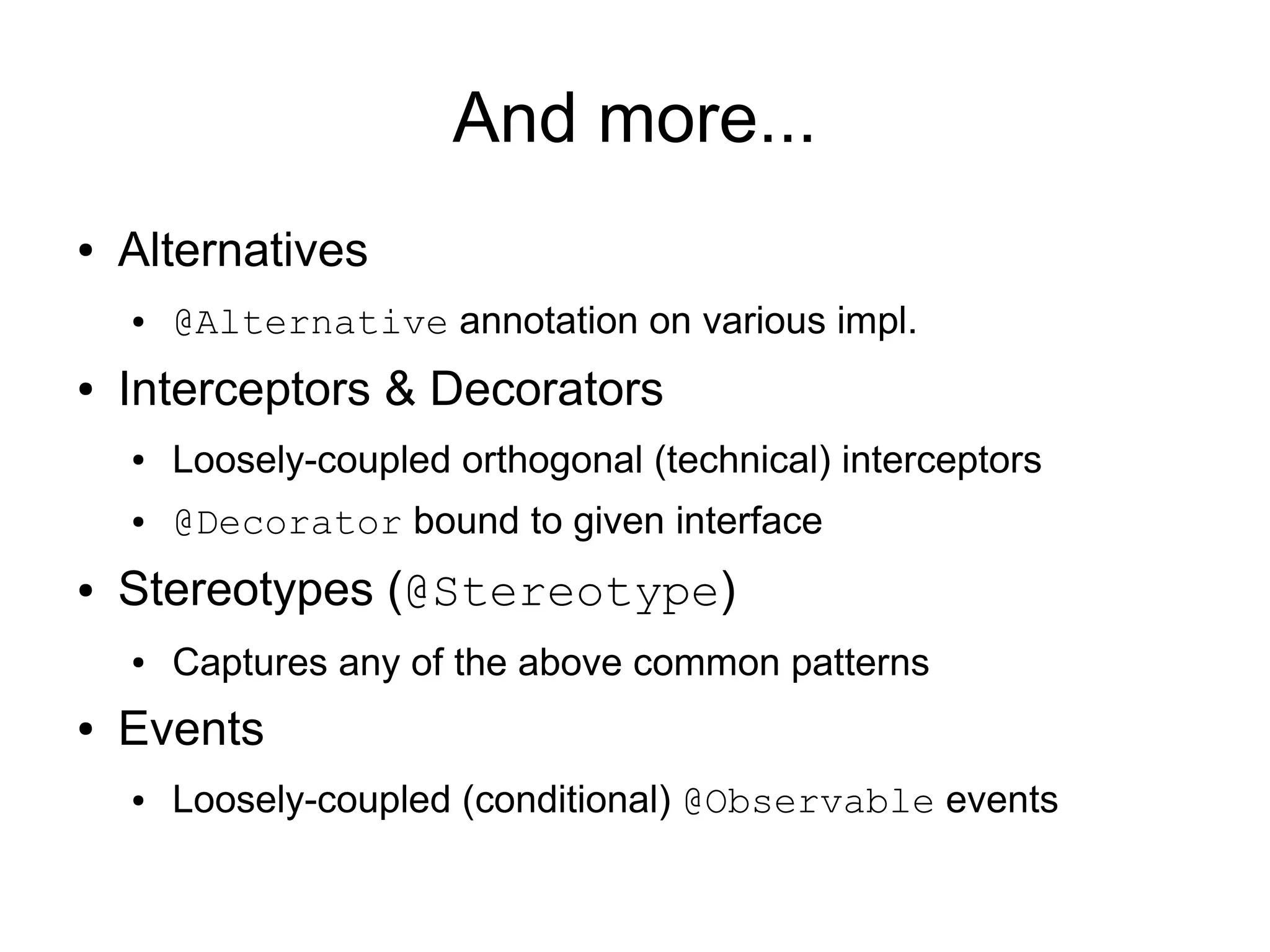
And more...
●   Alternatives
    ●   @Alternative annotation on various impl.
●   Interceptors & Decorators
    ●   Loosely-coupled orthogonal (technical) interceptors
    ●   @Decorator bound to given interface
●   Stereotypes (@Stereotype)
    ●   Captures any of the above common patterns
●   Events
    ●   Loosely-coupled (conditional) @Observable events
Agenda
●   Quick overview
●   New concepts
●   New features on existing specifications
●   New specifications
●   Summary
Java EE 6 is...


   Richer
   Ligther
   Simpler
Application servers are...


   Less monolithic
  More OSGi based
Ready for other profiles
Time is changing


Java EE 6 and GlassFish v3 shipped
                             th
final releases on December 10 2009
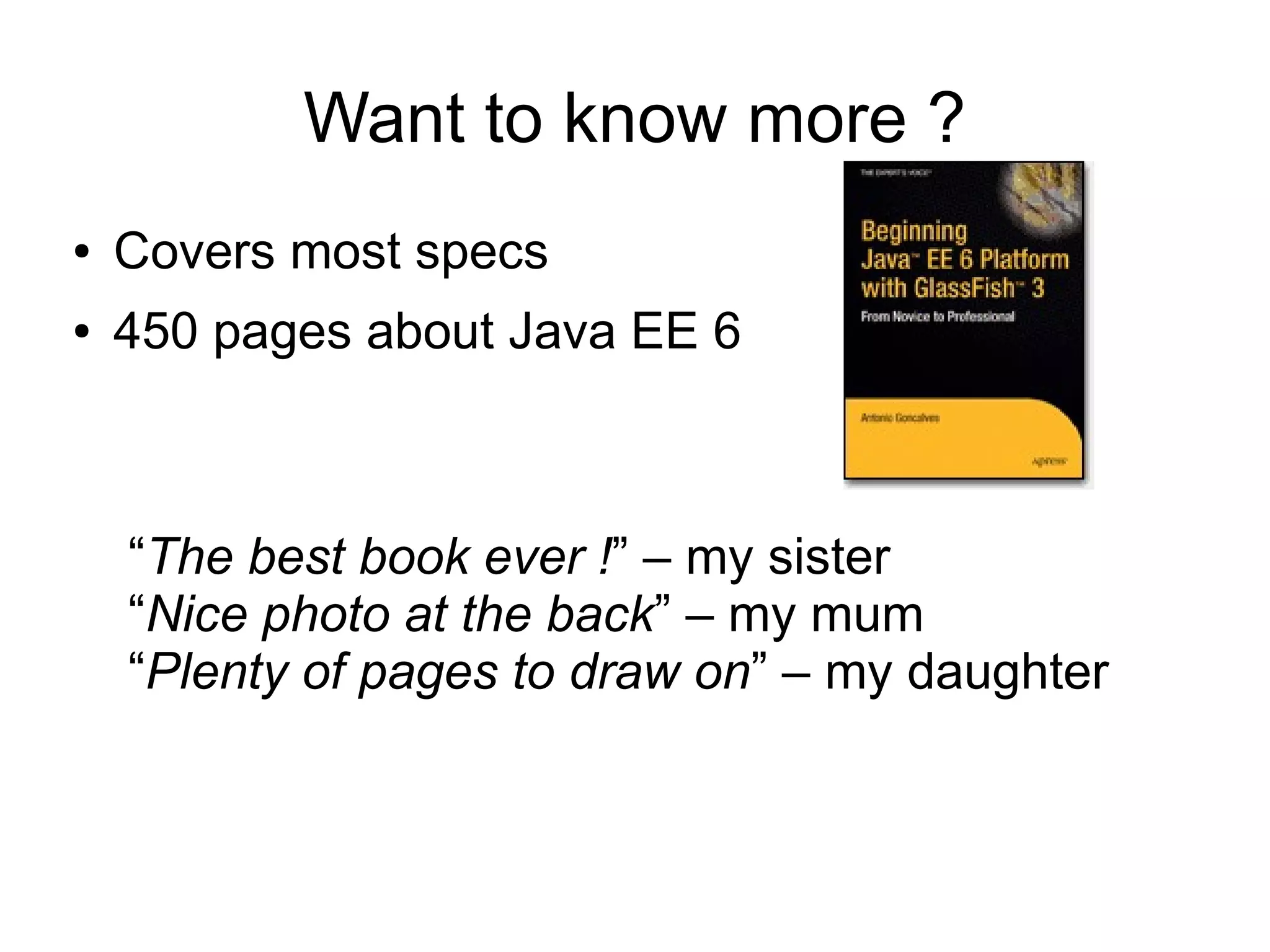
Want to know more ?
●   Covers most specs
●   450 pages about Java EE 6


    “The best book ever !” – my sister
    “Nice photo at the back” – my mum
    “Plenty of pages to draw on” – my daughter
Thanks for your attention!


       Q&A

Whats New In Java Ee 6

  • 1.
    What's new inJava EE 6 ? Antonio Goncalves
  • 2.
    Overall presentation Focuses onnews features of Java EE 6 You must know Java EE 5 28 specifications Thousands of pages Tough presentation
  • 3.
    Agenda ● Quick overview ● New concepts ● New features on existing specifications ● New specifications ● Summary
  • 4.
    Antonio Goncalves ● Freelance software architect ● Former BEA consultant ● Author (Java EE 5 and Java EE 6) ● JCP expert member ● Co-leader of the Paris JUG ● Les Cast Codeurs podcast ● Java Champion ● antonio dot goncalves at gmail dot com
  • 5.
    Agenda ● Quick overview ● New concepts ● New features on existing specifications ● New specifications ● Summary
  • 6.
  • 7.
    Zooming in JavaEE 6 Web Enterprise Web Services JSF 2.0 EJB 3.1 JAX-RPC 1.1 Servlet 3.0 JAF 1.1 JAXM 1.0 JSP 2.2 JavaMail 1.4 JAX-RS 1.1 EL 2.2 JCA 1.6 JAXR 1.0 JSTL 1.2 JMS 1.1 Web Services 1.3 Debugging 1.0 JPA 2.0 WS Metadata 2.0 Support JTA 1.1 + Java SE 6 Management, Security, JAX-WS 2.2 Common JAXB 2.2 CDI (JSR 299) 1.0 JDBC 4.0 @Inject (JSR 330) 1.0 JNDI 1.5 Bean Validation 1.0 SAAJ 1.3 Interceptors 1.1 Common 1.1 Managed Beans 1.0 Annotations JACC 1.4 RMI Java EE Application Deployment 1.2 Java IDL Java EE Management 1.1 JMX JASPIC 1.0 JAAS JAXP StAX
  • 8.
    Agenda ● Quick overview ● New concepts ● Pruning, Profiles, EJB Lite, Portable JNDI names, Managed Beans, Interceptors 1.1 ● New features on existing specifications ● New specifications ● Summary
  • 9.
    Pruning (Soon lessspecs) ● Marks specifications optional in next version ● Pruned in Java EE 6 ● Entity CMP 2.x ● JAX-RPC ● JAX-R ● JSR 88 (Java EE Application Deployment) ● Might disappear from Java EE 7 ● Vendors may decide to keeps them... ● … or offer the delta as a set of modules
  • 10.
    Profiles Full Java EE 6 Profile X Web Profile Profile Y
  • 11.
    Web Profile 1.0 ● Subset of full platform JSF 2.0 Servlet 3.0 ● For web development JSP 2.2 EL 2.2 ● Packages in a war JSTL 1.2 EJB Lite 3.1 ● Separate specification Managed Beans 1.0 ● Evolves at its own pace Interceptors 1.1 JTA 1.1 ● Others will come JPA 2.0 Bean Validation 1.0 ● Minimal (Servlet/JSP) CDI 1.0 @Inject 1.0 ● Portal....
  • 12.
    EJB Lite ● Subset of the EJB 3.1 API ● Used in Web profile ● Packaged in a war Local Session Bean Message Driven Beans Injection EJB Web Service Endpoint CMT / BMT RMI/IIOP Interoperability Interceptors Remote interface Security EJB 2.x Timer service CMP / BMP
  • 13.
    Portable JNDI names ● Client inside a container (use DI) @EJB Hello h; ● Client outside a container Context ctx = new InitialContext(); Hello h = (Hello) ctx.lookup(xyz); ● Portable JNDI name is specified java:global/foo/bar/HelloEJB
  • 14.
    Portable JNDI names ● OrderBean implements Order packaged in orderejb.jar within orderapp.ear ● java:global/orderapp/orderejb/OrderBean java:global/orderapp/orderejb/OrderBean! org.foo.Order Usable from any application in the container ● java:app/orderejb/OrderBean java:app/orderejb/OrderBean!com.acme.Order Fully-qualified interface name ● java:module/OrderBean java:module/OrderBean! org.foo.Order
  • 15.
    Managed Beans 1.0 ● Separate spec shipped with Java EE 6 ● Container-managed POJOs ● Support a small set of basic services ● Injection (@Resource...) ● Life-cycle (@PostConstruct, @PreDestroy) ● Interceptor (@Interceptor, @AroundInvoke) ● Lightweight component model
  • 16.
    Managed Beans 1.0 @javax.annotation.ManagedBean publicclass MyPojo { @Resource private Datasource ds; @PostConstruct private void init() { .... } @Interceptors(LoggingInterceptor.class) public void myMethod() {...} }
  • 17.
    Interceptors 1.1 ● Address cross-cutting concerns in Java EE ● Were part of the EJB 3.0 spec ● Now a seperate spec shipped with EJB 3.1 ● Can be uses in EJBs... ● … as well as ManagedBeans ● @AroundInvoke ● @AroundTimeout for EJB timers
  • 18.
    Agenda ● Quick overview ● New concepts ● New features on existing specifications ● JPA 2.0, EJB 3.1, Servlet 3.0, JSF 2.0 ● New specifications ● Summary
  • 19.
    JPA 2.0 ● Evolves separately from EJB now ● JSR 317 ● Richer mappings ● Richer JPQL ● Standard config options ● Criteria API ● ...
  • 20.
    Richer mapping ● Collection of embeddables and basic types ● Not just collection of JPA entities ● Multiple levels of embeddables ● More flexible support for Maps ● Keys, values can be one of : entities, embeddables or basic types ● More relationship mapping options ● Unidirectional 1-many foreign key mappings
  • 21.
    Collections of EmbeddableTypes @Embeddable public class BookReference { String title; Float price; String description; String isbn; Integer nbOfPage; ... } @Entity public class ListOfGreatBooks { @ElementCollection protected Set<BookReference> javaBooks; @ElementCollection protected Set<String> tags; ... }
  • 22.
    Richer JPQL ● Added entity type to support non-polymorphic queries ● Allow joins in subquery FROM clause ● Added new reserved words ● ABS, BOTH, CONCAT, ELSE, END, ESCAPE, LEADING, LENGTH, LOCATE, SET, SIZE, SQRT, SUBSTRING, TRAILING
  • 23.
    Criteria API ● Strongly typed criteria API ● Object-based query definition objects ● (Rather than JPQL string-based) ● Operates on the meta-model ● Browse the structure of a Persistence Unit ● Dynamically: EntityManager.getMetamodel() ● Statically: Each entity X has a metamodel class X_ ● CriteriaQuery as a query graph
  • 24.
    Criteria API EntityManager em= ...; CriteriaBuilder cb = em.getCriteriaBuilder(); CriteriaQuery<Book> query = cb.createQuery(Book.class); Root<Book> book = query.from(Book.class); query.select(book) .where(cb.equal(book.get("description"), "")); SELECT b FROM Book b WHERE b.description IS EMPTY
  • 25.
    Criteria API (Type-safe) EntityManagerem = ...; CriteriaBuilder cb = em.getCriteriaBuilder(); CriteriaQuery<Book> query = cb.createQuery(Book.class); Root<Book> book = query.from(Book.class); query.select(book) .where(cb.isEmpty(book.get(Book_.description))); Statically generated JPA 2.0 MetaModel
  • 26.
    Criteria API (Builderpattern) EntityManager em = ...; CriteriaBuilder cb = em.getCriteriaBuilder(); CriteriaQuery<Book> query = cb.createQuery(Book.class); Root<Book> book = query.from(Book.class); query.select(book) .where(cb.isEmpty(book.get(Book_.description))) .orderBy(...) .distinct(true) .having(...) .groupBy(...); List<Book> books = em.createQuery(query).getResultList();
  • 27.
    Standard properties ● In persistence.xml : ● javax.persistence.jdbc.driver ● javax.persistence.jdbc.url ● javax.persistence.jdbc.user ● javax.persistence.jdbc.password ● javax.persistence.lock.scope ● javax.persistence.lock.timeout
  • 28.
    And more... ● detach() ● Join<X,Y>, ListJoin, MapJoin ● Orphan removal functionality ● @OneToMany(orphanRemoval=true) ● BeanValidation integration on lifecycle ● Second-level cache API ● @Cacheable annotation on entities ● contain(Class,PK), evict(Class,PK), ... ● Pessimistic locking
  • 29.
    Servlet 3.0 ● Ease of development ● Pluggability ● Asynchronous support
  • 30.
    Ease of development ● Annotations based programming model ● @WebServlet ● @WebFilter ● @WebListener ● @WebInitParam ● Optional web.xml ● Better defaults and CoC
  • 31.
    A servlet 3.0example @WebServlet(urlPatterns={"/MyApp"}) public class MyServlet extends HttpServlet { public void doGet (HttpServletRequest req, HttpServletResponse res){ .... } } web.xml is optional ● Same for @WebFilter and @WebListener
  • 32.
    Pluggability ● Fragments are similar to web.xml ● <web-fragment> instead of <web-app> ● Declare their own servlets, listeners and filters ● Annotations and web fragments are merged following a configurable order ● JARs need to be placed in WEB-INF/lib ● and use /META-INF/web-fragment.xml ● Overridden by main web.xml
  • 33.
    And more... ● Async support (Comet-style) ● Static resources in META-INF/resources ● Configuration API ● Add and configure Servlet, Filters, Listeners ● Add security constraints ● Using ServletContext API ● File upload (similar to Apache File Upload) ● Configure cookie session name ● Security with @ServletSecurity
  • 34.
    EJB 3.1 ● Optional local interface ● Packaging in a war ● Asynchronous calls ● Timer service ● Singleton ● Embeddable container
  • 35.
    Optional Local Interface ● @Local, @Remote ● Interfaces are not always needed ● Only for local interfaces ● Remote interfaces are now optional ! @Stateless public class HelloBean { public String sayHello() { return "Hello world!"; } }
  • 36.
    Packaging in awar foo.ear foo.war lib/foo_common.jar WEB-INF/classes com/acme/Foo.class com/acme/Foo.class com/acme/FooServlet.class com/acme/FooEJB.class foo_web.war WEB-INF/web.xml WEB-INF/classes com/acme/FooServlet.class foo_ejb.jar com/acme/FooEJB.class com/acme/FooEJBLocal.class
  • 37.
    Asynchronous calls ● How to have asynchronous call in EJBs ? ● JMS is more about sending messages ● Threads and EJB's don't integrate well ● @Asynchronous ● Applicable to any EJB type ● Best effort, no delivery guarantee ● Method returns void or Future<T> ● javax.ejb.AsyncResult helper class : return new AsyncResult<int>(result)
  • 38.
    Asynchronous calls @Stateless public classOrderBean { public void createOrder() { Order order = persistOrder(); sendEmail(order); // fire and forget } public Order persistOrder() {...} @Asynchronous public void sendEmail(Order order) {...} }
  • 39.
    Timer Service ● Programmatic and Calendar based scheduling ● « Last day of the month » ● « Every five minutes on Monday and Friday » ● Cron-like syntax ● second [0..59], minute[0..59], hour[0..23]... ● dayOfMonth[1..31] ● dayOfWeek[0..7] or [sun, mon, tue..] ● Month[0..12] or [jan,feb..]
  • 40.
    Timer Service @Stateless public classWakeUpBean { @Schedule(dayOfWeek="Mon-Fri", hour="9") void wakeUp() { ... } }
  • 41.
    Singleton ● New component ● No/local/remote interface ● Follows the Singleton pattern ● One single EJB per application per JVM ● Used to share state in the entire application ● State not preserved after container shutdown ● Added concurrency management ● Default is single-threaded ● @ConcurrencyManagement
  • 42.
    Singleton @Singleton public class CachingBean{ private Map cache; @PostConstruct void init() { cache = ...; } public Map getCache() { return cache; } public void addToCache(Object key, Object val) { cache.put(key, val); } }
  • 43.
    Embeddable Container ● API allowing to : EJB 3.1 Embedded container Transaction Security Messaging ● Initialize a container manager system engine ● Get container ctx Java SE ● … ● Can run in any Java SE environment ● Batch processing ● Simplifies testing ● Just a jar file in your classpath
  • 44.
    Embeddable Container public staticvoid main(String[] args){ EJBContainer container = EJBContainer.createEJBContainer(); Context context = container.getContext(); Hello h = (Hello)context.lookup("Global_JNDI_Name"); h.sayHello(); container.close(); }
  • 45.
    And more... ● Interceptors and InterceptorBinding ● Singletons can be chained ● Non persistent timer ● @StatefulTimeout ● ...
  • 46.
    JSF 2.0 ● The standard component-oriented MVC framework ● Part of Java EE 5 ● Part of Java EE 6 and Web Profile ● Other frameworks can rely on EE 6 extensibility ● Deserves its 2.0 version number ● New features, issues fixed, performance focus ● Fully available today in Mojarra 2.0.2 ● Production-quality implementation ● Part of GlassFish v3
  • 47.
    Facelets now preferredVDL ● Facelets (XHTML) as alternative to JSP ● Based on a generic View Description Language (VDL) ● Can't add Java code to XHTML page (and “that's a good thing!”™) ● Pages are usable from basic editors ● IDEs offer traditional value-add: ● Auto-completion (EL) ● (Composite) Component management ● Project management, testing, etc...
  • 48.
    Setup, configuration ● JSF 2.0 does not mandate Servlet 3.0 ● Servlet 2.5 containers will run JSF 2.0 ● web.xml may be optional depending on runtime ● faces-config.xml now optional ● @javax.faces.bean.ManagedBean ● Not required with JSR 299 ● Navigation can now belong to the page (<navigation-rules> become optional)
  • 49.
    JSF Composite Component ● Using JSF 1.x ● Implement UIComponent, markup in renderer, register in faces-config.xml, add tld, ... ● With JSF 2.0 ● Single file, no Java code needed ● Use XHTML and JSF tags to create components <html xmlns:cc="http://java.sun.com/jsf/composite"> <cc:interface> <cc:attribute ...> <cc:implementation> ● Everything else is auto-wired
  • 50.
    /resources/ezcomp/mycomponent.xhtml Naming the component <!DOCTYPE html PUBLIC "-//W3C//DTD XHTML 1.0 Transitional//EN" "http://www.w3.org/TR/xhtml1/DTD/xhtml1-transitional.dtd"> <html xmlns="http://www.w3.org/1999/xhtml" xmlns:h="http://java.sun.com/jsf/html" xmlns:composite="http://java.sun.com/jsf/composite"> Defining the <!-- INTERFACE --> <composite:interface> component <composite:attribute name="param"/> Implicit EL object </composite:interface> <!-- IMPLEMENTATION --> <composite:implementation> <h:outputText value="Hello there, #{cc.attrs.param}"/> </composite:implementation> </html> <?xml version='1.0' encoding='UTF-8' ?> <!DOCTYPE html PUBLIC "-//W3C//DTD XHTML 1.0 Transitional//EN" "http://www.w3.org/TR/xhtml1/DTD/xhtml1-transitional.dtd"> <html xmlns="http://www.w3.org/1999/xhtml" xmlns:h="http://java.sun.com/jsf/html" Using the xmlns:custom="http://java.sun.com/jsf/composite/ezcomp"> <h:body> component <custom:mycomponent param="Java EE 6 attendees"/> </h:body> </html>
  • 51.
    Ajax support ● Inspired by RichFaces, IceFaces, DynaFaces, ... ● Common JavaScript library (jsf.js) ● request JavaScript functions captured by PartialViewContext for sub-tree processing ● Client JavaScript updates the DOM <h:commandButton onclick="jsf.ajax.request(this,event,{render:'foo'}); return false;"/> ● <f:ajax> tag to ajaxify existing pages xmlns:f="http://java.sun.com/jsf/core" <h:commandButton> <f:ajax event="change" execute="myForm" render="foo" /> </h:commandButton>
  • 52.
    And more... ● Validation delegated to BeanValidation ● Easier resources management ● Better error reporting ● New managed bean scope (View) ● Groovy support (Mojarra) ● Bookmarkable URLs ● Templating : define and apply layouts ● Project stages (dev vs. test vs. production) ● ...
  • 53.
    Agenda ● Quick overview ● New concepts ● New features on existing specifications ● New specifications ● Bean Validation, JAX-RS, @Inject, CDI ● Summary
  • 54.
    Bean Validation 1.0 ● Enable declarative validation in your applications ● Constrain Once, Validate Anywhere ● restriction on a bean, field or property ● not null, size between 1 and 7, valid email... ● Standard way to validate constraints ● Integration with JPA 2.0 & JSF 2.0
  • 55.
    Bean Validation 1.0 publicclass Address { @NotNull @Size(max=30, message="longer than {max} characters") private String street1; ... @NotNull @Valid private Country country; } public class Country { @NotNull @Size(max=20) request recursive private String name; object graph ... validation }
  • 56.
    Build your own! @Size(min=5,max=5) @ConstraintValidator(ZipcodeValidator.class) @Documented @Target({ANNOTATION_TYPE, METHOD, FIELD}) @Retention(RUNTIME) public @interface ZipCode { String message() default "Wrong zipcode"; String[] groups() default {}; }
  • 57.
    Integration with JPA2.0 and JSF 2.0 ● Automatic ● No extra code ● Happens during @PrePersist, @PreUpdate, @PreRemove ● Shows how well integrated EE can be
  • 58.
    And more... ● Group subsets of constraints ● Partial validation ● Order constraint validations ● Create your own ● Bootstrap API ● Messages can be i18n ● ...
  • 59.
    JAX-RS 1.1 ● High-level HTTP API for RESTful Services ● POJO and Annotations Based ● API also available ● Maps HTTP verbs (Get, Post, Put, Delete...) ● JAX-RS 1.0 has been released in 2008 ● JAX-RS 1.1 integrates with EJBs (and more generally with Java EE 6)
  • 60.
    Hello World @Path("/helloworld") public classHelloWorldResource { @GET @Produces("text/plain") public String sayHello() { return "Hello World"; } } GET http://example.com/helloworld
  • 61.
    Hello World Request GET /helloworld HTTP/1.1 Host: example.com Accept: text/plain Response HTTP/1.1 200 OK Date: Wed, 12 Nov 2008 16:41:58 GMT Server: GlassFish v3 Content-Type: text/plain; charset=UTF-8 Hello World
  • 62.
    Different Mime Types @Path("/helloworld") publicclass HelloWorldResource { @GET @Produces("image/jpeg") public byte[] paintHello() { ... @GET @Produces("text/plain") public String displayHello() { ... @POST @Consumes("text/xml") public void updateHello(String xml) { ... }
  • 63.
    Parameters & EJBs @Path("/users/{userId}") @Stateless publicclass UserResource { @PersistenceContext EntityManage em; @GET @Produces("text/xml") public String getUser(@PathParam("userId") String id){ User u = em.find(User.class, id) ... } }
  • 64.
    And more... ● Different parameters (@MatrixParam, @QueryParam, @CookieParam ...) ● Support for @Head and @Option ● Inject UriInfo using @Context ● JAX-RS servlet mapping with @ApplicationPath("rs") ● ...
  • 65.
    Injection in JavaEE 5 ● Common Annotation ● @Resource ● Specialized cases ● @EJB, @WebServicesRef, @PersistenceUnit … ● Requires managed objects ● EJB, Servlet and JSF Managed Bean in EE 5 ● Also in any Java EE 6's javax.annotation.ManagedBean
  • 66.
    Injection in JavaEE 6 CDI (JSR 299) & @Inject (JSR 330) Inject just about anything anywhere... ...yet with strong typing
  • 67.
    The tale of2 dependency JSRs ● Context & Dependency Injection for Java EE ● Born as WebBeans, unification of JSF and EJB ● “Loose coupling, strong typing" ● Weld as the reference implementation, others to follow (Caucho, Apache) ● Dependency Injection for Java (JSR 330) ● Lead by Google and SpringSource ● Minimalistic dependency injection, @Inject ● Applies to Java SE, Guice as the reference impl. ● Both aligned and part of Java EE 6 Web Profile
  • 68.
    @Inject ● javax.inject package ● @Inject : Identifies injectable constructors, methods, and fields ● @Named : String-based qualifier (for EL) ● @Qualifier : Identifies qualifier ● @Scope : Identifies scope annotations ● @Singleton : Instantiates once
  • 69.
  • 70.
    Qualifier Annotation @Target({TYPE,METHOD,PARAMETER,FIELD}) @Retention(RUNTIME) @Documented @Qualifier public @interfacePremium {…} @Premium // my own qualifier (see above) public class SpecialCustomer implements Customer { public void buy() {…} }
  • 71.
    Injection with qualifier qualifier (user-defined label) i.e. « which one? » @Inject @Premium Customer cust; injection point type
  • 72.
    Contexts (The 'C'in CDI) ● Built-in “Web” Scopes : ● @RequestScoped *: requires Serializable fields to enable passivation ● @SessionScoped* ● @ApplicationScoped* ● @ConversationScoped* ● Other Scopes ● @Dependent is the default pseudo-scope for un-scoped beans (same as Managed Beans) ● Build your own @ScopeType ● Clients need not be scope-aware
  • 73.
    @ConversationScoped ● A conversation is : ● explicitly demarcated ● associated with individual browser tabs ● accessible from any JSF request @Named @ConversationScoped public class ItemFacade implements Serializable { @Inject Conversation conversation; ... conversation.begin(); // long-running ... conversation.end(); // schedule for destruction
  • 74.
    And more... ● Alternatives ● @Alternative annotation on various impl. ● Interceptors & Decorators ● Loosely-coupled orthogonal (technical) interceptors ● @Decorator bound to given interface ● Stereotypes (@Stereotype) ● Captures any of the above common patterns ● Events ● Loosely-coupled (conditional) @Observable events
  • 75.
    Agenda ● Quick overview ● New concepts ● New features on existing specifications ● New specifications ● Summary
  • 76.
    Java EE 6is... Richer Ligther Simpler
  • 77.
    Application servers are... Less monolithic More OSGi based Ready for other profiles
  • 78.
    Time is changing JavaEE 6 and GlassFish v3 shipped th final releases on December 10 2009
  • 79.
    Want to knowmore ? ● Covers most specs ● 450 pages about Java EE 6 “The best book ever !” – my sister “Nice photo at the back” – my mum “Plenty of pages to draw on” – my daughter
  • 80.
    Thanks for yourattention! Q&A