TOP 50 JAVA EE 7 BEST
PRACTICES
Ryan Cuprak
Michael Remijan
About Us
Ryan
• @ctjava
• rcuprak@gmail.com
• http://www.cuprak.info
• https://www.linkedin.com/in/rcuprak
Michael
• @mjremijan
• mjremijan@yahoo.com
• http://mjremijan.blogspot.com
• http://linkedin.com/in/mjremijan
EJB 3 In Action 2nd Edition
Updated For
• EE 7
• EJB 3.2
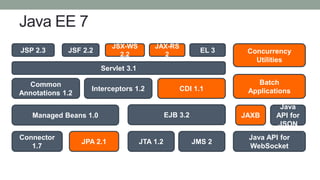
Java EE 7
Concurrency
Utilities
Batch
Applications
Java
API for
JSON
Java API for
WebSocket
JSF 2.2
JSX-WS
2.2
JAX-RS
2
EL 3
Servlet 3.1
Common
Annotations 1.2
Interceptors 1.2 CDI 1.1
Managed Beans 1.0 EJB 3.2
Connector
1.7
JPA 2.1 JTA 1.2 JMS 2
JSP 2.3
JAXB
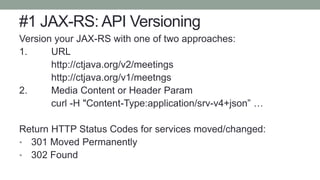
#1 JAX-RS: API Versioning
Version your JAX-RS with one of two approaches:
1. URL
http://ctjava.org/v2/meetings
http://ctjava.org/v1/meetngs
2. Media Content or Header Param
curl -H "Content-Type:application/srv-v4+json” …
Return HTTP Status Codes for services moved/changed:
• 301 Moved Permanently
• 302 Found
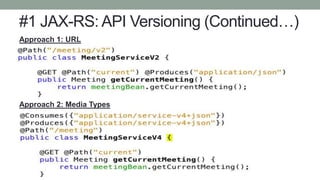
#1 JAX-RS: API Versioning (Continued…)
Approach 1: URL
Approach 2: Media Types
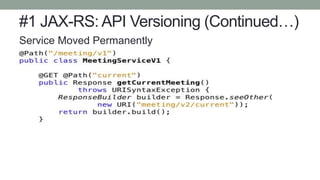
#1 JAX-RS: API Versioning (Continued…)
Service Moved Permanently
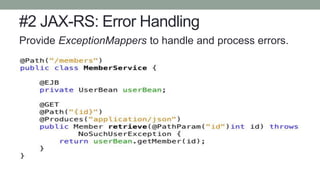
#2 JAX-RS: Error Handling
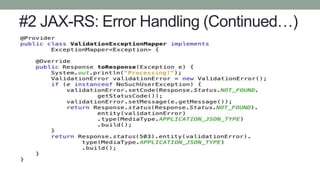
Provide ExceptionMappers to handle and process errors.
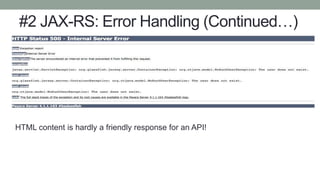
#2 JAX-RS: Error Handling (Continued…)
HTML content is hardly a friendly response for an API!
#2 JAX-RS: Error Handling (Continued…)
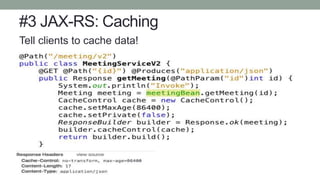
#3 JAX-RS: Caching
Tell clients to cache data!
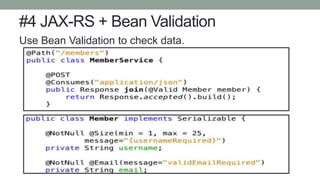
#4 JAX-RS + Bean Validation
Use Bean Validation to check data.
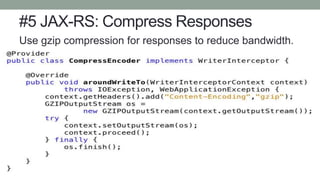
#5 JAX-RS: Compress Responses
Use gzip compression for responses to reduce bandwidth.
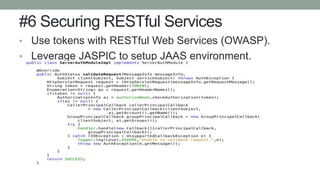
#6 Securing RESTful Services
• Use tokens with RESTful Web Services (OWASP).
• Leverage JASPIC to setup JAAS environment.
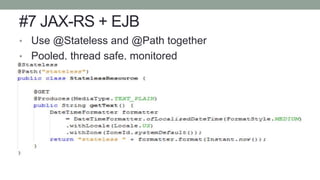
#7 JAX-RS + EJB
• Use @Stateless and @Path together
• Pooled, thread safe, monitored
#7 JAX-RS + EJB (Continued…)
• http://localhost:4848/monitoring/domain/server/applications/WebApp
lication1/StatelessResource/bean-methods/getText[.json]
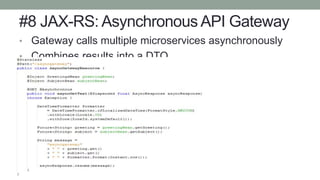
#8 JAX-RS: Asynchronous API Gateway
• Gateway calls multiple microservices asynchronously
• Combines results into a DTO
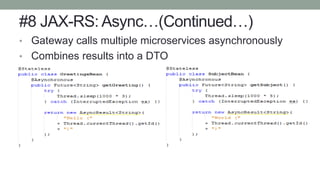
#8 JAX-RS: Async…(Continued…)
• Gateway calls multiple microservices asynchronously
• Combines results into a DTO
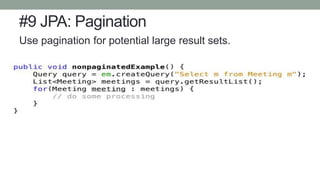
#9 JPA: Pagination
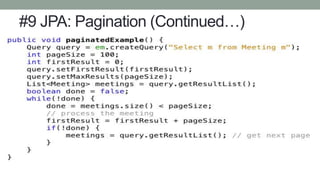
Use pagination for potential large result sets.
#9 JPA: Pagination (Continued…)
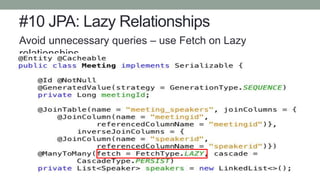
#10 JPA: Lazy Relationships
Avoid unnecessary queries – use Fetch on Lazy
relationships.
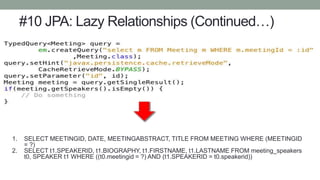
#10 JPA: Lazy Relationships (Continued…)
1. SELECT MEETINGID, DATE, MEETINGABSTRACT, TITLE FROM MEETING WHERE (MEETINGID
= ?)
2. SELECT t1.SPEAKERID, t1.BIOGRAPHY, t1.FIRSTNAME, t1.LASTNAME FROM meeting_speakers
t0, SPEAKER t1 WHERE ((t0.meetingid = ?) AND (t1.SPEAKERID = t0.speakerid))
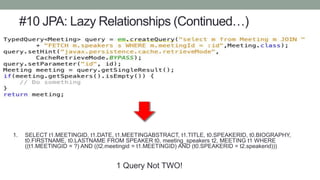
#10 JPA: Lazy Relationships (Continued…)
1. SELECT t1.MEETINGID, t1.DATE, t1.MEETINGABSTRACT, t1.TITLE, t0.SPEAKERID, t0.BIOGRAPHY,
t0.FIRSTNAME, t0.LASTNAME FROM SPEAKER t0, meeting_speakers t2, MEETING t1 WHERE
((t1.MEETINGID = ?) AND ((t2.meetingid = t1.MEETINGID) AND (t0.SPEAKERID = t2.speakerid)))
1 Query Not TWO!
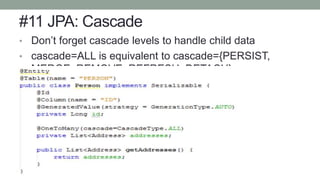
#11 JPA: Cascade
• Don’t forget cascade levels to handle child data
• cascade=ALL is equivalent to cascade={PERSIST,
MERGE, REMOVE, REFRESH, DETACH}
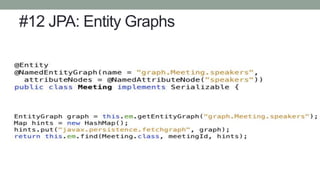
#12 JPA: Entity Graphs
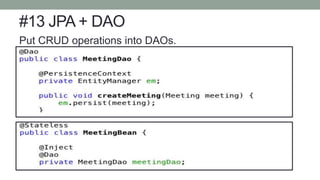
#13 JPA + DAO
Put CRUD operations into DAOs.
#14 JPA: hashcode() & equals()
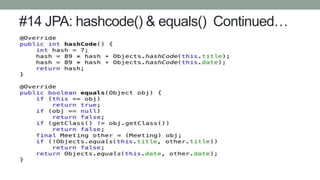
The equals and hashcode are required for:
• Entity is added to a collection
• When re-attaching entities to a new persistence context.
Important points:
• Do not use generated identifiers
• Use business key equality
#14 JPA: hashcode() & equals() Continued…
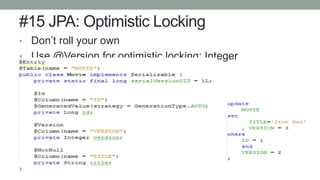
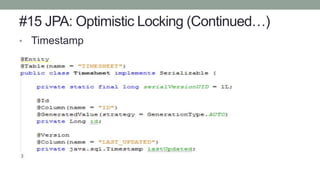
#15 JPA: Optimistic Locking
• Don’t roll your own
• Use @Version for optimistic locking: Integer
#15 JPA: Optimistic Locking (Continued…)
• Timestamp
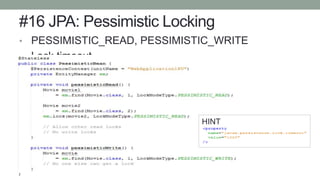
#16 JPA: Pessimistic Locking
• PESSIMISTIC_READ, PESSIMISTIC_WRITE
• Lock timeout
HINT
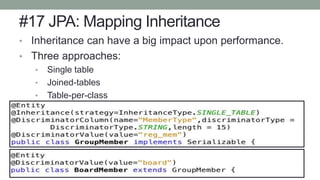
#17 JPA: Mapping Inheritance
• Inheritance can have a big impact upon performance.
• Three approaches:
• Single table
• Joined-tables
• Table-per-class
• Denormalize for better performance
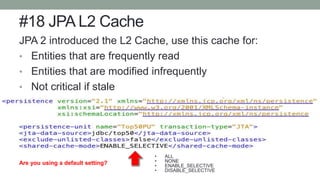
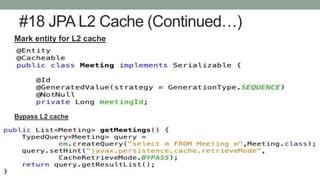
#18 JPA L2 Cache
JPA 2 introduced the L2 Cache, use this cache for:
• Entities that are frequently read
• Entities that are modified infrequently
• Not critical if stale
• L2 cache can consume large amounts of memory
• ALL
• NONE
• ENABLE_SELECTIVE
• DISABLE_SELECTIVE
Are you using a default setting?
#18 JPA L2 Cache (Continued…)
Mark entity for L2 cache
Bypass L2 cache
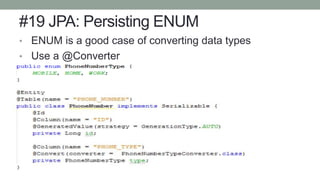
#19 JPA: Persisting ENUM
• ENUM is a good case of converting data types
• Use a @Converter
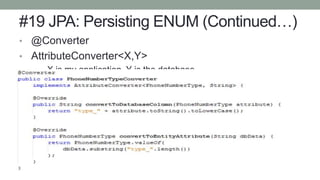
#19 JPA: Persisting ENUM (Continued…)
• @Converter
• AttributeConverter<X,Y>
• X is my application, Y is the database
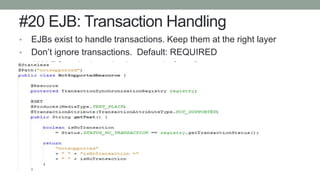
#20 EJB: Transaction Handling
• EJBs exist to handle transactions. Keep them at the right layer
• Don’t ignore transactions. Default: REQUIRED
• JAX-RS endpoints, database reads & performance
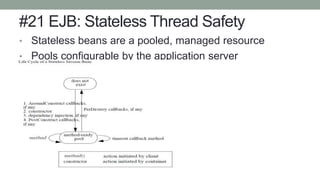
#21 EJB: Stateless Thread Safety
• Stateless beans are a pooled, managed resource
• Pools configurable by the application server
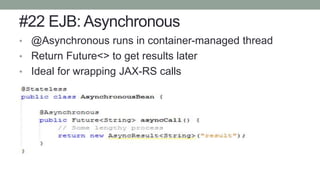
#22 EJB: Asynchronous
• @Asynchronous runs in container-managed thread
• Return Future<> to get results later
• Ideal for wrapping JAX-RS calls
• Good way to avoid any of your own threading
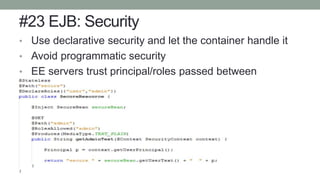
#23 EJB: Security
• Use declarative security and let the container handle it
• Avoid programmatic security
• EE servers trust principal/roles passed between
containers.
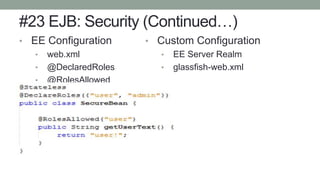
#23 EJB: Security (Continued…)
• EE Configuration
• web.xml
• @DeclaredRoles
• @RolesAllowed
• Custom Configuration
• EE Server Realm
• glassfish-web.xml
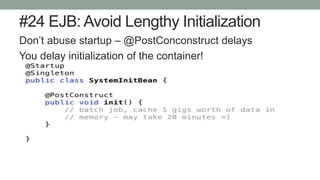
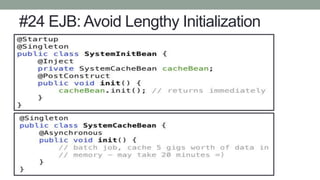
#24 EJB: Avoid Lengthy Initialization
Don’t abuse startup – @PostConconstruct delays
You delay initialization of the container!
#24 EJB: Avoid Lengthy Initialization
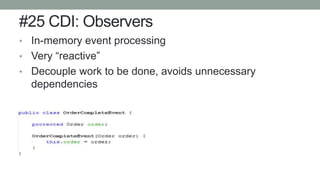
#25 CDI: Observers
• In-memory event processing
• Very “reactive”
• Decouple work to be done, avoids unnecessary
dependencies
• Create an event to fire
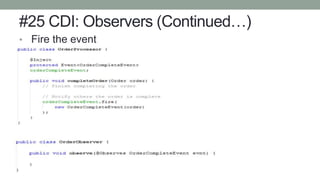
#25 CDI: Observers (Continued…)
• Fire the event
• Observers process the event
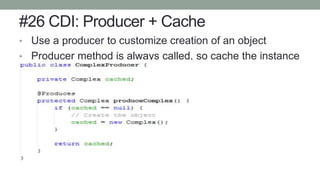
#26 CDI: Producer + Cache
• Use a producer to customize creation of an object
• Producer method is always called, so cache the instance
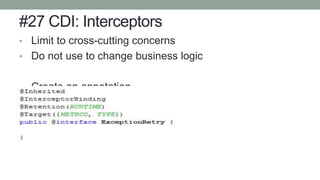
#27 CDI: Interceptors
• Limit to cross-cutting concerns
• Do not use to change business logic
• Create an annotation
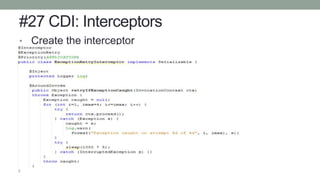
#27 CDI: Interceptors
• Create the interceptor
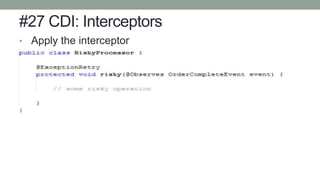
#27 CDI: Interceptors
• Apply the interceptor
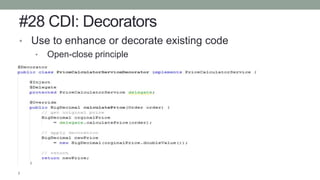
#28 CDI: Decorators
• Use to enhance or decorate existing code
• Open-close principle
• Do not use for cross-cutting concerns
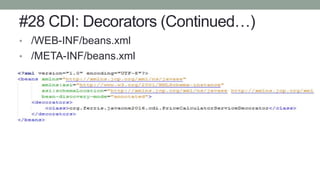
#28 CDI: Decorators (Continued…)
• /WEB-INF/beans.xml
• /META-INF/beans.xml
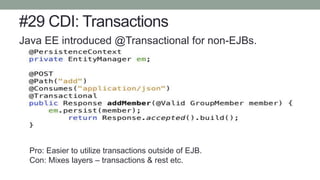
#29 CDI: Transactions
Java EE introduced @Transactional for non-EJBs.
Pro: Easier to utilize transactions outside of EJB.
Con: Mixes layers – transactions & rest etc.
#30 CDI: Bean Discovery
• Java EE 7 CDI is enabled by default.
• beans.xml is no longer required as in EE 6
• Bean discovery mode:
• Annotated – only annotated classes
• All – includes beans that are not annotated
• None – CDI disabled
• Default mode is ‘annotated’
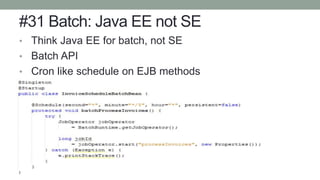
#31 Batch: Java EE not SE
• Think Java EE for batch, not SE
• Batch API
• Cron like schedule on EJB methods
• META-INF/batch-jobs/processInvoices.xml
#32: Batch Best Practices
• Package/deploy batch jobs separately
• Implement logic to cleanup old jobs
• Implement logic for auto-restart
• Test restart and checkpoint logic
• Configure database to store jobs
• Configure thread pool for batch jobs
• Only invoke batch jobs from logic that is secured (@Role
etc.)
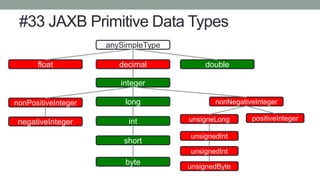
#33 JAXB Primitive Data Types
anySimpleType
decimal
integer
long
int
short
byte
float double
nonPositiveInteger
negativeInteger
nonNegativeInteger
unsigneLong positiveInteger
unsignedInt
unsignedInt
unsignedByte
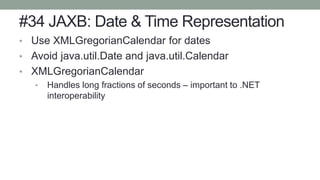
#34 JAXB: Date & Time Representation
• Use XMLGregorianCalendar for dates
• Avoid java.util.Date and java.util.Calendar
• XMLGregorianCalendar
• Handles long fractions of seconds – important to .NET
interoperability
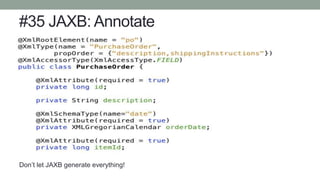
#35 JAXB: Annotate
Don’t let JAXB generate everything!
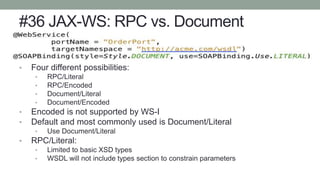
#36 JAX-WS: RPC vs. Document
• Four different possibilities:
• RPC/Literal
• RPC/Encoded
• Document/Literal
• Document/Encoded
• Encoded is not supported by WS-I
• Default and most commonly used is Document/Literal
• Use Document/Literal
• RPC/Literal:
• Limited to basic XSD types
• WSDL will not include types section to constrain parameters
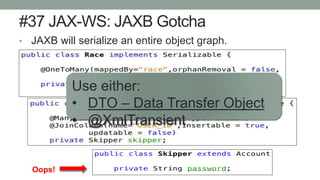
#37 JAX-WS: JAXB Gotcha
• JAXB will serialize an entire object graph.
Oops!
Use either:
• DTO – Data Transfer Object
• @XmlTransient
#38 JAX-WS Interoperable Services
• Design service starting with the WSDL
• Create data types using XSD
• Keep data types SIMPLE
• Avoid xsd:anyType
• Avoid sending Null values
• Use byte[] instead of String when character encoding is
unknown
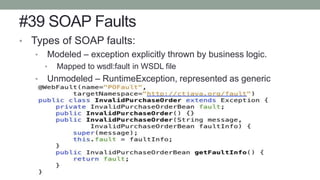
#39 SOAP Faults
• Types of SOAP faults:
• Modeled – exception explicitly thrown by business logic.
• Mapped to wsdl:fault in WSDL file
• Unmodeled – RuntimeException, represented as generic
SOAPFaultException
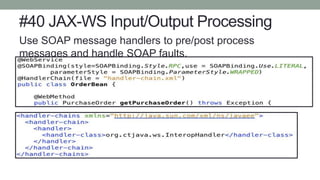
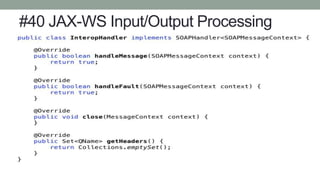
#40 JAX-WS Input/Output Processing
Use SOAP message handlers to pre/post process
messages and handle SOAP faults.
#40 JAX-WS Input/Output Processing
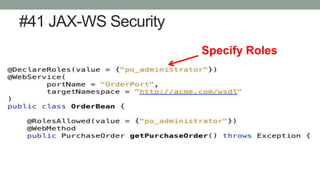
#41 JAX-WS Security
Specify Roles
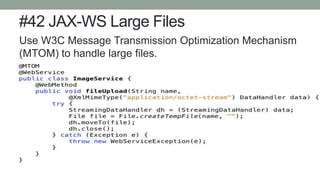
#42 JAX-WS Large Files
Use W3C Message Transmission Optimization Mechanism
(MTOM) to handle large files.
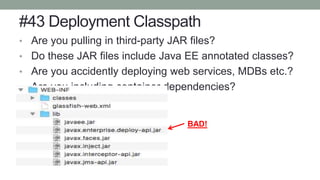
#43 Deployment Classpath
• Are you pulling in third-party JAR files?
• Do these JAR files include Java EE annotated classes?
• Are you accidently deploying web services, MDBs etc.?
• Are you including container dependencies?
BAD!
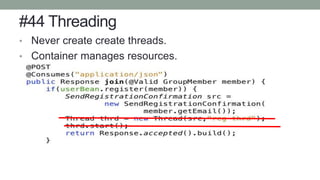
#44 Threading
• Never create create threads.
• Container manages resources.
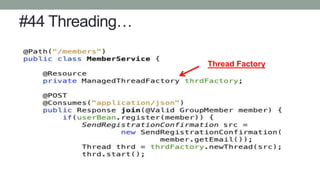
#44 Threading…
Thread Factory
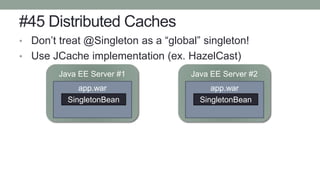
#45 Distributed Caches
• Don’t treat @Singleton as a “global” singleton!
• Use JCache implementation (ex. HazelCast)
Java EE Server #1
app.war
SingletonBean
Java EE Server #2
app.war
SingletonBean
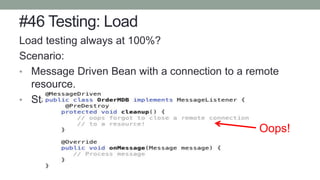
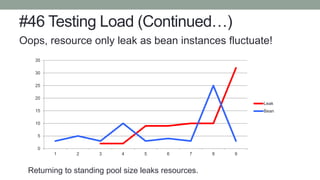
#46 Testing: Load
Load testing always at 100%?
Scenario:
• Message Driven Bean with a connection to a remote
resource.
• Standing pool size: 3
Oops!
#46 Testing Load (Continued…)
Oops, resource only leak as bean instances fluctuate!
0
5
10
15
20
25
30
35
1 2 3 4 5 6 7 8 9
Leak
Bean
Returning to standing pool size leaks resources.
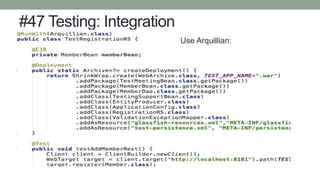
#47 Testing: Integration
Use Arquillian:
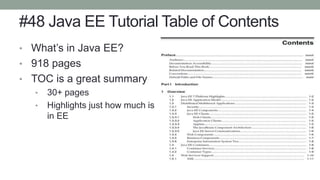
#48 Java EE Tutorial Table of Contents
• What’s in Java EE?
• 918 pages
• TOC is a great summary
• 30+ pages
• Highlights just how much is
in EE
#49 There are no “small” applications
• Don’t fall into these traps:
• “It’s just a simple application”
• “It only needs to do…”
• “Code it up real quick…”
• EE Specification exists for a reason
• Multiple users
• Concurrency
• Multi-threading
• Transaction management
• External resources
• Messaging
#50 Start with an EE Server
• Because there are no “small” applications
• Start with an EE Server
Avoid filling yourWAR with
“EE Features”
because you are not using an EE server
• But Servers are “heavy-weight”?
• Payara
• WildFly
• TomEE
• Benefits
• “Light-weight”
• Regular updates
• Great online community support
Join Us!
https://javaee-guardians.io
Q&A

Top 50 java ee 7 best practices [con5669]

  • 1.
    TOP 50 JAVAEE 7 BEST PRACTICES Ryan Cuprak Michael Remijan
  • 2.
    About Us Ryan • @ctjava •rcuprak@gmail.com • http://www.cuprak.info • https://www.linkedin.com/in/rcuprak Michael • @mjremijan • mjremijan@yahoo.com • http://mjremijan.blogspot.com • http://linkedin.com/in/mjremijan
  • 3.
    EJB 3 InAction 2nd Edition Updated For • EE 7 • EJB 3.2
  • 4.
    Java EE 7 Concurrency Utilities Batch Applications Java APIfor JSON Java API for WebSocket JSF 2.2 JSX-WS 2.2 JAX-RS 2 EL 3 Servlet 3.1 Common Annotations 1.2 Interceptors 1.2 CDI 1.1 Managed Beans 1.0 EJB 3.2 Connector 1.7 JPA 2.1 JTA 1.2 JMS 2 JSP 2.3 JAXB
  • 5.
    #1 JAX-RS: APIVersioning Version your JAX-RS with one of two approaches: 1. URL http://ctjava.org/v2/meetings http://ctjava.org/v1/meetngs 2. Media Content or Header Param curl -H "Content-Type:application/srv-v4+json” … Return HTTP Status Codes for services moved/changed: • 301 Moved Permanently • 302 Found
  • 6.
    #1 JAX-RS: APIVersioning (Continued…) Approach 1: URL Approach 2: Media Types
  • 7.
    #1 JAX-RS: APIVersioning (Continued…) Service Moved Permanently
  • 8.
    #2 JAX-RS: ErrorHandling Provide ExceptionMappers to handle and process errors.
  • 9.
    #2 JAX-RS: ErrorHandling (Continued…) HTML content is hardly a friendly response for an API!
  • 10.
    #2 JAX-RS: ErrorHandling (Continued…)
  • 11.
    #3 JAX-RS: Caching Tellclients to cache data!
  • 12.
    #4 JAX-RS +Bean Validation Use Bean Validation to check data.
  • 13.
    #5 JAX-RS: CompressResponses Use gzip compression for responses to reduce bandwidth.
  • 14.
    #6 Securing RESTfulServices • Use tokens with RESTful Web Services (OWASP). • Leverage JASPIC to setup JAAS environment.
  • 15.
    #7 JAX-RS +EJB • Use @Stateless and @Path together • Pooled, thread safe, monitored
  • 16.
    #7 JAX-RS +EJB (Continued…) • http://localhost:4848/monitoring/domain/server/applications/WebApp lication1/StatelessResource/bean-methods/getText[.json]
  • 17.
    #8 JAX-RS: AsynchronousAPI Gateway • Gateway calls multiple microservices asynchronously • Combines results into a DTO
  • 18.
    #8 JAX-RS: Async…(Continued…) •Gateway calls multiple microservices asynchronously • Combines results into a DTO
  • 19.
    #9 JPA: Pagination Usepagination for potential large result sets.
  • 20.
    #9 JPA: Pagination(Continued…)
  • 21.
    #10 JPA: LazyRelationships Avoid unnecessary queries – use Fetch on Lazy relationships.
  • 22.
    #10 JPA: LazyRelationships (Continued…) 1. SELECT MEETINGID, DATE, MEETINGABSTRACT, TITLE FROM MEETING WHERE (MEETINGID = ?) 2. SELECT t1.SPEAKERID, t1.BIOGRAPHY, t1.FIRSTNAME, t1.LASTNAME FROM meeting_speakers t0, SPEAKER t1 WHERE ((t0.meetingid = ?) AND (t1.SPEAKERID = t0.speakerid))
  • 23.
    #10 JPA: LazyRelationships (Continued…) 1. SELECT t1.MEETINGID, t1.DATE, t1.MEETINGABSTRACT, t1.TITLE, t0.SPEAKERID, t0.BIOGRAPHY, t0.FIRSTNAME, t0.LASTNAME FROM SPEAKER t0, meeting_speakers t2, MEETING t1 WHERE ((t1.MEETINGID = ?) AND ((t2.meetingid = t1.MEETINGID) AND (t0.SPEAKERID = t2.speakerid))) 1 Query Not TWO!
  • 24.
    #11 JPA: Cascade •Don’t forget cascade levels to handle child data • cascade=ALL is equivalent to cascade={PERSIST, MERGE, REMOVE, REFRESH, DETACH}
  • 25.
  • 26.
    #13 JPA +DAO Put CRUD operations into DAOs.
  • 27.
    #14 JPA: hashcode()& equals() The equals and hashcode are required for: • Entity is added to a collection • When re-attaching entities to a new persistence context. Important points: • Do not use generated identifiers • Use business key equality
  • 28.
    #14 JPA: hashcode()& equals() Continued…
  • 29.
    #15 JPA: OptimisticLocking • Don’t roll your own • Use @Version for optimistic locking: Integer
  • 30.
    #15 JPA: OptimisticLocking (Continued…) • Timestamp
  • 31.
    #16 JPA: PessimisticLocking • PESSIMISTIC_READ, PESSIMISTIC_WRITE • Lock timeout HINT
  • 32.
    #17 JPA: MappingInheritance • Inheritance can have a big impact upon performance. • Three approaches: • Single table • Joined-tables • Table-per-class • Denormalize for better performance
  • 33.
    #18 JPA L2Cache JPA 2 introduced the L2 Cache, use this cache for: • Entities that are frequently read • Entities that are modified infrequently • Not critical if stale • L2 cache can consume large amounts of memory • ALL • NONE • ENABLE_SELECTIVE • DISABLE_SELECTIVE Are you using a default setting?
  • 34.
    #18 JPA L2Cache (Continued…) Mark entity for L2 cache Bypass L2 cache
  • 35.
    #19 JPA: PersistingENUM • ENUM is a good case of converting data types • Use a @Converter
  • 36.
    #19 JPA: PersistingENUM (Continued…) • @Converter • AttributeConverter<X,Y> • X is my application, Y is the database
  • 37.
    #20 EJB: TransactionHandling • EJBs exist to handle transactions. Keep them at the right layer • Don’t ignore transactions. Default: REQUIRED • JAX-RS endpoints, database reads & performance
  • 38.
    #21 EJB: StatelessThread Safety • Stateless beans are a pooled, managed resource • Pools configurable by the application server
  • 39.
    #22 EJB: Asynchronous •@Asynchronous runs in container-managed thread • Return Future<> to get results later • Ideal for wrapping JAX-RS calls • Good way to avoid any of your own threading
  • 40.
    #23 EJB: Security •Use declarative security and let the container handle it • Avoid programmatic security • EE servers trust principal/roles passed between containers.
  • 41.
    #23 EJB: Security(Continued…) • EE Configuration • web.xml • @DeclaredRoles • @RolesAllowed • Custom Configuration • EE Server Realm • glassfish-web.xml
  • 42.
    #24 EJB: AvoidLengthy Initialization Don’t abuse startup – @PostConconstruct delays You delay initialization of the container!
  • 43.
    #24 EJB: AvoidLengthy Initialization
  • 44.
    #25 CDI: Observers •In-memory event processing • Very “reactive” • Decouple work to be done, avoids unnecessary dependencies • Create an event to fire
  • 45.
    #25 CDI: Observers(Continued…) • Fire the event • Observers process the event
  • 46.
    #26 CDI: Producer+ Cache • Use a producer to customize creation of an object • Producer method is always called, so cache the instance
  • 47.
    #27 CDI: Interceptors •Limit to cross-cutting concerns • Do not use to change business logic • Create an annotation
  • 48.
    #27 CDI: Interceptors •Create the interceptor
  • 49.
    #27 CDI: Interceptors •Apply the interceptor
  • 50.
    #28 CDI: Decorators •Use to enhance or decorate existing code • Open-close principle • Do not use for cross-cutting concerns
  • 51.
    #28 CDI: Decorators(Continued…) • /WEB-INF/beans.xml • /META-INF/beans.xml
  • 52.
    #29 CDI: Transactions JavaEE introduced @Transactional for non-EJBs. Pro: Easier to utilize transactions outside of EJB. Con: Mixes layers – transactions & rest etc.
  • 53.
    #30 CDI: BeanDiscovery • Java EE 7 CDI is enabled by default. • beans.xml is no longer required as in EE 6 • Bean discovery mode: • Annotated – only annotated classes • All – includes beans that are not annotated • None – CDI disabled • Default mode is ‘annotated’
  • 54.
    #31 Batch: JavaEE not SE • Think Java EE for batch, not SE • Batch API • Cron like schedule on EJB methods • META-INF/batch-jobs/processInvoices.xml
  • 55.
    #32: Batch BestPractices • Package/deploy batch jobs separately • Implement logic to cleanup old jobs • Implement logic for auto-restart • Test restart and checkpoint logic • Configure database to store jobs • Configure thread pool for batch jobs • Only invoke batch jobs from logic that is secured (@Role etc.)
  • 56.
    #33 JAXB PrimitiveData Types anySimpleType decimal integer long int short byte float double nonPositiveInteger negativeInteger nonNegativeInteger unsigneLong positiveInteger unsignedInt unsignedInt unsignedByte
  • 57.
    #34 JAXB: Date& Time Representation • Use XMLGregorianCalendar for dates • Avoid java.util.Date and java.util.Calendar • XMLGregorianCalendar • Handles long fractions of seconds – important to .NET interoperability
  • 58.
    #35 JAXB: Annotate Don’tlet JAXB generate everything!
  • 59.
    #36 JAX-WS: RPCvs. Document • Four different possibilities: • RPC/Literal • RPC/Encoded • Document/Literal • Document/Encoded • Encoded is not supported by WS-I • Default and most commonly used is Document/Literal • Use Document/Literal • RPC/Literal: • Limited to basic XSD types • WSDL will not include types section to constrain parameters
  • 60.
    #37 JAX-WS: JAXBGotcha • JAXB will serialize an entire object graph. Oops! Use either: • DTO – Data Transfer Object • @XmlTransient
  • 61.
    #38 JAX-WS InteroperableServices • Design service starting with the WSDL • Create data types using XSD • Keep data types SIMPLE • Avoid xsd:anyType • Avoid sending Null values • Use byte[] instead of String when character encoding is unknown
  • 62.
    #39 SOAP Faults •Types of SOAP faults: • Modeled – exception explicitly thrown by business logic. • Mapped to wsdl:fault in WSDL file • Unmodeled – RuntimeException, represented as generic SOAPFaultException
  • 63.
    #40 JAX-WS Input/OutputProcessing Use SOAP message handlers to pre/post process messages and handle SOAP faults.
  • 64.
  • 65.
  • 66.
    #42 JAX-WS LargeFiles Use W3C Message Transmission Optimization Mechanism (MTOM) to handle large files.
  • 67.
    #43 Deployment Classpath •Are you pulling in third-party JAR files? • Do these JAR files include Java EE annotated classes? • Are you accidently deploying web services, MDBs etc.? • Are you including container dependencies? BAD!
  • 68.
    #44 Threading • Nevercreate create threads. • Container manages resources.
  • 69.
  • 70.
    #45 Distributed Caches •Don’t treat @Singleton as a “global” singleton! • Use JCache implementation (ex. HazelCast) Java EE Server #1 app.war SingletonBean Java EE Server #2 app.war SingletonBean
  • 71.
    #46 Testing: Load Loadtesting always at 100%? Scenario: • Message Driven Bean with a connection to a remote resource. • Standing pool size: 3 Oops!
  • 72.
    #46 Testing Load(Continued…) Oops, resource only leak as bean instances fluctuate! 0 5 10 15 20 25 30 35 1 2 3 4 5 6 7 8 9 Leak Bean Returning to standing pool size leaks resources.
  • 73.
  • 74.
    #48 Java EETutorial Table of Contents • What’s in Java EE? • 918 pages • TOC is a great summary • 30+ pages • Highlights just how much is in EE
  • 75.
    #49 There areno “small” applications • Don’t fall into these traps: • “It’s just a simple application” • “It only needs to do…” • “Code it up real quick…” • EE Specification exists for a reason • Multiple users • Concurrency • Multi-threading • Transaction management • External resources • Messaging
  • 76.
    #50 Start withan EE Server • Because there are no “small” applications • Start with an EE Server Avoid filling yourWAR with “EE Features” because you are not using an EE server • But Servers are “heavy-weight”? • Payara • WildFly • TomEE • Benefits • “Light-weight” • Regular updates • Great online community support
  • 77.
  • 78.

Editor's Notes

  • #2 [Ryan] - Welcome to the Top 50 Java Best Practices
  • #3  I am Ryan, this is Michael,