Enterprise JavaBeans 3.1
                   Bert Ertman
                berte@infosupport.com
Enterprise JavaBeans 3.1
Bert	
  Ertman
Technology	
  Manager
Competence	
  Center	
  Java


Co-­‐lead	
  NLJUG,	
  Sun/Oracle	
  recognized	
  Java	
  Champion
Author	
  and	
  editorial	
  board	
  member	
  
for	
  Dutch	
  Java	
  Magazine

E-­‐mail:	
  berte@infosupport.com
Follow	
  me	
  on	
  TwiLer:	
  @BertErtman
J2EE
  #fail
          #fail


           EJB
                  #fail
BeJUG Evening Session - Enterprise JavaBeans 3.1
Agenda


           • EJB 3: short recap
           • What’s new in EJB 3.1
               •    Ease-of-use improvements

               •    EJB Lite

               •    New features


BeJUG Evening Session - Enterprise JavaBeans 3.1
The 3 minutes introduction to EJB 3


BeJUG Evening Session - Enterprise JavaBeans 3.1
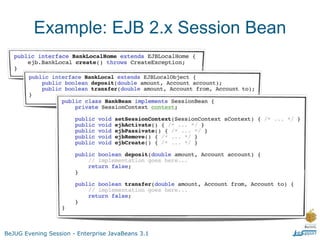
Example: EJB 2.x Session Bean


BeJUG Evening Session - Enterprise JavaBeans 3.1
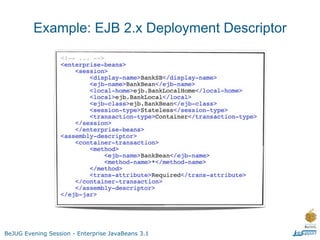
Example: EJB 2.x Deployment Descriptor


BeJUG Evening Session - Enterprise JavaBeans 3.1
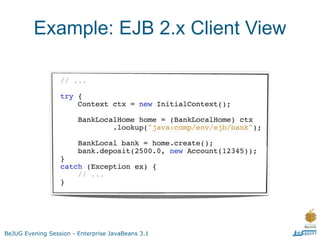
Example: EJB 2.x Client View


BeJUG Evening Session - Enterprise JavaBeans 3.1
blissful ignorance
          or painful truth of reality?


BeJUG Evening Session - Enterprise JavaBeans 3.1
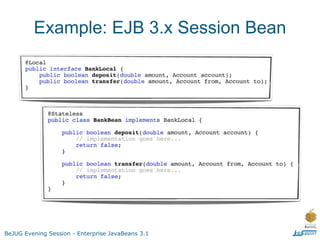
Example: EJB 3.x Session Bean


BeJUG Evening Session - Enterprise JavaBeans 3.1
Example: EJB 3.x Deployment Descriptor


BeJUG Evening Session - Enterprise JavaBeans 3.1
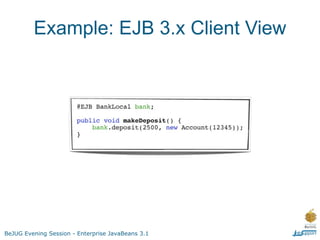
Example: EJB 3.x Client View


BeJUG Evening Session - Enterprise JavaBeans 3.1
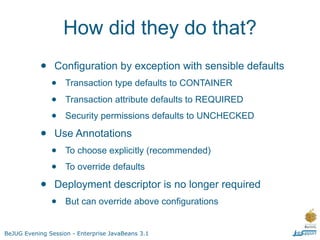
How did they do that?
           •    Configuration by exception with sensible defaults
               •    Transaction type defaults to CONTAINER

               •    Transaction attribute defaults to REQUIRED

               •    Security permissions defaults to UNCHECKED

           •    Use Annotations
               •    To choose explicitly (recommended)

               •    To override defaults

           •    Deployment descriptor is no longer required
               •    But can override above configurations


BeJUG Evening Session - Enterprise JavaBeans 3.1
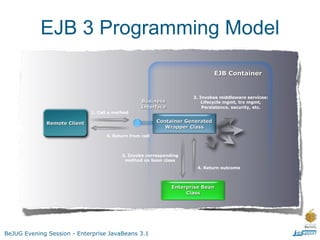
EJB 3 Programming Model


                                                                   2. Invokes middleware services:
                                                                       Lifecycle mgmt, trx mgmt,
                                                                       Persistence, security, etc.
                            1. Call a method


                                  4. Return from call


                                         3. Invoke corresponding
                                          method on bean class
                                                                    4. Return outcome


BeJUG Evening Session - Enterprise JavaBeans 3.1
So, what’s new in EJB 3.1?


BeJUG Evening Session - Enterprise JavaBeans 3.1
EJB 3.1


           • Separate JSR (318)
               •    Evolve separately from JPA

               •    Focus on ease-of-use

           • Expert group formed - Aug 2007
           • Final release - December 2009

BeJUG Evening Session - Enterprise JavaBeans 3.1
Ease-of-use improvements


           • Optional Local Business interface
           • Simplified packaging
           • EJB-Lite
           • Portable JNDI names
           • Simple component testing

BeJUG Evening Session - Enterprise JavaBeans 3.1
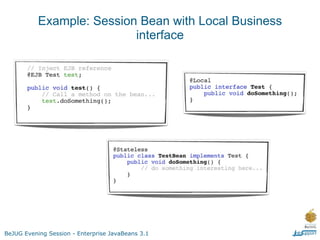
Example: Session Bean with Local Business
                           interface


BeJUG Evening Session - Enterprise JavaBeans 3.1
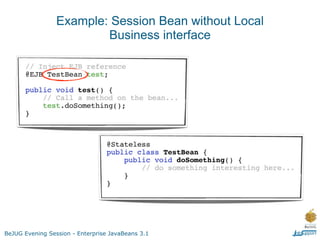
Example: Session Bean without Local
                         Business interface


BeJUG Evening Session - Enterprise JavaBeans 3.1
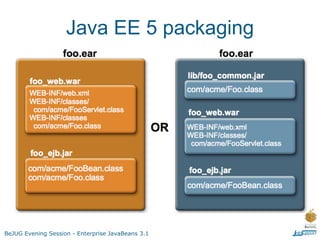
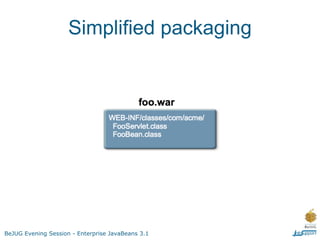
Simplified packaging

           • Goal is to remove artificial packaging
                restrictions
               •    All resources are shared within .war

               •    Web application APIs are not exposed to
                    EJB components

           • ejb-jar.xml is still optional
               •    If needed, placed in WEB-INF


BeJUG Evening Session - Enterprise JavaBeans 3.1
Java EE 5 packaging


BeJUG Evening Session - Enterprise JavaBeans 3.1
Simplified packaging


BeJUG Evening Session - Enterprise JavaBeans 3.1
EJB 3.1
                                       lite

BeJUG Evening Session - Enterprise JavaBeans 3.1
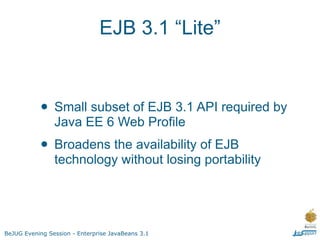
EJB 3.1 “Lite”


           • Small subset of EJB 3.1 API required by
                Java EE 6 Web Profile
           • Broadens the availability of EJB
                technology without losing portability


BeJUG Evening Session - Enterprise JavaBeans 3.1
Specs are ok:

            Blond hair,
            blue eyes,
             red lips,                             EJB HEAVY
           pink thong...

                   BUT...


              EJB lite
BeJUG Evening Session - Enterprise JavaBeans 3.1
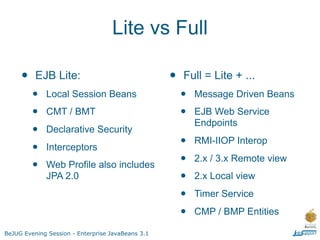
Lite vs Full

     •    EJB Lite:                                •   Full = Lite + ...
         •   Local Session Beans                       •   Message Driven Beans

         •   CMT / BMT                                 •   EJB Web Service
                                                           Endpoints
         •   Declarative Security

         •   Interceptors                              •   RMI-IIOP Interop

         •   Web Profile also includes                 •   2.x / 3.x Remote view
             JPA 2.0                                   •   2.x Local view

                                                       •   Timer Service

                                                       •   CMP / BMP Entities

BeJUG Evening Session - Enterprise JavaBeans 3.1
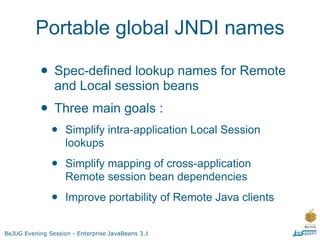
Portable global JNDI names

           • Spec-defined lookup names for Remote
                and Local session beans
           • Three main goals :
               •    Simplify intra-application Local Session
                    lookups

               •    Simplify mapping of cross-application
                    Remote session bean dependencies

               •    Improve portability of Remote Java clients


BeJUG Evening Session - Enterprise JavaBeans 3.1
Portable naming syntax
         • Each session bean gets the following
              entries :
               •    Globally unique name:
                    java:global[/<app-name>]/<module-name>/<ejb-name>

               •    Unique name within same application:
                    java:app[/<module-name>]/<ejb-name>

               •    Unique name within defining module:
                    java:module/<ejb-name>


BeJUG Evening Session - Enterprise JavaBeans 3.1
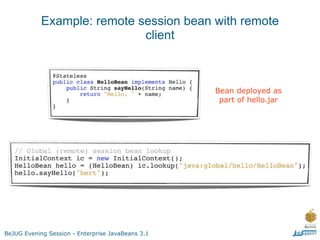
Example: remote session bean with remote
                             client


                                                   Bean deployed as
                                                    part of hello.jar


BeJUG Evening Session - Enterprise JavaBeans 3.1
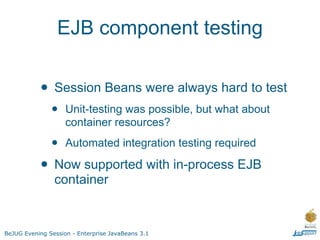
EJB component testing


           • Session Beans were always hard to test
               •    Unit-testing was possible, but what about
                    container resources?

               •    Automated integration testing required

           • Now supported with in-process EJB
                container


BeJUG Evening Session - Enterprise JavaBeans 3.1
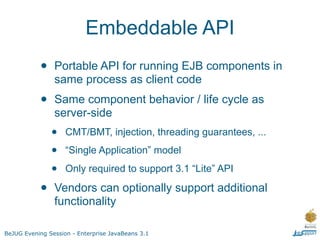
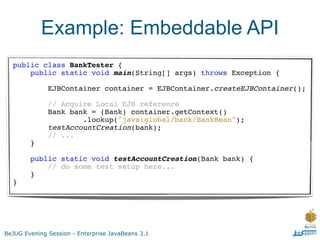
Embeddable API
           •    Portable API for running EJB components in
                same process as client code
           •    Same component behavior / life cycle as
                server-side
               •    CMT/BMT, injection, threading guarantees, ...

               •    “Single Application” model

               •    Only required to support 3.1 “Lite” API

           •    Vendors can optionally support additional
                functionality

BeJUG Evening Session - Enterprise JavaBeans 3.1
Example: Embeddable API


BeJUG Evening Session - Enterprise JavaBeans 3.1
New features

           • Singletons
           • Startup / shutdown callbacks
           • Calendar-based timers / automatic
                timer creation
           • Asynchronous invocations
           • JAX-RS integration
BeJUG Evening Session - Enterprise JavaBeans 3.1
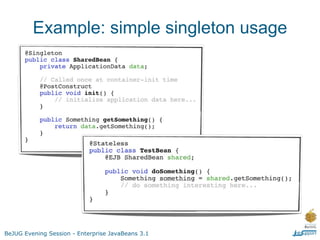
Singletons

           • One instance per application, per JVM
               •    Not intended to provide cluster-wide singleton

           • Fits into existing dependency injection
                architecture
               •    Access through @EJB or lookup

               •    Intended for sharing data within entire
                    application (not just EJB components)

               •    Designed for concurrent access


BeJUG Evening Session - Enterprise JavaBeans 3.1
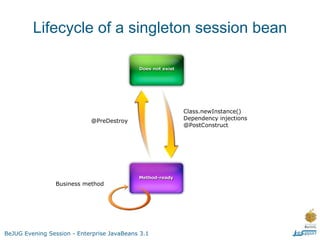
Lifecycle of a singleton session bean

                                            Does not exist


                                                             Class.newInstance()
                            @PreDestroy                      Dependency injections
                                                             @PostConstruct


                                            Method-ready
                 Business method


BeJUG Evening Session - Enterprise JavaBeans 3.1
Example: simple singleton usage


BeJUG Evening Session - Enterprise JavaBeans 3.1
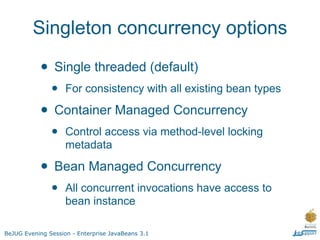
Singleton concurrency options

           • Single threaded (default)
               •    For consistency with all existing bean types

           • Container Managed Concurrency
               •    Control access via method-level locking
                    metadata

           • Bean Managed Concurrency
               •    All concurrent invocations have access to
                    bean instance

BeJUG Evening Session - Enterprise JavaBeans 3.1
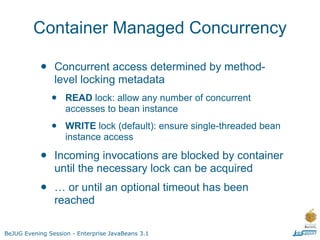
Container Managed Concurrency

           •    Concurrent access determined by method-
                level locking metadata
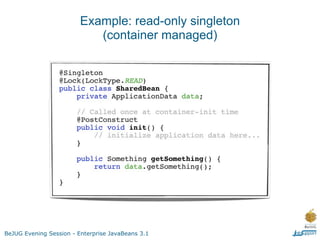
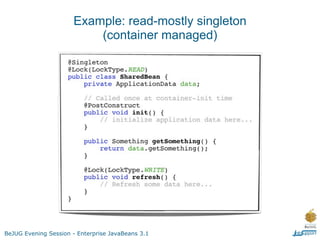
               •    READ lock: allow any number of concurrent
                    accesses to bean instance

               •    WRITE lock (default): ensure single-threaded bean
                    instance access

           •    Incoming invocations are blocked by container
                until the necessary lock can be acquired
           •    … or until an optional timeout has been
                reached

BeJUG Evening Session - Enterprise JavaBeans 3.1
Example: read-only singleton
                            (container managed)


BeJUG Evening Session - Enterprise JavaBeans 3.1
Example: read-mostly singleton
                          (container managed)


BeJUG Evening Session - Enterprise JavaBeans 3.1
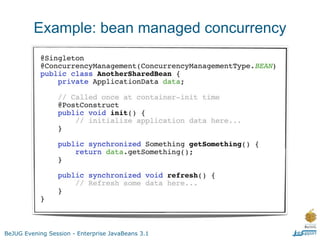
Bean Managed Concurrency


           • All incoming invocations allowed to
                access bean instance concurrently
               •    Bean developer is solely responsible for
                    maintaining integrity of instance state

               •    Can use synchronization primitives such as
                    synchronized, volatile


BeJUG Evening Session - Enterprise JavaBeans 3.1
Example: bean managed concurrency


BeJUG Evening Session - Enterprise JavaBeans 3.1
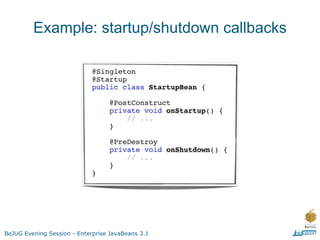
Application Startup/shutdown callbacks

           •    Uses singleton bean life cycle
           •    Full container services available
               •    Container-managed transactions

               •    Entity Managers, Timer Service, etc.

           •    Startup callback:
               •    @Startup and @PostConstruct

           •    Shutdown callback:
               • @PreDestroy
BeJUG Evening Session - Enterprise JavaBeans 3.1
Example: startup/shutdown callbacks


BeJUG Evening Session - Enterprise JavaBeans 3.1
Timer Service enhancements


           • Calendar-based timeouts
           • Automatic timer creation
           • Non-persistent timers


BeJUG Evening Session - Enterprise JavaBeans 3.1
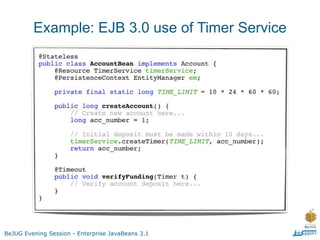
Example: EJB 3.0 use of Timer Service


BeJUG Evening Session - Enterprise JavaBeans 3.1
Some (hard) lessons learned...

           • Difficult to configure calendar-based
                events using only relative time units
           • How to register the timer in the first
                place?
               •    Typical container events not a great fit; they
                    happen every time application initializes and
                    in every server instance
                   •   Burden is on developer to figure out if timer already exists

                   •   No way to guarantee that only one is created per cluster


BeJUG Evening Session - Enterprise JavaBeans 3.1
Calendar based timeouts

           •    Cron-like semantics with improved syntax
           •    Can be created programmatically or
                automatically
           •    Named attributes:
               •    second, minute, hour (default = “0”)

               •    dayOfMonth, month, dayOfWeek, year
                    (default = “*”)

           •    Relative to optionally specified time zone

BeJUG Evening Session - Enterprise JavaBeans 3.1
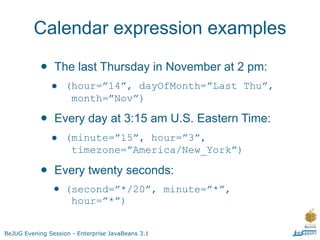
Calendar expression examples

           •    The last Thursday in November at 2 pm:
               •    (hour=”14”, dayOfMonth=”Last Thu”,
                     month=”Nov”)

           •    Every day at 3:15 am U.S. Eastern Time:
               •    (minute=”15”, hour=”3”,
                     timezone=”America/New_York”)

           •    Every twenty seconds:
               • (second=”*/20”,                   minute=”*”,
                      hour=”*”)


BeJUG Evening Session - Enterprise JavaBeans 3.1
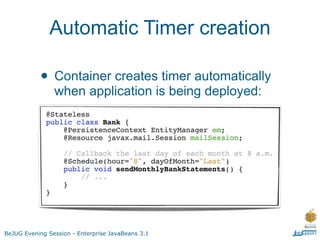
Automatic Timer creation

           • Container creates timer automatically
                when application is being deployed:


BeJUG Evening Session - Enterprise JavaBeans 3.1
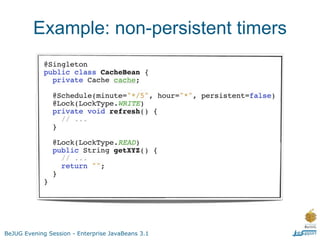
Example: non-persistent timers


BeJUG Evening Session - Enterprise JavaBeans 3.1
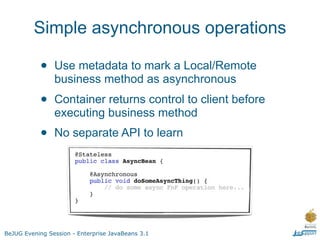
Simple asynchronous operations

           •    Use metadata to mark a Local/Remote
                business method as asynchronous
           •    Container returns control to client before
                executing business method
           •    No separate API to learn


BeJUG Evening Session - Enterprise JavaBeans 3.1
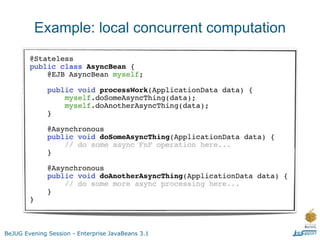
Example: local concurrent computation


BeJUG Evening Session - Enterprise JavaBeans 3.1
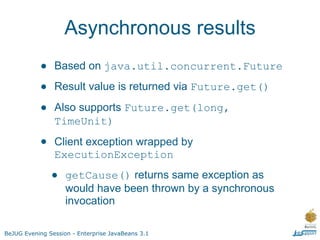
Asynchronous results
           •    Based on java.util.concurrent.Future

           •    Result value is returned via Future.get()

           •    Also supports Future.get(long,
                TimeUnit)

           •    Client exception wrapped by
                ExecutionException

               •    getCause() returns same exception as
                    would have been thrown by a synchronous
                    invocation

BeJUG Evening Session - Enterprise JavaBeans 3.1
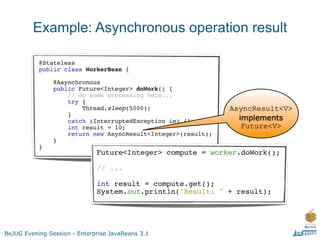
Example: Asynchronous operation result


                                                   AsyncResult<V>
                                                     implements
                                                      Future<V>


BeJUG Evening Session - Enterprise JavaBeans 3.1
JAX-RS support


           • Java API for XML RESTful Services
           • JSR-311 annotations can be used
                within Stateless Session Beans


BeJUG Evening Session - Enterprise JavaBeans 3.1
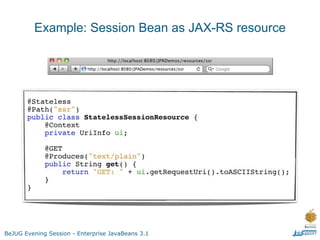
Example: Session Bean as JAX-RS resource


BeJUG Evening Session - Enterprise JavaBeans 3.1
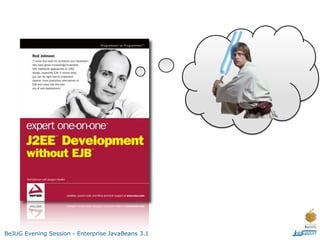
Rod, I am your father
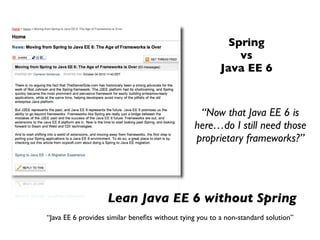
Spring
                                                             vs
                                                         Java EE 6


                                                 “Now that Java EE 6 is
                                                here…do I still need those
                                                proprietary frameworks?”


                    Lean Java EE 6 without Spring
“Java EE 6 provides similar benefits without tying you to a non-standard solution”
BeJUG Evening Session - Enterprise JavaBeans 3.1
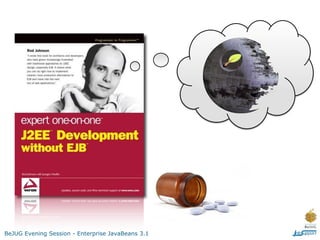
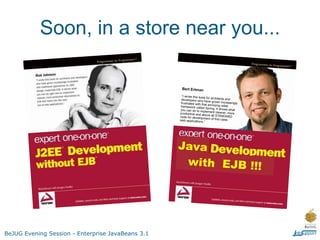
Soon, in a store near you...

                                                    Bert Ertman
                                                     “I wrote this book
                                                                        for
                                                    developers who ha architects and
                                                                         ve grown increasin
                                                    frustrated with that                    gly
                                                                         annoying rebel
                                                   framework called
                                                                        Sp
                                                   you can do to impl ring. It shows what
                                                                        ement cleaner, m
                                                   productive and ab                     ore
                                                                       ove all STANDARD
                                                   code for developm
                                                                        en
                                                   web applications.” t of first class


                                                   Java
                                                    with EJB !!!


BeJUG Evening Session - Enterprise JavaBeans 3.1
Questions?


BeJUG Evening Session - Enterprise JavaBeans 3.1
EJB 3.1 by Bert Ertman

EJB 3.1 by Bert Ertman

  • 1.
    Enterprise JavaBeans 3.1 Bert Ertman berte@infosupport.com
  • 2.
    Enterprise JavaBeans 3.1 Bert  Ertman Technology  Manager Competence  Center  Java Co-­‐lead  NLJUG,  Sun/Oracle  recognized  Java  Champion Author  and  editorial  board  member   for  Dutch  Java  Magazine E-­‐mail:  berte@infosupport.com Follow  me  on  TwiLer:  @BertErtman
  • 3.
    J2EE #fail #fail EJB #fail
  • 5.
    BeJUG Evening Session- Enterprise JavaBeans 3.1
  • 6.
    Agenda • EJB 3: short recap • What’s new in EJB 3.1 • Ease-of-use improvements • EJB Lite • New features BeJUG Evening Session - Enterprise JavaBeans 3.1
  • 7.
    The 3 minutesintroduction to EJB 3 BeJUG Evening Session - Enterprise JavaBeans 3.1
  • 8.
    Example: EJB 2.xSession Bean BeJUG Evening Session - Enterprise JavaBeans 3.1
  • 9.
    Example: EJB 2.xDeployment Descriptor BeJUG Evening Session - Enterprise JavaBeans 3.1
  • 10.
    Example: EJB 2.xClient View BeJUG Evening Session - Enterprise JavaBeans 3.1
  • 11.
    blissful ignorance or painful truth of reality? BeJUG Evening Session - Enterprise JavaBeans 3.1
  • 12.
    Example: EJB 3.xSession Bean BeJUG Evening Session - Enterprise JavaBeans 3.1
  • 13.
    Example: EJB 3.xDeployment Descriptor BeJUG Evening Session - Enterprise JavaBeans 3.1
  • 14.
    Example: EJB 3.xClient View BeJUG Evening Session - Enterprise JavaBeans 3.1
  • 15.
    How did theydo that? • Configuration by exception with sensible defaults • Transaction type defaults to CONTAINER • Transaction attribute defaults to REQUIRED • Security permissions defaults to UNCHECKED • Use Annotations • To choose explicitly (recommended) • To override defaults • Deployment descriptor is no longer required • But can override above configurations BeJUG Evening Session - Enterprise JavaBeans 3.1
  • 16.
    EJB 3 ProgrammingModel 2. Invokes middleware services: Lifecycle mgmt, trx mgmt, Persistence, security, etc. 1. Call a method 4. Return from call 3. Invoke corresponding method on bean class 4. Return outcome BeJUG Evening Session - Enterprise JavaBeans 3.1
  • 17.
    So, what’s newin EJB 3.1? BeJUG Evening Session - Enterprise JavaBeans 3.1
  • 18.
    EJB 3.1 • Separate JSR (318) • Evolve separately from JPA • Focus on ease-of-use • Expert group formed - Aug 2007 • Final release - December 2009 BeJUG Evening Session - Enterprise JavaBeans 3.1
  • 19.
    Ease-of-use improvements • Optional Local Business interface • Simplified packaging • EJB-Lite • Portable JNDI names • Simple component testing BeJUG Evening Session - Enterprise JavaBeans 3.1
  • 20.
    Example: Session Beanwith Local Business interface BeJUG Evening Session - Enterprise JavaBeans 3.1
  • 21.
    Example: Session Beanwithout Local Business interface BeJUG Evening Session - Enterprise JavaBeans 3.1
  • 22.
    Simplified packaging • Goal is to remove artificial packaging restrictions • All resources are shared within .war • Web application APIs are not exposed to EJB components • ejb-jar.xml is still optional • If needed, placed in WEB-INF BeJUG Evening Session - Enterprise JavaBeans 3.1
  • 23.
    Java EE 5packaging BeJUG Evening Session - Enterprise JavaBeans 3.1
  • 24.
    Simplified packaging BeJUG EveningSession - Enterprise JavaBeans 3.1
  • 25.
    EJB 3.1 lite BeJUG Evening Session - Enterprise JavaBeans 3.1
  • 26.
    EJB 3.1 “Lite” • Small subset of EJB 3.1 API required by Java EE 6 Web Profile • Broadens the availability of EJB technology without losing portability BeJUG Evening Session - Enterprise JavaBeans 3.1
  • 27.
    Specs are ok: Blond hair, blue eyes, red lips, EJB HEAVY pink thong... BUT... EJB lite BeJUG Evening Session - Enterprise JavaBeans 3.1
  • 28.
    Lite vs Full • EJB Lite: • Full = Lite + ... • Local Session Beans • Message Driven Beans • CMT / BMT • EJB Web Service Endpoints • Declarative Security • Interceptors • RMI-IIOP Interop • Web Profile also includes • 2.x / 3.x Remote view JPA 2.0 • 2.x Local view • Timer Service • CMP / BMP Entities BeJUG Evening Session - Enterprise JavaBeans 3.1
  • 29.
    Portable global JNDInames • Spec-defined lookup names for Remote and Local session beans • Three main goals : • Simplify intra-application Local Session lookups • Simplify mapping of cross-application Remote session bean dependencies • Improve portability of Remote Java clients BeJUG Evening Session - Enterprise JavaBeans 3.1
  • 30.
    Portable naming syntax • Each session bean gets the following entries : • Globally unique name: java:global[/<app-name>]/<module-name>/<ejb-name> • Unique name within same application: java:app[/<module-name>]/<ejb-name> • Unique name within defining module: java:module/<ejb-name> BeJUG Evening Session - Enterprise JavaBeans 3.1
  • 31.
    Example: remote sessionbean with remote client Bean deployed as part of hello.jar BeJUG Evening Session - Enterprise JavaBeans 3.1
  • 32.
    EJB component testing • Session Beans were always hard to test • Unit-testing was possible, but what about container resources? • Automated integration testing required • Now supported with in-process EJB container BeJUG Evening Session - Enterprise JavaBeans 3.1
  • 33.
    Embeddable API • Portable API for running EJB components in same process as client code • Same component behavior / life cycle as server-side • CMT/BMT, injection, threading guarantees, ... • “Single Application” model • Only required to support 3.1 “Lite” API • Vendors can optionally support additional functionality BeJUG Evening Session - Enterprise JavaBeans 3.1
  • 34.
    Example: Embeddable API BeJUGEvening Session - Enterprise JavaBeans 3.1
  • 35.
    New features • Singletons • Startup / shutdown callbacks • Calendar-based timers / automatic timer creation • Asynchronous invocations • JAX-RS integration BeJUG Evening Session - Enterprise JavaBeans 3.1
  • 36.
    Singletons • One instance per application, per JVM • Not intended to provide cluster-wide singleton • Fits into existing dependency injection architecture • Access through @EJB or lookup • Intended for sharing data within entire application (not just EJB components) • Designed for concurrent access BeJUG Evening Session - Enterprise JavaBeans 3.1
  • 37.
    Lifecycle of asingleton session bean Does not exist Class.newInstance() @PreDestroy Dependency injections @PostConstruct Method-ready Business method BeJUG Evening Session - Enterprise JavaBeans 3.1
  • 38.
    Example: simple singletonusage BeJUG Evening Session - Enterprise JavaBeans 3.1
  • 39.
    Singleton concurrency options • Single threaded (default) • For consistency with all existing bean types • Container Managed Concurrency • Control access via method-level locking metadata • Bean Managed Concurrency • All concurrent invocations have access to bean instance BeJUG Evening Session - Enterprise JavaBeans 3.1
  • 40.
    Container Managed Concurrency • Concurrent access determined by method- level locking metadata • READ lock: allow any number of concurrent accesses to bean instance • WRITE lock (default): ensure single-threaded bean instance access • Incoming invocations are blocked by container until the necessary lock can be acquired • … or until an optional timeout has been reached BeJUG Evening Session - Enterprise JavaBeans 3.1
  • 41.
    Example: read-only singleton (container managed) BeJUG Evening Session - Enterprise JavaBeans 3.1
  • 42.
    Example: read-mostly singleton (container managed) BeJUG Evening Session - Enterprise JavaBeans 3.1
  • 43.
    Bean Managed Concurrency • All incoming invocations allowed to access bean instance concurrently • Bean developer is solely responsible for maintaining integrity of instance state • Can use synchronization primitives such as synchronized, volatile BeJUG Evening Session - Enterprise JavaBeans 3.1
  • 44.
    Example: bean managedconcurrency BeJUG Evening Session - Enterprise JavaBeans 3.1
  • 45.
    Application Startup/shutdown callbacks • Uses singleton bean life cycle • Full container services available • Container-managed transactions • Entity Managers, Timer Service, etc. • Startup callback: • @Startup and @PostConstruct • Shutdown callback: • @PreDestroy BeJUG Evening Session - Enterprise JavaBeans 3.1
  • 46.
    Example: startup/shutdown callbacks BeJUGEvening Session - Enterprise JavaBeans 3.1
  • 47.
    Timer Service enhancements • Calendar-based timeouts • Automatic timer creation • Non-persistent timers BeJUG Evening Session - Enterprise JavaBeans 3.1
  • 48.
    Example: EJB 3.0use of Timer Service BeJUG Evening Session - Enterprise JavaBeans 3.1
  • 49.
    Some (hard) lessonslearned... • Difficult to configure calendar-based events using only relative time units • How to register the timer in the first place? • Typical container events not a great fit; they happen every time application initializes and in every server instance • Burden is on developer to figure out if timer already exists • No way to guarantee that only one is created per cluster BeJUG Evening Session - Enterprise JavaBeans 3.1
  • 50.
    Calendar based timeouts • Cron-like semantics with improved syntax • Can be created programmatically or automatically • Named attributes: • second, minute, hour (default = “0”) • dayOfMonth, month, dayOfWeek, year (default = “*”) • Relative to optionally specified time zone BeJUG Evening Session - Enterprise JavaBeans 3.1
  • 51.
    Calendar expression examples • The last Thursday in November at 2 pm: • (hour=”14”, dayOfMonth=”Last Thu”, month=”Nov”) • Every day at 3:15 am U.S. Eastern Time: • (minute=”15”, hour=”3”, timezone=”America/New_York”) • Every twenty seconds: • (second=”*/20”, minute=”*”, hour=”*”) BeJUG Evening Session - Enterprise JavaBeans 3.1
  • 52.
    Automatic Timer creation • Container creates timer automatically when application is being deployed: BeJUG Evening Session - Enterprise JavaBeans 3.1
  • 53.
    Example: non-persistent timers BeJUGEvening Session - Enterprise JavaBeans 3.1
  • 54.
    Simple asynchronous operations • Use metadata to mark a Local/Remote business method as asynchronous • Container returns control to client before executing business method • No separate API to learn BeJUG Evening Session - Enterprise JavaBeans 3.1
  • 55.
    Example: local concurrentcomputation BeJUG Evening Session - Enterprise JavaBeans 3.1
  • 56.
    Asynchronous results • Based on java.util.concurrent.Future • Result value is returned via Future.get() • Also supports Future.get(long, TimeUnit) • Client exception wrapped by ExecutionException • getCause() returns same exception as would have been thrown by a synchronous invocation BeJUG Evening Session - Enterprise JavaBeans 3.1
  • 57.
    Example: Asynchronous operationresult AsyncResult<V> implements Future<V> BeJUG Evening Session - Enterprise JavaBeans 3.1
  • 58.
    JAX-RS support • Java API for XML RESTful Services • JSR-311 annotations can be used within Stateless Session Beans BeJUG Evening Session - Enterprise JavaBeans 3.1
  • 59.
    Example: Session Beanas JAX-RS resource BeJUG Evening Session - Enterprise JavaBeans 3.1
  • 60.
    Rod, I amyour father
  • 61.
    Spring vs Java EE 6 “Now that Java EE 6 is here…do I still need those proprietary frameworks?” Lean Java EE 6 without Spring “Java EE 6 provides similar benefits without tying you to a non-standard solution”
  • 62.
    BeJUG Evening Session- Enterprise JavaBeans 3.1
  • 63.
    Soon, in astore near you... Bert Ertman “I wrote this book for developers who ha architects and ve grown increasin frustrated with that gly annoying rebel framework called Sp you can do to impl ring. It shows what ement cleaner, m productive and ab ore ove all STANDARD code for developm en web applications.” t of first class Java with EJB !!! BeJUG Evening Session - Enterprise JavaBeans 3.1
  • 64.
    Questions? BeJUG Evening Session- Enterprise JavaBeans 3.1