Enterprise Java Bean 3.0
               Yet Another Introduction…


               Kelum Senanayake
Tag-Cloud

ResourceInjection
                      StatelessSessionBean

   EnterpriseJavaBeans
 EntityBean               StatefulSessionBean
                    MessageDrivenBean
  JavaEE                                  POJO
                       JavaPersistenceAPI
Annotations                Transactions
Enterprise Java Beans
Enterprise Java Beans (EJB)
• A platform for building portable, reusable, and
  scalable business applications.
• Allows to focus on building business logic
  without having to spend time on building
  infrastructure code for services such as
  transactions, security, automated persistence.
• An EJB is a piece of Java code that executes in
  a specialized runtime environment.
EJB as a component …
• A component should effectively encapsulate
  application behavior.
• All we need to know is what to pass in and
  what to expect back.
• Components can be reusable.
• Three types of EJB components:
  – Session beans
  – Message-driven beans
  – Entities
EJB as a framework …
• EJB components live in a container.
• Together, the components, or EJBs, and the
  container can be viewed as a framework.
• EJB framework provides valuable services for
  enterprise application development
EJB History
• EJB 1.0 (1998-03-24)
  – Defined the responsibilities of EJB Container provider
  – Defined the distinct “EJB Roles”
• EJB 1.1 (1999-12-17)
  – XML deployment descriptors
  – Session Beans, Entity Beans
  – Remote interface
• EJB 2.0 (2001-08-22)
  – Message-Driven Beans
  – Entity 2.x and EJB QL
EJB History …contd
• EJB 2.1 (2003-11-24)
  – EJB Timer Service
  – Web service support
• EJB 3.0 (2006-05-11)
  – POJO, Annotations
  – Dependency injection
• EJB 3.1 (2009-12-10)
  –   Local view without interface
  –   .war packaging of EJB components
  –   Singletons (Singleton Session Beans)
  –   EJB Lite: definition of a subset of EJB
  –   @Asynchronous for session beans
EJB 3.0 vs EJB 2.1
• EJB 3.0 is much faster than EJB 2
• An EJB 2.1 session bean must implement the
  SessionBean interface
• EJB 3.0 session bean class includes only business
  methods.
• EJB 3.0 interfaces are POJI business interfaces
  and do not require home and component
  interfaces.
• EJB 2.1 must have the deployment descriptor. But
  optional in EJB 3.0. Annotations are added to the
  language.
EJB 3.0 vs EJB 2.1 …contd
• EJB 3 introduced persistence API for database
  access. In EJB 2 you can use Entity bean.
• An EJB 2.1 Entity EJB bean class must implement
  the EntityBean interface and must provide
  implementation to the ejbCreate() and
  ejbPostCreate() methods.
• EJB 2.1 entity bean includes the home,
  component, local home and local component
  interfaces that extend the EJBHome, EJBObject,
  EJBLocalHome and EJBObject interfaces
  respectively.
EJB 3.0 vs EJB 2.1 …contd
• An EJB 2.1 bean must define resource-ref in ejb-
  jar.xml to lookup resources. An EJB 3.0 bean can
  use either dependency injection or JNDI lookup.
• An EJB 2.1 message-driven must implement the
  javax.ejb.MessgeDrivenBean interface.
• Standardized Simplified persistence with POJO
  – You couldn’t send an EJB 2 entity bean across the wire
    in different tiers.
  – They are permanently attached to the database.
  – You have to write data transfer objects
Why choose EJB 3.0?
• Ease of use
  – POJO programming, annotations in favor of verbose
    XML, heavy use of sensible defaults & JPA
• Integrated solution stack
  – EJB 3 offers a complete stack of server solutions
  – Persistence, messaging, lightweight scheduling,
    remoting, web services, dependency injection (DI) and
    interceptors
  – You won’t have to spend a lot of time looking for
    third-party tools
Why EJB 3.0 …contd
• Open Java EE standard
  – EJB is a critical part of the Java EE standard
  – EJB 3 has an open, public API specification
  – The open standard leads to broader vendor
    support
  – You don’t have to depend on a proprietary solution
Why EJB 3.0 …contd
• Broad vendor support
  – You are not at the mercy of the ups and downs of
    a particular company or group of people
  – Vendors have historically competed against one
    another by providing value-added nonstandard
    features
• Stable, high-quality code base
  – Clustering, load balancing, and failover support
    with no changes to code, no third-party tool
    integration, and relatively simple configuration
Why EJB 3.0 …contd
• Unit-testable POJO components
  – All EJB 3 components are POJOs, they can easily
    be executed outside the container
  – It is possible to unit-test all component business
    logic using testing frameworks
• Annotations and descriptors are not mutually
  exclusive
  – Deployment descriptor entries override
    configuration values hard-coded into EJB
    components
JavaEE Container
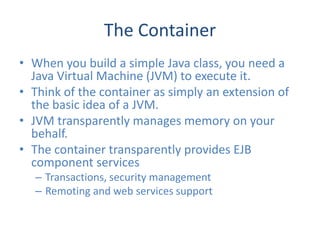
The Container
• When you build a simple Java class, you need a
  Java Virtual Machine (JVM) to execute it.
• Think of the container as simply an extension of
  the basic idea of a JVM.
• JVM transparently manages memory on your
  behalf.
• The container transparently provides EJB
  component services
  – Transactions, security management
  – Remoting and web services support
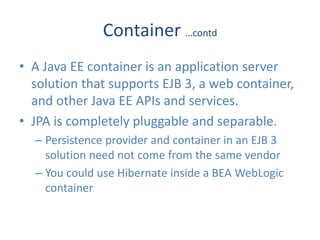
Container …contd
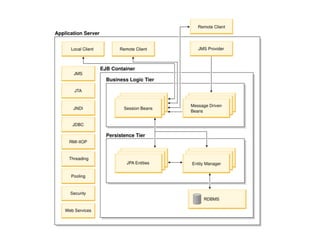
• A Java EE container is an application server
  solution that supports EJB 3, a web container,
  and other Java EE APIs and services.
• JPA is completely pluggable and separable.
  – Persistence provider and container in an EJB 3
    solution need not come from the same vendor
  – You could use Hibernate inside a BEA WebLogic
    container
Hello World !
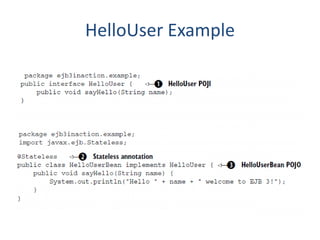
HelloUser Example
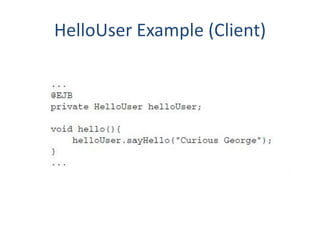
HelloUser Example (Client)
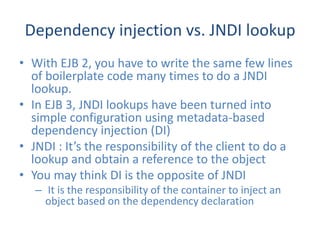
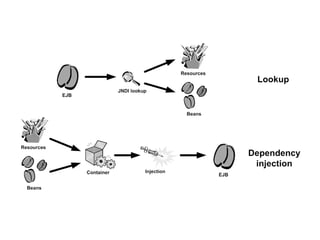
Dependency injection vs. JNDI lookup
• With EJB 2, you have to write the same few lines
  of boilerplate code many times to do a JNDI
  lookup.
• In EJB 3, JNDI lookups have been turned into
  simple configuration using metadata-based
  dependency injection (DI)
• JNDI : It’s the responsibility of the client to do a
  lookup and obtain a reference to the object
• You may think DI is the opposite of JNDI
   – It is the responsibility of the container to inject an
     object based on the dependency declaration
Building business logic with
       Session Beans
Getting to know Session Beans
• So what is a Session?
   – A session is a connection between a client and a
     server that lasts for a finite period of time
• Session beans centers on the idea that each
  request by a client to complete a distinct business
  process is completed in a session.
• Recall that session beans come in two flavors:
  Stateful and Stateless
• A bean may maintain its state between calls, in
  which case it is stateful, or it may be a one-time
  call, in which case it’s stateless.
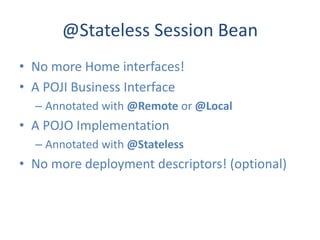
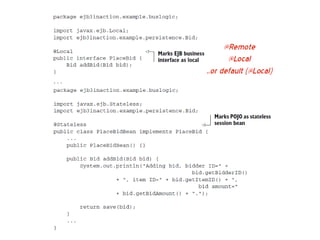
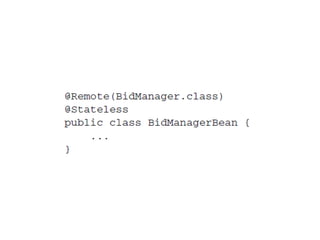
@Stateless Session Bean
• No more Home interfaces!
• A POJI Business Interface
  – Annotated with @Remote or @Local
• A POJO Implementation
  – Annotated with @Stateless
• No more deployment descriptors! (optional)
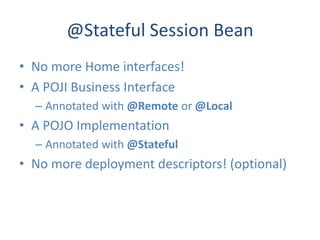
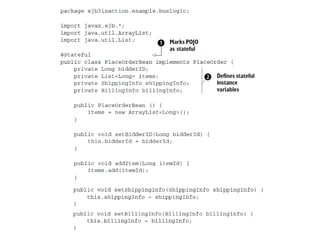
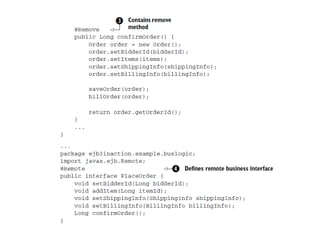
@Stateful Session Bean
• No more Home interfaces!
• A POJI Business Interface
  – Annotated with @Remote or @Local
• A POJO Implementation
  – Annotated with @Stateful
• No more deployment descriptors! (optional)
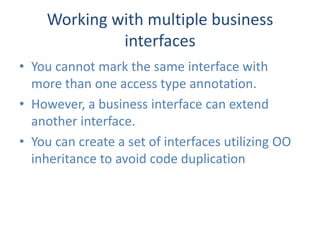
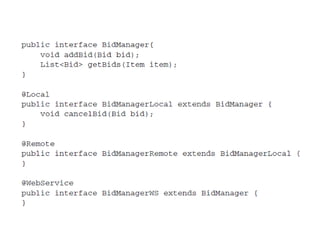
Working with multiple business
             interfaces
• You cannot mark the same interface with
  more than one access type annotation.
• However, a business interface can extend
  another interface.
• You can create a set of interfaces utilizing OO
  inheritance to avoid code duplication
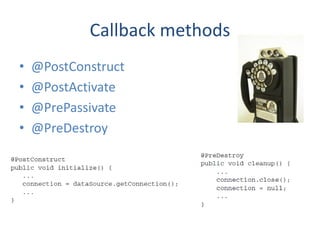
Callback methods
•   @PostConstruct
•   @PostActivate
•   @PrePassivate
•   @PreDestroy
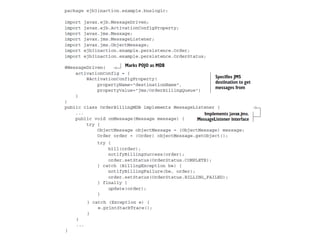
@MessageDriven Bean
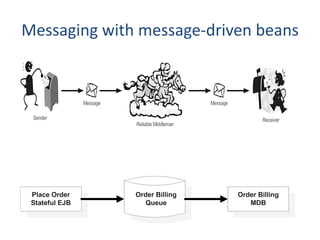
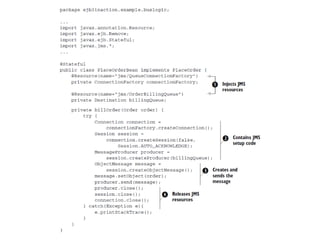
Messaging with message-driven beans
Diving into the Java Persistence API
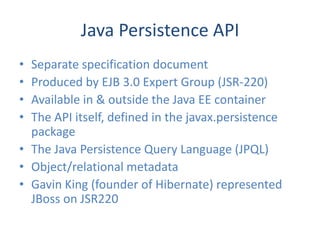
Java Persistence API
• Separate specification document
• Produced by EJB 3.0 Expert Group (JSR-220)
• Available in & outside the Java EE container
• The API itself, defined in the javax.persistence
  package
• The Java Persistence Query Language (JPQL)
• Object/relational metadata
• Gavin King (founder of Hibernate) represented
  JBoss on JSR220
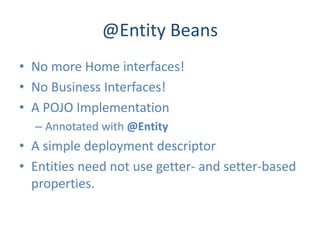
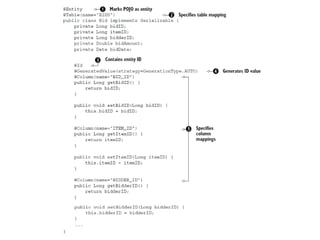
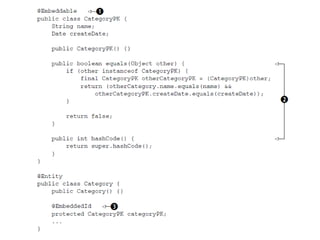
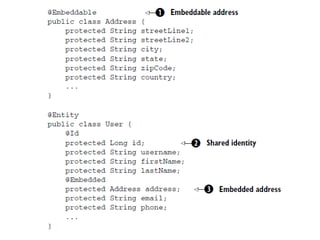
@Entity Beans
• No more Home interfaces!
• No Business Interfaces!
• A POJO Implementation
  – Annotated with @Entity
• A simple deployment descriptor
• Entities need not use getter- and setter-based
  properties.
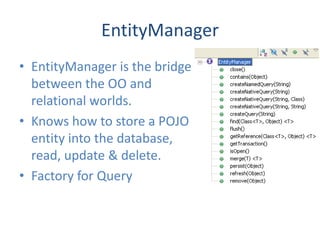
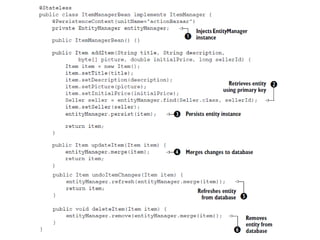
EntityManager
• EntityManager is the bridge
  between the OO and
  relational worlds.
• Knows how to store a POJO
  entity into the database,
  read, update & delete.
• Factory for Query
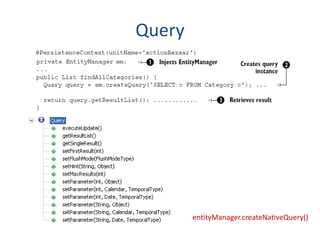
Query


        entityManager.createNativeQuery()
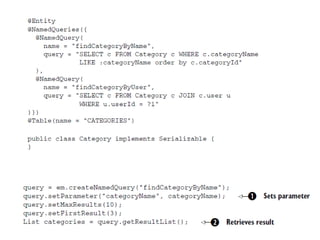
Named queries
• They improve reusability of queries.
• They improve maintainability of code
  – Queries are not scattered among the business logic.
• They can enhance performance because they
  are prepared once and can be efficiently reused.
• Can be defined either in the entity using
  annotations, or in the XML file defining O/R
  mapping metadata.
Transaction Management
Understanding transactions
• A transaction is a grouping of tasks that must be
  processed as an inseparable unit.
• Every task that is part of the transaction must
  succeed in order for the transaction to succeed.
  All-or-nothing
• The Transaction Manager is a component that,
  coordinates a transaction over multiple
  distributed resources
• EJB provides through the Java Transaction API
  (JTA)
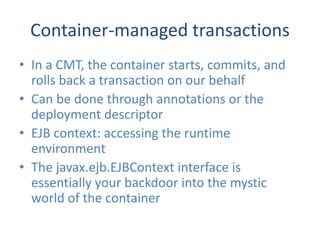
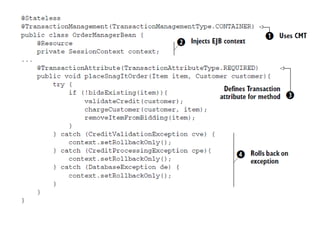
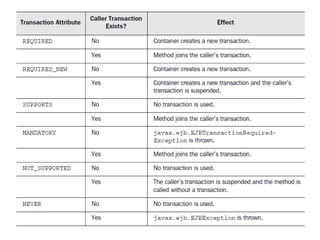
Container-managed transactions
• In a CMT, the container starts, commits, and
  rolls back a transaction on our behalf
• Can be done through annotations or the
  deployment descriptor
• EJB context: accessing the runtime
  environment
• The javax.ejb.EJBContext interface is
  essentially your backdoor into the mystic
  world of the container
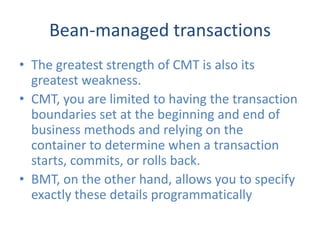
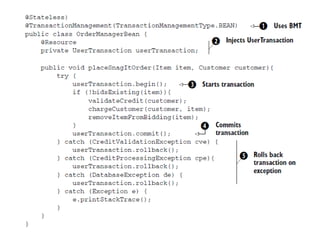
Bean-managed transactions
• The greatest strength of CMT is also its
  greatest weakness.
• CMT, you are limited to having the transaction
  boundaries set at the beginning and end of
  business methods and relying on the
  container to determine when a transaction
  starts, commits, or rolls back.
• BMT, on the other hand, allows you to specify
  exactly these details programmatically
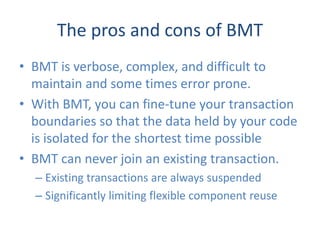
The pros and cons of BMT
• BMT is verbose, complex, and difficult to
  maintain and some times error prone.
• With BMT, you can fine-tune your transaction
  boundaries so that the data held by your code
  is isolated for the shortest time possible
• BMT can never join an existing transaction.
  – Existing transactions are always suspended
  – Significantly limiting flexible component reuse
References
• [1] D. Panda, R. Rahman, and D. Lane, EJB 3 in Action, 1st
  ed. Manning Publications, 2007.

• [2] “Enterprise JavaBeans - Wikipedia, the free
  encyclopedia.” [Online]. Available:
  http://en.wikipedia.org/wiki/Ejb. [Accessed: 10-Mar-2012].

• [3] “What I’m Learning: Differences between EJB 3.0 and
  EJB 2.1.” [Online]. Available:
  http://mytechnicaldocs.blogspot.com/2011/08/differences
  -between-ejb-30-and-ejb-21.html. [Accessed: 10-Mar-
  2012].
@Questions?

EJB 3.0 - Yet Another Introduction

  • 1.
    Enterprise Java Bean3.0 Yet Another Introduction… Kelum Senanayake
  • 2.
    Tag-Cloud ResourceInjection StatelessSessionBean EnterpriseJavaBeans EntityBean StatefulSessionBean MessageDrivenBean JavaEE POJO JavaPersistenceAPI Annotations Transactions
  • 3.
  • 4.
    Enterprise Java Beans(EJB) • A platform for building portable, reusable, and scalable business applications. • Allows to focus on building business logic without having to spend time on building infrastructure code for services such as transactions, security, automated persistence. • An EJB is a piece of Java code that executes in a specialized runtime environment.
  • 5.
    EJB as acomponent … • A component should effectively encapsulate application behavior. • All we need to know is what to pass in and what to expect back. • Components can be reusable. • Three types of EJB components: – Session beans – Message-driven beans – Entities
  • 6.
    EJB as aframework … • EJB components live in a container. • Together, the components, or EJBs, and the container can be viewed as a framework. • EJB framework provides valuable services for enterprise application development
  • 7.
    EJB History • EJB1.0 (1998-03-24) – Defined the responsibilities of EJB Container provider – Defined the distinct “EJB Roles” • EJB 1.1 (1999-12-17) – XML deployment descriptors – Session Beans, Entity Beans – Remote interface • EJB 2.0 (2001-08-22) – Message-Driven Beans – Entity 2.x and EJB QL
  • 8.
    EJB History …contd •EJB 2.1 (2003-11-24) – EJB Timer Service – Web service support • EJB 3.0 (2006-05-11) – POJO, Annotations – Dependency injection • EJB 3.1 (2009-12-10) – Local view without interface – .war packaging of EJB components – Singletons (Singleton Session Beans) – EJB Lite: definition of a subset of EJB – @Asynchronous for session beans
  • 9.
    EJB 3.0 vsEJB 2.1 • EJB 3.0 is much faster than EJB 2 • An EJB 2.1 session bean must implement the SessionBean interface • EJB 3.0 session bean class includes only business methods. • EJB 3.0 interfaces are POJI business interfaces and do not require home and component interfaces. • EJB 2.1 must have the deployment descriptor. But optional in EJB 3.0. Annotations are added to the language.
  • 10.
    EJB 3.0 vsEJB 2.1 …contd • EJB 3 introduced persistence API for database access. In EJB 2 you can use Entity bean. • An EJB 2.1 Entity EJB bean class must implement the EntityBean interface and must provide implementation to the ejbCreate() and ejbPostCreate() methods. • EJB 2.1 entity bean includes the home, component, local home and local component interfaces that extend the EJBHome, EJBObject, EJBLocalHome and EJBObject interfaces respectively.
  • 11.
    EJB 3.0 vsEJB 2.1 …contd • An EJB 2.1 bean must define resource-ref in ejb- jar.xml to lookup resources. An EJB 3.0 bean can use either dependency injection or JNDI lookup. • An EJB 2.1 message-driven must implement the javax.ejb.MessgeDrivenBean interface. • Standardized Simplified persistence with POJO – You couldn’t send an EJB 2 entity bean across the wire in different tiers. – They are permanently attached to the database. – You have to write data transfer objects
  • 12.
    Why choose EJB3.0? • Ease of use – POJO programming, annotations in favor of verbose XML, heavy use of sensible defaults & JPA • Integrated solution stack – EJB 3 offers a complete stack of server solutions – Persistence, messaging, lightweight scheduling, remoting, web services, dependency injection (DI) and interceptors – You won’t have to spend a lot of time looking for third-party tools
  • 13.
    Why EJB 3.0…contd • Open Java EE standard – EJB is a critical part of the Java EE standard – EJB 3 has an open, public API specification – The open standard leads to broader vendor support – You don’t have to depend on a proprietary solution
  • 14.
    Why EJB 3.0…contd • Broad vendor support – You are not at the mercy of the ups and downs of a particular company or group of people – Vendors have historically competed against one another by providing value-added nonstandard features • Stable, high-quality code base – Clustering, load balancing, and failover support with no changes to code, no third-party tool integration, and relatively simple configuration
  • 15.
    Why EJB 3.0…contd • Unit-testable POJO components – All EJB 3 components are POJOs, they can easily be executed outside the container – It is possible to unit-test all component business logic using testing frameworks • Annotations and descriptors are not mutually exclusive – Deployment descriptor entries override configuration values hard-coded into EJB components
  • 16.
  • 17.
    The Container • Whenyou build a simple Java class, you need a Java Virtual Machine (JVM) to execute it. • Think of the container as simply an extension of the basic idea of a JVM. • JVM transparently manages memory on your behalf. • The container transparently provides EJB component services – Transactions, security management – Remoting and web services support
  • 18.
    Container …contd • AJava EE container is an application server solution that supports EJB 3, a web container, and other Java EE APIs and services. • JPA is completely pluggable and separable. – Persistence provider and container in an EJB 3 solution need not come from the same vendor – You could use Hibernate inside a BEA WebLogic container
  • 20.
  • 21.
  • 22.
  • 23.
    Dependency injection vs.JNDI lookup • With EJB 2, you have to write the same few lines of boilerplate code many times to do a JNDI lookup. • In EJB 3, JNDI lookups have been turned into simple configuration using metadata-based dependency injection (DI) • JNDI : It’s the responsibility of the client to do a lookup and obtain a reference to the object • You may think DI is the opposite of JNDI – It is the responsibility of the container to inject an object based on the dependency declaration
  • 25.
    Building business logicwith Session Beans
  • 26.
    Getting to knowSession Beans • So what is a Session? – A session is a connection between a client and a server that lasts for a finite period of time • Session beans centers on the idea that each request by a client to complete a distinct business process is completed in a session. • Recall that session beans come in two flavors: Stateful and Stateless • A bean may maintain its state between calls, in which case it is stateful, or it may be a one-time call, in which case it’s stateless.
  • 27.
    @Stateless Session Bean •No more Home interfaces! • A POJI Business Interface – Annotated with @Remote or @Local • A POJO Implementation – Annotated with @Stateless • No more deployment descriptors! (optional)
  • 29.
    @Stateful Session Bean •No more Home interfaces! • A POJI Business Interface – Annotated with @Remote or @Local • A POJO Implementation – Annotated with @Stateful • No more deployment descriptors! (optional)
  • 32.
    Working with multiplebusiness interfaces • You cannot mark the same interface with more than one access type annotation. • However, a business interface can extend another interface. • You can create a set of interfaces utilizing OO inheritance to avoid code duplication
  • 35.
    Callback methods • @PostConstruct • @PostActivate • @PrePassivate • @PreDestroy
  • 36.
  • 37.
  • 40.
    Diving into theJava Persistence API
  • 41.
    Java Persistence API •Separate specification document • Produced by EJB 3.0 Expert Group (JSR-220) • Available in & outside the Java EE container • The API itself, defined in the javax.persistence package • The Java Persistence Query Language (JPQL) • Object/relational metadata • Gavin King (founder of Hibernate) represented JBoss on JSR220
  • 42.
    @Entity Beans • Nomore Home interfaces! • No Business Interfaces! • A POJO Implementation – Annotated with @Entity • A simple deployment descriptor • Entities need not use getter- and setter-based properties.
  • 46.
    EntityManager • EntityManager isthe bridge between the OO and relational worlds. • Knows how to store a POJO entity into the database, read, update & delete. • Factory for Query
  • 48.
    Query entityManager.createNativeQuery()
  • 49.
    Named queries • Theyimprove reusability of queries. • They improve maintainability of code – Queries are not scattered among the business logic. • They can enhance performance because they are prepared once and can be efficiently reused. • Can be defined either in the entity using annotations, or in the XML file defining O/R mapping metadata.
  • 51.
  • 52.
    Understanding transactions • Atransaction is a grouping of tasks that must be processed as an inseparable unit. • Every task that is part of the transaction must succeed in order for the transaction to succeed. All-or-nothing • The Transaction Manager is a component that, coordinates a transaction over multiple distributed resources • EJB provides through the Java Transaction API (JTA)
  • 53.
    Container-managed transactions • Ina CMT, the container starts, commits, and rolls back a transaction on our behalf • Can be done through annotations or the deployment descriptor • EJB context: accessing the runtime environment • The javax.ejb.EJBContext interface is essentially your backdoor into the mystic world of the container
  • 56.
    Bean-managed transactions • Thegreatest strength of CMT is also its greatest weakness. • CMT, you are limited to having the transaction boundaries set at the beginning and end of business methods and relying on the container to determine when a transaction starts, commits, or rolls back. • BMT, on the other hand, allows you to specify exactly these details programmatically
  • 58.
    The pros andcons of BMT • BMT is verbose, complex, and difficult to maintain and some times error prone. • With BMT, you can fine-tune your transaction boundaries so that the data held by your code is isolated for the shortest time possible • BMT can never join an existing transaction. – Existing transactions are always suspended – Significantly limiting flexible component reuse
  • 59.
    References • [1] D.Panda, R. Rahman, and D. Lane, EJB 3 in Action, 1st ed. Manning Publications, 2007. • [2] “Enterprise JavaBeans - Wikipedia, the free encyclopedia.” [Online]. Available: http://en.wikipedia.org/wiki/Ejb. [Accessed: 10-Mar-2012]. • [3] “What I’m Learning: Differences between EJB 3.0 and EJB 2.1.” [Online]. Available: http://mytechnicaldocs.blogspot.com/2011/08/differences -between-ejb-30-and-ejb-21.html. [Accessed: 10-Mar- 2012].
  • 60.