50 EJB 3 Best Practices in 50 
Minutes 
Michael Remijan – Fusion Technology Solutions 
Ryan Cuprak – Dassault Systemès
About Us 
• Michael 
• @mjremijan 
• mjremijan@yahoo.com 
• http://mjremijan.blogspot.com 
• http://linkedin.com/in/mjremijan 
• Ryan 
• @ctjava 
• rcuprak@gmail.com 
• http://www.cuprak.info
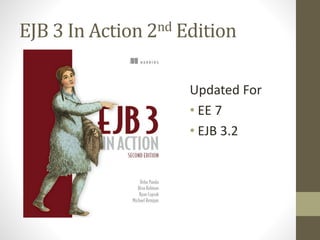
EJB 3 In Action 2nd Edition 
Updated For 
• EE 7 
• EJB 3.2
#1 Where to use EJBs 
• Full EE server not needed 
• Web profiles 
• @since 2009 
• Introduced in EE 6 
• JSF 2.2, CDI 1.1, EJB 3.2 Lite, JPA 2.1, JTA 1.2, bean 
validation. 
• TomEE 
• Resin 
• GlassFish 
• WebLogic 
• WildFly 
• JBoss App Server 
Michael Remijan | Ryan Cuprak | https://github.com/mjremijan/JavaOne
@Singleton 
Michael Remijan | Ryan Cuprak | https://github.com/mjremijan/JavaOne
#2 Concurrency 
• Singleton beans are unique per deployment. 
• Default concurrency on singleton beans is WRITE. 
• Default type is CONTAINER 
• @ConcurrencyManagement 
• ConcurrencyManagementType.CONTAINER 
• Use @Lock(LockType.READ) – on non-mutable methods 
• Use @AccessTimeout() – to reduce the chances of a deadlock. 
• value = -1 – Wait indefinitely 
• value = 0 – Timeout immediately if locked 
• value = 1+ - Wait this many time units (default millis) 
• unit = java.util. concurrent.TimeUnit 
• ConcurrencyManagementType.BEAN 
• Program for multiple threads – use sparingly. 
• Don’t mix approaches! 
Michael Remijan | Ryan Cuprak | https://github.com/mjremijan/JavaOne
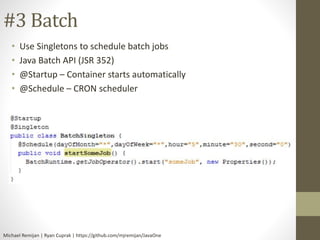
#3 Batch 
• Use Singletons to schedule batch jobs 
• Java Batch API (JSR 352) 
• @Startup – Container starts automatically 
• @Schedule – CRON scheduler 
Michael Remijan | Ryan Cuprak | https://github.com/mjremijan/JavaOne
#4 Batch Server 
• Common question 
• Does the batch API handle clustering? 
• No. 
• How do you handle deployment to a cluster? 
• Each cluster will run the job 
• Synchronization strategies 
• Database lock 
• @Resource environment entry 
• File system file/directory check 
• Avoid it all together 
• Dedicated server just for batch operations 
• Typically need special resources anyway 
• Separate from application server stack 
Michael Remijan | Ryan Cuprak | https://github.com/mjremijan/JavaOne
@Stateful 
Michael Remijan | Ryan Cuprak | https://github.com/mjremijan/JavaOne
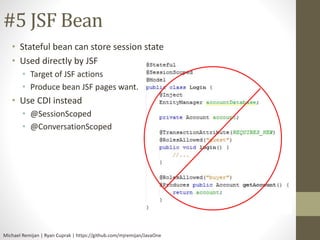
#5 JSF Bean 
• Stateful bean can store session state 
• Used directly by JSF 
• Target of JSF actions 
• Produce bean JSF pages want. 
• Use CDI instead 
• @SessionScoped 
• @ConversationScoped 
Michael Remijan | Ryan Cuprak | https://github.com/mjremijan/JavaOne
@Stateless 
Michael Remijan | Ryan Cuprak | https://github.com/mjremijan/JavaOne
#6 Injection 
• Am I a POJO? 
• @Inject 
• Am I an EJB? 
• @EJB 
Answer is YES! 
• Both are valid 
• Prefer @Inject for 
• @Local, @LocalBean, no-interface EJB 
• Running in web profile 
• Must use @EJB for: 
• @Remote EJB 
• Running in full EE server 
• Remote XA Transactions 
Michael Remijan | Ryan Cuprak | https://github.com/mjremijan/JavaOne
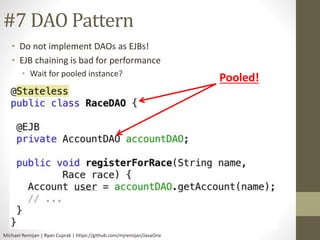
#7 DAO Pattern 
• Do not implement DAOs as EJBs! 
• EJB chaining is bad for performance 
• Wait for pooled instance? 
Michael Remijan | Ryan Cuprak | https://github.com/mjremijan/JavaOne 
Pooled!
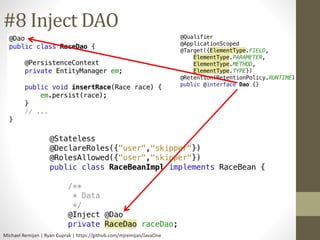
#8 Inject DAO 
Michael Remijan | Ryan Cuprak | https://github.com/mjremijan/JavaOne
#9 DTO Pattern 
• 15 years ago 
• EJBs are mysterious things 
• All EJB calls remote 
• Container managed Entity beans 
• SQL select for getter methods 
• Data Transfer Object (DTO) pattern created 
• Get massive object with one call 
• All data, even unrelated 
• Now 
• EJBs are POJOs 
• EJBs are local 
• EJBs are injectable 
• Avoid the DTO pattern 
• Multiple injects to get different data 
Michael Remijan | Ryan Cuprak | https://github.com/mjremijan/JavaOne
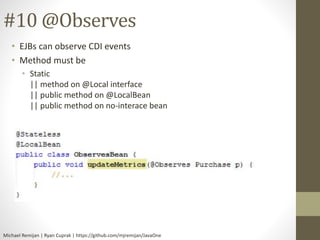
#10 @Observes 
• EJBs can observe CDI events 
• Method must be 
• Static 
|| method on @Local interface 
|| public method on @LocalBean 
|| public method on no-interace bean 
Michael Remijan | Ryan Cuprak | https://github.com/mjremijan/JavaOne
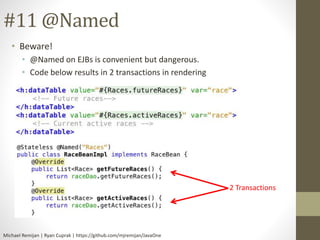
#11 @Named 
• Beware! 
• @Named on EJBs is convenient but dangerous. 
• Code below results in 2 transactions in rendering 
Michael Remijan | Ryan Cuprak | https://github.com/mjremijan/JavaOne 
2 Transactions
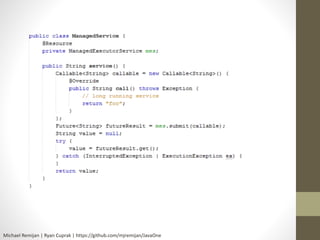
#12 Threading 
• Never been a good idea to do your own threading. 
• Even worse idea now 
• More communication between client and server 
• JAX-WS 
• JAX-RS 
• WebSockets 
• All fighting for threads 
• Threads must be managed 
• Use ManagedExecutorService 
Michael Remijan | Ryan Cuprak | https://github.com/mjremijan/JavaOne
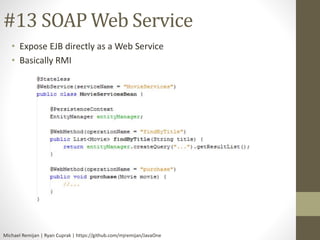
#13 SOAP Web Service 
• Expose EJB directly as a Web Service 
• Basically RMI 
Michael Remijan | Ryan Cuprak | https://github.com/mjremijan/JavaOne
#14 REST Web Service 
• Do not expose EJB methods directly as RESTful services. 
• Aggregate operations into a single message. 
• Service should be a façade over EJBs. 
• RESTful services are stateless – no Stateful Session Beans. 
• Stay true to RESTful services design principles: 
• PUT/POST/GET/DELETE 
• Don’t let transport specific code creep into EJBs: 
• JsonGenerator, JsonGeneratorFactory, etc. 
Michael Remijan | Ryan Cuprak | https://github.com/mjremijan/JavaOne
#15 @Remote Beans 
• Full EE Server 
• EJBs are accessible remotely 
• Not available in web profile 
• Why? 
• Heavy CPU or data processing 
• Clients need to be transactional 
• @Remote 
• Must be on an interface. . .AccountService 
• Implementation Bean 
• Must implement interface. . .AccountServiceBean 
• No-interface bean not allowed 
Michael Remijan | Ryan Cuprak | https://github.com/mjremijan/JavaOne
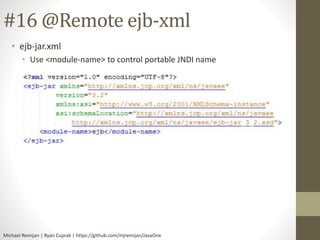
#16 @Remote ejb-xml 
• ejb-jar.xml 
• Use <module-name> to control portable JNDI name 
Michael Remijan | Ryan Cuprak | https://github.com/mjremijan/JavaOne
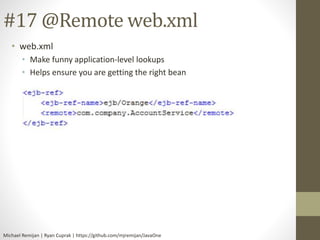
#17 @Remote web.xml 
• web.xml 
• Make funny application-level lookups 
• Helps ensure you are getting the right bean 
Michael Remijan | Ryan Cuprak | https://github.com/mjremijan/JavaOne
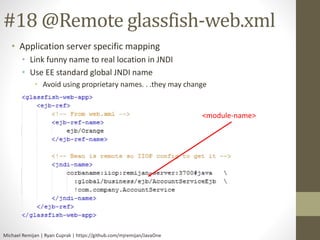
#18 @Remote glassfish-web.xml 
• Application server specific mapping 
• Link funny name to real location in JNDI 
• Use EE standard global JNDI name 
• Avoid using proprietary names. . .they may change 
Michael Remijan | Ryan Cuprak | https://github.com/mjremijan/JavaOne 
<module-name>
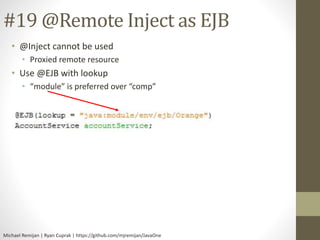
#19 @Remote Inject as EJB 
• @Inject cannot be used 
• Proxied remote resource 
• Use @EJB with lookup 
• “module” is preferred over “comp” 
Michael Remijan | Ryan Cuprak | https://github.com/mjremijan/JavaOne
Security & 
Transactions 
Michael Remijan | Ryan Cuprak | https://github.com/mjremijan/JavaOne
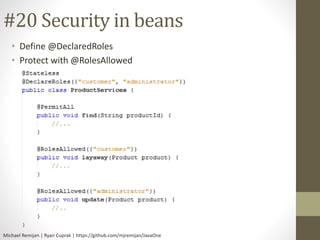
#20 Security in beans 
• Define @DeclaredRoles 
• Protect with @RolesAllowed 
Michael Remijan | Ryan Cuprak | https://github.com/mjremijan/JavaOne
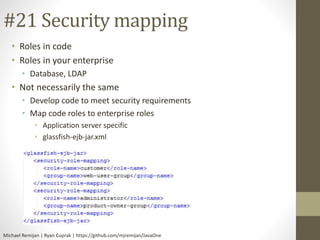
#21 Security mapping 
• Roles in code 
• Roles in your enterprise 
• Database, LDAP 
• Not necessarily the same 
• Develop code to meet security requirements 
• Map code roles to enterprise roles 
• Application server specific 
• glassfish-ejb-jar.xml 
Michael Remijan | Ryan Cuprak | https://github.com/mjremijan/JavaOne
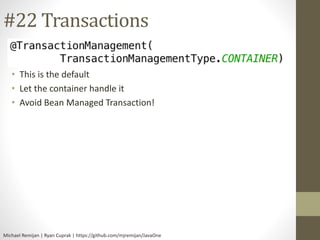
#22 Transactions 
• This is the default 
• Let the container handle it 
• Avoid Bean Managed Transaction! 
Michael Remijan | Ryan Cuprak | https://github.com/mjremijan/JavaOne
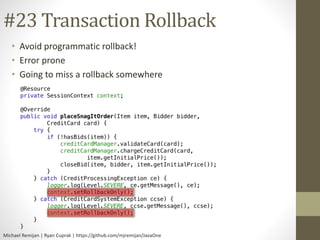
#23 Transaction Rollback 
• Avoid programmatic rollback! 
• Error prone 
• Going to miss a rollback somewhere 
Michael Remijan | Ryan Cuprak | https://github.com/mjremijan/JavaOne
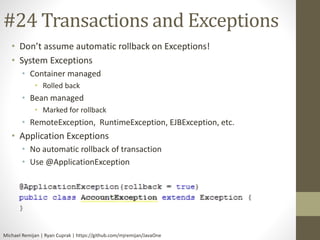
#24 Transactions and Exceptions 
• Don’t assume automatic rollback on Exceptions! 
• System Exceptions 
• Container managed 
• Rolled back 
• Bean managed 
• Marked for rollback 
• RemoteException, RuntimeException, EJBException, etc. 
• Application Exceptions 
• No automatic rollback of transaction 
• Use @ApplicationException 
Michael Remijan | Ryan Cuprak | https://github.com/mjremijan/JavaOne
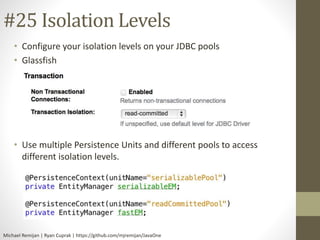
#25 Isolation Levels 
• Configure your isolation levels on your JDBC pools 
• Glassfish 
• Use multiple Persistence Units and different pools to access 
different isolation levels. 
Michael Remijan | Ryan Cuprak | https://github.com/mjremijan/JavaOne
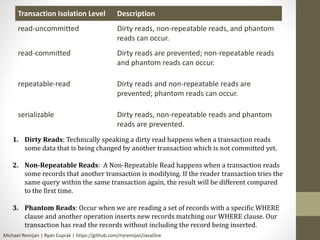
Transaction Isolation Level Description 
read-uncommitted Dirty reads, non-repeatable reads, and phantom 
reads can occur. 
read-committed Dirty reads are prevented; non-repeatable reads 
and phantom reads can occur. 
repeatable-read Dirty reads and non-repeatable reads are 
prevented; phantom reads can occur. 
serializable Dirty reads, non-repeatable reads and phantom 
reads are prevented. 
1. Dirty Reads: Technically speaking a dirty read happens when a transaction reads 
some data that is being changed by another transaction which is not committed yet. 
2. Non-Repeatable Reads: A Non-Repeatable Read happens when a transaction reads 
some records that another transaction is modifying. If the reader transaction tries the 
same query within the same transaction again, the result will be different compared 
to the first time. 
3. Phantom Reads: Occur when we are reading a set of records with a specific WHERE 
clause and another operation inserts new records matching our WHERE clause. Our 
transaction has read the records without including the record being inserted. 
Michael Remijan | Ryan Cuprak | https://github.com/mjremijan/JavaOne
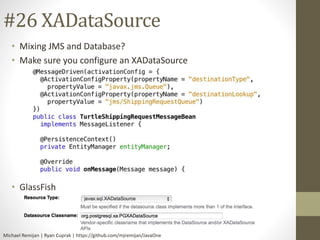
#26 XADataSource 
• Mixing JMS and Database? 
• Make sure you configure an XADataSource 
• GlassFish 
Michael Remijan | Ryan Cuprak | https://github.com/mjremijan/JavaOne
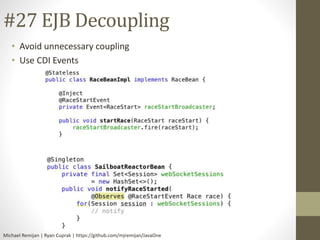
#27 EJB Decoupling 
• Avoid unnecessary coupling 
• Use CDI Events 
Michael Remijan | Ryan Cuprak | https://github.com/mjremijan/JavaOne
#28 WebSockets 
• Exposing an EJB as a WebSocket endpoint? 
• Not well defined in the Java EE 7 specification 
• Implementation specific at this point 
• Invoking an EJB from a WebSocket endpoint 
• Use @Inject or @EJB 
• Inject into a WebSocket 
• Similar to JAX-RS 
• Stateful and SingleBeans are the best match. 
Michael Remijan | Ryan Cuprak | https://github.com/mjremijan/JavaOne
Messaging 
Michael Remijan | Ryan Cuprak | https://github.com/mjremijan/JavaOne
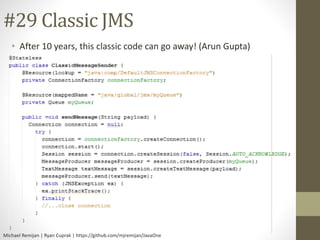
#29 Classic JMS 
• After 10 years, this classic code can go away! (Arun Gupta) 
Michael Remijan | Ryan Cuprak | https://github.com/mjremijan/JavaOne
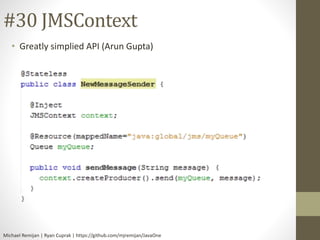
#30 JMSContext 
• Greatly simplied API (Arun Gupta) 
Michael Remijan | Ryan Cuprak | https://github.com/mjremijan/JavaOne
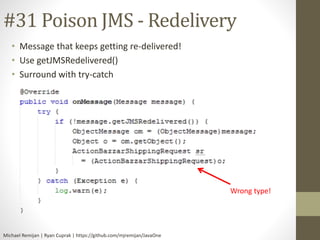
#31 Poison JMS - Redelivery 
• Message that keeps getting re-delivered! 
• Use getJMSRedelivered() 
• Surround with try-catch 
Michael Remijan | Ryan Cuprak | https://github.com/mjremijan/JavaOne 
Wrong type!
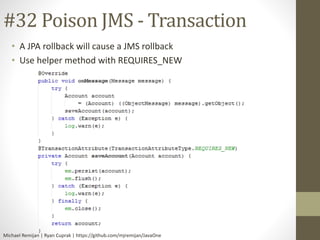
#32 Poison JMS - Transaction 
• A JPA rollback will cause a JMS rollback 
• Use helper method with REQUIRES_NEW 
Michael Remijan | Ryan Cuprak | https://github.com/mjremijan/JavaOne
Interceptors 
Michael Remijan | Ryan Cuprak | https://github.com/mjremijan/JavaOne
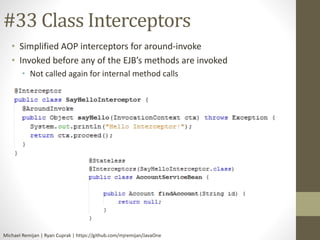
#33 Class Interceptors 
• Simplified AOP interceptors for around-invoke 
• Invoked before any of the EJB’s methods are invoked 
• Not called again for internal method calls 
Michael Remijan | Ryan Cuprak | https://github.com/mjremijan/JavaOne
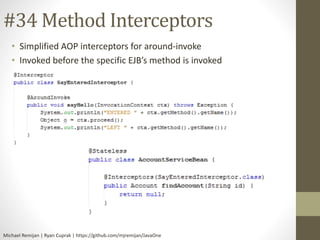
#34 Method Interceptors 
• Simplified AOP interceptors for around-invoke 
• Invoked before the specific EJB’s method is invoked 
Michael Remijan | Ryan Cuprak | https://github.com/mjremijan/JavaOne
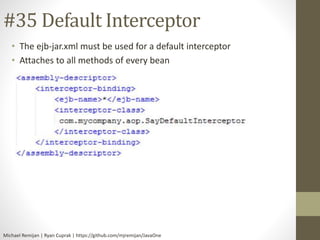
#35 Default Interceptor 
• The ejb-jar.xml must be used for a default interceptor 
• Attaches to all methods of every bean 
Michael Remijan | Ryan Cuprak | https://github.com/mjremijan/JavaOne
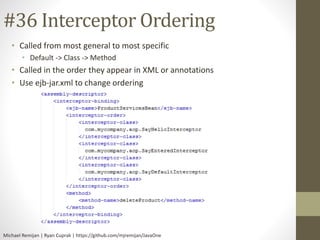
#36 Interceptor Ordering 
• Called from most general to most specific 
• Default -> Class -> Method 
• Called in the order they appear in XML or annotations 
• Use ejb-jar.xml to change ordering 
Michael Remijan | Ryan Cuprak | https://github.com/mjremijan/JavaOne
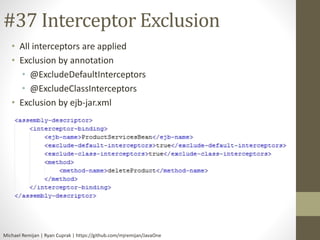
#37 Interceptor Exclusion 
• All interceptors are applied 
• Exclusion by annotation 
• @ExcludeDefaultInterceptors 
• @ExcludeClassInterceptors 
• Exclusion by ejb-jar.xml 
Michael Remijan | Ryan Cuprak | https://github.com/mjremijan/JavaOne
Testing 
Michael Remijan | Ryan Cuprak | https://github.com/mjremijan/JavaOne
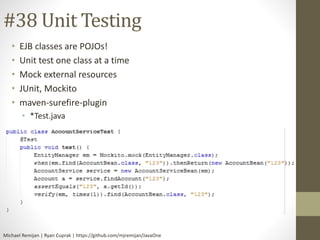
#38 Unit Testing 
• EJB classes are POJOs! 
• Unit test one class at a time 
• Mock external resources 
• JUnit, Mockito 
• maven-surefire-plugin 
• *Test.java 
Michael Remijan | Ryan Cuprak | https://github.com/mjremijan/JavaOne
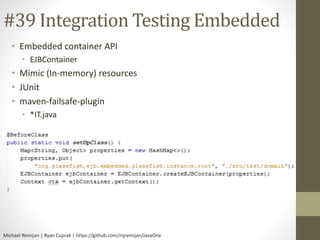
#39 Integration Testing Embedded 
• Embedded container API 
• EJBContainer 
• Mimic (In-memory) resources 
• JUnit 
• maven-failsafe-plugin 
• *IT.java 
Michael Remijan | Ryan Cuprak | https://github.com/mjremijan/JavaOne
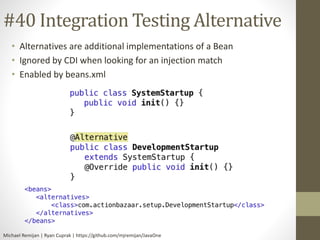
#40 Integration Testing Alternative 
• Alternatives are additional implementations of a Bean 
• Ignored by CDI when looking for an injection match 
• Enabled by beans.xml 
Michael Remijan | Ryan Cuprak | https://github.com/mjremijan/JavaOne
Packaging 
Michael Remijan | Ryan Cuprak | https://github.com/mjremijan/JavaOne
#41 EAR 
• Recall global JNDI lookup names for EJBs 
java:<namespace>/[app-name]/<module-name> 
/<bean-name>[!fully-qualified-interface-name] 
• Default value for [app-name] is EAR file name. 
• ejbrace-business-ear-1.0.0.0-SNAPSHOT.ear 
• Use application.xml 
• <application-name> 
• <display-name> 
Michael Remijan | Ryan Cuprak | https://github.com/mjremijan/JavaOne
#42 EJB-JAR 
• Recall global JNDI lookup names for EJBs 
java:<namespace>/[app-name]/<module-name> 
/<bean-name>[!fully-qualified-interface-name] 
• Default value for <module-name> is EJB-JAR file name. 
• ejbrace-ejb-1.0.0.0-SNAPSHOT.jar 
• Use ejb-jar.xml 
• <module-name> 
Michael Remijan | Ryan Cuprak | https://github.com/mjremijan/JavaOne
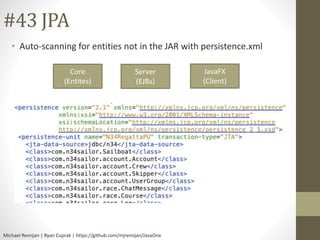
#43 JPA 
• Auto-scanning for entities not in the JAR with persistence.xml 
Core 
(Entites) 
Server 
(EJBs) 
Michael Remijan | Ryan Cuprak | https://github.com/mjremijan/JavaOne 
JavaFX 
(Client)
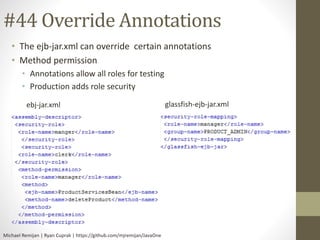
#44 Override Annotations 
• The ejb-jar.xml can override certain annotations 
• Method permission 
• Annotations allow all roles for testing 
• Production adds role security 
ebj-jar.xml glassfish-ejb-jar.xml 
Michael Remijan | Ryan Cuprak | https://github.com/mjremijan/JavaOne
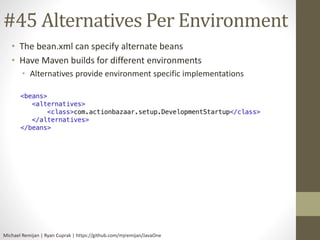
#45 Alternatives Per Environment 
• The bean.xml can specify alternate beans 
• Have Maven builds for different environments 
• Alternatives provide environment specific implementations 
Michael Remijan | Ryan Cuprak | https://github.com/mjremijan/JavaOne
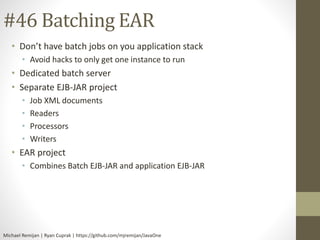
#46 Batching EAR 
• Don’t have batch jobs on you application stack 
• Avoid hacks to only get one instance to run 
• Dedicated batch server 
• Separate EJB-JAR project 
• Job XML documents 
• Readers 
• Processors 
• Writers 
• EAR project 
• Combines Batch EJB-JAR and application EJB-JAR 
Michael Remijan | Ryan Cuprak | https://github.com/mjremijan/JavaOne
Miscellaneous 
Michael Remijan | Ryan Cuprak | https://github.com/mjremijan/JavaOne
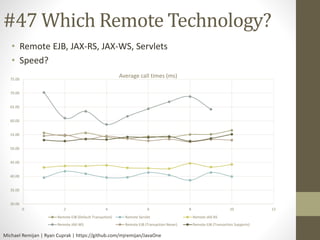
#47 Which Remote Technology? 
• Remote EJB, JAX-RS, JAX-WS, Servlets 
• Speed? 
75.00 
70.00 
65.00 
60.00 
55.00 
50.00 
45.00 
40.00 
35.00 
30.00 
Average call times (ms) 
0 2 4 6 8 10 12 
Remote EJB (Default Transaction) Remote Servlet Remote JAX-RS 
Remote JAX-WS Remote EJB (Transaction Never) Remote EJB (Transaction Supports) 
Michael Remijan | Ryan Cuprak | https://github.com/mjremijan/JavaOne
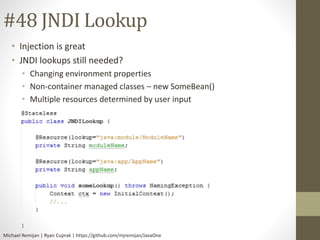
#48 JNDI Lookup 
• Injection is great 
• JNDI lookups still needed? 
• Changing environment properties 
• Non-container managed classes – new SomeBean() 
• Multiple resources determined by user input 
Michael Remijan | Ryan Cuprak | https://github.com/mjremijan/JavaOne
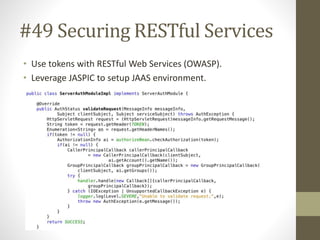
#49 Securing RESTful Services 
• Use tokens with RESTful Web Services (OWASP). 
• Leverage JASPIC to setup JAAS environment.
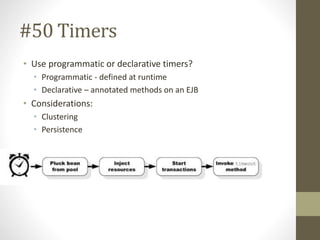
#50 Timers 
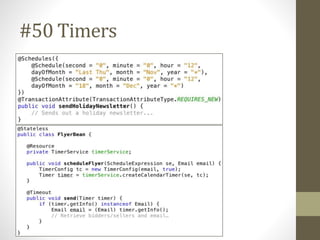
• Use programmatic or declarative timers? 
• Programmatic - defined at runtime 
• Declarative – annotated methods on an EJB 
• Considerations: 
• Clustering 
• Persistence
#50 Timers
Final Thoughts 
Michael Remijan | Ryan Cuprak | https://github.com/mjremijan/JavaOne
Don’t Panic 
Michael Remijan | Ryan Cuprak | https://github.com/mjremijan/JavaOne
Buy the Book 
Michael Remijan | Ryan Cuprak | https://github.com/mjremijan/JavaOne
Evangelize 
• EJB is a super technology 
Michael Remijan | Ryan Cuprak | https://github.com/mjremijan/JavaOne

50 EJB 3 Best Practices in 50 Minutes - JavaOne 2014

  • 1.
    50 EJB 3Best Practices in 50 Minutes Michael Remijan – Fusion Technology Solutions Ryan Cuprak – Dassault Systemès
  • 2.
    About Us •Michael • @mjremijan • mjremijan@yahoo.com • http://mjremijan.blogspot.com • http://linkedin.com/in/mjremijan • Ryan • @ctjava • rcuprak@gmail.com • http://www.cuprak.info
  • 3.
    EJB 3 InAction 2nd Edition Updated For • EE 7 • EJB 3.2
  • 4.
    #1 Where touse EJBs • Full EE server not needed • Web profiles • @since 2009 • Introduced in EE 6 • JSF 2.2, CDI 1.1, EJB 3.2 Lite, JPA 2.1, JTA 1.2, bean validation. • TomEE • Resin • GlassFish • WebLogic • WildFly • JBoss App Server Michael Remijan | Ryan Cuprak | https://github.com/mjremijan/JavaOne
  • 5.
    @Singleton Michael Remijan| Ryan Cuprak | https://github.com/mjremijan/JavaOne
  • 6.
    #2 Concurrency •Singleton beans are unique per deployment. • Default concurrency on singleton beans is WRITE. • Default type is CONTAINER • @ConcurrencyManagement • ConcurrencyManagementType.CONTAINER • Use @Lock(LockType.READ) – on non-mutable methods • Use @AccessTimeout() – to reduce the chances of a deadlock. • value = -1 – Wait indefinitely • value = 0 – Timeout immediately if locked • value = 1+ - Wait this many time units (default millis) • unit = java.util. concurrent.TimeUnit • ConcurrencyManagementType.BEAN • Program for multiple threads – use sparingly. • Don’t mix approaches! Michael Remijan | Ryan Cuprak | https://github.com/mjremijan/JavaOne
  • 7.
    #3 Batch •Use Singletons to schedule batch jobs • Java Batch API (JSR 352) • @Startup – Container starts automatically • @Schedule – CRON scheduler Michael Remijan | Ryan Cuprak | https://github.com/mjremijan/JavaOne
  • 8.
    #4 Batch Server • Common question • Does the batch API handle clustering? • No. • How do you handle deployment to a cluster? • Each cluster will run the job • Synchronization strategies • Database lock • @Resource environment entry • File system file/directory check • Avoid it all together • Dedicated server just for batch operations • Typically need special resources anyway • Separate from application server stack Michael Remijan | Ryan Cuprak | https://github.com/mjremijan/JavaOne
  • 9.
    @Stateful Michael Remijan| Ryan Cuprak | https://github.com/mjremijan/JavaOne
  • 10.
    #5 JSF Bean • Stateful bean can store session state • Used directly by JSF • Target of JSF actions • Produce bean JSF pages want. • Use CDI instead • @SessionScoped • @ConversationScoped Michael Remijan | Ryan Cuprak | https://github.com/mjremijan/JavaOne
  • 11.
    @Stateless Michael Remijan| Ryan Cuprak | https://github.com/mjremijan/JavaOne
  • 12.
    #6 Injection •Am I a POJO? • @Inject • Am I an EJB? • @EJB Answer is YES! • Both are valid • Prefer @Inject for • @Local, @LocalBean, no-interface EJB • Running in web profile • Must use @EJB for: • @Remote EJB • Running in full EE server • Remote XA Transactions Michael Remijan | Ryan Cuprak | https://github.com/mjremijan/JavaOne
  • 13.
    #7 DAO Pattern • Do not implement DAOs as EJBs! • EJB chaining is bad for performance • Wait for pooled instance? Michael Remijan | Ryan Cuprak | https://github.com/mjremijan/JavaOne Pooled!
  • 14.
    #8 Inject DAO Michael Remijan | Ryan Cuprak | https://github.com/mjremijan/JavaOne
  • 15.
    #9 DTO Pattern • 15 years ago • EJBs are mysterious things • All EJB calls remote • Container managed Entity beans • SQL select for getter methods • Data Transfer Object (DTO) pattern created • Get massive object with one call • All data, even unrelated • Now • EJBs are POJOs • EJBs are local • EJBs are injectable • Avoid the DTO pattern • Multiple injects to get different data Michael Remijan | Ryan Cuprak | https://github.com/mjremijan/JavaOne
  • 16.
    #10 @Observes •EJBs can observe CDI events • Method must be • Static || method on @Local interface || public method on @LocalBean || public method on no-interace bean Michael Remijan | Ryan Cuprak | https://github.com/mjremijan/JavaOne
  • 17.
    #11 @Named •Beware! • @Named on EJBs is convenient but dangerous. • Code below results in 2 transactions in rendering Michael Remijan | Ryan Cuprak | https://github.com/mjremijan/JavaOne 2 Transactions
  • 18.
    #12 Threading •Never been a good idea to do your own threading. • Even worse idea now • More communication between client and server • JAX-WS • JAX-RS • WebSockets • All fighting for threads • Threads must be managed • Use ManagedExecutorService Michael Remijan | Ryan Cuprak | https://github.com/mjremijan/JavaOne
  • 19.
    Michael Remijan |Ryan Cuprak | https://github.com/mjremijan/JavaOne
  • 20.
    #13 SOAP WebService • Expose EJB directly as a Web Service • Basically RMI Michael Remijan | Ryan Cuprak | https://github.com/mjremijan/JavaOne
  • 21.
    #14 REST WebService • Do not expose EJB methods directly as RESTful services. • Aggregate operations into a single message. • Service should be a façade over EJBs. • RESTful services are stateless – no Stateful Session Beans. • Stay true to RESTful services design principles: • PUT/POST/GET/DELETE • Don’t let transport specific code creep into EJBs: • JsonGenerator, JsonGeneratorFactory, etc. Michael Remijan | Ryan Cuprak | https://github.com/mjremijan/JavaOne
  • 22.
    #15 @Remote Beans • Full EE Server • EJBs are accessible remotely • Not available in web profile • Why? • Heavy CPU or data processing • Clients need to be transactional • @Remote • Must be on an interface. . .AccountService • Implementation Bean • Must implement interface. . .AccountServiceBean • No-interface bean not allowed Michael Remijan | Ryan Cuprak | https://github.com/mjremijan/JavaOne
  • 23.
    #16 @Remote ejb-xml • ejb-jar.xml • Use <module-name> to control portable JNDI name Michael Remijan | Ryan Cuprak | https://github.com/mjremijan/JavaOne
  • 24.
    #17 @Remote web.xml • web.xml • Make funny application-level lookups • Helps ensure you are getting the right bean Michael Remijan | Ryan Cuprak | https://github.com/mjremijan/JavaOne
  • 25.
    #18 @Remote glassfish-web.xml • Application server specific mapping • Link funny name to real location in JNDI • Use EE standard global JNDI name • Avoid using proprietary names. . .they may change Michael Remijan | Ryan Cuprak | https://github.com/mjremijan/JavaOne <module-name>
  • 26.
    #19 @Remote Injectas EJB • @Inject cannot be used • Proxied remote resource • Use @EJB with lookup • “module” is preferred over “comp” Michael Remijan | Ryan Cuprak | https://github.com/mjremijan/JavaOne
  • 27.
    Security & Transactions Michael Remijan | Ryan Cuprak | https://github.com/mjremijan/JavaOne
  • 28.
    #20 Security inbeans • Define @DeclaredRoles • Protect with @RolesAllowed Michael Remijan | Ryan Cuprak | https://github.com/mjremijan/JavaOne
  • 29.
    #21 Security mapping • Roles in code • Roles in your enterprise • Database, LDAP • Not necessarily the same • Develop code to meet security requirements • Map code roles to enterprise roles • Application server specific • glassfish-ejb-jar.xml Michael Remijan | Ryan Cuprak | https://github.com/mjremijan/JavaOne
  • 30.
    #22 Transactions •This is the default • Let the container handle it • Avoid Bean Managed Transaction! Michael Remijan | Ryan Cuprak | https://github.com/mjremijan/JavaOne
  • 31.
    #23 Transaction Rollback • Avoid programmatic rollback! • Error prone • Going to miss a rollback somewhere Michael Remijan | Ryan Cuprak | https://github.com/mjremijan/JavaOne
  • 32.
    #24 Transactions andExceptions • Don’t assume automatic rollback on Exceptions! • System Exceptions • Container managed • Rolled back • Bean managed • Marked for rollback • RemoteException, RuntimeException, EJBException, etc. • Application Exceptions • No automatic rollback of transaction • Use @ApplicationException Michael Remijan | Ryan Cuprak | https://github.com/mjremijan/JavaOne
  • 33.
    #25 Isolation Levels • Configure your isolation levels on your JDBC pools • Glassfish • Use multiple Persistence Units and different pools to access different isolation levels. Michael Remijan | Ryan Cuprak | https://github.com/mjremijan/JavaOne
  • 34.
    Transaction Isolation LevelDescription read-uncommitted Dirty reads, non-repeatable reads, and phantom reads can occur. read-committed Dirty reads are prevented; non-repeatable reads and phantom reads can occur. repeatable-read Dirty reads and non-repeatable reads are prevented; phantom reads can occur. serializable Dirty reads, non-repeatable reads and phantom reads are prevented. 1. Dirty Reads: Technically speaking a dirty read happens when a transaction reads some data that is being changed by another transaction which is not committed yet. 2. Non-Repeatable Reads: A Non-Repeatable Read happens when a transaction reads some records that another transaction is modifying. If the reader transaction tries the same query within the same transaction again, the result will be different compared to the first time. 3. Phantom Reads: Occur when we are reading a set of records with a specific WHERE clause and another operation inserts new records matching our WHERE clause. Our transaction has read the records without including the record being inserted. Michael Remijan | Ryan Cuprak | https://github.com/mjremijan/JavaOne
  • 35.
    #26 XADataSource •Mixing JMS and Database? • Make sure you configure an XADataSource • GlassFish Michael Remijan | Ryan Cuprak | https://github.com/mjremijan/JavaOne
  • 36.
    #27 EJB Decoupling • Avoid unnecessary coupling • Use CDI Events Michael Remijan | Ryan Cuprak | https://github.com/mjremijan/JavaOne
  • 37.
    #28 WebSockets •Exposing an EJB as a WebSocket endpoint? • Not well defined in the Java EE 7 specification • Implementation specific at this point • Invoking an EJB from a WebSocket endpoint • Use @Inject or @EJB • Inject into a WebSocket • Similar to JAX-RS • Stateful and SingleBeans are the best match. Michael Remijan | Ryan Cuprak | https://github.com/mjremijan/JavaOne
  • 38.
    Messaging Michael Remijan| Ryan Cuprak | https://github.com/mjremijan/JavaOne
  • 39.
    #29 Classic JMS • After 10 years, this classic code can go away! (Arun Gupta) Michael Remijan | Ryan Cuprak | https://github.com/mjremijan/JavaOne
  • 40.
    #30 JMSContext •Greatly simplied API (Arun Gupta) Michael Remijan | Ryan Cuprak | https://github.com/mjremijan/JavaOne
  • 41.
    #31 Poison JMS- Redelivery • Message that keeps getting re-delivered! • Use getJMSRedelivered() • Surround with try-catch Michael Remijan | Ryan Cuprak | https://github.com/mjremijan/JavaOne Wrong type!
  • 42.
    #32 Poison JMS- Transaction • A JPA rollback will cause a JMS rollback • Use helper method with REQUIRES_NEW Michael Remijan | Ryan Cuprak | https://github.com/mjremijan/JavaOne
  • 43.
    Interceptors Michael Remijan| Ryan Cuprak | https://github.com/mjremijan/JavaOne
  • 44.
    #33 Class Interceptors • Simplified AOP interceptors for around-invoke • Invoked before any of the EJB’s methods are invoked • Not called again for internal method calls Michael Remijan | Ryan Cuprak | https://github.com/mjremijan/JavaOne
  • 45.
    #34 Method Interceptors • Simplified AOP interceptors for around-invoke • Invoked before the specific EJB’s method is invoked Michael Remijan | Ryan Cuprak | https://github.com/mjremijan/JavaOne
  • 46.
    #35 Default Interceptor • The ejb-jar.xml must be used for a default interceptor • Attaches to all methods of every bean Michael Remijan | Ryan Cuprak | https://github.com/mjremijan/JavaOne
  • 47.
    #36 Interceptor Ordering • Called from most general to most specific • Default -> Class -> Method • Called in the order they appear in XML or annotations • Use ejb-jar.xml to change ordering Michael Remijan | Ryan Cuprak | https://github.com/mjremijan/JavaOne
  • 48.
    #37 Interceptor Exclusion • All interceptors are applied • Exclusion by annotation • @ExcludeDefaultInterceptors • @ExcludeClassInterceptors • Exclusion by ejb-jar.xml Michael Remijan | Ryan Cuprak | https://github.com/mjremijan/JavaOne
  • 49.
    Testing Michael Remijan| Ryan Cuprak | https://github.com/mjremijan/JavaOne
  • 50.
    #38 Unit Testing • EJB classes are POJOs! • Unit test one class at a time • Mock external resources • JUnit, Mockito • maven-surefire-plugin • *Test.java Michael Remijan | Ryan Cuprak | https://github.com/mjremijan/JavaOne
  • 51.
    #39 Integration TestingEmbedded • Embedded container API • EJBContainer • Mimic (In-memory) resources • JUnit • maven-failsafe-plugin • *IT.java Michael Remijan | Ryan Cuprak | https://github.com/mjremijan/JavaOne
  • 52.
    #40 Integration TestingAlternative • Alternatives are additional implementations of a Bean • Ignored by CDI when looking for an injection match • Enabled by beans.xml Michael Remijan | Ryan Cuprak | https://github.com/mjremijan/JavaOne
  • 53.
    Packaging Michael Remijan| Ryan Cuprak | https://github.com/mjremijan/JavaOne
  • 54.
    #41 EAR •Recall global JNDI lookup names for EJBs java:<namespace>/[app-name]/<module-name> /<bean-name>[!fully-qualified-interface-name] • Default value for [app-name] is EAR file name. • ejbrace-business-ear-1.0.0.0-SNAPSHOT.ear • Use application.xml • <application-name> • <display-name> Michael Remijan | Ryan Cuprak | https://github.com/mjremijan/JavaOne
  • 55.
    #42 EJB-JAR •Recall global JNDI lookup names for EJBs java:<namespace>/[app-name]/<module-name> /<bean-name>[!fully-qualified-interface-name] • Default value for <module-name> is EJB-JAR file name. • ejbrace-ejb-1.0.0.0-SNAPSHOT.jar • Use ejb-jar.xml • <module-name> Michael Remijan | Ryan Cuprak | https://github.com/mjremijan/JavaOne
  • 56.
    #43 JPA •Auto-scanning for entities not in the JAR with persistence.xml Core (Entites) Server (EJBs) Michael Remijan | Ryan Cuprak | https://github.com/mjremijan/JavaOne JavaFX (Client)
  • 57.
    #44 Override Annotations • The ejb-jar.xml can override certain annotations • Method permission • Annotations allow all roles for testing • Production adds role security ebj-jar.xml glassfish-ejb-jar.xml Michael Remijan | Ryan Cuprak | https://github.com/mjremijan/JavaOne
  • 58.
    #45 Alternatives PerEnvironment • The bean.xml can specify alternate beans • Have Maven builds for different environments • Alternatives provide environment specific implementations Michael Remijan | Ryan Cuprak | https://github.com/mjremijan/JavaOne
  • 59.
    #46 Batching EAR • Don’t have batch jobs on you application stack • Avoid hacks to only get one instance to run • Dedicated batch server • Separate EJB-JAR project • Job XML documents • Readers • Processors • Writers • EAR project • Combines Batch EJB-JAR and application EJB-JAR Michael Remijan | Ryan Cuprak | https://github.com/mjremijan/JavaOne
  • 60.
    Miscellaneous Michael Remijan| Ryan Cuprak | https://github.com/mjremijan/JavaOne
  • 61.
    #47 Which RemoteTechnology? • Remote EJB, JAX-RS, JAX-WS, Servlets • Speed? 75.00 70.00 65.00 60.00 55.00 50.00 45.00 40.00 35.00 30.00 Average call times (ms) 0 2 4 6 8 10 12 Remote EJB (Default Transaction) Remote Servlet Remote JAX-RS Remote JAX-WS Remote EJB (Transaction Never) Remote EJB (Transaction Supports) Michael Remijan | Ryan Cuprak | https://github.com/mjremijan/JavaOne
  • 62.
    #48 JNDI Lookup • Injection is great • JNDI lookups still needed? • Changing environment properties • Non-container managed classes – new SomeBean() • Multiple resources determined by user input Michael Remijan | Ryan Cuprak | https://github.com/mjremijan/JavaOne
  • 63.
    #49 Securing RESTfulServices • Use tokens with RESTful Web Services (OWASP). • Leverage JASPIC to setup JAAS environment.
  • 64.
    #50 Timers •Use programmatic or declarative timers? • Programmatic - defined at runtime • Declarative – annotated methods on an EJB • Considerations: • Clustering • Persistence
  • 65.
  • 66.
    Final Thoughts MichaelRemijan | Ryan Cuprak | https://github.com/mjremijan/JavaOne
  • 67.
    Don’t Panic MichaelRemijan | Ryan Cuprak | https://github.com/mjremijan/JavaOne
  • 68.
    Buy the Book Michael Remijan | Ryan Cuprak | https://github.com/mjremijan/JavaOne
  • 69.
    Evangelize • EJBis a super technology Michael Remijan | Ryan Cuprak | https://github.com/mjremijan/JavaOne

Editor's Notes

  • #22 21
  • #40 [Michael] Specify the locking policy on singleton beans. Singleton beans are are unique per JVM. By