on FLSA
Which Employers Are
Covered?
O Those with 2 or more employees
O The FLSA applies only to employers whose annual sales
total $500,000 or more or who are engaged in interstate
commerce.
O You might think that this would restrict the FLSA to covering
only employees in large companies. Because the courts
have interpreted the term interstate commerce very broadly,
the law really covers nearly all workplaces. For example,
courts have ruled that companies that regularly use the
U.S. mail to send or receive letters to and from other states
are engaged in interstate commerce. Even the fact that
employees use company telephones or computers to place
or accept interstate business calls or take orders has
subjected an employer to the FLSA. There are a few
exemptions listed with the DOL.
www.GWHumanResources.com © Copyright 2016 GW Human Resources 2
What Does the FLSA Provide?
O Requires employers to pay employees at
a rate no less than the minimum wage.
O Requires employers to pay employees an
amount equal to 1.5 times their regular
rate of pay for all hours worked over 40
hours in a given week, unless an
exemption applies.
O Restricts employers from employing
minors in certain jobs and for longer than
certain periods of time
www.GWHumanResources.com © Copyright 2016 GW Human Resources 3
What is the “Regular Rate?”
O The total amount of money earned by an
employee in a particular workweek divided
by the number of hours worked
www.GWHumanResources.com © Copyright 2016 GW Human Resources 4
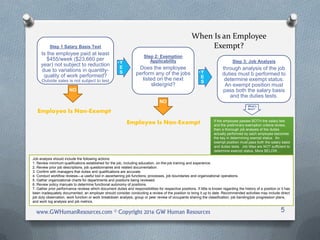
When Is an Employee
Exempt?
•Y
E
S
Step 1 Salary Basis Test
Is the employee paid at least
$455/week ($23,660 per
year) not subject to reduction
due to variations in quantity-
quality of work performed?
Outside sales is not subject to test
•Y
E
S
Step 2: Exemption
Applicability
Does the employee
perform any of the jobs
listed on the next
slide/grid?
• What’s
Next?
Step 3: Job Analysis
through analysis of the job
duties must b performed to
determine exempt status.
An exempt position must
pass both the salary basis
and the duties tests.
NO
NO
Employee Is Non-Exempt
Employee Is Non-Exempt If the employee passes BOTH the salary test
and the preliminary exemption criteria review,
then a thorough job analysis of the duties
actually performed by each employee becomes
the key in determining exempt status. An
exempt position must pass both the salary basis
and duties tests. Job titles are NOT sufficient to
determine exempt status. More BELOW…
Job analysis should include the following actions:
1. Review minimum qualifications established for the job, including education, on-the-job training and experience.
2. Review prior job descriptions, job questionnaires and related documentation.
3. Confirm with managers that duties and qualifications are accurate.
4. Conduct workflow reviews—a useful tool in ascertaining job functions, processes, job boundaries and organizational operations.
5. Gather organizational charts for departments and positions being reviewed.
6. Review policy manuals to determine functional autonomy of positions.
7. Gather prior performance reviews which document duties and responsibilities for respective positions. If little is known regarding the history of a position or it has
been inadequately documented, an employer should consider conducting a review of the position to bring it up to date. Recommended activities may include direct
job duty observation, work function or work breakdown analysis, group or peer review of occupants sharing the classification, job banding/job progression plans,
and work log analysis and job metrics.
www.GWHumanResources.com © Copyright 2016 GW Human Resources 5
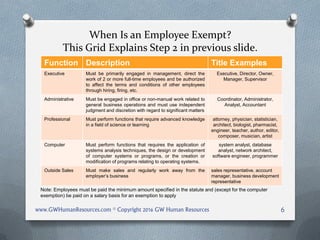
When Is an Employee Exempt?
This Grid Explains Step 2 in previous slide.
Function Description Title Examples
Executive Must be primarily engaged in management, direct the
work of 2 or more full-time employees and be authorized
to affect the terms and conditions of other employees
through hiring, firing, etc.
Executive, Director, Owner,
Manager, Supervisor
Administrative Must be engaged in office or non-manual work related to
general business operations and must use independent
judgment and discretion with regard to significant matters
Coordinator, Administrator,
Analyst, Accountant
Professional Must perform functions that require advanced knowledge
in a field of science or learning
attorney, physician, statistician,
architect, biologist, pharmacist,
engineer, teacher, author, editor,
composer, musician, artist
Computer Must perform functions that requires the application of
systems analysis techniques, the design or development
of computer systems or programs, or the creation or
modification of programs relating to operating systems.
system analyst, database
analyst, network architect,
software engineer, programmer
Outside Sales Must make sales and regularly work away from the
employer’s business
sales representative, account
manager, business development
representative
Note: Employees must be paid the minimum amount specified in the statute and (except for the computer
exemption) be paid on a salary basis for an exemption to apply
www.GWHumanResources.com © Copyright 2016 GW Human Resources 6
What Records Must Be
Retained?
O Must maintain records of wages paid to non-
exempt employees
O Must maintain records of hours worked by
non-exempt employees
O Must keep records for 3 years
O The Act does not require a particular format
for these records, but does require that the
records include certain accurate identifying
info about the employee and about the hours
worked and wages earned.
www.GWHumanResources.com © Copyright 2016 GW Human Resources 7
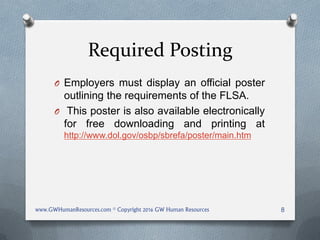
Required Posting
O Employers must display an official poster
outlining the requirements of the FLSA.
O This poster is also available electronically
for free downloading and printing at
http://www.dol.gov/osbp/sbrefa/poster/main.htm
www.GWHumanResources.com © Copyright 2016 GW Human Resources 8
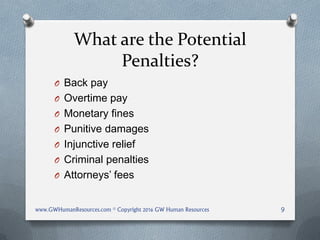
What are the Potential
Penalties?
O Back pay
O Overtime pay
O Monetary fines
O Punitive damages
O Injunctive relief
O Criminal penalties
O Attorneys’ fees
www.GWHumanResources.com © Copyright 2016 GW Human Resources 9
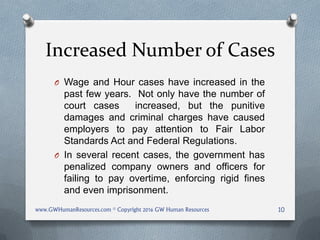
Increased Number of Cases
O Wage and Hour cases have increased in the
past few years. Not only have the number of
court cases increased, but the punitive
damages and criminal charges have caused
employers to pay attention to Fair Labor
Standards Act and Federal Regulations.
O In several recent cases, the government has
penalized company owners and officers for
failing to pay overtime, enforcing rigid fines
and even imprisonment.
www.GWHumanResources.com © Copyright 2016 GW Human Resources 10
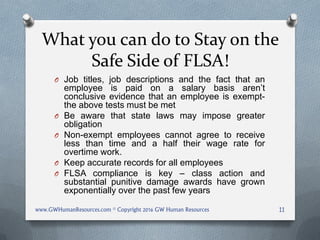
What you can do to Stay on the
Safe Side of FLSA!
O Job titles, job descriptions and the fact that an
employee is paid on a salary basis aren’t
conclusive evidence that an employee is exempt-
the above tests must be met
O Be aware that state laws may impose greater
obligation
O Non-exempt employees cannot agree to receive
less than time and a half their wage rate for
overtime work.
O Keep accurate records for all employees
O FLSA compliance is key – class action and
substantial punitive damage awards have grown
exponentially over the past few years
www.GWHumanResources.com © Copyright 2016 GW Human Resources 11
GW Human Resources &
Business Services
For more great tools, tips, guidance and
training, visit www.GWHumanResources.com
Disclaimer: Upon purchasing our product you are understanding, acknowledging and agreeing with this
disclaimer. This information is provided for general informational purposes only. GW Human Resources and
Business Services makes no warranties, express, implied or statutory, as to the adequacy, timelines,
completeness or accuracy of the information provided. The provided information does not
constitute advice and does not bind us in any way to a business-client relationship. Laws are
numerous. The amount of regulations is rising. Statements concerning legal matters should be understood
to be general observations and should not be relied upon as legal advice, which we are not authorized to
provide. Consult legal counsel to make sure that you are fully compliant.
www.GWHumanResources.com © Copyright 2016 GW Human Resources 12

F.U.N. slides Fair Labor Standards Act (FLSA)

  • 1.
  • 2.
    Which Employers Are Covered? OThose with 2 or more employees O The FLSA applies only to employers whose annual sales total $500,000 or more or who are engaged in interstate commerce. O You might think that this would restrict the FLSA to covering only employees in large companies. Because the courts have interpreted the term interstate commerce very broadly, the law really covers nearly all workplaces. For example, courts have ruled that companies that regularly use the U.S. mail to send or receive letters to and from other states are engaged in interstate commerce. Even the fact that employees use company telephones or computers to place or accept interstate business calls or take orders has subjected an employer to the FLSA. There are a few exemptions listed with the DOL. www.GWHumanResources.com © Copyright 2016 GW Human Resources 2
  • 3.
    What Does theFLSA Provide? O Requires employers to pay employees at a rate no less than the minimum wage. O Requires employers to pay employees an amount equal to 1.5 times their regular rate of pay for all hours worked over 40 hours in a given week, unless an exemption applies. O Restricts employers from employing minors in certain jobs and for longer than certain periods of time www.GWHumanResources.com © Copyright 2016 GW Human Resources 3
  • 4.
    What is the“Regular Rate?” O The total amount of money earned by an employee in a particular workweek divided by the number of hours worked www.GWHumanResources.com © Copyright 2016 GW Human Resources 4
  • 5.
    When Is anEmployee Exempt? •Y E S Step 1 Salary Basis Test Is the employee paid at least $455/week ($23,660 per year) not subject to reduction due to variations in quantity- quality of work performed? Outside sales is not subject to test •Y E S Step 2: Exemption Applicability Does the employee perform any of the jobs listed on the next slide/grid? • What’s Next? Step 3: Job Analysis through analysis of the job duties must b performed to determine exempt status. An exempt position must pass both the salary basis and the duties tests. NO NO Employee Is Non-Exempt Employee Is Non-Exempt If the employee passes BOTH the salary test and the preliminary exemption criteria review, then a thorough job analysis of the duties actually performed by each employee becomes the key in determining exempt status. An exempt position must pass both the salary basis and duties tests. Job titles are NOT sufficient to determine exempt status. More BELOW… Job analysis should include the following actions: 1. Review minimum qualifications established for the job, including education, on-the-job training and experience. 2. Review prior job descriptions, job questionnaires and related documentation. 3. Confirm with managers that duties and qualifications are accurate. 4. Conduct workflow reviews—a useful tool in ascertaining job functions, processes, job boundaries and organizational operations. 5. Gather organizational charts for departments and positions being reviewed. 6. Review policy manuals to determine functional autonomy of positions. 7. Gather prior performance reviews which document duties and responsibilities for respective positions. If little is known regarding the history of a position or it has been inadequately documented, an employer should consider conducting a review of the position to bring it up to date. Recommended activities may include direct job duty observation, work function or work breakdown analysis, group or peer review of occupants sharing the classification, job banding/job progression plans, and work log analysis and job metrics. www.GWHumanResources.com © Copyright 2016 GW Human Resources 5
  • 6.
    When Is anEmployee Exempt? This Grid Explains Step 2 in previous slide. Function Description Title Examples Executive Must be primarily engaged in management, direct the work of 2 or more full-time employees and be authorized to affect the terms and conditions of other employees through hiring, firing, etc. Executive, Director, Owner, Manager, Supervisor Administrative Must be engaged in office or non-manual work related to general business operations and must use independent judgment and discretion with regard to significant matters Coordinator, Administrator, Analyst, Accountant Professional Must perform functions that require advanced knowledge in a field of science or learning attorney, physician, statistician, architect, biologist, pharmacist, engineer, teacher, author, editor, composer, musician, artist Computer Must perform functions that requires the application of systems analysis techniques, the design or development of computer systems or programs, or the creation or modification of programs relating to operating systems. system analyst, database analyst, network architect, software engineer, programmer Outside Sales Must make sales and regularly work away from the employer’s business sales representative, account manager, business development representative Note: Employees must be paid the minimum amount specified in the statute and (except for the computer exemption) be paid on a salary basis for an exemption to apply www.GWHumanResources.com © Copyright 2016 GW Human Resources 6
  • 7.
    What Records MustBe Retained? O Must maintain records of wages paid to non- exempt employees O Must maintain records of hours worked by non-exempt employees O Must keep records for 3 years O The Act does not require a particular format for these records, but does require that the records include certain accurate identifying info about the employee and about the hours worked and wages earned. www.GWHumanResources.com © Copyright 2016 GW Human Resources 7
  • 8.
    Required Posting O Employersmust display an official poster outlining the requirements of the FLSA. O This poster is also available electronically for free downloading and printing at http://www.dol.gov/osbp/sbrefa/poster/main.htm www.GWHumanResources.com © Copyright 2016 GW Human Resources 8
  • 9.
    What are thePotential Penalties? O Back pay O Overtime pay O Monetary fines O Punitive damages O Injunctive relief O Criminal penalties O Attorneys’ fees www.GWHumanResources.com © Copyright 2016 GW Human Resources 9
  • 10.
    Increased Number ofCases O Wage and Hour cases have increased in the past few years. Not only have the number of court cases increased, but the punitive damages and criminal charges have caused employers to pay attention to Fair Labor Standards Act and Federal Regulations. O In several recent cases, the government has penalized company owners and officers for failing to pay overtime, enforcing rigid fines and even imprisonment. www.GWHumanResources.com © Copyright 2016 GW Human Resources 10
  • 11.
    What you cando to Stay on the Safe Side of FLSA! O Job titles, job descriptions and the fact that an employee is paid on a salary basis aren’t conclusive evidence that an employee is exempt- the above tests must be met O Be aware that state laws may impose greater obligation O Non-exempt employees cannot agree to receive less than time and a half their wage rate for overtime work. O Keep accurate records for all employees O FLSA compliance is key – class action and substantial punitive damage awards have grown exponentially over the past few years www.GWHumanResources.com © Copyright 2016 GW Human Resources 11
  • 12.
    GW Human Resources& Business Services For more great tools, tips, guidance and training, visit www.GWHumanResources.com Disclaimer: Upon purchasing our product you are understanding, acknowledging and agreeing with this disclaimer. This information is provided for general informational purposes only. GW Human Resources and Business Services makes no warranties, express, implied or statutory, as to the adequacy, timelines, completeness or accuracy of the information provided. The provided information does not constitute advice and does not bind us in any way to a business-client relationship. Laws are numerous. The amount of regulations is rising. Statements concerning legal matters should be understood to be general observations and should not be relied upon as legal advice, which we are not authorized to provide. Consult legal counsel to make sure that you are fully compliant. www.GWHumanResources.com © Copyright 2016 GW Human Resources 12