fisherphillips.com
Countdown to FLSA Compliance
George A. Reeves III
greeves@fisherphillips.com
Phone: (803) 255-0000
fisherphillips.com
fisherphillips.com
Overview
• FLSA requires:
• Payment of minimum wage
• Payment of overtime for hours worked over 40
• Record keeping requirements
• Minimum wage and overtime requirements do not apply to
exempt employees
• Certain requirements must be met
• Paid a sufficient weekly salary
• Perform certain job duties
• Default rule: Everybody is non-exempt, unless an exemption
clearly applies
fisherphillips.com
What is Changing?
• Salary level for exemptions from FLSA overtime requirement
for “white collar” exemptions
• Executive
• Administrative
• Professional
• Highly Compensated Employee
• Other exemptions are not impacted
• Outside sales
• Computer employees
• Etc.
fisherphillips.com
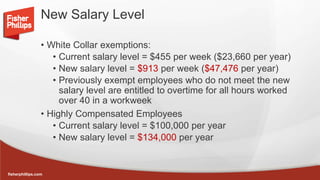
New Salary Level
• White Collar exemptions:
• Current salary level = $455 per week ($23,660 per year)
• New salary level = $913 per week ($47,476 per year)
• Previously exempt employees who do not meet the new
salary level are entitled to overtime for all hours worked
over 40 in a workweek
• Highly Compensated Employees
• Current salary level = $100,000 per year
• New salary level = $134,000 per year
fisherphillips.com
When Will This Happen?
New regulations are set to take effect December 1,
2016
Salary level will automatically increase every 3 years
150 days notice
First increase in 2020
Increase will equal 40th percentile of earnings of full-
time employees in lowest wage Census Region
(South)
No real chance changes will be delayed/repealed
fisherphillips.com
What Is Changing?
 Employers will be able to satisfy up to 10% of the salary threshold
from "nondiscretionary bonuses and incentive payments“
 Includes commissions
 Can count only those paid quarterly or more frequently
 Weekly salary must be at least $821.70/week (90% of $913)
• Permits employer to make a “catch-up” payment within one pay
period at the end of each quarter
 Cannot do this as to the salaries of employees treated as exempt
under the "highly compensated" exception
fisherphillips.com
Any Exceptions?
 No, for the most part
 Time-Limited Non-Enforcement Policy for "providers of
Medicaid-funded services for individuals with intellectual or
developmental disabilities in residential homes and facilities
with 15 or fewer beds"
 Separate USDOL materials on non-profits, governments,
higher education provide no exceptions but expand upon
USDOL's views
fisherphillips.com
What Should You Do?
 Immediately evaluate exempt employees' current status,
develop action plan
 Continue to treat some or all as "white collar" exempt?
 Treat as exempt on some other basis?
 Consider the FLSA alternatives (but don't forget the applicable
laws of other jurisdictions)
fisherphillips.com
Are They Really Exempt?
 Default position: Each employee is non-exempt, that is, each
is subject to FLSA's requirements
 Exemptions are strictly interpreted
 Specific requirements apply
 The employer has the legal burden to prove when challenged
that each one is met
 Otherwise, the employer loses
fisherphillips.com
Are They Really Exempt?
 Exemptions relate to individuals – Not to job descriptions, pay
classifications, positions, job groups, conventional wisdom,
etc.
 Detailed, accurate, current job information is essential
 Must be based upon actual work, real facts
 Opponents will dig-into what the employees actually do
 Job descriptions alone do not "make employees exempt"
fisherphillips.com
Course of Action
• Right now, you should:
• Analyze whether the requirements for the “white collar” exemptions
you have been relying upon are met;
• Evaluate what might be changed about one or more jobs so that the
incumbents may be treated as exempt in the future;
• Consider the possible application of alternative FLSA exemptions;
and
• Develop FLSA-compliant pay plans for employees who have been
treated as exempt but who will no longer.
www.laborlawyers.com
fisherphillips.com
What Are My Options?
Raise salaries to maintain exemption
Convert to non-exempt, pay hourly and pay
overtime after 40 hours
Pay salary with overtime after 40 hours
Reorganize workloads, adjust schedules or
spread work hours
Hire additional/part-time employees
fisherphillips.com
Can I . . .
• Set a salary that includes some overtime “built in?”
• Technically – yes
• Practically – high risk of noncompliance
• Prohibit/Limit overtime?
• Yes
• Must pay OT even if not authorized
• Treat some employees in same job as exempt and others as
non-exempt?
• Yes
• Beware of wage disparity
fisherphillips.com
Timekeeping
• FLSA requires employer to keep records of how many hours
overtime-eligible employees work
• Employers may use any method they choose for recording
hours
• But MUST be
• Accurate
• Complete
• Employer may use their own system or require employee to
keep track
• “Punch in/punch out” times are not required
fisherphillips.com
Accurate Timekeeping
 If non-exempt, must keep accurate records of worktime:
 Know everything that counts
 Have a system and policies for capturing the time accurately
 Train employees to follow
 Train supervisors/managers to enforce
 Periodically see whether the time records appear to be accurate
 BEWARE OF “OFF THE CLOCK” work
fisherphillips.com
Final Questions
Presented by:
George A. Reeves III
E-mail: greeves@fisherphillips.com
Phone: (803) 255-0000

FLSA Compliance Countdown

  • 1.
    fisherphillips.com Countdown to FLSACompliance George A. Reeves III greeves@fisherphillips.com Phone: (803) 255-0000
  • 2.
  • 3.
    fisherphillips.com Overview • FLSA requires: •Payment of minimum wage • Payment of overtime for hours worked over 40 • Record keeping requirements • Minimum wage and overtime requirements do not apply to exempt employees • Certain requirements must be met • Paid a sufficient weekly salary • Perform certain job duties • Default rule: Everybody is non-exempt, unless an exemption clearly applies
  • 4.
    fisherphillips.com What is Changing? •Salary level for exemptions from FLSA overtime requirement for “white collar” exemptions • Executive • Administrative • Professional • Highly Compensated Employee • Other exemptions are not impacted • Outside sales • Computer employees • Etc.
  • 5.
    fisherphillips.com New Salary Level •White Collar exemptions: • Current salary level = $455 per week ($23,660 per year) • New salary level = $913 per week ($47,476 per year) • Previously exempt employees who do not meet the new salary level are entitled to overtime for all hours worked over 40 in a workweek • Highly Compensated Employees • Current salary level = $100,000 per year • New salary level = $134,000 per year
  • 6.
    fisherphillips.com When Will ThisHappen? New regulations are set to take effect December 1, 2016 Salary level will automatically increase every 3 years 150 days notice First increase in 2020 Increase will equal 40th percentile of earnings of full- time employees in lowest wage Census Region (South) No real chance changes will be delayed/repealed
  • 7.
    fisherphillips.com What Is Changing? Employers will be able to satisfy up to 10% of the salary threshold from "nondiscretionary bonuses and incentive payments“  Includes commissions  Can count only those paid quarterly or more frequently  Weekly salary must be at least $821.70/week (90% of $913) • Permits employer to make a “catch-up” payment within one pay period at the end of each quarter  Cannot do this as to the salaries of employees treated as exempt under the "highly compensated" exception
  • 8.
    fisherphillips.com Any Exceptions?  No,for the most part  Time-Limited Non-Enforcement Policy for "providers of Medicaid-funded services for individuals with intellectual or developmental disabilities in residential homes and facilities with 15 or fewer beds"  Separate USDOL materials on non-profits, governments, higher education provide no exceptions but expand upon USDOL's views
  • 9.
    fisherphillips.com What Should YouDo?  Immediately evaluate exempt employees' current status, develop action plan  Continue to treat some or all as "white collar" exempt?  Treat as exempt on some other basis?  Consider the FLSA alternatives (but don't forget the applicable laws of other jurisdictions)
  • 10.
    fisherphillips.com Are They ReallyExempt?  Default position: Each employee is non-exempt, that is, each is subject to FLSA's requirements  Exemptions are strictly interpreted  Specific requirements apply  The employer has the legal burden to prove when challenged that each one is met  Otherwise, the employer loses
  • 11.
    fisherphillips.com Are They ReallyExempt?  Exemptions relate to individuals – Not to job descriptions, pay classifications, positions, job groups, conventional wisdom, etc.  Detailed, accurate, current job information is essential  Must be based upon actual work, real facts  Opponents will dig-into what the employees actually do  Job descriptions alone do not "make employees exempt"
  • 12.
    fisherphillips.com Course of Action •Right now, you should: • Analyze whether the requirements for the “white collar” exemptions you have been relying upon are met; • Evaluate what might be changed about one or more jobs so that the incumbents may be treated as exempt in the future; • Consider the possible application of alternative FLSA exemptions; and • Develop FLSA-compliant pay plans for employees who have been treated as exempt but who will no longer. www.laborlawyers.com
  • 13.
    fisherphillips.com What Are MyOptions? Raise salaries to maintain exemption Convert to non-exempt, pay hourly and pay overtime after 40 hours Pay salary with overtime after 40 hours Reorganize workloads, adjust schedules or spread work hours Hire additional/part-time employees
  • 14.
    fisherphillips.com Can I .. . • Set a salary that includes some overtime “built in?” • Technically – yes • Practically – high risk of noncompliance • Prohibit/Limit overtime? • Yes • Must pay OT even if not authorized • Treat some employees in same job as exempt and others as non-exempt? • Yes • Beware of wage disparity
  • 15.
    fisherphillips.com Timekeeping • FLSA requiresemployer to keep records of how many hours overtime-eligible employees work • Employers may use any method they choose for recording hours • But MUST be • Accurate • Complete • Employer may use their own system or require employee to keep track • “Punch in/punch out” times are not required
  • 16.
    fisherphillips.com Accurate Timekeeping  Ifnon-exempt, must keep accurate records of worktime:  Know everything that counts  Have a system and policies for capturing the time accurately  Train employees to follow  Train supervisors/managers to enforce  Periodically see whether the time records appear to be accurate  BEWARE OF “OFF THE CLOCK” work
  • 17.
    fisherphillips.com Final Questions Presented by: GeorgeA. Reeves III E-mail: greeves@fisherphillips.com Phone: (803) 255-0000