Crack modelling using 
zero-thickness interface elements 
Nguyen Vinh Phu 
! 
The University of Adelaide
Introduction 
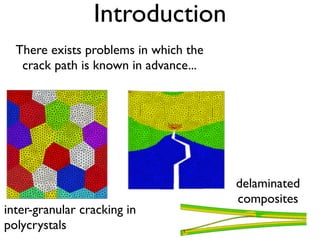
There exists problems in which the 
crack path is known in advance... 
inter-granular cracking in 
polycrystals 
delaminated 
composites
Introduction (cont.) 
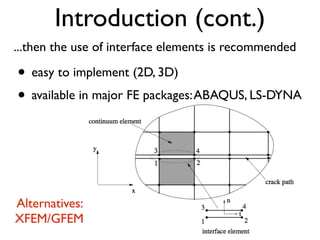
...then the use of interface elements is recommended 
• easy to implement (2D, 3D) 
• available in major FE packages: ABAQUS, LS-DYNA 
Alternatives: 
XFEM/GFEM
Cohesive crack model 
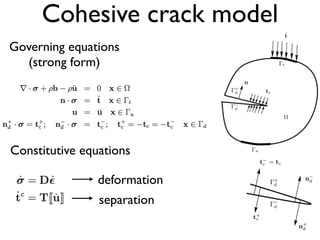
Governing equations 
(strong form) 
Constitutive equations 
deformation 
separation
Cohesive crack model 
Weak form 
new term 
(skipped for static problems) 
where
Discrete equations 
upper face 
lower face 
Solid elements 
Discrete equation 
N1 = 0.5(1  ⇠) 
N2 = 0.5(1 + ⇠)
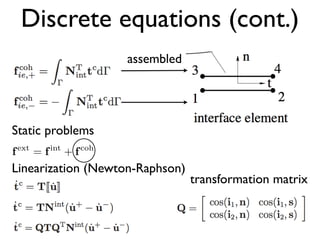
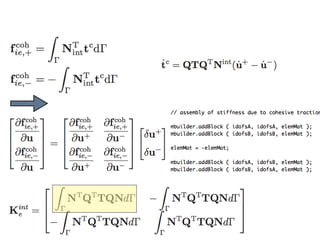
Discrete equations (cont.) 
assembled 
Static problems 
f ext = f int + f coh 
Linearization (Newton-Raphson) 
transformation matrix
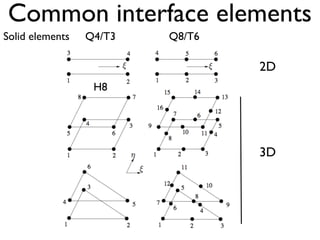
Common interface elements 
2D 
3D 
Solid elements Q4/T3 Q8/T6 
H8
Numerical integration 
It has been observed numerically that integrating the 
internal force and stiffness matrix of interface elements 
using the standard Gauss rule led to oscillatory response 
[de Borst, IJNME, 1993]. 
Newton-Cotes integration scheme 
for interface elements
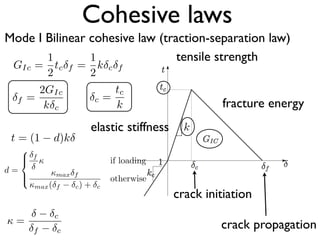
Cohesive laws 
Mode I Bilinear cohesive law (traction-separation law) 
tensile strength 
k 
fracture energy 
crack initiation 
crack propagation 
GIc = 
1 
2 
tcf = 
1 
2 
kcf 
f = 
2GIc 
kc 
c = 
tc 
k 
t = (1  d)k 
d = 
8 
: 
!f 
! 
 if loading 
max!f 
max(!f  !c) + !c 
otherwise 
 = 
  c 
f  c 
elastic stiffness
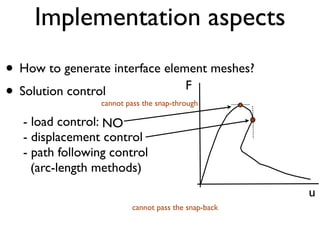
Implementation aspects 
• How to generate interface element meshes? 
• Solution control 
- load control: 
- displacement control 
- path following control 
(arc-length methods) 
F 
u 
cannot pass the snap-through 
NO 
cannot pass the snap-back
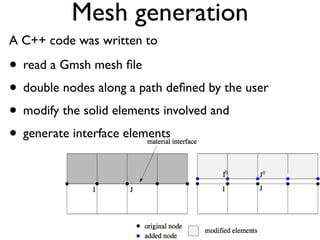
Mesh generation 
A C++ code was written to 
• read a Gmsh mesh file 
• double nodes along a path defined by the user 
• modify the solid elements involved and 
• generate interface elements
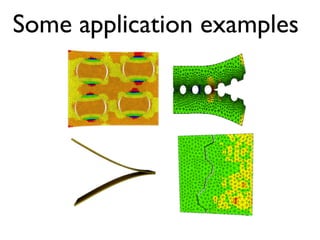
Some application examples
Path following method 
Riks 1972  load factor 
Newton-Raphson 
f ext = g 
where 
!(u, ) arc-length/constraint function 
uI = K1r, uII = K1g 
correction 
reference load vector
Energy control 
✏ = Ba BT 
Gutierrez 2004 equilibrium 
V = 
1 
2 
Z 
⌦ 
✏T = 
1 
2 
Z 
⌦ 
aTBT = 
1 
2 
aTf int = 
1 
2 
aTg 
Energy release rate  a˙Tg 
˙V 
f int = 
Z 
⌦ 
Arc-length function 
predefined amount of energy 
to be released [Nm] 
forward Euler 
G  0
Assumption: secant unloading!!! 
E 
straight line
Indirect displacement 
control [de Borst 1986] 
imagine what if 
there are 2 cracks??? 
SEN beam 
Indirect displacement control 
(||uA  uB|| ,l) local quantity!!!
Advantages of 
energy control SEN beam 
Energy control 
- fast to evaluate 
- global quantity 
multiple cracks 
FP van der Mer 
EFM, 2008
Solution procedure 
load 
control 
energy control 
FP van der Mer 
EFM, 2008
f int + f coh
Numerical examples 
• Simple tests (to debug code) 
• Material interface debonding 
• Multi-delamination of a composite DCB 
• Delamination of the DCB
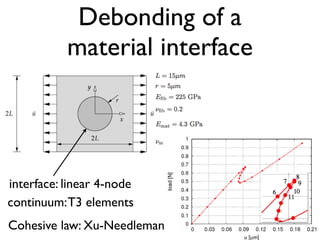
Debonding of a 
material interface 
interface: linear 4-node 
continuum: T3 elements 
Cohesive law: Xu-Needleman
Simple test 
plane strain
Multi-delamination
Multi-delamination
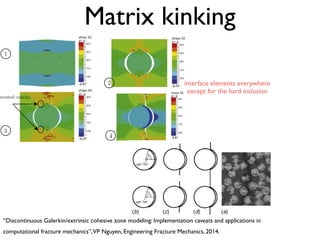
Matrix kinking 
interface elements everywhere 
except for the hard inclusion 
“Discontinuous Galerkin/extrinsic cohesive zone modeling: Implementation caveats and applications in 
computational fracture mechanics”, VP Nguyen, Engineering Fracture Mechanics, 2014.
Final remarks 
• Basic of interface elements was introduced 
• Energy control path-following method was presented 
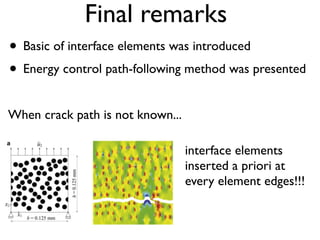
When crack path is not known... 
interface elements 
inserted a priori at 
every element edges!!!
Things to explore 
• New cohesive laws 
• New (better) interface element formulations 
(current element technology does not allow 
industrial applications to be realized.) 
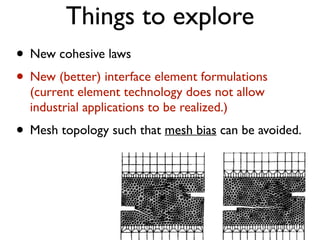
• Mesh topology such that mesh bias can be avoided.

Interface cohesive elements for fracture modeling

  • 1.
    Crack modelling using zero-thickness interface elements Nguyen Vinh Phu ! The University of Adelaide
  • 2.
    Introduction There existsproblems in which the crack path is known in advance... inter-granular cracking in polycrystals delaminated composites
  • 3.
    Introduction (cont.) ...thenthe use of interface elements is recommended • easy to implement (2D, 3D) • available in major FE packages: ABAQUS, LS-DYNA Alternatives: XFEM/GFEM
  • 4.
    Cohesive crack model Governing equations (strong form) Constitutive equations deformation separation
  • 5.
    Cohesive crack model Weak form new term (skipped for static problems) where
  • 6.
    Discrete equations upperface lower face Solid elements Discrete equation N1 = 0.5(1 ⇠) N2 = 0.5(1 + ⇠)
  • 7.
    Discrete equations (cont.) assembled Static problems f ext = f int + f coh Linearization (Newton-Raphson) transformation matrix
  • 9.
    Common interface elements 2D 3D Solid elements Q4/T3 Q8/T6 H8
  • 10.
    Numerical integration Ithas been observed numerically that integrating the internal force and stiffness matrix of interface elements using the standard Gauss rule led to oscillatory response [de Borst, IJNME, 1993]. Newton-Cotes integration scheme for interface elements
  • 11.
    Cohesive laws ModeI Bilinear cohesive law (traction-separation law) tensile strength k fracture energy crack initiation crack propagation GIc = 1 2 tcf = 1 2 kcf f = 2GIc kc c = tc k t = (1 d)k d = 8 : !f !  if loading max!f max(!f !c) + !c otherwise  = c f c elastic stiffness
  • 12.
    Implementation aspects •How to generate interface element meshes? • Solution control - load control: - displacement control - path following control (arc-length methods) F u cannot pass the snap-through NO cannot pass the snap-back
  • 13.
    Mesh generation AC++ code was written to • read a Gmsh mesh file • double nodes along a path defined by the user • modify the solid elements involved and • generate interface elements
  • 14.
  • 15.
    Path following method Riks 1972 load factor Newton-Raphson f ext = g where !(u, ) arc-length/constraint function uI = K1r, uII = K1g correction reference load vector
  • 16.
    Energy control ✏= Ba BT Gutierrez 2004 equilibrium V = 1 2 Z ⌦ ✏T = 1 2 Z ⌦ aTBT = 1 2 aTf int = 1 2 aTg Energy release rate a˙Tg ˙V f int = Z ⌦ Arc-length function predefined amount of energy to be released [Nm] forward Euler G 0
  • 17.
  • 18.
    Indirect displacement control[de Borst 1986] imagine what if there are 2 cracks??? SEN beam Indirect displacement control (||uA uB|| ,l) local quantity!!!
  • 19.
    Advantages of energycontrol SEN beam Energy control - fast to evaluate - global quantity multiple cracks FP van der Mer EFM, 2008
  • 20.
    Solution procedure load control energy control FP van der Mer EFM, 2008
  • 21.
    f int +f coh
  • 22.
    Numerical examples •Simple tests (to debug code) • Material interface debonding • Multi-delamination of a composite DCB • Delamination of the DCB
  • 23.
    Debonding of a material interface interface: linear 4-node continuum: T3 elements Cohesive law: Xu-Needleman
  • 24.
  • 25.
  • 26.
  • 27.
    Matrix kinking interfaceelements everywhere except for the hard inclusion “Discontinuous Galerkin/extrinsic cohesive zone modeling: Implementation caveats and applications in computational fracture mechanics”, VP Nguyen, Engineering Fracture Mechanics, 2014.
  • 28.
    Final remarks •Basic of interface elements was introduced • Energy control path-following method was presented When crack path is not known... interface elements inserted a priori at every element edges!!!
  • 29.
    Things to explore • New cohesive laws • New (better) interface element formulations (current element technology does not allow industrial applications to be realized.) • Mesh topology such that mesh bias can be avoided.