Applied Stochastic Processes


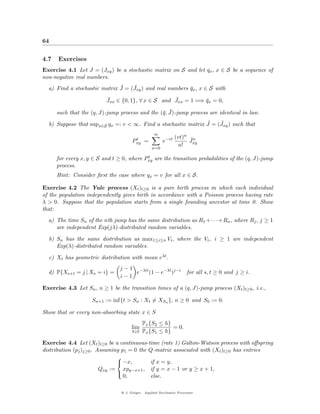
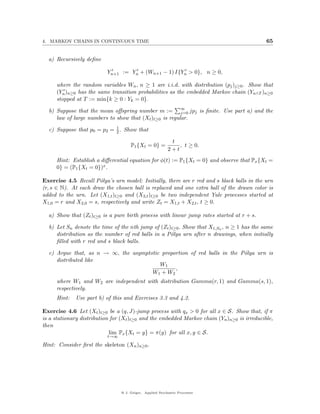
          Jochen Geiger


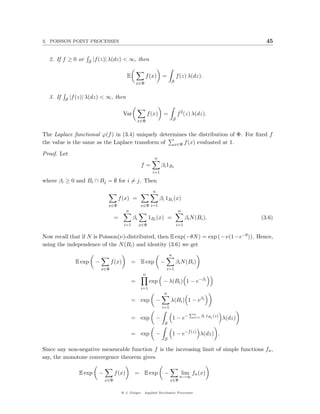
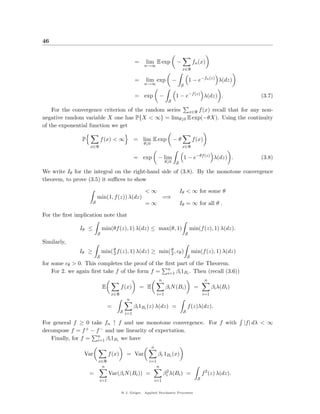
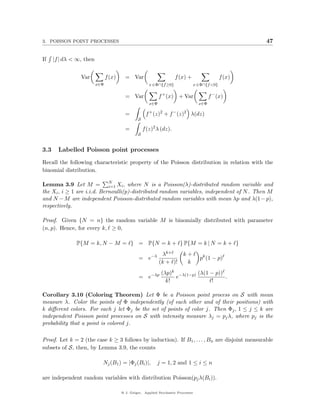
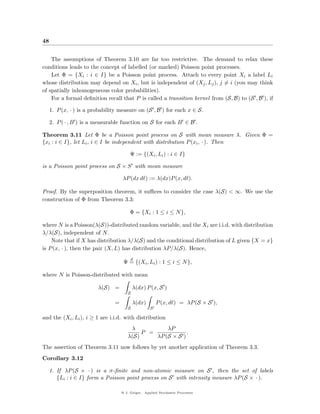
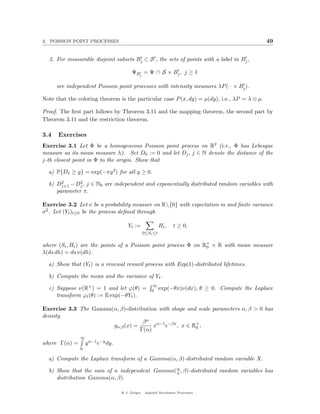
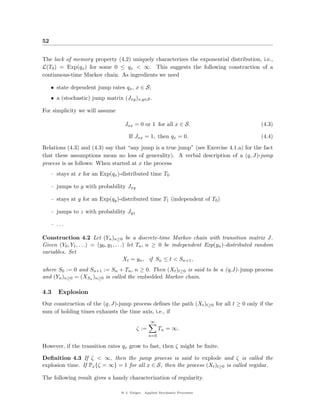
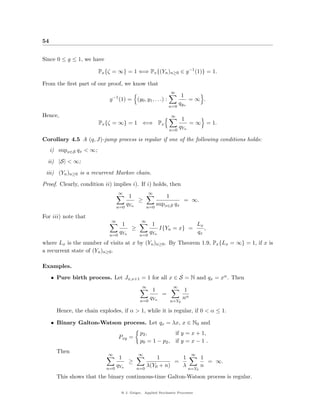
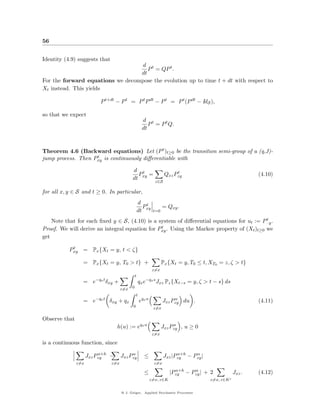
     (last update: July 18, 2007)
Contents

 1   Discrete Markov chains . . . . . . . . . . . . . . . .      . . .   .   .   .   .   .   .   .   .   .   .   .   .   .   .   .   .   .   .   .   .   .    1
     1.1    Basic properties and examples . . . . . . . .        . . .   .   .   .   .   .   .   .   .   .   .   .   .   .   .   .   .   .   .   .   .   .    1
     1.2    Hitting times and hitting probabilities . . . .      . . .   .   .   .   .   .   .   .   .   .   .   .   .   .   .   .   .   .   .   .   .   .    4
     1.3    Recurrence and transience . . . . . . . . . . .      . . .   .   .   .   .   .   .   .   .   .   .   .   .   .   .   .   .   .   .   .   .   .    9
     1.4    Stationary distributions . . . . . . . . . . . .     . . .   .   .   .   .   .   .   .   .   .   .   .   .   .   .   .   .   .   .   .   .   .   13
     1.5    Limit theorems . . . . . . . . . . . . . . . . .     . . .   .   .   .   .   .   .   .   .   .   .   .   .   .   .   .   .   .   .   .   .   .   17
     1.6    Optimal stopping . . . . . . . . . . . . . . . .     . . .   .   .   .   .   .   .   .   .   .   .   .   .   .   .   .   .   .   .   .   .   .   21
     1.7    Exercises . . . . . . . . . . . . . . . . . . . .    . . .   .   .   .   .   .   .   .   .   .   .   .   .   .   .   .   .   .   .   .   .   .   23
 2   Renewal processes . . . . . . . . . . . . . . . . . . .     . . .   .   .   .   .   .   .   .   .   .   .   .   .   .   .   .   .   .   .   .   .   .   28
     2.1    Limit theorems . . . . . . . . . . . . . . . . .     . . .   .   .   .   .   .   .   .   .   .   .   .   .   .   .   .   .   .   .   .   .   .   28
     2.2    Stationary renewal processes . . . . . . . . .       . . .   .   .   .   .   .   .   .   .   .   .   .   .   .   .   .   .   .   .   .   .   .   31
     2.3    The homogeneous Poisson process on the half          line    .   .   .   .   .   .   .   .   .   .   .   .   .   .   .   .   .   .   .   .   .   35
     2.4    Exercises . . . . . . . . . . . . . . . . . . . .    . . .   .   .   .   .   .   .   .   .   .   .   .   .   .   .   .   .   .   .   .   .   .   37
 3   Poisson point processes . . . . . . . . . . . . . . . .     . . .   .   .   .   .   .   .   .   .   .   .   .   .   .   .   .   .   .   .   .   .   .   40
     3.1    Construction and basic properties . . . . . .        . . .   .   .   .   .   .   .   .   .   .   .   .   .   .   .   .   .   .   .   .   .   .   40
     3.2    Sums over Poisson point processes . . . . . .        . . .   .   .   .   .   .   .   .   .   .   .   .   .   .   .   .   .   .   .   .   .   .   44
     3.3    Labelled Poisson point processes . . . . . . .       . . .   .   .   .   .   .   .   .   .   .   .   .   .   .   .   .   .   .   .   .   .   .   47
     3.4    Exercises . . . . . . . . . . . . . . . . . . . .    . . .   .   .   .   .   .   .   .   .   .   .   .   .   .   .   .   .   .   .   .   .   .   49
 4   Markov chains in continuous time . . . . . . . . . . .      . . .   .   .   .   .   .   .   .   .   .   .   .   .   .   .   .   .   .   .   .   .   .   51
     4.1    Definition and basic properties . . . . . . . .       . . .   .   .   .   .   .   .   .   .   .   .   .   .   .   .   .   .   .   .   .   .   .   51
     4.2    Jump processes . . . . . . . . . . . . . . . . .     . . .   .   .   .   .   .   .   .   .   .   .   .   .   .   .   .   .   .   .   .   .   .   51
     4.3    Explosion . . . . . . . . . . . . . . . . . . . .    . . .   .   .   .   .   .   .   .   .   .   .   .   .   .   .   .   .   .   .   .   .   .   52
     4.4    Backward and forward equations . . . . . . .         . . .   .   .   .   .   .   .   .   .   .   .   .   .   .   .   .   .   .   .   .   .   .   55
     4.5    Stationary distributions . . . . . . . . . . . .     . . .   .   .   .   .   .   .   .   .   .   .   .   .   .   .   .   .   .   .   .   .   .   58
     4.6    Standard transition semi-groups . . . . . . .        . . .   .   .   .   .   .   .   .   .   .   .   .   .   .   .   .   .   .   .   .   .   .   59
     4.7    Exercises . . . . . . . . . . . . . . . . . . . .    . . .   .   .   .   .   .   .   .   .   .   .   .   .   .   .   .   .   .   .   .   .   .   64
 5   Martingales . . . . . . . . . . . . . . . . . . . . . . .   . . .   .   .   .   .   .   .   .   .   .   .   .   .   .   .   .   .   .   .   .   .   .   66
 6   Brownian motion . . . . . . . . . . . . . . . . . . . .     . . .   .   .   .   .   .   .   .   .   .   .   .   .   .   .   .   .   .   .   .   .   .   67
     Bibliography . . . . . . . . . . . . . . . . . . . . . .    . . .   .   .   .   .   .   .   .   .   .   .   .   .   .   .   .   .   .   .   .   .   .   68


                                                      i
1. DISCRETE MARKOV CHAINS                                                                                             1


1        Discrete Markov chains
Markov processes form an important class of random processes with many applications in areas
like physics, biology, computer science or finance. The characteristic property of a Markov
process is its lack of memory, that is, the decision where to go next may (and typically does)
depend on the current state of the process but not on how it got there. If the process can
take only countably many different values then it is referred to as a Markov chain.

1.1       Basic properties and examples
A stochastic process X = (Xt )t∈T is a random variable which takes values in some path space
S T := {x = (xt )t∈T : T → S}. Here, the space of possible outcomes S is some discrete (i.e.,
finite or countably infinite) state space and Xt is the state at time t (with values in S). In
this chapter, we will assume that time is discrete, i.e., we take the index set T to be the
non-negative integers N0 := {0, 1, 2, . . .}.
    The distribution of X can be specified by describing the dynamics of the process, i.e., how
to start and how to proceed. By the multiplication rule, we have

    P {(X0 , X1 , . . . , Xn ) = (x0 , x1 , . . . , xn )}
         =     P{X0 = x0 } P{X1 = x1 | X0 = x0 } P{X2 = x2 |X0 = x0 , X1 = x1 } · · ·
                                                                  · · · P{Xn = xn | X0 = x0 , . . . , Xn−1 = xn−1 }
         =: p0 (x0 ) p1 (x0 , x1 ) · · · pn (x0 , . . . , xn }.                                                  (1.1)

The left-hand side of equation (1.1) can be written as:

         P{X ∈ Bx0 ,...,xn }, where Bx0 ,...,xn = {x0 } × {x1 } × · · · × {xn } × S {n+1,n+2,...} .              (1.2)

Note that the functions pj , j ≥ 0 have to satisfy the following conditions.

    1. pj (x0 , . . . , xj ) ≥ 0 for all j ≥ 0, x0 , . . . , xj ∈ S;

    2.            pj (x0 , . . . , xj ) = 1 for all j ≥ 0, x0 , . . . , xj−1 ∈ S.
          xj ∈S


Remark. The measures in (1.1) uniquely extend to a probability measure on (S N0 , B),
where B is the σ-algebra generated by all sets of the form (1.2) (see Theorem 3.1 in [1]).

   In general, the pj may depend on the entire collection x0 , . . . , xj . However, little can be said
about interesting properties of a stochastic process in this generality. This is quite different
for so-called Markovian stochastic dynamics, where the pj depend on xj−1 and xj only.

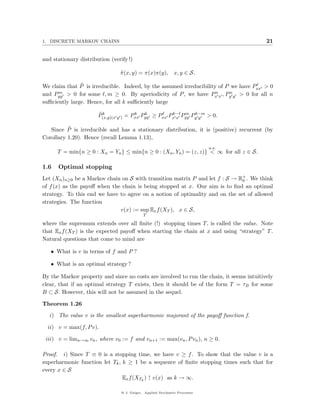
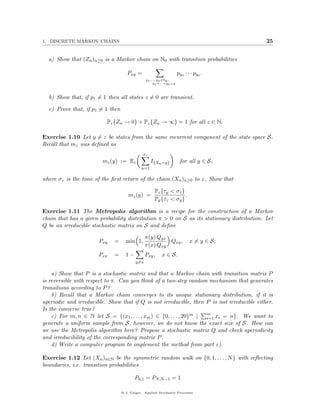
Definition 1.1 Let S be a countable space and P = (Pxy )x,y∈S a stochastic matrix (i.e.,
Pxy ≥ 0 and           y∈S Pxy = 1, ∀ x ∈ S). A sequence of S-valued random variables (r.v.’s)
X0 , X1 , . . . is called a Markov chain (MC) with state space S and transition matrix P , if

                           P{Xn+1 = y | X0 = x0 , . . . , Xn−1 = xn−1 , Xn = x} = Pxy                            (1.3)

                                             @ J. Geiger, Applied Stochastic Processes
2


holds for every n ∈ N0 and x0 , . . . , xn−1 , x, y ∈ S (provided that the conditional probability is
well defined).


Remarks.

    • To be precise, the process (Xn )n≥0 defined above is a time-homogeneous Markov chain
      (in general, the matrix P in (1.3) may depend on n).

    • The dynamics (described by P ) will be considered as fixed, but we will vary the initial
      distribution µ := P{X0 ∈ · }. It is standard notation to add the initial distribution as
      a subscript:

              Pµ {X0 = x0 , . . . , Xn = xn } := µ(x0 ) P{X1 = x1 , . . . , Xn = xn |X0 = x0 }
                                                   =    µ(x0 ) Px0 x1 · · · Pxn−1 xn .            (1.4)

      If µ = δz , then we write Pz := Pδz for short.

    The following proposition formalizes the Markov property, which says that the future and
the past are conditionally independent given the present state of the chain.

Proposition 1.2 (Markov property) Let (Xn )n≥0 be a (time-homogeneous) Markov
chain with state space S and initial distribution µ, then

    Pµ {(Xm , . . . , Xm+n ) ∈ B | Xm = x, (X0 , . . . , Xm−1 ) ∈ B } = Px {(X0 , . . . , Xn ) ∈ B}

holds for every m, n ∈ N0 , x ∈ S, B ⊂ S n+1 and B ⊂ S m .

In other words, conditional on the event {Xm = x} the process (Xm+n )n≥0 is a Markov chain
started at x, independent of (X0 , . . . , Xm−1 ).
Proof. By (1.4), we have for any x0 , . . . , xm−1 , x, y0 , . . . , yn

                   Pµ {X0 = x0 , . . . , Xm−1 = xm−1 , Xm = x, Xm = y0 , Xm+1 = y1 , . . . , Xm+n = yn }
                      = δxy0 µ(x0 )Px0 x1 · · · Pxm−1 x Py0 y1 · · · Pyn−1 yn
                      = Pµ {X0 = x0 , . . . , Xm = x} Px {X0 = y0 , . . . , Xn = yn }.            (1.5)

Summation over all (x0 , . . . , xm−1 ) ∈ B and (y0 , . . . , yn ) ∈ B gives

                Pµ {(X0 , . . . , Xm−1 ) ∈ B , Xm = x, (Xm , . . . , Xm+n ) ∈ B}
                   = Pµ {(X0 , . . . , Xm−1 ) ∈ B , Xm = x} Px {(X0 , . . . , Xn ) ∈ B}.          (1.6)

Dividing either side by Pµ {(X0 , . . . , Xm−1 ) ∈ B , Xm = x} gives the assertion of the propo-
sition.

                                     @ J. Geiger, Applied Stochastic Processes
1. DISCRETE MARKOV CHAINS                                                                  3


   A simple consequence of the Markov property is the following formula for the n-step
transition probabilities of the Markov chain (Xn )n≥0 .

Lemma 1.3 (n-step transition probabilities) Let (Xn )n≥0 be a Markov chain with state
space S and transition matrix P . Then, for every x, y ∈ S and every n ∈ N0
                                                     n
                                      Px {Xn = y} = Pxy

holds, where

                             P n = (Pxy )x,y∈S = P · · · P , n ≥ 1
                                     n

                                                 n times

and P 0 := Id.

Proof. By induction. For n = 0 we have

                                                          0
                              Px {X0 = y} = δxy = Idxy = Pxy .

To get from n to n + 1 note that by means of the law of total probability we have

                 Px {Xn+1 = y} =            Px {Xn = z} Px {Xn+1 = y | Xn = z}
                                      z∈S
                                             n         n+1
                                 =          Pxz Pzy = Pxy ,
                                      z∈S

where for the second equality we have used the induction hypothesis and the Markov property
(Proposition 1.2).

Remark. If the chain is started with initial distribution µ then the law of total probability
and Lemma 1.3 give

                    Pµ {Xn = y} =             µ(x) Px {Xn = y}
                                        x∈S

                                  =           µ(x) Pxy =: (µP n )(y), y ∈ S.
                                                    n

                                        x∈S


Examples.

   • Random products. Let Y0 , Y1 , . . . be independent and identically distributed (i.i.d.)
     random variables with values in a discrete set S ⊂ R. Set

                                       Xn := Y0 · · · Yn , n ≥ 0.

     and
                               Xn := Yn−1 Yn , n ≥ 1 and X0 := 1.

                               @ J. Geiger, Applied Stochastic Processes
4


      Then (Xn )n≥0 is a Markov chain with transition probabilities
                                                                ∞
                                          y
                           Pxy   = P Y0 =   , x, y ∈                 {y0 · · · yk : yi ∈ S}.
                                          x
                                                               k=0

      The process (Xn )n≥0 is not Markovian since the past gives precise information on the
      factor Yn−1 , which is contained in Xn but not in Xn+1 .

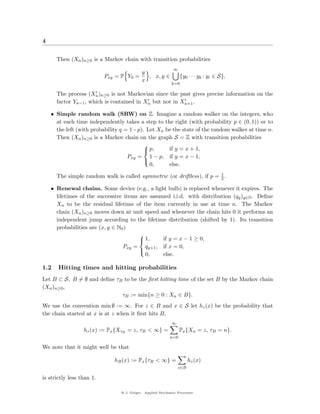
    • Simple random walk (SRW) on Z. Imagine a random walker on the integers, who
      at each time independently takes a step to the right (with probability p ∈ (0, 1)) or to
      the left (with probability q = 1−p). Let Xn be the state of the random walker at time n.
      Then (Xn )n≥0 is a Markov chain on the graph S = Z with transition probabilities
                                          
                                           p,     if y = x + 1,
                                    Pxy = 1 − p, if y = x − 1,
                                          
                                            0,     else.

      The simple random walk is called symmetric (or driftless), if p = 1 .
                                                                        2

    • Renewal chains. Some device (e.g., a light bulb) is replaced whenever it expires. The
      lifetimes of the successive items are assumed i.i.d. with distribution (qy )y∈N . Define
      Xn to be the residual lifetime of the item currently in use at time n. The Markov
      chain (Xn )n≥0 moves down at unit speed and whenever the chain hits 0 it performs an
      independent jump according to the lifetime distribution (shifted by 1). Its transition
      probabilities are (x, y ∈ N0 )
                                                 if y = x − 1 ≥ 0,
                                        
                                         1,
                                  Pxy = qy+1 , if x = 0,
                                        
                                          0,     else.

1.2    Hitting times and hitting probabilities
Let B ⊂ S, B = ∅ and define τB to be the first hitting time of the set B by the Markov chain
(Xn )n≥0 ,
                             τB := min{n ≥ 0 : Xn ∈ B}.
We use the convention min ∅ := ∞. For z ∈ B and x ∈ S let hz (x) be the probability that
the chain started at x is at z when it first hits B,
                                                               ∞
                  hz (x) := Px {XτB = z, τB < ∞} =                  Px {Xn = z, τB = n}.
                                                              n=0

We note that it might well be that

                                 hB (x) := Px {τB < ∞} =                 hz (x)
                                                                   z∈B

is strictly less than 1.

                                   @ J. Geiger, Applied Stochastic Processes
1. DISCRETE MARKOV CHAINS                                                                                5


   For f : S → R+ we define the function P f : S → R+ through
                0                                  0


                       (P f )(x) :=           Pxy f (y)     = Ex f (X1 ) , x ∈ S.
                                        y∈S

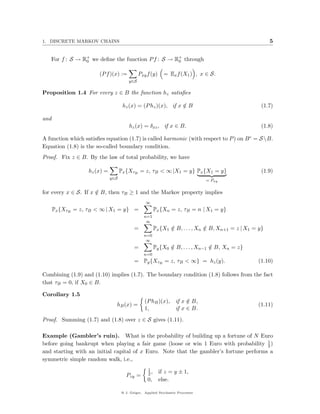
Proposition 1.4 For every z ∈ B the function hz satisfies

                                     hz (x) = (P hz )(x), if x ∈ B
                                                               /                                     (1.7)

and
                                        hz (x) = δxz , if x ∈ B.                                     (1.8)

A function which satisfies equation (1.7) is called harmonic (with respect to P ) on B c = S B.
Equation (1.8) is the so-called boundary condition.
Proof. Fix z ∈ B. By the law of total probability, we have

                   hz (x) =         Px {XτB = z, τB < ∞ |X1 = y} Px {X1 = y}                         (1.9)
                              y∈S
                                                                                = Pxy

for every x ∈ S. If x ∈ B, then τB ≥ 1 and the Markov property implies
                      /
                                                  ∞
      Px {XτB = z, τB < ∞ | X1 = y} =                   Px {Xn = z, τB = n | X1 = y}
                                                n=1
                                                 ∞
                                           =            Px {X1 ∈ B, . . . , Xn ∈ B, Xn+1 = z | X1 = y}
                                                               /               /
                                                n=0
                                                 ∞
                                           =            Py {X0 ∈ B, . . . , Xn−1 ∈ B, Xn = z}
                                                               /                 /
                                                n=0
                                           = Py {XτB = z, τB < ∞} = hz (y).                        (1.10)

Combining (1.9) and (1.10) implies (1.7). The boundary condition (1.8) follows from the fact
that τB = 0, if X0 ∈ B.

Corollary 1.5
                                                 (P hB )(x),       if x ∈ B,
                                                                        /
                                hB (x) =                                                           (1.11)
                                                 1,                if x ∈ B.

Proof. Summing (1.7) and (1.8) over z ∈ S gives (1.11).

Example (Gambler’s ruin). What is the probability of building up a fortune of N Euro
                                                                                        1
before going bankrupt when playing a fair game (loose or win 1 Euro with probability 2 )
and starting with an initial capital of x Euro. Note that the gambler’s fortune performs a
symmetric simple random walk, i.e.,
                                                   1
                                                   2,     if z = y ± 1,
                                      Pzy =
                                                   0,     else.

                                    @ J. Geiger, Applied Stochastic Processes
6


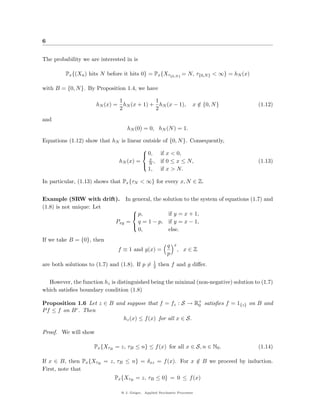
The probability we are interested in is

         Px {(Xn ) hits N before it hits 0} = Px {Xτ{0,N } = N, τ{0,N } < ∞} = hN (x)

with B = {0, N }. By Proposition 1.4, we have

                              1            1
                      hN (x) = hN (x + 1) + hN (x − 1),                 x ∈ {0, N }
                                                                          /               (1.12)
                              2            2
and
                                    hN (0) = 0, hN (N ) = 1.

Equations (1.12) show that hN is linear outside of {0, N }. Consequently,
                                           
                                            0,         if x < 0,
                                               x
                               hN (x) =        N,       if 0 ≤ x ≤ N,                     (1.13)
                                           
                                               1,       if x > N.

In particular, (1.13) shows that Px {τN < ∞} for every x, N ∈ Z.


Example (SRW with drift).           In general, the solution to the system of equations (1.7) and
(1.8) is not unique: Let
                                     
                                      p,        if y = x + 1,
                              Pxy   = q = 1 − p, if y = x − 1,
                                     
                                       0,        else.
If we take B = {0}, then
                                                           q   x
                               f ≡ 1 and g(x) =                    , x∈Z
                                                           p
                                                    1
are both solutions to (1.7) and (1.8). If p =       2   then f and g differ.


  However, the function hz is distinguished being the minimal (non-negative) solution to (1.7)
which satisfies boundary condition (1.8)

Proposition 1.6 Let z ∈ B and suppose that f = fz : S → R+ satisfies f = 1{z} on B and
                                                           0
P f ≤ f on B c . Then
                             hz (x) ≤ f (x) for all x ∈ S.

Proof. We will show

                     Px {XτB = z, τB ≤ n} ≤ f (x) for all x ∈ S, n ∈ N0 .                 (1.14)

If x ∈ B, then Px {XτB = z, τB ≤ n} = δxz = f (x). For x ∈ B we proceed by induction.
                                                         /
First, note that
                             Px {XτB = z, τB ≤ 0} = 0 ≤ f (x)

                                @ J. Geiger, Applied Stochastic Processes
1. DISCRETE MARKOV CHAINS                                                                           7


by the assumed non-negativity of f . For the induction step use τB ≥ 1 Px -a.s. to deduce that

          Px {XτB = z, τB ≤ n + 1} =                   Px {XτB = z, τB ≤ n + 1 | X1 = y} Pxy
                                                 y∈S

                                             =         Py {XτB = z, τB ≤ n} Pxy
                                                 y∈S

                                             ≤         f (y)Pxy = (P f )(x) ≤ f (x).
                                                 y∈S


Passing to the limit n → ∞ in (1.14) proves the assertion of Proposition 1.6.

   Now let eB (x) be the expected time to hit B when starting at x, i.e.,
                                        ∞
               eB (x) := Ex τB =             n Px {τB = n} + ∞ Px {τB = ∞}, x ∈ S.
                                       n=0

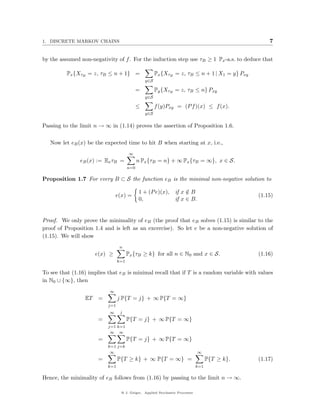
Proposition 1.7 For every B ⊂ S the function eB is the minimal non-negative solution to

                                             1 + (P e)(x),      if x ∈ B
                                                                     /
                               e(x) =                                                           (1.15)
                                             0,                 if x ∈ B.


Proof. We only prove the minimality of eB (the proof that eB solves (1.15) is similar to the
proof of Proposition 1.4 and is left as an excercise). So let e be a non-negative solution of
(1.15). We will show
                                  n
                      e(x) ≥           Px {τB ≥ k} for all n ∈ N0 and x ∈ S.                    (1.16)
                                 k=1

To see that (1.16) implies that eB is minimal recall that if T is a random variable with values
in N0 ∪ {∞}, then
                           ∞
                 ET    =         j P{T = j} + ∞ P{T = ∞}
                           j=1
                           ∞      j
                       =               P{T = j} + ∞ P{T = ∞}
                           j=1 k=1
                            ∞ ∞
                       =               P{T = j} + ∞ P{T = ∞}
                           k=1 j=k
                            ∞                                                 ∞
                       =         P{T ≥ k} + ∞ P{T = ∞} =                            P{T ≥ k}.   (1.17)
                           k=1                                                k=1

Hence, the minimality of eB follows from (1.16) by passing to the limit n → ∞.

                                  @ J. Geiger, Applied Stochastic Processes
8


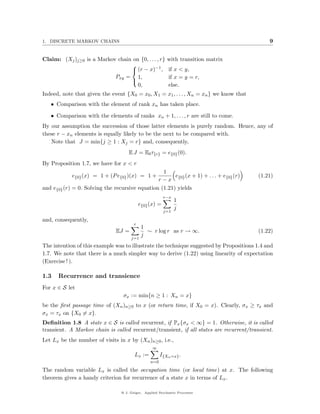
    Inequality (1.16) is obvious for x ∈ B or if n = 0. To establish the general case we proceed
by induction. Note that that for x ∈ B/
                      n+1                             n+1
                            Px {τB ≥ k} = 1 +                     Pxy Py {τB ≥ k − 1}
                      k=1                             k=2 y∈S
                                                                   n
                                           = 1+             Pxy         Py {τB ≥ k}
                                                      y∈S         k=1

                                           ≤ 1+             Pxy e(y)
                                                      y∈S
                                           = 1 + (P e)(x) = e(x).                          (1.18)

Example.      Let (Xn ) be symmetric SRW on Z and take B = {0, N }. Then (1.15) implies
                                           1            1
                               eB (x) = 1 + eB (x − 1) + eB (x + 1)                        (1.19)
                                           2            2
for x ∈ {0, N }. Equation (1.19) shows that on Z  {0, N } the function eB is quadratic with
      /
eB (x) = −2 (if eB (x) exists). Since eB (0) = eB (N ) = 0 we obtain

                                             x(N − x), if 0 ≤ x ≤ N ,
                               eB (x) =                                                    (1.20)
                                             ∞,        else.

Example (An algorithm for finding the maximum). Let Y1 , Y2 , . . . , Yr be i.i.d. random
variables with values in R and a density f (this assumption is merely to ensure that the Yi
are pairwise different).

    1. Set M := Y1

    2. For i = 2, . . . , r:
       If Yi > M , then set M := Yi

    3. Output: M

Let Ij+1 be the time of the jth exchange of the current record, i.e., we set I1 := 1 and

                                min{i > Ij : Yi > YIj }, if {i : Yi > YIj } = ∅,
                     Ij+1 :=
                                Ij ,                     else.
We write J for the total number of record holders during the execution of the algorithm,

                                    J := min{j ≥ 1 : Ij+1 = Ij }.

Note that J − 1 is the total number of exchanges which we take as a measure for the costs
of the algorithm. We will do an average case analysis and calculate EJ. For this purpose we
introduce the process (Xn )n≥0 with X0 := 0 and

                                       Xj := rank(YIj ), j ≥ 1.

                                   @ J. Geiger, Applied Stochastic Processes
1. DISCRETE MARKOV CHAINS                                                                    9


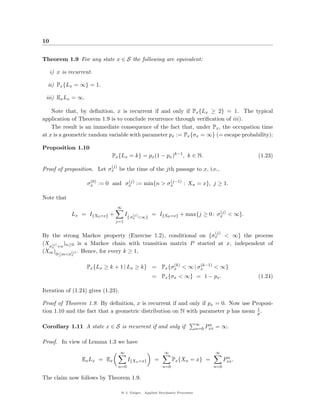
Claim: (Xj )j≥0 is a Markov chain on {0, . . . , r}        with transition matrix
                                             −1
                                 
                                  (r − x) ,                if x < y,
                           Pxy = 1,                         if x = y = r,
                                 
                                    0,                      else.
Indeed, note that given the event {X0 = x0 , X1 = x1 , . . . , Xn = xn } we know that
   • Comparison with the element of rank xn has taken place.

   • Comparison with the elements of ranks xn + 1, . . . , r are still to come.
By our assumption the succession of those latter elements is purely random. Hence, any of
these r − xn elements is equally likely to be the next to be compared with.
   Note that J = min{j ≥ 1 : Xj = r} and, consequently,
                                     E J = E0 τ{r} = e{0} (0).
By Proposition 1.7, we have for x < r
                                                  1
            e{0} (x) = 1 + (P e{0} )(x) = 1 +          e (x + 1) + . . . + e{0} (r)     (1.21)
                                                r − x {0}
and e{0} (r) = 0. Solving the recursive equation (1.21) yields
                                                         r−x
                                                               1
                                            e{0} (x) =
                                                               j
                                                         j=1

and, consequently,
                                        r
                                             1
                              EJ =             ∼ r log r as r → ∞.                      (1.22)
                                             j
                                      j=1
The intention of this example was to illustrate the technique suggested by Propositions 1.4 and
1.7. We note that there is a much simpler way to derive (1.22) using linearity of expectation
(Exercise ! ).

1.3   Recurrence and transience
For x ∈ S let
                                  σx := min{n ≥ 1 : Xn = x}
be the first passage time of (Xn )n≥0 to x (or return time, if X0 = x). Clearly, σx ≥ τx and
σx = τx on {X0 = x}.
Definition 1.8 A state x ∈ S is called recurrent, if Px {σx < ∞} = 1. Otherwise, it is called
transient. A Markov chain is called recurrent/transient, if all states are recurrent/transient.
Let Lx be the number of visits in x by (Xn )n≥0 , i.e.,
                                                  ∞
                                        Lx :=          I{Xn =x} .
                                                 n=0

The random variable Lx is called the occupation time (or local time) at x. The following
theorem gives a handy criterion for recurrence of a state x in terms of Lx .

                                 @ J. Geiger, Applied Stochastic Processes
10


Theorem 1.9 For any state x ∈ S the following are equivalent:

     i) x is recurrent.

  ii) Px {Lx = ∞} = 1.

 iii) Ex Lx = ∞.

    Note that, by definition, x is recurrent if and only if Px {Lx ≥ 2} = 1. The typical
application of Theorem 1.9 is to conclude recurrence through verification of iii).
    The result is an immediate consequence of the fact that, under Px , the occupation time
at x is a geometric random variable with parameter px := Px {σx = ∞} (= escape probability):

Proposition 1.10
                             Px {Lx = k} = px (1 − px )k−1 , k ∈ N.                                     (1.23)
                             (j)
Proof of proposition. Let σx be the time of the jth passage to x, i.e.,

                     (0)         (j)           (j−1)
                    σx := 0 and σx := min{n > σx     : Xn = x}, j ≥ 1.

Note that
                                   ∞
                                                                              (j)
              Lx = I{X0 =x} +           I{ σ(j) <∞} = I{X0 =x} + max{j ≥ 0 : σx < ∞}.
                                           x
                                j=1

                                                                                          (j)
By the strong Markov property (Exercise 1.2), conditional on {σx < ∞} the process
(Xσ(j) +n )n≥0 is a Markov chain with transition matrix P started at x, independent of
   x
(Xm )0≤m<σ(j) . Hence, for every k ≥ 1,
              x


                                                    (k)      (k−1)
                    Px {Lx ≥ k + 1 | Lx ≥ k} = Px {σx < ∞ | σx     < ∞}
                                                     = Px {σx < ∞} = 1 − px .                           (1.24)

Iteration of (1.24) gives (1.23).

Proof of Theorem 1.9. By definition, x is recurrent if and only if px = 0. Now use Proposi-
                                                                                    1
tion 1.10 and the fact that a geometric distribution on N with parameter p has mean p .

                                                                                ∞    n
Corollary 1.11 A state x ∈ S is recurrent if and only if                        n=0 Pxx   = ∞.

Proof. In view of Lemma 1.3 we have
                                    ∞                       ∞                             ∞
                                                                                                 n
                  Ex Lx = Ex             I{Xn =x}      =         Px {Xn = x} =                  Pxx .
                                   n=0                     n=0                            n=0

The claim now follows by Theorem 1.9.

                                    @ J. Geiger, Applied Stochastic Processes
1. DISCRETE MARKOV CHAINS                                                                             11


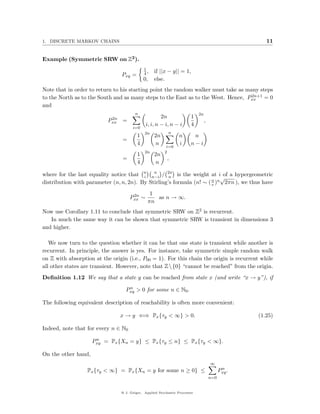
Example (Symmetric SRW on Z2 ).
                                             1
                                             4,   if ||x − y|| = 1,
                                 Pxy =
                                             0,   else.
Note that in order to return to his starting point the random walker must take as many steps
                                                                                    2n+1
to the North as to the South and as many steps to the East as to the West. Hence, Pxx = 0
and
                                       n                                    2n
                            2n                        2n               1
                           Pxx =                                                 ,
                                              i, i, n − i, n − i       4
                                      i=0
                                             2n            n
                                         1        2n             n      n
                                 =
                                         4         n             i     n−i
                                                         i=0
                                             2n         2
                                         1        2n
                                 =                        ,
                                         4         n

where for the last equality notice that n n−i / 2n is the weight at i of a hypergeometric
                                             n
                                         i          n                     √
distribution with parameter (n, n, 2n). By Stirling’s formula (n! ∼ ( n )n 2πn ), we thus have
                                                                      e

                                      2n        1
                                     Pxx ∼        as n → ∞.
                                               πn
Now use Corollary 1.11 to conclude that symmetric SRW on Z2 is recurrent.
   In much the same way it can be shown that symmetric SRW is transient in dimensions 3
and higher.

   We now turn to the question whether it can be that one state is transient while another is
recurrent. In principle, the answer is yes. For instance, take symmetric simple random walk
on Z with absorption at the origin (i.e., P00 = 1). For this chain the origin is recurrent while
all other states are transient. However, note that Z  {0} “cannot be reached” from the origin.
Definition 1.12 We say that a state y can be reached from state x (and write “x → y”), if
                                   n
                                  Pxy > 0 for some n ∈ N0 .

The following equivalent description of reachability is often more convenient:

                                x → y ⇐⇒ Px {τy < ∞} > 0.                                          (1.25)

Indeed, note that for every n ∈ N0
                      n
                     Pxy = Px {Xn = y} ≤ Px {τy ≤ n} ≤ Px {τy < ∞}.

On the other hand,
                                                                                     ∞
                                                                                            n
                  Px {τy < ∞} = Px {Xn = y for some n ≥ 0} ≤                               Pxy .
                                                                                     n=0


                                @ J. Geiger, Applied Stochastic Processes
12


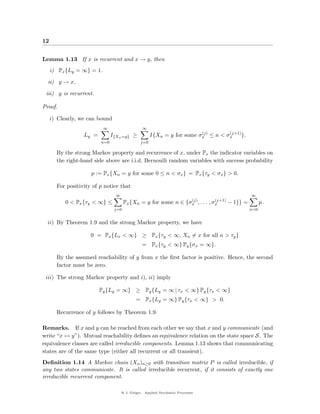
Lemma 1.13 If x is recurrent and x → y, then
     i) Px {Ly = ∞} = 1.

  ii) y → x.

 iii) y is recurrent.

Proof.

     i) Clearly, we can bound
                           ∞                     ∞
                                                                         (j)      (j+1)
                  Ly =         I{Xn =y} ≥             I{Xn = y for some σx ≤ n < σx     }.
                         n=0                    j=0

       By the strong Markov property and recurrence of x, under Px the indicator variables on
       the right-hand side above are i.i.d. Bernoulli random variables with success probability

                     p := Px {Xn = y for some 0 ≤ n < σx } = Px {τy < σx } > 0.

       For positivity of p notice that
                                 ∞                                                           ∞
                                                                (j)          (j+1)
           0 < Px {τy < ∞} ≤          Px {Xn = y for some n ∈ {σx , . . . , σx     − 1}} =         p.
                                j=0                                                          n=0


  ii) By Theorem 1.9 and the strong Markov property, we have

                     0 = Px {Lx < ∞} ≥ Px {τy < ∞, Xn = x for all n > τy }
                                                = Px {τy < ∞} Py {σx = ∞}.

       By the assumed reachability of y from x the first factor is positive. Hence, the second
       factor must be zero.

 iii) The strong Markov property and i), ii) imply

                         Py {Ly = ∞} ≥ Py {Ly = ∞ | τx < ∞} Py {τx < ∞}
                                             = Px {Ly = ∞} Py {τx < ∞} > 0.

       Recurrence of y follows by Theorem 1.9.

Remarks. If x and y can be reached from each other we say that x and y communicate (and
write “x ↔ y”). Mutual reachability defines an equivalence relation on the state space S. The
equivalence classes are called irreducible components. Lemma 1.13 shows that communicating
states are of the same type (either all recurrent or all transient).
Definition 1.14 A Markov chain (Xn )n≥0 with transition matrix P is called irreducible, if
any two states communicate. It is called irreducible recurrent, if it consists of exactly one
irreducible recurrent component.

                                     @ J. Geiger, Applied Stochastic Processes
1. DISCRETE MARKOV CHAINS                                                                                13


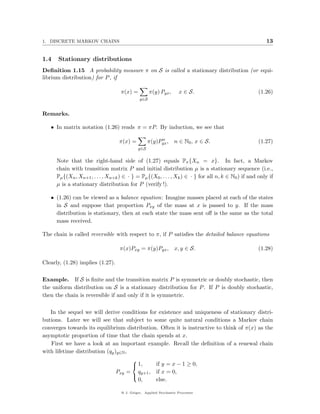
1.4   Stationary distributions
Definition 1.15 A probability measure π on S is called a stationary distribution (or equi-
librium distribution) for P , if

                                    π(x) =          π(y) Pyx ,      x ∈ S.                            (1.26)
                                              y∈S


Remarks.

   • In matrix notation (1.26) reads π = πP. By induction, we see that

                                                        n
                                   π(x) =          π(y)Pyx , n ∈ N0 , x ∈ S.                          (1.27)
                                             y∈S


      Note that the right-hand side of (1.27) equals Pπ {Xn = x}. In fact, a Markov
      chain with transition matrix P and initial distribution µ is a stationary sequence (i.e.,
      Pµ {(Xn , Xn+1 , . . . , Xn+k ) ∈ · } = Pµ {(X0 , . . . , Xk ) ∈ · } for all n, k ∈ N0 ) if and only if
      µ is a stationary distribution for P (verify !).

   • (1.26) can be viewed as a balance equation: Imagine masses placed at each of the states
     in S and suppose that proportion Pxy of the mass at x is passed to y. If the mass
     distribution is stationary, then at each state the mass sent off is the same as the total
     mass received.

The chain is called reversible with respect to π, if P satisfies the detailed balance equations

                                    π(x)Pxy = π(y)Pyx , x, y ∈ S.                                     (1.28)

Clearly, (1.28) implies (1.27).

Example. If S is finite and the transition matrix P is symmetric or doubly stochastic, then
the uniform distribution on S is a stationary distribution for P . If P is doubly stochastic,
then the chain is reversible if and only if it is symmetric.

   In the sequel we will derive conditions for existence and uniqueness of stationary distri-
butions. Later we will see that subject to some quite natural conditions a Markov chain
converges towards its equilibrium distribution. Often it is instructive to think of π(x) as the
asymptotic proportion of time that the chain spends at x.
   First we have a look at an important example. Recall the definition of a renewal chain
with lifetime distribution (qy )y∈N ,

                                                 if y = x − 1 ≥ 0,
                                         
                                          1,
                                  Pxy   = qy+1 , if x = 0,
                                         
                                           0,    else.

                                    @ J. Geiger, Applied Stochastic Processes
14


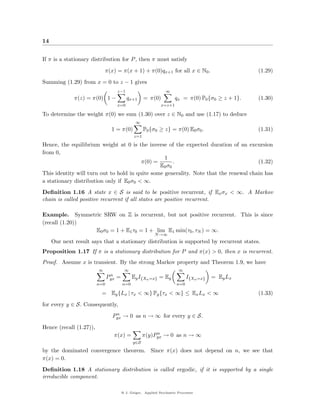
If π is a stationary distribution for P , then π must satisfy
                             π(x) = π(x + 1) + π(0)qx+1 for all x ∈ N0 .                            (1.29)
Summing (1.29) from x = 0 to z − 1 gives
                                     z−1                          ∞
              π(z) = π(0) 1 −               qx+1      = π(0)           qx = π(0) P0 {σ0 ≥ z + 1}.   (1.30)
                                     x=0                       x=z+1

To determine the weight π(0) we sum (1.30) over z ∈ N0 and use (1.17) to deduce
                                                 ∞
                                1 = π(0)              P0 {σ0 ≥ z} = π(0) E0 σ0 .                    (1.31)
                                                z=1

Hence, the equilibrium weight at 0 is the inverse of the expected duration of an excursion
from 0,
                                                  1
                                         π(0) =       .                                (1.32)
                                                E0 σ0
This identity will turn out to hold in quite some generality. Note that the renewal chain has
a stationary distribution only if E0 σ0 < ∞.
Definition 1.16 A state x ∈ S is said to be positive recurrent, if Ex σx < ∞. A Markov
chain is called positive recurrent if all states are positive recurrent.

Example. Symmetric SRW on Z is recurrent, but not positive recurrent. This is since
(recall (1.20))
                E0 σ0 = 1 + E1 τ0 = 1 + lim E1 min(τ0 , τN ) = ∞.
                                                            N →∞
     Our next result says that a stationary distribution is supported by recurrent states.
Proposition 1.17 If π is a stationary distribution for P and π(x) > 0, then x is recurrent.
Proof. Assume x is transient. By the strong Markov property and Theorem 1.9, we have
                         ∞                ∞                              ∞
                                n
                               Pyx   =         Ey I{Xn =x} = Ey               I{Xn =x}   = Ey Lx
                         n=0             n=0                            n=0

                          = Ey {Lx | τx < ∞} Py {τx < ∞} ≤ Ex Lx < ∞                                (1.33)
for every y ∈ S. Consequently,
                                  n
                                 Pyx → 0 as n → ∞ for every y ∈ S.
Hence (recall (1.27)),
                                                           n
                                 π(x) =               π(y)Pyx → 0 as n → ∞
                                               y∈S

by the dominated convergence theorem. Since π(x) does not depend on n, we see that
π(x) = 0.
Definition 1.18 A stationary distribution is called ergodic, if it is supported by a single
irreducible component.

                                         @ J. Geiger, Applied Stochastic Processes
1. DISCRETE MARKOV CHAINS                                                                            15


Remarks.
   • Note that this component is equal to supp π := {x : π(x) > 0} (because all states of
     the component communicate with each other).

   • Suppose that π is a stationary distribution for P with irreducible components S1 , S2 , . . ..
     For i ∈ I = {j : π(Sj ) > 0} define the probability measure πi as
                                            
                                             π(x) , if x ∈ S ,
                                                              i
                                   πi (x) := π(Si )
                                            
                                            
                                              0,       else.
      Then, πi is an ergodic stationary distribution for P (verify !) and
                                                π=           π(Si ) πi
                                                       i∈I

      is the so-called ergodic decomposition of π.
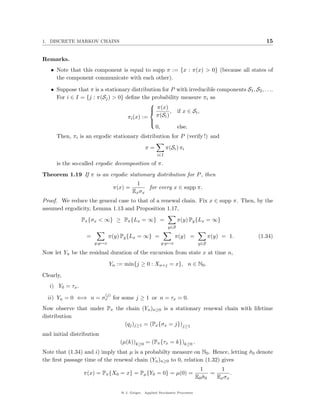
Theorem 1.19 If π is an ergodic stationary distribution for P , then
                                           1
                                 π(x) =         for every x ∈ supp π.
                                          Ex σx
Proof. We reduce the general case to that of a renewal chain. Fix x ∈ supp π. Then, by the
assumed ergodicity, Lemma 1.13 and Proposition 1.17,
                  Pπ {σx < ∞} ≥ Pπ {Lx = ∞} =                       π(y) Py {Lx = ∞}
                                                              y∈S

                   =           π(y) Py {Lx = ∞} =                π(y) =               π(y) = 1.   (1.34)
                       y:y↔x                             y:y↔x                  y∈S

Now let Yn be the residual duration of the excursion from state x at time n,
                               Yn := min{j ≥ 0 : Xn+j = x}, n ∈ N0 .
Clearly,
   i) Y0 = τx .
                           (j)
  ii) Yn = 0 ⇐⇒ n = σx for some j ≥ 1 or n = τx = 0.
Now observe that under Pπ the chain (Yn )n≥0 is a stationary renewal chain with lifetime
distribution
                             (qj )j≥1 = (Px {σx = j})j≥1
and initial distribution
                                   (µ(k))k≥0 = (Pπ {τx = k})k≥0 .
Note that (1.34) and i) imply that µ is a probabilty measure on N0 . Hence, letting σ0 denote
                                                                                    ˜
the first passage time of the renewal chain (Yn )n≥0 to 0, relation (1.32) gives
                                                                                 1      1
                  π(x) = Pπ {X0 = x} = Pµ {Y0 = 0} = µ(0) =                          =       .
                                                                               E0 σ0
                                                                                  ˜    Ex σx

                                   @ J. Geiger, Applied Stochastic Processes
16


Corollary 1.20 (Uniqueness) An irreducible Markov chain has at most one stationary dis-
tribution. If it has one, then all states are positive recurrent.

   How about existence of a stationary distribution? This question will be answered in the
affirmative, i.e., π is indeed an equilibrium distribution. To prove the result we need a more
convenient representation of π(x) than the one given in Theorem 1.19.
   Fix z ∈ S. Let mz (x) be the expected number of visits to x during an excursion from z,
                                                    σz
                               mz (x) := Ez              I{Xn =x} ,       x ∈ S.
                                                   n=1

Note that mz induces a measure on S with total mass
                                     σz                            σz
              mz (S) =         Ez          I{Xn =x}      = Ez               I{Xn =x}   = Ez σz .
                         x∈S         n=1                          n=1 x∈S


Theorem 1.21 (Existence) If z ∈ S is recurrent, then mz is P -invariant, i.e.,

                               mz (x) =           mz (y)Pyx for all x ∈ S.                         (1.35)
                                            y∈S


In particular, if (Xn )n≥0 is an irreducible Markov chain and z is positive recurrent, then
                                                          mz
                                                  π =
                                                         mz (S)

is the unique stationary distribution.
    Moreover,
                                                           σz
                                 f (y)π(y) = Ez                  f (Xn ) / Ez σz                   (1.36)
                           y∈S                             n=1

for every π-integrable f : S → R.

     Note that Theorem 1.21 implies

                                     1      mz (x)
                                          =        for all x, z ∈ S
                                    Ex σx   mz (S)

(which is what we expect in view of our interpretation of π(x) as the asymptotic proportion
of time spent in x). If P is symmetric or doubly stochastic then m ≡ 1 is P -invariant.

Proof. To understand identity (1.35) note that Pyx is the probability to move to x when
presently at y and that mz (y) is the expected number of trials to go from y to x during an
excursion from z. Hence, ignoring dependencies between the number of visits to different
states during an excursion from z the law of total probability should give the P -invariance

                                    @ J. Geiger, Applied Stochastic Processes
1. DISCRETE MARKOV CHAINS                                                                      17


of mz . To give a formal proof we use a so-called “last exit decomposition”. For x ∈ S we
have
                                             σz
                       mz (x) = Ez                I{Xn =x}
                                            n=1
                                             ∞
                              = Ez                    I{Xn−1 =y, Xn =x, n≤σz }
                                            n=1 y∈S
                                            ∞
                              =                   Pz {Xn−1 = y, Xn = x, n ≤ σz }.
                                      y∈S n=1

Since {σz ≥ n} = {X1 = z, X2 = z, . . . , Xn−1 = z}, the Markov property implies
                Pz {Xn−1 = y, Xn = x, σz ≥ n} = Pz {Xn−1 = y, σz ≥ n} Pyx .
To complete the proof of the P -invariance of mz it remains to show that
                              ∞
                                   Pz {Xn−1 = y, σz ≥ n} = mz (y).
                             n=1

Since σz < ∞ (by recurrence of z) and since X0 = Xσz = z under Pz , we have
                   ∞                                               σz
                        Pz {Xn−1 = y, σz ≥ n} = Ez                       I{Xn−1 =y}
                  n=1                                              n=1
                              σz −1                               σz
                    = Ez              I{Xn =y}       = Ez               I{Xn =y}   = mz (y).
                              n=0                                n=1

    If z is positive recurrent (i.e., mz (S) = Ez σz < ∞), then π = mz /mz (S) is a stationary
distribution. If (Xn )n≥0 is irreducible, then π is unique (by Corollary 1.20).
    For functions f of the form f = 1{y} for some y ∈ S assertion (1.36) is the same as (1.35).
Since any function f can be represented as
                                            f=           f (y) 1{y} ,
                                                   y∈S

the case of general π-integrable f follows by linearity of expectation.

1.5   Limit theorems
Ergodic theorems are limit theorems which deal with the equality of space and time averages.
Our first result is of that kind. It states that the time average of a Markov chain sample
converges towards the mean w.r.t. its stationary distribution.
Theorem 1.22 (Law of large numbers) Let (Xn )n≥0 be an irreducible and positive recur-
rent Markov chain with stationary distribution π. Then
                                        n
                               1
                          lim                f (Xk ) =           f (y)π(y)    Pz - a.s.
                         n→∞ n + 1
                                       k=0                 y∈S

for every z ∈ S and every π-integrable f : S → R.

                                  @ J. Geiger, Applied Stochastic Processes
18


Remark. Taking f = 1{x} gives
                                                             n
                                                  1
                                             lim                  I{Xk =x} = π(x) Pz - a.s.,
                                            n→∞ n + 1
                                                            k=0

i.e., π(x) is indeed the asymptotic proportion of time spent at x.

Proof. With no loss of generality we may assume f ≥ 0 (else decompose f = f + − f − ). Fix
z ∈ S and let Jn be the number of passages to z until time n,
                                                                       (j)
                                                    Jn := max{j ≥ 0 : σz ≤ n}.

Note that
             Pz - a.s.
     i) Jn       →       ∞ as n → ∞ (by recurrence of z).
         (Jn )                    (Jn +1)
  ii) σz         ≤ n < σz                    (by definition of Jn ).

Since f ≥ 0 we have
                         (Jn )                                                                 (Jn +1)
                     σz          −1                          n                              σz           −1
             1                                   1                                   1
         (Jn +1)
                                      f (Xk ) ≤                   f (Xk ) ≤         (Jn )
                                                                                                          f (Xk ) Pz - a.s.          (1.37)
       σz                                       n+1                                σz
                         k=0                                k=0                                  k=0

Under Pz ,
                                                                  (i)
                                                                 σz −1
                                                     Yi :=              f (Xk ),     i≥1
                                                                (i−1)
                                                             k=σz

are i.i.d. random variables with mean (compare (1.36))
                                         σz −1                           σz
                  Ez Y1 = Ez                     f (Xk )    = Ez               f (Xk )      = (Ez σz )              f (y)π(y).
                                         k=0                             k=1                                  y∈S

Hence, the standard law of large numbers implies
                          (j)
                         σz −1                          j
                     1                          1                 Pz - a.s.
                                      f (Xk ) =             Yi     −→         (Ez σz )         f (y)π(y) as j → ∞.                   (1.38)
                     j                          j
                          k=0                         i=1                                y∈S

Also, under Pz ,
                                                                   j
                                                       (j)                (i)  (i−1)
                                                      σz =               σz − σz
                                                                  i=1
is the sum of j i.i.d. random variables with mean Ez σz . Hence,
                                                    1 (j) Pz - a.s.
                                                     σ     −→ Ez σz as j → ∞.                                                        (1.39)
                                                    j z
Combining (1.38) and(1.39) with ii) shows that both sides of (1.37) converge to                                              y∈S   f (y)π(y)
Pz - a.s.

                                                   @ J. Geiger, Applied Stochastic Processes
1. DISCRETE MARKOV CHAINS                                                                      19


   We now turn to the question, under which circumstances we have the stronger convergence
P{Xn = y} → π(y) as n → ∞. We need some additional conditions as the following example
shows.
    Consider symmetric SRW on Z2k for some k ∈ N. By symmetry, the uniform distribution
π(x) = (2k)−1 , x ∈ Z2k is the (unique) stationary distribution. However, Px {X2n+1 = x} = 0
for every n ∈ N0 . We will see, however, that this kind of periodicity is all that can go wrong.

Definition 1.23 A state x of a Markov chain with transition matrix P is called aperiodic if
                                                 n
                                   gcd {n ≥ 1 : Pxx > 0} = 1.

A Markov chain is called aperiodic, if all states are aperiodic.

Lemma 1.24
                         n
   i) x is aperiodic ⇐⇒ Pxx > 0 for all n sufficiently large.

  ii) If (Xn )n≥0 is irreducible and some state is aperiodic, then the chain is aperiodic.

Proof.

   i) A fundamental (and elementary) theorem from number theory states that, if A ⊂ N
      is closed under addition and gcd A = 1, then N  A is finite (for a proof see, e.g., the
                                  n+k    n k                      n
      appendix of [2]). Clearly, Pxx ≥ Pxx Pxx . Hence, {n ≥ 1 : Pxx > 0} is such a set.

  ii) Let z = x and suppose x is aperiodic. By the assumed irreducibility, states x and z
                                m
      communicate, i.e., Pzx , Pxz > 0 for some , m ∈ N. Consequently,
                                         +m+n        n   m
                                       Pzz    ≥ Pzx Pxx Pxz > 0

      for all n sufficiently large. Part i) implies aperiodicity of z.

Theorem 1.25 (Convergence theorem) Let (Xn )n≥0 be an irreducible and aperiodic
Markov chain with stationary distribution π. Then

                           lim Px {Xn = y} = π(y) for all x, y ∈ S.                        (1.40)
                          n→∞


Remark. By the dominated convergence theorem, assertion (1.40) is equivalent to

                                 lim dT V [Pµ {Xn ∈ · }, π] = 0
                                 n→∞

for every initial distribution µ. (Recall that the total variation distance between probability
measures ρ1 and ρ2 on a discrete space S equals 1 x∈S |ρ1 (x) − ρ2 (x)|.)
                                                    2

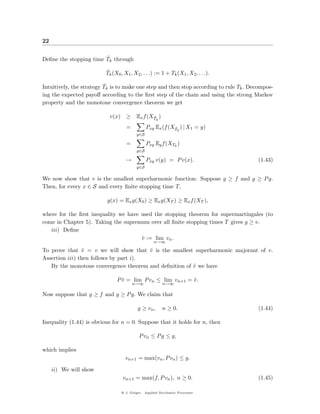
Proof. The idea is to couple the chain (Xn )n≥0 with an independent chain (Yn )n≥0 which has
the same transition matrix P but initial distribution π, i.e., we will follow the path of (Xn )n≥0
until the two chains first meet, then follow the path of (Yn )n≥0 . The exact construction is as
follows.

                                 @ J. Geiger, Applied Stochastic Processes
20


   Let (Yn )n≥0 be a stationary version of (Xn )n≥0 , i.e., a Markov chain with transition matrix
P and initial distribution π, independent of (Xn )n≥0 started at x. Set
                                                    Xn , if n < T,
                                        Xn :=
                                                    Yn , if n ≥ T ,
where
                                      T := min{n ≥ 0 : Xn = Yn }
is the so-called coupling time. We claim that

     i) (Xn )n≥0 and (Xn )n≥0 have the same distribution.

  ii) The coupling inequality holds:

                 | Px {Xn ∈ B} − Pπ {Yn ∈ B}| ≤ P{T > n} for all n ∈ N0 and B ⊂ S.

 iii) P{T < ∞} = 1.

Once we have proved i), −, iii) we are done since then

                               i)                                         ii)      iii)
      | Px {Xn = y} − π(y)| = | Px {Xn = y} − Pπ {Yn = y}| ≤ P{T > n} −→ 0 as n → ∞.

Claim i) is intuitively clear, here comes a formal proof. For n < k ≤ ∞ we have

          P{X0 = x0 , . . . , Xn = xn , T = k} = Px {X0 = x0 , . . . , Xn = xn , T = k}                 (1.41)

and for k ≤ n (using independence of (Xn ) and (Yn ) and the Markov property)

        Px {X0 = x0 , . . . , Xn = xn , T = k}
          = P{X0 = x0 , . . . , Xk = xk , Y0 = x0 , . . . , Yk−1 = xk−1 , Yk = xk , . . . , Yn = xn }
          = Px {X0 = x0 , . . . , Xk = xk } P{Yk+1 = xk+1 , . . . , Yn = xn | Yk = xk }
                   · Pπ {Y0 = x0 , . . . , Yk−1 = xk−1 , Yk = xk }
          = P{X0 = x0 , . . . , Xn = xn , Y0 = x0 , . . . , Yk−1 = xk−1 , Yk = xk }
          = Px {X0 = x0 , . . . , Xn = xn , T = k}.                                                     (1.42)

Summing (1.41) and (1.42) over k gives the desired distributional identity.
For ii) observe that

      | Px {Xn ∈ B} − Pπ {Yn ∈ B}| = | Px {Xn ∈ B, T ≤ n} + Px {Xn ∈ B, T > n}
                                                        − P{Yn ∈ B, T ≤ n} − P{Yn ∈ B, T > n}|
                                          = | Px {Xn ∈ B, T > n} − P{Yn ∈ B, T > n}|
                                          ≤ P{T > n}.

For iii) observe that the pair (Xn , Yn ) is a Markov chain on S × S with transition matrix
                               ˜
                               P(x,y)(x ,y ) = Pxx Pyy , x, x , y, y ∈ S

                                     @ J. Geiger, Applied Stochastic Processes
1. DISCRETE MARKOV CHAINS                                                                 21


and stationary distribution (verify !)

                                π (x, y) = π(x)π(y), x, y ∈ S.
                                ˜

               ˜
We claim that P is irreducible. Indeed, by the assumed irreducibility of P we have Pxx > 0
      m > 0 for some , m ≥ 0. By aperiodicity of P , we have P n , P n
and Pyy                                                             xx    y y > 0 for all n
sufficiently large. Hence, for all k sufficiently large

                       ˜k              k   k         k−   m k−m
                       P(x,y)(x y ) = Pxx Pyy ≥ Pxx Px x Pyy Py y > 0.

          ˜
   Since P is irreducible and has a stationary distribution, it is (positive) recurrent (by
Corollary 1.20). Hence (recall Lemma 1.13),
                                                                             a.s.
      T = min{n ≥ 0 : Xn = Yn } ≤ min{n ≥ 0 : (Xn , Yn ) = (z, z)} < ∞ for all z ∈ S.

1.6   Optimal stopping
Let (Xn )n≥0 be a Markov chain on S with transition matrix P and let f : S → R+ . We think
                                                                              0
of f (x) as the payoff when the chain is being stopped at x. Our aim is to find an optimal
strategy. To this end we have to agree on a notion of optimality and on the set of allowed
strategies. The function
                              v(x) := sup Ex f (XT ), x ∈ S,
                                             T

where the supremum extends over all finite (!) stopping times T, is called the value. Note
that Ex f (XT ) is the expected payoff when starting the chain at x and using “strategy” T .
Natural questions that come to mind are

   • What is v in terms of f and P ?

   • What is an optimal strategy ?

By the Markov property and since no costs are involved to run the chain, it seems intuitively
clear, that if an optimal strategy T exists, then it should be of the form T = τB for some
B ⊂ S. However, this will not be assumed in the sequel.

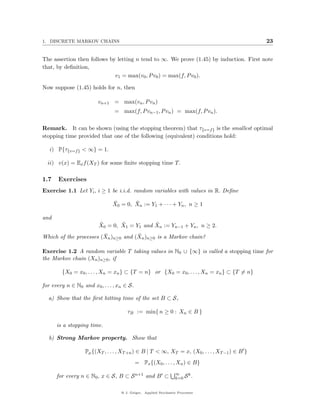
Theorem 1.26

   i) The value v is the smallest superharmonic majorant of the payoff function f.

  ii) v = max(f, P v).

 iii) v = limn→∞ vn , where v0 := f and vn+1 := max(vn , P vn ), n ≥ 0.

Proof. i) Since T ≡ 0 is a stopping time, we have v ≥ f . To show that the value v is a
superharmonic function let Tk , k ≥ 1 be a sequence of finite stopping times such that for
every x ∈ S
                                Ex f (XTk ) ↑ v(x) as k → ∞.

                                 @ J. Geiger, Applied Stochastic Processes
22

                        ˜
Define the stopping time Tk through

                          ˜
                          Tk (X0 , X1 , X2 , . . .) := 1 + Tk (X1 , X2 , . . .).

                          ˜
Intuitively, the strategy Tk is to make one step and then stop according to rule Tk . Decompos-
ing the expected payoff according to the first step of the chain and using the strong Markov
property and the monotone convergence theorem we get

                            v(x)     ≥     Ex f (XTk )
                                                  ˜

                                     =           Pxy Ex (f (XTk ) | X1 = y)
                                                             ˜
                                           y∈S

                                     =           Pxy Ey f (XTk )
                                           y∈S

                                     →           Pxy v(y) = P v(x).                     (1.43)
                                           y∈S

We now show that v is the smallest superharmonic function: Suppose g ≥ f and g ≥ P g.
Then, for every x ∈ S and every finite stopping time T,

                          g(x) = Ex g(X0 ) ≥ Ex g(XT ) ≥ Ex f (XT ),

where for the first inequality we have used the stopping theorem for supermartingales (to
come in Chapter 5). Taking the supremum over all finite stopping times T gives g ≥ v.
   iii) Define
                                      v := lim vn .
                                      ˜
                                                     n→∞

To prove that v = v we will show that v is the smallest superharmonic majorant of v.
                ˜                       ˜
Assertion iii) then follows by part i).
   By the monotone convergence theorem and definition of v we have
                                                        ˜

                               P v = lim P vn ≤ lim vn+1 = v .
                                 ˜                         ˜
                                         n→∞              n→∞

Now suppose that g ≥ f and g ≥ P g. We claim that

                                            g ≥ vn ,      n ≥ 0.                        (1.44)

Inequality (1.44) is obvious for n = 0. Suppose that it holds for n, then

                                             P vn ≤ P g ≤ g,

which implies
                                     vn+1 = max(vn , P vn ) ≤ g.

     ii) We will show
                                   vn+1 = max(f, P vn ), n ≥ 0.                         (1.45)

                                   @ J. Geiger, Applied Stochastic Processes
1. DISCRETE MARKOV CHAINS                                                                       23


The assertion then follows by letting n tend to ∞. We prove (1.45) by induction. First note
that, by definition,
                             v1 = max(v0 , P v0 ) = max(f, P v0 ).

Now suppose (1.45) holds for n, then

                        vn+1 = max(vn , P vn )
                                = max(f, P vn−1 , P vn ) = max(f, P vn ).


Remark. It can be shown (using the stopping theorem) that τ{v=f } is the smallest optimal
stopping time provided that one of the following (equivalent) conditions hold:

   i) P{τ{v=f } < ∞} = 1.

  ii) v(x) = Ex f (XT ) for some finite stopping time T.

1.7    Exercises
Exercise 1.1 Let Yi , i ≥ 1 be i.i.d. random variables with values in R. Define

                               ¯       ¯
                               X0 = 0, Xn := Y1 + · · · + Yn , n ≥ 1

and
                         ˜       ˜           ˜
                         X0 = 0, X1 = Y1 and Xn := Yn−1 + Yn , n ≥ 2.
                        ¯            ˜
Which of the processes (Xn )n≥0 and (Xn )n≥0 is a Markov chain?

Exercise 1.2 A random variable T taking values in N0 ∪ {∞} is called a stopping time for
the Markov chain (Xn )n≥0 , if

        {X0 = x0 , . . . , Xn = xn } ⊂ {T = n} or {X0 = x0 , . . . , Xn = xn } ⊂ {T = n}

for every n ∈ N0 and x0 , . . . , xn ∈ S.

  a) Show that the first hitting time of the set B ⊂ S,

                                      τB := min{ n ≥ 0 : Xn ∈ B }

      is a stopping time.

  b) Strong Markov property. Show that

                   Pµ {(XT , . . . , XT +n ) ∈ B | T < ∞, XT = x, (X0 , . . . , XT −1 ) ∈ B }
                                            = Px {(X0 , . . . , Xn ) ∈ B}
                                                                 ∞
      for every n ∈ N0 , x ∈ S, B ⊂ S n+1 and B ⊂                     k
                                                                 k=0 S .


                                   @ J. Geiger, Applied Stochastic Processes
24


Exercise 1.3 Let (Xn )n≥0 be a Markov chain with state space S and transition matrix P .
Set Gn (x, y) := n Pxy . Show that
                 k=0
                      k


                      Gn (x, y) ≤ Gn (y, y)        for all n ∈ N0 and x, y ∈ S.

Hint: Observe that Gn (x, y) is the expected number of visits of the chain in y until time n
when started at x.

Exercise 1.4 Let (Xn )n≥0 be simple random walk on Z with drift (i.e., p := Px,x+1           =
1 − Px,x−1 = 1 .) Calculate
             2

                       Px {τy < τ0 } and Ex min(τ0 , τy ) for 0 ≤ x ≤ y.

Exercise 1.5 Show that simple symmetric random walk on Z2 is recurrent.

Exercise 1.6 Let T be the infinite rooted d-ary tree (i.e., T is the infinite graph where all
vertices have degree d + 1, except the root which has degree d). At each time a random walker
on the vertex set of T independently jumps from the present vertex to any of the adjacent
vertices equally likely. Show that for d ≥ 2 the random walk on T is transient.
Hint: Use the first part of Exercise 1.4.

Exercise 1.7 Downward excursions on the way up. Let (Xn )n≥0 be simple symmetric
random walk on Z. The maximum of the random walk until time n is defined as Mn :=
max0≤k≤n Xk and the downward excursion depth at n as Dn := Mn − Xn . Show that, for
z ∈ Z,
                                                 z
                                             y
                    P0 max Yk < y =                , y = 1, 2, . . .
                       0≤k≤σz              1+y
where τz denotes the first hitting time of z.

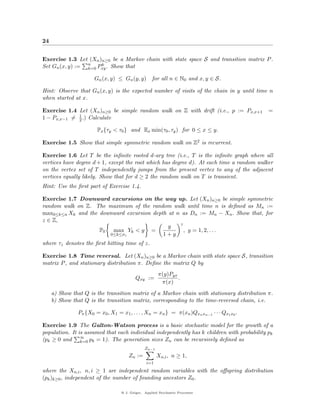
Exercise 1.8 Time reversal. Let (Xn )n≥0 be a Markov chain with state space S, transition
matrix P , and stationary distribution π. Define the matrix Q by
                                                       π(y)Pyx
                                          Qxy :=               .
                                                        π(x)
     a) Show that Q is the transition matrix of a Markov chain with stationary distribution π.
     b) Show that Q is the transition matrix, corresponding to the time-reversed chain, i.e.

               Pπ {X0 = x0 , X1 = x1 , . . . , Xn = xn } = π(xn )Qxn xn−1 · · · Qx1 x0 .

Exercise 1.9 The Galton-Watson process is a basic stochastic model for the growth of a
population. It is assumed that each individual independently has k children with probability pk
(pk ≥ 0 and ∞ pk = 1). The generation sizes Zn can be recursively defined as
                k=0
                                               Zn−1
                                      Zn :=           Xn,i , n ≥ 1,
                                                i=1
where the Xn,i , n, i ≥ 1 are independent random variables with the offspring distribution
(pk )k≥0 , independent of the number of founding ancestors Z0 .

                                  @ J. Geiger, Applied Stochastic Processes
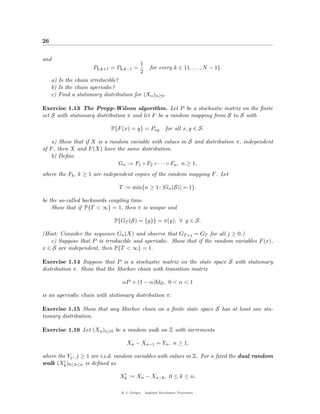
1. DISCRETE MARKOV CHAINS                                                                   25


  a) Show that (Zn )n≥0 is a Markov chain on N0 with transition probabilities

                                     Pxy =                           py1 · · · pyx .
                                                y1 ,...,yx ∈N0 :
                                                     y1 +···+yx =y


  b) Show that, if p1 = 1 then all states z = 0 are transient.

  c) Prove that, if p1 = 1 then

                          Pz {Zn → 0} + Pz {Zn → ∞} = 1 for all z ∈ N.

Exercise 1.10 Let y = z be states from the same recurrent component of the state space S.
Recall that mz was defined as
                                              σz
                        mz (y) := Ez               I{Xn =y}           for all y ∈ S,
                                             n=1

where σz is the time of the first return of the chain (Xn )n≥0 to z. Show that

                                                     Pz {τy < σz }
                                      mz (y) =                     .
                                                     Py {τz < σy }

Exercise 1.11 The Metropolis algorithm is a recipe for the construction of a Markov
chain that has a given probability distribution π > 0 on S as its stationary distribution: Let
Q be an irreducible stochastic matrix on S and define

                                                π(y) Qyx
                       Pxy   =      min 1,               Qxy ,              x = y ∈ S;
                                                π(x) Qxy
                       Pxx   =      1−          Pxy ,    x ∈ S.
                                          y=x

    a) Show that P is a stochastic matrix and that a Markov chain with transition matrix P
is reversible with respect to π. Can you think of a two-step random mechanism that generates
transitions according to P ?
    b) Recall that a Markov chain converges to its unique stationary distribution, if it is
aperiodic and irreducible. Show that if Q is not irreducible, then P is not irreducible either.
Is the converse true?
                                                                     m
    c) For m, n ∈ N let S = {(x1 , . . . , xm ) ∈ {0, . . . , 20}m | i=1 xi = n}. We want to
generate a uniform sample from S, however, we do not know the exact size of S. How can
we use the Metropolis algorithm here? Propose a stochastic matrix Q and check aperiodicity
and irreducibility of the corresponding matrix P .
    d) Write a computer program to implement the method from part c).

Exercise 1.12 Let (Xn )n∈N be the symmetric random walk on {0, 1, . . . , N } with reflecting
boundaries, i.e. transition probabilities

                                         P0,1 = PN,N −1 = 1

                                  @ J. Geiger, Applied Stochastic Processes
26


and
                                             1
                      Pk,k+1 = Pk,k−1 =           for every k ∈ {1, . . . , N − 1}.
                                             2
     a) Is the chain irreducible?
     b) Is the chain aperiodic?
     c) Find a stationary distribution for (Xn )n≥0 .

Exercise 1.13 The Propp-Wilson algorithm. Let P be a stochastic matrix on the finite
set S with stationary distribution π and let F be a random mapping from S to S with

                              P{F (x) = y} = Pxy           for all x, y ∈ S.

    a) Show that if X is a random variable with values in S and distribution π, independent
of F , then X and F (X) have the same distribution.
    b) Define
                              Gn := F1 ◦ F2 ◦ · · · ◦ Fn , n ≥ 1,
where the Fk , k ≥ 1 are independent copies of the random mapping F . Let

                                 T := min{n ≥ 1 : |Gn (S)| = 1}.

be the so-called backwards coupling time.
    Show that if P{T < ∞} = 1, then π is unique and

                               P{GT (S) = {y}} = π(y), ∀ y ∈ S.

(Hint: Consider the sequence Gn (X) and observe that GT +j = GT for all j ≥ 0.)
   c) Suppose that P is irreducible and aperiodic. Show that if the random variables F (x),
x ∈ S are independent, then P{T < ∞} = 1.

Exercise 1.14 Suppose that P is a stochastic matrix on the state space S with stationary
distribution π. Show that the Markov chain with transition matrix

                                  αP + (1 − α)IdS , 0 < α < 1

is an aperiodic chain with stationary distribution π.

Exercise 1.15 Show that any Markov chain on a finite state space S has at least one sta-
tionary distribution.

Exercise 1.16 Let (Xn )n≥0 be a random walk on Z with increments

                                     Xn − Xn−1 = Yn , n ≥ 1,

where the Yj , j ≥ 1 are i.i.d. random variables with values in Z. For n fixed the dual random
walk (Xk )0≤k≤n is defined as

                                 Xk := Xn − Xn−k , 0 ≤ k ≤ n.

                                  @ J. Geiger, Applied Stochastic Processes
1. DISCRETE MARKOV CHAINS                                                                   27


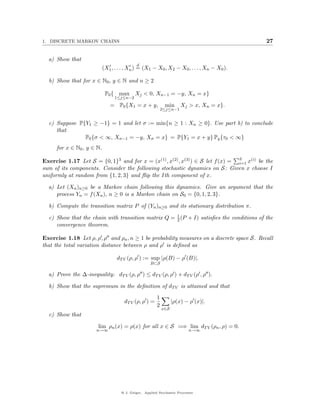
  a) Show that
                                            d
                           (X1 , . . . , Xn ) = (X1 − X0 , X2 − X0 , . . . , Xn − X0 ).

  b) Show that for x ∈ N0 , y ∈ N and n ≥ 2

                            P0 { max Xj < 0, Xn−1 = −y, Xn = x}
                                1≤j≤n−2
                              = P0 {X1 = x + y,              min      Xj > x, Xn = x}.
                                                            2≤j≤n−1


  c) Suppose P{Y1 ≥ −1} = 1 and let σ := min{n ≥ 1 : Xn ≥ 0}. Use part b) to conclude
     that
               P0 {σ < ∞, Xσ−1 = −y, Xσ = x} = P{Y1 = x + y} Py {τ0 < ∞}
     for x ∈ N0 , y ∈ N.

Exercise 1.17 Let S = {0, 1}3 and for x = (x(1) , x(2) , x(3) ) ∈ S let f (x) = 3 x(i) be the
                                                                                i=1
sum of its components. Consider the following stochastic dynamics on S: Given x choose I
uniformly at random from {1, 2, 3} and flip the Ith component of x.

  a) Let (Xn )n≥0 be a Markov chain following this dynamics. Give an argument that the
     process Yn = f (Xn ), n ≥ 0 is a Markov chain on S0 = {0, 1, 2, 3}.

  b) Compute the transition matrix P of (Yn )n≥0 and its stationary distribution π.

  c) Show that the chain with transition matrix Q = 1 (P + I) satisfies the conditions of the
                                                    2
     convergence theorem.

Exercise 1.18 Let ρ, ρ , ρ and ρn , n ≥ 1 be probability measures on a discrete space S. Recall
that the total variation distance between ρ and ρ is defined as

                                  dT V (ρ, ρ ) := sup |ρ(B) − ρ (B)|.
                                                    B⊂S

  a) Prove the ∆-inequality: dT V (ρ, ρ ) ≤ dT V (ρ, ρ ) + dT V (ρ , ρ ).

  b) Show that the supremum in the definition of dT V is attained and that
                                                        1
                                     dT V (ρ, ρ ) =               |ρ(x) − ρ (x)|.
                                                        2
                                                            x∈S
  c) Show that

                       lim ρn (x) = ρ(x) for all x ∈ S =⇒ lim dT V (ρn , ρ) = 0.
                      n→∞                                                 n→∞


                                    @ J. Geiger, Applied Stochastic Processes
28


2     Renewal processes
2.1    Limit theorems
                                                                                +
Let Tj , j ≥ 1 be non-negative i.i.d. random variables with values in R0 and let T0 be a
R+ -valued random variable, independent of (Tj )j≥1 . Set S0 := 0 and
 0
                                                       n
                                  Sn+1 := T0 +             Tj ,    n ≥ 0.                   (2.1)
                                                     j=1

The times Sn , n ≥ 1 are called renewal points. The number of renewals until time t is denoted
by
                              Nt := max{n ≥ 0 : Sn ≤ t}, t ≥ 0.
Note the relation
                        {Nt ≥ n} = {Sn ≤ t} for all n ∈ N and t ≥ 0.
Definition 2.1 The process (Yt )t≥0 with
                                     Yt := SNt +1 − t,            t ≥ 0,
is called a renewal process with lifetime distribution ν := L(T1 ) and delay T0 .
    (Yt )t≥0 is the continuous-time analogue to the renewal chain studied in Chapter 1. Tradi-
tionally, the process (Nt )t≥0 is called renewal process. Note that in general the latter process
is not Markovian.
Proposition 2.2 (Law of large numbers) Suppose µ := E T1 ∈ (0, ∞], then
                                             Nt  1
                                           lim  = a.s.                                      (2.2)
                                          t→∞ t  µ
Proof. If P{T1 = ∞} = θ > 0 then Nt ↑ N∞ < ∞ a.s. as t → ∞, where

                             P{N∞ = k} = θ(1 − θ)k−1 ,                 k ∈ N.

Hence,
                                     Nt       1
                                         =0=
                                        lim      a.s.
                                      tt→∞    µ
Now assume P{T1 = ∞} = 0. By definition of Nt , we have SNt ≤ t < SNt +1 for all t ≥ 0.
Division by Nt gives
                             N t − 1 SNt    t     SNt +1
                                          ≤     <        .                        (2.3)
                               Nt Nt − 1    Nt      Nt
Now observe that
                     n
       Sn+1    T0    j=1 Tj a.s.
  i)        =      +        → µ as n → ∞ (by the standard LLN);
        n       n     n
          a.s.             a.s.
    ii) Nt → ∞ (since Sn < ∞ for all n).
Asymptotics i) and ii) show that when passing to the limit t → ∞ in (2.3), both the lower
and upper bound converge to µ a.s.

                                  @ J. Geiger, Applied Stochastic Processes
2. RENEWAL PROCESSES                                                                                           29


   The function
                                               ∞                        ∞
                       u(t) := ENt =                 P{Nt ≥ n} =              P{Sn ≤ t}
                                               n=1                     n=1
is the so-called renewal function. The following theorem shows that we may interchange
expectation and limiting procedures in (2.2).
Theorem 2.3 (Elementary renewal theorem) Suppose that µ ∈ (0, ∞], then
                                                  u(t)  1
                                                lim    = .
                                               t→∞ t    µ
To prove Theorem 2.3 we need the following result which is interesting in its own.
Lemma 2.4 (Wald’s Identity) Let Z1 , Z2 , Z3 , . . . be i.i.d. random variables with E|Z1 | <
∞. Let τ be a stopping time for (Zn )n≥0 with E τ < ∞. Then
                                                τ
                                      E              Zi       = E τ EZ1 .                                    (2.4)
                                               i=1
                                                                            τ
Relation (2.4) states that the mean of the random sum                       i=1 Zi    is the same as if the Zi and
τ were independent.

Proof. Clearly,
                                       τ                ∞
                                            Zi =              Zi I{i ≤ τ }.
                                      i=1               i=1
Note that
                                                                              i−1
                    I{i ≤ τ } = 1 − I{τ ≤ i − 1} = 1 −                              I{τ = j}.                (2.5)
                                                                              j=0

Identity (2.5) and the fact that τ is a stopping time for (Zn ) show that the random variables
Zi and I{i ≤ τ } are independent. Thus (compare (1.17))
                            τ                       ∞
                       E         Zi        =            E(Zi I{i ≤ τ })
                           i=1                   i=1
                                                  ∞
                                           =            EZi P{τ ≥ i}
                                                 i=1
                                                          ∞
                                           = EZ1                P{τ ≥ i} = EZ1 E τ.
                                                          i=1
                                                                                      1
Proof of Thm. 2.3. We may assume µ < ∞ (else u(t) ↑ u(∞) =                            θ   < ∞). We first prove the
lower bound
                                          u(t)  1
                                  lim inf      ≥ .                                                           (2.6)
                                    t→∞    t    µ
Since
                                                                      n−1                  n
                  {Nt = n} = {Sn ≤ t, Sn+1 > t} =                           Tj ≤ t <            Tj
                                                                      j=0                 j=0


                                  @ J. Geiger, Applied Stochastic Processes
30


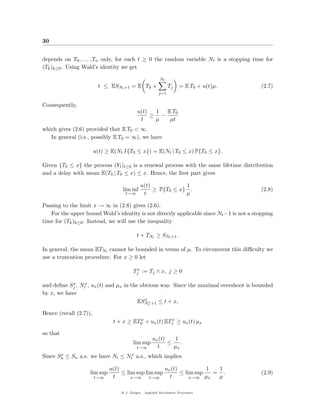
depends on T0 , . . . , Tn only, for each t ≥ 0 the random variable Nt is a stopping time for
(Tk )k≥0 . Using Wald’s identity we get

                                                        Nt
                         t ≤ ESNt +1 = E T0 +                Tj    = E T0 + u(t)µ.        (2.7)
                                                       j=1

Consequently,
                                           u(t)  1 E T0
                                                ≥ −
                                            t    µ  µt
which gives (2.6) provided that E T0 < ∞.
   In general (i.e., possibly E T0 = ∞), we have

                        u(t) ≥ E(Nt I{T0 ≤ x}) = E(Nt | T0 ≤ x) P{T0 ≤ x}.

Given {T0 ≤ x} the process (Yt )t≥0 is a renewal process with the same lifetime distribution
and a delay with mean E(T0 | T0 ≤ x) ≤ x. Hence, the first part gives

                                             u(t)            1
                                   lim inf        ≥ P{T0 ≤ x} .                           (2.8)
                                    t→∞       t              µ

Passing to the limit x → ∞ in (2.8) gives (2.6).
   For the upper bound Wald’s identity is not directly applicable since Nt −1 is not a stopping
time for (Tk )k≥0 . Instead, we will use the inequality

                                          t + TNt ≥ SNt +1 .

In general, the mean ETNt cannot be bounded in terms of µ. To circumvent this difficulty we
use a truncation procedure. For x ≥ 0 let

                                        Tjx := Tj ∧ x, j ≥ 0

and define Sj , Ntx , ux (t) and µx in the obvious way. Since the maximal overshoot is bounded
            x

by x, we have
                                            x
                                         ESNtx +1 ≤ t + x,

Hence (recall (2.7)),
                                         x            x
                               t + x ≥ ET0 + ux (t) ET1 ≥ ux (t) µx

so that
                                                   ux (t)   1
                                        lim sup           ≤    .
                                          t→∞        t      µx
Since Sn ≤ Sn a.s. we have Nt ≤ Ntx a.s., which implies
       x


                              u(t)                   ux (t)           1   1
                    lim sup        ≤ lim sup lim sup        ≤ lim sup    = .              (2.9)
                        t→∞    t       x→∞     t→∞     t        x→∞   µx  µ

                                  @ J. Geiger, Applied Stochastic Processes
2. RENEWAL PROCESSES                                                                            31


2.2   Stationary renewal processes
This section deals with the question when the renewal process (Yt )t≥0 is a stationary process
(i.e., for what L(T0 )). By the Markov property, for (Yt )t≥0 to be stationary it is sufficient
that L(Yt ) does not depend on t. Now recall from Section 1.5 that if (Xn )n≥0 is an aperiodic,
irreducible and positive recurrent Markov chain then

                        Px {Xn = y} → π(y) as n → ∞ for all x, y ∈ S,

where π is the unique stationary distribution of (Xn )n≥0 . Hence, our opening question boils
down to finding the law of Yt = SNt +1 − t as t → ∞. Let

                                            At := t − SNt

be the age of the item in use at time t. The first guess (?!) that the total lifetime TNt = At +Yt
of the item in use at t has asymptotic distribution ν = L(T1 ) is wrong. This is because of the
so-called size-biasing effect: It is more likely that t falls in a large renewal interval than that
it is covered by a small one.

   To explain things in a simple setting we first have a look at stationary renewal chains (i.e.,
we take time to be discrete). Consider the augmented process (Yn , Zn )n≥0 , where Zn is the
total lifetime of the item in use at n. Observe that (Yn , Zn )n≥0 is a Markov chain on the state
space S = {(y, z) ∈ N2 : 0 ≤ y < z < ∞, qz > 0} with transition matrix
                        0
                                         
                                          1,  if y = y − 1, z = z,
                          P(y,z)(y ,z ) = qz , if y = 0, y = z − 1,
                                         
                                           0,  else.

Note that the chain (Yn , Zn )n≥0 is irreducible, since (y, z) → (0, z) → (z − 1, z ) → (y , z ).

Proposition 2.5 Suppose 0 < µ := ET1 = ∞ kqk < ∞. Then the stationary distribution
                                                k=1
of the Markov chain (Yn , Zn )n≥0 is the distribution of the pair ( U T1 , T1 ), where T1 has the
size-biased distribution of T1 ,

                                                y P{T1 = y}
                              P{T1 = y} =                   , y ∈ N0 ,
                                                     µ

and U is uniformly distributed on the interval [0, 1], independent of T1 .

                                                 2
Remark. Note that P{T1 ≥ 1} = 1 and that ET1 = ET1 /ET1 ≥ ET1 by Jensen’s inequality.
In fact, T1 is stochastically larger than T1 .

Proof. We first compute the weights of the distribution ( U T1 , T1 ) and then verify station-
arity. For 0 ≤ y < z < ∞ with qz > 0 we have
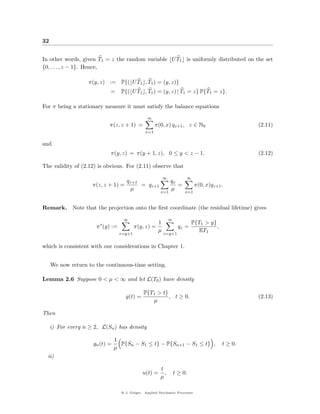
                                                                                 1
        P{ U T1 = y | T1 = z} = P{ U z = y} = P{y ≤ U z < y + 1} =                 .        (2.10)
                                                                                 z

                                 @ J. Geiger, Applied Stochastic Processes
32


In other words, given T1 = z the random variable U T1 is uniformly distributed on the set
{0, . . . , z − 1}. Hence,

                    π(y, z) := P{( U T1 , T1 ) = (y, z)}
                             =     P{( U T1 , T1 ) = (y, z) | T1 = z} P{T1 = z}.

For π being a stationary measure it must satisfy the balance equations
                                                 ∞
                             π(z, z + 1) =            π(0, x) qz+1 , z ∈ N0                         (2.11)
                                                x=1

and
                             π(y, z) = π(y + 1, z), 0 ≤ y < z − 1.                                  (2.12)

The validity of (2.12) is obvious. For (2.11) observe that

                                                          ∞             ∞
                                   qz+1                        qx
                     π(z, z + 1) =      = qz+1                    =            π(0, x)qz+1 .
                                    µ                          µ
                                                         x=1            x=1


Remark.      Note that the projection onto the first coordinate (the residual lifetime) gives

                                    ∞                          ∞
                        ∗                           1                       P{T1 > y}
                       π (y) :=           π(y, z) =                  qz =             ,
                                                    µ                         ET1
                                  z=y+1                    z=y+1


which is consistent with our considerations in Chapter 1.


     We now return to the continuous-time setting.

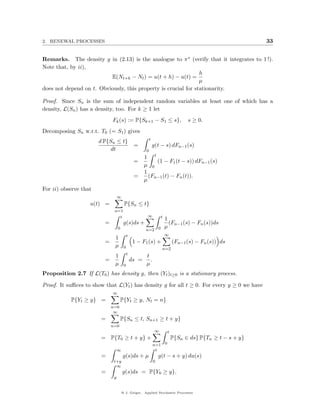
Lemma 2.6 Suppose 0 < µ < ∞ and let L(T0 ) have density

                                               P{T1 > t}
                                     g(t) =              , t ≥ 0.                                   (2.13)
                                                  µ

Then

     i) For every n ≥ 2, L(Sn ) has density

                                 1
                      gn (t) =     P{Sn − S1 ≤ t} − P{Sn+1 − S1 ≤ t} ,                     t ≥ 0.
                                 µ
  ii)

                                                         t
                                               u(t) =      ,       t ≥ 0.
                                                         µ

                                   @ J. Geiger, Applied Stochastic Processes
2. RENEWAL PROCESSES                                                                                        33


Remarks. The density g in (2.13) is the analogue to π ∗ (verify that it integrates to 1 !).
Note that, by ii),
                                                                h
                          E(Nt+h − Nt ) = u(t + h) − u(t) =
                                                                µ
does not depend on t. Obviously, this property is crucial for stationarity.

Proof. Since Sn is the sum of independent random variables at least one of which has a
density, L(Sn ) has a density, too. For k ≥ 1 let
                             Fk (s) := P{Sk+1 − S1 ≤ s},                           s ≥ 0.
Decomposing Sn w.r.t. T0 (= S1 ) gives
                                                           t
                       d P{Sn ≤ t}
                                                =              g(t − s) dFn−1 (s)
                            dt                         0
                                                      1 t
                                                =          (1 − F1 (t − s)) dFn−1 (s)
                                                      µ 0
                                                      1
                                                =       (Fn−1 (t) − Fn (t)).
                                                      µ
For ii) observe that
                                  ∞
                   u(t) =              P{Sn ≤ t}
                              n=1
                                t                      ∞            t
                                                                        1
                         =             g(s)ds +                           (Fn−1 (s) − Fn (s))ds
                                  0                                     µ
                                                      n=2 0
                                           t                            ∞
                              1
                         =                      1 − F1 (s) +                 (Fn−1 (s) − Fn (s)) ds
                              µ        0                            n=2
                                           t
                              1                        t
                         =                     ds =      .
                              µ        0               µ
Proposition 2.7 If L(T0 ) has density g, then (Yt )t≥0 is a stationary process.

Proof. It suffices to show that L(Yt ) has density g for all t ≥ 0. For every y ≥ 0 we have
                             ∞
           P{Yt ≥ y} =                P{Yt ≥ y, Nt = n}
                             n=0
                              ∞
                       =              P{Sn ≤ t, Sn+1 ≥ t + y}
                             n=0
                                                                ∞        t
                       = P{T0 ≥ t + y} +                                     P{Sn ∈ ds} P{Tn ≥ t − s + y}
                                                               n=1 0
                                  ∞                             t
                       =              g(s)ds + µ                   g(t − s + y) du(s)
                              t+y                              0
                               ∞
                       =              g(s)ds = P{Y0 ≥ y}.
                              y


                                      @ J. Geiger, Applied Stochastic Processes
34


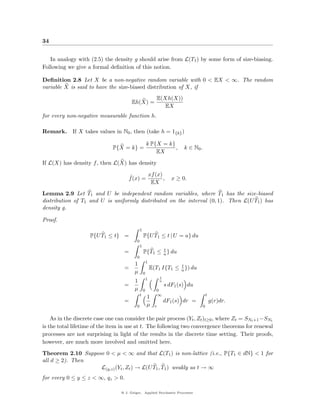
   In analogy with (2.5) the density g should arise from L(T1 ) by some form of size-biasing.
Following we give a formal definition of this notion.

Definition 2.8 Let X be a non-negative random variable with 0 < EX < ∞. The random
variable X is said to have the size-biased distribution of X, if
                                                              E(Xh(X))
                                        Eh(X) =
                                                                 EX
for every non-negative measurable function h.

Remark. If X takes values in N0 , then (take h = 1{k} )

                                                       k P{X = k}
                              P{X = k} =                          ,          k ∈ N0 .
                                                           EX
If L(X) has density f , then L(X) has density

                                      ˆ       xf (x)
                                      f (x) =        ,                  x ≥ 0.
                                               EX
Lemma 2.9 Let T1 and U be independent random variables, where T1 has the size-biased
distribution of T1 and U is uniformly distributed on the interval (0, 1). Then L(U T1 ) has
density g.

Proof.
                                               1
                    P{U T1 ≤ t} =                  P{U T1 ≤ t | U = u} du
                                           0
                                               1
                                                          t
                                   =               P{T1 ≤ u } du
                                           0
                                                       1
                                         1                             t
                                   =                       E(T1 I{T1 ≤ u }) du
                                         µ         0
                                                                 t
                                                       1
                                         1                       u
                                   =                                 s dF1 (s) du
                                         µ         0         0
                                               t             ∞                              t
                                                       1
                                   =                                 dF1 (s) dr =               g(r)dr.
                                           0           µ     r                          0


    As in the discrete case one can consider the pair process (Yt , Zt )t≥0 , where Zt = SNt +1 −SNt
is the total lifetime of the item in use at t. The following two convergence theorems for renewal
processes are not surprising in light of the results in the discrete time setting. Their proofs,
however, are much more involved and omitted here.
Theorem 2.10 Suppose 0 < µ < ∞ and that L(T1 ) is non-lattice (i.e., P{T1 ∈ dN} < 1 for
all d ≥ 2). Then
                   L(y,z) (Yt , Zt ) → L(U T1 , T1 ) weakly as t → ∞
for every 0 ≤ y ≤ z < ∞, qz > 0.

                                  @ J. Geiger, Applied Stochastic Processes
2. RENEWAL PROCESSES                                                                            35


Theorem 2.11 (Blackwell’s renewal theorem) Suppose 0 < µ < ∞ and that L(T1 ) is
non-lattice. Then
                                           h
                         u(t + h) − u(t) →   as t → ∞
                                           µ
for every h ≥ 0.

2.3   The homogeneous Poisson process on the half line
We now consider the case where the lifetimes Tj , j ≥ 1 have exponential distribution.
Definition 2.12 A non-negative random variable T is said to be exponentially distributed
with parameter λ > 0 (“Exp(λ)-distributed” for short), if
                                    P{T ≥ t} = e−λt ,          t ≥ 0.
We list some elementary properties of the exponential distribution.
  1. L(T ) has density f (t) = λe−λt , t ≥ 0.

  2. T has mean E T = 1/λ and variance Var T = 1/λ2 .

  3. The Laplace transform of T is
                                                                 λ
                                ϕ(θ) := E exp(−θT ) =               , θ ≥ 0.
                                                                λ+θ
  4. The “lack of memory”:
                          P{T ≥ t + s | T ≥ t} = P{T ≥ s} for all s, t ≥ 0.                 (2.14)

Property (2.14) says that knowledge of the age gives no information on the residual lifetime.
This explains why in the case of exponential lifetimes the stationary density of T0 and the
lifetime distribution agree,
                                  P{T1 > t}
                           g(t) =             = λe−λt = f (t), t ≥ 0.
                                       µ
This is commonly referred to as the bus stop paradox: If the interarrival times are exponen-
tially distributed then arriving at the bus stop at time t one has to wait as long as if arriving
immediately after a bus has left.
Definition 2.13 Let Tj , j ≥ 0 be independent Exp(λ)-distributed random variables. Then
the random set Φ := {Sn : n ≥ 1} is called a homogeneous Poisson process on R+ with
                                                                                 0
intensity λ.
The “homogeneous” refers to the process (Nt )t≥0 having stationary increments. The name
Poisson process is due to the following.
Proposition 2.14 Let N1 := | Φ ∩ [0, 1] | be the number of points of Φ in the unit interval.
Then
   i) N1 is Poisson distributed with mean λ.
  ii) Given N1 = n, the random variable (S1 , . . . , Sn ) is distributed like the order statistics
      (U(1) , . . . , U(n) ) of n independent uniform random variables U1 , . . . , Un .

                                 @ J. Geiger, Applied Stochastic Processes
36


   Recall that the order statistics is the Ui in increasing order. The respective assertions hold
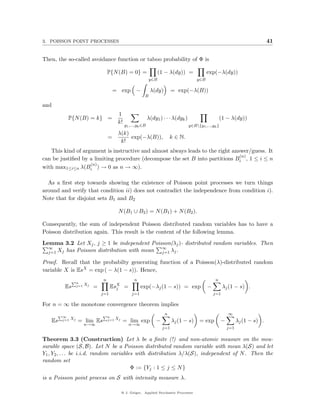
for any interval [a, b].

Definition 2.15 A random variable X with values in the non-negative integers N0 is called
Poisson-distributed with parameter λ > 0, if

                                                             λk
                                    P{X = k} = e−λ              ,      k ∈ N0 .
                                                             k!
Sometimes it is convenient to have the case λ = ∞ included: The Poisson distribution with
parameter ∞ is the delta measure at ∞. We list some elementary properties of the Poisson
distribution.

     1. X has mean EX = λ and variance Var X = λ.

     2. The generating function of X is

                                           EsX = e−λ(1−s) , 0 ≤ s ≤ 1.

     3. The Poisson approximation of the binomial distribution B(n, pn ):
        If npn → λ as n → ∞, then

                                            n k                      λk
                       B(n, pn , k) =         pn (1 − pn )n−k −→ e−λ    as n → ∞.
                                            k                        k!

Proof of Proposition 2.14. Let

                       B ⊂ {(s1 , s2 , . . . , sn ) : 0 ≤ s1 ≤ s2 ≤ . . . ≤ sn ≤ 1}

                           ˜
be a measurable set. Write B for the corresponding inter arrival times,

                     ˜
                     B := {(s1 , s2 − s1 , . . . , sn − sn−1 ) : (s1 , . . . , sn ) ∈ B}.

Then,

                      P{N1 = n, (S1 , . . . , Sn ) ∈ B}
                        = P((S1 , . . . , Sn ) ∈ B, Sn+1 > 1)
                                                                  n
                                                   ˜
                        = P (T0 , . . . , Tn−1 ) ∈ B,                 Tj > 1
                                                              j=0

                        =                     ˜
                                                   λe−λt0 λe−λt1 · · · λe−λtn dt0 · · · dtn
                              (t0 ,...,tn−1 )∈B,
                                t0 +···+tn >1


                        =                                λn λe−λsn+1 ds1 · · · dsn+1
                              (s1 ,...,sn )∈B, sn+1 >1
                             λn e−λ
                        =             n!        ds1 · · · dsn .                               (2.15)
                               n!           B

                                    @ J. Geiger, Applied Stochastic Processes
2. RENEWAL PROCESSES                                                                                  37


On the other hand,

            P{(U(1) , . . . , U(n) ) ∈ B}
              =                    P{(U(1) , . . . , U(n) ) ∈ B, Uρ(1) < Uρ(2) < · · · < Uρ(n) }
                   ρ permutation

              =                    P{(Uρ(1) , . . . , Uρ(n) ) ∈ B}
                   ρ permutation

              = n! P{(U1 , . . . , Un ) ∈ B}
              = n!         ds1 · · · dsn .                                                         (2.16)
                       B

Combining (2.15) and (2.16) establishes the claim of the proposition.

  Observe that Proposition 2.14 suggests the following two-step construction of a homoge-
neous Poisson point process.

  1. Choose a P oisson(λ)-distributed random number N , say.

  2. Generate N independent uniform random variables on [0, 1].

Note that this construction has an obvious extension to more general state spaces (other than
the construction via lifetimes which uses the linear ordering of R). We will get back to this
construction in the next chapter.

2.4   Exercises
Exercise 2.1 (Stationary age processes) Consider a renewal chain (Yn )n≥0 with lifetime
distribution (qk )k≥1 and finite expected lifetime E T1 .
  a) Compute the transition matrix of the time-reversed chain (compare Exercise 1.8 and
     recall that π(y) = P{T1 > y}/ET1 , y ∈ N0 ).
  b) Compute the so-called hazard function: the conditional probability that the lifetime T1
     equals y given that it exceeds y.

Exercise 2.2 Let (Yt )t≥0 be a renewal process with renewal points Sn+1 = n Tj , n ≥ 0
                                                                                   j=0
and let X1 , X2 , . . . be a sequence of i.i.d. random variables with finite mean m := EX1 . The
renewal reward process is defined as
                                                     Nt
                                             Rt :=         Xj , t ≥ 0.
                                                     j=1

                                                                             a.s.
  a) Let µ = ET1 be the expected lifetime. Show that Rt /t → m/µ.
  b) Define At := t − SNt to the time at t since the last renewal (= age of the item in use).
     Show that                            t                2
                                                  a.s. ET1
                                   t−1      As ds −→         .
                                        0                2µ

                                      @ J. Geiger, Applied Stochastic Processes
38


Exercise 2.3 Patterns of discrete random variables. Let X1 , X2 , . . . be i.i.d. random
variables with P{X1 = j} = pj , j ∈ N. Let τ be the first time the pattern j1 , . . . , jk occurs,

                           τ := min{n ≥ k : Xn−k+1 = j1 , . . . , Xn = jk }.

Suppose that j1 = jk . Use the elementary renewal theorem to compute E τ .

Exercise 2.4 Consider a single server bank in which customers arrive at the times of a
Poisson point process on R+ with rate λ, but only enter when the server is free. Let the
service times of the customers entering the bank be i.i.d. with finite mean m.

  a) Argue that the times at which customers enter the bank form a renewal process.

  b) Compute the expected number of customers arriving while one customer is served.

  c) What fraction of potential customers enter the bank in the long run?

  d) What fraction of time is the server busy?

Exercise 2.5 Let X be a non-negative random variable with positive finite mean. Recall that
a random variable X is said to have the size-biased distribution of X, if
                                                       E(Xh(X))
                                           Eh(X) =
                                                          EX
for every non-negative measurable function h.

  a) Show that P{X ∈ · } is a probability measure on (R+ , B).
                                                       0

  b) Show that X is stochastically larger than X,

                                 P{X ≥ x} ≥ P{X ≥ x} for all x ≥ 0.

  c) Show that if X1 , . . . , Xn are i.i.d. random variables then

                                       n
                                                 d
                                           Xi = X1 + X2 + · · · + Xn ,
                                     i=1

     where X1 is independent of X2 , . . . , Xn .

  d) Suppose that X takes values in the non-negative integers N0 . Show that Y has probability
     generating function (p.g.f.)

                                           ˆ       sf (s)
                                           f (s) =        , 0 ≤ s ≤ 1,
                                                   f (1)
     where
                                               ∞
                                   f (s) :=          P(X = k)sk , 0 ≤ s ≤ 1,
                                              k=0
     is the p.g.f. of X.

                                   @ J. Geiger, Applied Stochastic Processes
2. RENEWAL PROCESSES                                                                39


  e) Let X have (shifted) geometric distribution,

                                 P{X = k} = p(1 − p)k , k ∈ N0 .

     Show that
                                 d                                         d
                             X = 1 + X1 + X2             and       U X = X,
     where X1 and X2 are independent copies of X, and U is uniformly distributed on the
     interval [0, 1], independent of X.


                               @ J. Geiger, Applied Stochastic Processes
40


3      Poisson point processes
The Poisson point process is a fundamental model in the theory of stochastic processes. It is
used to model spatial phenomena (like the spread of colonies of bacteria on a culture medium
or the positions of visible stars in a patch of the sky) or a random series of events occurring
in time (like the emission of radioactive particles or the arrival times of phone calls).
     Formally, a (Poisson) point process is a countable random subset of some state space S.
The distribution of Φ can be described by specifying the law of the number of points of Φ
falling into “test sets” Bi (where the Bi are from some σ-field B on S). To this end one needs
to ensure that there are enough sets in B. This can be done by the weak assumption that
the diagonal D = {(x, y) : x = y} is measurable in the product space (S × S, B ⊗ B), which
implies that singletons {x} are in B for every x ∈ S.
     We will not address the measure theoretic niceties here (but be aware that there is some
demand !) and only list a few important properties (for a thorough account we refer to the
monographs [3, 6]).

     • The set of countable subsets of a measurable set S is a Polish space when equipped with
       the vague topology (identify Φ = {xi : i ∈ I} with the counting measure i∈I δxi ).

     • The distribution of Φ is uniquely determined by the “finite-dimensional distributions”
       of (N (B1 ), . . . , N (Bn )), where N (Bi ) := |Φ ∩ Bi | is the number of points that fall into
       the set Bi .

3.1     Construction and basic properties
Definition 3.1 Let λ be a σ-finite (and non-atomic) measure on the measurable space (S, B).
A random countable subset Φ of S is called a (simple) Poisson point process on S with
intensity (or mean) measure λ, if

     i) The random variables N (B1 ), . . . , N (Bn ) are independent for any finite collection of
        disjoint measurable subsets B1 , . . . , Bn ∈ B.

    ii) For every B ∈ B the random variable N (B) has Poisson distribution with mean λ(B).

Recall that a measure λ is called non-atomic if λ({x}) = 0 for all x ∈ S. This property is not
essential for the definition of a Poisson point process, but guarantees that Φ has no multiple
points. A measure λ is called σ-finite if there exist B1 ⊂ B2 ⊂ · · · ⊂ S such that i≥1 Bi = S
and λ(Bi ) < ∞ for all i, i.e., if S can be exhausted by sets of finite measure.

The inevitability of the Poisson distribution. We give a (somewhat heuristic) argu-
ment that the Poisson distribution is inevitable if one requires the maximal independence in
condition i) of Definition 3.1. Suppose that we independently throw points into the infinites-
imal volume elements dy with probability

                                 P{N (dy) = 1} = EN (dy) = λ(dy).

                                    @ J. Geiger, Applied Stochastic Processes
3. POISSON POINT PROCESSES                                                                                                             41


Then, the so-called avoidance function or taboo probability of Φ is

                                      P{N (B) = 0} =                    (1 − λ(dy)) =               exp(−λ(dy))
                                                                  y∈B                         y∈B

                                          = exp −                  λ(dy)        = exp(−λ(B))
                                                              B

and
                                             1
           P{N (B) = k} =                                         λ(dy1 ) · · · λ(dyk )                       (1 − λ(dy))
                                             k!
                                                  y1 ,...,yk ∈B                           y∈B{y1 ,...,yk }
                                             λ(k)
                                      =           exp(−λ(B)),                  k ∈ N.
                                              k!
   This kind of argument is instructive and almost always leads to the right answer/guess. It
                                                                                (n)
can be justified by a limiting procedure (decompose the set B into partitions Bi , 1 ≤ i ≤ n
                   (n)
with max1≤i≤n λ(Bi ) → 0 as n → ∞).

  As a first step towards showing the existence of Poisson point processes we turn things
around and verify that condition ii) does not contradict the independence from condition i).
Note that for disjoint sets B1 and B2

                                             N (B1 ∪ B2 ) = N (B1 ) + N (B2 ).

Consequently, the sum of independent Poisson distributed random variables has to have a
Poisson distribution again. This result is the content of the following lemma.
Lemma 3.2 Let Xj , j ≥ 1 be independent Poisson(λj )- distributed random variables. Then
  ∞                                         ∞
  j=1 Xj has Poisson distribution with mean j=1 λj .

Proof. Recall that the probabilty generating function of a Poisson(λ)-distributed random
variable X is EsX = exp ( − λ(1 − s)). Hence,
              Pn                  n                     n                                                n
                         Xj
         Es        j=1        =         EsX =
                                          j                  exp(−λj (1 − s)) = exp                 −          λj (1 − s) .
                                  j=1                  j=1                                              j=1

For n = ∞ the monotone convergence theorem implies
      P∞                          Pn                                       n                                      ∞
              Xj                            Xj
   Es   j=1        = lim Es           j=1        = lim exp            −         λj (1 − s)      = exp         −         λj (1 − s) .
                         n→∞                         n→∞
                                                                          j=1                                     j=1

Theorem 3.3 (Construction) Let λ be a finite (!) and non-atomic measure on the mea-
surable space (S, B). Let N be a Poisson distributed random variable with mean λ(S) and let
Y1 , Y2 , . . . be i.i.d. random variables with distribution λ/λ(S), independent of N . Then the
random set
                                         Φ := {Yj : 1 ≤ j ≤ N }
is a Poisson point process on S with intensity measure λ.

                                                 @ J. Geiger, Applied Stochastic Processes
42


Proof. Let B1 , . . . , Bn ∈ B be disjoint subsets of S and set
                                                                n
                                            Bn+1 := S                Bi .
                                                                i=1

Note that given N = the counts (N (B1 ), . . . , N (Bn+1 )) have multinomial distribution with
parameter ( , p1 , . . . , pn+1 ), where pj = λ(Bj )/λ(S), 1 ≤ j ≤ n + 1. Hence, for k1 , . . . , kn+1 ∈
N0 and = k1 + · · · + kn+1 we have

           P{N (B1 ) = k1 , . . . , N (Bn+1 ) = kn+1 }

              = P{N = } P{N (B1 ) = k1 , . . . , N (Bn+1 ) = kn+1 | N = }
                                                                                   k1                    kn+1
                                  λ(S)                                λ(B1 )                  λ(Bn+1 )
              = exp(−λ(S))                                                              ···
                                    !       k1 , . . . , kn+1         λ(S)                      λ(S)
                            n+1
                                           λ(B1 )k1     λ(Bn+1 )kn+1
              = exp −             λ(Bj )            ···
                                             k1 !          kn+1 !
                            j=1

                  n+1
                                        λ(Bj )kj
              =         exp(−λ(Bj ))             .                                                              (3.1)
                                          kj !
                  j=1


Properties i) and ii) follow from (3.1) by summation over kn+1 .

Theorem 3.4 (Restriction theorem) Let Φ be a Poisson point process on S with mean
measure λ and let B be a measurable subset of S. Then the random countable set ΦB := Φ∩B
is a Poisson point process on S with mean measure λB = λ(B ∩ · ) .

Proof. Conditions i) and ii) are easily verified for ΦB .

   The following result will be useful to extend the construction of a Poisson point process
given in Theorem 3.3 to the case λ(S) = ∞.

Theorem 3.5 (Superposition theorem) Let Φj , j ≥ 1 be independent Poisson point pro-
                                                            ∞
cesses on S with non-atomic intensity measures λj . If λ := j=1 λj is σ-finite, then the
union
                                                          ∞
                                                 Φ :=           Φj
                                                         j=1

is a Poisson point process on S with intensity measure λ.

Proof. If X and Y are independent random variables with values in S and non-atomic
distributions νX and νY , then, by means of Fubini’s theorem,

             P{X = Y } =          P{X = Y | Y = y} νY (dy) =                       νX ({x}) νY (dy) = 0.
                              S                                                S

                                     @ J. Geiger, Applied Stochastic Processes
3. POISSON POINT PROCESSES                                                                                      43


Hence, letting Xi and Xj have distribution λi ( · ∩B)/λi (B) and λj ( · ∩B)/λj (B), respectively,
Theorem 3.3 shows that

               P{Φi ∩ Φj ∩ B = ∅} ≤ E |Φi ∩ Φj ∩ B|
                                          = E E |Φi ∩ Φj ∩ B| Ni (B), Nj (B)
                                          ≤ P{Xi = Xj } E(Ni (B)Nj (B))
                                          = P{Xi = Xj } λi (B) λj (B) = 0                                     (3.2)

provided that λi (B), λj (B) < ∞. Taking B1 ⊂ B2 ⊂ · · · ⊂ S such that                            n≥1 Bn   = S and
λ(Bn ) < ∞ for all n, we see that (3.2) holds for all B. Hence,

                                                                  ∞
                                                           a.s.
                                 N (B) := |Φ ∩ B| =                     Nj (B).
                                                                  j=1


By Lemma 3.2, N (B) is Poisson(λ(B))-distributed. For the independence note that

                                                     ∞                          ∞
                                              a.s.
                   (N (B1 ), . . . , N (Bn )) =            Nj (B1 ), . . . ,         Nj (Bn ) ,
                                                     j=1                       j=1


with the Nj (Bk ), 1 ≤ k ≤ n and j ≥ 1 being mutually independent if the Bk are disjoint.

Corollary 3.6 (Existence theorem) Let λ be a σ-finite (non-atomic) measure on (S, B).
Then there exists a Poisson point process on S with mean measure λ.

                                                             ∞
Proof. Let B1 ⊂ B2 ⊂ · · · with λ(Bj ) < ∞ and               j=1 Bj      = S. Set

                                                     j−1
                                      ∗
                                     Bj    := Bj           Bi , j ≥ 1.
                                                     i=1


Note that the Bj , j ≥ 1 are disjoint and that j Bi = j Bi for all j ≥ 1. Following
               ∗
                                                 i=1
                                                     ∗
                                                            i=1
Theorem 3.3 we can construct independent Poisson point processes Φ∗ on S with intensity
                                                                  j
measures λ∗ = λ( · ∩ Bj ). By Theorem 3.5, the superposition
          j
                      ∗


                                                       ∞
                                                 ∗
                                              Φ :=           Φ∗
                                                              j
                                                       j=1


is a Poisson point process on S with intensity measure
                           ∞           ∞                                 ∞
                  λ∗ =          λ∗ =
                                 j
                                                     ∗
                                             λ( · ∩ Bj ) = λ                        ∗
                                                                               · ∩ Bj     = λ.
                          j=1          j=1                               j=1


                                  @ J. Geiger, Applied Stochastic Processes
44


    Another nice property of Poisson point processes is that, if the state space is mapped
into some other space, then the transformed points again form a Poisson point process. The
only thing one has to pay attention to is that the function might pile distinct points. This
possibility, however, can be detected by merely looking at the transformed intensity measure.

Theorem 3.7 (Mapping theorem) Let Φ be a Poisson point process on S with mean mea-
sure λ and let f : S → S be a measurable function such that the image (or induced) measure

                                                    λf = λ ◦ f −1

on S is σ-finite and non-atomic. Then f (Φ) = {f (x) : x ∈ Φ} is a Poisson point process on
S with mean measure λf .

Proof. Let Bn ↑ S with λ(Bn ) < ∞ and let Yn,1 and Yn,2 be i.i.d. with distribution λBn .
Similar to (3.2) we deduce

  P{f (x) = f (y) for some x = y ∈ Φ} =                        lim P{f (x) = f (y) for some x = y ∈ Φ ∩ Bn }
                                                               n→∞
                                                    ≤          lim P{f (Yn,1 ) = f (Yn,2 )} EN (Bn )2 = 0.
                                                               n→∞

Hence,
                                                        a.s.
                   Nf (B ) := |f (Φ) ∩ B | = |Φ ∩ f −1 (B )| = N (f −1 (B )),                                (3.3)

which shoes that Nf (B ) has Poisson distribution with mean λ(f −1 (B )) = λf (B ). For the
independence properties note that f −1 (Bi ) ∩ f −1 (Bj ) = f −1 (Bi ∩ Bj ) = ∅, if Bi ∩ Bj = ∅.

3.2     Sums over Poisson point processes
In this section we study random quantities x∈Φ f (x), where Φ is a Poisson point process
on S and f : S → R is some measurable function. We will address questions about absolute
convergence, the expectation and variance of such sums and their Laplace functionals. The
general strategy will be to first look at simple functions f = n βi 1Bi with non-negative βi
                                                              i=1
and disjoint measurable sets Bi , 1 ≤ i ≤ n, and then apply standard techniques from inte-
gration theory to extend the results to general f .

Theorem 3.8 Let Φ be a Poisson point process on S with mean measure λ and let f : S → R
be a measurable function.

     1. If f ≥ 0, then

                             E exp    −         f (x)      = exp         −        1 − e−f (z) λ(dz)          (3.4)
                                          x∈Φ                                 S


        and                                               
                                                           1,      if   S   min(1, f (z)) λ(dz) < ∞;
                         P           f (x) < ∞ =                                                             (3.5)
                                                               0,   else.
                                                          
                              x∈Φ


                                        @ J. Geiger, Applied Stochastic Processes
3. POISSON POINT PROCESSES                                                                                                45


  2. If f ≥ 0 or     S   |f (z)| λ(dz) < ∞, then

                                             E             f (x)      =            f (z) λ(dz).
                                                     x∈Φ                    S


  3. If   S   |f (z)| λ(dz) < ∞, then

                                            Var             f (x)      =           f 2 (z) λ(dz).
                                                     x∈Φ                       S


The Laplace functional ϕ(f ) in (3.4) uniquely determines the distribution of Φ. For fixed f
the value is the same as the Laplace transform of   x∈Φ f (x) evaluated at 1.

Proof. Let
                                                               n
                                                       f=             βi 1Bi
                                                              i=1

where βi ≥ 0 and Bi ∩ Bj = ∅ for i = j. Then
                                                              n
                                       f (x) =                      βi 1Bi (x)
                                x∈Φ                    x∈Φ i=1
                                             n                                      n
                                     =            βi         1Bi (x) =                   βi N (Bi ).                    (3.6)
                                            i=1        x∈Φ                         i=1

Now recall that if N is Poisson(ν)-distributed, then E exp(−θN ) = exp (−ν(1−e−θ )). Hence,
using the independence of the N (Bi ) and identity (3.6) we get
                                                                           n
                E exp     −         f (x)        = E exp              −         βi N (Bi )
                              x∈Φ                                         i=1
                                                        n
                                                 =           exp − λ(Bi ) 1 − e−βi
                                                       i=1
                                                                       n
                                                 = exp            −         λ(Bi ) 1 − eβi
                                                                      i=1
                                                                                           Pn
                                                 = exp            −            1 − e−        i=1   βi 1Bi (z)
                                                                                                                λ(dz)
                                                                       S

                                                 = exp            −            1 − e−f (z) λ(dz) .
                                                                       S

Since any non-negative measurable function f is the increasing limit of simple functions fn ,
say, the monotone convergence theorem gives

                 E exp     −         f (x)        = E exp              −                lim fn (x)
                                                                                    n→∞
                               x∈Φ                                          x∈Φ

                                         @ J. Geiger, Applied Stochastic Processes
46


                                                  =     lim E exp                  −           fn (x)
                                                       n→∞
                                                                                       x∈Φ

                                                  =     lim exp                −           1 − e−fn (z) λ(dz)
                                                       n→∞                         S

                                                  = exp              −         1 − e−f (z) λ(dz) .                           (3.7)
                                                                          S

    For the convergence criterion of the random series x∈Φ f (x) recall that for any non-
negative random variable X one has P{X < ∞} = limθ↓0 E exp(−θX). Using the continuity
of the exponential function we get

               P              f (x) < ∞           = lim E exp                  −θ              f (x)
                                                       θ↓0
                   x∈Φ                                                                 x∈Φ

                                                  = exp           − lim                1 − e−θf (z) λ(dz) .                  (3.8)
                                                                         θ↓0   S

We write Iθ for the integral on the right-hand side of (3.8). By the monotone convergence
theorem, to prove (3.5) it suffices to show

                                                       <∞                          Iθ < ∞ for some θ
                          min(1, f (z)) λ(dz)                          =⇒
                      S                                =∞                          Iθ = ∞ for all θ .

For the first implication note that

               Iθ ≤           min(θf (z), 1) λ(dz) ≤ max(θ, 1)                             min(f (z), 1) λ(dz).
                          S                                                            S

Similarly,
                                   θ                        θ
              Iθ ≥            min( 2 f (z), 1) λ(dz) ≥ min( 2 , cθ )                           min(f (z), 1) λ(dz)
                          S                                                                S
for some cθ > 0. This completes the proof of the first part of the Theorem.
    For 2. we again first take f of the form f = n βi 1Bi . Then (recall (3.6))
                                                  i=1
                                                                  n                                    n
                              E           f (x)       = E                βi N (Bi )             =          βi λ(Bi )
                                   x∈Φ                            i=1                                i=1
                                             n
                                  =               βi 1Bi (z) λ(dz) =                       f (z)λ(dz).
                                          S i=1                                        S

For general f ≥ 0 take fn ↑ f and use monotone convergence. For f with                                                 |f | dλ < ∞
decompose f = f + − f − and use linearity of expectation.
   Finally, for f = n βi 1Bi we have
                    i=1
                                                             n
                Var               f (x)      = Var                βi 1Bi (x)
                          x∈Φ                             i=1
                           n                                     n
                                                                        2
                   =              Var(βi N (Bi )) =                    βi λ(Bi ) =                   f 2 (z) λ(dz).
                           i=1                                   i=1                             S


                                          @ J. Geiger, Applied Stochastic Processes
3. POISSON POINT PROCESSES                                                                                47


If    |f | dλ < ∞, then


                 Var            f (x)     = Var                       f (x) +                     f (x)
                          x∈Φ                           x ∈Φ∩{f ≥0}                 x ∈Φ∩{f <0}

                                          = Var               f + (x) + Var                 f − (x)
                                                        x∈Φ                           x∈Φ

                                          =           f + (z)2 + f − (z)2 λ(dz)
                                                 S

                                          =          f (z)2 λ (dz).
                                                 S


3.3     Labelled Poisson point processes
Recall the following characteristic property of the Poisson distribution in relation with the
binomial distribution.

Lemma 3.9 Let M = N Xi , where N is a Poisson(λ)-distributed random variable and
                             i=1
the Xi , i ≥ 1 are i.i.d. Bernoulli(p)-distributed random variables, independent of N . Then M
and N − M are independent Poisson-distributed random variables with mean λp and λ(1 − p),
respectively.

Proof. Given {N = n} the random variable M is binomially distributed with parameter
(n, p). Hence, for every k, ≥ 0,

               P{M = k, N − M = } = P{N = k + } P{M = k | N = k + }
                                                               λk+         k+
                                                  = e−λ                                pk (1 − p)
                                                              (k + )!       k
                                                              (λp)k −λ(1−p) (λ(1 − p))
                                                  = e−λp           e                   .
                                                                k!               !

Corollary 3.10 (Coloring Theorem) Let Φ be a Poisson point process on S with mean
measure λ. Color the points of Φ independently (of each other and of their positions) with
k different colors. For each j let Φj be the set of points of color j. Then Φj , 1 ≤ j ≤ k are
independent Poisson point processes on S with intensity measure λj = pj λ, where pj is the
probability that a point is colored j.

Proof. Let k = 2 (the case k ≥ 3 follows by induction). If B1 , . . . , Bn are disjoint measurable
subsets of S, then, by Lemma 3.9, the counts

                            Nj (B1 ) = |Φj (Bi )|,          j = 1, 2 and 1 ≤ i ≤ n

are independent random variables with distribution Poisson(pj λ(Bi )).

                                        @ J. Geiger, Applied Stochastic Processes
48


    The assumptions of Theorem 3.10 are far too restrictive. The demand to relax these
conditions leads to the concept of labelled (or marked) Poisson point processes.
    Let Φ = {Xi : i ∈ I} be a Poisson point process. Attach to every point Xi a label Li
whose distribution may depend on Xi , but is independent of (Xj , Lj ), j = i (you may think
of spatially inhomogeneous color probabilities).
    For a formal definition recall that P is called a transition kernel from (S, B) to (S , B ), if

     1. P (x, · ) is a probability measure on (S , B ) for each x ∈ S.

     2. P ( · , B ) is a measurable function on S for each B ∈ B .

Theorem 3.11 Let Φ be a Poisson point process on S with mean measure λ. Given Φ =
{xi : i ∈ I}, let Li , i ∈ I be independent with distribution P (xi , · ). Then

                                         Ψ := {(Xi , Li ) : i ∈ I}

is a Poisson point process on S × S with mean measure

                                    λP (dx d ) := λ(dx)P (x, d ).

Proof. By the superposition theorem, it suffices to consider the case λ(S) < ∞. We use the
construction of Φ from Theorem 3.3:

                                        Φ = {Xi : 1 ≤ i ≤ N },

where N is a Poisson(λ(S))-distributed random variable, and the Xi are i.i.d. with distribution
λ/λ(S), independent of N.
    Note that if X has distribution λ/λ(S) and the conditional distribution of L given {X = x}
is P (x, · ), then the pair (X, L) has distribution λP/λ(S). Hence,
                                           d
                                     Ψ = {(Xi , Li ) : 1 ≤ i ≤ N },

where N is Poisson-distributed with mean

                         λ(S) =            λ(dx) P (x, S )
                                       S

                                =          λ(dx)        P (x, d ) = λP (S × S ),
                                       S            S

and the (Xi , Li ), i ≥ 1 are i.i.d. with distribution
                                        λ           λP
                                            P =             .
                                       λ(S)     λP (S × S )
The assertion of Theorem 3.11 now follows by yet another application of Theorem 3.3.
Corollary 3.12

     1. If λP (S × · ) is a σ-finite and non-atomic measure on S , then the set of labels
        {Li : i ∈ I} form a Poisson point process on S with intensity measure λP (S × · ).

                                    @ J. Geiger, Applied Stochastic Processes
3. POISSON POINT PROCESSES                                                                            49


  2. For measurable disjoint subsets Bj ⊂ S , the sets of points with a label in Bj ,

                                         ΨBj = Ψ ∩ S × Bj , j ≥ 1

      are independent Poisson point processes with intensity measures λP ( · × Bj ).

Note that the coloring theorem is the particular case P (x, dy) = µ(dy), i.e., λP = λ ⊗ µ.

Proof. The first part follows by Theorem 3.11 and the mapping theorem, the second part by
Theorem 3.11 and the restriction theorem.

3.4   Exercises
Exercise 3.1 Let Φ be a homogeneous Poisson point process on R2 (i.e., Φ has Lebesgue
measure as its mean measure λ). Set D0 := 0 and let Dj , j ∈ N denote the distance of the
j-th closest point in Φ to the origin. Show that

  a) P{D1 ≥ y} = exp(−πy 2 ) for all y ≥ 0.
       2      2
  b) Dj+1 − Dj , j ∈ N0 are independent and exponentially distributed random variables with
     parameter π.

Exercise 3.2 Let ν be a probability measure on R{0} with expectation m and finite variance
σ 2 . Let (Yt )t≥0 be the process defined through

                                      Yt :=              Hi ,   t ≥ 0,
                                               0≤Si ≤t


where (Si , Hi ) are the points of a Poisson point process Φ on R+ × R with mean measure
                                                                 0
λ(ds dh) = ds ν(dh).

  a) Show that (Yt ) is a renewal reward process with Exp(1)-distributed lifetimes.

  b) Compute the mean and the variance of Yt .
                                                     ∞
  c) Suppose ν(R+ ) = 1 and let ϕ(θ) =              0 exp(−θx)ν(dx),           θ ≥ 0. Compute the Laplace
     transform ϕt (θ) := E exp(−θYt ).

Exercise 3.3 The Gamma(α, β)-distribution with shape and scale parameters α, β > 0 has
density
                                    β α α−1 −βx
                       gα,β (x) =       x   e    , x ∈ R+ ,
                                                        0
                                   Γ(α)
               ∞
where Γ(α) =       y α−1 e−y dy.
               0

  a) Compute the Laplace transform of a Gamma(α, β)-distributed random variable X.

  b) Show that the sum of n independent Gamma( α , β)-distributed random variables has
                                               n
     distribution Gamma(α, β).

                                   @ J. Geiger, Applied Stochastic Processes
50


  c) Let Φ be a Poisson point process on R+ with intensity measure

                                                          α e−βz
                                         λα,β (dz) =             dz.
                                                             z
     Show that
                                                 Y :=          x
                                                         x∈Φ

     has distribution Gamma(α, β).

Exercise 3.4 PPP representation of the Gamma process. Let Φ be a Poisson point
process on R+ × R+ with intensity measure λ(ds dz) = ds λα,β (dz). Set
            0

                                   Yt :=               y,      t ≥ 0.
                                           (u,y)∈ Φ ∩ [0,t]

Show that:

  a) Yt = limh↓0 Yt+h and Yt− := limh↓0 Yt−h exists a.s. for every t ≥ 0.

  b) In every non-empty bounded time interval [t1 , t2 ] the process (Yt )t≥0 takes infinitely
     many jumps, only finitely many of which exceed ε (> 0).

  c) For every 0 ≤ t1 < t2 < · · · < tn+1 the increments Ytj+1 −Ytj , 1 ≤ j ≤ n are independent
     random variables with distribution Gamma(α(tj+1 − tj ), β).


                                @ J. Geiger, Applied Stochastic Processes
4. MARKOV CHAINS IN CONTINUOUS TIME                                                                 51


4     Markov chains in continuous time
In this chapter time is continuous while the state space S is still discrete.

4.1    Definition and basic properties
Definition 4.1 Let P t , t ≥ 0 be a sequence of stochastic matrices on a discrete space S. A
stochastic process (Xt )t≥0 is called a (time-homogeneous) continuous-time Markov chain with
                                              s
state space S and transition probabilities Pyz , if
                                                                              s
                      Px {Xt+s = z | Xt1 = y1 , . . . , Xtn = yn , Xt = y} = Pyz                 (4.1)

for every n ∈ N0 , 0 ≤ t1 ≤ t2 ≤ . . . ≤ tn ≤ t, s ≥ 0 and x, y, y1 , . . . , yn , z ∈ S (provided that
the conditional probability is well defined). Here, Px is the law of (Xt )t≥0 when started at x.

Note that in the continuous-time setting we need a whole sequence of stochastic matrices to
describe the dynamics of the chain rather than a single transition matrix as in the discrete-
time case. The analogue of Lemma 1.3 are the so-called Chapman-Kolmogorov-equations:
The law of total probability and (4.1) imply that the P t satisfy
                   t+s
                  Pxy =         Pxz Pzy = (P t P s )xy for all s, t ≥ 0 and x, y ∈ S.
                                 t   s

                          z∈S

In other words, the sequence P t , t ≥ 0 is a semigroup of stochastic matrices.
    The distribution of the path (Xt )t≥0 is not uniquely determined by the finite-dimensional
distributions (4.1) as can be seen by the following example. Let
                                                     (1)
                                                 (Xt )t>0 ≡0

and
                                           (2)        1, if t = U,
                                        Xt       =
                                                      0, else,
where U is uniformly distributed on the unit interval [0, 1], say. Both processes have transition
probabilities
                                      t      1, if y = 0,
                                    Pxy =
                                             0, else.
    In order to have uniqueness of L((Xt )t≥0 ) one has to require some smoothness of the paths
(e.g., that the paths are a.s. continuous or c`dl`g).
                                               a a

4.2    Jump processes
Jump processes are an important class of Markov chains in continuous time. They can be
thought of as disrete-time Markov chains with randomized holding times.
    Let T0 := inf{t > 0 : Xt = X0 } and assume Px {T0 > 0} = 1, i.e., the chain does not
instantaneously move away from its initial point (later on we will learn of processes where
this is not the case). The Markov property (4.1) then implies

    Px {T0 ≥ t + s | T0 ≥ t} = Px {T0 ≥ t + s | Xu− = x for all 0 ≤ u ≤ t} = Px {T0 ≥ s}.        (4.2)

                                    @ J. Geiger, Applied Stochastic Processes
52


The lack of memory property (4.2) uniquely characterizes the exponential distribution, i.e.,
L(T0 ) = Exp(qx ) for some 0 ≤ qx < ∞. This suggests the following construction of a
continuous-time Markov chain. As ingredients we need

     • state dependent jump rates qx , x ∈ S;
     • a (stochastic) jump matrix (Jxy )x,y∈S .

For simplicity we will assume

                                    Jxx = 0 or 1 for all x ∈ S.                                (4.3)

                                      If Jxx = 1, then qx = 0.                                 (4.4)
Relations (4.3) and (4.3) say that “any jump is a true jump” (see Exercise 4.1.a) for the fact
that these assumptions mean no loss of generality). A verbal description of a (q, J)-jump
process is as follows: When started at x the process
     – stays at x for an Exp(qx )-distributed time T0

     – jumps to y with probability Jxy

     – stays at y for an Exp(qy )-distributed time T1 (independent of T0 )

     – jumps to z with probability Jyz

     – ...

Construction 4.2 Let (Yn )n≥0 be a discrete-time Markov chain with transition matrix J.
Given (Y0 , Y1 , . . .) = (y0 , y1 , . . .) let Tn , n ≥ 0 be independent Exp(yn )-distributed random
variables. Set
                                          Xt = yn , if Sn ≤ t < Sn+1 ,
where S0 := 0 and Sn+1 := Sn + Tn , n ≥ 0. Then (Xt )t≥0 is said to be a (q,J)- jump process
and (Yn )n≥0 = (XSn )n≥0 is called the embedded Markov chain.

4.3     Explosion
Our construction of the (q, J)-jump process defines the path (Xt )t≥0 for all t ≥ 0 only if the
sum of holding times exhausts the time axis, i.e., if
                                                  ∞
                                          ζ :=         Tn = ∞.
                                                 n=0

However, if the transition rates qx grow to fast, then ζ might be finite.

Definition 4.3 If ζ < ∞, then the jump process is said to explode and ζ is called the
explosion time. If Px {ζ = ∞} = 1 for all x ∈ S, then the process (Xt )t≥0 is called regular.

The following result gives a handy characterization of regularity.

                                  @ J. Geiger, Applied Stochastic Processes
4. MARKOV CHAINS IN CONTINUOUS TIME                                                                      53


Lemma 4.4 A (q, J)-jump process is regular if and only if
                                      ∞
                                             1
                               Px               =∞            = 1 for all x ∈ S.
                                            qYn
                                      n=0

Proof. We first consider the case where the embedded Markov chain (Yn )n≥0 is deterministic,
i.e., we assume that for each x ∈ S we have
                                                        x
                                      Px { (Yn )n≥0 = (yn )n≥0 } = 1
           x
for some (yn )n≥0 ∈ S N0 . In this case we need to show that
                                                                    ∞
                                                                              1
                                Px {ζ = ∞} = 1 ⇐⇒                                 = ∞.                 (4.5)
                                                                             q yn
                                                                                x
                                                                    n=0

For the necessity part of (4.5) observe that
                                             ∞                 ∞                 ∞
                                                                                        1
                             Ex ζ = Ex            Tn =              Ex Tn =                 .
                                                                                       q yn
                                                                                          x
                                            n=0               n=0                n=0

Hence,
                        ∞
                              1
                                  < ∞ =⇒ Ex ζ < ∞ =⇒ Px {ζ < ∞} = 1.
                             q yn
                                x
                       n=0
For the other direction first observe that

                              Px {ζ = ∞} = 1 ⇐⇒ Ex exp(−ζ) = 0.

Clearly, we may assume qyn > 0 for all n. By the assumed independence of the Tn , we have
                         x


                                                              ∞                  ∞
                    Ex exp(−ζ) = Ex exp −                           Tn       =         Ex exp(−Tn )
                                                              n=0                n=0
                              ∞
                                      q yn
                                         x                     1                           1
                        =                    =                                   ≤       ∞    1    .
                                    1 + q yn
                                           x            ∞
                                                               1+        1
                                                                                         n=0 qyx
                             n=0                        n=0          q yn
                                                                        x                      n


Hence,
                   ∞
                         1
                             = ∞ =⇒ Ex exp(−ζ) = 0 =⇒ Px {ζ < ∞} = 1.
                        q yn
                           x
                  n=0
   Now let (Xt )t≥0 have a general jump matrix J. By the law of total probability,
                                                  ∞
                       Px {ζ = ∞} = Px                  Tn = ∞ = Ex g(Y0 , Y1 , . . .),                (4.6)
                                                  n=0

where g : S N0 → [0, 1] is defined as
                                                   ∞
                        g(y0 , y1 , . . .) := P         Tn = ∞ Yn = yn , n ≥ 0 .
                                                  n=0

                                     @ J. Geiger, Applied Stochastic Processes
54


Since 0 ≤ g ≤ 1, we have

                         Px {ζ = ∞} = 1 ⇐⇒ Px {(Yn )n≥0 ∈ g −1 (1)} = 1.

From the first part of our proof, we know that
                                                                        ∞
                                 −1                                           1
                             g        (1) = (y0 , y1 , . . .) :                   =∞ .
                                                                             q yn
                                                                    n=0

Hence,                                                                  ∞
                                                                               1
                         Px {ζ = ∞} = 1 ⇐⇒ Px                                       = ∞ = 1.
                                                                       q
                                                                    n=0 Yn

Corollary 4.5 A (q, J)-jump process is regular if one of the following conditions holds:
     i) supx∈S qx < ∞;
  ii) |S| < ∞;
 iii) (Yn )n≥0 is a recurrent Markov chain.
Proof. Clearly, condition ii) implies i). If i) holds, then
                                  ∞                     ∞
                                              1                     1
                                                  ≥                            = ∞.
                                     q                        supx∈S qx
                                  n=0 Yn                n=0

For iii) note that
                              ∞                    ∞
                                          1               1                             Lx
                                              ≥                I{Yn = x} =                 ,
                                q                     q                                 qx
                             n=0 Yn                n=0 Yn
where Lx is the number of visits at x by (Yn )n≥0 . By Theorem 1.9, Px {Lx = ∞} = 1, if x is
a recurrent state of (Yn )n≥0 .

Examples.
     • Pure birth process. Let Jx,x+1 = 1 for all x ∈ S = N and qx = xα . Then
                                                   ∞                     ∞
                                                          1                     1
                                                                =
                                                      q                        nα
                                                   n=0 Yn               n=Y0

       Hence, the chain explodes, if α > 1, while it is regular, if 0 < α ≤ 1.

     • Binary Galton-Watson process. Let qx = λx, x ∈ N0 and
                                                   p2 ,          if y = x + 1,
                                      Pxy =
                                                   p0 = 1 − p2 , if y = x − 1 .
       Then
                             ∞                    ∞                                 ∞
                                      1                     1       1                     1
                                              ≥                   =                         = ∞.
                               q                        λ(Y0 + n)   λ                     n
                            n=0 Yn                n=0                              n=Y0

       This shows that the binary continuous-time Galton-Watson process is regular.

                                       @ J. Geiger, Applied Stochastic Processes
4. MARKOV CHAINS IN CONTINUOUS TIME                                                        55


   Is there a Markovian continuation of a non-regular (q, J)-jump process after its time of
explosion? In what follows we briefly discuss two possible extensions.

The minimal process. Let ∆ be some element not in S and set S ∆ := S ∪ {∆}. The
                    ∆
minimal process (Xt )t≥0 following the dynamics (q, J) is constructed as above for all times
before ζ and is set equal to ∆ for times after the explosion (the absorbing external state ∆
is sometimes called cemetery). The minimal process is thus a continuous-time Markov chain
on S ∆ with transition probabilities
                                      t
                                      Pxy ,      x, y ∈ S;
                              ∆t
                             Pxy = P{ζ ≤ t}, x ∈ S, y = ∆;
                                     
                                       δxy ,      x = ∆.

Revival after explosion. Instead of letting the process being absorbed in the cemetery ∆
we can modify our (q, J)-jump process such that Px {Xt mod ∈ S} = 1 for all t ≥ 0: At time

of explosion let the process immediately jump back into S landing at z with probability ν(z)
where ν is some probability measure on S. At the next explosion we independently repeat
                                                   mod
this procedure (same ν !). The resulting process (Xt )t≥0 is a continuous-time Markov chain
on S whose distribution depends on ν.

4.4       Backward and forward equations
The backward and forward equations are two systems of differential equations for P t : R+ →0
                                                             t
[0, 1]. The idea behind is that, in general, computation of Pxy is difficult whereas computation
   dP t
    xy
of dt is easy. By the Markov property, those infinitesimal characteristics should contain
(almost) all information on the transition semi-group (P t )t≥0 .

Heuristics. We analyze P t near t = 0. Neglecting effects of multiple jumps (compare
Exercise 4.3) we have (recall our assumption Jxx ∈ {0, 1})

                      1 − Pxx = Px {T0 ≤ dt} = 1 − e−qx dt = qx dt
                           dt
                                                                                         (4.7)

and                     dt
                       Pxy = Px {T0 ≤ dt} Jxy = qx Jxy dt,                  x = y.       (4.8)
The Q-matrix associated with q and J (or infinitesimal generator of the jump process (Xt )t≥0 )
is defined as
                                          qx Jxy , if x = y,
                                Qxy :=
                                          −qx ,    if x = y.
                                                             0
Note that q and J can be recovered from Q. Also, since Pxy = δxy , we can rewrite (4.7) and
(4.8) in matrix notation as
                                       d t
                                          P        = Q.                                (4.9)
                                       dt      t=0
For the backward equations we decompose the evolution until time t + dt with respect to
Xdt , i.e., we write
                        P t+dt − P t = P dt P t − P t = (P dt − IdS )P t .

                                @ J. Geiger, Applied Stochastic Processes
56


Identity (4.9) suggests that
                                   d t
                                     P = QP t .
                                  dt
For the forward equations we decompose the evolution up to time t + dt with respect to
Xt instead. This yields

                         P t+dt − P t = P t P dt − P t = P t (P dt − IdS ),

so that we expect
                                                     d t
                                                        P = P t Q.
                                                     dt


Theorem 4.6 (Backward equations) Let (P t )t≥0 be the transition semi-group of a (q,J)-
                    t
jump process. Then Pxy is continuously differentiable with

                                           d t                           t
                                             P =                    Qxz Pzy                                 (4.10)
                                           dt xy
                                                              z∈S

for all x, y ∈ S and t ≥ 0. In particular,
                                                 d t
                                                   P               = Qxy .
                                                 dt xy       t=0

                                                                                           t
    Note that for each fixed y ∈ S, (4.10) is a system of differential equations for ut := P · y .
                                                t
Proof. We will derive an integral equation for Pxy . Using the Markov property of (Xt )t≥0 we
get
            t
           Pxy = Px {Xt = y, t < ζ}

                 = Px {Xt = y, T0 > t} +                           Px {Xt = y, T0 ≤ t, XT0 = z, ζ > t}
                                                             z=x
                                             t
                 = e−qx t δxy +                  qx e−qx s Jxz Pz {Xt−s = y, ζ > t − s} ds
                                     z=x 0
                                                t
                 = e−qx t δxy + qx                  eqx u                u
                                                                    Jxz Pzy du .                            (4.11)
                                            0                z=x

Observe that
                                 h(u) := eqx u                          u
                                                                   Jxz Pzy , u ≥ 0
                                                             z=x

is a continuous function, since
                          u+h             u                               u+h   u
                     Jxz Pzy −       Jxz Pzy          ≤             Jxz |Pzy − Pzy |
               z=x             z=x                            z=x
                                                                         u+h   u
                                                      ≤                |Pzy − Pzy | + 2             Jxz .   (4.12)
                                                            z=x, z∈K                   z=x, z∈K c


                                     @ J. Geiger, Applied Stochastic Processes
4. MARKOV CHAINS IN CONTINUOUS TIME                                                                       57


By (4.11), the first sum goes to zero as h ↓ 0 for each finite K, while the second sum can be
made arbitrarily small by choosing the set K large enough.
   Hence, the product formula for differentiation yields

                  d t
                    P   = −qx Pxy + e−qx t qx eqx t
                               t                                      t
                                                                eJxz Pzy =              t
                                                                                   Qxz Pzy .           (4.13)
                  dt xy
                                                          z=x                z∈S


For continuity of the derivative on the right-hand side of (4.13) recall (4.12).


Theorem 4.7 (Forward equations) Let (P t )t≥0 be the transition semi-group of a (q,J)-
jump process and assume
                                                  t
                                                 Pxy qy < ∞                                            (4.14)
                                           y∈S

                                  t
for all x, y ∈ S and t ≥ 0. Then Pxy is continuously differentiable with

                                       d t                 t
                                         P =              Pxz Qzy .                                    (4.15)
                                       dt xy
                                                    z∈S


Remarks.

   • The assertion of Theorem 4.7 holds without assumption (4.12) (see [10], pp.100–103 for
     a proof).

   • Condition (4.14) can be interpreted as the chain having finite expected speed at time t.

                                                                                 t
   • For each fixed x ∈ S, (4.15) is a system of differential equations for vt := Px · .


Proof. For x = y we have

                             h
                           Pxy   Px {T0 ≤ h}   1 − e−qx h
                               ≤             =            ≤ qx .
                            h         h            h

Also,
                           t+h   t
                          Pxy − Pxy                         h
                                                          Pzy        h
                                                                    Pyy − 1
                                                     t           t
                                    =               Pxz       + Pxy         .
                               h                           h           h
                                              z=y

Hence, by assumption (4.14) and the dominated convergence theorem,

                  t+h   t
                 Pxy − Pxy                         h
                                                 Pzy            h
                                                               Pyy − 1
                                            t           t                                   t
           lim             = lim           Pxz       + Pxy lim         =                   Pxz Qzy .
           h↓0        h      h↓0                  h        h↓0    h
                                     z=y                                             z∈S


                                 @ J. Geiger, Applied Stochastic Processes
58


    To stress the different role of the backward and forward equations consider a function
f : S → R and a measure µ on S. Note that
                              Ex f (Xt ) =           Pxy f (y) =: (P t f )(x)
                                                      t

                                               y∈S

is the expected payoff at t when started at x and that
                             Pµ {Xt = y} =                µ(x)Pxy =: (µP t )(y)
                                                               t

                                                    x∈S

is the distribution of Xt when started with initial distribution µ. The function Pt f satisfies
the backward equations while the measure µt P satisfies the forward equations. Indeed,
                d t                       d t                                             t
                   (P f )(x) =              P f (y) =                  f (y)         Qxz Pzy
                dt                        dt xy
                                   y∈S                           y∈S           z∈S
                                         t
                  =         Qxz         Pzy f (y)   =           Qxz (P f )(z) =: (QP t f )(x).
                                                                         t

                      z∈S         y∈S                     z∈S

Similarly,
                               d
                                  (µP t )(y) = (µP t Q)(y).
                               dt
The interchange of summation and differentiation has to be justified from case to case.

4.5   Stationary distributions
The notions of stationarity and ergodicity introduced in Chapter 1 have a natural extension
to the continuous-time setting. Also, the main results extend to continuous time with only
minor modifications.
Definition 4.8 A probability measure π on S is called a stationary distribution for (P t )t≥0 ,
if
                                πP t = π for all t ≥ 0.
Theorem 4.9 Suppose that the embedded chain (Yn )n≥0 is irreducible and positive recurrent
with stationary distribution ν. If (P t )t≥0 has a stationary distribution π, then
                                                        ν(x)
                                          π(x) = c           , x ∈ S,
                                                         qx
                   ν(y)
where c−1 =    y∈S qy .

The result (see [2], pp. 358–359 for a proof) is not surprising in view of our interpretation of
π(x) as the asymptotic proportion of time that the chain spends in x. Note that ν(x) is the
asymptotic proportion of times at x while 1/qx is the expected time time spent at x per visit.
    The following theorem is the continuous-time analogue of Theorem 1.25 (see Exercise 4.6
for a proof).
Theorem 4.10 (Convergence theorem) Let (Yn )n≥0 be an irreducible Markov chain and
suppose that (P t )t≥0 has stationary distribution π. Then,
                                       t
                                  lim Pxy = π(y) for all x, y ∈ S.
                                  t→∞


                                   @ J. Geiger, Applied Stochastic Processes
4. MARKOV CHAINS IN CONTINUOUS TIME                                                      59


4.6   Standard transition semi-groups
In Section 4.2 we obtained a semi-group of stochastic matrices starting from the description
of the dynamics of a continuous-time Markov chain in terms of the transition rates q and
the jump matrix J. Now we turn things around and start from the sequence of stochastic
matrices.
Definition 4.11 A sequence of stochastic matrices P t , t ≥ 0 is called a standard transition
semi-group on S, if
   i) P 0 = IdS .
  ii) P s+t = P s P t for all s, t ≥ 0.
              h
 iii) limh↓0 Pxx = 1 for all x ∈ S.
Properties i),–, iii) imply a great deal more than one might expect:
Theorem 4.12 Let (P t )t≥0 be a standard transition semi-group on S. Then
                                                 P h − IdS
                                           lim             =Q                         (4.16)
                                           h↓0       h
exists with
                                 −∞ ≤ Qxx ≤ 0                for all x ∈ S;
                                    0 ≤ Qxy < ∞              for all x = y ∈ S;

                                  y=x Qxy   ≤ −Qxx for all x ∈ S.                     (4.17)
For a proof of Theorem 4.12, see [8], pp. 138–142.
Definition 4.13 A state x ∈ S is called
                                 instantaneous,          if Qxx = −∞,
                                      stable ,           if Qxx > −∞.
A stable state x ∈ S is called
                                   conservative,        if         Qxy = 0
                                                             y∈S

and non-conservative, else.

We will now discuss the probabilistic meaning of instantaneous and non-conservative states.
Note that the process has to jump away from an instantaneous state x immediately (since
Qxx = −∞). However, by the assumed continuity iii), the chain is at x for small times h
with probability close to 1. For a stable but non-conservative state x note that the process
should exit from S at the time it jumps away from x. However, since the P t are stochastic
matrices, it should immediately return.
    The following two examples due to Kolmogorov illustrate these effects. They have become
known as K1 and K2. Starting from a Q-matrix which satisfies (4.17) (allowing Qxx = −∞ or
                                                                                       t
  y Qxy < 0) we will construct a Markov chain (Xt )t≥0 . The associated semi-group (P )t≥0
will then be shown to satisfy (4.16).

                                   @ J. Geiger, Applied Stochastic Processes
60


Example K2. This is an example of a continous-time Markov chain with state space S = N0
that has a stable but non-conservative state.


                                                                                             
                            −1 0         0       0     0 ···                              ··· 
                                                                                              
                     
                            0       0    0       0     0 ···                              ··· 
                                                                                               
                                                                                              
                             0       4 −4         0     0 ···                              ··· 
                                                                                              
                     
                                                                                              
                                                 −9 0 · · ·                                ··· 
                                                                                              
                            0       0    9
                                                                                              
                   Q=                                      ..                                     (4.18)
                                                                                              
                                                                 .
                                                                                               
                                                                                              
                                                                                              
                            .
                             .
                                                                                               
                             .                              · · · 0 i2 −i2               0 ··· 
                                                                                              
                     
                                                                                              
                                                                            ..                
                     
                                                                                 .            
                                                                                               
                                                                                              
                                         ···               ···                            ··· 


At a state i ≥ 2 thechain stays an Exp(i2 )-distributed time before it jumps to i − 1. When
started at 0 the process waits an Exp(1)-distributed time before it jumps to ∞, then imme-
diately “implodes” and is finally absorbed in 1. Such a process can be constructed as follows.
Let Ti , i ≥ 1 be independent Exp(i2 )-distributed random variables and note that


                                 ∞              ∞                       ∞
                                                      1                           a.s.
                         E           Ti    =             < ∞ =⇒              Ti < ∞.
                                                      i2
                              i=1               i=1                    i=1


Set

                             
                              0, if 0 ≤ t ≤ T1 ;
                             
                             
                             
                                            ∞                    ∞
                             
                             
                             
                             
                               k, if T1 +        Ti ≤ t < T 1 +     Ti ;
                             
                       Xt :=
                                         i=k+1                 i=k
                                          ∞
                             
                             
                             
                             
                              1, if t ≥
                                           Ti .
                             
                             
                                                      i=1


It is easily verified that the transition probabilities of the Markov chain (Xt )t≥0 satisfy (4.16).

                                     @ J. Geiger, Applied Stochastic Processes
4. MARKOV CHAINS IN CONTINUOUS TIME                                                                             61


Example K1. The second process is an example of a continous-time Markov chain with an
instantaneous state. The state space is again the set of non-negative integers N0 .
                                                                          
                   −∞ 1  1  1                           1 ···                                     ···   
                                                                                                        
                   1
                      −1 0  0                           0 ···                                     ···   
                                                                                                         
                                                                                                        
                   4  0 −4 0                            0 ···                                     ···
                                                                                                        
                                                                                                         
                                                                                                        
                          0 −9                           0 ···                                     ···
                                                                                                        
                   9  0                                                                                 
                                                                                                        
                   .
                Q= .                                         ..                                             (4.19)
                                                                                                         
                   .                                              .
                                                                                                         
                                                                                                         
                                                                                                        
                                                                                                        
                   2
                   i   0   ···                                            0 −i2          0        ···
                                                                                                         
                                                                                                         
                                                                                                        
                                                                                         ..             
                  
                                                                                              .         
                                                                                                         
                   .                                                                                    
                   ..      ···                                                                    ···   


At i ≥ 1 the process stays an Exp(i2 )-distributed time, then jumps to 0. To better understand
what happens at state 0, we first have a look at an approximation of the chain with a finite
state space SM = {0, 1, . . . , M }. Let
                                                                        
                             −M       1            1     1            1            ···        1    
                                                                                                   
                             1       −1            0     0            0            ···        0
                                                                                                   
                                                                                                    
                                                                                                   
                                                   −4                               ···
                                                                                                   
                             4        0                  0            0                       0    
                                                                                                   
                    QM     =                                                                               (4.20)
                             9
                                      0            0     −9 0                      ···        0    
                                                                                                    
                             .                                            ..                  .
                                                                                                   
                             .                                                 .              .    
                               .                                                               .    
                                                                                                   
                                                                                                   
                                                                                                   
                              M2       0           ···                              · · · −M 2

Now we are back again in the setting of Section 4.2 and may use Construction 4.2 to build a
                 M
jump process (Xt )t≥0 with infinitesimal generator QM . At 0 this process stays an Exp(M )-
distributed time before it takes a jump to a uniformly distributed element of SM . Note that
the expected height of the jump is (M +1)/2 whereas the expected return time is ≈ c/M (with
c = k≥1 k −2 ). In order to pass to the limit M → ∞ we need an alternative construction of
   M
(Xt )t≥0 . Let
                                               t
                              LM :=
                               t
                                                      M
                                                   I{Xs = 0}ds, t ≥ 0,
                                           0
be the local (or occupation) time of the jump process at 0 before t. We describe an excursion
of the jump process away from 0 starting at (real) time t by

   – the local time LM ,
                      t
   – its height H M ,
                                @ J. Geiger, Applied Stochastic Processes
62


     – its duration DM .
To do so let
                                            ΦM = {(LM , HiM , Di ), i ∈ I}
                                                    i
                                                               M

be a Poisson point process on R+ × {1, . . . , M } × R+ with intensity measure
                                    λ(ds × {k} × du) = ds k 2 exp(−k 2 u)du.                            (4.21)
(Note that the intensity measure depends on M only through the underlying space.) The i-th
excursion starts at real time
                                  ¯M
                                  Si := LM +
                                          i          DjM

                                                                   LM <LM
                                                                    j   i

            ¯M    M                      M
and ends at Si + Di . The jump process (Xt )t≥0 can be recovered from the point process
Φ M through
                          M
                        Xt =                ¯M ¯M
                                 HiM I{t ∈ [Si , Si + Di )}.
                                                        M
                                                                                 (4.22)
                                               i∈I
Other than Construction 4.2 the Poisson point process construction above also works for
M = ∞:
    Let Φ = {(Li , Hi , Di ), i ∈ I} be a Poisson point process on R+ × N × R+ with intensity λ
as in (4.21). Define At to be the time spent away from 0 until the moment when (first) spent
time t at 0,
                                                            L−1
                                                             t
                                              At :=               I{Xs = 0} ds,
                                                        0
where
                                              L−1 := inf{s ≥ 0 | Ls = t}.
                                               t

Note that
                                               ∞
      EAt = E                  Di   = E                           Di
                       Li <t                  k=1 Li <t, Hi =k
             ∞                                    ∞                                         ∞
                                                                       2           2              1
        =          E                   Di    =                     u k exp(−k u)du ds = t            < ∞.
                                                                                                  k2
            k=1         Li <t, Hi =k                k=1(0,t)×R+                             k=1

            a.s.
Hence, At < ∞ which implies
                                                                           a.s.
                                              ¯
                                              Si := Li +               Dj < ∞
                                                              Lj <Li

for every i ∈ I. In analogy with (4.23) we may thus define
                                    Xt :=                     ¯ ¯
                                                    Hi I{t ∈ [Si , Si + Di )}, t ≥ 0.                   (4.23)
                                              i∈I

We are left with the question whether the process (Xt )t≥0 has a standard transition matrix
that satisfies (4.16). The answer is yes. Propeties i) and ii) as well as (4.16) are easy to
verify whereas the continuity iii) is a little involved. We will not give a complete proof here.
However, the next result gives some strong evidence.

                                            @ J. Geiger, Applied Stochastic Processes
4. MARKOV CHAINS IN CONTINUOUS TIME                                                                                     63


Lemma 4.14 For all ε > 0

                           P0 {At ≤ εt} ≥ 1 − ε for all t sufficiently small.                                          (4.24)

Assertion (4.24) states that the proportion of time before t that the process spends away from
state 0 tends to 0 as t ↓ 0. Indeed, note that (4.24) is equivalent to P0 {Lt ≥ (1 − ε) t} ≥ 1 − ε
for all t sufficiently small.

Proof. For k ∈ N set
                                                           L−1
                                                            t
                                         Ak,t :=                 I{Xs =k} ds,
                                                       0
                ∞
so that At =    k=1 Ak,t .     Observe that

                                               M                                ∞
               P0 {At > εt} ≤ P0                     Ak,t > 0 or                     Ak,t ≥ εt
                                               k=1                         k=M +1
                                               M                                        ∞
                                  ≤ P0               Ak,t > 0          + P0                    Ak,t ≥ εt .           (4.25)
                                               k=1                                   k=M +1


Now                  M
               P0          Ak,t > 0      = P Φ ∩ (0, t) × {1, . . . , M } × R+ = ∅
                     k=1
                                         = 1 − exp − λ((0, t) × {1, . . . , M } × R+ )

                                         = 1 − exp(−M t) → 0 as t ↓ 0.                                               (4.26)

For the other term on the right-hand side of (4.25) the Markov inequality gives

                           ∞                                                     ∞
                                                                 −1
                P0               Ak,t ≥ εt         ≤ (εt)             E0                Ak,t
                       k=M +1                                                  k=M +1
                                                                           ∞
                                                   = (εt)−1                      E0 Ak,t
                                                                      k=M +1
                                                                      ∞
                                                                               1
                                                   = ε−1                          → 0 as M → ∞.                      (4.27)
                                                                               k2
                                                                 k=M +1


Combining (4.26) and (4.27) with (4.25) gives

                                                            M                                     ∞
lim sup P0 {At > εt} ≤ lim sup lim sup P0                         Ak,t > 0           + P0                Ak,t > εt   = 0.
  t↓0                          M →∞      t↓0                k=1                                 k=M +1


                                      @ J. Geiger, Applied Stochastic Processes
64


4.7   Exercises
Exercise 4.1 Let J = (Jxy ) be a stochastic matrix on S and let qx , x ∈ S be a sequence of
non-negative real numbers.
                              ¯    ¯
  a) Find a stochastic matrix J = (Jxy ) and real numbers qx , x ∈ S with
                                                          ¯
                          ¯                         ¯
                          Jxx ∈ {0, 1}, ∀ x ∈ S and Jxx = 1 =⇒ qx = 0,
                                                               ¯

                                                 q ¯
      such that the (q, J)-jump process and the (¯, J)-jump process are identical in law.
                                                               ˜    ˜
  b) Suppose that supx∈S qx =: v < ∞. Find a stochastic matrix J = (Jxy ) such that
                                                   ∞
                                                               (vt)n ˜n
                                        t
                                       Pxy    =         e−vt         Jxy
                                                                n!
                                                  n=0

                                           t
      for every x, y ∈ S and t ≥ 0, where Pxy are the transition probabilities of the (q, J)-jump
      process.
      Hint: Consider first the case where qx = v for all x ∈ S.

Exercise 4.2 The Yule process (Xt )t≥0 is a pure birth process in which each individual
of the population independently gives birth in accordance with a Poisson process having rate
λ > 0. Suppose that the population starts from a single founding ancestor at time 0. Show
that:
  a) The time Sn of the nth jump has the same distribution as R1 +· · ·+Rn , where Rj , j ≥ 1
     are independent Exp(jλ)-distributed random variables.

  b) Sn has the same distribution as max1≤i≤n Vi , where the Vi , i ≥ 1 are independent
     Exp(λ)-distributed random variables.

  c) Xt has geometric distribution with mean eλt .
                                j − 1 −λti
  d) P{Xs+t = j | Xs = i} =           e    (1 − e−λt )j−i             for all s, t ≥ 0 and j ≥ i.
                                i−1

Exercise 4.3 Let Sn , n ≥ 1 be the transition times of a (q, J)-jump process (Xt )t≥0 , i.e.,

                    Sn+1 := inf{t > Sn : Xt = XSn }, n ≥ 0 and S0 := 0.

Show that or every non-absorbing state x ∈ S
                                             Px {S2 ≤ h}
                                       lim               = 0.
                                       h↓0   Px {S1 ≤ h}

Exercise 4.4 Let (Xt )t≥0 be a continuous-time (rate 1) Galton-Watson process with offspring
distribution (pj )j≥0 . Assuming p1 = 0 the Q-matrix associated with (Xt )t≥0 has entries
                               
                                −x,        if x = y,
                         Qxy := xpy−x+1 , if y = x − 1 or y ≥ x + 1,
                                  0,        else.
                               


                                 @ J. Geiger, Applied Stochastic Processes
4. MARKOV CHAINS IN CONTINUOUS TIME                                                          65


  a) Recursively define

                           Yn+1 := Yn + (Wn+1 − 1) I{Yn > 0}, n ≥ 0,

     where the random variables Wn , n ≥ 1 are i.i.d. with distribution (pj )j≥0 . Show that
     (Yn )n≥0 has the same transition probabilities as the embedded Markov chain (Yn∧T )n≥0
     stopped at T := min{k ≥ 0 : Yk = 0}.

  b) Suppose that the mean offspring number m := ∞ jpj is finite. Use part a) and the
                                                        j=0
     law of large numbers to show that (Xt )t≥0 is regular.

  c) Suppose that p0 = p2 = 1 . Show that
                            2

                                                            t
                                      P1 {Xt = 0} =            , t ≥ 0.
                                                           2+t
     Hint: Establish a differential equation for φ(t) := P1 {Xt = 0} and observe that Px {Xt =
     0} = (P1 {Xt = 0})x .

Exercise 4.5 Recall P´lya’s urn model: Initially, there are r red and s black balls in the urn
                       o
(r, s ∈ N). At each draw the chosen ball is replaced and one extra ball of the drawn color is
added to the urn. Let (X1,t )t≥0 and (X2,t )t≥0 be two independent Yule processes started at
X1,0 = r and X2,0 = s, respectively and write Zt = X1,t + X2,t , t ≥ 0.

  a) Show that (Zt )t≥0 is a pure birth process with linear jump rates started at r + s.

  b) Let Sn denote the time of the nth jump of (Zt )t≥0 . Show that X1,Sn , n ≥ 1 has the same
     distribution as the number of red balls in a P´lya urn after n drawings, when initially
                                                    o
     filled with r red and s black balls.

  c) Argue that, as n → ∞, the asymptotic proportion of red balls in the P´lya urn is
                                                                          o
     distributed like
                                         W1
                                               ,
                                      W1 + W2
     where W1 and W2 are independent with distribution Gamma(r, 1) and Gamma(s, 1),
     respectively.
     Hint:   Use part b) of this and Exercises 3.3 and 4.2.

Exercise 4.6 Let (Xt )t≥0 be a (q, J)-jump process with qx > 0 for all x ∈ S. Show that, if π
is a stationary distribution for (Xt )t≥0 and the embedded Markov chain (Yn )n≥0 is irreducible,
then
                            lim Px {Xt = y} = π(y) for all x, y ∈ S.
                           t→∞

Hint: Consider first the skeleton (Xn )n≥0 .


                                 @ J. Geiger, Applied Stochastic Processes
66


5    Martingales


                   @ J. Geiger, Applied Stochastic Processes
6. BROWNIAN MOTION                                                67


6   Brownian motion


                      @ J. Geiger, Applied Stochastic Processes
68


     @ J. Geiger, Applied Stochastic Processes
Bibliography

 [1] Billingsley, P. (1995) Probability and measure, 3rd ed., Wiley, Chichester.

 [2] Bremaud, P. (1999) Markov chains. Gibbs fields, Monte Carlo simulation, and queues.
        ´
     Springer, New York.

 [3] Daley, D.J. and Vere-Jones, D. (1988). An introduction to the theory of point
     processes. Springer, New York.

 [4] Durrett, R. (1999). Essentials of stochastic processes. Springer, New York.

 [5] Haggstrom, O. (2002). Finite Markov chains and algorithmic applications, Cambridge
      ¨        ¨
     University Press, Cambridge.

 [6] Kallenberg, O. Foundations of modern probability. 2nd ed. Springer, New York.

 [7] Karlin, S. and Taylor, H. M. (1975). A first course in stochastic processes, 2nd ed.
     Academic Press, New York.

 [8] Karlin, S. and Taylor, H. M. (1981). A second course in stochastic processes. Aca-
     demic Press, New York.

 [9] Kingman, J.F.C. (1993). Poisson processes. Clarendon Press, Oxford.

[10] Norris, J. R.(1997). Markov chains. Cambridge University Press, Cambridge.


                                          69

Applied Stochastic Processes

  • 1.
    Applied Stochastic Processes Jochen Geiger (last update: July 18, 2007)
  • 2.
    Contents 1 Discrete Markov chains . . . . . . . . . . . . . . . . . . . . . . . . . . . . . . . . . . . . . . . . 1 1.1 Basic properties and examples . . . . . . . . . . . . . . . . . . . . . . . . . . . . . . . . 1 1.2 Hitting times and hitting probabilities . . . . . . . . . . . . . . . . . . . . . . . . . . . . 4 1.3 Recurrence and transience . . . . . . . . . . . . . . . . . . . . . . . . . . . . . . . . . . . 9 1.4 Stationary distributions . . . . . . . . . . . . . . . . . . . . . . . . . . . . . . . . . . . . 13 1.5 Limit theorems . . . . . . . . . . . . . . . . . . . . . . . . . . . . . . . . . . . . . . . . . 17 1.6 Optimal stopping . . . . . . . . . . . . . . . . . . . . . . . . . . . . . . . . . . . . . . . . 21 1.7 Exercises . . . . . . . . . . . . . . . . . . . . . . . . . . . . . . . . . . . . . . . . . . . . 23 2 Renewal processes . . . . . . . . . . . . . . . . . . . . . . . . . . . . . . . . . . . . . . . . . . . 28 2.1 Limit theorems . . . . . . . . . . . . . . . . . . . . . . . . . . . . . . . . . . . . . . . . . 28 2.2 Stationary renewal processes . . . . . . . . . . . . . . . . . . . . . . . . . . . . . . . . . 31 2.3 The homogeneous Poisson process on the half line . . . . . . . . . . . . . . . . . . . . . 35 2.4 Exercises . . . . . . . . . . . . . . . . . . . . . . . . . . . . . . . . . . . . . . . . . . . . 37 3 Poisson point processes . . . . . . . . . . . . . . . . . . . . . . . . . . . . . . . . . . . . . . . . 40 3.1 Construction and basic properties . . . . . . . . . . . . . . . . . . . . . . . . . . . . . . 40 3.2 Sums over Poisson point processes . . . . . . . . . . . . . . . . . . . . . . . . . . . . . . 44 3.3 Labelled Poisson point processes . . . . . . . . . . . . . . . . . . . . . . . . . . . . . . . 47 3.4 Exercises . . . . . . . . . . . . . . . . . . . . . . . . . . . . . . . . . . . . . . . . . . . . 49 4 Markov chains in continuous time . . . . . . . . . . . . . . . . . . . . . . . . . . . . . . . . . . . 51 4.1 Definition and basic properties . . . . . . . . . . . . . . . . . . . . . . . . . . . . . . . . 51 4.2 Jump processes . . . . . . . . . . . . . . . . . . . . . . . . . . . . . . . . . . . . . . . . . 51 4.3 Explosion . . . . . . . . . . . . . . . . . . . . . . . . . . . . . . . . . . . . . . . . . . . . 52 4.4 Backward and forward equations . . . . . . . . . . . . . . . . . . . . . . . . . . . . . . . 55 4.5 Stationary distributions . . . . . . . . . . . . . . . . . . . . . . . . . . . . . . . . . . . . 58 4.6 Standard transition semi-groups . . . . . . . . . . . . . . . . . . . . . . . . . . . . . . . 59 4.7 Exercises . . . . . . . . . . . . . . . . . . . . . . . . . . . . . . . . . . . . . . . . . . . . 64 5 Martingales . . . . . . . . . . . . . . . . . . . . . . . . . . . . . . . . . . . . . . . . . . . . . . . 66 6 Brownian motion . . . . . . . . . . . . . . . . . . . . . . . . . . . . . . . . . . . . . . . . . . . . 67 Bibliography . . . . . . . . . . . . . . . . . . . . . . . . . . . . . . . . . . . . . . . . . . . . . . 68 i
  • 3.
    1. DISCRETE MARKOVCHAINS 1 1 Discrete Markov chains Markov processes form an important class of random processes with many applications in areas like physics, biology, computer science or finance. The characteristic property of a Markov process is its lack of memory, that is, the decision where to go next may (and typically does) depend on the current state of the process but not on how it got there. If the process can take only countably many different values then it is referred to as a Markov chain. 1.1 Basic properties and examples A stochastic process X = (Xt )t∈T is a random variable which takes values in some path space S T := {x = (xt )t∈T : T → S}. Here, the space of possible outcomes S is some discrete (i.e., finite or countably infinite) state space and Xt is the state at time t (with values in S). In this chapter, we will assume that time is discrete, i.e., we take the index set T to be the non-negative integers N0 := {0, 1, 2, . . .}. The distribution of X can be specified by describing the dynamics of the process, i.e., how to start and how to proceed. By the multiplication rule, we have P {(X0 , X1 , . . . , Xn ) = (x0 , x1 , . . . , xn )} = P{X0 = x0 } P{X1 = x1 | X0 = x0 } P{X2 = x2 |X0 = x0 , X1 = x1 } · · · · · · P{Xn = xn | X0 = x0 , . . . , Xn−1 = xn−1 } =: p0 (x0 ) p1 (x0 , x1 ) · · · pn (x0 , . . . , xn }. (1.1) The left-hand side of equation (1.1) can be written as: P{X ∈ Bx0 ,...,xn }, where Bx0 ,...,xn = {x0 } × {x1 } × · · · × {xn } × S {n+1,n+2,...} . (1.2) Note that the functions pj , j ≥ 0 have to satisfy the following conditions. 1. pj (x0 , . . . , xj ) ≥ 0 for all j ≥ 0, x0 , . . . , xj ∈ S; 2. pj (x0 , . . . , xj ) = 1 for all j ≥ 0, x0 , . . . , xj−1 ∈ S. xj ∈S Remark. The measures in (1.1) uniquely extend to a probability measure on (S N0 , B), where B is the σ-algebra generated by all sets of the form (1.2) (see Theorem 3.1 in [1]). In general, the pj may depend on the entire collection x0 , . . . , xj . However, little can be said about interesting properties of a stochastic process in this generality. This is quite different for so-called Markovian stochastic dynamics, where the pj depend on xj−1 and xj only. Definition 1.1 Let S be a countable space and P = (Pxy )x,y∈S a stochastic matrix (i.e., Pxy ≥ 0 and y∈S Pxy = 1, ∀ x ∈ S). A sequence of S-valued random variables (r.v.’s) X0 , X1 , . . . is called a Markov chain (MC) with state space S and transition matrix P , if P{Xn+1 = y | X0 = x0 , . . . , Xn−1 = xn−1 , Xn = x} = Pxy (1.3) @ J. Geiger, Applied Stochastic Processes
  • 4.
    2 holds for everyn ∈ N0 and x0 , . . . , xn−1 , x, y ∈ S (provided that the conditional probability is well defined). Remarks. • To be precise, the process (Xn )n≥0 defined above is a time-homogeneous Markov chain (in general, the matrix P in (1.3) may depend on n). • The dynamics (described by P ) will be considered as fixed, but we will vary the initial distribution µ := P{X0 ∈ · }. It is standard notation to add the initial distribution as a subscript: Pµ {X0 = x0 , . . . , Xn = xn } := µ(x0 ) P{X1 = x1 , . . . , Xn = xn |X0 = x0 } = µ(x0 ) Px0 x1 · · · Pxn−1 xn . (1.4) If µ = δz , then we write Pz := Pδz for short. The following proposition formalizes the Markov property, which says that the future and the past are conditionally independent given the present state of the chain. Proposition 1.2 (Markov property) Let (Xn )n≥0 be a (time-homogeneous) Markov chain with state space S and initial distribution µ, then Pµ {(Xm , . . . , Xm+n ) ∈ B | Xm = x, (X0 , . . . , Xm−1 ) ∈ B } = Px {(X0 , . . . , Xn ) ∈ B} holds for every m, n ∈ N0 , x ∈ S, B ⊂ S n+1 and B ⊂ S m . In other words, conditional on the event {Xm = x} the process (Xm+n )n≥0 is a Markov chain started at x, independent of (X0 , . . . , Xm−1 ). Proof. By (1.4), we have for any x0 , . . . , xm−1 , x, y0 , . . . , yn Pµ {X0 = x0 , . . . , Xm−1 = xm−1 , Xm = x, Xm = y0 , Xm+1 = y1 , . . . , Xm+n = yn } = δxy0 µ(x0 )Px0 x1 · · · Pxm−1 x Py0 y1 · · · Pyn−1 yn = Pµ {X0 = x0 , . . . , Xm = x} Px {X0 = y0 , . . . , Xn = yn }. (1.5) Summation over all (x0 , . . . , xm−1 ) ∈ B and (y0 , . . . , yn ) ∈ B gives Pµ {(X0 , . . . , Xm−1 ) ∈ B , Xm = x, (Xm , . . . , Xm+n ) ∈ B} = Pµ {(X0 , . . . , Xm−1 ) ∈ B , Xm = x} Px {(X0 , . . . , Xn ) ∈ B}. (1.6) Dividing either side by Pµ {(X0 , . . . , Xm−1 ) ∈ B , Xm = x} gives the assertion of the propo- sition. @ J. Geiger, Applied Stochastic Processes
  • 5.
    1. DISCRETE MARKOVCHAINS 3 A simple consequence of the Markov property is the following formula for the n-step transition probabilities of the Markov chain (Xn )n≥0 . Lemma 1.3 (n-step transition probabilities) Let (Xn )n≥0 be a Markov chain with state space S and transition matrix P . Then, for every x, y ∈ S and every n ∈ N0 n Px {Xn = y} = Pxy holds, where P n = (Pxy )x,y∈S = P · · · P , n ≥ 1 n n times and P 0 := Id. Proof. By induction. For n = 0 we have 0 Px {X0 = y} = δxy = Idxy = Pxy . To get from n to n + 1 note that by means of the law of total probability we have Px {Xn+1 = y} = Px {Xn = z} Px {Xn+1 = y | Xn = z} z∈S n n+1 = Pxz Pzy = Pxy , z∈S where for the second equality we have used the induction hypothesis and the Markov property (Proposition 1.2). Remark. If the chain is started with initial distribution µ then the law of total probability and Lemma 1.3 give Pµ {Xn = y} = µ(x) Px {Xn = y} x∈S = µ(x) Pxy =: (µP n )(y), y ∈ S. n x∈S Examples. • Random products. Let Y0 , Y1 , . . . be independent and identically distributed (i.i.d.) random variables with values in a discrete set S ⊂ R. Set Xn := Y0 · · · Yn , n ≥ 0. and Xn := Yn−1 Yn , n ≥ 1 and X0 := 1. @ J. Geiger, Applied Stochastic Processes
  • 6.
    4 Then (Xn )n≥0 is a Markov chain with transition probabilities ∞ y Pxy = P Y0 = , x, y ∈ {y0 · · · yk : yi ∈ S}. x k=0 The process (Xn )n≥0 is not Markovian since the past gives precise information on the factor Yn−1 , which is contained in Xn but not in Xn+1 . • Simple random walk (SRW) on Z. Imagine a random walker on the integers, who at each time independently takes a step to the right (with probability p ∈ (0, 1)) or to the left (with probability q = 1−p). Let Xn be the state of the random walker at time n. Then (Xn )n≥0 is a Markov chain on the graph S = Z with transition probabilities   p, if y = x + 1, Pxy = 1 − p, if y = x − 1,  0, else. The simple random walk is called symmetric (or driftless), if p = 1 . 2 • Renewal chains. Some device (e.g., a light bulb) is replaced whenever it expires. The lifetimes of the successive items are assumed i.i.d. with distribution (qy )y∈N . Define Xn to be the residual lifetime of the item currently in use at time n. The Markov chain (Xn )n≥0 moves down at unit speed and whenever the chain hits 0 it performs an independent jump according to the lifetime distribution (shifted by 1). Its transition probabilities are (x, y ∈ N0 ) if y = x − 1 ≥ 0,   1, Pxy = qy+1 , if x = 0,  0, else. 1.2 Hitting times and hitting probabilities Let B ⊂ S, B = ∅ and define τB to be the first hitting time of the set B by the Markov chain (Xn )n≥0 , τB := min{n ≥ 0 : Xn ∈ B}. We use the convention min ∅ := ∞. For z ∈ B and x ∈ S let hz (x) be the probability that the chain started at x is at z when it first hits B, ∞ hz (x) := Px {XτB = z, τB < ∞} = Px {Xn = z, τB = n}. n=0 We note that it might well be that hB (x) := Px {τB < ∞} = hz (x) z∈B is strictly less than 1. @ J. Geiger, Applied Stochastic Processes
  • 7.
    1. DISCRETE MARKOVCHAINS 5 For f : S → R+ we define the function P f : S → R+ through 0 0 (P f )(x) := Pxy f (y) = Ex f (X1 ) , x ∈ S. y∈S Proposition 1.4 For every z ∈ B the function hz satisfies hz (x) = (P hz )(x), if x ∈ B / (1.7) and hz (x) = δxz , if x ∈ B. (1.8) A function which satisfies equation (1.7) is called harmonic (with respect to P ) on B c = S B. Equation (1.8) is the so-called boundary condition. Proof. Fix z ∈ B. By the law of total probability, we have hz (x) = Px {XτB = z, τB < ∞ |X1 = y} Px {X1 = y} (1.9) y∈S = Pxy for every x ∈ S. If x ∈ B, then τB ≥ 1 and the Markov property implies / ∞ Px {XτB = z, τB < ∞ | X1 = y} = Px {Xn = z, τB = n | X1 = y} n=1 ∞ = Px {X1 ∈ B, . . . , Xn ∈ B, Xn+1 = z | X1 = y} / / n=0 ∞ = Py {X0 ∈ B, . . . , Xn−1 ∈ B, Xn = z} / / n=0 = Py {XτB = z, τB < ∞} = hz (y). (1.10) Combining (1.9) and (1.10) implies (1.7). The boundary condition (1.8) follows from the fact that τB = 0, if X0 ∈ B. Corollary 1.5 (P hB )(x), if x ∈ B, / hB (x) = (1.11) 1, if x ∈ B. Proof. Summing (1.7) and (1.8) over z ∈ S gives (1.11). Example (Gambler’s ruin). What is the probability of building up a fortune of N Euro 1 before going bankrupt when playing a fair game (loose or win 1 Euro with probability 2 ) and starting with an initial capital of x Euro. Note that the gambler’s fortune performs a symmetric simple random walk, i.e., 1 2, if z = y ± 1, Pzy = 0, else. @ J. Geiger, Applied Stochastic Processes
  • 8.
    6 The probability weare interested in is Px {(Xn ) hits N before it hits 0} = Px {Xτ{0,N } = N, τ{0,N } < ∞} = hN (x) with B = {0, N }. By Proposition 1.4, we have 1 1 hN (x) = hN (x + 1) + hN (x − 1), x ∈ {0, N } / (1.12) 2 2 and hN (0) = 0, hN (N ) = 1. Equations (1.12) show that hN is linear outside of {0, N }. Consequently,   0, if x < 0, x hN (x) = N, if 0 ≤ x ≤ N, (1.13)  1, if x > N. In particular, (1.13) shows that Px {τN < ∞} for every x, N ∈ Z. Example (SRW with drift). In general, the solution to the system of equations (1.7) and (1.8) is not unique: Let   p, if y = x + 1, Pxy = q = 1 − p, if y = x − 1,  0, else. If we take B = {0}, then q x f ≡ 1 and g(x) = , x∈Z p 1 are both solutions to (1.7) and (1.8). If p = 2 then f and g differ. However, the function hz is distinguished being the minimal (non-negative) solution to (1.7) which satisfies boundary condition (1.8) Proposition 1.6 Let z ∈ B and suppose that f = fz : S → R+ satisfies f = 1{z} on B and 0 P f ≤ f on B c . Then hz (x) ≤ f (x) for all x ∈ S. Proof. We will show Px {XτB = z, τB ≤ n} ≤ f (x) for all x ∈ S, n ∈ N0 . (1.14) If x ∈ B, then Px {XτB = z, τB ≤ n} = δxz = f (x). For x ∈ B we proceed by induction. / First, note that Px {XτB = z, τB ≤ 0} = 0 ≤ f (x) @ J. Geiger, Applied Stochastic Processes
  • 9.
    1. DISCRETE MARKOVCHAINS 7 by the assumed non-negativity of f . For the induction step use τB ≥ 1 Px -a.s. to deduce that Px {XτB = z, τB ≤ n + 1} = Px {XτB = z, τB ≤ n + 1 | X1 = y} Pxy y∈S = Py {XτB = z, τB ≤ n} Pxy y∈S ≤ f (y)Pxy = (P f )(x) ≤ f (x). y∈S Passing to the limit n → ∞ in (1.14) proves the assertion of Proposition 1.6. Now let eB (x) be the expected time to hit B when starting at x, i.e., ∞ eB (x) := Ex τB = n Px {τB = n} + ∞ Px {τB = ∞}, x ∈ S. n=0 Proposition 1.7 For every B ⊂ S the function eB is the minimal non-negative solution to 1 + (P e)(x), if x ∈ B / e(x) = (1.15) 0, if x ∈ B. Proof. We only prove the minimality of eB (the proof that eB solves (1.15) is similar to the proof of Proposition 1.4 and is left as an excercise). So let e be a non-negative solution of (1.15). We will show n e(x) ≥ Px {τB ≥ k} for all n ∈ N0 and x ∈ S. (1.16) k=1 To see that (1.16) implies that eB is minimal recall that if T is a random variable with values in N0 ∪ {∞}, then ∞ ET = j P{T = j} + ∞ P{T = ∞} j=1 ∞ j = P{T = j} + ∞ P{T = ∞} j=1 k=1 ∞ ∞ = P{T = j} + ∞ P{T = ∞} k=1 j=k ∞ ∞ = P{T ≥ k} + ∞ P{T = ∞} = P{T ≥ k}. (1.17) k=1 k=1 Hence, the minimality of eB follows from (1.16) by passing to the limit n → ∞. @ J. Geiger, Applied Stochastic Processes
  • 10.
    8 Inequality (1.16) is obvious for x ∈ B or if n = 0. To establish the general case we proceed by induction. Note that that for x ∈ B/ n+1 n+1 Px {τB ≥ k} = 1 + Pxy Py {τB ≥ k − 1} k=1 k=2 y∈S n = 1+ Pxy Py {τB ≥ k} y∈S k=1 ≤ 1+ Pxy e(y) y∈S = 1 + (P e)(x) = e(x). (1.18) Example. Let (Xn ) be symmetric SRW on Z and take B = {0, N }. Then (1.15) implies 1 1 eB (x) = 1 + eB (x − 1) + eB (x + 1) (1.19) 2 2 for x ∈ {0, N }. Equation (1.19) shows that on Z {0, N } the function eB is quadratic with / eB (x) = −2 (if eB (x) exists). Since eB (0) = eB (N ) = 0 we obtain x(N − x), if 0 ≤ x ≤ N , eB (x) = (1.20) ∞, else. Example (An algorithm for finding the maximum). Let Y1 , Y2 , . . . , Yr be i.i.d. random variables with values in R and a density f (this assumption is merely to ensure that the Yi are pairwise different). 1. Set M := Y1 2. For i = 2, . . . , r: If Yi > M , then set M := Yi 3. Output: M Let Ij+1 be the time of the jth exchange of the current record, i.e., we set I1 := 1 and min{i > Ij : Yi > YIj }, if {i : Yi > YIj } = ∅, Ij+1 := Ij , else. We write J for the total number of record holders during the execution of the algorithm, J := min{j ≥ 1 : Ij+1 = Ij }. Note that J − 1 is the total number of exchanges which we take as a measure for the costs of the algorithm. We will do an average case analysis and calculate EJ. For this purpose we introduce the process (Xn )n≥0 with X0 := 0 and Xj := rank(YIj ), j ≥ 1. @ J. Geiger, Applied Stochastic Processes
  • 11.
    1. DISCRETE MARKOVCHAINS 9 Claim: (Xj )j≥0 is a Markov chain on {0, . . . , r} with transition matrix −1   (r − x) , if x < y, Pxy = 1, if x = y = r,  0, else. Indeed, note that given the event {X0 = x0 , X1 = x1 , . . . , Xn = xn } we know that • Comparison with the element of rank xn has taken place. • Comparison with the elements of ranks xn + 1, . . . , r are still to come. By our assumption the succession of those latter elements is purely random. Hence, any of these r − xn elements is equally likely to be the next to be compared with. Note that J = min{j ≥ 1 : Xj = r} and, consequently, E J = E0 τ{r} = e{0} (0). By Proposition 1.7, we have for x < r 1 e{0} (x) = 1 + (P e{0} )(x) = 1 + e (x + 1) + . . . + e{0} (r) (1.21) r − x {0} and e{0} (r) = 0. Solving the recursive equation (1.21) yields r−x 1 e{0} (x) = j j=1 and, consequently, r 1 EJ = ∼ r log r as r → ∞. (1.22) j j=1 The intention of this example was to illustrate the technique suggested by Propositions 1.4 and 1.7. We note that there is a much simpler way to derive (1.22) using linearity of expectation (Exercise ! ). 1.3 Recurrence and transience For x ∈ S let σx := min{n ≥ 1 : Xn = x} be the first passage time of (Xn )n≥0 to x (or return time, if X0 = x). Clearly, σx ≥ τx and σx = τx on {X0 = x}. Definition 1.8 A state x ∈ S is called recurrent, if Px {σx < ∞} = 1. Otherwise, it is called transient. A Markov chain is called recurrent/transient, if all states are recurrent/transient. Let Lx be the number of visits in x by (Xn )n≥0 , i.e., ∞ Lx := I{Xn =x} . n=0 The random variable Lx is called the occupation time (or local time) at x. The following theorem gives a handy criterion for recurrence of a state x in terms of Lx . @ J. Geiger, Applied Stochastic Processes
  • 12.
    10 Theorem 1.9 Forany state x ∈ S the following are equivalent: i) x is recurrent. ii) Px {Lx = ∞} = 1. iii) Ex Lx = ∞. Note that, by definition, x is recurrent if and only if Px {Lx ≥ 2} = 1. The typical application of Theorem 1.9 is to conclude recurrence through verification of iii). The result is an immediate consequence of the fact that, under Px , the occupation time at x is a geometric random variable with parameter px := Px {σx = ∞} (= escape probability): Proposition 1.10 Px {Lx = k} = px (1 − px )k−1 , k ∈ N. (1.23) (j) Proof of proposition. Let σx be the time of the jth passage to x, i.e., (0) (j) (j−1) σx := 0 and σx := min{n > σx : Xn = x}, j ≥ 1. Note that ∞ (j) Lx = I{X0 =x} + I{ σ(j) <∞} = I{X0 =x} + max{j ≥ 0 : σx < ∞}. x j=1 (j) By the strong Markov property (Exercise 1.2), conditional on {σx < ∞} the process (Xσ(j) +n )n≥0 is a Markov chain with transition matrix P started at x, independent of x (Xm )0≤m<σ(j) . Hence, for every k ≥ 1, x (k) (k−1) Px {Lx ≥ k + 1 | Lx ≥ k} = Px {σx < ∞ | σx < ∞} = Px {σx < ∞} = 1 − px . (1.24) Iteration of (1.24) gives (1.23). Proof of Theorem 1.9. By definition, x is recurrent if and only if px = 0. Now use Proposi- 1 tion 1.10 and the fact that a geometric distribution on N with parameter p has mean p . ∞ n Corollary 1.11 A state x ∈ S is recurrent if and only if n=0 Pxx = ∞. Proof. In view of Lemma 1.3 we have ∞ ∞ ∞ n Ex Lx = Ex I{Xn =x} = Px {Xn = x} = Pxx . n=0 n=0 n=0 The claim now follows by Theorem 1.9. @ J. Geiger, Applied Stochastic Processes
  • 13.
    1. DISCRETE MARKOVCHAINS 11 Example (Symmetric SRW on Z2 ). 1 4, if ||x − y|| = 1, Pxy = 0, else. Note that in order to return to his starting point the random walker must take as many steps 2n+1 to the North as to the South and as many steps to the East as to the West. Hence, Pxx = 0 and n 2n 2n 2n 1 Pxx = , i, i, n − i, n − i 4 i=0 2n n 1 2n n n = 4 n i n−i i=0 2n 2 1 2n = , 4 n where for the last equality notice that n n−i / 2n is the weight at i of a hypergeometric n i n √ distribution with parameter (n, n, 2n). By Stirling’s formula (n! ∼ ( n )n 2πn ), we thus have e 2n 1 Pxx ∼ as n → ∞. πn Now use Corollary 1.11 to conclude that symmetric SRW on Z2 is recurrent. In much the same way it can be shown that symmetric SRW is transient in dimensions 3 and higher. We now turn to the question whether it can be that one state is transient while another is recurrent. In principle, the answer is yes. For instance, take symmetric simple random walk on Z with absorption at the origin (i.e., P00 = 1). For this chain the origin is recurrent while all other states are transient. However, note that Z {0} “cannot be reached” from the origin. Definition 1.12 We say that a state y can be reached from state x (and write “x → y”), if n Pxy > 0 for some n ∈ N0 . The following equivalent description of reachability is often more convenient: x → y ⇐⇒ Px {τy < ∞} > 0. (1.25) Indeed, note that for every n ∈ N0 n Pxy = Px {Xn = y} ≤ Px {τy ≤ n} ≤ Px {τy < ∞}. On the other hand, ∞ n Px {τy < ∞} = Px {Xn = y for some n ≥ 0} ≤ Pxy . n=0 @ J. Geiger, Applied Stochastic Processes
  • 14.
    12 Lemma 1.13 Ifx is recurrent and x → y, then i) Px {Ly = ∞} = 1. ii) y → x. iii) y is recurrent. Proof. i) Clearly, we can bound ∞ ∞ (j) (j+1) Ly = I{Xn =y} ≥ I{Xn = y for some σx ≤ n < σx }. n=0 j=0 By the strong Markov property and recurrence of x, under Px the indicator variables on the right-hand side above are i.i.d. Bernoulli random variables with success probability p := Px {Xn = y for some 0 ≤ n < σx } = Px {τy < σx } > 0. For positivity of p notice that ∞ ∞ (j) (j+1) 0 < Px {τy < ∞} ≤ Px {Xn = y for some n ∈ {σx , . . . , σx − 1}} = p. j=0 n=0 ii) By Theorem 1.9 and the strong Markov property, we have 0 = Px {Lx < ∞} ≥ Px {τy < ∞, Xn = x for all n > τy } = Px {τy < ∞} Py {σx = ∞}. By the assumed reachability of y from x the first factor is positive. Hence, the second factor must be zero. iii) The strong Markov property and i), ii) imply Py {Ly = ∞} ≥ Py {Ly = ∞ | τx < ∞} Py {τx < ∞} = Px {Ly = ∞} Py {τx < ∞} > 0. Recurrence of y follows by Theorem 1.9. Remarks. If x and y can be reached from each other we say that x and y communicate (and write “x ↔ y”). Mutual reachability defines an equivalence relation on the state space S. The equivalence classes are called irreducible components. Lemma 1.13 shows that communicating states are of the same type (either all recurrent or all transient). Definition 1.14 A Markov chain (Xn )n≥0 with transition matrix P is called irreducible, if any two states communicate. It is called irreducible recurrent, if it consists of exactly one irreducible recurrent component. @ J. Geiger, Applied Stochastic Processes
  • 15.
    1. DISCRETE MARKOVCHAINS 13 1.4 Stationary distributions Definition 1.15 A probability measure π on S is called a stationary distribution (or equi- librium distribution) for P , if π(x) = π(y) Pyx , x ∈ S. (1.26) y∈S Remarks. • In matrix notation (1.26) reads π = πP. By induction, we see that n π(x) = π(y)Pyx , n ∈ N0 , x ∈ S. (1.27) y∈S Note that the right-hand side of (1.27) equals Pπ {Xn = x}. In fact, a Markov chain with transition matrix P and initial distribution µ is a stationary sequence (i.e., Pµ {(Xn , Xn+1 , . . . , Xn+k ) ∈ · } = Pµ {(X0 , . . . , Xk ) ∈ · } for all n, k ∈ N0 ) if and only if µ is a stationary distribution for P (verify !). • (1.26) can be viewed as a balance equation: Imagine masses placed at each of the states in S and suppose that proportion Pxy of the mass at x is passed to y. If the mass distribution is stationary, then at each state the mass sent off is the same as the total mass received. The chain is called reversible with respect to π, if P satisfies the detailed balance equations π(x)Pxy = π(y)Pyx , x, y ∈ S. (1.28) Clearly, (1.28) implies (1.27). Example. If S is finite and the transition matrix P is symmetric or doubly stochastic, then the uniform distribution on S is a stationary distribution for P . If P is doubly stochastic, then the chain is reversible if and only if it is symmetric. In the sequel we will derive conditions for existence and uniqueness of stationary distri- butions. Later we will see that subject to some quite natural conditions a Markov chain converges towards its equilibrium distribution. Often it is instructive to think of π(x) as the asymptotic proportion of time that the chain spends at x. First we have a look at an important example. Recall the definition of a renewal chain with lifetime distribution (qy )y∈N , if y = x − 1 ≥ 0,   1, Pxy = qy+1 , if x = 0,  0, else. @ J. Geiger, Applied Stochastic Processes
  • 16.
    14 If π isa stationary distribution for P , then π must satisfy π(x) = π(x + 1) + π(0)qx+1 for all x ∈ N0 . (1.29) Summing (1.29) from x = 0 to z − 1 gives z−1 ∞ π(z) = π(0) 1 − qx+1 = π(0) qx = π(0) P0 {σ0 ≥ z + 1}. (1.30) x=0 x=z+1 To determine the weight π(0) we sum (1.30) over z ∈ N0 and use (1.17) to deduce ∞ 1 = π(0) P0 {σ0 ≥ z} = π(0) E0 σ0 . (1.31) z=1 Hence, the equilibrium weight at 0 is the inverse of the expected duration of an excursion from 0, 1 π(0) = . (1.32) E0 σ0 This identity will turn out to hold in quite some generality. Note that the renewal chain has a stationary distribution only if E0 σ0 < ∞. Definition 1.16 A state x ∈ S is said to be positive recurrent, if Ex σx < ∞. A Markov chain is called positive recurrent if all states are positive recurrent. Example. Symmetric SRW on Z is recurrent, but not positive recurrent. This is since (recall (1.20)) E0 σ0 = 1 + E1 τ0 = 1 + lim E1 min(τ0 , τN ) = ∞. N →∞ Our next result says that a stationary distribution is supported by recurrent states. Proposition 1.17 If π is a stationary distribution for P and π(x) > 0, then x is recurrent. Proof. Assume x is transient. By the strong Markov property and Theorem 1.9, we have ∞ ∞ ∞ n Pyx = Ey I{Xn =x} = Ey I{Xn =x} = Ey Lx n=0 n=0 n=0 = Ey {Lx | τx < ∞} Py {τx < ∞} ≤ Ex Lx < ∞ (1.33) for every y ∈ S. Consequently, n Pyx → 0 as n → ∞ for every y ∈ S. Hence (recall (1.27)), n π(x) = π(y)Pyx → 0 as n → ∞ y∈S by the dominated convergence theorem. Since π(x) does not depend on n, we see that π(x) = 0. Definition 1.18 A stationary distribution is called ergodic, if it is supported by a single irreducible component. @ J. Geiger, Applied Stochastic Processes
  • 17.
    1. DISCRETE MARKOVCHAINS 15 Remarks. • Note that this component is equal to supp π := {x : π(x) > 0} (because all states of the component communicate with each other). • Suppose that π is a stationary distribution for P with irreducible components S1 , S2 , . . .. For i ∈ I = {j : π(Sj ) > 0} define the probability measure πi as   π(x) , if x ∈ S ,  i πi (x) := π(Si )   0, else. Then, πi is an ergodic stationary distribution for P (verify !) and π= π(Si ) πi i∈I is the so-called ergodic decomposition of π. Theorem 1.19 If π is an ergodic stationary distribution for P , then 1 π(x) = for every x ∈ supp π. Ex σx Proof. We reduce the general case to that of a renewal chain. Fix x ∈ supp π. Then, by the assumed ergodicity, Lemma 1.13 and Proposition 1.17, Pπ {σx < ∞} ≥ Pπ {Lx = ∞} = π(y) Py {Lx = ∞} y∈S = π(y) Py {Lx = ∞} = π(y) = π(y) = 1. (1.34) y:y↔x y:y↔x y∈S Now let Yn be the residual duration of the excursion from state x at time n, Yn := min{j ≥ 0 : Xn+j = x}, n ∈ N0 . Clearly, i) Y0 = τx . (j) ii) Yn = 0 ⇐⇒ n = σx for some j ≥ 1 or n = τx = 0. Now observe that under Pπ the chain (Yn )n≥0 is a stationary renewal chain with lifetime distribution (qj )j≥1 = (Px {σx = j})j≥1 and initial distribution (µ(k))k≥0 = (Pπ {τx = k})k≥0 . Note that (1.34) and i) imply that µ is a probabilty measure on N0 . Hence, letting σ0 denote ˜ the first passage time of the renewal chain (Yn )n≥0 to 0, relation (1.32) gives 1 1 π(x) = Pπ {X0 = x} = Pµ {Y0 = 0} = µ(0) = = . E0 σ0 ˜ Ex σx @ J. Geiger, Applied Stochastic Processes
  • 18.
    16 Corollary 1.20 (Uniqueness)An irreducible Markov chain has at most one stationary dis- tribution. If it has one, then all states are positive recurrent. How about existence of a stationary distribution? This question will be answered in the affirmative, i.e., π is indeed an equilibrium distribution. To prove the result we need a more convenient representation of π(x) than the one given in Theorem 1.19. Fix z ∈ S. Let mz (x) be the expected number of visits to x during an excursion from z, σz mz (x) := Ez I{Xn =x} , x ∈ S. n=1 Note that mz induces a measure on S with total mass σz σz mz (S) = Ez I{Xn =x} = Ez I{Xn =x} = Ez σz . x∈S n=1 n=1 x∈S Theorem 1.21 (Existence) If z ∈ S is recurrent, then mz is P -invariant, i.e., mz (x) = mz (y)Pyx for all x ∈ S. (1.35) y∈S In particular, if (Xn )n≥0 is an irreducible Markov chain and z is positive recurrent, then mz π = mz (S) is the unique stationary distribution. Moreover, σz f (y)π(y) = Ez f (Xn ) / Ez σz (1.36) y∈S n=1 for every π-integrable f : S → R. Note that Theorem 1.21 implies 1 mz (x) = for all x, z ∈ S Ex σx mz (S) (which is what we expect in view of our interpretation of π(x) as the asymptotic proportion of time spent in x). If P is symmetric or doubly stochastic then m ≡ 1 is P -invariant. Proof. To understand identity (1.35) note that Pyx is the probability to move to x when presently at y and that mz (y) is the expected number of trials to go from y to x during an excursion from z. Hence, ignoring dependencies between the number of visits to different states during an excursion from z the law of total probability should give the P -invariance @ J. Geiger, Applied Stochastic Processes
  • 19.
    1. DISCRETE MARKOVCHAINS 17 of mz . To give a formal proof we use a so-called “last exit decomposition”. For x ∈ S we have σz mz (x) = Ez I{Xn =x} n=1 ∞ = Ez I{Xn−1 =y, Xn =x, n≤σz } n=1 y∈S ∞ = Pz {Xn−1 = y, Xn = x, n ≤ σz }. y∈S n=1 Since {σz ≥ n} = {X1 = z, X2 = z, . . . , Xn−1 = z}, the Markov property implies Pz {Xn−1 = y, Xn = x, σz ≥ n} = Pz {Xn−1 = y, σz ≥ n} Pyx . To complete the proof of the P -invariance of mz it remains to show that ∞ Pz {Xn−1 = y, σz ≥ n} = mz (y). n=1 Since σz < ∞ (by recurrence of z) and since X0 = Xσz = z under Pz , we have ∞ σz Pz {Xn−1 = y, σz ≥ n} = Ez I{Xn−1 =y} n=1 n=1 σz −1 σz = Ez I{Xn =y} = Ez I{Xn =y} = mz (y). n=0 n=1 If z is positive recurrent (i.e., mz (S) = Ez σz < ∞), then π = mz /mz (S) is a stationary distribution. If (Xn )n≥0 is irreducible, then π is unique (by Corollary 1.20). For functions f of the form f = 1{y} for some y ∈ S assertion (1.36) is the same as (1.35). Since any function f can be represented as f= f (y) 1{y} , y∈S the case of general π-integrable f follows by linearity of expectation. 1.5 Limit theorems Ergodic theorems are limit theorems which deal with the equality of space and time averages. Our first result is of that kind. It states that the time average of a Markov chain sample converges towards the mean w.r.t. its stationary distribution. Theorem 1.22 (Law of large numbers) Let (Xn )n≥0 be an irreducible and positive recur- rent Markov chain with stationary distribution π. Then n 1 lim f (Xk ) = f (y)π(y) Pz - a.s. n→∞ n + 1 k=0 y∈S for every z ∈ S and every π-integrable f : S → R. @ J. Geiger, Applied Stochastic Processes
  • 20.
    18 Remark. Taking f= 1{x} gives n 1 lim I{Xk =x} = π(x) Pz - a.s., n→∞ n + 1 k=0 i.e., π(x) is indeed the asymptotic proportion of time spent at x. Proof. With no loss of generality we may assume f ≥ 0 (else decompose f = f + − f − ). Fix z ∈ S and let Jn be the number of passages to z until time n, (j) Jn := max{j ≥ 0 : σz ≤ n}. Note that Pz - a.s. i) Jn → ∞ as n → ∞ (by recurrence of z). (Jn ) (Jn +1) ii) σz ≤ n < σz (by definition of Jn ). Since f ≥ 0 we have (Jn ) (Jn +1) σz −1 n σz −1 1 1 1 (Jn +1) f (Xk ) ≤ f (Xk ) ≤ (Jn ) f (Xk ) Pz - a.s. (1.37) σz n+1 σz k=0 k=0 k=0 Under Pz , (i) σz −1 Yi := f (Xk ), i≥1 (i−1) k=σz are i.i.d. random variables with mean (compare (1.36)) σz −1 σz Ez Y1 = Ez f (Xk ) = Ez f (Xk ) = (Ez σz ) f (y)π(y). k=0 k=1 y∈S Hence, the standard law of large numbers implies (j) σz −1 j 1 1 Pz - a.s. f (Xk ) = Yi −→ (Ez σz ) f (y)π(y) as j → ∞. (1.38) j j k=0 i=1 y∈S Also, under Pz , j (j) (i) (i−1) σz = σz − σz i=1 is the sum of j i.i.d. random variables with mean Ez σz . Hence, 1 (j) Pz - a.s. σ −→ Ez σz as j → ∞. (1.39) j z Combining (1.38) and(1.39) with ii) shows that both sides of (1.37) converge to y∈S f (y)π(y) Pz - a.s. @ J. Geiger, Applied Stochastic Processes
  • 21.
    1. DISCRETE MARKOVCHAINS 19 We now turn to the question, under which circumstances we have the stronger convergence P{Xn = y} → π(y) as n → ∞. We need some additional conditions as the following example shows. Consider symmetric SRW on Z2k for some k ∈ N. By symmetry, the uniform distribution π(x) = (2k)−1 , x ∈ Z2k is the (unique) stationary distribution. However, Px {X2n+1 = x} = 0 for every n ∈ N0 . We will see, however, that this kind of periodicity is all that can go wrong. Definition 1.23 A state x of a Markov chain with transition matrix P is called aperiodic if n gcd {n ≥ 1 : Pxx > 0} = 1. A Markov chain is called aperiodic, if all states are aperiodic. Lemma 1.24 n i) x is aperiodic ⇐⇒ Pxx > 0 for all n sufficiently large. ii) If (Xn )n≥0 is irreducible and some state is aperiodic, then the chain is aperiodic. Proof. i) A fundamental (and elementary) theorem from number theory states that, if A ⊂ N is closed under addition and gcd A = 1, then N A is finite (for a proof see, e.g., the n+k n k n appendix of [2]). Clearly, Pxx ≥ Pxx Pxx . Hence, {n ≥ 1 : Pxx > 0} is such a set. ii) Let z = x and suppose x is aperiodic. By the assumed irreducibility, states x and z m communicate, i.e., Pzx , Pxz > 0 for some , m ∈ N. Consequently, +m+n n m Pzz ≥ Pzx Pxx Pxz > 0 for all n sufficiently large. Part i) implies aperiodicity of z. Theorem 1.25 (Convergence theorem) Let (Xn )n≥0 be an irreducible and aperiodic Markov chain with stationary distribution π. Then lim Px {Xn = y} = π(y) for all x, y ∈ S. (1.40) n→∞ Remark. By the dominated convergence theorem, assertion (1.40) is equivalent to lim dT V [Pµ {Xn ∈ · }, π] = 0 n→∞ for every initial distribution µ. (Recall that the total variation distance between probability measures ρ1 and ρ2 on a discrete space S equals 1 x∈S |ρ1 (x) − ρ2 (x)|.) 2 Proof. The idea is to couple the chain (Xn )n≥0 with an independent chain (Yn )n≥0 which has the same transition matrix P but initial distribution π, i.e., we will follow the path of (Xn )n≥0 until the two chains first meet, then follow the path of (Yn )n≥0 . The exact construction is as follows. @ J. Geiger, Applied Stochastic Processes
  • 22.
    20 Let (Yn )n≥0 be a stationary version of (Xn )n≥0 , i.e., a Markov chain with transition matrix P and initial distribution π, independent of (Xn )n≥0 started at x. Set Xn , if n < T, Xn := Yn , if n ≥ T , where T := min{n ≥ 0 : Xn = Yn } is the so-called coupling time. We claim that i) (Xn )n≥0 and (Xn )n≥0 have the same distribution. ii) The coupling inequality holds: | Px {Xn ∈ B} − Pπ {Yn ∈ B}| ≤ P{T > n} for all n ∈ N0 and B ⊂ S. iii) P{T < ∞} = 1. Once we have proved i), −, iii) we are done since then i) ii) iii) | Px {Xn = y} − π(y)| = | Px {Xn = y} − Pπ {Yn = y}| ≤ P{T > n} −→ 0 as n → ∞. Claim i) is intuitively clear, here comes a formal proof. For n < k ≤ ∞ we have P{X0 = x0 , . . . , Xn = xn , T = k} = Px {X0 = x0 , . . . , Xn = xn , T = k} (1.41) and for k ≤ n (using independence of (Xn ) and (Yn ) and the Markov property) Px {X0 = x0 , . . . , Xn = xn , T = k} = P{X0 = x0 , . . . , Xk = xk , Y0 = x0 , . . . , Yk−1 = xk−1 , Yk = xk , . . . , Yn = xn } = Px {X0 = x0 , . . . , Xk = xk } P{Yk+1 = xk+1 , . . . , Yn = xn | Yk = xk } · Pπ {Y0 = x0 , . . . , Yk−1 = xk−1 , Yk = xk } = P{X0 = x0 , . . . , Xn = xn , Y0 = x0 , . . . , Yk−1 = xk−1 , Yk = xk } = Px {X0 = x0 , . . . , Xn = xn , T = k}. (1.42) Summing (1.41) and (1.42) over k gives the desired distributional identity. For ii) observe that | Px {Xn ∈ B} − Pπ {Yn ∈ B}| = | Px {Xn ∈ B, T ≤ n} + Px {Xn ∈ B, T > n} − P{Yn ∈ B, T ≤ n} − P{Yn ∈ B, T > n}| = | Px {Xn ∈ B, T > n} − P{Yn ∈ B, T > n}| ≤ P{T > n}. For iii) observe that the pair (Xn , Yn ) is a Markov chain on S × S with transition matrix ˜ P(x,y)(x ,y ) = Pxx Pyy , x, x , y, y ∈ S @ J. Geiger, Applied Stochastic Processes
  • 23.
    1. DISCRETE MARKOVCHAINS 21 and stationary distribution (verify !) π (x, y) = π(x)π(y), x, y ∈ S. ˜ ˜ We claim that P is irreducible. Indeed, by the assumed irreducibility of P we have Pxx > 0 m > 0 for some , m ≥ 0. By aperiodicity of P , we have P n , P n and Pyy xx y y > 0 for all n sufficiently large. Hence, for all k sufficiently large ˜k k k k− m k−m P(x,y)(x y ) = Pxx Pyy ≥ Pxx Px x Pyy Py y > 0. ˜ Since P is irreducible and has a stationary distribution, it is (positive) recurrent (by Corollary 1.20). Hence (recall Lemma 1.13), a.s. T = min{n ≥ 0 : Xn = Yn } ≤ min{n ≥ 0 : (Xn , Yn ) = (z, z)} < ∞ for all z ∈ S. 1.6 Optimal stopping Let (Xn )n≥0 be a Markov chain on S with transition matrix P and let f : S → R+ . We think 0 of f (x) as the payoff when the chain is being stopped at x. Our aim is to find an optimal strategy. To this end we have to agree on a notion of optimality and on the set of allowed strategies. The function v(x) := sup Ex f (XT ), x ∈ S, T where the supremum extends over all finite (!) stopping times T, is called the value. Note that Ex f (XT ) is the expected payoff when starting the chain at x and using “strategy” T . Natural questions that come to mind are • What is v in terms of f and P ? • What is an optimal strategy ? By the Markov property and since no costs are involved to run the chain, it seems intuitively clear, that if an optimal strategy T exists, then it should be of the form T = τB for some B ⊂ S. However, this will not be assumed in the sequel. Theorem 1.26 i) The value v is the smallest superharmonic majorant of the payoff function f. ii) v = max(f, P v). iii) v = limn→∞ vn , where v0 := f and vn+1 := max(vn , P vn ), n ≥ 0. Proof. i) Since T ≡ 0 is a stopping time, we have v ≥ f . To show that the value v is a superharmonic function let Tk , k ≥ 1 be a sequence of finite stopping times such that for every x ∈ S Ex f (XTk ) ↑ v(x) as k → ∞. @ J. Geiger, Applied Stochastic Processes
  • 24.
    22 ˜ Define the stopping time Tk through ˜ Tk (X0 , X1 , X2 , . . .) := 1 + Tk (X1 , X2 , . . .). ˜ Intuitively, the strategy Tk is to make one step and then stop according to rule Tk . Decompos- ing the expected payoff according to the first step of the chain and using the strong Markov property and the monotone convergence theorem we get v(x) ≥ Ex f (XTk ) ˜ = Pxy Ex (f (XTk ) | X1 = y) ˜ y∈S = Pxy Ey f (XTk ) y∈S → Pxy v(y) = P v(x). (1.43) y∈S We now show that v is the smallest superharmonic function: Suppose g ≥ f and g ≥ P g. Then, for every x ∈ S and every finite stopping time T, g(x) = Ex g(X0 ) ≥ Ex g(XT ) ≥ Ex f (XT ), where for the first inequality we have used the stopping theorem for supermartingales (to come in Chapter 5). Taking the supremum over all finite stopping times T gives g ≥ v. iii) Define v := lim vn . ˜ n→∞ To prove that v = v we will show that v is the smallest superharmonic majorant of v. ˜ ˜ Assertion iii) then follows by part i). By the monotone convergence theorem and definition of v we have ˜ P v = lim P vn ≤ lim vn+1 = v . ˜ ˜ n→∞ n→∞ Now suppose that g ≥ f and g ≥ P g. We claim that g ≥ vn , n ≥ 0. (1.44) Inequality (1.44) is obvious for n = 0. Suppose that it holds for n, then P vn ≤ P g ≤ g, which implies vn+1 = max(vn , P vn ) ≤ g. ii) We will show vn+1 = max(f, P vn ), n ≥ 0. (1.45) @ J. Geiger, Applied Stochastic Processes
  • 25.
    1. DISCRETE MARKOVCHAINS 23 The assertion then follows by letting n tend to ∞. We prove (1.45) by induction. First note that, by definition, v1 = max(v0 , P v0 ) = max(f, P v0 ). Now suppose (1.45) holds for n, then vn+1 = max(vn , P vn ) = max(f, P vn−1 , P vn ) = max(f, P vn ). Remark. It can be shown (using the stopping theorem) that τ{v=f } is the smallest optimal stopping time provided that one of the following (equivalent) conditions hold: i) P{τ{v=f } < ∞} = 1. ii) v(x) = Ex f (XT ) for some finite stopping time T. 1.7 Exercises Exercise 1.1 Let Yi , i ≥ 1 be i.i.d. random variables with values in R. Define ¯ ¯ X0 = 0, Xn := Y1 + · · · + Yn , n ≥ 1 and ˜ ˜ ˜ X0 = 0, X1 = Y1 and Xn := Yn−1 + Yn , n ≥ 2. ¯ ˜ Which of the processes (Xn )n≥0 and (Xn )n≥0 is a Markov chain? Exercise 1.2 A random variable T taking values in N0 ∪ {∞} is called a stopping time for the Markov chain (Xn )n≥0 , if {X0 = x0 , . . . , Xn = xn } ⊂ {T = n} or {X0 = x0 , . . . , Xn = xn } ⊂ {T = n} for every n ∈ N0 and x0 , . . . , xn ∈ S. a) Show that the first hitting time of the set B ⊂ S, τB := min{ n ≥ 0 : Xn ∈ B } is a stopping time. b) Strong Markov property. Show that Pµ {(XT , . . . , XT +n ) ∈ B | T < ∞, XT = x, (X0 , . . . , XT −1 ) ∈ B } = Px {(X0 , . . . , Xn ) ∈ B} ∞ for every n ∈ N0 , x ∈ S, B ⊂ S n+1 and B ⊂ k k=0 S . @ J. Geiger, Applied Stochastic Processes
  • 26.
    24 Exercise 1.3 Let(Xn )n≥0 be a Markov chain with state space S and transition matrix P . Set Gn (x, y) := n Pxy . Show that k=0 k Gn (x, y) ≤ Gn (y, y) for all n ∈ N0 and x, y ∈ S. Hint: Observe that Gn (x, y) is the expected number of visits of the chain in y until time n when started at x. Exercise 1.4 Let (Xn )n≥0 be simple random walk on Z with drift (i.e., p := Px,x+1 = 1 − Px,x−1 = 1 .) Calculate 2 Px {τy < τ0 } and Ex min(τ0 , τy ) for 0 ≤ x ≤ y. Exercise 1.5 Show that simple symmetric random walk on Z2 is recurrent. Exercise 1.6 Let T be the infinite rooted d-ary tree (i.e., T is the infinite graph where all vertices have degree d + 1, except the root which has degree d). At each time a random walker on the vertex set of T independently jumps from the present vertex to any of the adjacent vertices equally likely. Show that for d ≥ 2 the random walk on T is transient. Hint: Use the first part of Exercise 1.4. Exercise 1.7 Downward excursions on the way up. Let (Xn )n≥0 be simple symmetric random walk on Z. The maximum of the random walk until time n is defined as Mn := max0≤k≤n Xk and the downward excursion depth at n as Dn := Mn − Xn . Show that, for z ∈ Z, z y P0 max Yk < y = , y = 1, 2, . . . 0≤k≤σz 1+y where τz denotes the first hitting time of z. Exercise 1.8 Time reversal. Let (Xn )n≥0 be a Markov chain with state space S, transition matrix P , and stationary distribution π. Define the matrix Q by π(y)Pyx Qxy := . π(x) a) Show that Q is the transition matrix of a Markov chain with stationary distribution π. b) Show that Q is the transition matrix, corresponding to the time-reversed chain, i.e. Pπ {X0 = x0 , X1 = x1 , . . . , Xn = xn } = π(xn )Qxn xn−1 · · · Qx1 x0 . Exercise 1.9 The Galton-Watson process is a basic stochastic model for the growth of a population. It is assumed that each individual independently has k children with probability pk (pk ≥ 0 and ∞ pk = 1). The generation sizes Zn can be recursively defined as k=0 Zn−1 Zn := Xn,i , n ≥ 1, i=1 where the Xn,i , n, i ≥ 1 are independent random variables with the offspring distribution (pk )k≥0 , independent of the number of founding ancestors Z0 . @ J. Geiger, Applied Stochastic Processes
  • 27.
    1. DISCRETE MARKOVCHAINS 25 a) Show that (Zn )n≥0 is a Markov chain on N0 with transition probabilities Pxy = py1 · · · pyx . y1 ,...,yx ∈N0 : y1 +···+yx =y b) Show that, if p1 = 1 then all states z = 0 are transient. c) Prove that, if p1 = 1 then Pz {Zn → 0} + Pz {Zn → ∞} = 1 for all z ∈ N. Exercise 1.10 Let y = z be states from the same recurrent component of the state space S. Recall that mz was defined as σz mz (y) := Ez I{Xn =y} for all y ∈ S, n=1 where σz is the time of the first return of the chain (Xn )n≥0 to z. Show that Pz {τy < σz } mz (y) = . Py {τz < σy } Exercise 1.11 The Metropolis algorithm is a recipe for the construction of a Markov chain that has a given probability distribution π > 0 on S as its stationary distribution: Let Q be an irreducible stochastic matrix on S and define π(y) Qyx Pxy = min 1, Qxy , x = y ∈ S; π(x) Qxy Pxx = 1− Pxy , x ∈ S. y=x a) Show that P is a stochastic matrix and that a Markov chain with transition matrix P is reversible with respect to π. Can you think of a two-step random mechanism that generates transitions according to P ? b) Recall that a Markov chain converges to its unique stationary distribution, if it is aperiodic and irreducible. Show that if Q is not irreducible, then P is not irreducible either. Is the converse true? m c) For m, n ∈ N let S = {(x1 , . . . , xm ) ∈ {0, . . . , 20}m | i=1 xi = n}. We want to generate a uniform sample from S, however, we do not know the exact size of S. How can we use the Metropolis algorithm here? Propose a stochastic matrix Q and check aperiodicity and irreducibility of the corresponding matrix P . d) Write a computer program to implement the method from part c). Exercise 1.12 Let (Xn )n∈N be the symmetric random walk on {0, 1, . . . , N } with reflecting boundaries, i.e. transition probabilities P0,1 = PN,N −1 = 1 @ J. Geiger, Applied Stochastic Processes
  • 28.
    26 and 1 Pk,k+1 = Pk,k−1 = for every k ∈ {1, . . . , N − 1}. 2 a) Is the chain irreducible? b) Is the chain aperiodic? c) Find a stationary distribution for (Xn )n≥0 . Exercise 1.13 The Propp-Wilson algorithm. Let P be a stochastic matrix on the finite set S with stationary distribution π and let F be a random mapping from S to S with P{F (x) = y} = Pxy for all x, y ∈ S. a) Show that if X is a random variable with values in S and distribution π, independent of F , then X and F (X) have the same distribution. b) Define Gn := F1 ◦ F2 ◦ · · · ◦ Fn , n ≥ 1, where the Fk , k ≥ 1 are independent copies of the random mapping F . Let T := min{n ≥ 1 : |Gn (S)| = 1}. be the so-called backwards coupling time. Show that if P{T < ∞} = 1, then π is unique and P{GT (S) = {y}} = π(y), ∀ y ∈ S. (Hint: Consider the sequence Gn (X) and observe that GT +j = GT for all j ≥ 0.) c) Suppose that P is irreducible and aperiodic. Show that if the random variables F (x), x ∈ S are independent, then P{T < ∞} = 1. Exercise 1.14 Suppose that P is a stochastic matrix on the state space S with stationary distribution π. Show that the Markov chain with transition matrix αP + (1 − α)IdS , 0 < α < 1 is an aperiodic chain with stationary distribution π. Exercise 1.15 Show that any Markov chain on a finite state space S has at least one sta- tionary distribution. Exercise 1.16 Let (Xn )n≥0 be a random walk on Z with increments Xn − Xn−1 = Yn , n ≥ 1, where the Yj , j ≥ 1 are i.i.d. random variables with values in Z. For n fixed the dual random walk (Xk )0≤k≤n is defined as Xk := Xn − Xn−k , 0 ≤ k ≤ n. @ J. Geiger, Applied Stochastic Processes
  • 29.
    1. DISCRETE MARKOVCHAINS 27 a) Show that d (X1 , . . . , Xn ) = (X1 − X0 , X2 − X0 , . . . , Xn − X0 ). b) Show that for x ∈ N0 , y ∈ N and n ≥ 2 P0 { max Xj < 0, Xn−1 = −y, Xn = x} 1≤j≤n−2 = P0 {X1 = x + y, min Xj > x, Xn = x}. 2≤j≤n−1 c) Suppose P{Y1 ≥ −1} = 1 and let σ := min{n ≥ 1 : Xn ≥ 0}. Use part b) to conclude that P0 {σ < ∞, Xσ−1 = −y, Xσ = x} = P{Y1 = x + y} Py {τ0 < ∞} for x ∈ N0 , y ∈ N. Exercise 1.17 Let S = {0, 1}3 and for x = (x(1) , x(2) , x(3) ) ∈ S let f (x) = 3 x(i) be the i=1 sum of its components. Consider the following stochastic dynamics on S: Given x choose I uniformly at random from {1, 2, 3} and flip the Ith component of x. a) Let (Xn )n≥0 be a Markov chain following this dynamics. Give an argument that the process Yn = f (Xn ), n ≥ 0 is a Markov chain on S0 = {0, 1, 2, 3}. b) Compute the transition matrix P of (Yn )n≥0 and its stationary distribution π. c) Show that the chain with transition matrix Q = 1 (P + I) satisfies the conditions of the 2 convergence theorem. Exercise 1.18 Let ρ, ρ , ρ and ρn , n ≥ 1 be probability measures on a discrete space S. Recall that the total variation distance between ρ and ρ is defined as dT V (ρ, ρ ) := sup |ρ(B) − ρ (B)|. B⊂S a) Prove the ∆-inequality: dT V (ρ, ρ ) ≤ dT V (ρ, ρ ) + dT V (ρ , ρ ). b) Show that the supremum in the definition of dT V is attained and that 1 dT V (ρ, ρ ) = |ρ(x) − ρ (x)|. 2 x∈S c) Show that lim ρn (x) = ρ(x) for all x ∈ S =⇒ lim dT V (ρn , ρ) = 0. n→∞ n→∞ @ J. Geiger, Applied Stochastic Processes
  • 30.
    28 2 Renewal processes 2.1 Limit theorems + Let Tj , j ≥ 1 be non-negative i.i.d. random variables with values in R0 and let T0 be a R+ -valued random variable, independent of (Tj )j≥1 . Set S0 := 0 and 0 n Sn+1 := T0 + Tj , n ≥ 0. (2.1) j=1 The times Sn , n ≥ 1 are called renewal points. The number of renewals until time t is denoted by Nt := max{n ≥ 0 : Sn ≤ t}, t ≥ 0. Note the relation {Nt ≥ n} = {Sn ≤ t} for all n ∈ N and t ≥ 0. Definition 2.1 The process (Yt )t≥0 with Yt := SNt +1 − t, t ≥ 0, is called a renewal process with lifetime distribution ν := L(T1 ) and delay T0 . (Yt )t≥0 is the continuous-time analogue to the renewal chain studied in Chapter 1. Tradi- tionally, the process (Nt )t≥0 is called renewal process. Note that in general the latter process is not Markovian. Proposition 2.2 (Law of large numbers) Suppose µ := E T1 ∈ (0, ∞], then Nt 1 lim = a.s. (2.2) t→∞ t µ Proof. If P{T1 = ∞} = θ > 0 then Nt ↑ N∞ < ∞ a.s. as t → ∞, where P{N∞ = k} = θ(1 − θ)k−1 , k ∈ N. Hence, Nt 1 =0= lim a.s. tt→∞ µ Now assume P{T1 = ∞} = 0. By definition of Nt , we have SNt ≤ t < SNt +1 for all t ≥ 0. Division by Nt gives N t − 1 SNt t SNt +1 ≤ < . (2.3) Nt Nt − 1 Nt Nt Now observe that n Sn+1 T0 j=1 Tj a.s. i) = + → µ as n → ∞ (by the standard LLN); n n n a.s. a.s. ii) Nt → ∞ (since Sn < ∞ for all n). Asymptotics i) and ii) show that when passing to the limit t → ∞ in (2.3), both the lower and upper bound converge to µ a.s. @ J. Geiger, Applied Stochastic Processes
  • 31.
    2. RENEWAL PROCESSES 29 The function ∞ ∞ u(t) := ENt = P{Nt ≥ n} = P{Sn ≤ t} n=1 n=1 is the so-called renewal function. The following theorem shows that we may interchange expectation and limiting procedures in (2.2). Theorem 2.3 (Elementary renewal theorem) Suppose that µ ∈ (0, ∞], then u(t) 1 lim = . t→∞ t µ To prove Theorem 2.3 we need the following result which is interesting in its own. Lemma 2.4 (Wald’s Identity) Let Z1 , Z2 , Z3 , . . . be i.i.d. random variables with E|Z1 | < ∞. Let τ be a stopping time for (Zn )n≥0 with E τ < ∞. Then τ E Zi = E τ EZ1 . (2.4) i=1 τ Relation (2.4) states that the mean of the random sum i=1 Zi is the same as if the Zi and τ were independent. Proof. Clearly, τ ∞ Zi = Zi I{i ≤ τ }. i=1 i=1 Note that i−1 I{i ≤ τ } = 1 − I{τ ≤ i − 1} = 1 − I{τ = j}. (2.5) j=0 Identity (2.5) and the fact that τ is a stopping time for (Zn ) show that the random variables Zi and I{i ≤ τ } are independent. Thus (compare (1.17)) τ ∞ E Zi = E(Zi I{i ≤ τ }) i=1 i=1 ∞ = EZi P{τ ≥ i} i=1 ∞ = EZ1 P{τ ≥ i} = EZ1 E τ. i=1 1 Proof of Thm. 2.3. We may assume µ < ∞ (else u(t) ↑ u(∞) = θ < ∞). We first prove the lower bound u(t) 1 lim inf ≥ . (2.6) t→∞ t µ Since n−1 n {Nt = n} = {Sn ≤ t, Sn+1 > t} = Tj ≤ t < Tj j=0 j=0 @ J. Geiger, Applied Stochastic Processes
  • 32.
    30 depends on T0, . . . , Tn only, for each t ≥ 0 the random variable Nt is a stopping time for (Tk )k≥0 . Using Wald’s identity we get Nt t ≤ ESNt +1 = E T0 + Tj = E T0 + u(t)µ. (2.7) j=1 Consequently, u(t) 1 E T0 ≥ − t µ µt which gives (2.6) provided that E T0 < ∞. In general (i.e., possibly E T0 = ∞), we have u(t) ≥ E(Nt I{T0 ≤ x}) = E(Nt | T0 ≤ x) P{T0 ≤ x}. Given {T0 ≤ x} the process (Yt )t≥0 is a renewal process with the same lifetime distribution and a delay with mean E(T0 | T0 ≤ x) ≤ x. Hence, the first part gives u(t) 1 lim inf ≥ P{T0 ≤ x} . (2.8) t→∞ t µ Passing to the limit x → ∞ in (2.8) gives (2.6). For the upper bound Wald’s identity is not directly applicable since Nt −1 is not a stopping time for (Tk )k≥0 . Instead, we will use the inequality t + TNt ≥ SNt +1 . In general, the mean ETNt cannot be bounded in terms of µ. To circumvent this difficulty we use a truncation procedure. For x ≥ 0 let Tjx := Tj ∧ x, j ≥ 0 and define Sj , Ntx , ux (t) and µx in the obvious way. Since the maximal overshoot is bounded x by x, we have x ESNtx +1 ≤ t + x, Hence (recall (2.7)), x x t + x ≥ ET0 + ux (t) ET1 ≥ ux (t) µx so that ux (t) 1 lim sup ≤ . t→∞ t µx Since Sn ≤ Sn a.s. we have Nt ≤ Ntx a.s., which implies x u(t) ux (t) 1 1 lim sup ≤ lim sup lim sup ≤ lim sup = . (2.9) t→∞ t x→∞ t→∞ t x→∞ µx µ @ J. Geiger, Applied Stochastic Processes
  • 33.
    2. RENEWAL PROCESSES 31 2.2 Stationary renewal processes This section deals with the question when the renewal process (Yt )t≥0 is a stationary process (i.e., for what L(T0 )). By the Markov property, for (Yt )t≥0 to be stationary it is sufficient that L(Yt ) does not depend on t. Now recall from Section 1.5 that if (Xn )n≥0 is an aperiodic, irreducible and positive recurrent Markov chain then Px {Xn = y} → π(y) as n → ∞ for all x, y ∈ S, where π is the unique stationary distribution of (Xn )n≥0 . Hence, our opening question boils down to finding the law of Yt = SNt +1 − t as t → ∞. Let At := t − SNt be the age of the item in use at time t. The first guess (?!) that the total lifetime TNt = At +Yt of the item in use at t has asymptotic distribution ν = L(T1 ) is wrong. This is because of the so-called size-biasing effect: It is more likely that t falls in a large renewal interval than that it is covered by a small one. To explain things in a simple setting we first have a look at stationary renewal chains (i.e., we take time to be discrete). Consider the augmented process (Yn , Zn )n≥0 , where Zn is the total lifetime of the item in use at n. Observe that (Yn , Zn )n≥0 is a Markov chain on the state space S = {(y, z) ∈ N2 : 0 ≤ y < z < ∞, qz > 0} with transition matrix 0   1, if y = y − 1, z = z, P(y,z)(y ,z ) = qz , if y = 0, y = z − 1,  0, else. Note that the chain (Yn , Zn )n≥0 is irreducible, since (y, z) → (0, z) → (z − 1, z ) → (y , z ). Proposition 2.5 Suppose 0 < µ := ET1 = ∞ kqk < ∞. Then the stationary distribution k=1 of the Markov chain (Yn , Zn )n≥0 is the distribution of the pair ( U T1 , T1 ), where T1 has the size-biased distribution of T1 , y P{T1 = y} P{T1 = y} = , y ∈ N0 , µ and U is uniformly distributed on the interval [0, 1], independent of T1 . 2 Remark. Note that P{T1 ≥ 1} = 1 and that ET1 = ET1 /ET1 ≥ ET1 by Jensen’s inequality. In fact, T1 is stochastically larger than T1 . Proof. We first compute the weights of the distribution ( U T1 , T1 ) and then verify station- arity. For 0 ≤ y < z < ∞ with qz > 0 we have 1 P{ U T1 = y | T1 = z} = P{ U z = y} = P{y ≤ U z < y + 1} = . (2.10) z @ J. Geiger, Applied Stochastic Processes
  • 34.
    32 In other words,given T1 = z the random variable U T1 is uniformly distributed on the set {0, . . . , z − 1}. Hence, π(y, z) := P{( U T1 , T1 ) = (y, z)} = P{( U T1 , T1 ) = (y, z) | T1 = z} P{T1 = z}. For π being a stationary measure it must satisfy the balance equations ∞ π(z, z + 1) = π(0, x) qz+1 , z ∈ N0 (2.11) x=1 and π(y, z) = π(y + 1, z), 0 ≤ y < z − 1. (2.12) The validity of (2.12) is obvious. For (2.11) observe that ∞ ∞ qz+1 qx π(z, z + 1) = = qz+1 = π(0, x)qz+1 . µ µ x=1 x=1 Remark. Note that the projection onto the first coordinate (the residual lifetime) gives ∞ ∞ ∗ 1 P{T1 > y} π (y) := π(y, z) = qz = , µ ET1 z=y+1 z=y+1 which is consistent with our considerations in Chapter 1. We now return to the continuous-time setting. Lemma 2.6 Suppose 0 < µ < ∞ and let L(T0 ) have density P{T1 > t} g(t) = , t ≥ 0. (2.13) µ Then i) For every n ≥ 2, L(Sn ) has density 1 gn (t) = P{Sn − S1 ≤ t} − P{Sn+1 − S1 ≤ t} , t ≥ 0. µ ii) t u(t) = , t ≥ 0. µ @ J. Geiger, Applied Stochastic Processes
  • 35.
    2. RENEWAL PROCESSES 33 Remarks. The density g in (2.13) is the analogue to π ∗ (verify that it integrates to 1 !). Note that, by ii), h E(Nt+h − Nt ) = u(t + h) − u(t) = µ does not depend on t. Obviously, this property is crucial for stationarity. Proof. Since Sn is the sum of independent random variables at least one of which has a density, L(Sn ) has a density, too. For k ≥ 1 let Fk (s) := P{Sk+1 − S1 ≤ s}, s ≥ 0. Decomposing Sn w.r.t. T0 (= S1 ) gives t d P{Sn ≤ t} = g(t − s) dFn−1 (s) dt 0 1 t = (1 − F1 (t − s)) dFn−1 (s) µ 0 1 = (Fn−1 (t) − Fn (t)). µ For ii) observe that ∞ u(t) = P{Sn ≤ t} n=1 t ∞ t 1 = g(s)ds + (Fn−1 (s) − Fn (s))ds 0 µ n=2 0 t ∞ 1 = 1 − F1 (s) + (Fn−1 (s) − Fn (s)) ds µ 0 n=2 t 1 t = ds = . µ 0 µ Proposition 2.7 If L(T0 ) has density g, then (Yt )t≥0 is a stationary process. Proof. It suffices to show that L(Yt ) has density g for all t ≥ 0. For every y ≥ 0 we have ∞ P{Yt ≥ y} = P{Yt ≥ y, Nt = n} n=0 ∞ = P{Sn ≤ t, Sn+1 ≥ t + y} n=0 ∞ t = P{T0 ≥ t + y} + P{Sn ∈ ds} P{Tn ≥ t − s + y} n=1 0 ∞ t = g(s)ds + µ g(t − s + y) du(s) t+y 0 ∞ = g(s)ds = P{Y0 ≥ y}. y @ J. Geiger, Applied Stochastic Processes
  • 36.
    34 In analogy with (2.5) the density g should arise from L(T1 ) by some form of size-biasing. Following we give a formal definition of this notion. Definition 2.8 Let X be a non-negative random variable with 0 < EX < ∞. The random variable X is said to have the size-biased distribution of X, if E(Xh(X)) Eh(X) = EX for every non-negative measurable function h. Remark. If X takes values in N0 , then (take h = 1{k} ) k P{X = k} P{X = k} = , k ∈ N0 . EX If L(X) has density f , then L(X) has density ˆ xf (x) f (x) = , x ≥ 0. EX Lemma 2.9 Let T1 and U be independent random variables, where T1 has the size-biased distribution of T1 and U is uniformly distributed on the interval (0, 1). Then L(U T1 ) has density g. Proof. 1 P{U T1 ≤ t} = P{U T1 ≤ t | U = u} du 0 1 t = P{T1 ≤ u } du 0 1 1 t = E(T1 I{T1 ≤ u }) du µ 0 t 1 1 u = s dF1 (s) du µ 0 0 t ∞ t 1 = dF1 (s) dr = g(r)dr. 0 µ r 0 As in the discrete case one can consider the pair process (Yt , Zt )t≥0 , where Zt = SNt +1 −SNt is the total lifetime of the item in use at t. The following two convergence theorems for renewal processes are not surprising in light of the results in the discrete time setting. Their proofs, however, are much more involved and omitted here. Theorem 2.10 Suppose 0 < µ < ∞ and that L(T1 ) is non-lattice (i.e., P{T1 ∈ dN} < 1 for all d ≥ 2). Then L(y,z) (Yt , Zt ) → L(U T1 , T1 ) weakly as t → ∞ for every 0 ≤ y ≤ z < ∞, qz > 0. @ J. Geiger, Applied Stochastic Processes
  • 37.
    2. RENEWAL PROCESSES 35 Theorem 2.11 (Blackwell’s renewal theorem) Suppose 0 < µ < ∞ and that L(T1 ) is non-lattice. Then h u(t + h) − u(t) → as t → ∞ µ for every h ≥ 0. 2.3 The homogeneous Poisson process on the half line We now consider the case where the lifetimes Tj , j ≥ 1 have exponential distribution. Definition 2.12 A non-negative random variable T is said to be exponentially distributed with parameter λ > 0 (“Exp(λ)-distributed” for short), if P{T ≥ t} = e−λt , t ≥ 0. We list some elementary properties of the exponential distribution. 1. L(T ) has density f (t) = λe−λt , t ≥ 0. 2. T has mean E T = 1/λ and variance Var T = 1/λ2 . 3. The Laplace transform of T is λ ϕ(θ) := E exp(−θT ) = , θ ≥ 0. λ+θ 4. The “lack of memory”: P{T ≥ t + s | T ≥ t} = P{T ≥ s} for all s, t ≥ 0. (2.14) Property (2.14) says that knowledge of the age gives no information on the residual lifetime. This explains why in the case of exponential lifetimes the stationary density of T0 and the lifetime distribution agree, P{T1 > t} g(t) = = λe−λt = f (t), t ≥ 0. µ This is commonly referred to as the bus stop paradox: If the interarrival times are exponen- tially distributed then arriving at the bus stop at time t one has to wait as long as if arriving immediately after a bus has left. Definition 2.13 Let Tj , j ≥ 0 be independent Exp(λ)-distributed random variables. Then the random set Φ := {Sn : n ≥ 1} is called a homogeneous Poisson process on R+ with 0 intensity λ. The “homogeneous” refers to the process (Nt )t≥0 having stationary increments. The name Poisson process is due to the following. Proposition 2.14 Let N1 := | Φ ∩ [0, 1] | be the number of points of Φ in the unit interval. Then i) N1 is Poisson distributed with mean λ. ii) Given N1 = n, the random variable (S1 , . . . , Sn ) is distributed like the order statistics (U(1) , . . . , U(n) ) of n independent uniform random variables U1 , . . . , Un . @ J. Geiger, Applied Stochastic Processes
  • 38.
    36 Recall that the order statistics is the Ui in increasing order. The respective assertions hold for any interval [a, b]. Definition 2.15 A random variable X with values in the non-negative integers N0 is called Poisson-distributed with parameter λ > 0, if λk P{X = k} = e−λ , k ∈ N0 . k! Sometimes it is convenient to have the case λ = ∞ included: The Poisson distribution with parameter ∞ is the delta measure at ∞. We list some elementary properties of the Poisson distribution. 1. X has mean EX = λ and variance Var X = λ. 2. The generating function of X is EsX = e−λ(1−s) , 0 ≤ s ≤ 1. 3. The Poisson approximation of the binomial distribution B(n, pn ): If npn → λ as n → ∞, then n k λk B(n, pn , k) = pn (1 − pn )n−k −→ e−λ as n → ∞. k k! Proof of Proposition 2.14. Let B ⊂ {(s1 , s2 , . . . , sn ) : 0 ≤ s1 ≤ s2 ≤ . . . ≤ sn ≤ 1} ˜ be a measurable set. Write B for the corresponding inter arrival times, ˜ B := {(s1 , s2 − s1 , . . . , sn − sn−1 ) : (s1 , . . . , sn ) ∈ B}. Then, P{N1 = n, (S1 , . . . , Sn ) ∈ B} = P((S1 , . . . , Sn ) ∈ B, Sn+1 > 1) n ˜ = P (T0 , . . . , Tn−1 ) ∈ B, Tj > 1 j=0 = ˜ λe−λt0 λe−λt1 · · · λe−λtn dt0 · · · dtn (t0 ,...,tn−1 )∈B, t0 +···+tn >1 = λn λe−λsn+1 ds1 · · · dsn+1 (s1 ,...,sn )∈B, sn+1 >1 λn e−λ = n! ds1 · · · dsn . (2.15) n! B @ J. Geiger, Applied Stochastic Processes
  • 39.
    2. RENEWAL PROCESSES 37 On the other hand, P{(U(1) , . . . , U(n) ) ∈ B} = P{(U(1) , . . . , U(n) ) ∈ B, Uρ(1) < Uρ(2) < · · · < Uρ(n) } ρ permutation = P{(Uρ(1) , . . . , Uρ(n) ) ∈ B} ρ permutation = n! P{(U1 , . . . , Un ) ∈ B} = n! ds1 · · · dsn . (2.16) B Combining (2.15) and (2.16) establishes the claim of the proposition. Observe that Proposition 2.14 suggests the following two-step construction of a homoge- neous Poisson point process. 1. Choose a P oisson(λ)-distributed random number N , say. 2. Generate N independent uniform random variables on [0, 1]. Note that this construction has an obvious extension to more general state spaces (other than the construction via lifetimes which uses the linear ordering of R). We will get back to this construction in the next chapter. 2.4 Exercises Exercise 2.1 (Stationary age processes) Consider a renewal chain (Yn )n≥0 with lifetime distribution (qk )k≥1 and finite expected lifetime E T1 . a) Compute the transition matrix of the time-reversed chain (compare Exercise 1.8 and recall that π(y) = P{T1 > y}/ET1 , y ∈ N0 ). b) Compute the so-called hazard function: the conditional probability that the lifetime T1 equals y given that it exceeds y. Exercise 2.2 Let (Yt )t≥0 be a renewal process with renewal points Sn+1 = n Tj , n ≥ 0 j=0 and let X1 , X2 , . . . be a sequence of i.i.d. random variables with finite mean m := EX1 . The renewal reward process is defined as Nt Rt := Xj , t ≥ 0. j=1 a.s. a) Let µ = ET1 be the expected lifetime. Show that Rt /t → m/µ. b) Define At := t − SNt to the time at t since the last renewal (= age of the item in use). Show that t 2 a.s. ET1 t−1 As ds −→ . 0 2µ @ J. Geiger, Applied Stochastic Processes
  • 40.
    38 Exercise 2.3 Patternsof discrete random variables. Let X1 , X2 , . . . be i.i.d. random variables with P{X1 = j} = pj , j ∈ N. Let τ be the first time the pattern j1 , . . . , jk occurs, τ := min{n ≥ k : Xn−k+1 = j1 , . . . , Xn = jk }. Suppose that j1 = jk . Use the elementary renewal theorem to compute E τ . Exercise 2.4 Consider a single server bank in which customers arrive at the times of a Poisson point process on R+ with rate λ, but only enter when the server is free. Let the service times of the customers entering the bank be i.i.d. with finite mean m. a) Argue that the times at which customers enter the bank form a renewal process. b) Compute the expected number of customers arriving while one customer is served. c) What fraction of potential customers enter the bank in the long run? d) What fraction of time is the server busy? Exercise 2.5 Let X be a non-negative random variable with positive finite mean. Recall that a random variable X is said to have the size-biased distribution of X, if E(Xh(X)) Eh(X) = EX for every non-negative measurable function h. a) Show that P{X ∈ · } is a probability measure on (R+ , B). 0 b) Show that X is stochastically larger than X, P{X ≥ x} ≥ P{X ≥ x} for all x ≥ 0. c) Show that if X1 , . . . , Xn are i.i.d. random variables then n d Xi = X1 + X2 + · · · + Xn , i=1 where X1 is independent of X2 , . . . , Xn . d) Suppose that X takes values in the non-negative integers N0 . Show that Y has probability generating function (p.g.f.) ˆ sf (s) f (s) = , 0 ≤ s ≤ 1, f (1) where ∞ f (s) := P(X = k)sk , 0 ≤ s ≤ 1, k=0 is the p.g.f. of X. @ J. Geiger, Applied Stochastic Processes
  • 41.
    2. RENEWAL PROCESSES 39 e) Let X have (shifted) geometric distribution, P{X = k} = p(1 − p)k , k ∈ N0 . Show that d d X = 1 + X1 + X2 and U X = X, where X1 and X2 are independent copies of X, and U is uniformly distributed on the interval [0, 1], independent of X. @ J. Geiger, Applied Stochastic Processes
  • 42.
    40 3 Poisson point processes The Poisson point process is a fundamental model in the theory of stochastic processes. It is used to model spatial phenomena (like the spread of colonies of bacteria on a culture medium or the positions of visible stars in a patch of the sky) or a random series of events occurring in time (like the emission of radioactive particles or the arrival times of phone calls). Formally, a (Poisson) point process is a countable random subset of some state space S. The distribution of Φ can be described by specifying the law of the number of points of Φ falling into “test sets” Bi (where the Bi are from some σ-field B on S). To this end one needs to ensure that there are enough sets in B. This can be done by the weak assumption that the diagonal D = {(x, y) : x = y} is measurable in the product space (S × S, B ⊗ B), which implies that singletons {x} are in B for every x ∈ S. We will not address the measure theoretic niceties here (but be aware that there is some demand !) and only list a few important properties (for a thorough account we refer to the monographs [3, 6]). • The set of countable subsets of a measurable set S is a Polish space when equipped with the vague topology (identify Φ = {xi : i ∈ I} with the counting measure i∈I δxi ). • The distribution of Φ is uniquely determined by the “finite-dimensional distributions” of (N (B1 ), . . . , N (Bn )), where N (Bi ) := |Φ ∩ Bi | is the number of points that fall into the set Bi . 3.1 Construction and basic properties Definition 3.1 Let λ be a σ-finite (and non-atomic) measure on the measurable space (S, B). A random countable subset Φ of S is called a (simple) Poisson point process on S with intensity (or mean) measure λ, if i) The random variables N (B1 ), . . . , N (Bn ) are independent for any finite collection of disjoint measurable subsets B1 , . . . , Bn ∈ B. ii) For every B ∈ B the random variable N (B) has Poisson distribution with mean λ(B). Recall that a measure λ is called non-atomic if λ({x}) = 0 for all x ∈ S. This property is not essential for the definition of a Poisson point process, but guarantees that Φ has no multiple points. A measure λ is called σ-finite if there exist B1 ⊂ B2 ⊂ · · · ⊂ S such that i≥1 Bi = S and λ(Bi ) < ∞ for all i, i.e., if S can be exhausted by sets of finite measure. The inevitability of the Poisson distribution. We give a (somewhat heuristic) argu- ment that the Poisson distribution is inevitable if one requires the maximal independence in condition i) of Definition 3.1. Suppose that we independently throw points into the infinites- imal volume elements dy with probability P{N (dy) = 1} = EN (dy) = λ(dy). @ J. Geiger, Applied Stochastic Processes
  • 43.
    3. POISSON POINTPROCESSES 41 Then, the so-called avoidance function or taboo probability of Φ is P{N (B) = 0} = (1 − λ(dy)) = exp(−λ(dy)) y∈B y∈B = exp − λ(dy) = exp(−λ(B)) B and 1 P{N (B) = k} = λ(dy1 ) · · · λ(dyk ) (1 − λ(dy)) k! y1 ,...,yk ∈B y∈B{y1 ,...,yk } λ(k) = exp(−λ(B)), k ∈ N. k! This kind of argument is instructive and almost always leads to the right answer/guess. It (n) can be justified by a limiting procedure (decompose the set B into partitions Bi , 1 ≤ i ≤ n (n) with max1≤i≤n λ(Bi ) → 0 as n → ∞). As a first step towards showing the existence of Poisson point processes we turn things around and verify that condition ii) does not contradict the independence from condition i). Note that for disjoint sets B1 and B2 N (B1 ∪ B2 ) = N (B1 ) + N (B2 ). Consequently, the sum of independent Poisson distributed random variables has to have a Poisson distribution again. This result is the content of the following lemma. Lemma 3.2 Let Xj , j ≥ 1 be independent Poisson(λj )- distributed random variables. Then ∞ ∞ j=1 Xj has Poisson distribution with mean j=1 λj . Proof. Recall that the probabilty generating function of a Poisson(λ)-distributed random variable X is EsX = exp ( − λ(1 − s)). Hence, Pn n n n Xj Es j=1 = EsX = j exp(−λj (1 − s)) = exp − λj (1 − s) . j=1 j=1 j=1 For n = ∞ the monotone convergence theorem implies P∞ Pn n ∞ Xj Xj Es j=1 = lim Es j=1 = lim exp − λj (1 − s) = exp − λj (1 − s) . n→∞ n→∞ j=1 j=1 Theorem 3.3 (Construction) Let λ be a finite (!) and non-atomic measure on the mea- surable space (S, B). Let N be a Poisson distributed random variable with mean λ(S) and let Y1 , Y2 , . . . be i.i.d. random variables with distribution λ/λ(S), independent of N . Then the random set Φ := {Yj : 1 ≤ j ≤ N } is a Poisson point process on S with intensity measure λ. @ J. Geiger, Applied Stochastic Processes
  • 44.
    42 Proof. Let B1, . . . , Bn ∈ B be disjoint subsets of S and set n Bn+1 := S Bi . i=1 Note that given N = the counts (N (B1 ), . . . , N (Bn+1 )) have multinomial distribution with parameter ( , p1 , . . . , pn+1 ), where pj = λ(Bj )/λ(S), 1 ≤ j ≤ n + 1. Hence, for k1 , . . . , kn+1 ∈ N0 and = k1 + · · · + kn+1 we have P{N (B1 ) = k1 , . . . , N (Bn+1 ) = kn+1 } = P{N = } P{N (B1 ) = k1 , . . . , N (Bn+1 ) = kn+1 | N = } k1 kn+1 λ(S) λ(B1 ) λ(Bn+1 ) = exp(−λ(S)) ··· ! k1 , . . . , kn+1 λ(S) λ(S) n+1 λ(B1 )k1 λ(Bn+1 )kn+1 = exp − λ(Bj ) ··· k1 ! kn+1 ! j=1 n+1 λ(Bj )kj = exp(−λ(Bj )) . (3.1) kj ! j=1 Properties i) and ii) follow from (3.1) by summation over kn+1 . Theorem 3.4 (Restriction theorem) Let Φ be a Poisson point process on S with mean measure λ and let B be a measurable subset of S. Then the random countable set ΦB := Φ∩B is a Poisson point process on S with mean measure λB = λ(B ∩ · ) . Proof. Conditions i) and ii) are easily verified for ΦB . The following result will be useful to extend the construction of a Poisson point process given in Theorem 3.3 to the case λ(S) = ∞. Theorem 3.5 (Superposition theorem) Let Φj , j ≥ 1 be independent Poisson point pro- ∞ cesses on S with non-atomic intensity measures λj . If λ := j=1 λj is σ-finite, then the union ∞ Φ := Φj j=1 is a Poisson point process on S with intensity measure λ. Proof. If X and Y are independent random variables with values in S and non-atomic distributions νX and νY , then, by means of Fubini’s theorem, P{X = Y } = P{X = Y | Y = y} νY (dy) = νX ({x}) νY (dy) = 0. S S @ J. Geiger, Applied Stochastic Processes
  • 45.
    3. POISSON POINTPROCESSES 43 Hence, letting Xi and Xj have distribution λi ( · ∩B)/λi (B) and λj ( · ∩B)/λj (B), respectively, Theorem 3.3 shows that P{Φi ∩ Φj ∩ B = ∅} ≤ E |Φi ∩ Φj ∩ B| = E E |Φi ∩ Φj ∩ B| Ni (B), Nj (B) ≤ P{Xi = Xj } E(Ni (B)Nj (B)) = P{Xi = Xj } λi (B) λj (B) = 0 (3.2) provided that λi (B), λj (B) < ∞. Taking B1 ⊂ B2 ⊂ · · · ⊂ S such that n≥1 Bn = S and λ(Bn ) < ∞ for all n, we see that (3.2) holds for all B. Hence, ∞ a.s. N (B) := |Φ ∩ B| = Nj (B). j=1 By Lemma 3.2, N (B) is Poisson(λ(B))-distributed. For the independence note that ∞ ∞ a.s. (N (B1 ), . . . , N (Bn )) = Nj (B1 ), . . . , Nj (Bn ) , j=1 j=1 with the Nj (Bk ), 1 ≤ k ≤ n and j ≥ 1 being mutually independent if the Bk are disjoint. Corollary 3.6 (Existence theorem) Let λ be a σ-finite (non-atomic) measure on (S, B). Then there exists a Poisson point process on S with mean measure λ. ∞ Proof. Let B1 ⊂ B2 ⊂ · · · with λ(Bj ) < ∞ and j=1 Bj = S. Set j−1 ∗ Bj := Bj Bi , j ≥ 1. i=1 Note that the Bj , j ≥ 1 are disjoint and that j Bi = j Bi for all j ≥ 1. Following ∗ i=1 ∗ i=1 Theorem 3.3 we can construct independent Poisson point processes Φ∗ on S with intensity j measures λ∗ = λ( · ∩ Bj ). By Theorem 3.5, the superposition j ∗ ∞ ∗ Φ := Φ∗ j j=1 is a Poisson point process on S with intensity measure ∞ ∞ ∞ λ∗ = λ∗ = j ∗ λ( · ∩ Bj ) = λ ∗ · ∩ Bj = λ. j=1 j=1 j=1 @ J. Geiger, Applied Stochastic Processes
  • 46.
    44 Another nice property of Poisson point processes is that, if the state space is mapped into some other space, then the transformed points again form a Poisson point process. The only thing one has to pay attention to is that the function might pile distinct points. This possibility, however, can be detected by merely looking at the transformed intensity measure. Theorem 3.7 (Mapping theorem) Let Φ be a Poisson point process on S with mean mea- sure λ and let f : S → S be a measurable function such that the image (or induced) measure λf = λ ◦ f −1 on S is σ-finite and non-atomic. Then f (Φ) = {f (x) : x ∈ Φ} is a Poisson point process on S with mean measure λf . Proof. Let Bn ↑ S with λ(Bn ) < ∞ and let Yn,1 and Yn,2 be i.i.d. with distribution λBn . Similar to (3.2) we deduce P{f (x) = f (y) for some x = y ∈ Φ} = lim P{f (x) = f (y) for some x = y ∈ Φ ∩ Bn } n→∞ ≤ lim P{f (Yn,1 ) = f (Yn,2 )} EN (Bn )2 = 0. n→∞ Hence, a.s. Nf (B ) := |f (Φ) ∩ B | = |Φ ∩ f −1 (B )| = N (f −1 (B )), (3.3) which shoes that Nf (B ) has Poisson distribution with mean λ(f −1 (B )) = λf (B ). For the independence properties note that f −1 (Bi ) ∩ f −1 (Bj ) = f −1 (Bi ∩ Bj ) = ∅, if Bi ∩ Bj = ∅. 3.2 Sums over Poisson point processes In this section we study random quantities x∈Φ f (x), where Φ is a Poisson point process on S and f : S → R is some measurable function. We will address questions about absolute convergence, the expectation and variance of such sums and their Laplace functionals. The general strategy will be to first look at simple functions f = n βi 1Bi with non-negative βi i=1 and disjoint measurable sets Bi , 1 ≤ i ≤ n, and then apply standard techniques from inte- gration theory to extend the results to general f . Theorem 3.8 Let Φ be a Poisson point process on S with mean measure λ and let f : S → R be a measurable function. 1. If f ≥ 0, then E exp − f (x) = exp − 1 − e−f (z) λ(dz) (3.4) x∈Φ S and   1, if S min(1, f (z)) λ(dz) < ∞; P f (x) < ∞ = (3.5) 0, else.  x∈Φ @ J. Geiger, Applied Stochastic Processes
  • 47.
    3. POISSON POINTPROCESSES 45 2. If f ≥ 0 or S |f (z)| λ(dz) < ∞, then E f (x) = f (z) λ(dz). x∈Φ S 3. If S |f (z)| λ(dz) < ∞, then Var f (x) = f 2 (z) λ(dz). x∈Φ S The Laplace functional ϕ(f ) in (3.4) uniquely determines the distribution of Φ. For fixed f the value is the same as the Laplace transform of x∈Φ f (x) evaluated at 1. Proof. Let n f= βi 1Bi i=1 where βi ≥ 0 and Bi ∩ Bj = ∅ for i = j. Then n f (x) = βi 1Bi (x) x∈Φ x∈Φ i=1 n n = βi 1Bi (x) = βi N (Bi ). (3.6) i=1 x∈Φ i=1 Now recall that if N is Poisson(ν)-distributed, then E exp(−θN ) = exp (−ν(1−e−θ )). Hence, using the independence of the N (Bi ) and identity (3.6) we get n E exp − f (x) = E exp − βi N (Bi ) x∈Φ i=1 n = exp − λ(Bi ) 1 − e−βi i=1 n = exp − λ(Bi ) 1 − eβi i=1 Pn = exp − 1 − e− i=1 βi 1Bi (z) λ(dz) S = exp − 1 − e−f (z) λ(dz) . S Since any non-negative measurable function f is the increasing limit of simple functions fn , say, the monotone convergence theorem gives E exp − f (x) = E exp − lim fn (x) n→∞ x∈Φ x∈Φ @ J. Geiger, Applied Stochastic Processes
  • 48.
    46 = lim E exp − fn (x) n→∞ x∈Φ = lim exp − 1 − e−fn (z) λ(dz) n→∞ S = exp − 1 − e−f (z) λ(dz) . (3.7) S For the convergence criterion of the random series x∈Φ f (x) recall that for any non- negative random variable X one has P{X < ∞} = limθ↓0 E exp(−θX). Using the continuity of the exponential function we get P f (x) < ∞ = lim E exp −θ f (x) θ↓0 x∈Φ x∈Φ = exp − lim 1 − e−θf (z) λ(dz) . (3.8) θ↓0 S We write Iθ for the integral on the right-hand side of (3.8). By the monotone convergence theorem, to prove (3.5) it suffices to show <∞ Iθ < ∞ for some θ min(1, f (z)) λ(dz) =⇒ S =∞ Iθ = ∞ for all θ . For the first implication note that Iθ ≤ min(θf (z), 1) λ(dz) ≤ max(θ, 1) min(f (z), 1) λ(dz). S S Similarly, θ θ Iθ ≥ min( 2 f (z), 1) λ(dz) ≥ min( 2 , cθ ) min(f (z), 1) λ(dz) S S for some cθ > 0. This completes the proof of the first part of the Theorem. For 2. we again first take f of the form f = n βi 1Bi . Then (recall (3.6)) i=1 n n E f (x) = E βi N (Bi ) = βi λ(Bi ) x∈Φ i=1 i=1 n = βi 1Bi (z) λ(dz) = f (z)λ(dz). S i=1 S For general f ≥ 0 take fn ↑ f and use monotone convergence. For f with |f | dλ < ∞ decompose f = f + − f − and use linearity of expectation. Finally, for f = n βi 1Bi we have i=1 n Var f (x) = Var βi 1Bi (x) x∈Φ i=1 n n 2 = Var(βi N (Bi )) = βi λ(Bi ) = f 2 (z) λ(dz). i=1 i=1 S @ J. Geiger, Applied Stochastic Processes
  • 49.
    3. POISSON POINTPROCESSES 47 If |f | dλ < ∞, then Var f (x) = Var f (x) + f (x) x∈Φ x ∈Φ∩{f ≥0} x ∈Φ∩{f <0} = Var f + (x) + Var f − (x) x∈Φ x∈Φ = f + (z)2 + f − (z)2 λ(dz) S = f (z)2 λ (dz). S 3.3 Labelled Poisson point processes Recall the following characteristic property of the Poisson distribution in relation with the binomial distribution. Lemma 3.9 Let M = N Xi , where N is a Poisson(λ)-distributed random variable and i=1 the Xi , i ≥ 1 are i.i.d. Bernoulli(p)-distributed random variables, independent of N . Then M and N − M are independent Poisson-distributed random variables with mean λp and λ(1 − p), respectively. Proof. Given {N = n} the random variable M is binomially distributed with parameter (n, p). Hence, for every k, ≥ 0, P{M = k, N − M = } = P{N = k + } P{M = k | N = k + } λk+ k+ = e−λ pk (1 − p) (k + )! k (λp)k −λ(1−p) (λ(1 − p)) = e−λp e . k! ! Corollary 3.10 (Coloring Theorem) Let Φ be a Poisson point process on S with mean measure λ. Color the points of Φ independently (of each other and of their positions) with k different colors. For each j let Φj be the set of points of color j. Then Φj , 1 ≤ j ≤ k are independent Poisson point processes on S with intensity measure λj = pj λ, where pj is the probability that a point is colored j. Proof. Let k = 2 (the case k ≥ 3 follows by induction). If B1 , . . . , Bn are disjoint measurable subsets of S, then, by Lemma 3.9, the counts Nj (B1 ) = |Φj (Bi )|, j = 1, 2 and 1 ≤ i ≤ n are independent random variables with distribution Poisson(pj λ(Bi )). @ J. Geiger, Applied Stochastic Processes
  • 50.
    48 The assumptions of Theorem 3.10 are far too restrictive. The demand to relax these conditions leads to the concept of labelled (or marked) Poisson point processes. Let Φ = {Xi : i ∈ I} be a Poisson point process. Attach to every point Xi a label Li whose distribution may depend on Xi , but is independent of (Xj , Lj ), j = i (you may think of spatially inhomogeneous color probabilities). For a formal definition recall that P is called a transition kernel from (S, B) to (S , B ), if 1. P (x, · ) is a probability measure on (S , B ) for each x ∈ S. 2. P ( · , B ) is a measurable function on S for each B ∈ B . Theorem 3.11 Let Φ be a Poisson point process on S with mean measure λ. Given Φ = {xi : i ∈ I}, let Li , i ∈ I be independent with distribution P (xi , · ). Then Ψ := {(Xi , Li ) : i ∈ I} is a Poisson point process on S × S with mean measure λP (dx d ) := λ(dx)P (x, d ). Proof. By the superposition theorem, it suffices to consider the case λ(S) < ∞. We use the construction of Φ from Theorem 3.3: Φ = {Xi : 1 ≤ i ≤ N }, where N is a Poisson(λ(S))-distributed random variable, and the Xi are i.i.d. with distribution λ/λ(S), independent of N. Note that if X has distribution λ/λ(S) and the conditional distribution of L given {X = x} is P (x, · ), then the pair (X, L) has distribution λP/λ(S). Hence, d Ψ = {(Xi , Li ) : 1 ≤ i ≤ N }, where N is Poisson-distributed with mean λ(S) = λ(dx) P (x, S ) S = λ(dx) P (x, d ) = λP (S × S ), S S and the (Xi , Li ), i ≥ 1 are i.i.d. with distribution λ λP P = . λ(S) λP (S × S ) The assertion of Theorem 3.11 now follows by yet another application of Theorem 3.3. Corollary 3.12 1. If λP (S × · ) is a σ-finite and non-atomic measure on S , then the set of labels {Li : i ∈ I} form a Poisson point process on S with intensity measure λP (S × · ). @ J. Geiger, Applied Stochastic Processes
  • 51.
    3. POISSON POINTPROCESSES 49 2. For measurable disjoint subsets Bj ⊂ S , the sets of points with a label in Bj , ΨBj = Ψ ∩ S × Bj , j ≥ 1 are independent Poisson point processes with intensity measures λP ( · × Bj ). Note that the coloring theorem is the particular case P (x, dy) = µ(dy), i.e., λP = λ ⊗ µ. Proof. The first part follows by Theorem 3.11 and the mapping theorem, the second part by Theorem 3.11 and the restriction theorem. 3.4 Exercises Exercise 3.1 Let Φ be a homogeneous Poisson point process on R2 (i.e., Φ has Lebesgue measure as its mean measure λ). Set D0 := 0 and let Dj , j ∈ N denote the distance of the j-th closest point in Φ to the origin. Show that a) P{D1 ≥ y} = exp(−πy 2 ) for all y ≥ 0. 2 2 b) Dj+1 − Dj , j ∈ N0 are independent and exponentially distributed random variables with parameter π. Exercise 3.2 Let ν be a probability measure on R{0} with expectation m and finite variance σ 2 . Let (Yt )t≥0 be the process defined through Yt := Hi , t ≥ 0, 0≤Si ≤t where (Si , Hi ) are the points of a Poisson point process Φ on R+ × R with mean measure 0 λ(ds dh) = ds ν(dh). a) Show that (Yt ) is a renewal reward process with Exp(1)-distributed lifetimes. b) Compute the mean and the variance of Yt . ∞ c) Suppose ν(R+ ) = 1 and let ϕ(θ) = 0 exp(−θx)ν(dx), θ ≥ 0. Compute the Laplace transform ϕt (θ) := E exp(−θYt ). Exercise 3.3 The Gamma(α, β)-distribution with shape and scale parameters α, β > 0 has density β α α−1 −βx gα,β (x) = x e , x ∈ R+ , 0 Γ(α) ∞ where Γ(α) = y α−1 e−y dy. 0 a) Compute the Laplace transform of a Gamma(α, β)-distributed random variable X. b) Show that the sum of n independent Gamma( α , β)-distributed random variables has n distribution Gamma(α, β). @ J. Geiger, Applied Stochastic Processes
  • 52.
    50 c)Let Φ be a Poisson point process on R+ with intensity measure α e−βz λα,β (dz) = dz. z Show that Y := x x∈Φ has distribution Gamma(α, β). Exercise 3.4 PPP representation of the Gamma process. Let Φ be a Poisson point process on R+ × R+ with intensity measure λ(ds dz) = ds λα,β (dz). Set 0 Yt := y, t ≥ 0. (u,y)∈ Φ ∩ [0,t] Show that: a) Yt = limh↓0 Yt+h and Yt− := limh↓0 Yt−h exists a.s. for every t ≥ 0. b) In every non-empty bounded time interval [t1 , t2 ] the process (Yt )t≥0 takes infinitely many jumps, only finitely many of which exceed ε (> 0). c) For every 0 ≤ t1 < t2 < · · · < tn+1 the increments Ytj+1 −Ytj , 1 ≤ j ≤ n are independent random variables with distribution Gamma(α(tj+1 − tj ), β). @ J. Geiger, Applied Stochastic Processes
  • 53.
    4. MARKOV CHAINSIN CONTINUOUS TIME 51 4 Markov chains in continuous time In this chapter time is continuous while the state space S is still discrete. 4.1 Definition and basic properties Definition 4.1 Let P t , t ≥ 0 be a sequence of stochastic matrices on a discrete space S. A stochastic process (Xt )t≥0 is called a (time-homogeneous) continuous-time Markov chain with s state space S and transition probabilities Pyz , if s Px {Xt+s = z | Xt1 = y1 , . . . , Xtn = yn , Xt = y} = Pyz (4.1) for every n ∈ N0 , 0 ≤ t1 ≤ t2 ≤ . . . ≤ tn ≤ t, s ≥ 0 and x, y, y1 , . . . , yn , z ∈ S (provided that the conditional probability is well defined). Here, Px is the law of (Xt )t≥0 when started at x. Note that in the continuous-time setting we need a whole sequence of stochastic matrices to describe the dynamics of the chain rather than a single transition matrix as in the discrete- time case. The analogue of Lemma 1.3 are the so-called Chapman-Kolmogorov-equations: The law of total probability and (4.1) imply that the P t satisfy t+s Pxy = Pxz Pzy = (P t P s )xy for all s, t ≥ 0 and x, y ∈ S. t s z∈S In other words, the sequence P t , t ≥ 0 is a semigroup of stochastic matrices. The distribution of the path (Xt )t≥0 is not uniquely determined by the finite-dimensional distributions (4.1) as can be seen by the following example. Let (1) (Xt )t>0 ≡0 and (2) 1, if t = U, Xt = 0, else, where U is uniformly distributed on the unit interval [0, 1], say. Both processes have transition probabilities t 1, if y = 0, Pxy = 0, else. In order to have uniqueness of L((Xt )t≥0 ) one has to require some smoothness of the paths (e.g., that the paths are a.s. continuous or c`dl`g). a a 4.2 Jump processes Jump processes are an important class of Markov chains in continuous time. They can be thought of as disrete-time Markov chains with randomized holding times. Let T0 := inf{t > 0 : Xt = X0 } and assume Px {T0 > 0} = 1, i.e., the chain does not instantaneously move away from its initial point (later on we will learn of processes where this is not the case). The Markov property (4.1) then implies Px {T0 ≥ t + s | T0 ≥ t} = Px {T0 ≥ t + s | Xu− = x for all 0 ≤ u ≤ t} = Px {T0 ≥ s}. (4.2) @ J. Geiger, Applied Stochastic Processes
  • 54.
    52 The lack ofmemory property (4.2) uniquely characterizes the exponential distribution, i.e., L(T0 ) = Exp(qx ) for some 0 ≤ qx < ∞. This suggests the following construction of a continuous-time Markov chain. As ingredients we need • state dependent jump rates qx , x ∈ S; • a (stochastic) jump matrix (Jxy )x,y∈S . For simplicity we will assume Jxx = 0 or 1 for all x ∈ S. (4.3) If Jxx = 1, then qx = 0. (4.4) Relations (4.3) and (4.3) say that “any jump is a true jump” (see Exercise 4.1.a) for the fact that these assumptions mean no loss of generality). A verbal description of a (q, J)-jump process is as follows: When started at x the process – stays at x for an Exp(qx )-distributed time T0 – jumps to y with probability Jxy – stays at y for an Exp(qy )-distributed time T1 (independent of T0 ) – jumps to z with probability Jyz – ... Construction 4.2 Let (Yn )n≥0 be a discrete-time Markov chain with transition matrix J. Given (Y0 , Y1 , . . .) = (y0 , y1 , . . .) let Tn , n ≥ 0 be independent Exp(yn )-distributed random variables. Set Xt = yn , if Sn ≤ t < Sn+1 , where S0 := 0 and Sn+1 := Sn + Tn , n ≥ 0. Then (Xt )t≥0 is said to be a (q,J)- jump process and (Yn )n≥0 = (XSn )n≥0 is called the embedded Markov chain. 4.3 Explosion Our construction of the (q, J)-jump process defines the path (Xt )t≥0 for all t ≥ 0 only if the sum of holding times exhausts the time axis, i.e., if ∞ ζ := Tn = ∞. n=0 However, if the transition rates qx grow to fast, then ζ might be finite. Definition 4.3 If ζ < ∞, then the jump process is said to explode and ζ is called the explosion time. If Px {ζ = ∞} = 1 for all x ∈ S, then the process (Xt )t≥0 is called regular. The following result gives a handy characterization of regularity. @ J. Geiger, Applied Stochastic Processes
  • 55.
    4. MARKOV CHAINSIN CONTINUOUS TIME 53 Lemma 4.4 A (q, J)-jump process is regular if and only if ∞ 1 Px =∞ = 1 for all x ∈ S. qYn n=0 Proof. We first consider the case where the embedded Markov chain (Yn )n≥0 is deterministic, i.e., we assume that for each x ∈ S we have x Px { (Yn )n≥0 = (yn )n≥0 } = 1 x for some (yn )n≥0 ∈ S N0 . In this case we need to show that ∞ 1 Px {ζ = ∞} = 1 ⇐⇒ = ∞. (4.5) q yn x n=0 For the necessity part of (4.5) observe that ∞ ∞ ∞ 1 Ex ζ = Ex Tn = Ex Tn = . q yn x n=0 n=0 n=0 Hence, ∞ 1 < ∞ =⇒ Ex ζ < ∞ =⇒ Px {ζ < ∞} = 1. q yn x n=0 For the other direction first observe that Px {ζ = ∞} = 1 ⇐⇒ Ex exp(−ζ) = 0. Clearly, we may assume qyn > 0 for all n. By the assumed independence of the Tn , we have x ∞ ∞ Ex exp(−ζ) = Ex exp − Tn = Ex exp(−Tn ) n=0 n=0 ∞ q yn x 1 1 = = ≤ ∞ 1 . 1 + q yn x ∞ 1+ 1 n=0 qyx n=0 n=0 q yn x n Hence, ∞ 1 = ∞ =⇒ Ex exp(−ζ) = 0 =⇒ Px {ζ < ∞} = 1. q yn x n=0 Now let (Xt )t≥0 have a general jump matrix J. By the law of total probability, ∞ Px {ζ = ∞} = Px Tn = ∞ = Ex g(Y0 , Y1 , . . .), (4.6) n=0 where g : S N0 → [0, 1] is defined as ∞ g(y0 , y1 , . . .) := P Tn = ∞ Yn = yn , n ≥ 0 . n=0 @ J. Geiger, Applied Stochastic Processes
  • 56.
    54 Since 0 ≤g ≤ 1, we have Px {ζ = ∞} = 1 ⇐⇒ Px {(Yn )n≥0 ∈ g −1 (1)} = 1. From the first part of our proof, we know that ∞ −1 1 g (1) = (y0 , y1 , . . .) : =∞ . q yn n=0 Hence, ∞ 1 Px {ζ = ∞} = 1 ⇐⇒ Px = ∞ = 1. q n=0 Yn Corollary 4.5 A (q, J)-jump process is regular if one of the following conditions holds: i) supx∈S qx < ∞; ii) |S| < ∞; iii) (Yn )n≥0 is a recurrent Markov chain. Proof. Clearly, condition ii) implies i). If i) holds, then ∞ ∞ 1 1 ≥ = ∞. q supx∈S qx n=0 Yn n=0 For iii) note that ∞ ∞ 1 1 Lx ≥ I{Yn = x} = , q q qx n=0 Yn n=0 Yn where Lx is the number of visits at x by (Yn )n≥0 . By Theorem 1.9, Px {Lx = ∞} = 1, if x is a recurrent state of (Yn )n≥0 . Examples. • Pure birth process. Let Jx,x+1 = 1 for all x ∈ S = N and qx = xα . Then ∞ ∞ 1 1 = q nα n=0 Yn n=Y0 Hence, the chain explodes, if α > 1, while it is regular, if 0 < α ≤ 1. • Binary Galton-Watson process. Let qx = λx, x ∈ N0 and p2 , if y = x + 1, Pxy = p0 = 1 − p2 , if y = x − 1 . Then ∞ ∞ ∞ 1 1 1 1 ≥ = = ∞. q λ(Y0 + n) λ n n=0 Yn n=0 n=Y0 This shows that the binary continuous-time Galton-Watson process is regular. @ J. Geiger, Applied Stochastic Processes
  • 57.
    4. MARKOV CHAINSIN CONTINUOUS TIME 55 Is there a Markovian continuation of a non-regular (q, J)-jump process after its time of explosion? In what follows we briefly discuss two possible extensions. The minimal process. Let ∆ be some element not in S and set S ∆ := S ∪ {∆}. The ∆ minimal process (Xt )t≥0 following the dynamics (q, J) is constructed as above for all times before ζ and is set equal to ∆ for times after the explosion (the absorbing external state ∆ is sometimes called cemetery). The minimal process is thus a continuous-time Markov chain on S ∆ with transition probabilities  t  Pxy , x, y ∈ S; ∆t Pxy = P{ζ ≤ t}, x ∈ S, y = ∆;  δxy , x = ∆. Revival after explosion. Instead of letting the process being absorbed in the cemetery ∆ we can modify our (q, J)-jump process such that Px {Xt mod ∈ S} = 1 for all t ≥ 0: At time of explosion let the process immediately jump back into S landing at z with probability ν(z) where ν is some probability measure on S. At the next explosion we independently repeat mod this procedure (same ν !). The resulting process (Xt )t≥0 is a continuous-time Markov chain on S whose distribution depends on ν. 4.4 Backward and forward equations The backward and forward equations are two systems of differential equations for P t : R+ →0 t [0, 1]. The idea behind is that, in general, computation of Pxy is difficult whereas computation dP t xy of dt is easy. By the Markov property, those infinitesimal characteristics should contain (almost) all information on the transition semi-group (P t )t≥0 . Heuristics. We analyze P t near t = 0. Neglecting effects of multiple jumps (compare Exercise 4.3) we have (recall our assumption Jxx ∈ {0, 1}) 1 − Pxx = Px {T0 ≤ dt} = 1 − e−qx dt = qx dt dt (4.7) and dt Pxy = Px {T0 ≤ dt} Jxy = qx Jxy dt, x = y. (4.8) The Q-matrix associated with q and J (or infinitesimal generator of the jump process (Xt )t≥0 ) is defined as qx Jxy , if x = y, Qxy := −qx , if x = y. 0 Note that q and J can be recovered from Q. Also, since Pxy = δxy , we can rewrite (4.7) and (4.8) in matrix notation as d t P = Q. (4.9) dt t=0 For the backward equations we decompose the evolution until time t + dt with respect to Xdt , i.e., we write P t+dt − P t = P dt P t − P t = (P dt − IdS )P t . @ J. Geiger, Applied Stochastic Processes
  • 58.
    56 Identity (4.9) suggeststhat d t P = QP t . dt For the forward equations we decompose the evolution up to time t + dt with respect to Xt instead. This yields P t+dt − P t = P t P dt − P t = P t (P dt − IdS ), so that we expect d t P = P t Q. dt Theorem 4.6 (Backward equations) Let (P t )t≥0 be the transition semi-group of a (q,J)- t jump process. Then Pxy is continuously differentiable with d t t P = Qxz Pzy (4.10) dt xy z∈S for all x, y ∈ S and t ≥ 0. In particular, d t P = Qxy . dt xy t=0 t Note that for each fixed y ∈ S, (4.10) is a system of differential equations for ut := P · y . t Proof. We will derive an integral equation for Pxy . Using the Markov property of (Xt )t≥0 we get t Pxy = Px {Xt = y, t < ζ} = Px {Xt = y, T0 > t} + Px {Xt = y, T0 ≤ t, XT0 = z, ζ > t} z=x t = e−qx t δxy + qx e−qx s Jxz Pz {Xt−s = y, ζ > t − s} ds z=x 0 t = e−qx t δxy + qx eqx u u Jxz Pzy du . (4.11) 0 z=x Observe that h(u) := eqx u u Jxz Pzy , u ≥ 0 z=x is a continuous function, since u+h u u+h u Jxz Pzy − Jxz Pzy ≤ Jxz |Pzy − Pzy | z=x z=x z=x u+h u ≤ |Pzy − Pzy | + 2 Jxz . (4.12) z=x, z∈K z=x, z∈K c @ J. Geiger, Applied Stochastic Processes
  • 59.
    4. MARKOV CHAINSIN CONTINUOUS TIME 57 By (4.11), the first sum goes to zero as h ↓ 0 for each finite K, while the second sum can be made arbitrarily small by choosing the set K large enough. Hence, the product formula for differentiation yields d t P = −qx Pxy + e−qx t qx eqx t t t eJxz Pzy = t Qxz Pzy . (4.13) dt xy z=x z∈S For continuity of the derivative on the right-hand side of (4.13) recall (4.12). Theorem 4.7 (Forward equations) Let (P t )t≥0 be the transition semi-group of a (q,J)- jump process and assume t Pxy qy < ∞ (4.14) y∈S t for all x, y ∈ S and t ≥ 0. Then Pxy is continuously differentiable with d t t P = Pxz Qzy . (4.15) dt xy z∈S Remarks. • The assertion of Theorem 4.7 holds without assumption (4.12) (see [10], pp.100–103 for a proof). • Condition (4.14) can be interpreted as the chain having finite expected speed at time t. t • For each fixed x ∈ S, (4.15) is a system of differential equations for vt := Px · . Proof. For x = y we have h Pxy Px {T0 ≤ h} 1 − e−qx h ≤ = ≤ qx . h h h Also, t+h t Pxy − Pxy h Pzy h Pyy − 1 t t = Pxz + Pxy . h h h z=y Hence, by assumption (4.14) and the dominated convergence theorem, t+h t Pxy − Pxy h Pzy h Pyy − 1 t t t lim = lim Pxz + Pxy lim = Pxz Qzy . h↓0 h h↓0 h h↓0 h z=y z∈S @ J. Geiger, Applied Stochastic Processes
  • 60.
    58 To stress the different role of the backward and forward equations consider a function f : S → R and a measure µ on S. Note that Ex f (Xt ) = Pxy f (y) =: (P t f )(x) t y∈S is the expected payoff at t when started at x and that Pµ {Xt = y} = µ(x)Pxy =: (µP t )(y) t x∈S is the distribution of Xt when started with initial distribution µ. The function Pt f satisfies the backward equations while the measure µt P satisfies the forward equations. Indeed, d t d t t (P f )(x) = P f (y) = f (y) Qxz Pzy dt dt xy y∈S y∈S z∈S t = Qxz Pzy f (y) = Qxz (P f )(z) =: (QP t f )(x). t z∈S y∈S z∈S Similarly, d (µP t )(y) = (µP t Q)(y). dt The interchange of summation and differentiation has to be justified from case to case. 4.5 Stationary distributions The notions of stationarity and ergodicity introduced in Chapter 1 have a natural extension to the continuous-time setting. Also, the main results extend to continuous time with only minor modifications. Definition 4.8 A probability measure π on S is called a stationary distribution for (P t )t≥0 , if πP t = π for all t ≥ 0. Theorem 4.9 Suppose that the embedded chain (Yn )n≥0 is irreducible and positive recurrent with stationary distribution ν. If (P t )t≥0 has a stationary distribution π, then ν(x) π(x) = c , x ∈ S, qx ν(y) where c−1 = y∈S qy . The result (see [2], pp. 358–359 for a proof) is not surprising in view of our interpretation of π(x) as the asymptotic proportion of time that the chain spends in x. Note that ν(x) is the asymptotic proportion of times at x while 1/qx is the expected time time spent at x per visit. The following theorem is the continuous-time analogue of Theorem 1.25 (see Exercise 4.6 for a proof). Theorem 4.10 (Convergence theorem) Let (Yn )n≥0 be an irreducible Markov chain and suppose that (P t )t≥0 has stationary distribution π. Then, t lim Pxy = π(y) for all x, y ∈ S. t→∞ @ J. Geiger, Applied Stochastic Processes
  • 61.
    4. MARKOV CHAINSIN CONTINUOUS TIME 59 4.6 Standard transition semi-groups In Section 4.2 we obtained a semi-group of stochastic matrices starting from the description of the dynamics of a continuous-time Markov chain in terms of the transition rates q and the jump matrix J. Now we turn things around and start from the sequence of stochastic matrices. Definition 4.11 A sequence of stochastic matrices P t , t ≥ 0 is called a standard transition semi-group on S, if i) P 0 = IdS . ii) P s+t = P s P t for all s, t ≥ 0. h iii) limh↓0 Pxx = 1 for all x ∈ S. Properties i),–, iii) imply a great deal more than one might expect: Theorem 4.12 Let (P t )t≥0 be a standard transition semi-group on S. Then P h − IdS lim =Q (4.16) h↓0 h exists with −∞ ≤ Qxx ≤ 0 for all x ∈ S; 0 ≤ Qxy < ∞ for all x = y ∈ S; y=x Qxy ≤ −Qxx for all x ∈ S. (4.17) For a proof of Theorem 4.12, see [8], pp. 138–142. Definition 4.13 A state x ∈ S is called instantaneous, if Qxx = −∞, stable , if Qxx > −∞. A stable state x ∈ S is called conservative, if Qxy = 0 y∈S and non-conservative, else. We will now discuss the probabilistic meaning of instantaneous and non-conservative states. Note that the process has to jump away from an instantaneous state x immediately (since Qxx = −∞). However, by the assumed continuity iii), the chain is at x for small times h with probability close to 1. For a stable but non-conservative state x note that the process should exit from S at the time it jumps away from x. However, since the P t are stochastic matrices, it should immediately return. The following two examples due to Kolmogorov illustrate these effects. They have become known as K1 and K2. Starting from a Q-matrix which satisfies (4.17) (allowing Qxx = −∞ or t y Qxy < 0) we will construct a Markov chain (Xt )t≥0 . The associated semi-group (P )t≥0 will then be shown to satisfy (4.16). @ J. Geiger, Applied Stochastic Processes
  • 62.
    60 Example K2. Thisis an example of a continous-time Markov chain with state space S = N0 that has a stable but non-conservative state.    −1 0 0 0 0 ··· ···      0 0 0 0 0 ··· ···     0 4 −4 0 0 ··· ···       −9 0 · · · ···     0 0 9   Q= .. (4.18)   .       . .  . · · · 0 i2 −i2 0 ···        ..    .      ··· ··· ···  At a state i ≥ 2 thechain stays an Exp(i2 )-distributed time before it jumps to i − 1. When started at 0 the process waits an Exp(1)-distributed time before it jumps to ∞, then imme- diately “implodes” and is finally absorbed in 1. Such a process can be constructed as follows. Let Ti , i ≥ 1 be independent Exp(i2 )-distributed random variables and note that ∞ ∞ ∞ 1 a.s. E Ti = < ∞ =⇒ Ti < ∞. i2 i=1 i=1 i=1 Set   0, if 0 ≤ t ≤ T1 ;    ∞ ∞     k, if T1 + Ti ≤ t < T 1 + Ti ;  Xt :=  i=k+1 i=k ∞      1, if t ≥  Ti .   i=1 It is easily verified that the transition probabilities of the Markov chain (Xt )t≥0 satisfy (4.16). @ J. Geiger, Applied Stochastic Processes
  • 63.
    4. MARKOV CHAINSIN CONTINUOUS TIME 61 Example K1. The second process is an example of a continous-time Markov chain with an instantaneous state. The state space is again the set of non-negative integers N0 .    −∞ 1 1 1 1 ··· ···     1  −1 0 0 0 ··· ···      4 0 −4 0 0 ··· ···      0 −9 0 ··· ···    9 0     . Q= . .. (4.19)   . .        2  i 0 ··· 0 −i2 0 ···      ..    .    .   .. ··· ···  At i ≥ 1 the process stays an Exp(i2 )-distributed time, then jumps to 0. To better understand what happens at state 0, we first have a look at an approximation of the chain with a finite state space SM = {0, 1, . . . , M }. Let    −M 1 1 1 1 ··· 1     1 −1 0 0 0 ··· 0      −4 ···    4 0 0 0 0    QM =  (4.20)  9  0 0 −9 0 ··· 0    . .. .    . . .  . .        M2 0 ··· · · · −M 2 Now we are back again in the setting of Section 4.2 and may use Construction 4.2 to build a M jump process (Xt )t≥0 with infinitesimal generator QM . At 0 this process stays an Exp(M )- distributed time before it takes a jump to a uniformly distributed element of SM . Note that the expected height of the jump is (M +1)/2 whereas the expected return time is ≈ c/M (with c = k≥1 k −2 ). In order to pass to the limit M → ∞ we need an alternative construction of M (Xt )t≥0 . Let t LM := t M I{Xs = 0}ds, t ≥ 0, 0 be the local (or occupation) time of the jump process at 0 before t. We describe an excursion of the jump process away from 0 starting at (real) time t by – the local time LM , t – its height H M , @ J. Geiger, Applied Stochastic Processes
  • 64.
    62 – its duration DM . To do so let ΦM = {(LM , HiM , Di ), i ∈ I} i M be a Poisson point process on R+ × {1, . . . , M } × R+ with intensity measure λ(ds × {k} × du) = ds k 2 exp(−k 2 u)du. (4.21) (Note that the intensity measure depends on M only through the underlying space.) The i-th excursion starts at real time ¯M Si := LM + i DjM LM <LM j i ¯M M M and ends at Si + Di . The jump process (Xt )t≥0 can be recovered from the point process Φ M through M Xt = ¯M ¯M HiM I{t ∈ [Si , Si + Di )}. M (4.22) i∈I Other than Construction 4.2 the Poisson point process construction above also works for M = ∞: Let Φ = {(Li , Hi , Di ), i ∈ I} be a Poisson point process on R+ × N × R+ with intensity λ as in (4.21). Define At to be the time spent away from 0 until the moment when (first) spent time t at 0, L−1 t At := I{Xs = 0} ds, 0 where L−1 := inf{s ≥ 0 | Ls = t}. t Note that ∞ EAt = E Di = E Di Li <t k=1 Li <t, Hi =k ∞ ∞ ∞ 2 2 1 = E Di = u k exp(−k u)du ds = t < ∞. k2 k=1 Li <t, Hi =k k=1(0,t)×R+ k=1 a.s. Hence, At < ∞ which implies a.s. ¯ Si := Li + Dj < ∞ Lj <Li for every i ∈ I. In analogy with (4.23) we may thus define Xt := ¯ ¯ Hi I{t ∈ [Si , Si + Di )}, t ≥ 0. (4.23) i∈I We are left with the question whether the process (Xt )t≥0 has a standard transition matrix that satisfies (4.16). The answer is yes. Propeties i) and ii) as well as (4.16) are easy to verify whereas the continuity iii) is a little involved. We will not give a complete proof here. However, the next result gives some strong evidence. @ J. Geiger, Applied Stochastic Processes
  • 65.
    4. MARKOV CHAINSIN CONTINUOUS TIME 63 Lemma 4.14 For all ε > 0 P0 {At ≤ εt} ≥ 1 − ε for all t sufficiently small. (4.24) Assertion (4.24) states that the proportion of time before t that the process spends away from state 0 tends to 0 as t ↓ 0. Indeed, note that (4.24) is equivalent to P0 {Lt ≥ (1 − ε) t} ≥ 1 − ε for all t sufficiently small. Proof. For k ∈ N set L−1 t Ak,t := I{Xs =k} ds, 0 ∞ so that At = k=1 Ak,t . Observe that M ∞ P0 {At > εt} ≤ P0 Ak,t > 0 or Ak,t ≥ εt k=1 k=M +1 M ∞ ≤ P0 Ak,t > 0 + P0 Ak,t ≥ εt . (4.25) k=1 k=M +1 Now M P0 Ak,t > 0 = P Φ ∩ (0, t) × {1, . . . , M } × R+ = ∅ k=1 = 1 − exp − λ((0, t) × {1, . . . , M } × R+ ) = 1 − exp(−M t) → 0 as t ↓ 0. (4.26) For the other term on the right-hand side of (4.25) the Markov inequality gives ∞ ∞ −1 P0 Ak,t ≥ εt ≤ (εt) E0 Ak,t k=M +1 k=M +1 ∞ = (εt)−1 E0 Ak,t k=M +1 ∞ 1 = ε−1 → 0 as M → ∞. (4.27) k2 k=M +1 Combining (4.26) and (4.27) with (4.25) gives M ∞ lim sup P0 {At > εt} ≤ lim sup lim sup P0 Ak,t > 0 + P0 Ak,t > εt = 0. t↓0 M →∞ t↓0 k=1 k=M +1 @ J. Geiger, Applied Stochastic Processes
  • 66.
    64 4.7 Exercises Exercise 4.1 Let J = (Jxy ) be a stochastic matrix on S and let qx , x ∈ S be a sequence of non-negative real numbers. ¯ ¯ a) Find a stochastic matrix J = (Jxy ) and real numbers qx , x ∈ S with ¯ ¯ ¯ Jxx ∈ {0, 1}, ∀ x ∈ S and Jxx = 1 =⇒ qx = 0, ¯ q ¯ such that the (q, J)-jump process and the (¯, J)-jump process are identical in law. ˜ ˜ b) Suppose that supx∈S qx =: v < ∞. Find a stochastic matrix J = (Jxy ) such that ∞ (vt)n ˜n t Pxy = e−vt Jxy n! n=0 t for every x, y ∈ S and t ≥ 0, where Pxy are the transition probabilities of the (q, J)-jump process. Hint: Consider first the case where qx = v for all x ∈ S. Exercise 4.2 The Yule process (Xt )t≥0 is a pure birth process in which each individual of the population independently gives birth in accordance with a Poisson process having rate λ > 0. Suppose that the population starts from a single founding ancestor at time 0. Show that: a) The time Sn of the nth jump has the same distribution as R1 +· · ·+Rn , where Rj , j ≥ 1 are independent Exp(jλ)-distributed random variables. b) Sn has the same distribution as max1≤i≤n Vi , where the Vi , i ≥ 1 are independent Exp(λ)-distributed random variables. c) Xt has geometric distribution with mean eλt . j − 1 −λti d) P{Xs+t = j | Xs = i} = e (1 − e−λt )j−i for all s, t ≥ 0 and j ≥ i. i−1 Exercise 4.3 Let Sn , n ≥ 1 be the transition times of a (q, J)-jump process (Xt )t≥0 , i.e., Sn+1 := inf{t > Sn : Xt = XSn }, n ≥ 0 and S0 := 0. Show that or every non-absorbing state x ∈ S Px {S2 ≤ h} lim = 0. h↓0 Px {S1 ≤ h} Exercise 4.4 Let (Xt )t≥0 be a continuous-time (rate 1) Galton-Watson process with offspring distribution (pj )j≥0 . Assuming p1 = 0 the Q-matrix associated with (Xt )t≥0 has entries   −x, if x = y, Qxy := xpy−x+1 , if y = x − 1 or y ≥ x + 1, 0, else.  @ J. Geiger, Applied Stochastic Processes
  • 67.
    4. MARKOV CHAINSIN CONTINUOUS TIME 65 a) Recursively define Yn+1 := Yn + (Wn+1 − 1) I{Yn > 0}, n ≥ 0, where the random variables Wn , n ≥ 1 are i.i.d. with distribution (pj )j≥0 . Show that (Yn )n≥0 has the same transition probabilities as the embedded Markov chain (Yn∧T )n≥0 stopped at T := min{k ≥ 0 : Yk = 0}. b) Suppose that the mean offspring number m := ∞ jpj is finite. Use part a) and the j=0 law of large numbers to show that (Xt )t≥0 is regular. c) Suppose that p0 = p2 = 1 . Show that 2 t P1 {Xt = 0} = , t ≥ 0. 2+t Hint: Establish a differential equation for φ(t) := P1 {Xt = 0} and observe that Px {Xt = 0} = (P1 {Xt = 0})x . Exercise 4.5 Recall P´lya’s urn model: Initially, there are r red and s black balls in the urn o (r, s ∈ N). At each draw the chosen ball is replaced and one extra ball of the drawn color is added to the urn. Let (X1,t )t≥0 and (X2,t )t≥0 be two independent Yule processes started at X1,0 = r and X2,0 = s, respectively and write Zt = X1,t + X2,t , t ≥ 0. a) Show that (Zt )t≥0 is a pure birth process with linear jump rates started at r + s. b) Let Sn denote the time of the nth jump of (Zt )t≥0 . Show that X1,Sn , n ≥ 1 has the same distribution as the number of red balls in a P´lya urn after n drawings, when initially o filled with r red and s black balls. c) Argue that, as n → ∞, the asymptotic proportion of red balls in the P´lya urn is o distributed like W1 , W1 + W2 where W1 and W2 are independent with distribution Gamma(r, 1) and Gamma(s, 1), respectively. Hint: Use part b) of this and Exercises 3.3 and 4.2. Exercise 4.6 Let (Xt )t≥0 be a (q, J)-jump process with qx > 0 for all x ∈ S. Show that, if π is a stationary distribution for (Xt )t≥0 and the embedded Markov chain (Yn )n≥0 is irreducible, then lim Px {Xt = y} = π(y) for all x, y ∈ S. t→∞ Hint: Consider first the skeleton (Xn )n≥0 . @ J. Geiger, Applied Stochastic Processes
  • 68.
    66 5 Martingales @ J. Geiger, Applied Stochastic Processes
  • 69.
    6. BROWNIAN MOTION 67 6 Brownian motion @ J. Geiger, Applied Stochastic Processes
  • 70.
    68 @ J. Geiger, Applied Stochastic Processes
  • 71.
    Bibliography [1] Billingsley,P. (1995) Probability and measure, 3rd ed., Wiley, Chichester. [2] Bremaud, P. (1999) Markov chains. Gibbs fields, Monte Carlo simulation, and queues. ´ Springer, New York. [3] Daley, D.J. and Vere-Jones, D. (1988). An introduction to the theory of point processes. Springer, New York. [4] Durrett, R. (1999). Essentials of stochastic processes. Springer, New York. [5] Haggstrom, O. (2002). Finite Markov chains and algorithmic applications, Cambridge ¨ ¨ University Press, Cambridge. [6] Kallenberg, O. Foundations of modern probability. 2nd ed. Springer, New York. [7] Karlin, S. and Taylor, H. M. (1975). A first course in stochastic processes, 2nd ed. Academic Press, New York. [8] Karlin, S. and Taylor, H. M. (1981). A second course in stochastic processes. Aca- demic Press, New York. [9] Kingman, J.F.C. (1993). Poisson processes. Clarendon Press, Oxford. [10] Norris, J. R.(1997). Markov chains. Cambridge University Press, Cambridge. 69