Page 1 of 19
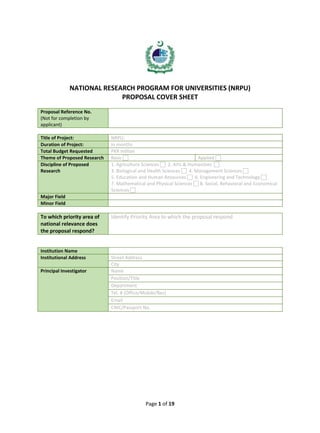
NATIONAL RESEARCH PROGRAM FOR UNIVERSITIES (NRPU)
PROPOSAL COVER SHEET
Proposal Reference No.
(Not for completion by
applicant)
Title of Project: NRPU:
Duration of Project: In months
Total Budget Requested PKR million
Theme of Proposed Research Basic  Applied 
Discipline of Proposed
Research
1. Agriculture Sciences  2. Arts & Humanities 
3. Biological and Health Sciences  4. Management Sciences 
5. Education and Human Resources  6. Engineering and Technology 
7. Mathematical and Physical Sciences  8. Social, Behavioral and Economical
Sciences 
Major Field
Minor Field
To which priority area of
national relevance does
the proposal respond?
Identify Priority Area to which the proposal respond
Institution Name
Institutional Address Street Address
City
Principal Investigator Name
Position/Title
Department
Tel. # (Office/Mobile/Res)
Email
CNIC/Passport No.
Page 2 of 19
TABLE OF CONTENTS
Contents
TABLE OF CONTENTS....................................................................................................................................2
II. EXECUTIVE SUMMARY.............................................................................................................................3
III. PRIORITY AREA OF NATIONAL RELEVANCE, AND IMPACT OF PROPOSED NRPU PROJECT ON THE
PRIORITY AREA.............................................................................................................................................4
IV. ACADEMIC COLLABORATORS.................................................................................................................5
V. SECTORAL COLLABORATORS ..................................................................................................................7
VI. PROJECT DESCRIPTION............................................................................................................................9
VII. PROJECT MANAGEMENT .....................................................................................................................10
VIII. IMPLEMENTATION TIMELINE .............................................................................................................11
IX. PHYSICAL RESOURCES AND FACILITIES.................................................................................................12
X. PROJECT WEAKNESSES AT LAUNCH ......................................................................................................13
XI. RISK MANAGEMENT STRATEGY...........................................................................................................14
XII. RESEARCH GRANTS AVAILED BY THE PRINCIPAL INVESTIGATOR ......................................................15
XIII. LIST OF REFERENCES ...........................................................................................................................16
Page 3 of 19
II. EXECUTIVE SUMMARY
The Executive Summary (limited to one page) provides an overview of the proposed research project. It
should clearly identify the research questions/ challenges related to priority areas of national relevance
and justify how the proposed project addresses those challenges for socio-economic development of the
country. The broad research objectives should be briefly described, as well as the activities to be
undertaken to achieve the project goals. In addition, it should identify the roles of partners – academic
and sectoral1
– that will contribute to the success of the proposed project should be identified.
1
Sectoral stakeholders can include private enterprise (including, but not limited to, large multinationals and regional or local
SMEs), relevant Ministries, government agencies, public authorities, chambers of commerce, trade groups and professional
associations, policymakers and other appropriate stakeholders.
Page 4 of 19
III. PRIORITY AREA OF NATIONAL RELEVANCE, AND IMPACT OF PROPOSED
NRPU PROJECT ON THE PRIORITY AREA
In this Section (maximum two pages), the priority area of national relevance to be addressed by the
proposed NRPU project should be clearly identified. Discuss in some detail (with specifics) what the
proposed project research activities would contribute to the body of research associated with the Priority
Area. Focus the narrative on why the proposed research is important, and why it would be a timely
contribution to research in this field. Finally, address why the proposed research is important in national
context and how the project will support socioeconomic development in Pakistan.
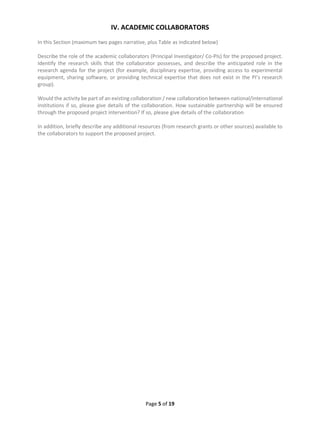
Page 5 of 19
IV. ACADEMIC COLLABORATORS
In this Section (maximum two pages narrative, plus Table as indicated below)
Describe the role of the academic collaborators (Principal Investigator/ Co-PIs) for the proposed project.
Identify the research skills that the collaborator possesses, and describe the anticipated role in the
research agenda for the project (for example, disciplinary expertise, providing access to experimental
equipment, sharing software, or providing technical expertise that does not exist in the PI’s research
group).
Would the activity be part of an existing collaboration / new collaboration between national/international
institutions if so, please give details of the collaboration. How sustainable partnership will be ensured
through the proposed project intervention? If so, please give details of the collaboration
In addition, briefly describe any additional resources (from research grants or other sources) available to
the collaborators to support the proposed project.
Page 6 of 19
Table: Academic Collaborators
All confirmed Academic Collaborators should be identified in this Table. In addition, Letters of
Commitment may be attached to the proposal.
Academic Collaborators
Name of Collaborator
Institution of Collaborator
Country
Location Focus of collaboration: education or research
Tel. # Email
Name of Collaborator
Institution of Collaborator
Country
Location Focus of collaboration: education or research
Tel. # Email
Name of Collaborator
Country
Institution of Collaborator
Location Focus of collaboration: education or research
Tel. # Email
Page 7 of 19
V. SECTORAL COLLABORATORS
In this Section (maximum two pages narrative, plus Table as indicated below),
In this Section (maximum two pages narrative, plus Table as indicated below), describe the role of sectoral
collaborators for the proposed NRPU project.
Identify the research skills that the collaborator possesses, and describe the anticipated role in the
research agenda for the project (for example, disciplinary expertise, providing access to experimental
equipment, sharing software, or providing technical expertise that does not exist in the PI’s research
group).
While the collaborators may evolve over the lifetime of the proposed project, it is expected that the
Principal Investigators has secured upfront commitments from collaborators prior to the submission of
the proposal. If the collaboration existed prior to the development of this proposal, briefly describe the
outcomes of the collaboration to date.
Briefly describe the additional financial resources that the sectoral collaborators bring to support the
proposed project.
Describe how the proposed project will strengthen linkages between HEIs and sectoral stakeholders
through activities such as student internships and dissemination of results.
Page 8 of 19
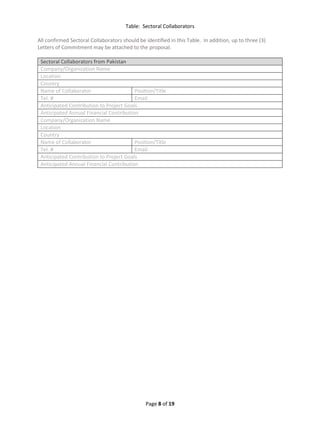
Table: Sectoral Collaborators
All confirmed Sectoral Collaborators should be identified in this Table. In addition, up to three (3)
Letters of Commitment may be attached to the proposal.
Sectoral Collaborators from Pakistan
Company/Organization Name
Location
Country
Name of Collaborator Position/Title
Tel. # Email
Anticipated Contribution to Project Goals
Anticipated Annual Financial Contribution
Company/Organization Name
Location
Country
Name of Collaborator Position/Title
Tel. # Email
Anticipated Contribution to Project Goals
Anticipated Annual Financial Contribution
Page 9 of 19
VI. PROJECT DESCRIPTION
In this Section (maximum ten pages, including Tables and Figures), describe in detail the research plan for
the proposed NRPU project.
Problem Statement: Clearly identify the research challenge, and the approach the project team will
employ to address the challenge. Provide a brief survey of the relevant literature clearly highlighting the
existing gaps and what new information will be added to the existing pool of knowledge and describe how
the proposed project builds on prior research. In case of applied research, identify the industry in Pakistan
which will get benefit from the process/product.
Methodology: Describe how the research plan will be accomplished over the three years of funding
available for the proposed project, and identify appropriate milestones and anticipated deliverables.
Project Team, including partnerships: Comment on the capacity of the proposed team – including faculty
expertise, collaborators and facilities (current or anticipated) – to deliver results in timely manner.
Plans for Dissemination: Given the focus on addressing a research challenge, dissemination of research
results is a core requirement for the proposed project. Describe how data will be collected, curated,
maintained and shared. Beyond publication in international, academic, peer-reviewed journals, what
reports or other formal mechanisms will be employed to share research results with governments,
policymakers and other stakeholders?
Ethical considerations related to the proposed research (If any): The proposal should have a description
of ethical considerations relating to the study. This section should document the issues that are likely to
raise ethical concerns. It should also describe how the Principal Investigator is planning to address it and
how he/she plans to obtain informed consent from the research participants (the informed consent
process).
Incomplete proposal and exceeding the established page limits may not be considered.
Page 10 of 19
VII. PROJECT MANAGEMENT
In this Section (maximum one page), describe the anticipated Project Management structure for the
proposed project. An organogram may be employed.
Discuss how the Principal Investigator plans to motivate and incentivize collaborators – academic and
sectoral - to fulfill their commitments to the research agenda. How will the research results, and
challenges that emerge, be communicated to the Principal Investigators and the rest of the research
team?
As the leader of the host institution, the University Vice-Chancellor/ Rector has a crucial role in the success
of the proposed project. What support will the university leadership provide to the proposed project?
Page 11 of 19
VIII. IMPLEMENTATION TIMELINE
The Implementation Timeline is designed to provide a high-level overview of the planned research
activities of the proposed project. Develop a Gantt Chart to demonstrate how the project will proceed in
a timely fashion. Then, in the Table below, identify up to five major tasks and deliverables planned for
each year of the proposed project. In all aspects, disparate activities should link together to result in a
coherent work plan that achieves the objectives of the proposed project.
In addition to the Gantt Chart and the Table, this Section can include a narrative (maximum two pages)
that provides further details on the Implementation Timeline.
All projects selected for NRPU Funding will be evaluated annually on the achievement of outcome
targets as part of project oversight.
YEAR ONE
Major Tasks and Deliverables





YEAR TWO
Major Tasks and Deliverables





YEAR THREE
Major Tasks and Deliverables





Page 12 of 19
IX. PHYSICAL RESOURCES AND FACILITIES
In this Section (maximum two pages), describe the physical resources and facilities that are available to
the proposed project. Be sure to comment on how these resources and facilities will enable the workplan
of the proposed project to be accomplished.
In this Section, be sure to identify major anticipated equipment expenditures as part of the proposed
project. Include preliminary cost estimates and a plan for maintenance costs both during the lifetime of
the proposed project and after the project funding concludes.
Page 13 of 19
X. PROJECT WEAKNESSES AT LAUNCH
Projects supported through the NRPU will be competitively selected based upon the proposed research
and education activities, the partners and the institutional capability to make significant contributions in
addressing nationally relevant problems as well as the broader societal impacts. At the same time, the
selected projects should be aware of the project weaknesses at launch, and have a plan in place to
overcome these challenges.
In this Section (maximum one page), identify the most significant (between three and five) capacity gaps
that exist at the launch of the proposed project. For each of these gaps, describe the strategy to address
these weaknesses so that the proposed project can achieve its goals.
Page 14 of 19
XI. RISK MANAGEMENT STRATEGY
In this Section (maximum two pages), describe the Risk Management Strategy that will be employed by
the proposed project.
First, consider the potential risks2
that could imperil the progress and success of the proposed project,
and describe the strategy and process that will be used to minimize and address these risks.
Second, describe the strategy that will be used to identify, mitigate and address those unexpected risks
that emerge during the project lifetime.
In both contexts, discuss how the Principal Investigator will work together with the institutional leadership
and collaborators to implement the strategy.
2 Examples of potential risks could include: student or faculty strikes; non-adherence to the university calendar; significant
change to institutional finances; procurement delays; the Covid-19 pandemic.
Page 15 of 19
XII. RESEARCH GRANTS AVAILED BY THE PRINCIPAL INVESTIGATOR
In this section PI will provide one-page summary of each research project completed, on-going or
Submitted (to HEC or any other funding agency) as PI or Co-PI. In the table below please provide following
information:
Sr.
#
Title of Project Initiation
date
Completion
date
Amount(s)
awarded
Funding
source(s)
Page 16 of 19
XIII. LIST OF REFERENCES
Proposals should follow accepted academic practice in citing references throughout the proposal.
References should numbered sequentially, and listed separately as a required attachment to the proposal.
References should be reported in a standard form, and include: the names of all authors; the article and
journal title; book title; volume and page numbers; and year of publication. If available, a Digital Object
Identifier (DOI) may be provided.
Page 17 of 19
XIV. PROPOSED PROJECT BUDGET
Complete the provided Budget Table. Additional rows may be added in each category as required.
(Detailed budget guidelines are available on the website in download section)
 In addition to the institution submitting the proposal, all universities that will have sub awards
must complete a Budget Table for costs anticipated at the sub award university.
 For Personnel Costs, identify the total annual costs for each individual to be charged to the
proposed Grant, and in the narrative indicated below show the months charged for each
individual.
 For Faculty members, identify the faculty member by name
 “Other Personnel” may include technicians, IT specialists, etc.. Identify the role of each “Other
Personnel” listed.
 For Major Equipment, identify the proposed equipment and the anticipated cost. Provide details
in the narrative indicated below
 Provide a broad description of the supplies that will be purchased
 For Travel, provide details of anticipated travel in the narrative indicated below
 For each Sub award, complete a separate Institutional Budget Table and include in this Section of
the Proposal
 For Other Costs, describe in some detail any other costs in the Budget narrative indicated below
 Overhead rates should reflect the official rate for the higher education institution as indicated in
the Budget narrative.
 Overhead should be included for the Project costs at each institution. For example, Overhead can
be included on subaward1. However, the line for Overhead on the Budget Table prepared by the
submitting institution should only include the amounts incurred by the submitting institution.
In addition to the Budget Table, this Section can include a narrative (maximum two pages) that provides
further details on the proposed budget. Each institution submitting a budget for a sub award may include
a (maximum 2 pages) budget narrative.
Page 18 of 19
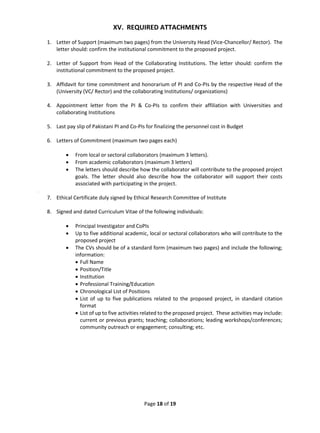
XV. REQUIRED ATTACHMENTS
1. Letter of Support (maximum two pages) from the University Head (Vice-Chancellor/ Rector). The
letter should: confirm the institutional commitment to the proposed project.
2. Letter of Support from Head of the Collaborating Institutions. The letter should: confirm the
institutional commitment to the proposed project.
3. Affidavit for time commitment and honorarium of PI and Co-PIs by the respective Head of the
(University (VC/ Rector) and the collaborating Institutions/ organizations)
4. Appointment letter from the PI & Co-PIs to confirm their affiliation with Universities and
collaborating Institutions
5. Last pay slip of Pakistani PI and Co-PIs for finalizing the personnel cost in Budget
6. Letters of Commitment (maximum two pages each)
 From local or sectoral collaborators (maximum 3 letters).
 From academic collaborators (maximum 3 letters)
 The letters should describe how the collaborator will contribute to the proposed project
goals. The letter should also describe how the collaborator will support their costs
associated with participating in the project.
.
7. Ethical Certificate duly signed by Ethical Research Committee of Institute
8. Signed and dated Curriculum Vitae of the following individuals:
 Principal Investigator and CoPIs
 Up to five additional academic, local or sectoral collaborators who will contribute to the
proposed project
 The CVs should be of a standard form (maximum two pages) and include the following;
information:
 Full Name
 Position/Title
 Institution
 Professional Training/Education
 Chronological List of Positions
 List of up to five publications related to the proposed project, in standard citation
format
 List of up to five activities related to the proposed project. These activities may include:
current or previous grants; teaching; collaborations; leading workshops/conferences;
community outreach or engagement; consulting; etc.
Page 19 of 19
Declaration Certificate:
It is hereby certified that:
a) PI is a full time regular faculty member of HEI or if is hired on contract, same is not less
than project life/duration.
b) The university will spare the faculty members from any teaching or administrative
responsibilities against their time committed on the proposed project.
c) Equipment(s) demanded for the proposed project is / are not available in the University
/ Institute.
d) No portion of the proposed project has been submitted and /or funded by HEC or any
other funding agency.
e) The proposed project is genuinely novel and that there is no plagiarized material including
self-plagiarism.
f) PI has never been blacklisted by HEC.
g) PI is not executing any other project of HEC which is delayed.
h) Decision of HEC will be considered final and will not be challenged in a court of law.
i) The University/DAI will provide complete support and facilitation to the PI and his project
team for the establishment & operation of the proposed project, if approved by HEC and
funds awarded to the University/ DAI. Accordingly, the University/ DAI will provide
necessary facilities for smooth execution of the project including land, building, space,
laboratories, machinery, equipment, transport, amenities like utilities and other services.
j) The University/DAI will get clearance from HEC (Project Completion Certificate /Project
Clearance Certificate (PCC)) in order to relieve the PI, for any reason e.g. for postdoc
leave/EOL/study leave/ termination of job etc, if the proposed project is awarded by HEC.
k) The University/DAI will not replace the PI of the proposed project without getting prior
permission from HEC in writing.
Signature of Principal Investigator
Name:
Designation:
Department:
University/ DAI Name
Signature with Stamp of Director
(ORIC/Research Office)
Name:
Designation:
University/DAI Name
Signature with Stamp of the Head of University/ DAI
(Vice-chancellor/Rector)
Name:
University/ DAI Name:

Full Proposal Template - NRPU (2HEC).docx

  • 1.
    Page 1 of19 NATIONAL RESEARCH PROGRAM FOR UNIVERSITIES (NRPU) PROPOSAL COVER SHEET Proposal Reference No. (Not for completion by applicant) Title of Project: NRPU: Duration of Project: In months Total Budget Requested PKR million Theme of Proposed Research Basic  Applied  Discipline of Proposed Research 1. Agriculture Sciences  2. Arts & Humanities  3. Biological and Health Sciences  4. Management Sciences  5. Education and Human Resources  6. Engineering and Technology  7. Mathematical and Physical Sciences  8. Social, Behavioral and Economical Sciences  Major Field Minor Field To which priority area of national relevance does the proposal respond? Identify Priority Area to which the proposal respond Institution Name Institutional Address Street Address City Principal Investigator Name Position/Title Department Tel. # (Office/Mobile/Res) Email CNIC/Passport No.
  • 2.
    Page 2 of19 TABLE OF CONTENTS Contents TABLE OF CONTENTS....................................................................................................................................2 II. EXECUTIVE SUMMARY.............................................................................................................................3 III. PRIORITY AREA OF NATIONAL RELEVANCE, AND IMPACT OF PROPOSED NRPU PROJECT ON THE PRIORITY AREA.............................................................................................................................................4 IV. ACADEMIC COLLABORATORS.................................................................................................................5 V. SECTORAL COLLABORATORS ..................................................................................................................7 VI. PROJECT DESCRIPTION............................................................................................................................9 VII. PROJECT MANAGEMENT .....................................................................................................................10 VIII. IMPLEMENTATION TIMELINE .............................................................................................................11 IX. PHYSICAL RESOURCES AND FACILITIES.................................................................................................12 X. PROJECT WEAKNESSES AT LAUNCH ......................................................................................................13 XI. RISK MANAGEMENT STRATEGY...........................................................................................................14 XII. RESEARCH GRANTS AVAILED BY THE PRINCIPAL INVESTIGATOR ......................................................15 XIII. LIST OF REFERENCES ...........................................................................................................................16
  • 3.
    Page 3 of19 II. EXECUTIVE SUMMARY The Executive Summary (limited to one page) provides an overview of the proposed research project. It should clearly identify the research questions/ challenges related to priority areas of national relevance and justify how the proposed project addresses those challenges for socio-economic development of the country. The broad research objectives should be briefly described, as well as the activities to be undertaken to achieve the project goals. In addition, it should identify the roles of partners – academic and sectoral1 – that will contribute to the success of the proposed project should be identified. 1 Sectoral stakeholders can include private enterprise (including, but not limited to, large multinationals and regional or local SMEs), relevant Ministries, government agencies, public authorities, chambers of commerce, trade groups and professional associations, policymakers and other appropriate stakeholders.
  • 4.
    Page 4 of19 III. PRIORITY AREA OF NATIONAL RELEVANCE, AND IMPACT OF PROPOSED NRPU PROJECT ON THE PRIORITY AREA In this Section (maximum two pages), the priority area of national relevance to be addressed by the proposed NRPU project should be clearly identified. Discuss in some detail (with specifics) what the proposed project research activities would contribute to the body of research associated with the Priority Area. Focus the narrative on why the proposed research is important, and why it would be a timely contribution to research in this field. Finally, address why the proposed research is important in national context and how the project will support socioeconomic development in Pakistan.
  • 5.
    Page 5 of19 IV. ACADEMIC COLLABORATORS In this Section (maximum two pages narrative, plus Table as indicated below) Describe the role of the academic collaborators (Principal Investigator/ Co-PIs) for the proposed project. Identify the research skills that the collaborator possesses, and describe the anticipated role in the research agenda for the project (for example, disciplinary expertise, providing access to experimental equipment, sharing software, or providing technical expertise that does not exist in the PI’s research group). Would the activity be part of an existing collaboration / new collaboration between national/international institutions if so, please give details of the collaboration. How sustainable partnership will be ensured through the proposed project intervention? If so, please give details of the collaboration In addition, briefly describe any additional resources (from research grants or other sources) available to the collaborators to support the proposed project.
  • 6.
    Page 6 of19 Table: Academic Collaborators All confirmed Academic Collaborators should be identified in this Table. In addition, Letters of Commitment may be attached to the proposal. Academic Collaborators Name of Collaborator Institution of Collaborator Country Location Focus of collaboration: education or research Tel. # Email Name of Collaborator Institution of Collaborator Country Location Focus of collaboration: education or research Tel. # Email Name of Collaborator Country Institution of Collaborator Location Focus of collaboration: education or research Tel. # Email
  • 7.
    Page 7 of19 V. SECTORAL COLLABORATORS In this Section (maximum two pages narrative, plus Table as indicated below), In this Section (maximum two pages narrative, plus Table as indicated below), describe the role of sectoral collaborators for the proposed NRPU project. Identify the research skills that the collaborator possesses, and describe the anticipated role in the research agenda for the project (for example, disciplinary expertise, providing access to experimental equipment, sharing software, or providing technical expertise that does not exist in the PI’s research group). While the collaborators may evolve over the lifetime of the proposed project, it is expected that the Principal Investigators has secured upfront commitments from collaborators prior to the submission of the proposal. If the collaboration existed prior to the development of this proposal, briefly describe the outcomes of the collaboration to date. Briefly describe the additional financial resources that the sectoral collaborators bring to support the proposed project. Describe how the proposed project will strengthen linkages between HEIs and sectoral stakeholders through activities such as student internships and dissemination of results.
  • 8.
    Page 8 of19 Table: Sectoral Collaborators All confirmed Sectoral Collaborators should be identified in this Table. In addition, up to three (3) Letters of Commitment may be attached to the proposal. Sectoral Collaborators from Pakistan Company/Organization Name Location Country Name of Collaborator Position/Title Tel. # Email Anticipated Contribution to Project Goals Anticipated Annual Financial Contribution Company/Organization Name Location Country Name of Collaborator Position/Title Tel. # Email Anticipated Contribution to Project Goals Anticipated Annual Financial Contribution
  • 9.
    Page 9 of19 VI. PROJECT DESCRIPTION In this Section (maximum ten pages, including Tables and Figures), describe in detail the research plan for the proposed NRPU project. Problem Statement: Clearly identify the research challenge, and the approach the project team will employ to address the challenge. Provide a brief survey of the relevant literature clearly highlighting the existing gaps and what new information will be added to the existing pool of knowledge and describe how the proposed project builds on prior research. In case of applied research, identify the industry in Pakistan which will get benefit from the process/product. Methodology: Describe how the research plan will be accomplished over the three years of funding available for the proposed project, and identify appropriate milestones and anticipated deliverables. Project Team, including partnerships: Comment on the capacity of the proposed team – including faculty expertise, collaborators and facilities (current or anticipated) – to deliver results in timely manner. Plans for Dissemination: Given the focus on addressing a research challenge, dissemination of research results is a core requirement for the proposed project. Describe how data will be collected, curated, maintained and shared. Beyond publication in international, academic, peer-reviewed journals, what reports or other formal mechanisms will be employed to share research results with governments, policymakers and other stakeholders? Ethical considerations related to the proposed research (If any): The proposal should have a description of ethical considerations relating to the study. This section should document the issues that are likely to raise ethical concerns. It should also describe how the Principal Investigator is planning to address it and how he/she plans to obtain informed consent from the research participants (the informed consent process). Incomplete proposal and exceeding the established page limits may not be considered.
  • 10.
    Page 10 of19 VII. PROJECT MANAGEMENT In this Section (maximum one page), describe the anticipated Project Management structure for the proposed project. An organogram may be employed. Discuss how the Principal Investigator plans to motivate and incentivize collaborators – academic and sectoral - to fulfill their commitments to the research agenda. How will the research results, and challenges that emerge, be communicated to the Principal Investigators and the rest of the research team? As the leader of the host institution, the University Vice-Chancellor/ Rector has a crucial role in the success of the proposed project. What support will the university leadership provide to the proposed project?
  • 11.
    Page 11 of19 VIII. IMPLEMENTATION TIMELINE The Implementation Timeline is designed to provide a high-level overview of the planned research activities of the proposed project. Develop a Gantt Chart to demonstrate how the project will proceed in a timely fashion. Then, in the Table below, identify up to five major tasks and deliverables planned for each year of the proposed project. In all aspects, disparate activities should link together to result in a coherent work plan that achieves the objectives of the proposed project. In addition to the Gantt Chart and the Table, this Section can include a narrative (maximum two pages) that provides further details on the Implementation Timeline. All projects selected for NRPU Funding will be evaluated annually on the achievement of outcome targets as part of project oversight. YEAR ONE Major Tasks and Deliverables      YEAR TWO Major Tasks and Deliverables      YEAR THREE Major Tasks and Deliverables     
  • 12.
    Page 12 of19 IX. PHYSICAL RESOURCES AND FACILITIES In this Section (maximum two pages), describe the physical resources and facilities that are available to the proposed project. Be sure to comment on how these resources and facilities will enable the workplan of the proposed project to be accomplished. In this Section, be sure to identify major anticipated equipment expenditures as part of the proposed project. Include preliminary cost estimates and a plan for maintenance costs both during the lifetime of the proposed project and after the project funding concludes.
  • 13.
    Page 13 of19 X. PROJECT WEAKNESSES AT LAUNCH Projects supported through the NRPU will be competitively selected based upon the proposed research and education activities, the partners and the institutional capability to make significant contributions in addressing nationally relevant problems as well as the broader societal impacts. At the same time, the selected projects should be aware of the project weaknesses at launch, and have a plan in place to overcome these challenges. In this Section (maximum one page), identify the most significant (between three and five) capacity gaps that exist at the launch of the proposed project. For each of these gaps, describe the strategy to address these weaknesses so that the proposed project can achieve its goals.
  • 14.
    Page 14 of19 XI. RISK MANAGEMENT STRATEGY In this Section (maximum two pages), describe the Risk Management Strategy that will be employed by the proposed project. First, consider the potential risks2 that could imperil the progress and success of the proposed project, and describe the strategy and process that will be used to minimize and address these risks. Second, describe the strategy that will be used to identify, mitigate and address those unexpected risks that emerge during the project lifetime. In both contexts, discuss how the Principal Investigator will work together with the institutional leadership and collaborators to implement the strategy. 2 Examples of potential risks could include: student or faculty strikes; non-adherence to the university calendar; significant change to institutional finances; procurement delays; the Covid-19 pandemic.
  • 15.
    Page 15 of19 XII. RESEARCH GRANTS AVAILED BY THE PRINCIPAL INVESTIGATOR In this section PI will provide one-page summary of each research project completed, on-going or Submitted (to HEC or any other funding agency) as PI or Co-PI. In the table below please provide following information: Sr. # Title of Project Initiation date Completion date Amount(s) awarded Funding source(s)
  • 16.
    Page 16 of19 XIII. LIST OF REFERENCES Proposals should follow accepted academic practice in citing references throughout the proposal. References should numbered sequentially, and listed separately as a required attachment to the proposal. References should be reported in a standard form, and include: the names of all authors; the article and journal title; book title; volume and page numbers; and year of publication. If available, a Digital Object Identifier (DOI) may be provided.
  • 17.
    Page 17 of19 XIV. PROPOSED PROJECT BUDGET Complete the provided Budget Table. Additional rows may be added in each category as required. (Detailed budget guidelines are available on the website in download section)  In addition to the institution submitting the proposal, all universities that will have sub awards must complete a Budget Table for costs anticipated at the sub award university.  For Personnel Costs, identify the total annual costs for each individual to be charged to the proposed Grant, and in the narrative indicated below show the months charged for each individual.  For Faculty members, identify the faculty member by name  “Other Personnel” may include technicians, IT specialists, etc.. Identify the role of each “Other Personnel” listed.  For Major Equipment, identify the proposed equipment and the anticipated cost. Provide details in the narrative indicated below  Provide a broad description of the supplies that will be purchased  For Travel, provide details of anticipated travel in the narrative indicated below  For each Sub award, complete a separate Institutional Budget Table and include in this Section of the Proposal  For Other Costs, describe in some detail any other costs in the Budget narrative indicated below  Overhead rates should reflect the official rate for the higher education institution as indicated in the Budget narrative.  Overhead should be included for the Project costs at each institution. For example, Overhead can be included on subaward1. However, the line for Overhead on the Budget Table prepared by the submitting institution should only include the amounts incurred by the submitting institution. In addition to the Budget Table, this Section can include a narrative (maximum two pages) that provides further details on the proposed budget. Each institution submitting a budget for a sub award may include a (maximum 2 pages) budget narrative.
  • 18.
    Page 18 of19 XV. REQUIRED ATTACHMENTS 1. Letter of Support (maximum two pages) from the University Head (Vice-Chancellor/ Rector). The letter should: confirm the institutional commitment to the proposed project. 2. Letter of Support from Head of the Collaborating Institutions. The letter should: confirm the institutional commitment to the proposed project. 3. Affidavit for time commitment and honorarium of PI and Co-PIs by the respective Head of the (University (VC/ Rector) and the collaborating Institutions/ organizations) 4. Appointment letter from the PI & Co-PIs to confirm their affiliation with Universities and collaborating Institutions 5. Last pay slip of Pakistani PI and Co-PIs for finalizing the personnel cost in Budget 6. Letters of Commitment (maximum two pages each)  From local or sectoral collaborators (maximum 3 letters).  From academic collaborators (maximum 3 letters)  The letters should describe how the collaborator will contribute to the proposed project goals. The letter should also describe how the collaborator will support their costs associated with participating in the project. . 7. Ethical Certificate duly signed by Ethical Research Committee of Institute 8. Signed and dated Curriculum Vitae of the following individuals:  Principal Investigator and CoPIs  Up to five additional academic, local or sectoral collaborators who will contribute to the proposed project  The CVs should be of a standard form (maximum two pages) and include the following; information:  Full Name  Position/Title  Institution  Professional Training/Education  Chronological List of Positions  List of up to five publications related to the proposed project, in standard citation format  List of up to five activities related to the proposed project. These activities may include: current or previous grants; teaching; collaborations; leading workshops/conferences; community outreach or engagement; consulting; etc.
  • 19.
    Page 19 of19 Declaration Certificate: It is hereby certified that: a) PI is a full time regular faculty member of HEI or if is hired on contract, same is not less than project life/duration. b) The university will spare the faculty members from any teaching or administrative responsibilities against their time committed on the proposed project. c) Equipment(s) demanded for the proposed project is / are not available in the University / Institute. d) No portion of the proposed project has been submitted and /or funded by HEC or any other funding agency. e) The proposed project is genuinely novel and that there is no plagiarized material including self-plagiarism. f) PI has never been blacklisted by HEC. g) PI is not executing any other project of HEC which is delayed. h) Decision of HEC will be considered final and will not be challenged in a court of law. i) The University/DAI will provide complete support and facilitation to the PI and his project team for the establishment & operation of the proposed project, if approved by HEC and funds awarded to the University/ DAI. Accordingly, the University/ DAI will provide necessary facilities for smooth execution of the project including land, building, space, laboratories, machinery, equipment, transport, amenities like utilities and other services. j) The University/DAI will get clearance from HEC (Project Completion Certificate /Project Clearance Certificate (PCC)) in order to relieve the PI, for any reason e.g. for postdoc leave/EOL/study leave/ termination of job etc, if the proposed project is awarded by HEC. k) The University/DAI will not replace the PI of the proposed project without getting prior permission from HEC in writing. Signature of Principal Investigator Name: Designation: Department: University/ DAI Name Signature with Stamp of Director (ORIC/Research Office) Name: Designation: University/DAI Name Signature with Stamp of the Head of University/ DAI (Vice-chancellor/Rector) Name: University/ DAI Name: