Page 1
Proposal Templet
2024-2025
Contact Info.
Eng. Ahmed AbuAbdu
ahmedabuabdu90@outlook.com
0097599815677 (WhatsApp)
ProjectProposal
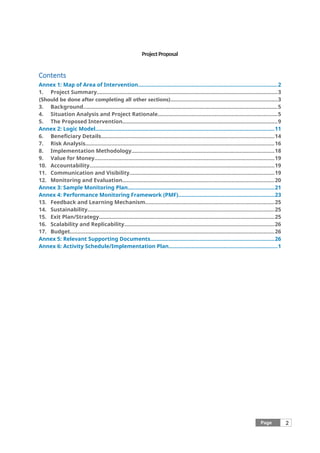
Contents
Annex 1: Map of Area of Intervention...........................................................................................2
1. Project Summary......................................................................................................................3
(Should be done after completing all other sections)......................................................................3
3. Background...............................................................................................................................5
4. Situation Analysis and Project Rationale..............................................................................5
5. The Proposed Intervention.....................................................................................................9
Annex 2: Logic Model.....................................................................................................................11
6. Beneficiary Details.................................................................................................................14
7. Risk Analysis...........................................................................................................................16
8. Implementation Methodology.............................................................................................18
9. Value for Money.....................................................................................................................19
10. Accountability.........................................................................................................................19
11. Communication and Visibility..............................................................................................19
12. Monitoring and Evaluation...................................................................................................20
Annex 3: Sample Monitoring Plan................................................................................................21
Annex 4: Performance Monitoring Framework (PMF)...............................................................23
13. Feedback and Learning Mechanism....................................................................................25
14. Sustainability..........................................................................................................................25
15. Exit Plan/Strategy..................................................................................................................25
16. Scalability and Replicability..................................................................................................26
17. Budget.....................................................................................................................................26
Annex 5: Relevant Supporting Documents.................................................................................26
Annex 6: Activity Schedule/Implementation Plan.......................................................................1
Page 2
Annex 1: Map of Area of Intervention
Background to the Problem
Enter a small paragraph here regarding a brief background about the problem.
Page 3
[Enter Caption here]
Click
on
snapshot
picture
above
to
insert
image
1. Project Summary
(Should be done after completing all other sections)
Concept ID Number
(From AX/PSP)
Enter Concept ID here
Project Name
(And acronym, if
relevant)
The title formulation should be based on the impact (long-term result) of the proje
IR PIN Code and
Donor
Enter PIN Code here. Enter Donor here.
Submitted By Name and Designation of Contact Person
Contact Person in
Field
Name and Designation of Contact Person (at Field Level)
Contact Person in
IRW
Name and Designation of Contact Person (at IRW)
Project Location Village(s), District, Region, Country
Project Type Select a Project Type
Project Sector
(Linked with the
Concept Note)
Select a Sector.
Project Summary
(1/2 Pages)
Please summarise the proposed project into one paragraph.
Project Duration Enter number of Months here Month
Proposed Start Date Select Start Date
Budget/SLA Value Reporting Currency GBP Conversion
Enter Budget Value here Select Currency Enter Budget Value here GBP
Cost per
Beneficiary
Reporting Currency GBP Conversion
Price Handles
(For Marketing
Purposes – Excluding
Fundraising Costs)
Enter Cost Value Select Currency Enter Cost Value GBP
Cost per
Project
Component
Enter Cost Value Select Currency Enter Cost Value GBP
Other Price
Handles
Enter Cost Value Select Currency Enter Cost Value GBP
Project
Implemented by
Select Implementing Partner/Islamic Relief Office
Project Contribution
Contributors can
either come from
Institutional Donors,
Partners, Middle
Eastern and
Emerging Market
donors etc.
Contributor
(Cash)
Enter Cost Value Select Currency Enter Cost Value GBP
Contributor
(In-kind)
Enter Cost Value Select Currency Enter Cost Value GBP
Community
Contribution
(Cash)
Enter Cost Value Select Currency Enter Cost Value GBP
Beneficiaries Total Number
of Direct Enter Number of Direct Beneficiaries.
Page 4
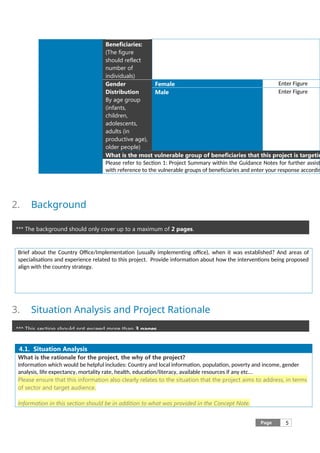
Beneficiaries:
(The figure
should reflect
number of
individuals)
Gender
Distribution
By age group
(infants,
children,
adolescents,
adults (in
productive age),
older people)
Female Enter Figure
Male Enter Figure
What is the most vulnerable group of beneficiaries that this project is targetin
Please refer to Section 1: Project Summary within the Guidance Notes for further assist
with reference to the vulnerable groups of beneficiaries and enter your response accordin
2. Background
Brief about the Country Office/Implementation (usually implementing office), when it was established? And areas of
specialisations and experience related to this project. Provide information about how the interventions being proposed
align with the country strategy.
3. Situation Analysis and Project Rationale
4.1. Situation Analysis
What is the rationale for the project, the why of the project?
Information which would be helpful includes: Country and local information, population, poverty and income, gender
analysis, life expectancy, mortality rate, health, education/literacy, available resources if any etc...
Please ensure that this information also clearly relates to the situation that the project aims to address, in terms
of sector and target audience.
Information in this section should be in addition to what was provided in the Concept Note.
Page 5
*** The background should only cover up to a maximum of 2 pages.
*** This section should not exceed more than 3 pages.
4.2. Problem Analysis
Based on the information which is provided in the Guidance Notes under section 4.1. Please provide a
problem analysis to the proposed project?
(Please refer to the ‘Problem Analysis’ section of the IRW Project Management handbook by clicking here)
Provide your response here with reference to the problem analysis
4.3. Needs Assessment
Provide details of any needs assessment carried out.
(Ensure that gender-specific needs of women, men, boys and girls are assessed)
Enter your response here
4.4. Baseline Survey
Please summarise the results from the baseline survey and attach the full results.
(Ensure that the baseline survey involves both females and males. Please refer to the Guidance Notes for
further information)
Enter baseline data here
Page 6
4.5. Stakeholder Analysis
Tool 1: Stakeholder Analysis to identify, define and map the problem to be addressed
Stakeholder 1 Stakeholder 2 Stakeholder 3 Stakeholder 4 Stakeholder 5
Role Enter Role for Stakeholder 1
here
Enter Role for
Stakeholder 2 here
Enter Role for
Stakeholder 3 here
Enter Role for
Stakeholder 4 here
Enter Role for
Stakeholder 5 here
Needs (From the Project) Enter Needs for
Stakeholder 1 here
Enter Needs for
Stakeholder 2 here
Enter Needs for
Stakeholder 3 here
Enter Needs for
Stakeholder 4 here
Enter Needs for
Stakeholder 5 here
Potential Positive
Impacts of the Project
on this Group
Enter Potential Positive
Impacts for Stakeholder 1
here
Enter Potential Positive
Impacts for Stakeholder
2 here
Enter Potential Positive
Impacts for
Stakeholder 3 here
Enter Potential Positive
Impacts for
Stakeholder 4 here
Enter Potential Positive
Impacts for
Stakeholder 5 here
Potential Negative
Impacts of the Project
on this Group
Enter Potential Negative
Impacts for Stakeholder 1
here
Enter Potential Negative
Impacts for Stakeholder
2 here
Enter Potential
Negative Impacts for
Stakeholder 3 here
Enter Potential
Negative Impacts for
Stakeholder 4 here
Enter Potential
Negative Impacts for
Stakeholder 5 here
Relative Priority of
Interests
(1 is Low and 10 is High)
Enter Priority of Interests
for Stakeholder 1 here
Enter Priority of Interests
for Stakeholder 2 here
Enter Priority of
Interests for
Stakeholder 3 here
Enter Priority of
Interests for
Stakeholder 4 here
Enter Priority of
Interests for
Stakeholder 5 here
RACI (Please refer to the
key below)
Select RACI Code for
Stakeholder 1
Select RACI Code for
Stakeholder 2
Select RACI Code for
Stakeholder 3
Select RACI Code for
Stakeholder 4
Select RACI Code for
Stakeholder 5
R Responsible A Accountable C Consulted I Informed
Page 7
4. The Proposed Intervention
5.1. Project Impact
What is the long term result?
Enter the project impact here
5.2. Project Outcomes
What are the medium term results?
Enter the project outcomes here
5.3. Project Outputs
What are the short term results?
Enter the project outputs here
5.4. Project Activities
What are the main activities that will be carried out to achieve the project results?
Enter the main activities here
5.5. Project Inputs
What are the main inputs that are required to carry out the project activities and thereby achieve the
project results?
Enter the main inputs here
5.6. Describing the Proposed Project
From what was provided in sections 5.1. - 5.4., please elaborate on what in practical terms are the
developmental long-term results (Impact), the medium term results (Outcomes) and short-term results
(Outputs) that the project hopes to achieve?
Enter your response here
Describe your overall theory of change which justifies the programme strategy you have chosen.
Enter your response here
Describe the aspects of project integration? (Please refer to section 5.5. of the Guidance Notes for further
details)
Enter your response here
Page 8
Describe project sustainability?
(Please refer to section 14 of the Guidance Notes for further details)
Enter your response here
Is the intervention part of an ongoing/or larger programme? How was it ensured that the project was
not duplicated? If similar projects do exist, how are aspects of these projects
alike/dissimilar/complementary (if applicable)? To what extent is this project building on lessons from
similar responses from previous interventions from this or other countries? (Please give references of all
documents that you have consulted)
Enter your response here
Page 9
5.7. Logic Model/Results Chain
Please complete the Logic Model (Annex 2) which should demonstrate a causal link between impact, outcomes, outputs and main activities.
You need to consider the following questions when completing the Logic Model.
 Are the outcomes and outputs logically linked to achieve the impact of the project?
 Are the activities logically linked to the outputs in order to achieve the project results?
 Were the key stakeholders consulted when developing the results chain?
Annex 2: Logic Model
Impact Enter Long Term Result here
Outcome Enter 1. Medium Term Result here Enter 2. Medium Term Result here Enter 3. Medium Term Result here
Outputs
(These are linked to each
outcome)
Enter 1.1
Short Term
Result here
Enter 1.2
Short Term
Result here
Enter 1.3
Short Term
Result here
Enter 2.1
Short Term
Result here
Enter 2.2
Short Term
Result here
Enter 2.3
Short Term
Result here
Enter 3.1
Short Term
Result here
Enter 3.2
Short Term
Result here
Enter 3.3
Short Term
Result here
Main Activities
(These are linked to each
output)
Enter Activity
for 1.1 Short
Term Result
here
Enter Activity
for 1.2 Short
Term Result
here
Enter Activity
for 1.3 Short
Term Result
here
Enter Activity
for 2.1 Short
Term Result
here
Enter Activity
for 2.2 Short
Term Result
here
Enter Activity
for 2.3 Short
Term Result
here
Enter Activity
for 3.1 Short
Term Result
here
Enter Activity
for 3.2 Short
Term Result
here
Enter Activity
for 3.3 Short
Term Result
here
Enter Activity
for 1.1 Short
Term Result
Enter Activity
for 1.2 Short
Term Result
Enter Activity
for 1.3 Short
Term Result
Enter Activity
for 2.1 Short
Term Result
Enter Activity
for 2.2 Short
Term Result
Enter Activity
for 2.3 Short
Term Result
Enter Activity
for 3.1 Short
Term Result
Enter Activity
for 3.2 Short
Term Result
Enter Activity
for 3.3 Short
Term Result
Page 1
0
here here here here here here here here here
Enter Activity
for 1.1 Short
Term Result
here
Enter Activity
for 1.2 Short
Term Result
here
Enter Activity
for 1.3 Short
Term Result
here
Enter Activity
for 2.1 Short
Term Result
here
Enter Activity
for 2.2 Short
Term Result
here
Enter Activity
for 2.3 Short
Term Result
here
Enter Activity
for 3.1 Short
Term Result
here
Enter Activity
for 3.2 Short
Term Result
here
Enter Activity
for 3.3 Short
Term Result
here
Enter Activity
for 1.1 Short
Term Result
here
Enter Activity
for 1.2 Short
Term Result
here
Enter Activity
for 1.3 Short
Term Result
here
Enter Activity
for 2.1 Short
Term Result
here
Enter Activity
for 2.2 Short
Term Result
here
Enter Activity
for 2.3 Short
Term Result
here
Enter Activity
for 3.1 Short
Term Result
here
Enter Activity
for 3.2 Short
Term Result
here
Enter Activity
for 3.3 Short
Term Result
here
Enter Activity
for 1.1 Short
Term Result
here
Enter Activity
for 1.2 Short
Term Result
here
Enter Activity
for 1.3 Short
Term Result
here
Enter Activity
for 2.1 Short
Term Result
here
Enter Activity
for 2.2 Short
Term Result
here
Enter Activity
for 2.3 Short
Term Result
here
Enter Activity
for 3.1 Short
Term Result
here
Enter Activity
for 3.2 Short
Term Result
here
Enter Activity
for 3.3 Short
Term Result
here
Main Inputs
(These are linked to each
activity)
Enter Input
for 1.1 Short
Term Result
here
Enter Input
for 1.2 Short
Term Result
here
Enter Input
for 1.3 Short
Term Result
here
Enter Input
for 2.1 Short
Term Result
here
Enter Input
for 2.2 Short
Term Result
here
Enter Input
for 2.3 Short
Term Result
here
Enter Input
for 3.1 Short
Term Result
here
Enter Input
for 3.2 Short
Term Result
here
Enter Input
for 3.3 Short
Term Result
here
Enter Input
for 1.1 Short
Term Result
here
Enter Input
for 1.2 Short
Term Result
here
Enter Input
for 1.3 Short
Term Result
here
Enter Input
for 2.1 Short
Term Result
here
Enter Input
for 2.2 Short
Term Result
here
Enter Input
for 2.3 Short
Term Result
here
Enter Input
for 3.1 Short
Term Result
here
Enter Input
for 3.2 Short
Term Result
here
Enter Input
for 3.3 Short
Term Result
here
Enter Input
for 1.1 Short
Term Result
here
Enter Input
for 1.2 Short
Term Result
here
Enter Input
for 1.3 Short
Term Result
here
Enter Input
for 2.1 Short
Term Result
here
Enter Input
for 2.2 Short
Term Result
here
Enter Input
for 2.3 Short
Term Result
here
Enter Input
for 3.1 Short
Term Result
here
Enter Input
for 3.2 Short
Term Result
here
Enter Input
for 3.3 Short
Term Result
here
Enter Input
for 1.1 Short
Term Result
here
Enter Input
for 1.2 Short
Term Result
here
Enter Input
for 1.3 Short
Term Result
here
Enter Input
for 2.1 Short
Term Result
here
Enter Input
for 2.2 Short
Term Result
here
Enter Input
for 2.3 Short
Term Result
here
Enter Input
for 3.1 Short
Term Result
here
Enter Input
for 3.2 Short
Term Result
here
Enter Input
for 3.3 Short
Term Result
here
Enter Input Enter Input Enter Input Enter Input Enter Input Enter Input Enter Input Enter Input Enter Input
Page 1
1
for 1.1 Short
Term Result
here
for 1.2 Short
Term Result
here
for 1.3 Short
Term Result
here
for 2.1 Short
Term Result
here
for 2.2 Short
Term Result
here
for 2.3 Short
Term Result
here
for 3.1 Short
Term Result
here
for 3.2 Short
Term Result
here
for 3.3 Short
Term Result
here
Page 1
2
Note: For short-term projects, the project can have two levels of results only (instead of three).
5.8. Cross Cutting Themes
Please indicate what contribution there will be on the IR Strategic Focus Areas and cross cutting themes
include consideration of the following:
 capacity building of civil society,
 climate change,
 child welfare,
 gender rights of women, men, boys and girls, supporting gender roles and responsibilities,
equitable share of resources, services and opportunities, equitable participation, division of labour
and protection,
 disaster risk reduction,
 disaster preparedness
 environmental protection
 others (please specify)
Enter the details for the Cross Cutting Themes here
5. Beneficiary Details
6.1. Direct Beneficiaries
Number of direct beneficiaries
(Disaggregate as far as possible by gender, age, disability, urban/rural, ethnicity/race, class/caste,
religion)
Enter your response here
What inequalities do exist between different social groups of beneficiaries in terms of access to and
control over resources, division of labour, decision making on the household and community level,
participation, power relations, security risks etc…? How will the project reduce these inequalities?
Enter your response here
6.2. Indirect Beneficiaries
Number of indirect beneficiaries
(Disaggregate as far as possible by gender, age, disability, internally displaced (IDPs), urban/rural,
ethnicity/race, class/caste, religion. In addition include the number of males and females as well)
Enter your response here
What profile of women, men, boys and girls of different social groups will indirectly benefit from this
project?
(E.g. rural or urban dwellers, literate, illiterate, employed, unemployed etc…)
Enter your response here
How will women, men, boys and girls of different social groups benefit from the project indirectly?
Enter your response here
Page 1
3
6.3. Role of Beneficiaries
How were women, men, boys and girls of different social groups consulted?
Enter your response here
How are the findings from the consultation reflected in the proposed project design?
Enter your response here
How will women, men, boys and girls of different social groups participate in the project? (Please
comment with respect to all of the components for PCM e.g. – programme assessment, design,
implementation, M & E and learning)
Enter your response here
Is there any contribution/involvement from the community/beneficiaries in any form with regards to
this proposed project?
Enter your response here
Page 1
4
6. Risk Analysis
Please complete the Risk Matrix below
(Risks are future problems/constraints that may affect the achievement & project results)
Risk Probability/
Likelihood
(High, Medium or Low)
Business Impact
(Select Level of Impact)
Risk Response
Strategy
(Select Risk Response
Strategy from Menu))
Detail of Risk
Response Strategy
Risk Owner
(Person Responsible for
Managing Risk)
Enter the risk here Select level of likelihood Select level of impact Select risk response
strategy
Enter your reason here Enter risk owner here
Enter the risk here Select level of likelihood Select level of impact Select risk response
strategy
Enter your reason here Enter risk owner here
Enter the risk here Select level of likelihood Select level of impact Select risk response
strategy
Enter your reason here Enter risk owner here
Enter the risk here Select level of likelihood Select level of impact Select risk response
strategy
Enter your reason here Enter risk owner here
Enter the risk here Select level of likelihood Select level of impact Select risk response
strategy
Enter your reason here Enter risk owner here
Page 1
5
7. Implementation Methodology
8.1. Implementation Strategy
Briefly explain how will the project be implemented? (Needs rephrasing)
Enter your response here
8.2. Project Organogram
How will the project be managed?
Provide a chart/table illustrating the organisation chart of the project team that showing staff positions.
Use the organogram chart below to construct the organisation chart.
8.3. Implementation Plan (See Annex 6)
Provide a Gantt chart of activities linked to time frames. This should link to the main activities from the
log frame. Please plan on a weekly, monthly or quarterly basis, depending on the life span.
Clearly show the Key milestones and highlight any ‘critical path’ activities.
Refer to Annex 6 to complete the Implementation Plan
Page 1
6
*** This section should not exceed more than 3 pages.
8. Value for Money
9.1. Overall Justification for Value for Money
Please explain why this project (and its core components) represents good value for money – in terms of
economy, efficiency, effectiveness and equity. What is the particular outcome that is being ‘valued’ in
this project? How are stakeholders being involved in identifying ‘value’ and how are their perspectives
being involved?
Enter your response here
9. Accountability
10.1. Accountability
Please explain how the IR Accountability Framework will be utilised during the project implementation
and completion.
Enter your response here
How does the project show commitment to agreed Islamic values, humanitarian principles and
international standards?
Enter your response here
How will you communicate information on the background of the agency, programme timelines,
beneficiary entitlements and selection criteria to the beneficiaries? How will you communicate the
project information to the wider communities?
Enter your response here
How will you develop a community based complaints system? How will you ensure that the complaints
system for males and females is equally functional? How will you communicate the complaints system
to staff, partners and beneficiaries? How will you deal with the complaints?
Enter your response here
10. Communication and Visibility
11.1. Visibility
Which tools (banners, stickers, video films, feeding website, radio reports etc…) will be used to make the
donor visible in the project?
Enter your response here
Page 1
7
Monitoring and Evaluation
12.1. Monitoring and Evaluation
Who is responsible overall within IR for M & E? (Please include your detailed Process Monitoring Plan under
Annex 3)
Enter the department and whether IRW or Country Office here
How will the results of the project be monitored (for female and male beneficiaries)?
(Please complete your Performance Monitoring Framework under Annex 4)
Enter your response here
Will a mid-term and end of project evaluation take place? How will you identify unintended programme
outcomes?
Enter your response here
Will there be an external evaluation?
Select your response
How will you ensure that community feedback (from both males and females) is captured, shared and
action is taken at an appropriate level?
Enter your response here
What mechanisms are in place to ensure issues are picked up at an early stage, acted upon and
disseminated so improvement occurs?
Enter your response here
Page 1
8
*** This section should not exceed more than 1 page.
Project
Activities
Time frame
(Months)
Person
Responsible
Indicator of
Success
Means of
Verification
Frequency
of
Monitoring
Tools to be
Used
Who Will
be Involved
from the
Stakeholder
s
Who Will
Receive the
Data
Enter Project
Activity here
Enter Time
frame here
Enter Person
Responsible
here
Enter
Indicator of
Success here
Enter Means
of
Verification
here
Enter
Frequency of
Monitoring
here
Enter Tools
to be Used
here
Enter
Involvement
from
Stakeholders
here
Enter Who
Will Receive
Data here
Enter Project
Activity here
Enter Time
frame here
Enter Person
Responsible
here
Enter
Indicator of
Success here
Enter Means
of
Verification
here
Enter
Frequency of
Monitoring
here
Enter Tools
to be Used
here
Enter
Involvement
from
Stakeholders
here
Enter Who
Will Receive
Data here
Enter Project
Activity here
Enter Time
frame here
Enter Person
Responsible
here
Enter
Indicator of
Success here
Enter Means
of
Verification
here
Enter
Frequency of
Monitoring
here
Enter Tools
to be Used
here
Enter
Involvement
from
Stakeholders
here
Enter Who
Will Receive
Data here
Page 1
9
Annex 4: Performance Monitoring Framework (PMF)
Results Performance
Indicators
Baseline Data Targets/
Milestones
Data Source
(Means of
Verification)
Data
Collection
Method
Frequency Responsibility
(Person or entity
responsible for
collecting data)
Assumptions
Impact (What are the
key indicators
to measure
progress in
achieving the
results)
Enter
Quantitative
Indicator here
Enter Baseline
Data here
Enter Targets
here
Enter Data
Source here
Enter Data
Collection
Method here
Enter
Frequency
here
Enter individual or
entity here
Enter Assumption here
Enter
Qualitative
Indicator here
Enter Baseline
Data here
Enter Targets
here
Enter Data
Source here
Enter Data
Collection
Method here
Enter
Frequency
here
Enter individual or
entity here
Enter Assumption here
Outcome # 1 Enter
Quantitative
Indicator here
Enter Baseline
Data here
Enter Targets
here
Enter Data
Source here
Enter Data
Collection
Method here
Enter
Frequency
here
Enter individual or
entity here
Enter Assumption here
Enter
Qualitative
Indicator here
Enter Baseline
Data here
Enter Targets
here
Enter Data
Source here
Enter Data
Collection
Method here
Enter
Frequency
here
Enter individual or
entity here
Enter Assumption here
Outcome # 2 Enter
Qualitative
Indicator here
Enter Baseline
Data here
Enter Targets
here
Enter Data
Source here
Enter Data
Collection
Method here
Enter
Frequency
here
Enter individual or
entity here
Enter Assumption here
Enter
Qualitative
Enter Baseline
Data here
Enter Targets
here
Enter Data
Source here
Enter Data
Collection
Enter
Frequency
Enter individual or
entity here
Enter Assumption here
Page 2
0
Indicator here Method here here
Output # 1.1 Enter
Qualitative
Indicator here
Enter Baseline
Data here
Enter Targets
here
Enter Data
Source here
Enter Data
Collection
Method here
Enter
Frequency
here
Enter individual or
entity here
Enter Assumption here
Enter
Qualitative
Indicator here
Enter Baseline
Data here
Enter Targets
here
Enter Data
Source here
Enter Data
Collection
Method here
Enter
Frequency
here
Enter individual or
entity here
Enter Assumption here
Output # 1.2 Enter
Qualitative
Indicator here
Enter Baseline
Data here
Enter Targets
here
Enter Data
Source here
Enter Data
Collection
Method here
Enter
Frequency
here
Enter individual or
entity here
Enter Assumption here
Enter
Qualitative
Indicator here
Enter Baseline
Data here
Enter Targets
here
Enter Data
Source here
Enter Data
Collection
Method here
Enter
Frequency
here
Enter individual or
entity here
Enter Assumption here
Output # 2.1 Enter
Qualitative
Indicator here
Enter Baseline
Data here
Enter Targets
here
Enter Data
Source here
Enter Data
Collection
Method here
Enter
Frequency
here
Enter individual or
entity here
Enter Assumption here
Enter
Qualitative
Indicator here
Enter Baseline
Data here
Enter Targets
here
Enter Data
Source here
Enter Data
Collection
Method here
Enter
Frequency
here
Enter individual or
entity here
Enter Assumption here
Output # 2.2 Enter
Qualitative
Indicator here
Enter Baseline
Data here
Enter Targets
here
Enter Data
Source here
Enter Data
Collection
Method here
Enter
Frequency
here
Enter individual or
entity here
Enter Assumption here
Enter
Qualitative
Indicator here
Enter Baseline
Data here
Enter Targets
here
Enter Data
Source here
Enter Data
Collection
Method here
Enter
Frequency
here
Enter individual or
entity here
Enter Assumption here
Page 2
1
11. Feedback and Learning Mechanism
13.1. Methods of Learning
How will you capture learning? What additional learning mechanisms are in place to ensure that
learning is captured, stored, used and disseminated so cross learning occurs? Has this project used any
learning from a previous similar project and how has this learning incorporated?
Enter your response here
13.2. Beneficiary Feedback Mechanism
What mechanisms do you have in place to collect beneficiary feedback and improve your work?
Include a discussion of your beneficiary feedback mechanism, what you do with the information received from
beneficiaries and how you close the feedback loop (i.e. how do you respond to the feedback received)
Please refer to Section 13.2 within the Guidance Notes for further clarification on this area.
Enter your response here
12. Sustainability
14.1. Level of Project Sustainability
How will the benefits of the project be maintained after it has been completed?
Enter your response here
What will be the multiplier effect of such a programme in the community (other follow-on benefits)?
Enter your response here
How is the project environmentally, economically and socially sustainable?
Enter your response here
13. Exit Plan/Strategy
Page 2
2
*** This section should not exceed more than 1 page.
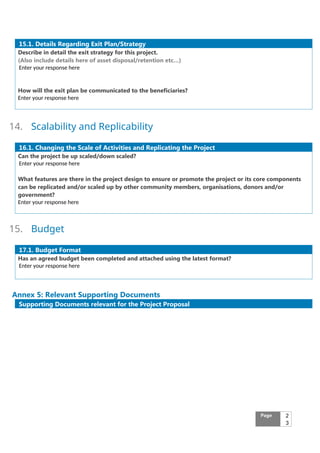
15.1. Details Regarding Exit Plan/Strategy
Describe in detail the exit strategy for this project.
(Also include details here of asset disposal/retention etc…)
Enter your response here
How will the exit plan be communicated to the beneficiaries?
Enter your response here
14. Scalability and Replicability
16.1. Changing the Scale of Activities and Replicating the Project
Can the project be up scaled/down scaled?
Enter your response here
What features are there in the project design to ensure or promote the project or its core components
can be replicated and/or scaled up by other community members, organisations, donors and/or
government?
Enter your response here
15. Budget
17.1. Budget Format
Has an agreed budget been completed and attached using the latest format?
Enter your response here
Annex 5: Relevant Supporting Documents
Supporting Documents relevant for the Project Proposal
Page 2
3
Page 2
4
Islamic Relief – Palestine Project Proposal
Annex 6: Activity Schedule/Implementation Plan
Project Name Enter Project Name here PIN Enter Project PIN
here
Donor
Name
Enter Donor Name here
Original Project
Calendar
Duration Enter No. of Months here Months Actual Project
Calendar
Duration Enter No. of Months here Months
Start Date Select Proposed Start Date Start Date Select Actual Start Date
End Date Select Proposed End Date End Date Select Actual End Date
Choose from one of the two options below to prepare your Gantt chart
Option 1: For Projects Up to 2 Years Long
S.N. Activity Duration: Year 1 2
Month J F M A M J J A S O N D J F M A M J J A S O N D
Project initiation, preparations and
planning
Outcome 1:
Enter Outcome 1 here from the Logic Model
Output 1.1:
Enter Output 1.1 here from the Logic Model
Activity 1.1.1:
Enter Activity 1.1.1 here from the Logic Model
Activity 1.1.2:
Enter Activity 1.1.2 here from the Logic Model
Activity 1.1.3:
Enter Activity 1.1.2 here from the Logic Model
Output 1.2:
Enter Output 1.2 here from the Logic Model
Activity 1.2.1:
1
Islamic Relief – Palestine Project Proposal
S.N. Activity Duration: Year 1 2
Month J F M A M J J A S O N D J F M A M J J A S O N D
Enter Activity 1.2.1 here from the Logic Model
Activity 1.2.2:
Enter Activity 1.2.2 here from the Logic Model
Activity 1.2.3:
Enter Activity 1.2.3 here from the Logic Model
Outcome 2:
Enter Outcome 2 here from the Logic Model
Output 2.1:
Enter Output 2.1 here from the Logic Model
Activity 2.1.1:
Enter Activity 2.1.1 here from the Logic Model
Activity 2.1.2:
Enter Activity 2.1.2 here from the Logic Model
Activity 2.1.3:
Enter Activity 2.1.3 here from the Logic Model
(…….and so on)
Monitoring, Reporting and Evaluation
Interim Report
Final Report
Interim Review
Final Evaluating
Project Closing
Option 2: For Projects Greater than 2 Years But Up to 6 Years
S.N. Activity Duration: Year 1 2 3 4 5 6
Quarter Period 1 2 3 4 1 2 3 4 1 2 3 4 1 2 3 4 1 2 3 4 1 2 3 4
Project initiation, preparations and
planning
2
Islamic Relief – Palestine Project Proposal
S.N. Activity Duration: Year 1 2 3 4 5 6
Quarter Period 1 2 3 4 1 2 3 4 1 2 3 4 1 2 3 4 1 2 3 4 1 2 3 4
Outcome 1:
Enter Outcome 1 here from the Logic Model
Output 1.1:
Enter Output 1.1 here from the Logic Model
Activity 1.1.1:
Enter Activity 1.1.1 here from the Logic Model
Activity 1.1.2:
Enter Activity 1.1.2 here from the Logic Model
Activity 1.1.3:
Enter Activity 1.1.2 here from the Logic Model
Output 1.2:
Enter Output 1.2 here from the Logic Model
Activity 1.2.1:
Enter Activity 1.2.1 here from the Logic Model
Activity 1.2.2:
Enter Activity 1.2.2 here from the Logic Model
Activity 1.2.3:
Enter Activity 1.2.3 here from the Logic Model
Outcome 2:
Enter Outcome 2 here from the Logic Model
Output 2.1:
Enter Output 2.1 here from the Logic Model
Activity 2.1.1:
Enter Activity 2.1.1 here from the Logic Model
Activity 2.1.2:
Enter Activity 2.1.2 here from the Logic Model
Activity 2.1.3:
Enter Activity 2.1.3 here from the Logic Model
(…….and so on)
Monitoring, Reporting and Evaluation
3
Islamic Relief – Palestine Project Proposal
S.N. Activity Duration: Year 1 2 3 4 5 6
Quarter Period 1 2 3 4 1 2 3 4 1 2 3 4 1 2 3 4 1 2 3 4 1 2 3 4
Interim Report
Final Report
Interim Review
Final Evaluating
Project Closing
Signature of Project Coordinator Enter Signature here Signature of Programme Manager Enter Signature here
Date Select Date here Date Select Date here
4

Proposal Template | قالب مقترح مشروع

  • 1.
    Page 1 Proposal Templet 2024-2025 ContactInfo. Eng. Ahmed AbuAbdu ahmedabuabdu90@outlook.com 0097599815677 (WhatsApp)
  • 2.
    ProjectProposal Contents Annex 1: Mapof Area of Intervention...........................................................................................2 1. Project Summary......................................................................................................................3 (Should be done after completing all other sections)......................................................................3 3. Background...............................................................................................................................5 4. Situation Analysis and Project Rationale..............................................................................5 5. The Proposed Intervention.....................................................................................................9 Annex 2: Logic Model.....................................................................................................................11 6. Beneficiary Details.................................................................................................................14 7. Risk Analysis...........................................................................................................................16 8. Implementation Methodology.............................................................................................18 9. Value for Money.....................................................................................................................19 10. Accountability.........................................................................................................................19 11. Communication and Visibility..............................................................................................19 12. Monitoring and Evaluation...................................................................................................20 Annex 3: Sample Monitoring Plan................................................................................................21 Annex 4: Performance Monitoring Framework (PMF)...............................................................23 13. Feedback and Learning Mechanism....................................................................................25 14. Sustainability..........................................................................................................................25 15. Exit Plan/Strategy..................................................................................................................25 16. Scalability and Replicability..................................................................................................26 17. Budget.....................................................................................................................................26 Annex 5: Relevant Supporting Documents.................................................................................26 Annex 6: Activity Schedule/Implementation Plan.......................................................................1 Page 2
  • 3.
    Annex 1: Mapof Area of Intervention Background to the Problem Enter a small paragraph here regarding a brief background about the problem. Page 3 [Enter Caption here] Click on snapshot picture above to insert image
  • 4.
    1. Project Summary (Shouldbe done after completing all other sections) Concept ID Number (From AX/PSP) Enter Concept ID here Project Name (And acronym, if relevant) The title formulation should be based on the impact (long-term result) of the proje IR PIN Code and Donor Enter PIN Code here. Enter Donor here. Submitted By Name and Designation of Contact Person Contact Person in Field Name and Designation of Contact Person (at Field Level) Contact Person in IRW Name and Designation of Contact Person (at IRW) Project Location Village(s), District, Region, Country Project Type Select a Project Type Project Sector (Linked with the Concept Note) Select a Sector. Project Summary (1/2 Pages) Please summarise the proposed project into one paragraph. Project Duration Enter number of Months here Month Proposed Start Date Select Start Date Budget/SLA Value Reporting Currency GBP Conversion Enter Budget Value here Select Currency Enter Budget Value here GBP Cost per Beneficiary Reporting Currency GBP Conversion Price Handles (For Marketing Purposes – Excluding Fundraising Costs) Enter Cost Value Select Currency Enter Cost Value GBP Cost per Project Component Enter Cost Value Select Currency Enter Cost Value GBP Other Price Handles Enter Cost Value Select Currency Enter Cost Value GBP Project Implemented by Select Implementing Partner/Islamic Relief Office Project Contribution Contributors can either come from Institutional Donors, Partners, Middle Eastern and Emerging Market donors etc. Contributor (Cash) Enter Cost Value Select Currency Enter Cost Value GBP Contributor (In-kind) Enter Cost Value Select Currency Enter Cost Value GBP Community Contribution (Cash) Enter Cost Value Select Currency Enter Cost Value GBP Beneficiaries Total Number of Direct Enter Number of Direct Beneficiaries. Page 4
  • 5.
    Beneficiaries: (The figure should reflect numberof individuals) Gender Distribution By age group (infants, children, adolescents, adults (in productive age), older people) Female Enter Figure Male Enter Figure What is the most vulnerable group of beneficiaries that this project is targetin Please refer to Section 1: Project Summary within the Guidance Notes for further assist with reference to the vulnerable groups of beneficiaries and enter your response accordin 2. Background Brief about the Country Office/Implementation (usually implementing office), when it was established? And areas of specialisations and experience related to this project. Provide information about how the interventions being proposed align with the country strategy. 3. Situation Analysis and Project Rationale 4.1. Situation Analysis What is the rationale for the project, the why of the project? Information which would be helpful includes: Country and local information, population, poverty and income, gender analysis, life expectancy, mortality rate, health, education/literacy, available resources if any etc... Please ensure that this information also clearly relates to the situation that the project aims to address, in terms of sector and target audience. Information in this section should be in addition to what was provided in the Concept Note. Page 5 *** The background should only cover up to a maximum of 2 pages. *** This section should not exceed more than 3 pages.
  • 6.
    4.2. Problem Analysis Basedon the information which is provided in the Guidance Notes under section 4.1. Please provide a problem analysis to the proposed project? (Please refer to the ‘Problem Analysis’ section of the IRW Project Management handbook by clicking here) Provide your response here with reference to the problem analysis 4.3. Needs Assessment Provide details of any needs assessment carried out. (Ensure that gender-specific needs of women, men, boys and girls are assessed) Enter your response here 4.4. Baseline Survey Please summarise the results from the baseline survey and attach the full results. (Ensure that the baseline survey involves both females and males. Please refer to the Guidance Notes for further information) Enter baseline data here Page 6
  • 7.
    4.5. Stakeholder Analysis Tool1: Stakeholder Analysis to identify, define and map the problem to be addressed Stakeholder 1 Stakeholder 2 Stakeholder 3 Stakeholder 4 Stakeholder 5 Role Enter Role for Stakeholder 1 here Enter Role for Stakeholder 2 here Enter Role for Stakeholder 3 here Enter Role for Stakeholder 4 here Enter Role for Stakeholder 5 here Needs (From the Project) Enter Needs for Stakeholder 1 here Enter Needs for Stakeholder 2 here Enter Needs for Stakeholder 3 here Enter Needs for Stakeholder 4 here Enter Needs for Stakeholder 5 here Potential Positive Impacts of the Project on this Group Enter Potential Positive Impacts for Stakeholder 1 here Enter Potential Positive Impacts for Stakeholder 2 here Enter Potential Positive Impacts for Stakeholder 3 here Enter Potential Positive Impacts for Stakeholder 4 here Enter Potential Positive Impacts for Stakeholder 5 here Potential Negative Impacts of the Project on this Group Enter Potential Negative Impacts for Stakeholder 1 here Enter Potential Negative Impacts for Stakeholder 2 here Enter Potential Negative Impacts for Stakeholder 3 here Enter Potential Negative Impacts for Stakeholder 4 here Enter Potential Negative Impacts for Stakeholder 5 here Relative Priority of Interests (1 is Low and 10 is High) Enter Priority of Interests for Stakeholder 1 here Enter Priority of Interests for Stakeholder 2 here Enter Priority of Interests for Stakeholder 3 here Enter Priority of Interests for Stakeholder 4 here Enter Priority of Interests for Stakeholder 5 here RACI (Please refer to the key below) Select RACI Code for Stakeholder 1 Select RACI Code for Stakeholder 2 Select RACI Code for Stakeholder 3 Select RACI Code for Stakeholder 4 Select RACI Code for Stakeholder 5 R Responsible A Accountable C Consulted I Informed Page 7
  • 8.
    4. The ProposedIntervention 5.1. Project Impact What is the long term result? Enter the project impact here 5.2. Project Outcomes What are the medium term results? Enter the project outcomes here 5.3. Project Outputs What are the short term results? Enter the project outputs here 5.4. Project Activities What are the main activities that will be carried out to achieve the project results? Enter the main activities here 5.5. Project Inputs What are the main inputs that are required to carry out the project activities and thereby achieve the project results? Enter the main inputs here 5.6. Describing the Proposed Project From what was provided in sections 5.1. - 5.4., please elaborate on what in practical terms are the developmental long-term results (Impact), the medium term results (Outcomes) and short-term results (Outputs) that the project hopes to achieve? Enter your response here Describe your overall theory of change which justifies the programme strategy you have chosen. Enter your response here Describe the aspects of project integration? (Please refer to section 5.5. of the Guidance Notes for further details) Enter your response here Page 8
  • 9.
    Describe project sustainability? (Pleaserefer to section 14 of the Guidance Notes for further details) Enter your response here Is the intervention part of an ongoing/or larger programme? How was it ensured that the project was not duplicated? If similar projects do exist, how are aspects of these projects alike/dissimilar/complementary (if applicable)? To what extent is this project building on lessons from similar responses from previous interventions from this or other countries? (Please give references of all documents that you have consulted) Enter your response here Page 9
  • 10.
    5.7. Logic Model/ResultsChain Please complete the Logic Model (Annex 2) which should demonstrate a causal link between impact, outcomes, outputs and main activities. You need to consider the following questions when completing the Logic Model.  Are the outcomes and outputs logically linked to achieve the impact of the project?  Are the activities logically linked to the outputs in order to achieve the project results?  Were the key stakeholders consulted when developing the results chain? Annex 2: Logic Model Impact Enter Long Term Result here Outcome Enter 1. Medium Term Result here Enter 2. Medium Term Result here Enter 3. Medium Term Result here Outputs (These are linked to each outcome) Enter 1.1 Short Term Result here Enter 1.2 Short Term Result here Enter 1.3 Short Term Result here Enter 2.1 Short Term Result here Enter 2.2 Short Term Result here Enter 2.3 Short Term Result here Enter 3.1 Short Term Result here Enter 3.2 Short Term Result here Enter 3.3 Short Term Result here Main Activities (These are linked to each output) Enter Activity for 1.1 Short Term Result here Enter Activity for 1.2 Short Term Result here Enter Activity for 1.3 Short Term Result here Enter Activity for 2.1 Short Term Result here Enter Activity for 2.2 Short Term Result here Enter Activity for 2.3 Short Term Result here Enter Activity for 3.1 Short Term Result here Enter Activity for 3.2 Short Term Result here Enter Activity for 3.3 Short Term Result here Enter Activity for 1.1 Short Term Result Enter Activity for 1.2 Short Term Result Enter Activity for 1.3 Short Term Result Enter Activity for 2.1 Short Term Result Enter Activity for 2.2 Short Term Result Enter Activity for 2.3 Short Term Result Enter Activity for 3.1 Short Term Result Enter Activity for 3.2 Short Term Result Enter Activity for 3.3 Short Term Result Page 1 0
  • 11.
    here here herehere here here here here here Enter Activity for 1.1 Short Term Result here Enter Activity for 1.2 Short Term Result here Enter Activity for 1.3 Short Term Result here Enter Activity for 2.1 Short Term Result here Enter Activity for 2.2 Short Term Result here Enter Activity for 2.3 Short Term Result here Enter Activity for 3.1 Short Term Result here Enter Activity for 3.2 Short Term Result here Enter Activity for 3.3 Short Term Result here Enter Activity for 1.1 Short Term Result here Enter Activity for 1.2 Short Term Result here Enter Activity for 1.3 Short Term Result here Enter Activity for 2.1 Short Term Result here Enter Activity for 2.2 Short Term Result here Enter Activity for 2.3 Short Term Result here Enter Activity for 3.1 Short Term Result here Enter Activity for 3.2 Short Term Result here Enter Activity for 3.3 Short Term Result here Enter Activity for 1.1 Short Term Result here Enter Activity for 1.2 Short Term Result here Enter Activity for 1.3 Short Term Result here Enter Activity for 2.1 Short Term Result here Enter Activity for 2.2 Short Term Result here Enter Activity for 2.3 Short Term Result here Enter Activity for 3.1 Short Term Result here Enter Activity for 3.2 Short Term Result here Enter Activity for 3.3 Short Term Result here Main Inputs (These are linked to each activity) Enter Input for 1.1 Short Term Result here Enter Input for 1.2 Short Term Result here Enter Input for 1.3 Short Term Result here Enter Input for 2.1 Short Term Result here Enter Input for 2.2 Short Term Result here Enter Input for 2.3 Short Term Result here Enter Input for 3.1 Short Term Result here Enter Input for 3.2 Short Term Result here Enter Input for 3.3 Short Term Result here Enter Input for 1.1 Short Term Result here Enter Input for 1.2 Short Term Result here Enter Input for 1.3 Short Term Result here Enter Input for 2.1 Short Term Result here Enter Input for 2.2 Short Term Result here Enter Input for 2.3 Short Term Result here Enter Input for 3.1 Short Term Result here Enter Input for 3.2 Short Term Result here Enter Input for 3.3 Short Term Result here Enter Input for 1.1 Short Term Result here Enter Input for 1.2 Short Term Result here Enter Input for 1.3 Short Term Result here Enter Input for 2.1 Short Term Result here Enter Input for 2.2 Short Term Result here Enter Input for 2.3 Short Term Result here Enter Input for 3.1 Short Term Result here Enter Input for 3.2 Short Term Result here Enter Input for 3.3 Short Term Result here Enter Input for 1.1 Short Term Result here Enter Input for 1.2 Short Term Result here Enter Input for 1.3 Short Term Result here Enter Input for 2.1 Short Term Result here Enter Input for 2.2 Short Term Result here Enter Input for 2.3 Short Term Result here Enter Input for 3.1 Short Term Result here Enter Input for 3.2 Short Term Result here Enter Input for 3.3 Short Term Result here Enter Input Enter Input Enter Input Enter Input Enter Input Enter Input Enter Input Enter Input Enter Input Page 1 1
  • 12.
    for 1.1 Short TermResult here for 1.2 Short Term Result here for 1.3 Short Term Result here for 2.1 Short Term Result here for 2.2 Short Term Result here for 2.3 Short Term Result here for 3.1 Short Term Result here for 3.2 Short Term Result here for 3.3 Short Term Result here Page 1 2 Note: For short-term projects, the project can have two levels of results only (instead of three).
  • 13.
    5.8. Cross CuttingThemes Please indicate what contribution there will be on the IR Strategic Focus Areas and cross cutting themes include consideration of the following:  capacity building of civil society,  climate change,  child welfare,  gender rights of women, men, boys and girls, supporting gender roles and responsibilities, equitable share of resources, services and opportunities, equitable participation, division of labour and protection,  disaster risk reduction,  disaster preparedness  environmental protection  others (please specify) Enter the details for the Cross Cutting Themes here 5. Beneficiary Details 6.1. Direct Beneficiaries Number of direct beneficiaries (Disaggregate as far as possible by gender, age, disability, urban/rural, ethnicity/race, class/caste, religion) Enter your response here What inequalities do exist between different social groups of beneficiaries in terms of access to and control over resources, division of labour, decision making on the household and community level, participation, power relations, security risks etc…? How will the project reduce these inequalities? Enter your response here 6.2. Indirect Beneficiaries Number of indirect beneficiaries (Disaggregate as far as possible by gender, age, disability, internally displaced (IDPs), urban/rural, ethnicity/race, class/caste, religion. In addition include the number of males and females as well) Enter your response here What profile of women, men, boys and girls of different social groups will indirectly benefit from this project? (E.g. rural or urban dwellers, literate, illiterate, employed, unemployed etc…) Enter your response here How will women, men, boys and girls of different social groups benefit from the project indirectly? Enter your response here Page 1 3
  • 14.
    6.3. Role ofBeneficiaries How were women, men, boys and girls of different social groups consulted? Enter your response here How are the findings from the consultation reflected in the proposed project design? Enter your response here How will women, men, boys and girls of different social groups participate in the project? (Please comment with respect to all of the components for PCM e.g. – programme assessment, design, implementation, M & E and learning) Enter your response here Is there any contribution/involvement from the community/beneficiaries in any form with regards to this proposed project? Enter your response here Page 1 4
  • 15.
    6. Risk Analysis Pleasecomplete the Risk Matrix below (Risks are future problems/constraints that may affect the achievement & project results) Risk Probability/ Likelihood (High, Medium or Low) Business Impact (Select Level of Impact) Risk Response Strategy (Select Risk Response Strategy from Menu)) Detail of Risk Response Strategy Risk Owner (Person Responsible for Managing Risk) Enter the risk here Select level of likelihood Select level of impact Select risk response strategy Enter your reason here Enter risk owner here Enter the risk here Select level of likelihood Select level of impact Select risk response strategy Enter your reason here Enter risk owner here Enter the risk here Select level of likelihood Select level of impact Select risk response strategy Enter your reason here Enter risk owner here Enter the risk here Select level of likelihood Select level of impact Select risk response strategy Enter your reason here Enter risk owner here Enter the risk here Select level of likelihood Select level of impact Select risk response strategy Enter your reason here Enter risk owner here Page 1 5
  • 16.
    7. Implementation Methodology 8.1.Implementation Strategy Briefly explain how will the project be implemented? (Needs rephrasing) Enter your response here 8.2. Project Organogram How will the project be managed? Provide a chart/table illustrating the organisation chart of the project team that showing staff positions. Use the organogram chart below to construct the organisation chart. 8.3. Implementation Plan (See Annex 6) Provide a Gantt chart of activities linked to time frames. This should link to the main activities from the log frame. Please plan on a weekly, monthly or quarterly basis, depending on the life span. Clearly show the Key milestones and highlight any ‘critical path’ activities. Refer to Annex 6 to complete the Implementation Plan Page 1 6 *** This section should not exceed more than 3 pages.
  • 17.
    8. Value forMoney 9.1. Overall Justification for Value for Money Please explain why this project (and its core components) represents good value for money – in terms of economy, efficiency, effectiveness and equity. What is the particular outcome that is being ‘valued’ in this project? How are stakeholders being involved in identifying ‘value’ and how are their perspectives being involved? Enter your response here 9. Accountability 10.1. Accountability Please explain how the IR Accountability Framework will be utilised during the project implementation and completion. Enter your response here How does the project show commitment to agreed Islamic values, humanitarian principles and international standards? Enter your response here How will you communicate information on the background of the agency, programme timelines, beneficiary entitlements and selection criteria to the beneficiaries? How will you communicate the project information to the wider communities? Enter your response here How will you develop a community based complaints system? How will you ensure that the complaints system for males and females is equally functional? How will you communicate the complaints system to staff, partners and beneficiaries? How will you deal with the complaints? Enter your response here 10. Communication and Visibility 11.1. Visibility Which tools (banners, stickers, video films, feeding website, radio reports etc…) will be used to make the donor visible in the project? Enter your response here Page 1 7
  • 18.
    Monitoring and Evaluation 12.1.Monitoring and Evaluation Who is responsible overall within IR for M & E? (Please include your detailed Process Monitoring Plan under Annex 3) Enter the department and whether IRW or Country Office here How will the results of the project be monitored (for female and male beneficiaries)? (Please complete your Performance Monitoring Framework under Annex 4) Enter your response here Will a mid-term and end of project evaluation take place? How will you identify unintended programme outcomes? Enter your response here Will there be an external evaluation? Select your response How will you ensure that community feedback (from both males and females) is captured, shared and action is taken at an appropriate level? Enter your response here What mechanisms are in place to ensure issues are picked up at an early stage, acted upon and disseminated so improvement occurs? Enter your response here Page 1 8 *** This section should not exceed more than 1 page.
  • 19.
    Project Activities Time frame (Months) Person Responsible Indicator of Success Meansof Verification Frequency of Monitoring Tools to be Used Who Will be Involved from the Stakeholder s Who Will Receive the Data Enter Project Activity here Enter Time frame here Enter Person Responsible here Enter Indicator of Success here Enter Means of Verification here Enter Frequency of Monitoring here Enter Tools to be Used here Enter Involvement from Stakeholders here Enter Who Will Receive Data here Enter Project Activity here Enter Time frame here Enter Person Responsible here Enter Indicator of Success here Enter Means of Verification here Enter Frequency of Monitoring here Enter Tools to be Used here Enter Involvement from Stakeholders here Enter Who Will Receive Data here Enter Project Activity here Enter Time frame here Enter Person Responsible here Enter Indicator of Success here Enter Means of Verification here Enter Frequency of Monitoring here Enter Tools to be Used here Enter Involvement from Stakeholders here Enter Who Will Receive Data here Page 1 9
  • 20.
    Annex 4: PerformanceMonitoring Framework (PMF) Results Performance Indicators Baseline Data Targets/ Milestones Data Source (Means of Verification) Data Collection Method Frequency Responsibility (Person or entity responsible for collecting data) Assumptions Impact (What are the key indicators to measure progress in achieving the results) Enter Quantitative Indicator here Enter Baseline Data here Enter Targets here Enter Data Source here Enter Data Collection Method here Enter Frequency here Enter individual or entity here Enter Assumption here Enter Qualitative Indicator here Enter Baseline Data here Enter Targets here Enter Data Source here Enter Data Collection Method here Enter Frequency here Enter individual or entity here Enter Assumption here Outcome # 1 Enter Quantitative Indicator here Enter Baseline Data here Enter Targets here Enter Data Source here Enter Data Collection Method here Enter Frequency here Enter individual or entity here Enter Assumption here Enter Qualitative Indicator here Enter Baseline Data here Enter Targets here Enter Data Source here Enter Data Collection Method here Enter Frequency here Enter individual or entity here Enter Assumption here Outcome # 2 Enter Qualitative Indicator here Enter Baseline Data here Enter Targets here Enter Data Source here Enter Data Collection Method here Enter Frequency here Enter individual or entity here Enter Assumption here Enter Qualitative Enter Baseline Data here Enter Targets here Enter Data Source here Enter Data Collection Enter Frequency Enter individual or entity here Enter Assumption here Page 2 0
  • 21.
    Indicator here Methodhere here Output # 1.1 Enter Qualitative Indicator here Enter Baseline Data here Enter Targets here Enter Data Source here Enter Data Collection Method here Enter Frequency here Enter individual or entity here Enter Assumption here Enter Qualitative Indicator here Enter Baseline Data here Enter Targets here Enter Data Source here Enter Data Collection Method here Enter Frequency here Enter individual or entity here Enter Assumption here Output # 1.2 Enter Qualitative Indicator here Enter Baseline Data here Enter Targets here Enter Data Source here Enter Data Collection Method here Enter Frequency here Enter individual or entity here Enter Assumption here Enter Qualitative Indicator here Enter Baseline Data here Enter Targets here Enter Data Source here Enter Data Collection Method here Enter Frequency here Enter individual or entity here Enter Assumption here Output # 2.1 Enter Qualitative Indicator here Enter Baseline Data here Enter Targets here Enter Data Source here Enter Data Collection Method here Enter Frequency here Enter individual or entity here Enter Assumption here Enter Qualitative Indicator here Enter Baseline Data here Enter Targets here Enter Data Source here Enter Data Collection Method here Enter Frequency here Enter individual or entity here Enter Assumption here Output # 2.2 Enter Qualitative Indicator here Enter Baseline Data here Enter Targets here Enter Data Source here Enter Data Collection Method here Enter Frequency here Enter individual or entity here Enter Assumption here Enter Qualitative Indicator here Enter Baseline Data here Enter Targets here Enter Data Source here Enter Data Collection Method here Enter Frequency here Enter individual or entity here Enter Assumption here Page 2 1
  • 22.
    11. Feedback andLearning Mechanism 13.1. Methods of Learning How will you capture learning? What additional learning mechanisms are in place to ensure that learning is captured, stored, used and disseminated so cross learning occurs? Has this project used any learning from a previous similar project and how has this learning incorporated? Enter your response here 13.2. Beneficiary Feedback Mechanism What mechanisms do you have in place to collect beneficiary feedback and improve your work? Include a discussion of your beneficiary feedback mechanism, what you do with the information received from beneficiaries and how you close the feedback loop (i.e. how do you respond to the feedback received) Please refer to Section 13.2 within the Guidance Notes for further clarification on this area. Enter your response here 12. Sustainability 14.1. Level of Project Sustainability How will the benefits of the project be maintained after it has been completed? Enter your response here What will be the multiplier effect of such a programme in the community (other follow-on benefits)? Enter your response here How is the project environmentally, economically and socially sustainable? Enter your response here 13. Exit Plan/Strategy Page 2 2 *** This section should not exceed more than 1 page.
  • 23.
    15.1. Details RegardingExit Plan/Strategy Describe in detail the exit strategy for this project. (Also include details here of asset disposal/retention etc…) Enter your response here How will the exit plan be communicated to the beneficiaries? Enter your response here 14. Scalability and Replicability 16.1. Changing the Scale of Activities and Replicating the Project Can the project be up scaled/down scaled? Enter your response here What features are there in the project design to ensure or promote the project or its core components can be replicated and/or scaled up by other community members, organisations, donors and/or government? Enter your response here 15. Budget 17.1. Budget Format Has an agreed budget been completed and attached using the latest format? Enter your response here Annex 5: Relevant Supporting Documents Supporting Documents relevant for the Project Proposal Page 2 3
  • 24.
  • 25.
    Islamic Relief –Palestine Project Proposal Annex 6: Activity Schedule/Implementation Plan Project Name Enter Project Name here PIN Enter Project PIN here Donor Name Enter Donor Name here Original Project Calendar Duration Enter No. of Months here Months Actual Project Calendar Duration Enter No. of Months here Months Start Date Select Proposed Start Date Start Date Select Actual Start Date End Date Select Proposed End Date End Date Select Actual End Date Choose from one of the two options below to prepare your Gantt chart Option 1: For Projects Up to 2 Years Long S.N. Activity Duration: Year 1 2 Month J F M A M J J A S O N D J F M A M J J A S O N D Project initiation, preparations and planning Outcome 1: Enter Outcome 1 here from the Logic Model Output 1.1: Enter Output 1.1 here from the Logic Model Activity 1.1.1: Enter Activity 1.1.1 here from the Logic Model Activity 1.1.2: Enter Activity 1.1.2 here from the Logic Model Activity 1.1.3: Enter Activity 1.1.2 here from the Logic Model Output 1.2: Enter Output 1.2 here from the Logic Model Activity 1.2.1: 1
  • 26.
    Islamic Relief –Palestine Project Proposal S.N. Activity Duration: Year 1 2 Month J F M A M J J A S O N D J F M A M J J A S O N D Enter Activity 1.2.1 here from the Logic Model Activity 1.2.2: Enter Activity 1.2.2 here from the Logic Model Activity 1.2.3: Enter Activity 1.2.3 here from the Logic Model Outcome 2: Enter Outcome 2 here from the Logic Model Output 2.1: Enter Output 2.1 here from the Logic Model Activity 2.1.1: Enter Activity 2.1.1 here from the Logic Model Activity 2.1.2: Enter Activity 2.1.2 here from the Logic Model Activity 2.1.3: Enter Activity 2.1.3 here from the Logic Model (…….and so on) Monitoring, Reporting and Evaluation Interim Report Final Report Interim Review Final Evaluating Project Closing Option 2: For Projects Greater than 2 Years But Up to 6 Years S.N. Activity Duration: Year 1 2 3 4 5 6 Quarter Period 1 2 3 4 1 2 3 4 1 2 3 4 1 2 3 4 1 2 3 4 1 2 3 4 Project initiation, preparations and planning 2
  • 27.
    Islamic Relief –Palestine Project Proposal S.N. Activity Duration: Year 1 2 3 4 5 6 Quarter Period 1 2 3 4 1 2 3 4 1 2 3 4 1 2 3 4 1 2 3 4 1 2 3 4 Outcome 1: Enter Outcome 1 here from the Logic Model Output 1.1: Enter Output 1.1 here from the Logic Model Activity 1.1.1: Enter Activity 1.1.1 here from the Logic Model Activity 1.1.2: Enter Activity 1.1.2 here from the Logic Model Activity 1.1.3: Enter Activity 1.1.2 here from the Logic Model Output 1.2: Enter Output 1.2 here from the Logic Model Activity 1.2.1: Enter Activity 1.2.1 here from the Logic Model Activity 1.2.2: Enter Activity 1.2.2 here from the Logic Model Activity 1.2.3: Enter Activity 1.2.3 here from the Logic Model Outcome 2: Enter Outcome 2 here from the Logic Model Output 2.1: Enter Output 2.1 here from the Logic Model Activity 2.1.1: Enter Activity 2.1.1 here from the Logic Model Activity 2.1.2: Enter Activity 2.1.2 here from the Logic Model Activity 2.1.3: Enter Activity 2.1.3 here from the Logic Model (…….and so on) Monitoring, Reporting and Evaluation 3
  • 28.
    Islamic Relief –Palestine Project Proposal S.N. Activity Duration: Year 1 2 3 4 5 6 Quarter Period 1 2 3 4 1 2 3 4 1 2 3 4 1 2 3 4 1 2 3 4 1 2 3 4 Interim Report Final Report Interim Review Final Evaluating Project Closing Signature of Project Coordinator Enter Signature here Signature of Programme Manager Enter Signature here Date Select Date here Date Select Date here 4