OOuuttppuutt,, IInnffllaattiioonn,, aanndd UUnneemmppllooyymmeenntt 
CChhaapptteerr 1111 
Prof. Steve Cunningham 
Intermediate Macroeconomics 
ECON 219
2 
OOrriiggiinnaall PPhhiilllliippss CCuurrvvee 
 A. W. Phillips (1958), “The Relation 
Between Unemployment and the Rate of 
Change of Money Wage Rates in the 
United Kingdom, 1861-1957”, Economica. 
Wage inflation vs. Unemployment 
 New Zealander at London School of 
Economics 
 Missing Equation of Keynesian 
economics?
5½ % = zero inflation 
3
4 
5½ %
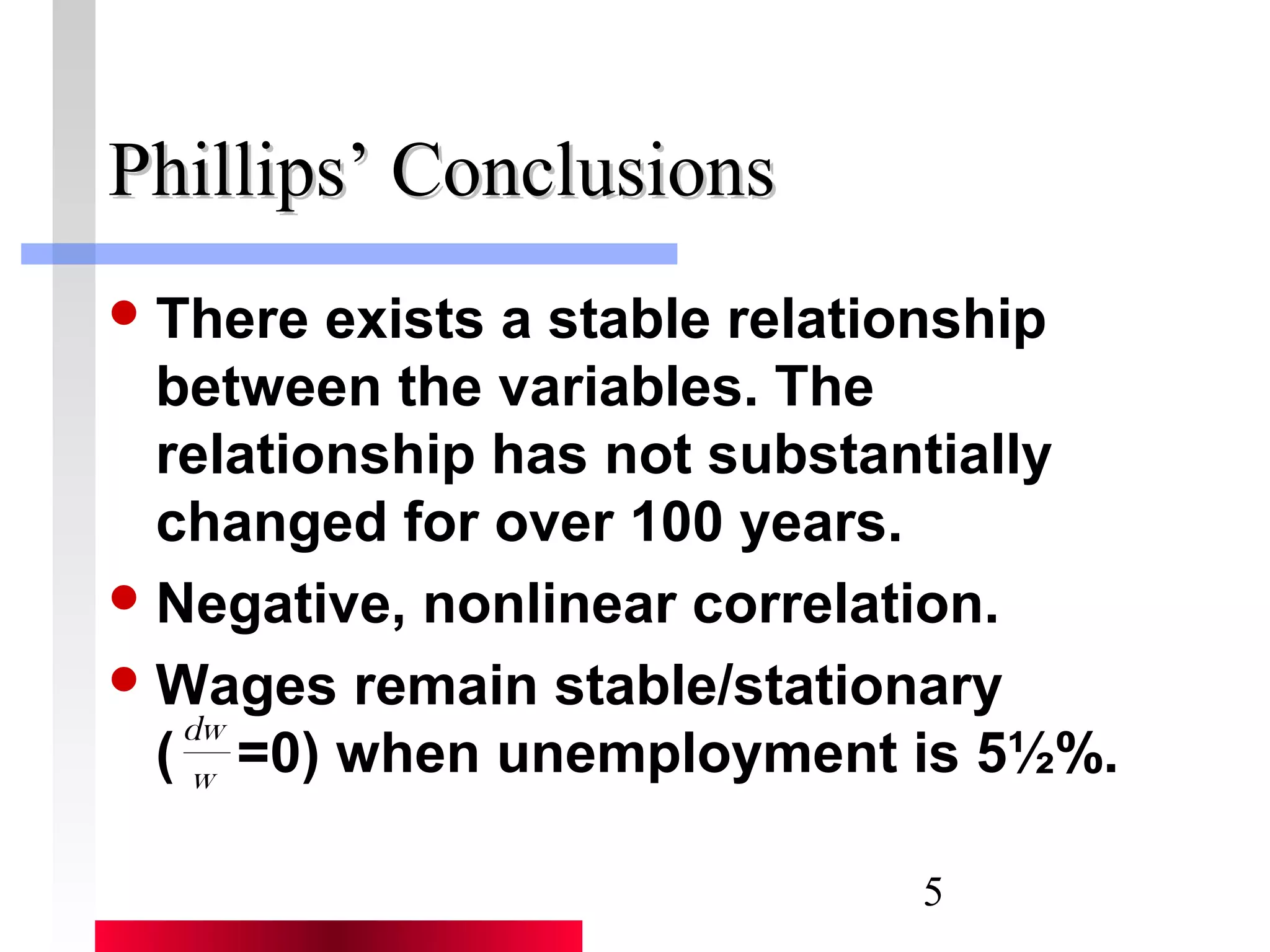
There exists a stable relationship 
between the variables. The 
relationship has not substantially 
changed for over 100 years. 
Negative, nonlinear correlation. 
Wages remain stable/stationary 
( =0) when unemployment is 5½%. 
5 
PPhhiilllliippss’’ CCoonncclluussiioonnss 
dw 
w
6 
CCoonncclluussiioonnss,, CCoonnttiinnuueedd 
 From the dispersion of the 
data points, Phillips 
concluded that there was a 
countercyclical “loop”: 
dw 
– Money wages rise faster 
as du/dt decreases, 
faster 
– Money wages fall slower 
as du/dt increases 
– Implies an inflationary 
slower 
bias, and is consistent 
with sticky wage theory. u 
w
7 
NNaattuurraall RRaattee TThheeoorryy 
MMiillttoonn FFrriieeddmmaann 
 In the long run, the influence of money is primarily on the 
price level and other nominal magnitudes. 
 In the long run, real variables, such as real output and 
employment are determined by real, not monetary, factors. 
 The equilibrium levels of real output and employment that 
are consistent with the microeconomics of production and 
the institutions of the society are called the natural rates of 
output and employment. 
 Short run levels of output and employment may vary from 
the natural rates as a result of monetary factors, but in the 
long run, the economy will always return to the natural 
rates.
EExxppeeccttaattiioonnss--AAuuggmmeenntteedd PPhhiilllliippss CCuurrvvee 
SRPC(p2) 
SRPC(p1) 
8 
inflation 
Unemployment 
SRPC(p0) 
Natural Rate 
1 
2 
3 
4 
5 
U U* 1 
p2 
p1
9 
AAnnootthheerr vviieeww:: 
KKeeyynneessiiaann PPeerrssppeeccttiivvee 
AD1 
AS1 
AD2 
AS2 
1 
2 
3
Milton Friedman. “The Role of Monetary Policy,” American Economic 
Review (March 1968), 1-17. 
10 
PPoolliiccyy IImmpplliiccaattiioonnss 
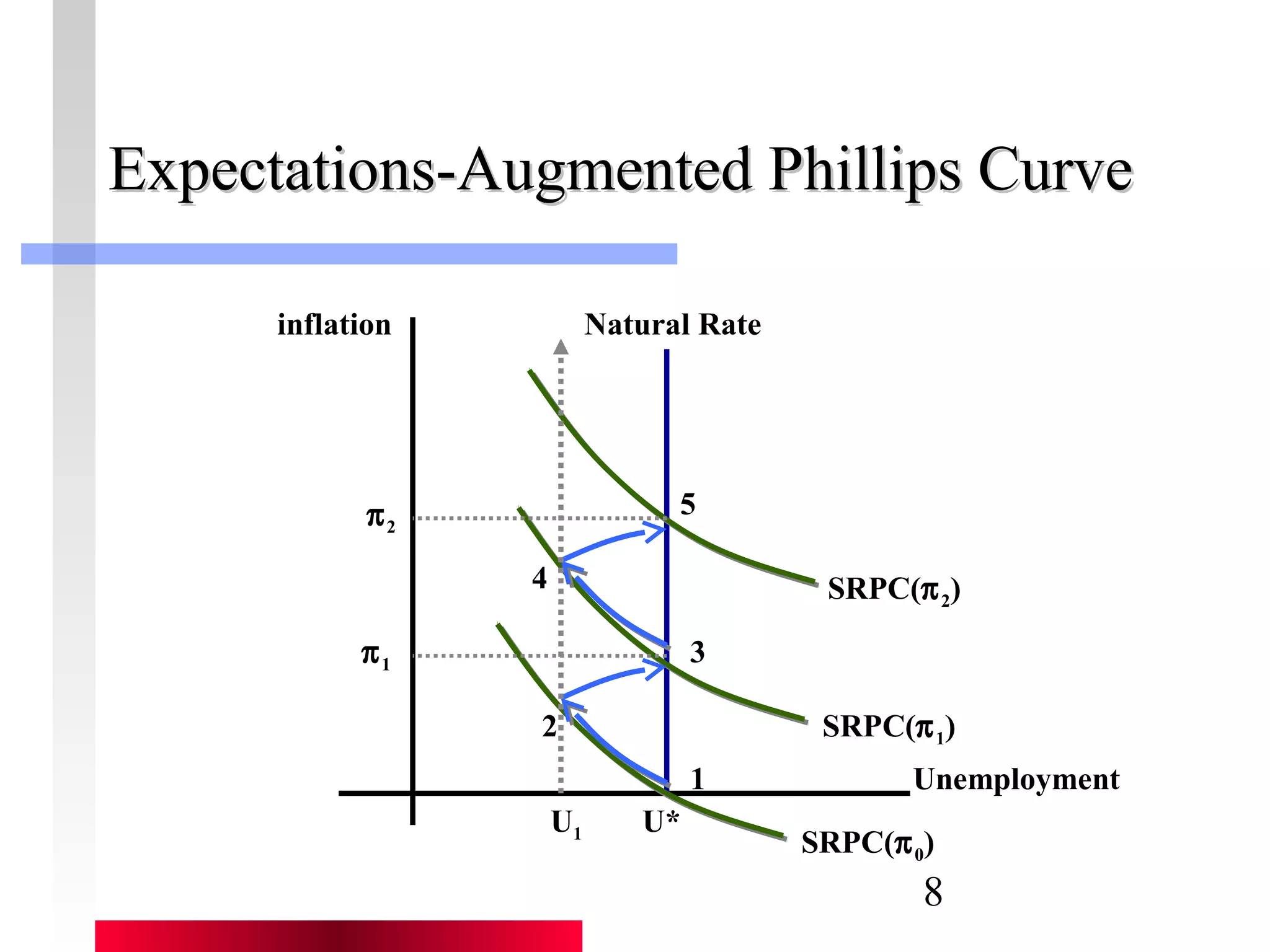
 Different Phillips curves exist for different inflation rates 
 Changes in inflation expectations shift the short-run Phillips 
curve. 
 Any tradeoff from a single change in the money supply is short-run. 
Any improvement in the economy due to such monetary 
stimulus is brief at best, and leads to long-run inflation. 
 To achieve a permanent reduction in unemployment via monetary 
policy would require continuously increasing the money supply, 
leading to infinite inflation, and the destruction of the economy. 
(The accelerationist hypothesis.) 
 To change the natural rate of output requires real sector changes.
NNaattuurraall RRaattee:: 
MMoorree RReecceenntt WWoorrkk 
 Friedman had argued that the natural rate would 
be related to the actual structural characteristics 
of the commodity and labor markets. 
– What would affect people getting information and 
making adjustments to their economic positions (asking 
for raises, etc.) 
 Modern theory relates these characteristics to 
those which determine frictional and structural 
unemployment: 
– Information costs and impediments to job search 
– Training 
 Natural rates are “time-varying” not “fixed and 
permanent”. 
11

Froyen11

  • 1.
    OOuuttppuutt,, IInnffllaattiioonn,, aannddUUnneemmppllooyymmeenntt CChhaapptteerr 1111 Prof. Steve Cunningham Intermediate Macroeconomics ECON 219
  • 2.
    2 OOrriiggiinnaall PPhhiilllliippssCCuurrvvee  A. W. Phillips (1958), “The Relation Between Unemployment and the Rate of Change of Money Wage Rates in the United Kingdom, 1861-1957”, Economica. Wage inflation vs. Unemployment  New Zealander at London School of Economics  Missing Equation of Keynesian economics?
  • 3.
    5½ % =zero inflation 3
  • 4.
  • 5.
    There exists astable relationship between the variables. The relationship has not substantially changed for over 100 years. Negative, nonlinear correlation. Wages remain stable/stationary ( =0) when unemployment is 5½%. 5 PPhhiilllliippss’’ CCoonncclluussiioonnss dw w
  • 6.
    6 CCoonncclluussiioonnss,, CCoonnttiinnuueedd  From the dispersion of the data points, Phillips concluded that there was a countercyclical “loop”: dw – Money wages rise faster as du/dt decreases, faster – Money wages fall slower as du/dt increases – Implies an inflationary slower bias, and is consistent with sticky wage theory. u w
  • 7.
    7 NNaattuurraall RRaatteeTThheeoorryy MMiillttoonn FFrriieeddmmaann  In the long run, the influence of money is primarily on the price level and other nominal magnitudes.  In the long run, real variables, such as real output and employment are determined by real, not monetary, factors.  The equilibrium levels of real output and employment that are consistent with the microeconomics of production and the institutions of the society are called the natural rates of output and employment.  Short run levels of output and employment may vary from the natural rates as a result of monetary factors, but in the long run, the economy will always return to the natural rates.
  • 8.
    EExxppeeccttaattiioonnss--AAuuggmmeenntteedd PPhhiilllliippss CCuurrvvee SRPC(p2) SRPC(p1) 8 inflation Unemployment SRPC(p0) Natural Rate 1 2 3 4 5 U U* 1 p2 p1
  • 9.
    9 AAnnootthheerr vviieeww:: KKeeyynneessiiaann PPeerrssppeeccttiivvee AD1 AS1 AD2 AS2 1 2 3
  • 10.
    Milton Friedman. “TheRole of Monetary Policy,” American Economic Review (March 1968), 1-17. 10 PPoolliiccyy IImmpplliiccaattiioonnss  Different Phillips curves exist for different inflation rates  Changes in inflation expectations shift the short-run Phillips curve.  Any tradeoff from a single change in the money supply is short-run. Any improvement in the economy due to such monetary stimulus is brief at best, and leads to long-run inflation.  To achieve a permanent reduction in unemployment via monetary policy would require continuously increasing the money supply, leading to infinite inflation, and the destruction of the economy. (The accelerationist hypothesis.)  To change the natural rate of output requires real sector changes.
  • 11.
    NNaattuurraall RRaattee:: MMoorreeRReecceenntt WWoorrkk  Friedman had argued that the natural rate would be related to the actual structural characteristics of the commodity and labor markets. – What would affect people getting information and making adjustments to their economic positions (asking for raises, etc.)  Modern theory relates these characteristics to those which determine frictional and structural unemployment: – Information costs and impediments to job search – Training  Natural rates are “time-varying” not “fixed and permanent”. 11