RReeaall BBuussiinneessss CCyycclleess aanndd NNeeww 
KKeeyynneessiiaann EEccoonnoommiiccss:: 
CChhaapptteerr 1133 
Professor Steve Cunningham 
Intermediate Macroeconomics 
ECON 219
Real BBuussiinneessss CCyyccllee ((RRBBCC)) MMooddeellss 
Like New Classical Economics, the 
RBC theorists agree that: 
2 
– Agents optimize 
– Markets clear 
Therefore, the business cycle is an 
equilibrium phenomenon, and is 
optimal!
3 
RRBBCC TThheeoorryy 
 New Classicals tend to favor monetary business 
cycles, caused by unexpected fluctuations in the 
money supply. 
 In contrast, RBC theorists believe that exogenous 
“real shocks” are largely responsible for 
business cycles. Such real shocks include: 
– Technology changes 
– Environmental conditions 
– Changes in real (relative) prices of basic crude materials 
and energy sources (oil) 
– Tax rates 
– Individual preferences
4 
TTyyppiiccaall RRBBCC MMooddeell 
 Identical agents. So examine on “representative 
agent” and multiply by the number of agents in 
the economy. 
– This amounts to focusing on the microeconomics and 
adding up the components to form the macroeconomy. 
 All agents maximize utility by maximizing 
consumption and leisure (minimize work). 
Ut = U(ct ,le) 
 Output is given by a production function. 
Yt = ztF(Kt ,Nt ) 
 The term zt captures shocks to production.
5 
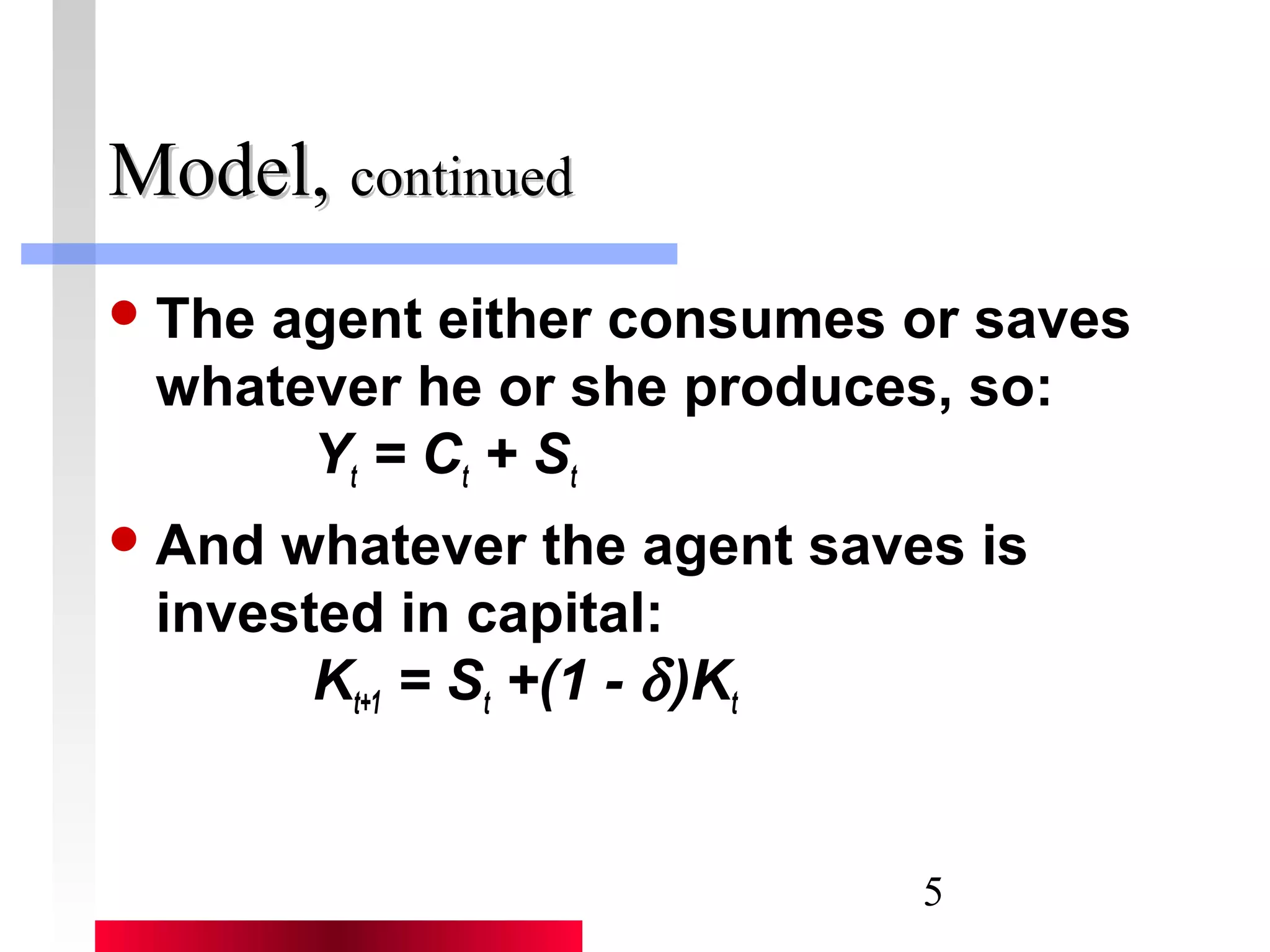
MMooddeell,, ccoonnttiinnuueedd 
The agent either consumes or saves 
whatever he or she produces, so: 
Yt = Ct + St 
And whatever the agent saves is 
invested in capital: 
Kt+1 = St +(1 - d )Kt
PPoossiittiivvee TTeecchhnnoollooggyy SShhoocckk 
6 
LRASP 1 
N 
LRAS2 
Y 
Y=F(N,K) 
P1 
P2 
If a shock occurs that the agent 
thinks will be temporary, the agent 
will save more of the increased 
output for the future, resulting in 
an increase in capital, affecting 
future growth. 
If a shock occurs that the agent 
thinks will be long-lived, the agent 
will likely consume a larger 
proportion of the current period’s 
increased output. 
In either case, the effect is more 
than a single period.
RRBBCC PPoolliiccyy RReeccoommmmeennddaattiioonnss 
7 
 Monetary Policy 
– Monetary Policy has little effect on the real 
sector outcomes, but can affect inflation. 
Therefore, maintain slow growth of money 
supply to maintain price stability (no inflation). 
 Fiscal Policy 
– Fiscal policy does affect the real economy. 
– Focus should be on removing distortions 
caused by taxes and inflation.
8 
AArrgguummeennttss aaggaaiinnsstt RRBBCC 
 The explanation of business cycles does 
not work. (Problem of persistence) 
 Technology shocks are typically limited to 
individual industries, and do not have 
such economy-wide effects. 
 The assumed (voluntary) response by the 
labor force to changes in the real wage. 
The real-world labor supply curve is very 
steep. (Work is a necessity.)
NNeeww KKeeyynneessiiaann EEccoonnoommiiccss 
 Attempts to build Keynesian arguments 
based upon rational expectations and 
microeconomic foundations. 
 Examples: 
– Contracting models 
– Sticky price models based upon transactions 
cost or menu costs 
– Efficiency wage models 
9
NNeeww KKeeyynneessiiaann MMooddeellss ((11)) 
10 
 Sticky Prices 
– Menu costs and other transactions costs: 
• It costs to change prices. 
– A firm might hold prices constant even if 
demand fell if the firm faced a cost to the price 
change. 
• Costs: loss of customer good will 
• Potential price war 
• Menu costs
NNeeww KKeeyynneessiiaann MMooddeellss ((22)) 
11 
 Efficiency Wage Models 
– Firms wish to buy worker effort, not their 
“attendance”. 
– Instead of Y = F(K,N), the firm really operates 
according to Y = F(K,eN), where N is the 
number of workers or worker-hours, and e is 
the effort per worker. 
– The firm does not seek to minimize the cost of 
labor, but rather seeks to minimize the cost 
per efficiency unit.
NNeeww KKeeyynneessiiaann MMooddeellss ((33)) 
12 
 Efficiency Wages, continued 
– By paying the worker more than the equilibrium wage 
for labor, the firm may reduce the cost per efficiency 
unit by reducing the costs associated with: 
• Paying supervisors (monitoring costs) 
• Hiring replacement workers when the current workers 
leave (turnover costs) 
• Poor worker morale. 
– This leads to: 
• Shirking models, 
• Turnover cost models, and 
• Gift exchange models.
NNeeww KKeeyynneessiiaann MMooddeellss ((44)) 
 Efficiency wage models identify a market failure: 
13 
$ 
N, eN 
eNs 
Ns 
Nd 
Ns > Nd
NNeeww KKeeyynneessiiaann MMooddeellss ((55)) 
14 
Insider-Outsider Models and 
Hysteresis 
– Hysteresis: present unemployment is 
highly related to past unemployment. 
– Past unemployment causes current 
unemployment by turning insiders into 
outsiders. 
– Outsiders cannot exert downward force 
on real wages.

Froyen13

  • 1.
    RReeaall BBuussiinneessss CCyycclleessaanndd NNeeww KKeeyynneessiiaann EEccoonnoommiiccss:: CChhaapptteerr 1133 Professor Steve Cunningham Intermediate Macroeconomics ECON 219
  • 2.
    Real BBuussiinneessss CCyyccllee((RRBBCC)) MMooddeellss Like New Classical Economics, the RBC theorists agree that: 2 – Agents optimize – Markets clear Therefore, the business cycle is an equilibrium phenomenon, and is optimal!
  • 3.
    3 RRBBCC TThheeoorryy  New Classicals tend to favor monetary business cycles, caused by unexpected fluctuations in the money supply.  In contrast, RBC theorists believe that exogenous “real shocks” are largely responsible for business cycles. Such real shocks include: – Technology changes – Environmental conditions – Changes in real (relative) prices of basic crude materials and energy sources (oil) – Tax rates – Individual preferences
  • 4.
    4 TTyyppiiccaall RRBBCCMMooddeell  Identical agents. So examine on “representative agent” and multiply by the number of agents in the economy. – This amounts to focusing on the microeconomics and adding up the components to form the macroeconomy.  All agents maximize utility by maximizing consumption and leisure (minimize work). Ut = U(ct ,le)  Output is given by a production function. Yt = ztF(Kt ,Nt )  The term zt captures shocks to production.
  • 5.
    5 MMooddeell,, ccoonnttiinnuueedd The agent either consumes or saves whatever he or she produces, so: Yt = Ct + St And whatever the agent saves is invested in capital: Kt+1 = St +(1 - d )Kt
  • 6.
    PPoossiittiivvee TTeecchhnnoollooggyy SShhoocckk 6 LRASP 1 N LRAS2 Y Y=F(N,K) P1 P2 If a shock occurs that the agent thinks will be temporary, the agent will save more of the increased output for the future, resulting in an increase in capital, affecting future growth. If a shock occurs that the agent thinks will be long-lived, the agent will likely consume a larger proportion of the current period’s increased output. In either case, the effect is more than a single period.
  • 7.
    RRBBCC PPoolliiccyy RReeccoommmmeennddaattiioonnss 7  Monetary Policy – Monetary Policy has little effect on the real sector outcomes, but can affect inflation. Therefore, maintain slow growth of money supply to maintain price stability (no inflation).  Fiscal Policy – Fiscal policy does affect the real economy. – Focus should be on removing distortions caused by taxes and inflation.
  • 8.
    8 AArrgguummeennttss aaggaaiinnssttRRBBCC  The explanation of business cycles does not work. (Problem of persistence)  Technology shocks are typically limited to individual industries, and do not have such economy-wide effects.  The assumed (voluntary) response by the labor force to changes in the real wage. The real-world labor supply curve is very steep. (Work is a necessity.)
  • 9.
    NNeeww KKeeyynneessiiaann EEccoonnoommiiccss  Attempts to build Keynesian arguments based upon rational expectations and microeconomic foundations.  Examples: – Contracting models – Sticky price models based upon transactions cost or menu costs – Efficiency wage models 9
  • 10.
    NNeeww KKeeyynneessiiaann MMooddeellss((11)) 10  Sticky Prices – Menu costs and other transactions costs: • It costs to change prices. – A firm might hold prices constant even if demand fell if the firm faced a cost to the price change. • Costs: loss of customer good will • Potential price war • Menu costs
  • 11.
    NNeeww KKeeyynneessiiaann MMooddeellss((22)) 11  Efficiency Wage Models – Firms wish to buy worker effort, not their “attendance”. – Instead of Y = F(K,N), the firm really operates according to Y = F(K,eN), where N is the number of workers or worker-hours, and e is the effort per worker. – The firm does not seek to minimize the cost of labor, but rather seeks to minimize the cost per efficiency unit.
  • 12.
    NNeeww KKeeyynneessiiaann MMooddeellss((33)) 12  Efficiency Wages, continued – By paying the worker more than the equilibrium wage for labor, the firm may reduce the cost per efficiency unit by reducing the costs associated with: • Paying supervisors (monitoring costs) • Hiring replacement workers when the current workers leave (turnover costs) • Poor worker morale. – This leads to: • Shirking models, • Turnover cost models, and • Gift exchange models.
  • 13.
    NNeeww KKeeyynneessiiaann MMooddeellss((44))  Efficiency wage models identify a market failure: 13 $ N, eN eNs Ns Nd Ns > Nd
  • 14.
    NNeeww KKeeyynneessiiaann MMooddeellss((55)) 14 Insider-Outsider Models and Hysteresis – Hysteresis: present unemployment is highly related to past unemployment. – Past unemployment causes current unemployment by turning insiders into outsiders. – Outsiders cannot exert downward force on real wages.