Global Livestock CRSP End of Program Conference F rom Problem models to solutions Montague Demment Director, Global Livestock CRSP Department of Plant Sciences  UC Davis
Comments Where we started. What we did to adapt. What we are. How we have evolved. Some personal perspectives on the future and its challenges.
Where we started. The environment of the 1990s The “A” word Focus on short-term Counting CRSP funding Higher versus Basic Education Research
Where we started. Old CRSP model No open competition for projects BOD composed of representatives of the participating institutions PIs controlled the allocation of resources Disciplinary focus at project level, interdisciplinary across projects
What we did. New CRSP structure Gore’s redesign of government Top-down-bottom-up planning process Stakeholders set themes and regional problems Problem model Open competition for Assessment Teams Final proposals
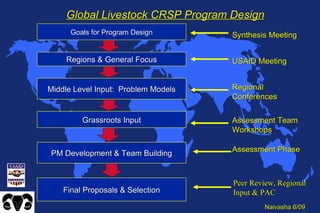
Global Livestock CRSP Program Design Goals for Program Design Regions & General Focus Middle Level Input:  Problem Models Grassroots Input PM Development & Team Building Synthesis Meeting USAID Meeting Regional Conferences Assessment Team Workshops Assessment Phase Final Proposals & Selection Peer Review, Regional Input & PAC
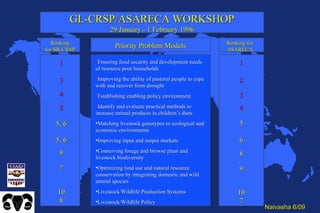
GL-CRSP/ASARECA WORKSHOP 29 January - 1 February 1996 Ensuring food security and development needs of resource poor households Improving the ability of pastoral people to cope with and recover from drought Establishing enabling policy environment Identify and evaluate practical methods to increase animal products in children’s diets  Matching livestock genotypes to ecological and economic environments Improving input and output markets Conserving forage and browse plant and livestock biodiversity Optimizing land use and natural resource conservation by integrating domestic and wild animal species Livestock/Wildlife Production Systems Livestock/Wildlife Policy  1 3 4 2 5, 6 5, 6 9 7 10 8 1 2 3 4 5 6 8 9 10 7 Priority Problem Models Ranking for SR-CRSP Ranking for ASARECA
What we did. Governance EPAC EEP/EPAC Outreach USAID Missions Problem Model brings diverse partners Research Briefs Website
Characteristics of the New CRSP Reduce Transaction Costs  (National Performance Review, Synthesis Meetings) Diversify Granting Mechanisms  (Synthesis Meetings) Effective Assessment and Problem Resolution  (USAID Re-engineering, Synthesis Meetings) Diversify Partnerships: Private Sector, IARCs (New Partnership Initiative, Synthesis Meetings, USAID/AFS) Regionalization  (Synthesis Meeting, USAID/AFS) Customer Oriented  (USAID Reengineering, Synthesis Meetings)
Problem Models Results orientation with strong logic framework Integrative mechanism for disciplinary research Continuum from research to extension Diversification of member institutions Incorporation of collaborators on the front end Capitalize on other funding sources
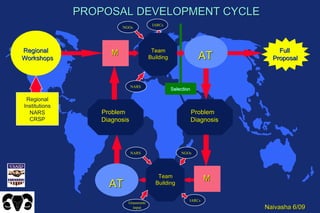
Regional Institutions NARS CRSP Grassroots input NARS IARCs IARCs NARS NGOs NGOs Regional  Regional  Workshops Workshops AT AT i i Problem  Problem  Diagnosis Diagnosis Team Team Building Building Problem  Problem  Diagnosis Diagnosis AT AT i i Full Full Proposal Proposal M M i i M M i i Team Team Building Building PROPOSAL DEVELOPMENT CYCLE PROPOSAL DEVELOPMENT CYCLE Selection Selection
Who we are Conference Brochure Advantages of the CRSP model Cost effective Leveraged funding US university and host country contribution Long-term engagement and partnerships Problem solving and capacity building linked Training model Internationalization of US HEIs and increase ability to produce globally competent students
How we evolved: 3 examples Between CRSP evolution : Nutrition CRSP>GL-CRSP CNP>GL-CRSP ENAM Within project transformation : PARIMA: Fundamental to action research to implementation Technology developed, implemented and spread : LEWS/LINKS > Gobi > PEACE > MLPI
How we see the future Changing landscape National security Food crisis, the Return of Agriculture and Higher Education Lugar/Casey Bill Africa-U.S. Higher Education Initiative Obama transition team
The Challenges USAID and USG foreign assistance Implications of Congressional constraints on staffing Fragmentation of foreign assistance Influence of State, PEPFAR, MCC Putting the pieces back together Support for increased staffing Making the Agency a “learning institution” again Development vs disaster Enhancing partnership with US universities and developing country entities
The Challenges Strong rationale for DA competing with huge budget deficits. Strong focus particularly in Africa on agriculture, can it be realized and maintained? Building human and institutional capacity particularly in fields related to economic development will increase ?
The Challenges Will higher education and degree training become a major component of the development portfolio? (Atlas Program) Can research return to rightful place in USAID development portfolio…can we learn by doing? Can the USG FA effort take full advantage of the S&T capacity of US higher education in the knowledge age?
Challenges at the Program Level Risk  Zoonotic disease Climate Change Conflict Economic growth Higher Education  Connection to markets Child nutrition and development Carbon cap and trade systems Building linkages with USAID Missions
The Conference Objectives Highlight achievements Discuss lessons learned Identify major challenges to conducting international development research Examine challenges by which the program has functioned Stimulate dialog for way forward for animal agricultural research in international development.
Thank you

From Problem Models to Solutions: the Global Livestock CRSP

  • 1.
    Global Livestock CRSPEnd of Program Conference F rom Problem models to solutions Montague Demment Director, Global Livestock CRSP Department of Plant Sciences UC Davis
  • 2.
    Comments Where westarted. What we did to adapt. What we are. How we have evolved. Some personal perspectives on the future and its challenges.
  • 3.
    Where we started.The environment of the 1990s The “A” word Focus on short-term Counting CRSP funding Higher versus Basic Education Research
  • 4.
    Where we started.Old CRSP model No open competition for projects BOD composed of representatives of the participating institutions PIs controlled the allocation of resources Disciplinary focus at project level, interdisciplinary across projects
  • 5.
    What we did.New CRSP structure Gore’s redesign of government Top-down-bottom-up planning process Stakeholders set themes and regional problems Problem model Open competition for Assessment Teams Final proposals
  • 6.
    Global Livestock CRSPProgram Design Goals for Program Design Regions & General Focus Middle Level Input: Problem Models Grassroots Input PM Development & Team Building Synthesis Meeting USAID Meeting Regional Conferences Assessment Team Workshops Assessment Phase Final Proposals & Selection Peer Review, Regional Input & PAC
  • 7.
    GL-CRSP/ASARECA WORKSHOP 29January - 1 February 1996 Ensuring food security and development needs of resource poor households Improving the ability of pastoral people to cope with and recover from drought Establishing enabling policy environment Identify and evaluate practical methods to increase animal products in children’s diets Matching livestock genotypes to ecological and economic environments Improving input and output markets Conserving forage and browse plant and livestock biodiversity Optimizing land use and natural resource conservation by integrating domestic and wild animal species Livestock/Wildlife Production Systems Livestock/Wildlife Policy 1 3 4 2 5, 6 5, 6 9 7 10 8 1 2 3 4 5 6 8 9 10 7 Priority Problem Models Ranking for SR-CRSP Ranking for ASARECA
  • 8.
    What we did.Governance EPAC EEP/EPAC Outreach USAID Missions Problem Model brings diverse partners Research Briefs Website
  • 9.
    Characteristics of theNew CRSP Reduce Transaction Costs (National Performance Review, Synthesis Meetings) Diversify Granting Mechanisms (Synthesis Meetings) Effective Assessment and Problem Resolution (USAID Re-engineering, Synthesis Meetings) Diversify Partnerships: Private Sector, IARCs (New Partnership Initiative, Synthesis Meetings, USAID/AFS) Regionalization (Synthesis Meeting, USAID/AFS) Customer Oriented (USAID Reengineering, Synthesis Meetings)
  • 10.
    Problem Models Resultsorientation with strong logic framework Integrative mechanism for disciplinary research Continuum from research to extension Diversification of member institutions Incorporation of collaborators on the front end Capitalize on other funding sources
  • 11.
    Regional Institutions NARSCRSP Grassroots input NARS IARCs IARCs NARS NGOs NGOs Regional Regional Workshops Workshops AT AT i i Problem Problem Diagnosis Diagnosis Team Team Building Building Problem Problem Diagnosis Diagnosis AT AT i i Full Full Proposal Proposal M M i i M M i i Team Team Building Building PROPOSAL DEVELOPMENT CYCLE PROPOSAL DEVELOPMENT CYCLE Selection Selection
  • 12.
    Who we areConference Brochure Advantages of the CRSP model Cost effective Leveraged funding US university and host country contribution Long-term engagement and partnerships Problem solving and capacity building linked Training model Internationalization of US HEIs and increase ability to produce globally competent students
  • 13.
    How we evolved:3 examples Between CRSP evolution : Nutrition CRSP>GL-CRSP CNP>GL-CRSP ENAM Within project transformation : PARIMA: Fundamental to action research to implementation Technology developed, implemented and spread : LEWS/LINKS > Gobi > PEACE > MLPI
  • 14.
    How we seethe future Changing landscape National security Food crisis, the Return of Agriculture and Higher Education Lugar/Casey Bill Africa-U.S. Higher Education Initiative Obama transition team
  • 15.
    The Challenges USAIDand USG foreign assistance Implications of Congressional constraints on staffing Fragmentation of foreign assistance Influence of State, PEPFAR, MCC Putting the pieces back together Support for increased staffing Making the Agency a “learning institution” again Development vs disaster Enhancing partnership with US universities and developing country entities
  • 16.
    The Challenges Strongrationale for DA competing with huge budget deficits. Strong focus particularly in Africa on agriculture, can it be realized and maintained? Building human and institutional capacity particularly in fields related to economic development will increase ?
  • 17.
    The Challenges Willhigher education and degree training become a major component of the development portfolio? (Atlas Program) Can research return to rightful place in USAID development portfolio…can we learn by doing? Can the USG FA effort take full advantage of the S&T capacity of US higher education in the knowledge age?
  • 18.
    Challenges at theProgram Level Risk Zoonotic disease Climate Change Conflict Economic growth Higher Education Connection to markets Child nutrition and development Carbon cap and trade systems Building linkages with USAID Missions
  • 19.
    The Conference ObjectivesHighlight achievements Discuss lessons learned Identify major challenges to conducting international development research Examine challenges by which the program has functioned Stimulate dialog for way forward for animal agricultural research in international development.
  • 20.