FREQUENT BLINKING
in CHILDREN
•   Normal rate- 1 in every 5 sec of 0.3 sec duration
•   neonates:1-4 /min
•   Adolescent to adults:12-15/min
•   Protection from unwanted stimuli
    ▫ Irritation of the cornea, conjunctiva, eyelashes
    ▫ Bright light/glare
    ▫ Loud noise
• Allows the spread of tear film
1.INVOLUNTARY-
• Response to external stimuli
• Afferent- CN II and VIII
• Efferent- CN VII
• Absent in infants
2. VOLUNTARY/Controlled/ Subconscious
• Spreads the tear film
• Afferent- CN V
• Efferent- CN VII
• early ipsilateral response- oligosynaptic pontine
  pathway
• late bilateral response -polysynaptic medullar
  arc.
• recovery curve
• Evaluation of blink reflex can be useful in
  examining patients with systemic disease
  (eg.brainstem dysfunction)
• Blinking increases with verbal conversation
• Decreases with reading
FREQUENT BLINKING
Causes:
2.Eye blinking tics- occur in boys, can be
  controlled voluntarily and usually are self–
  limited
3.Blepharospasm- adults, females
4. excessive blinking due to ocular surface
  disorders
Frequent blinking in Children
• A case series study was conducted by Aghadoost
  et.al., in 2002 to describe the causes of excessive
  blinking in childhood
• 60 subjects-30 males (65%), 21 females (35%)
• age: 3.5 to 16 y/o ( mean- 10)
• Bilateral excessive blinking ( 7 days to 15
  months)
▫   VA
▫   Cycloplegic refraction
▫   EOM
▫   SLE
▫   Funduscopy
▫   Evaluation of excessive blinking- bright light,
    lateral eye movement, gentle tapping on forehead
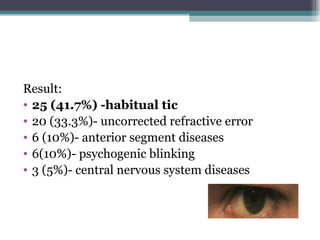
Result:
• 25 (41.7%) -habitual tic
• 20 (33.3%)- uncorrected refractive error
• 6 (10%)- anterior segment diseases
• 6(10%)- psychogenic blinking
• 3 (5%)- central nervous system diseases
• Habitual tic-
  ▫ Resolved spontaneously after 3 mos
• EOR-
  ▫ prescribed glasses.
  ▫ 20 resolved after 2 mos
• Anterior segment disease-
  ▫ 4/6 cases resolved after proper treatment
• Psychogenic blepharospasm-
  ▫ dx w/ history of stressful condition ( eg new
    environment, examination)
  ▫ 4/6 resolved after 3 mos.
Study done by Coats et al
• Subjects- 99
• < 16 y/o
• M:F- 2:1
• Follow- up- 2 mos
• Excessive blinking
•   Result:
•   37%- anterior segment abnormalities
•   23%- habitual tics
•   14%- uncorrected EOR
•   11%- Intermittent exotropia
•   10%- psychogenic blepharospasm
AGHADOOST et.al        COATS et. al

M:F        2:1                    2:1

      1.   habitual tic (41.7%)   anterior segment
                                  abnormalities (37%)


      2.   EOR (33.3%)-           habitual tics (23%)

      3.   anterior segment       uncorrected EOR (14%)
           diseases (10%)


      4.   psychogenic blinking   Intermittent exotropia (11%)
           (10%)

      5.   CNS dse ( 5%)          psychogenic blepharospasm
                                  (10%)
Conclusion
•   Benign or self limiting
•   Careful history and thorough examination
•   Reassurance and proper treatment
•   Neurologic evaluation is unnecessary
REFERENCES
• Coats DK, Paysse EA, Kim DS. Excessive blinking in
  childhood: a prospective evaluation of 99 children
  Ophthalmology. 2001 Sep;108(9):1556-1561.
• Aghadoost et.al., EVALUATION OF EXCESSIVE
  BLINKING IN CHILDHOOD Acta Medica Iranic.
  2004
• Frank Newell. Ophthalmology Principles and
  Concepts . Missouri:Mosby- Year Book 1996 p. 203
• Suthphin et.al., American Academy of
  Ophthalmology Section 8 External Disease and
  Cornea 2008-2009 p. 205
Frequent blinking in children

Frequent blinking in children

  • 1.
  • 2.
    Normal rate- 1 in every 5 sec of 0.3 sec duration • neonates:1-4 /min • Adolescent to adults:12-15/min • Protection from unwanted stimuli ▫ Irritation of the cornea, conjunctiva, eyelashes ▫ Bright light/glare ▫ Loud noise • Allows the spread of tear film
  • 3.
    1.INVOLUNTARY- • Response toexternal stimuli • Afferent- CN II and VIII • Efferent- CN VII • Absent in infants 2. VOLUNTARY/Controlled/ Subconscious • Spreads the tear film • Afferent- CN V • Efferent- CN VII
  • 4.
    • early ipsilateralresponse- oligosynaptic pontine pathway • late bilateral response -polysynaptic medullar arc. • recovery curve
  • 5.
    • Evaluation ofblink reflex can be useful in examining patients with systemic disease (eg.brainstem dysfunction) • Blinking increases with verbal conversation • Decreases with reading
  • 6.
    FREQUENT BLINKING Causes: 2.Eye blinkingtics- occur in boys, can be controlled voluntarily and usually are self– limited 3.Blepharospasm- adults, females 4. excessive blinking due to ocular surface disorders
  • 7.
    Frequent blinking inChildren • A case series study was conducted by Aghadoost et.al., in 2002 to describe the causes of excessive blinking in childhood • 60 subjects-30 males (65%), 21 females (35%) • age: 3.5 to 16 y/o ( mean- 10) • Bilateral excessive blinking ( 7 days to 15 months)
  • 8.
    VA ▫ Cycloplegic refraction ▫ EOM ▫ SLE ▫ Funduscopy ▫ Evaluation of excessive blinking- bright light, lateral eye movement, gentle tapping on forehead
  • 9.
    Result: • 25 (41.7%)-habitual tic • 20 (33.3%)- uncorrected refractive error • 6 (10%)- anterior segment diseases • 6(10%)- psychogenic blinking • 3 (5%)- central nervous system diseases
  • 10.
    • Habitual tic- ▫ Resolved spontaneously after 3 mos • EOR- ▫ prescribed glasses. ▫ 20 resolved after 2 mos • Anterior segment disease- ▫ 4/6 cases resolved after proper treatment • Psychogenic blepharospasm- ▫ dx w/ history of stressful condition ( eg new environment, examination) ▫ 4/6 resolved after 3 mos.
  • 11.
    Study done byCoats et al • Subjects- 99 • < 16 y/o • M:F- 2:1 • Follow- up- 2 mos • Excessive blinking
  • 12.
    Result: • 37%- anterior segment abnormalities • 23%- habitual tics • 14%- uncorrected EOR • 11%- Intermittent exotropia • 10%- psychogenic blepharospasm
  • 13.
    AGHADOOST et.al COATS et. al M:F 2:1 2:1 1. habitual tic (41.7%) anterior segment abnormalities (37%) 2. EOR (33.3%)- habitual tics (23%) 3. anterior segment uncorrected EOR (14%) diseases (10%) 4. psychogenic blinking Intermittent exotropia (11%) (10%) 5. CNS dse ( 5%) psychogenic blepharospasm (10%)
  • 14.
    Conclusion • Benign or self limiting • Careful history and thorough examination • Reassurance and proper treatment • Neurologic evaluation is unnecessary
  • 15.
    REFERENCES • Coats DK,Paysse EA, Kim DS. Excessive blinking in childhood: a prospective evaluation of 99 children Ophthalmology. 2001 Sep;108(9):1556-1561. • Aghadoost et.al., EVALUATION OF EXCESSIVE BLINKING IN CHILDHOOD Acta Medica Iranic. 2004 • Frank Newell. Ophthalmology Principles and Concepts . Missouri:Mosby- Year Book 1996 p. 203 • Suthphin et.al., American Academy of Ophthalmology Section 8 External Disease and Cornea 2008-2009 p. 205