TITLE:
FREQUENCY DIVISION
MULTIPLEXING & DE-
MULTIPLEXING
MD FARHAN --22R21A04N8
K.NANI ---22R21A04N3
INTRODUCTION:
• Frequency Division Multiplexing (FDM) is a networking technique in which multiple data
signals are combined for simultaneous transmission via a shared communication medium.
FDM uses a carrier signal at a discrete frequency for each data stream and then combines many
modulated signals.
• In this, a number of signals are transmitted at the same time, and each source transfers its
signals in the allotted frequency range. Since the signals are transmitted in the allotted
frequencies so this decreases the probability of collision. A number of signals are sent
simultaneously at the same time allocating separate frequency bands or channels to each
signal. Therefore to avoid interference between two successive channels Guard bands are used.
METHODOLOGY:
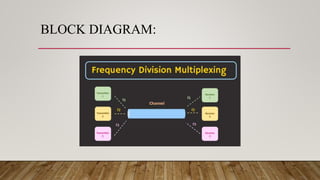
• In the FDM system, the transmitter end has several transmitters & the receiver end has several
receivers. In between the transmitter & receiver, the communication channel is there.
• In FDM, at the transmitter end, every transmitter transmits a signal with a different frequency. For
instance, the first transmitter transmits a signal with 30 kHz frequency, the second transmitter
transmits a signal with 40 kHz frequency & third transmitter transmits a signal with 50 kHz
frequency.
• After that, these signals with different frequencies are combined with a device known as a
multiplexer which transmits the multiplexed signals through a communication channel.At the
receiver end de-multiplexer is used to separate the multiplexed signals then it transmits these
separated signals to the particular receivers.
BLOCK DIAGRAM:
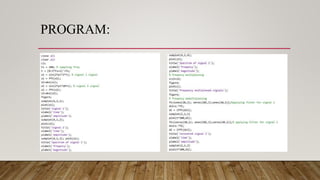
PROGRAM:
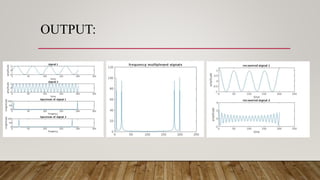
OUTPUT:
CONCLUSION:
• Frequency-division multiplexing (FDM) is a technique used in telecommunications to
efficiently share a communication medium’s total bandwidth among multiple independent
signals.
• It enables efficient data transmission by dividing available bandwidth into separate frequency
bands for different signals.
• FDM is a fundamental technique in telecommunications and plays a crucial role in various
communication systems.

Frequency division multiplexing and demultiplexing

  • 1.
    TITLE: FREQUENCY DIVISION MULTIPLEXING &DE- MULTIPLEXING MD FARHAN --22R21A04N8 K.NANI ---22R21A04N3
  • 2.
    INTRODUCTION: • Frequency DivisionMultiplexing (FDM) is a networking technique in which multiple data signals are combined for simultaneous transmission via a shared communication medium. FDM uses a carrier signal at a discrete frequency for each data stream and then combines many modulated signals. • In this, a number of signals are transmitted at the same time, and each source transfers its signals in the allotted frequency range. Since the signals are transmitted in the allotted frequencies so this decreases the probability of collision. A number of signals are sent simultaneously at the same time allocating separate frequency bands or channels to each signal. Therefore to avoid interference between two successive channels Guard bands are used.
  • 3.
    METHODOLOGY: • In theFDM system, the transmitter end has several transmitters & the receiver end has several receivers. In between the transmitter & receiver, the communication channel is there. • In FDM, at the transmitter end, every transmitter transmits a signal with a different frequency. For instance, the first transmitter transmits a signal with 30 kHz frequency, the second transmitter transmits a signal with 40 kHz frequency & third transmitter transmits a signal with 50 kHz frequency. • After that, these signals with different frequencies are combined with a device known as a multiplexer which transmits the multiplexed signals through a communication channel.At the receiver end de-multiplexer is used to separate the multiplexed signals then it transmits these separated signals to the particular receivers.
  • 4.
  • 5.
  • 6.
  • 7.
    CONCLUSION: • Frequency-division multiplexing(FDM) is a technique used in telecommunications to efficiently share a communication medium’s total bandwidth among multiple independent signals. • It enables efficient data transmission by dividing available bandwidth into separate frequency bands for different signals. • FDM is a fundamental technique in telecommunications and plays a crucial role in various communication systems.