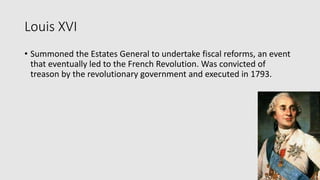
Louis XVI
• Summoned the Estates General to undertake fiscal reforms, an event
that eventually led to the French Revolution. Was convicted of
treason by the revolutionary government and executed in 1793.
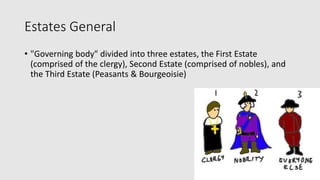
Estates General
• "Governing body" divided into three estates, the First Estate
(comprised of the clergy), Second Estate (comprised of nobles), and
the Third Estate (Peasants & Bourgeoisie)
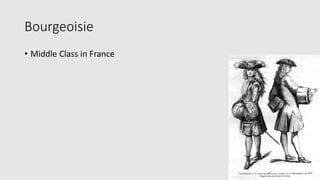
Bourgeoisie
• Middle Class in France
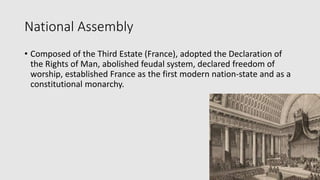
National Assembly
• Composed of the Third Estate (France), adopted the Declaration of
the Rights of Man, abolished feudal system, declared freedom of
worship, established France as the first modern nation-state and as a
constitutional monarchy.
The Convention
• Led by radicals named Jacobins, the ruling body of France after the
National Assembly, abolished the monarchy (and had him beheaded),
proclaimed France a republic, threw out their constitution and
created the Committee of Public Safety.
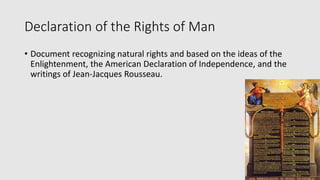
Declaration of the Rights of Man
• Document recognizing natural rights and based on the ideas of the
Enlightenment, the American Declaration of Independence, and the
writings of Jean-Jacques Rousseau.
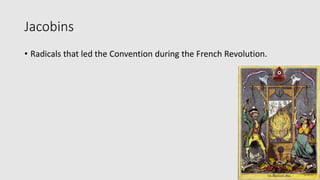
Jacobins
• Radicals that led the Convention during the French Revolution.
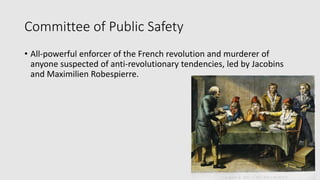
Committee of Public Safety
• All-powerful enforcer of the French revolution and murderer of
anyone suspected of anti-revolutionary tendencies, led by Jacobins
and Maximilien Robespierre.
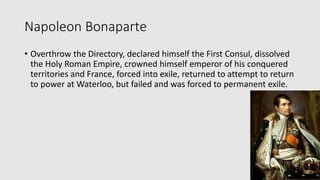
Napoleon Bonaparte
• Overthrow the Directory, declared himself the First Consul, dissolved
the Holy Roman Empire, crowned himself emperor of his conquered
territories and France, forced into exile, returned to attempt to return
to power at Waterloo, but failed and was forced to permanent exile.
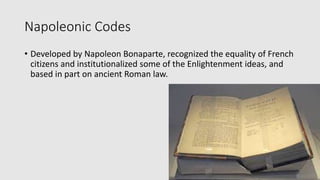
Napoleonic Codes
• Developed by Napoleon Bonaparte, recognized the equality of French
citizens and institutionalized some of the Enlightenment ideas, and
based in part on ancient Roman law.
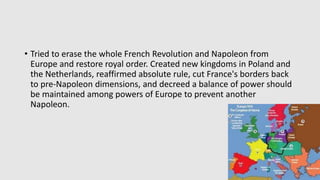
• Tried to erase the whole French Revolution and Napoleon from
Europe and restore royal order. Created new kingdoms in Poland and
the Netherlands, reaffirmed absolute rule, cut France's borders back
to pre-Napoleon dimensions, and decreed a balance of power should
be maintained among powers of Europe to prevent another
Napoleon.

French Revolution

  • 1.
    Louis XVI • Summonedthe Estates General to undertake fiscal reforms, an event that eventually led to the French Revolution. Was convicted of treason by the revolutionary government and executed in 1793.
  • 2.
    Estates General • "Governingbody" divided into three estates, the First Estate (comprised of the clergy), Second Estate (comprised of nobles), and the Third Estate (Peasants & Bourgeoisie)
  • 3.
  • 4.
    National Assembly • Composedof the Third Estate (France), adopted the Declaration of the Rights of Man, abolished feudal system, declared freedom of worship, established France as the first modern nation-state and as a constitutional monarchy.
  • 5.
    The Convention • Ledby radicals named Jacobins, the ruling body of France after the National Assembly, abolished the monarchy (and had him beheaded), proclaimed France a republic, threw out their constitution and created the Committee of Public Safety.
  • 6.
    Declaration of theRights of Man • Document recognizing natural rights and based on the ideas of the Enlightenment, the American Declaration of Independence, and the writings of Jean-Jacques Rousseau.
  • 7.
    Jacobins • Radicals thatled the Convention during the French Revolution.
  • 8.
    Committee of PublicSafety • All-powerful enforcer of the French revolution and murderer of anyone suspected of anti-revolutionary tendencies, led by Jacobins and Maximilien Robespierre.
  • 9.
    Napoleon Bonaparte • Overthrowthe Directory, declared himself the First Consul, dissolved the Holy Roman Empire, crowned himself emperor of his conquered territories and France, forced into exile, returned to attempt to return to power at Waterloo, but failed and was forced to permanent exile.
  • 10.
    Napoleonic Codes • Developedby Napoleon Bonaparte, recognized the equality of French citizens and institutionalized some of the Enlightenment ideas, and based in part on ancient Roman law.
  • 11.
    • Tried toerase the whole French Revolution and Napoleon from Europe and restore royal order. Created new kingdoms in Poland and the Netherlands, reaffirmed absolute rule, cut France's borders back to pre-Napoleon dimensions, and decreed a balance of power should be maintained among powers of Europe to prevent another Napoleon.