History Chapter- 1
The French Revolution
 ON THE MORNING OF 14TH JULY 1789, THE CITY OF PARIS
WAS AT ALARM.
THE KING HAD COMMENTED THR ARMY TROOPS TO ROAM
AROUND THE TERRITORY.
PEOPLE STARTED HEARING RUMOURS ON KING THAT HE HAS
ORDERED TROOPS TO FIRE ON PEOPLE
SOME 7000 MEN AND WOMEN GATHERED IN TOWN HALL AND
STARTED PEOPLE MILLITIA AND SEARCHED FOR ARMS.
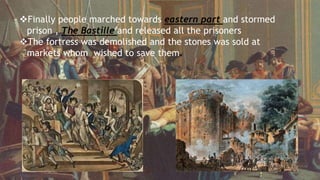
Finally people marched towards eastern part and stormed
prison , The Bastille and released all the prisoners
The fortress was demolished and the stones was sold at
markets whom wished to save them.
 The situation was getting even worse there were
more riots in Paris some people were protesting for high
prices of Bread these led to executions of Monarchy in
France.
Why, What happened in Paris what is the Problem and
why people started behaving like this?
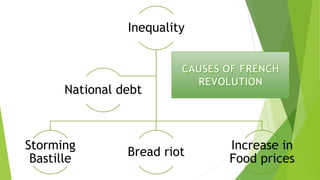
Inequality
Storming
Bastille
Bread riot
Increase in
Food prices
National debt
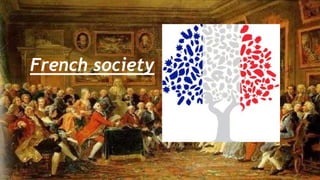
French society
 In 1774 Louis XVI ascended the throne. He
belong to Bourbon family. He was just 20 years
old and married a Austrian Princess Marie
Antoinette.
* When did Louis ascended the throne the
treasury was empty.
The reasons are
 Prolonged war – the France helped 13
American colonies to get freedom from
British.
 Maintaining huge army.
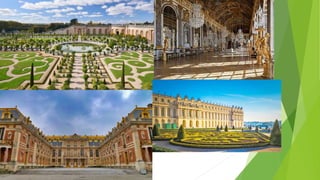
 Care of the huge and gigantic palace called
‘Versailles’
$ 8.14 million
59,61,06,852.00 in
Indian rupee
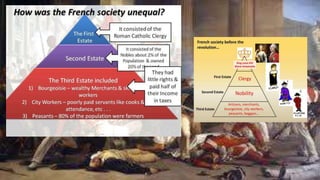
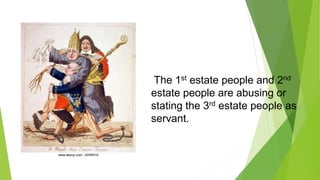
What can u observe in this
image?
The 1st estate people and 2nd
estate people are abusing or
stating the 3rd estate people as
servant.
The government collected 2 types of Tax:
*Tithes- This type of tax were paid to king that is
directly to government.
*Taille- Tax is used to pay to Churches.
Economic causes
 The French economy was based on Revenues we collect
from land.
 France had 2 billion livre debt. The Prolonged war with
America had a most cost to maintain army this has
increased still 1 billion debt.
 In his income 43% would go to Interest.
 To this Louis XVI has to increase the Tax on Huge people.
But the king himself cannot high the taxes. He need to
discuss with group of people called ‘GENERAL ESTATE’
General Estate:
General estate comprise of People from all estate.
• 300- 1st estate
• 300-2nd estate
• 600-3rd estate.
When the king told them about the tax increasement
the first 2 estates agreed upon because they no need to
pay tax. But who are the sufferers so the 3rd estate
people did not agree.
Each group has 1 vote. But the 3rd estate people asked
each vote for each person but the king did not agree.
Now there arises a new revolution . So the 3rd estate
people came out of the King’s court and gathered in a
tennis court and started National assembly.
They took the oath as ‘ we no need monarchy but we
need to rule ourselves and we will not go anywhere
before we draft a sample Constitution’.
As the first step the assembly abolished Tithes and taille.
This reduced a big burden of 3rd estate people.
Subsistence Crisis
 In France in the year 1789 the population increased from
23 million to 28million
So we need to increase the food production.
In the same time there occurred a drought so that the
farmers cannot cultivate an cannot pay taxes.
This led to food shortage and inflation.
So people started fighting and protesting for bread resulted
in Bread riots. This was the reason for the alarm situation
in Paris.
As people saw the troops the people thought that king
decided to make something on National assembly.
REVOLUTION STARTS!!!!
The 18th century is known as age of enlightenment . Many reformers were formed
and told their ideas to people.
• they told that classes should be according to merit.
• John Locke and Jacques Rousseau- published Two Treatises of government in that
they told that king should not have absolute power.
• Rousseau told that there should be link between people and government.
• Montesquieu wrote The spirit of Laws in that he devided the government into 3
groups
Legislative
Executive
Judiciary
This was the model of government that was in existence in American colonies.
 On the night of 4th August 1789 assembly passes
the decree of abolishing feudal system and taxes.
Tithes were abolished and the lands of churches
were confiscated to repay the debt. And clergy ere
also forced to leave some privileges.
France becomes constitutional
Monarchy
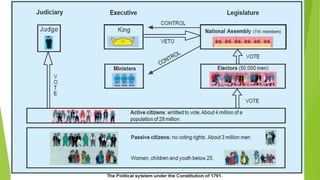
At last at 1791 the national assembly drafted a constitution.
Their prime objective was to limit the powers of king. They
bought different groups with that the France become a
constitutional monarchy. The people of France were divided into
two groups.
Active citizens – Men above 25 years and who payed tax were
allowed to vote
Passive citizens- women, children and other men
France abolishes Monarchy
and become republic
Reforms made by National assembly
 controlled the lands of clergy and sold to people who want to
buy them. With the money
got they solved the debt of France.
 Clergy people got salaries from government to maintain the
churches.
 Catholic church become the branch of state.
 Limited the power of monarch and divided the state into 3
groups
Legislative
Executive
Judiciary
 French clergy will be appointed by government.
 Legislature will be allowed to pass new laws and
collected tax.
 Granted all members to vote.
 Abolished privileges of nobility.
 End to feudal system.
 Taxes will be applied on people who can pay them.
King has signed the constitution. But he did not want to leave
the monarch power.
He involved into secret negotiations with Prussia and Austria.
rulers of Prussia and Austria was worried about the situation and
agreed to help the France.
Louis XVI and his family decided to exit the country and move to
another place. Before they
Reached the border the NA bought them back and declared war
against Austria and Prussia.
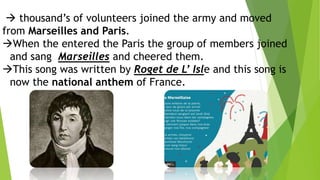
 thousand’s of volunteers joined the army and moved
from Marseilles and Paris.
When the entered the Paris the group of members joined
and sang Marseilles and cheered them.
This song was written by Roget de L’ Isle and this song is
now the national anthem of France.
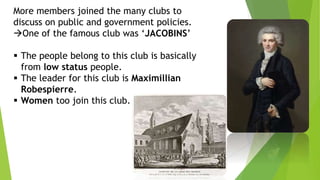
More members joined the many clubs to
discuss on public and government policies.
One of the famous club was ‘JACOBINS’
 The people belong to this club is basically
from low status people.
 The leader for this club is Maximillian
Robespierre.
 Women too join this club.
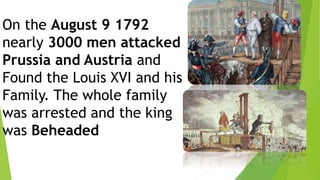
On the August 9 1792
nearly 3000 men attacked
Prussia and Austria and
Found the Louis XVI and his
Family. The whole family
was arrested and the king
was Beheaded
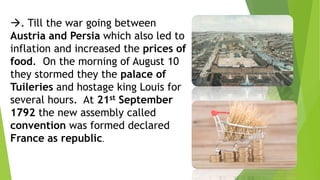
. Till the war going between
Austria and Persia which also led to
inflation and increased the prices of
food. On the morning of August 10
they stormed they the palace of
Tuileries and hostage king Louis for
several hours. At 21st September
1792 the new assembly called
convention was formed declared
France as republic.
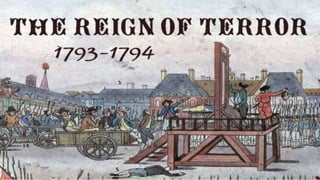
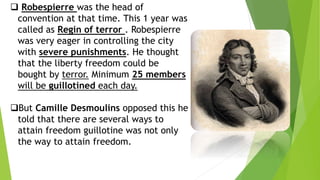
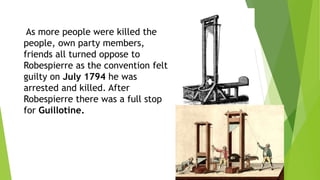
 Robespierre was the head of
convention at that time. This 1 year was
called as Regin of terror . Robespierre
was very eager in controlling the city
with severe punishments. He thought
that the liberty freedom could be
bought by terror. Minimum 25 members
will be guillotined each day.
But Camille Desmoulins opposed this he
told that there are several ways to
attain freedom guillotine was not only
the way to attain freedom.
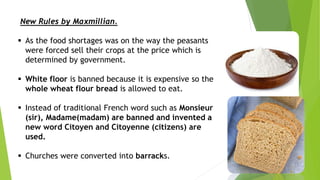
New Rules by Maxmillian.
 As the food shortages was on the way the peasants
were forced sell their crops at the price which is
determined by government.
 White floor is banned because it is expensive so the
whole wheat flour bread is allowed to eat.
 Instead of traditional French word such as Monsieur
(sir), Madame(madam) are banned and invented a
new word Citoyen and Citoyenne (citizens) are
used.
 Churches were converted into barracks.
As more people were killed the
people, own party members,
friends all turned oppose to
Robespierre as the convention felt
guilty on July 1794 he was
arrested and killed. After
Robespierre there was a full stop
for Guillotine.
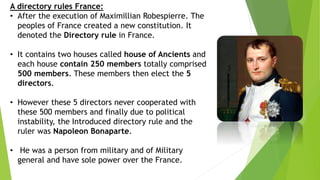
A directory rules France:
• After the execution of Maximillian Robespierre. The
peoples of France created a new constitution. It
denoted the Directory rule in France.
• It contains two houses called house of Ancients and
each house contain 250 members totally comprised
500 members. These members then elect the 5
directors.
• However these 5 directors never cooperated with
these 500 members and finally due to political
instability, the Introduced directory rule and the
ruler was Napoleon Bonaparte.
• He was a person from military and of Military
general and have sole power over the France.
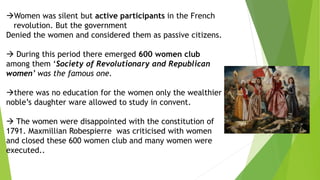
Did women have
Revolution?
Women was silent but active participants in the French
revolution. But the government
Denied the women and considered them as passive citizens.
 During this period there emerged 600 women club
among them ‘Society of Revolutionary and Republican
women’ was the famous one.
there was no education for the women only the wealthier
noble’s daughter ware allowed to study in convent.
 The women were disappointed with the constitution of
1791. Maxmillian Robespierre was criticised with women
and closed these 600 women club and many women were
executed..
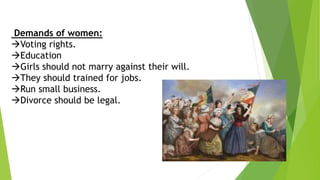
Demands of women:
Voting rights.
Education
Girls should not marry against their will.
They should trained for jobs.
Run small business.
Divorce should be legal.
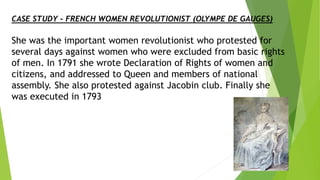
CASE STUDY – FRENCH WOMEN REVOLUTIONIST (OLYMPE DE GAUGES)
She was the important women revolutionist who protested for
several days against women who were excluded from basic rights
of men. In 1791 she wrote Declaration of Rights of women and
citizens, and addressed to Queen and members of national
assembly. She also protested against Jacobin club. Finally she
was executed in 1793
Abolition of Slavery
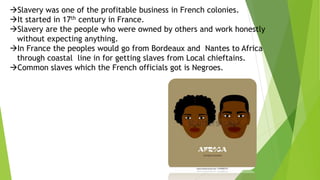
Slavery was one of the profitable business in French colonies.
It started in 17th century in France.
Slavery are the people who were owned by others and work honestly
without expecting anything.
In France the peoples would go from Bordeaux and Nantes to Africa
through coastal line in for getting slaves from Local chieftains.
Common slaves which the French officials got is Negroes.
The bought slaves are sent to Caribbean, Martinique, Guadeloupe,
San Domingo to maintain Plantations of coffee, indigo, sugar.
However as new constitution is in role long debates were held on
abolition of slavery but the 3rd estate people did not agree as their
income would not come.
Finally the convention of 1791 abolished slave in 1794.
But Napoleon Bonaparte reintroduced it. At last in 1848 the whole
slavery in French colonies were abolished.
The revolution and everyday life
 The following years after 1789 the France saw many
changes.
 After storming of Bastille abolished the censorship.
• Before conducting any speech, printing papers,
pamphlets, dramas, songs skits and everything, they need
to ask permission.
 The declared the right of speech and rights of men.
 Freedom of print opposed the government and show
cased all the views of people and press, whether it is good
or bad.
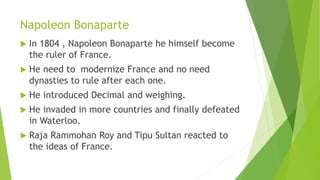
Napoleon Bonaparte
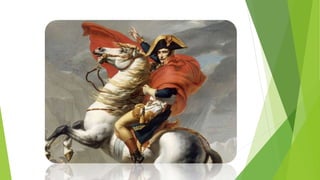
 In 1804 , Napoleon Bonaparte he himself become
the ruler of France.
 He need to modernize France and no need
dynasties to rule after each one.
 He introduced Decimal and weighing.
 He invaded in more countries and finally defeated
in Waterloo.
 Raja Rammohan Roy and Tipu Sultan reacted to
the ideas of France.
French revolution
French revolution

French revolution

  • 1.
    History Chapter- 1 TheFrench Revolution
  • 2.
     ON THEMORNING OF 14TH JULY 1789, THE CITY OF PARIS WAS AT ALARM. THE KING HAD COMMENTED THR ARMY TROOPS TO ROAM AROUND THE TERRITORY. PEOPLE STARTED HEARING RUMOURS ON KING THAT HE HAS ORDERED TROOPS TO FIRE ON PEOPLE SOME 7000 MEN AND WOMEN GATHERED IN TOWN HALL AND STARTED PEOPLE MILLITIA AND SEARCHED FOR ARMS.
  • 3.
    Finally people marchedtowards eastern part and stormed prison , The Bastille and released all the prisoners The fortress was demolished and the stones was sold at markets whom wished to save them.
  • 4.
     The situationwas getting even worse there were more riots in Paris some people were protesting for high prices of Bread these led to executions of Monarchy in France. Why, What happened in Paris what is the Problem and why people started behaving like this?
  • 5.
  • 6.
  • 7.
     In 1774Louis XVI ascended the throne. He belong to Bourbon family. He was just 20 years old and married a Austrian Princess Marie Antoinette. * When did Louis ascended the throne the treasury was empty.
  • 8.
    The reasons are Prolonged war – the France helped 13 American colonies to get freedom from British.  Maintaining huge army.  Care of the huge and gigantic palace called ‘Versailles’
  • 11.
  • 14.
    What can uobserve in this image?
  • 15.
    The 1st estatepeople and 2nd estate people are abusing or stating the 3rd estate people as servant.
  • 16.
    The government collected2 types of Tax: *Tithes- This type of tax were paid to king that is directly to government. *Taille- Tax is used to pay to Churches.
  • 17.
    Economic causes  TheFrench economy was based on Revenues we collect from land.  France had 2 billion livre debt. The Prolonged war with America had a most cost to maintain army this has increased still 1 billion debt.  In his income 43% would go to Interest.  To this Louis XVI has to increase the Tax on Huge people. But the king himself cannot high the taxes. He need to discuss with group of people called ‘GENERAL ESTATE’
  • 18.
    General Estate: General estatecomprise of People from all estate. • 300- 1st estate • 300-2nd estate • 600-3rd estate. When the king told them about the tax increasement the first 2 estates agreed upon because they no need to pay tax. But who are the sufferers so the 3rd estate people did not agree. Each group has 1 vote. But the 3rd estate people asked each vote for each person but the king did not agree.
  • 19.
    Now there arisesa new revolution . So the 3rd estate people came out of the King’s court and gathered in a tennis court and started National assembly. They took the oath as ‘ we no need monarchy but we need to rule ourselves and we will not go anywhere before we draft a sample Constitution’. As the first step the assembly abolished Tithes and taille. This reduced a big burden of 3rd estate people.
  • 20.
    Subsistence Crisis  InFrance in the year 1789 the population increased from 23 million to 28million So we need to increase the food production. In the same time there occurred a drought so that the farmers cannot cultivate an cannot pay taxes. This led to food shortage and inflation. So people started fighting and protesting for bread resulted in Bread riots. This was the reason for the alarm situation in Paris. As people saw the troops the people thought that king decided to make something on National assembly.
  • 21.
  • 22.
    The 18th centuryis known as age of enlightenment . Many reformers were formed and told their ideas to people. • they told that classes should be according to merit. • John Locke and Jacques Rousseau- published Two Treatises of government in that they told that king should not have absolute power. • Rousseau told that there should be link between people and government. • Montesquieu wrote The spirit of Laws in that he devided the government into 3 groups Legislative Executive Judiciary This was the model of government that was in existence in American colonies.
  • 23.
     On thenight of 4th August 1789 assembly passes the decree of abolishing feudal system and taxes. Tithes were abolished and the lands of churches were confiscated to repay the debt. And clergy ere also forced to leave some privileges.
  • 24.
    France becomes constitutional Monarchy Atlast at 1791 the national assembly drafted a constitution. Their prime objective was to limit the powers of king. They bought different groups with that the France become a constitutional monarchy. The people of France were divided into two groups. Active citizens – Men above 25 years and who payed tax were allowed to vote Passive citizens- women, children and other men
  • 28.
  • 29.
    Reforms made byNational assembly  controlled the lands of clergy and sold to people who want to buy them. With the money got they solved the debt of France.  Clergy people got salaries from government to maintain the churches.  Catholic church become the branch of state.
  • 30.
     Limited thepower of monarch and divided the state into 3 groups Legislative Executive Judiciary  French clergy will be appointed by government.  Legislature will be allowed to pass new laws and collected tax.  Granted all members to vote.  Abolished privileges of nobility.  End to feudal system.  Taxes will be applied on people who can pay them.
  • 31.
    King has signedthe constitution. But he did not want to leave the monarch power. He involved into secret negotiations with Prussia and Austria. rulers of Prussia and Austria was worried about the situation and agreed to help the France. Louis XVI and his family decided to exit the country and move to another place. Before they Reached the border the NA bought them back and declared war against Austria and Prussia.
  • 32.
     thousand’s ofvolunteers joined the army and moved from Marseilles and Paris. When the entered the Paris the group of members joined and sang Marseilles and cheered them. This song was written by Roget de L’ Isle and this song is now the national anthem of France.
  • 33.
    More members joinedthe many clubs to discuss on public and government policies. One of the famous club was ‘JACOBINS’  The people belong to this club is basically from low status people.  The leader for this club is Maximillian Robespierre.  Women too join this club.
  • 34.
    On the August9 1792 nearly 3000 men attacked Prussia and Austria and Found the Louis XVI and his Family. The whole family was arrested and the king was Beheaded
  • 35.
    . Till thewar going between Austria and Persia which also led to inflation and increased the prices of food. On the morning of August 10 they stormed they the palace of Tuileries and hostage king Louis for several hours. At 21st September 1792 the new assembly called convention was formed declared France as republic.
  • 37.
     Robespierre wasthe head of convention at that time. This 1 year was called as Regin of terror . Robespierre was very eager in controlling the city with severe punishments. He thought that the liberty freedom could be bought by terror. Minimum 25 members will be guillotined each day. But Camille Desmoulins opposed this he told that there are several ways to attain freedom guillotine was not only the way to attain freedom.
  • 38.
    New Rules byMaxmillian.  As the food shortages was on the way the peasants were forced sell their crops at the price which is determined by government.  White floor is banned because it is expensive so the whole wheat flour bread is allowed to eat.  Instead of traditional French word such as Monsieur (sir), Madame(madam) are banned and invented a new word Citoyen and Citoyenne (citizens) are used.  Churches were converted into barracks.
  • 39.
    As more peoplewere killed the people, own party members, friends all turned oppose to Robespierre as the convention felt guilty on July 1794 he was arrested and killed. After Robespierre there was a full stop for Guillotine.
  • 40.
    A directory rulesFrance: • After the execution of Maximillian Robespierre. The peoples of France created a new constitution. It denoted the Directory rule in France. • It contains two houses called house of Ancients and each house contain 250 members totally comprised 500 members. These members then elect the 5 directors. • However these 5 directors never cooperated with these 500 members and finally due to political instability, the Introduced directory rule and the ruler was Napoleon Bonaparte. • He was a person from military and of Military general and have sole power over the France.
  • 41.
  • 42.
    Women was silentbut active participants in the French revolution. But the government Denied the women and considered them as passive citizens.  During this period there emerged 600 women club among them ‘Society of Revolutionary and Republican women’ was the famous one. there was no education for the women only the wealthier noble’s daughter ware allowed to study in convent.  The women were disappointed with the constitution of 1791. Maxmillian Robespierre was criticised with women and closed these 600 women club and many women were executed..
  • 43.
    Demands of women: Votingrights. Education Girls should not marry against their will. They should trained for jobs. Run small business. Divorce should be legal.
  • 44.
    CASE STUDY –FRENCH WOMEN REVOLUTIONIST (OLYMPE DE GAUGES) She was the important women revolutionist who protested for several days against women who were excluded from basic rights of men. In 1791 she wrote Declaration of Rights of women and citizens, and addressed to Queen and members of national assembly. She also protested against Jacobin club. Finally she was executed in 1793
  • 45.
  • 46.
    Slavery was oneof the profitable business in French colonies. It started in 17th century in France. Slavery are the people who were owned by others and work honestly without expecting anything. In France the peoples would go from Bordeaux and Nantes to Africa through coastal line in for getting slaves from Local chieftains. Common slaves which the French officials got is Negroes.
  • 47.
    The bought slavesare sent to Caribbean, Martinique, Guadeloupe, San Domingo to maintain Plantations of coffee, indigo, sugar. However as new constitution is in role long debates were held on abolition of slavery but the 3rd estate people did not agree as their income would not come. Finally the convention of 1791 abolished slave in 1794. But Napoleon Bonaparte reintroduced it. At last in 1848 the whole slavery in French colonies were abolished.
  • 48.
    The revolution andeveryday life  The following years after 1789 the France saw many changes.  After storming of Bastille abolished the censorship. • Before conducting any speech, printing papers, pamphlets, dramas, songs skits and everything, they need to ask permission.  The declared the right of speech and rights of men.  Freedom of print opposed the government and show cased all the views of people and press, whether it is good or bad.
  • 49.
    Napoleon Bonaparte  In1804 , Napoleon Bonaparte he himself become the ruler of France.  He need to modernize France and no need dynasties to rule after each one.  He introduced Decimal and weighing.  He invaded in more countries and finally defeated in Waterloo.  Raja Rammohan Roy and Tipu Sultan reacted to the ideas of France.