The efficient movement of freight
is central to an effective transportation
system and essential to a robust economy.
Manufacturing, agriculture, retail and industry all
depend upon reliable freight movement to function.
The Texas A&M Transportation Institute is a
leader in multimodal freight research and an
innovator in exploring new ways of moving
freight across the nation and around
the world.
Saving Lives, Time and Resources tti.tamu.edu
Learn more at
tti.tamu.edu
Subject Matter Expertise
Trucking, Freight Rail,
Ports and Waterways,
Air Cargo
•	Motor Carriers
Truck congestion
chokepoints, truck emissions,
connected/automated
vehicles, oversize/overweight
trucks, heavy vehicle effects
on highways
•	Maritime
Port operations, inland
waterway planning,
international freight movement
•	Border & Trade
Border crossing performance
measures, freight intelligent
transportation systems,
NAFTA
•	Railroads
Highway-rail grade crossings,
rail market research, rail
infrastructure and equipment
engineering, rail safety
•	Freight Systems & Planning
Hazardous material
commodity flows, air cargo
landside accessibility, freight
policy, freight shuttle system
Texas A&M Transportation Institute’s (TTI)
Freight Shuttle System
TTI has developed a new freight transportation
system: the Freight Shuttle System (FSS). The FSS’s
electrically powered motors will not add to existing
pollution, will advance the United States’ effort to
achieve energy independence, and will allow more
environmentally friendly energy choices.
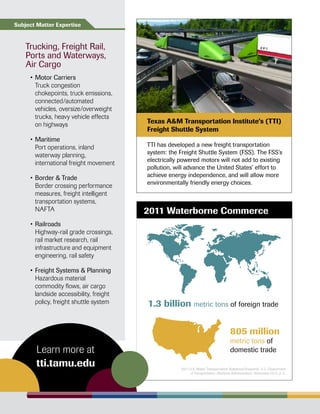
1.3 billion metric tons of foreign trade
805 million
metric tons of
domestic trade
2011 U.S. Water Transportation Statistical Snapshot, U.S. Department
of Transportation, Maritime Administration, November 2013, p. 3.
2011 Waterborne Commerce
Representative Sponsors
Public Sector
•	 Texas Department of Transportation
•	 Texas Department of Public Safety
•	 Port Authorities
•	 Transportation Research Board
•	 U.S. Department of Energy
•	 U.S. Department of Transportation
•	 U.S. Environmental Protection Agency
•	 U.S. Federal Highway Administration
•	 Inter-American Development Bank
•	 National Cooperative Highway Research
Program
Private Sector
•	 Association of American Railroads
•	 Transportation Technology Center Inc.
•	 Class I railroads: BNSF Railway, CSX
•	 National Waterways Foundation
•	 U.S. Soybean Export Council
•	 Private consultants
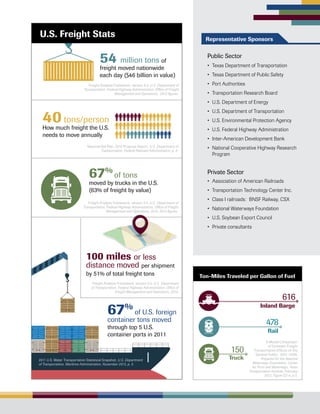
Inland Barge
Rail
Truck
616
478
150
54 million tons of
freight moved nationwide
each day ($46 billion in value)
40tons/person
How much freight the U.S.
needs to move annually
67%
of tons
moved by trucks in the U.S.
(63% of freight by value)
100 miles or less
distance moved per shipment
by 51% of total freight tons
67%
of U.S. foreign
container tons moved
through top 5 U.S.
container ports in 2011
Freight Analysis Framework, version 3.4, U.S. Department of
Transportation, Federal Highway Administration, Office of Freight
Management and Operations, 2014, 2012 figures.
National Rail Plan, 2010 Progress Report, U.S. Department of
Transportation, Federal Railroad Administration, p. 4.
Freight Analysis Framework, version 3.4, U.S. Department of
Transportation, Federal Highway Administration, Office of Freight
Management and Operations, 2012 figures.
2011 U.S. Water Transportation Statistical Snapshot, U.S. Department
of Transportation, Maritime Administration, November 2013, p. 5.
Freight Analysis Framework, version 3.4, U.S. Department
of Transportation, Federal Highway Administration, Office of
Freight Management and Operations, 2012.
A Modal Comparison
of Domestic Freight
Transportation Effects on the
General Public: 2001–2009,
Prepared for the National
Waterways Foundation, Center
for Ports and Waterways, Texas
Transportation Institute, February
2012, Figure ES-4, p 5.
U.S. Freight Stats
Ton-Miles Traveled per Gallon of Fuel
Representative Projects
NAS(NCFRP42)
Incorporating Surface
Transportation
Considerations into
Navigation Project
Budgeting
This project developed methodologies that (1) linked the performance of the
U.S. maritime transportation system (MTS) with the performance of the U.S.
freight transportation system and (2) could be used to identify MTS mainte-
nance investment strategies that improved the efficiency of the overall freight
transportation system. Researchers prepared methodologies that bridged
the available waterborne commerce statistical data with equivalent land-side,
multimodal transportation data to support system-level intermodal freight
mobility, including the identification of appropriate related MTS maintenance
investment strategies.
EPA
Truck Engine Idle
Reduction Technology
Demonstration
Program
Extended truck idling wastes fuel and generates emissions of green-
house gases and pollutants. This project produced prediction method-
ologies to assess the effectiveness of truck stop electrification (TSE) as
a strategy to reduce these harmful effects. TTI research showed that a
truck stop with TSE can reduce daily fuel consumption by 167 gallons,
oxides of nitrogen emissions by 24.5 kg, and carbon dioxide emissions by
2.1 tons.
TxDOT
Texas 100 Congested
Roadways and
MAP-21 Reporting
Assistance
Since 2009, TTI has led an effort to use traffic volume data and speed data
(from INRIX in 2013) to generate mobility measures to produce a ranked list of
the top congested bottleneck locations in Texas for both mixed vehicles and
trucks. The list is used by TxDOT to program dollars to address the worst traffic
locations across the state. TTI is also providing technical assistance to generate
and report the MAP-21 performance measures, including freight performance
measures at the statewide level for rural versus urban, NHS versus non-NHS,
Interstate-only and by county.
TexasDPS
Hazardous Materials
Commodity Flow
Studies and
Emergency Planning
In a series of projects, TTI provided expert analysis for local emergency
planning committees in a number of Texas counties. This included review of
local emergency plans and analyses of hazardous-material commodity flows
within each county, providing valuable information to inform the emergency
plans of community leaders and first responders.
FHWA
Border Crossing
and Wait Time
Measurement System
TTI developed, tested, and implemented a system to consistently measure
commercial vehicle crossing times at the U.S.-Mexico border. The system was
originally piloted at the Pharr/Reynosa and El Paso/Ciudad Juarez ports of
entry and is currently in operation at seven commercial international crossings
in Texas. TTI sought input from key stakeholders to develop an information
system to disseminate border- crossing information, seeking input from key
stakeholders — carriers, shippers, and U.S. and Mexican federal and state
agencies.
TxDOT
Houston Freight Rail
System Analysis
TTI contributed to the Houston Region Freight Study, an extensive inven-
tory and operational modeling study that identified a series of infrastructure
improvements to improve the safety and fluidity of the freight rail system in the
greater Houston region. TTI continues to provide support services to the Gulf
Coast Rail District to update the business case for grade crossing separation
and improvement projects outlined in the original study.
FHWA
Secure Border Trade
Demonstration ­—
County of El Paso
The Secure Border Trade Demonstration Project is a three-year effort fund-
ed with Coordinated Border Infrastructure funds administered by FHWA and
implemented by the County of El Paso. As part of this $3.6 million project, TTI
will assist the County of El Paso with project management, stakeholder facilita-
tion and the implementation of a technology-monitoring system for the project.
The project seeks to move vehicle and cargo monitoring away from the border
by providing more information across the entire supply chain and software-
enhanced analysis of data for customs and border security agencies.
(GulfCoastRailDistrict)(DivisionofEmergency
Management)
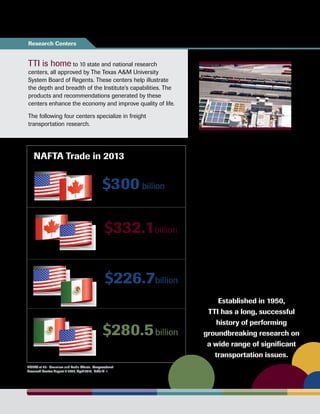
$300 billion
U.S. to Canada
$332.1billion
Canada to U.S.
$280.5billion
Mexico to U.S.
$226.7billion
U.S. to Mexico
Established in 1950,
TTI has a long, successful
history of performing
groundbreaking research on
a wide range of significant
transportation issues.
Research Centers
Center for Railway Research
TTI’s Center for Railway Research (CRR)
studies, develops, and applies new and
emerging technologies to solve rail indus-
try problems. The center’s researchers and
industry experts conduct basic research to
develop technologies to improve the safety,
reliability and economics of rail transporta-
tion and perform technology scanning to
identify emerging technology for the railroad
industry. CRR researchers investigate a vari-
ety of rail issues, such as multimodal inte-
gration of railroads, optimization of warning
signal performance, and enhanced safety in
all facets of operation.
TTI is home to 10 state and national research
centers, all approved by The Texas A&M University
System Board of Regents. These centers help illustrate
the depth and breadth of the Institute’s capabilities. The
products and recommendations generated by these
centers enhance the economy and improve quality of life.
The following four centers specialize in freight
transportation research.
NAFTA at 20: Overview and Trade Effects, Congressional
Research Service Report 7-5700, April 2014, Table A-1.
NAFTA Trade in 2013
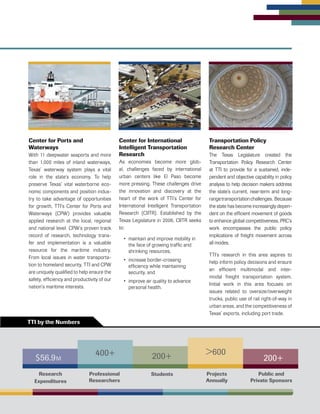
TTI by the Numbers
Research
Expenditures
$56.9M 200+400+
200+
>600
Public and
Private Sponsors
Professional
Researchers
Students Projects
Annually
Center for Ports and
Waterways
With 11 deepwater seaports and more
than 1,000 miles of inland waterways,
Texas’ waterway system plays a vital
role in the state’s economy. To help
preserve Texas’ vital waterborne eco-
nomic components and position indus-
try to take advantage of opportunities
for growth, TTI’s Center for Ports and
Waterways (CPW) provides valuable
applied research at the local, regional
and national level. CPW’s proven track
record of research, technology trans-
fer and implementation is a valuable
resource for the maritime industry.
From local issues in water transporta-
tion to homeland security, TTI and CPW
are uniquely qualified to help ensure the
safety, efficiency and productivity of our
nation’s maritime interests.
Center for International
Intelligent Transportation
Research
As economies become more glob-
al, challenges faced by international
urban centers like El Paso become
more pressing. These challenges drive
the innovation and discovery at the
heart of the work of TTI’s Center for
International Intelligent Transportation
Research (CIITR). Established by the
Texas Legislature in 2006, CIITR seeks
to:
•	 maintain and improve mobility in
the face of growing traffic and
shrinking resources,
•	 increase border-crossing
efficiency while maintaining
security, and
•	 improve air quality to advance
personal health.
Transportation Policy
Research Center
The Texas Legislature created the
Transportation Policy Research Center
at TTI to provide for a sustained, inde-
pendent and objective capability in policy
analysis to help decision makers address
the state’s current, near-term and long-
rangetransportationchallenges. Because
the state has become increasingly depen-
dent on the efficient movement of goods
to enhance global competitiveness, PRC’s
work encompasses the public policy
implications of freight movement across
all modes.
TTI’s research in this area aspires to
help inform policy decisions and ensure
an efficient multimodal and inter-
modal freight transportation system.
Initial work in this area focuses on
issues related to oversize/overweight
trucks, public use of rail right-of-way in
urban areas, and the competitiveness of
Texas’ exports, including port trade.
To identify and solve transportation problems through
research, to transfer technology and knowledge, and
to develop diverse human resources to meet
the transportation challenges of tomorrow.
TTI’s Mission
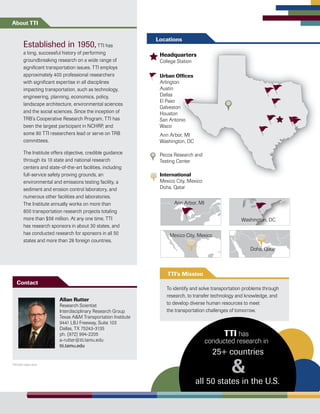
Headquarters
College Station
Urban Offices
Arlington
Austin
Dallas
El Paso
Galveston
Houston
San Antonio
Waco
Ann Arbor, MI
Washington, DC
Pecos Research and
Testing Center
International
Mexico City, Mexico
Doha, Qatar
Established in 1950,TTI has
a long, successful history of performing
groundbreaking research on a wide range of
significant transportation issues. TTI employs
approximately 400 professional researchers
with significant expertise in all disciplines
impacting transportation, such as technology,
engineering, planning, economics, policy,
landscape architecture, environmental sciences
and the social sciences. Since the inception of
TRB’s Cooperative Research Program, TTI has
been the largest participant in NCHRP, and
some 80 TTI researchers lead or serve on TRB
committees.
The Institute offers objective, credible guidance
through its 10 state and national research
centers and state-of-the-art facilities, including
full-service safety proving grounds, an
environmental and emissions testing facility, a
sediment and erosion control laboratory, and
numerous other facilities and laboratories.
The Institute annually works on more than
600 transportation research projects totaling
more than $56 million. At any one time, TTI
has research sponsors in about 30 states, and
has conducted research for sponsors in all 50
states and more than 28 foreign countries.
About TTI
Mexico
Peru
Fran
United
Kingd
Paraguay
Argentina
Colombia
Ann Arbor, MI
Washington, DC
Mexico City, Mexico
Doha, Qatar
Allan Rutter
Research Scientist
Interdisciplinary Research Group
Texas A&M Transportation Institute
9441 LBJ Freeway, Suite 103
Dallas, TX 75243-3135
ph. (972) 994-2205
a-rutter@tti.tamu.edu
tti.tamu.edu
Contact
Locations
&
TTI has
conducted research in
all 50 states in the U.S.
25+ countries
TTI1457.1054.1014

Freight Research at TTI

  • 1.
    The efficient movementof freight is central to an effective transportation system and essential to a robust economy. Manufacturing, agriculture, retail and industry all depend upon reliable freight movement to function. The Texas A&M Transportation Institute is a leader in multimodal freight research and an innovator in exploring new ways of moving freight across the nation and around the world. Saving Lives, Time and Resources tti.tamu.edu
  • 2.
    Learn more at tti.tamu.edu SubjectMatter Expertise Trucking, Freight Rail, Ports and Waterways, Air Cargo • Motor Carriers Truck congestion chokepoints, truck emissions, connected/automated vehicles, oversize/overweight trucks, heavy vehicle effects on highways • Maritime Port operations, inland waterway planning, international freight movement • Border & Trade Border crossing performance measures, freight intelligent transportation systems, NAFTA • Railroads Highway-rail grade crossings, rail market research, rail infrastructure and equipment engineering, rail safety • Freight Systems & Planning Hazardous material commodity flows, air cargo landside accessibility, freight policy, freight shuttle system Texas A&M Transportation Institute’s (TTI) Freight Shuttle System TTI has developed a new freight transportation system: the Freight Shuttle System (FSS). The FSS’s electrically powered motors will not add to existing pollution, will advance the United States’ effort to achieve energy independence, and will allow more environmentally friendly energy choices. 1.3 billion metric tons of foreign trade 805 million metric tons of domestic trade 2011 U.S. Water Transportation Statistical Snapshot, U.S. Department of Transportation, Maritime Administration, November 2013, p. 3. 2011 Waterborne Commerce
  • 3.
    Representative Sponsors Public Sector • Texas Department of Transportation • Texas Department of Public Safety • Port Authorities • Transportation Research Board • U.S. Department of Energy • U.S. Department of Transportation • U.S. Environmental Protection Agency • U.S. Federal Highway Administration • Inter-American Development Bank • National Cooperative Highway Research Program Private Sector • Association of American Railroads • Transportation Technology Center Inc. • Class I railroads: BNSF Railway, CSX • National Waterways Foundation • U.S. Soybean Export Council • Private consultants Inland Barge Rail Truck 616 478 150 54 million tons of freight moved nationwide each day ($46 billion in value) 40tons/person How much freight the U.S. needs to move annually 67% of tons moved by trucks in the U.S. (63% of freight by value) 100 miles or less distance moved per shipment by 51% of total freight tons 67% of U.S. foreign container tons moved through top 5 U.S. container ports in 2011 Freight Analysis Framework, version 3.4, U.S. Department of Transportation, Federal Highway Administration, Office of Freight Management and Operations, 2014, 2012 figures. National Rail Plan, 2010 Progress Report, U.S. Department of Transportation, Federal Railroad Administration, p. 4. Freight Analysis Framework, version 3.4, U.S. Department of Transportation, Federal Highway Administration, Office of Freight Management and Operations, 2012 figures. 2011 U.S. Water Transportation Statistical Snapshot, U.S. Department of Transportation, Maritime Administration, November 2013, p. 5. Freight Analysis Framework, version 3.4, U.S. Department of Transportation, Federal Highway Administration, Office of Freight Management and Operations, 2012. A Modal Comparison of Domestic Freight Transportation Effects on the General Public: 2001–2009, Prepared for the National Waterways Foundation, Center for Ports and Waterways, Texas Transportation Institute, February 2012, Figure ES-4, p 5. U.S. Freight Stats Ton-Miles Traveled per Gallon of Fuel
  • 4.
    Representative Projects NAS(NCFRP42) Incorporating Surface Transportation Considerationsinto Navigation Project Budgeting This project developed methodologies that (1) linked the performance of the U.S. maritime transportation system (MTS) with the performance of the U.S. freight transportation system and (2) could be used to identify MTS mainte- nance investment strategies that improved the efficiency of the overall freight transportation system. Researchers prepared methodologies that bridged the available waterborne commerce statistical data with equivalent land-side, multimodal transportation data to support system-level intermodal freight mobility, including the identification of appropriate related MTS maintenance investment strategies. EPA Truck Engine Idle Reduction Technology Demonstration Program Extended truck idling wastes fuel and generates emissions of green- house gases and pollutants. This project produced prediction method- ologies to assess the effectiveness of truck stop electrification (TSE) as a strategy to reduce these harmful effects. TTI research showed that a truck stop with TSE can reduce daily fuel consumption by 167 gallons, oxides of nitrogen emissions by 24.5 kg, and carbon dioxide emissions by 2.1 tons. TxDOT Texas 100 Congested Roadways and MAP-21 Reporting Assistance Since 2009, TTI has led an effort to use traffic volume data and speed data (from INRIX in 2013) to generate mobility measures to produce a ranked list of the top congested bottleneck locations in Texas for both mixed vehicles and trucks. The list is used by TxDOT to program dollars to address the worst traffic locations across the state. TTI is also providing technical assistance to generate and report the MAP-21 performance measures, including freight performance measures at the statewide level for rural versus urban, NHS versus non-NHS, Interstate-only and by county.
  • 5.
    TexasDPS Hazardous Materials Commodity Flow Studiesand Emergency Planning In a series of projects, TTI provided expert analysis for local emergency planning committees in a number of Texas counties. This included review of local emergency plans and analyses of hazardous-material commodity flows within each county, providing valuable information to inform the emergency plans of community leaders and first responders. FHWA Border Crossing and Wait Time Measurement System TTI developed, tested, and implemented a system to consistently measure commercial vehicle crossing times at the U.S.-Mexico border. The system was originally piloted at the Pharr/Reynosa and El Paso/Ciudad Juarez ports of entry and is currently in operation at seven commercial international crossings in Texas. TTI sought input from key stakeholders to develop an information system to disseminate border- crossing information, seeking input from key stakeholders — carriers, shippers, and U.S. and Mexican federal and state agencies. TxDOT Houston Freight Rail System Analysis TTI contributed to the Houston Region Freight Study, an extensive inven- tory and operational modeling study that identified a series of infrastructure improvements to improve the safety and fluidity of the freight rail system in the greater Houston region. TTI continues to provide support services to the Gulf Coast Rail District to update the business case for grade crossing separation and improvement projects outlined in the original study. FHWA Secure Border Trade Demonstration ­— County of El Paso The Secure Border Trade Demonstration Project is a three-year effort fund- ed with Coordinated Border Infrastructure funds administered by FHWA and implemented by the County of El Paso. As part of this $3.6 million project, TTI will assist the County of El Paso with project management, stakeholder facilita- tion and the implementation of a technology-monitoring system for the project. The project seeks to move vehicle and cargo monitoring away from the border by providing more information across the entire supply chain and software- enhanced analysis of data for customs and border security agencies. (GulfCoastRailDistrict)(DivisionofEmergency Management)
  • 6.
    $300 billion U.S. toCanada $332.1billion Canada to U.S. $280.5billion Mexico to U.S. $226.7billion U.S. to Mexico Established in 1950, TTI has a long, successful history of performing groundbreaking research on a wide range of significant transportation issues. Research Centers Center for Railway Research TTI’s Center for Railway Research (CRR) studies, develops, and applies new and emerging technologies to solve rail indus- try problems. The center’s researchers and industry experts conduct basic research to develop technologies to improve the safety, reliability and economics of rail transporta- tion and perform technology scanning to identify emerging technology for the railroad industry. CRR researchers investigate a vari- ety of rail issues, such as multimodal inte- gration of railroads, optimization of warning signal performance, and enhanced safety in all facets of operation. TTI is home to 10 state and national research centers, all approved by The Texas A&M University System Board of Regents. These centers help illustrate the depth and breadth of the Institute’s capabilities. The products and recommendations generated by these centers enhance the economy and improve quality of life. The following four centers specialize in freight transportation research. NAFTA at 20: Overview and Trade Effects, Congressional Research Service Report 7-5700, April 2014, Table A-1. NAFTA Trade in 2013
  • 7.
    TTI by theNumbers Research Expenditures $56.9M 200+400+ 200+ >600 Public and Private Sponsors Professional Researchers Students Projects Annually Center for Ports and Waterways With 11 deepwater seaports and more than 1,000 miles of inland waterways, Texas’ waterway system plays a vital role in the state’s economy. To help preserve Texas’ vital waterborne eco- nomic components and position indus- try to take advantage of opportunities for growth, TTI’s Center for Ports and Waterways (CPW) provides valuable applied research at the local, regional and national level. CPW’s proven track record of research, technology trans- fer and implementation is a valuable resource for the maritime industry. From local issues in water transporta- tion to homeland security, TTI and CPW are uniquely qualified to help ensure the safety, efficiency and productivity of our nation’s maritime interests. Center for International Intelligent Transportation Research As economies become more glob- al, challenges faced by international urban centers like El Paso become more pressing. These challenges drive the innovation and discovery at the heart of the work of TTI’s Center for International Intelligent Transportation Research (CIITR). Established by the Texas Legislature in 2006, CIITR seeks to: • maintain and improve mobility in the face of growing traffic and shrinking resources, • increase border-crossing efficiency while maintaining security, and • improve air quality to advance personal health. Transportation Policy Research Center The Texas Legislature created the Transportation Policy Research Center at TTI to provide for a sustained, inde- pendent and objective capability in policy analysis to help decision makers address the state’s current, near-term and long- rangetransportationchallenges. Because the state has become increasingly depen- dent on the efficient movement of goods to enhance global competitiveness, PRC’s work encompasses the public policy implications of freight movement across all modes. TTI’s research in this area aspires to help inform policy decisions and ensure an efficient multimodal and inter- modal freight transportation system. Initial work in this area focuses on issues related to oversize/overweight trucks, public use of rail right-of-way in urban areas, and the competitiveness of Texas’ exports, including port trade.
  • 8.
    To identify andsolve transportation problems through research, to transfer technology and knowledge, and to develop diverse human resources to meet the transportation challenges of tomorrow. TTI’s Mission Headquarters College Station Urban Offices Arlington Austin Dallas El Paso Galveston Houston San Antonio Waco Ann Arbor, MI Washington, DC Pecos Research and Testing Center International Mexico City, Mexico Doha, Qatar Established in 1950,TTI has a long, successful history of performing groundbreaking research on a wide range of significant transportation issues. TTI employs approximately 400 professional researchers with significant expertise in all disciplines impacting transportation, such as technology, engineering, planning, economics, policy, landscape architecture, environmental sciences and the social sciences. Since the inception of TRB’s Cooperative Research Program, TTI has been the largest participant in NCHRP, and some 80 TTI researchers lead or serve on TRB committees. The Institute offers objective, credible guidance through its 10 state and national research centers and state-of-the-art facilities, including full-service safety proving grounds, an environmental and emissions testing facility, a sediment and erosion control laboratory, and numerous other facilities and laboratories. The Institute annually works on more than 600 transportation research projects totaling more than $56 million. At any one time, TTI has research sponsors in about 30 states, and has conducted research for sponsors in all 50 states and more than 28 foreign countries. About TTI Mexico Peru Fran United Kingd Paraguay Argentina Colombia Ann Arbor, MI Washington, DC Mexico City, Mexico Doha, Qatar Allan Rutter Research Scientist Interdisciplinary Research Group Texas A&M Transportation Institute 9441 LBJ Freeway, Suite 103 Dallas, TX 75243-3135 ph. (972) 994-2205 a-rutter@tti.tamu.edu tti.tamu.edu Contact Locations & TTI has conducted research in all 50 states in the U.S. 25+ countries TTI1457.1054.1014