Saving Lives, Time and Resources tti.tamu.edu
The Texas A&M Transportation
Institute’s (TTI) Sediment and
Erosion Control Laboratory (SEC Lab)
provides the transportation industry
with a research and performance
evaluation program for roadside
environmental management. Research
at the SEC Lab includes stormwater
quality improvement, erosion and
sediment control, and vegetation
establishment and management.
TTI’sEnvironmentandPlanningProgram
operates this 19-acre, full-scale, indoor/
outdoor facility. Demand for the facility
has steadily grown for over 20 years,
necessitating the recent expansion to
meettheindustry’sresearchneeds.With
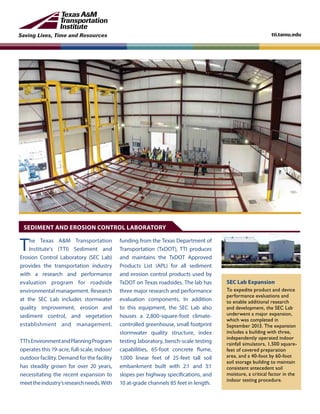
SEC Lab Expansion
To expedite product and device
performance evaluations and
to enable additional research
and development, the SEC Lab
underwent a major expansion,
which was completed in
September 2013. The expansion
includes a building with three,
independently operated indoor
rainfall simulators, 1,500 square-
feet of covered preparation
area, and a 40-foot by 60-foot
soil storage building to maintain
consistent antecedent soil
moisture, a critical factor in the
indoor testing procedure.
SEDIMENT AND EROSION CONTROL LABORATORY
funding from the Texas Department of
Transportation (TxDOT), TTI produces
and maintains the TxDOT Approved
Products List (APL) for all sediment
and erosion control products used by
TxDOT on Texas roadsides. The lab has
three major research and performance
evaluation components. In addition
to this equipment, the SEC Lab also
houses a 2,800-square-foot climate-
controlled greenhouse, small footprint
stormwater quality structure, index
testing laboratory, bench-scale testing
capabilities, 65-foot concrete flume,
1,000 linear feet of 25-feet tall soil
embankment built with 2:1 and 3:1
slopes per highway specifications, and
10 at-grade channels 85 feet in length.
Jett McFalls
Assistant Research Scientist
Environment and Planning Program
Texas A&M Transportation Institute
ph. (979) 847-8709
j-mcfalls1@tamu.edu
http://tti.tamu.edu/group/env-planning/
sec-lab/
Sediment Retention Device Flume
TheTxDOT2014StandardSpecificationsforConstructionandMaintenanceofHighways,Streets,
andBridgesnowrequirestheperformanceevaluationofsedimentretentiondevices(SRD)beforeuse
on TxDOT rights-of-way. TTI developed the SRD performance evaluation program for TxDOT
in 2010 and is currently producing an APL for SRDs similar to the established program for erosion
control products. The SRD flume consists of a 12-foot upper flume and a 2-foot lower flume with
a 4-foot soil-filled section between installed with the SRD test material. The 1500-gallon reservoir
mixes the well-graded slurry of artificial sediment. Turbidity and flow meters continually monitor
influent and effluent concentrations to determine product performance.
Variable Slope Channel Flume
The 30-foot outdoor variable slope channel
flume is used for evaluating the performance
capabilities of flexible channel liner materials
at a range of shear stress flows. The current
protocol evaluates products and materials up
to high stress flow of 12 psf (575 Pa).
Future of the SEC Lab
TheSECLabexpansionincludesASTMtesting
capabilities that will expand opportunities for
productperformanceevaluation.Thisexpansion
willresultincontinuedlong-termbenefitstonot
only TxDOT, but to other state DOTs and the
sediment and erosion control industry.
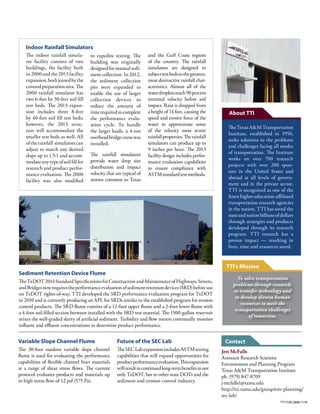
The indoor rainfall simula-
tor facility consists of two
buildings, the facility built
in 2000 and the 2013 facility
expansion,bothjoinedbythe
coveredpreparationarea.The
2000 rainfall simulator has
two 6-feet by 30-feet soil fill
test beds. The 2013 expan-
sion includes three 8-feet
by 40-feet soil fill test beds;
however, the 2013 struc-
ture will accommodate the
smaller test beds as well. All
oftherainfall simulatorscan
adjust to match any desired
slope up to 1.5:1 and accom-
modateanytypeofsoilfillfor
research and product perfor-
mance evaluation. The 2000
facility was also modified
to expedite testing. The
building was originally
designedformanualsedi-
ment collection. In 2012,
the sediment collection
pits were expanded to
enable the use of larger
collection devices to
reduce the amount of
timerequiredtocomplete
the performance evalu-
ation cycle. To handle
the larger loads, a 4-ton
overheadbridgecranewas
installed.
The rainfall simulators
provide water drop size
distribution and impact
velocity that are typical of
storms common to Texas
and the Gulf Coast regions
of the country. The rainfall
simulators are designed to
subjecttestbedstothegreatest,
most destructive rainfall char-
acteristics. Almost all of the
waterdropletsreach90percent
terminal velocity before soil
impact. Rain is dropped from
a height of 14 feet, causing the
speed and erosive force of the
water to approximate some
of the velocity most severe
rainfallproperties.Therainfall
simulators can produce up to
9 inches per hour. The 2013
facility design includes perfor-
mance evaluation capabilities
to ensure compliance with
ASTMstandardtestmethods.
Indoor Rainfall Simulators
The Texas A&M Transportation
Institute, established in 1950,
seeks solutions to the problems
and challenges facing all modes
of transportation. The Institute
works on over 700 research
projects with over 200 spon-
sors in the United States and
abroad at all levels of govern-
ment and in the private sector.
TTI is recognized as one of the
finesthigher-education-affiliated
transportation research agencies
in the nation. TTI has saved the
stateandnationbillionsofdollars
through strategies and products
developed through its research
program. TTI research has a
proven impact — resulting in
lives, time and resources saved.
TTI1726.3896.1116
Contact
About TTI
To solve transportation
problems through research,
to transfer technology and
to develop diverse human
resources to meet the
transportation challenges
of tomorrow.
TTI’s Mission

Sediment and Erosion Control (SEC) Laboratory

  • 1.
    Saving Lives, Timeand Resources tti.tamu.edu The Texas A&M Transportation Institute’s (TTI) Sediment and Erosion Control Laboratory (SEC Lab) provides the transportation industry with a research and performance evaluation program for roadside environmental management. Research at the SEC Lab includes stormwater quality improvement, erosion and sediment control, and vegetation establishment and management. TTI’sEnvironmentandPlanningProgram operates this 19-acre, full-scale, indoor/ outdoor facility. Demand for the facility has steadily grown for over 20 years, necessitating the recent expansion to meettheindustry’sresearchneeds.With SEC Lab Expansion To expedite product and device performance evaluations and to enable additional research and development, the SEC Lab underwent a major expansion, which was completed in September 2013. The expansion includes a building with three, independently operated indoor rainfall simulators, 1,500 square- feet of covered preparation area, and a 40-foot by 60-foot soil storage building to maintain consistent antecedent soil moisture, a critical factor in the indoor testing procedure. SEDIMENT AND EROSION CONTROL LABORATORY funding from the Texas Department of Transportation (TxDOT), TTI produces and maintains the TxDOT Approved Products List (APL) for all sediment and erosion control products used by TxDOT on Texas roadsides. The lab has three major research and performance evaluation components. In addition to this equipment, the SEC Lab also houses a 2,800-square-foot climate- controlled greenhouse, small footprint stormwater quality structure, index testing laboratory, bench-scale testing capabilities, 65-foot concrete flume, 1,000 linear feet of 25-feet tall soil embankment built with 2:1 and 3:1 slopes per highway specifications, and 10 at-grade channels 85 feet in length.
  • 2.
    Jett McFalls Assistant ResearchScientist Environment and Planning Program Texas A&M Transportation Institute ph. (979) 847-8709 j-mcfalls1@tamu.edu http://tti.tamu.edu/group/env-planning/ sec-lab/ Sediment Retention Device Flume TheTxDOT2014StandardSpecificationsforConstructionandMaintenanceofHighways,Streets, andBridgesnowrequirestheperformanceevaluationofsedimentretentiondevices(SRD)beforeuse on TxDOT rights-of-way. TTI developed the SRD performance evaluation program for TxDOT in 2010 and is currently producing an APL for SRDs similar to the established program for erosion control products. The SRD flume consists of a 12-foot upper flume and a 2-foot lower flume with a 4-foot soil-filled section between installed with the SRD test material. The 1500-gallon reservoir mixes the well-graded slurry of artificial sediment. Turbidity and flow meters continually monitor influent and effluent concentrations to determine product performance. Variable Slope Channel Flume The 30-foot outdoor variable slope channel flume is used for evaluating the performance capabilities of flexible channel liner materials at a range of shear stress flows. The current protocol evaluates products and materials up to high stress flow of 12 psf (575 Pa). Future of the SEC Lab TheSECLabexpansionincludesASTMtesting capabilities that will expand opportunities for productperformanceevaluation.Thisexpansion willresultincontinuedlong-termbenefitstonot only TxDOT, but to other state DOTs and the sediment and erosion control industry. The indoor rainfall simula- tor facility consists of two buildings, the facility built in 2000 and the 2013 facility expansion,bothjoinedbythe coveredpreparationarea.The 2000 rainfall simulator has two 6-feet by 30-feet soil fill test beds. The 2013 expan- sion includes three 8-feet by 40-feet soil fill test beds; however, the 2013 struc- ture will accommodate the smaller test beds as well. All oftherainfall simulatorscan adjust to match any desired slope up to 1.5:1 and accom- modateanytypeofsoilfillfor research and product perfor- mance evaluation. The 2000 facility was also modified to expedite testing. The building was originally designedformanualsedi- ment collection. In 2012, the sediment collection pits were expanded to enable the use of larger collection devices to reduce the amount of timerequiredtocomplete the performance evalu- ation cycle. To handle the larger loads, a 4-ton overheadbridgecranewas installed. The rainfall simulators provide water drop size distribution and impact velocity that are typical of storms common to Texas and the Gulf Coast regions of the country. The rainfall simulators are designed to subjecttestbedstothegreatest, most destructive rainfall char- acteristics. Almost all of the waterdropletsreach90percent terminal velocity before soil impact. Rain is dropped from a height of 14 feet, causing the speed and erosive force of the water to approximate some of the velocity most severe rainfallproperties.Therainfall simulators can produce up to 9 inches per hour. The 2013 facility design includes perfor- mance evaluation capabilities to ensure compliance with ASTMstandardtestmethods. Indoor Rainfall Simulators The Texas A&M Transportation Institute, established in 1950, seeks solutions to the problems and challenges facing all modes of transportation. The Institute works on over 700 research projects with over 200 spon- sors in the United States and abroad at all levels of govern- ment and in the private sector. TTI is recognized as one of the finesthigher-education-affiliated transportation research agencies in the nation. TTI has saved the stateandnationbillionsofdollars through strategies and products developed through its research program. TTI research has a proven impact — resulting in lives, time and resources saved. TTI1726.3896.1116 Contact About TTI To solve transportation problems through research, to transfer technology and to develop diverse human resources to meet the transportation challenges of tomorrow. TTI’s Mission