Saving Lives, Time and Resources tti.tamu.edu
Description
The Texas A&M Transportation Institute (TTI) opened
the Environmental and Emissions Research Facility
in Bryan, Texas, in January 2010. The development of
the facility resulted from competitive grant awards to
TTI from the U.S. Environmental Protection Agency (EPA)
and the Houston Advanced Research Center (HARC), with
additionalfundingprovidedbyTheTexasA&MUniversity
System and TTI. The Air Quality Program uses the facility
as a part of emissions and fuel efficiency research.
The $2.5 million facility is one of the largest drive-in
environmentalchambersinthecountry,andtheonlyone
based at a university. The EERF can be used to conduct
tests on vehicles as large as a full tractor-trailer or bus.
The initial project for the facility is to develop and apply a
verification protocol for testing onboard technologies to
reduce idling of heavy-duty diesel trucks. These onboard
technologies that TTI is testing include diesel- and battery-
powered auxiliary power units, direct-fired heaters and
thermal-storagecoolingunits.Thetestsmustbeperformed
in a humidity- and temperature-controlled chamber to
ensure consistency between tests and accuracy of results.
The results will be provided to EPA for assistance in setting
standardsandprotocolsforheavy-dutytruckemissionlevels.
The Need for Idle Reduction Research
The health of the Texas and U.S. economy is reliant on heavy-duty diesel trucks
to move a vast array of goods across the country. About 3 million of these trucks
operate in the United States, with considerable traffic throughout Texas from
in-state, out-of-state and out-of-country locations. The U.S. Department of
Transportation mandates that truck drivers rest for 10 hours for every 14 hours
thattheydrive.Thisresultsinextendedperiodsoftimethatdriversspendresting
and sleeping in the cabs of their trucks. As a consequence, almost all long-haul
drivers idle their vehicles for about 10 hours per day to operate heating systems
and air conditioners, generate electricity, charge their vehicles’ batteries, and
warm up the engines.
A typical long-haul truck is on the road for an estimated 250 to 300 days per
year,resultinginanaverageannualidlingdurationof2,100hourspertruck.Itis
estimated that more than 2,000 tons of nitrogen oxide is emitted every day due
to extended truck idling in the United States. In addition to emissions, extended
idling also results in considerable waste of fuel and can cause wear and tear on
truckengines.Atanidlingfuelconsumptionrateof1gallonperhour,morethan
13 million gallons of fuel is wasted on a daily basis nationwide.
Other Research and Testing Opportunities
The EERF offers numerous additional opportunities for research and testing
new vehicles, components and automotive products, as well as many other
products, for their durability under severe temperature, humidity and other
weather-like conditions. For example, the chamber can be used to test:
• 	 Emissions from vehicle idling
for cars, trucks and buses, and
“cold starts”
• 	 Engine fuel consumption and
emissions
• 	 Hybrid technologies
• 	 Clean fuels
• 	 Vehicle components such as
air conditioners, heaters and
auxiliary power units
• 	 Infiltration of pollutants into
vehicles
• 	 Emissions reduction
technologies
• 	 Evaporative emissions
• 	 New fuels
• 	 Lubricants and oils
• 	 Insulation materials
• 	 Ability of plant material to
absorb emissions
• 	 Steel and concrete construction
components
• 	 Agricultural and food products
FacilityTechnical Specifications
• Temperature range: -13 °F to +131 °F (-25 °C to +55 °C)
• Relative humidity range: up to 70 percent at 104 °F (40 °C)
• 7,500 square feet of gross floor area
• Dimensions: 75 feet × 23 feet × 22 feet
(capable of holding a tractor-trailer or bus)
• Other equipment: solar loading lights and wind simulator fans
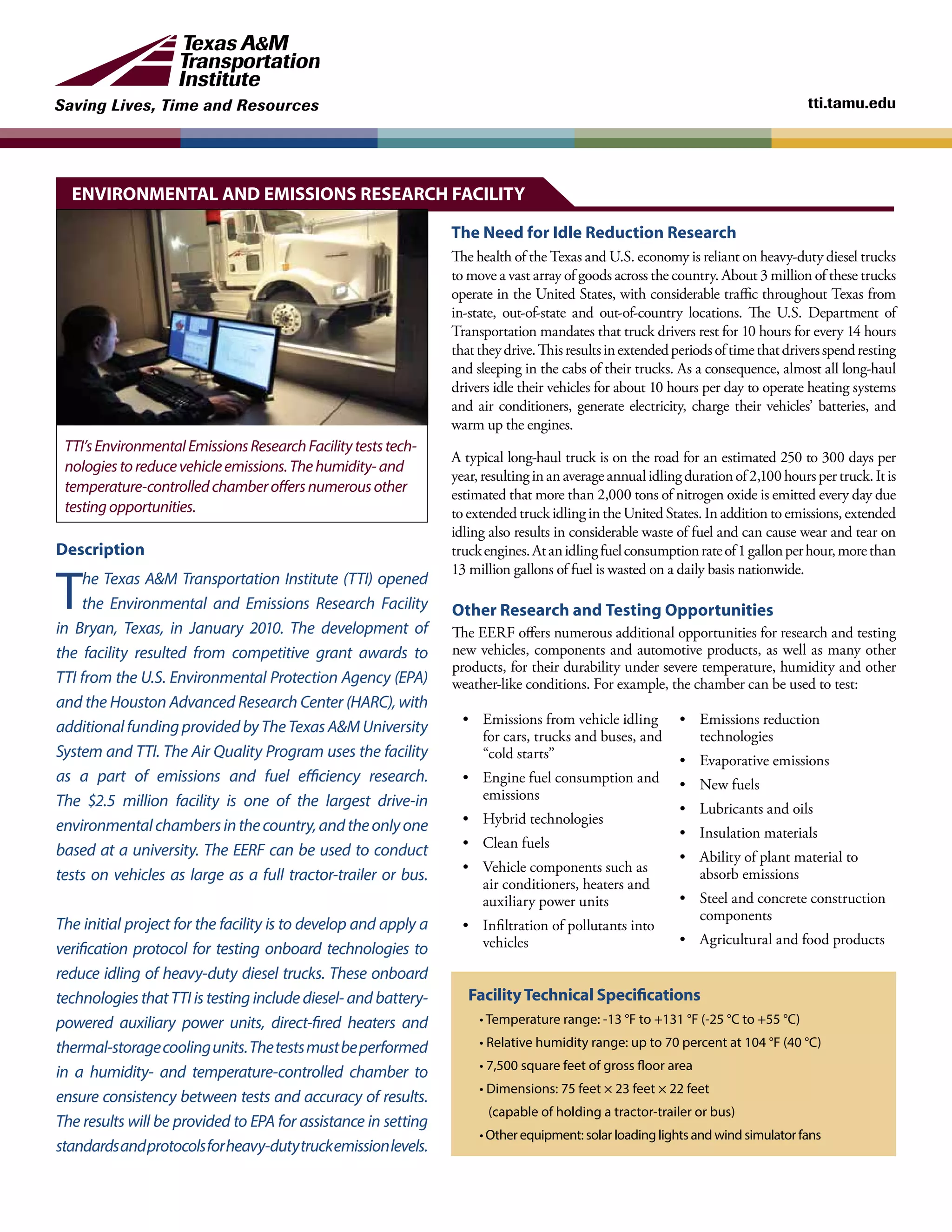
TTI’sEnvironmentalEmissionsResearchFacilityteststech-
nologiestoreducevehicleemissions.Thehumidity-and
temperature-controlledchamberoffersnumerousother
testingopportunities.
ENVIRONMENTAL AND EMISSIONS RESEARCH FACILITY
Joe Zietsman, Ph.D., P.E.
Division Head
Environment and Air Quality Division
Texas A&M Transportation Institute
College Station, TX 77843-3135
(979) 458-3476
zietsman@tamu.edu
http://tti.tamu.edu/airquality/eerf
Potential Cooperative Relationships and Sponsors
TTI is seeking sponsors and partners from the following
industries:
• Vehicle manufacturing
• Engine manufacturing
• Trucking industry
• Companies with long-haul
truck fleets
• Oil industry
Testing Capabilities
The Air Quality Program has the capability of conducting a wide
range of testing, both at the Environmental and Emissions Research
Facility and other locations. The group uses two different portable
emissions measurement systems (PEMS) to measure the emissions
characteristics of many different types of vehicles. The PEMS units
include a SEMTECH DS from Sensors, Inc., which measures
carbon monoxide, carbon dioxide, nitrogen oxide, nitrogen dioxide,
and hydrocarbons. In addition, an Axion system from Clean Air
Technologies is used to measure the particulate matter of emissions.
The facility is large enough to hold a heavy-duty
18-wheeler and includes offices and a research and testing
preparation area. The maker of the chamber is Weiss
Environmental Technology, Inc.
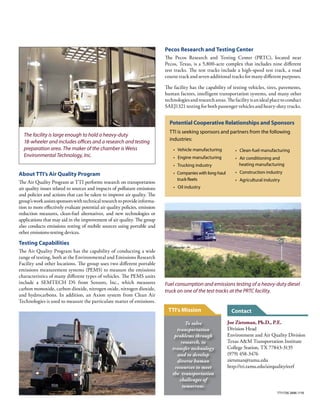
Fuel consumption and emissions testing of a heavy-duty diesel
truck on one of the test tracks at the PRTC facility.
About TTI’s Air Quality Program
The Air Quality Program at TTI performs research on transportation
air quality issues related to sources and impacts of pollutant emissions
and policies and actions that can be taken to improve air quality. The
group’sworkassistssponsorswithtechnicalresearchtoprovideinforma-
tion to more effectively evaluate potential air quality policies, emission
reduction measures, clean-fuel alternatives, and new technologies or
applications that may aid in the improvement of air quality. The group
also conducts emissions testing of mobile sources using portable and
other emissions-testing devices.
Pecos Research and Testing Center
The Pecos Research and Testing Center (PRTC), located near
Pecos, Texas, is a 5,800-acre complex that includes nine different
test tracks. The test tracks include a high-speed test track, a road
course track and seven additional tracks for many different purposes.
The facility has the capability of testing vehicles, tires, pavements,
human factors, intelligent transportation systems, and many other
technologiesandresearchareas.Thefacilityisanidealplacetoconduct
SAEJ1321 testing for both passenger vehicles and heavy-duty trucks.
• Clean-fuel manufacturing
• Air conditioning and
heating manufacturing
• Construction industry
• Agricultural industry
Contact
TTI1726.3896.1116
To solve
transportation
problems through
research, to
transfer technology
and to develop
diverse human
resources to meet
the transportation
challenges of
tomorrow.
TTI’s Mission

Environmental and Emissions Research Facility at TTI

  • 1.
    Saving Lives, Timeand Resources tti.tamu.edu Description The Texas A&M Transportation Institute (TTI) opened the Environmental and Emissions Research Facility in Bryan, Texas, in January 2010. The development of the facility resulted from competitive grant awards to TTI from the U.S. Environmental Protection Agency (EPA) and the Houston Advanced Research Center (HARC), with additionalfundingprovidedbyTheTexasA&MUniversity System and TTI. The Air Quality Program uses the facility as a part of emissions and fuel efficiency research. The $2.5 million facility is one of the largest drive-in environmentalchambersinthecountry,andtheonlyone based at a university. The EERF can be used to conduct tests on vehicles as large as a full tractor-trailer or bus. The initial project for the facility is to develop and apply a verification protocol for testing onboard technologies to reduce idling of heavy-duty diesel trucks. These onboard technologies that TTI is testing include diesel- and battery- powered auxiliary power units, direct-fired heaters and thermal-storagecoolingunits.Thetestsmustbeperformed in a humidity- and temperature-controlled chamber to ensure consistency between tests and accuracy of results. The results will be provided to EPA for assistance in setting standardsandprotocolsforheavy-dutytruckemissionlevels. The Need for Idle Reduction Research The health of the Texas and U.S. economy is reliant on heavy-duty diesel trucks to move a vast array of goods across the country. About 3 million of these trucks operate in the United States, with considerable traffic throughout Texas from in-state, out-of-state and out-of-country locations. The U.S. Department of Transportation mandates that truck drivers rest for 10 hours for every 14 hours thattheydrive.Thisresultsinextendedperiodsoftimethatdriversspendresting and sleeping in the cabs of their trucks. As a consequence, almost all long-haul drivers idle their vehicles for about 10 hours per day to operate heating systems and air conditioners, generate electricity, charge their vehicles’ batteries, and warm up the engines. A typical long-haul truck is on the road for an estimated 250 to 300 days per year,resultinginanaverageannualidlingdurationof2,100hourspertruck.Itis estimated that more than 2,000 tons of nitrogen oxide is emitted every day due to extended truck idling in the United States. In addition to emissions, extended idling also results in considerable waste of fuel and can cause wear and tear on truckengines.Atanidlingfuelconsumptionrateof1gallonperhour,morethan 13 million gallons of fuel is wasted on a daily basis nationwide. Other Research and Testing Opportunities The EERF offers numerous additional opportunities for research and testing new vehicles, components and automotive products, as well as many other products, for their durability under severe temperature, humidity and other weather-like conditions. For example, the chamber can be used to test: • Emissions from vehicle idling for cars, trucks and buses, and “cold starts” • Engine fuel consumption and emissions • Hybrid technologies • Clean fuels • Vehicle components such as air conditioners, heaters and auxiliary power units • Infiltration of pollutants into vehicles • Emissions reduction technologies • Evaporative emissions • New fuels • Lubricants and oils • Insulation materials • Ability of plant material to absorb emissions • Steel and concrete construction components • Agricultural and food products FacilityTechnical Specifications • Temperature range: -13 °F to +131 °F (-25 °C to +55 °C) • Relative humidity range: up to 70 percent at 104 °F (40 °C) • 7,500 square feet of gross floor area • Dimensions: 75 feet × 23 feet × 22 feet (capable of holding a tractor-trailer or bus) • Other equipment: solar loading lights and wind simulator fans TTI’sEnvironmentalEmissionsResearchFacilityteststech- nologiestoreducevehicleemissions.Thehumidity-and temperature-controlledchamberoffersnumerousother testingopportunities. ENVIRONMENTAL AND EMISSIONS RESEARCH FACILITY
  • 2.
    Joe Zietsman, Ph.D.,P.E. Division Head Environment and Air Quality Division Texas A&M Transportation Institute College Station, TX 77843-3135 (979) 458-3476 zietsman@tamu.edu http://tti.tamu.edu/airquality/eerf Potential Cooperative Relationships and Sponsors TTI is seeking sponsors and partners from the following industries: • Vehicle manufacturing • Engine manufacturing • Trucking industry • Companies with long-haul truck fleets • Oil industry Testing Capabilities The Air Quality Program has the capability of conducting a wide range of testing, both at the Environmental and Emissions Research Facility and other locations. The group uses two different portable emissions measurement systems (PEMS) to measure the emissions characteristics of many different types of vehicles. The PEMS units include a SEMTECH DS from Sensors, Inc., which measures carbon monoxide, carbon dioxide, nitrogen oxide, nitrogen dioxide, and hydrocarbons. In addition, an Axion system from Clean Air Technologies is used to measure the particulate matter of emissions. The facility is large enough to hold a heavy-duty 18-wheeler and includes offices and a research and testing preparation area. The maker of the chamber is Weiss Environmental Technology, Inc. Fuel consumption and emissions testing of a heavy-duty diesel truck on one of the test tracks at the PRTC facility. About TTI’s Air Quality Program The Air Quality Program at TTI performs research on transportation air quality issues related to sources and impacts of pollutant emissions and policies and actions that can be taken to improve air quality. The group’sworkassistssponsorswithtechnicalresearchtoprovideinforma- tion to more effectively evaluate potential air quality policies, emission reduction measures, clean-fuel alternatives, and new technologies or applications that may aid in the improvement of air quality. The group also conducts emissions testing of mobile sources using portable and other emissions-testing devices. Pecos Research and Testing Center The Pecos Research and Testing Center (PRTC), located near Pecos, Texas, is a 5,800-acre complex that includes nine different test tracks. The test tracks include a high-speed test track, a road course track and seven additional tracks for many different purposes. The facility has the capability of testing vehicles, tires, pavements, human factors, intelligent transportation systems, and many other technologiesandresearchareas.Thefacilityisanidealplacetoconduct SAEJ1321 testing for both passenger vehicles and heavy-duty trucks. • Clean-fuel manufacturing • Air conditioning and heating manufacturing • Construction industry • Agricultural industry Contact TTI1726.3896.1116 To solve transportation problems through research, to transfer technology and to develop diverse human resources to meet the transportation challenges of tomorrow. TTI’s Mission