Freedom and Development
William Easterly
New York University and
Brookings Institution
Development is fragile and
unpredictable
• Brazil and Cote d’Ivoire were success stories of
1960-80, China and India were definitely NOT
• China and India are success stories 1980-2007,
Brazil and Cote d’Ivoire definitely NOT
• Different answers that have disappointed:
investment, education, health, privatization,
structural adjustment, population control, foreign
aid.
• Recent consensus among development
economists is that we simply don’t know how to
achieve development
We don’t know how to achieve
development
• The World Bank (2005) : “different policies can yield the
same result, and the same policy can yield different results,
depending on country institutional contexts and underlying
growth strategies.”
• Similarly the Barcelona Development Agenda (2004) -- a
Who’s Who of leading economists --concluded that: “there is
no single set of policies that can be guaranteed to ignite
sustained growth. Nations that have succeeded at this
tremendously important task have faced different sets of
obstacles and have adopted varying policies regarding
regulation, export and industrial promotion, and
technological innovation and knowledge acquisition.”
• Lindauer and Pritchett (2002) call it most honestly: “it seems
harder than ever to identify the keys to growth. For every
example, there is a counter-example. The current nostrum
of one size doesn’t fit all is not itself a big idea, but a way of
expressing the absence of any big ideas.”
What to do when you don’t know
what to do
• Lack of consensus on how to achieve
economic development
• Freedom is what you do when you don’t
know what to do – let individuals be free to
figure it out for themselves.
F.A. Hayek on freedom and
development
• “The interaction of individuals, possessing different
knowledge and different views, is what constitutes the life
of thought. The growth of reason is a social process based
on the existence of such differences.”
• “It is of essence that its results cannot be predicted, that
we cannot know which views will assist this growth and
which will not – in short, that this growth cannot be
governed by any views which we now possess without at
the same time limiting it. To “plan” or “organize” the growth
of mind, or for that matter, progress in general, is a
contradiction in terms.”
• “Individualism is thus an attitude of humility before this
social process and of tolerance to other opinions and is
the exact opposite of that intellectual hubris which is at the
root of the demand for comprehensive direction of the
social process.”
Individual freedom, one and
indivisible
• Classic definition: individual can do what they want, as long as they
don’t hurt anyone else.
• Freedom to choose rulers, to dissent in politics and knowledge
(“democracy”)
• Freedom to trade, invest, and innovate (“free markets”)
• Freedoms of speech, press, assembly, religion
• Freedom from foreign control! (Imperialism, Invasion, Colonialism,
Structural Adjustment are NOT Freedom)
• All freedoms reinforce each other, lack of one freedom is a threat to
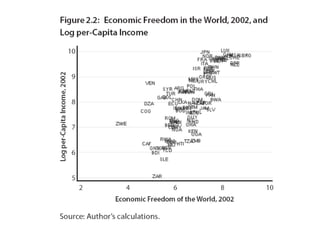
other freedoms (correlation of political and economic freedom=.74).
• Freedom depends on many social norms and values, it is not
something that can be mechanically implemented overnight (“just
hold elections”, “just remove price controls”)
Don’t lose the big picture for the
little picture
• Big stylized facts about freedom and
development have stood the test of time
• Results on democracy/economic freedom and
economic growth/recovery from war&state
failure are extremely fragile (depends on what
else you control for, and there are hundreds of
other possible controls).
• Yet movements towards greater freedom
associated with virtually all the “success stories”
Overconfident precision from non-
robust regressions (Collier)
• “Whether democracy contributes to stability
depends on the level of per capita income in a
country: in rich societies democracy makes
things much safer, in poor societies it has the
opposite effect. … at levels far below $ 2500, -
per capita, democracy appears to increase the
risk of civil war.”
• “Democracy will make matters worse {in the} the
resource-rich poor countries.”
AFG
AGO
ARG
AUS
AUT
BDI
BEL
BEN
BFA
BGD
BLZ
BOL
BRA
BWA
CAF
CAN
CHE
CHL
CHN
CIVCMR
COG
COL
COM
CPV
CRI
DNK
DOM
DZA ECU
EGY
ESP
ETH
FIN
FJI
FRA
GAB
GBR
GHA
GINGMB
GNB
GNQ
GRC
GRD
GTM
GUY
HKG
HND
HTI
IDN
IND
IRL
IRN
ISL
ISR
ITA
JAM
JOR
JPN
KEN KIR
KNA
KOR
LAO
LBR
LCA
LKA
LSO
LUX
MAR
MDG
MDV
MEX
MLI
MNG
MOZ
MRT
MUS
MWI
MYS
NAM
NER
NGA
NIC
NLD
NOR
NPL
NZL
PAK
PAN
PER
PHL
PNG
POL
PRT
PRY
ROM
RWA
SDN
SEN
SGP
SLE
SLV
SUR
SWE
SWZ
SYCSYR
TCD
TGO
THA
TON
TTO
TUN TUR
TWN
TZA
UGA
URY
USA
VCT
VEN
VUT
ZAF
ZAR
ZMB
ZWE
5678910
lpcy2002
-2 -1 0 1 2
voice2002
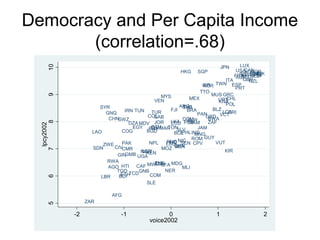
Democracy and Per Capita Income
(correlation=.68)
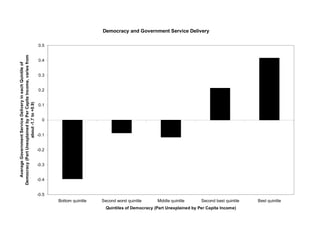
Democracy and Government Service Delivery
-0.5
-0.4
-0.3
-0.2
-0.1
0
0.1
0.2
0.3
0.4
0.5
Bottom quintile Second worst quintile Middle quintile Second best quintile Best quintile
Quintiles of Democracy (Part Unexplained by Per Capita Income)
AverageGovernmentServiceDeliveryineachQuintileof
Democracy(PartUnexplainedbyPerCapitaIncome,variesfrom
about-1.7to+0.9)
Freedom from foreign control
• Growth under colonialism was poor, growth has
been much higher since independence in most
countries
• Growth under foreign aid/structural adjustment is
poor
• Most successful examples of growth are
homegrown : China, India, Vietnam, Turkey,
Chile, Singapore, Taiwan, South Korea,
Mauritius. Each society figured out its own
unique path to accommodate dynamic
individuals. Not told what to do by international
organizations or invading armies.
Freedom includes Freedom from
Foreign Control, NOT “we tell the
poor what to do”:
• In Ghana Joint Assistance Strategy:
• Official donors said to Ghana: “Partners emphasized the need for
the investment plan to be fully consistent with macro-economic
stability, debt sustainability and principles for public financial
management. …Partners committed to a full review of the
Investment Plan…There is need to scale up investment in
infrastructure support services and the promotion of public-private
partnerships, especially in transportation, energy and ICT. There is
also the need improve the business environment: ensuring an
effective regulatory environment for all key sectors, particularly ICT;
reducing the administrative burden on the private sector; and
promoting flexible factor markets to address rigidities in the
reallocation of factors of production (land, labor, capital). ….”
• Violates freedom from foreign dictates, this is not democracy.
Time for FAR more caution about
military intervention
• It is by now obvious that Operation Iraqi
Freedom did not create “freedom”
• Cold war “regime change” interventions
worsened democracy in the long run, regardless
of whether they were Soviet or American
interventions (new research with Shanker
Satyanath).
• Over-optimistic to think that there is now some
neutral, humanitarian military force that can “fix
failed states”
Freedom
• Nobody is too poor to be free.
• Indivisible bundle of freedoms – democracy, free
markets – is robustly associated with prosperity
in the long run.
• In the short run, our knowledge is not great
enough to make precise recommendations
about transition paths.
• The lack of knowledge is itself another argument
for freedom – when the experts are in doubt, let
ordinary people (free market entrepreneurs,
democratic activists, intellectual dissenters)
figure it out for themselves.

Freedom and-development-2

  • 1.
    Freedom and Development WilliamEasterly New York University and Brookings Institution
  • 2.
    Development is fragileand unpredictable • Brazil and Cote d’Ivoire were success stories of 1960-80, China and India were definitely NOT • China and India are success stories 1980-2007, Brazil and Cote d’Ivoire definitely NOT • Different answers that have disappointed: investment, education, health, privatization, structural adjustment, population control, foreign aid. • Recent consensus among development economists is that we simply don’t know how to achieve development
  • 3.
    We don’t knowhow to achieve development • The World Bank (2005) : “different policies can yield the same result, and the same policy can yield different results, depending on country institutional contexts and underlying growth strategies.” • Similarly the Barcelona Development Agenda (2004) -- a Who’s Who of leading economists --concluded that: “there is no single set of policies that can be guaranteed to ignite sustained growth. Nations that have succeeded at this tremendously important task have faced different sets of obstacles and have adopted varying policies regarding regulation, export and industrial promotion, and technological innovation and knowledge acquisition.” • Lindauer and Pritchett (2002) call it most honestly: “it seems harder than ever to identify the keys to growth. For every example, there is a counter-example. The current nostrum of one size doesn’t fit all is not itself a big idea, but a way of expressing the absence of any big ideas.”
  • 4.
    What to dowhen you don’t know what to do • Lack of consensus on how to achieve economic development • Freedom is what you do when you don’t know what to do – let individuals be free to figure it out for themselves.
  • 5.
    F.A. Hayek onfreedom and development • “The interaction of individuals, possessing different knowledge and different views, is what constitutes the life of thought. The growth of reason is a social process based on the existence of such differences.” • “It is of essence that its results cannot be predicted, that we cannot know which views will assist this growth and which will not – in short, that this growth cannot be governed by any views which we now possess without at the same time limiting it. To “plan” or “organize” the growth of mind, or for that matter, progress in general, is a contradiction in terms.” • “Individualism is thus an attitude of humility before this social process and of tolerance to other opinions and is the exact opposite of that intellectual hubris which is at the root of the demand for comprehensive direction of the social process.”
  • 6.
    Individual freedom, oneand indivisible • Classic definition: individual can do what they want, as long as they don’t hurt anyone else. • Freedom to choose rulers, to dissent in politics and knowledge (“democracy”) • Freedom to trade, invest, and innovate (“free markets”) • Freedoms of speech, press, assembly, religion • Freedom from foreign control! (Imperialism, Invasion, Colonialism, Structural Adjustment are NOT Freedom) • All freedoms reinforce each other, lack of one freedom is a threat to other freedoms (correlation of political and economic freedom=.74). • Freedom depends on many social norms and values, it is not something that can be mechanically implemented overnight (“just hold elections”, “just remove price controls”)
  • 7.
    Don’t lose thebig picture for the little picture • Big stylized facts about freedom and development have stood the test of time • Results on democracy/economic freedom and economic growth/recovery from war&state failure are extremely fragile (depends on what else you control for, and there are hundreds of other possible controls). • Yet movements towards greater freedom associated with virtually all the “success stories”
  • 8.
    Overconfident precision fromnon- robust regressions (Collier) • “Whether democracy contributes to stability depends on the level of per capita income in a country: in rich societies democracy makes things much safer, in poor societies it has the opposite effect. … at levels far below $ 2500, - per capita, democracy appears to increase the risk of civil war.” • “Democracy will make matters worse {in the} the resource-rich poor countries.”
  • 9.
  • 11.
    Democracy and GovernmentService Delivery -0.5 -0.4 -0.3 -0.2 -0.1 0 0.1 0.2 0.3 0.4 0.5 Bottom quintile Second worst quintile Middle quintile Second best quintile Best quintile Quintiles of Democracy (Part Unexplained by Per Capita Income) AverageGovernmentServiceDeliveryineachQuintileof Democracy(PartUnexplainedbyPerCapitaIncome,variesfrom about-1.7to+0.9)
  • 12.
    Freedom from foreigncontrol • Growth under colonialism was poor, growth has been much higher since independence in most countries • Growth under foreign aid/structural adjustment is poor • Most successful examples of growth are homegrown : China, India, Vietnam, Turkey, Chile, Singapore, Taiwan, South Korea, Mauritius. Each society figured out its own unique path to accommodate dynamic individuals. Not told what to do by international organizations or invading armies.
  • 13.
    Freedom includes Freedomfrom Foreign Control, NOT “we tell the poor what to do”: • In Ghana Joint Assistance Strategy: • Official donors said to Ghana: “Partners emphasized the need for the investment plan to be fully consistent with macro-economic stability, debt sustainability and principles for public financial management. …Partners committed to a full review of the Investment Plan…There is need to scale up investment in infrastructure support services and the promotion of public-private partnerships, especially in transportation, energy and ICT. There is also the need improve the business environment: ensuring an effective regulatory environment for all key sectors, particularly ICT; reducing the administrative burden on the private sector; and promoting flexible factor markets to address rigidities in the reallocation of factors of production (land, labor, capital). ….” • Violates freedom from foreign dictates, this is not democracy.
  • 14.
    Time for FARmore caution about military intervention • It is by now obvious that Operation Iraqi Freedom did not create “freedom” • Cold war “regime change” interventions worsened democracy in the long run, regardless of whether they were Soviet or American interventions (new research with Shanker Satyanath). • Over-optimistic to think that there is now some neutral, humanitarian military force that can “fix failed states”
  • 15.
    Freedom • Nobody istoo poor to be free. • Indivisible bundle of freedoms – democracy, free markets – is robustly associated with prosperity in the long run. • In the short run, our knowledge is not great enough to make precise recommendations about transition paths. • The lack of knowledge is itself another argument for freedom – when the experts are in doubt, let ordinary people (free market entrepreneurs, democratic activists, intellectual dissenters) figure it out for themselves.