•
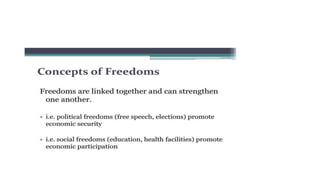
CONCEPT OF FREEDOM
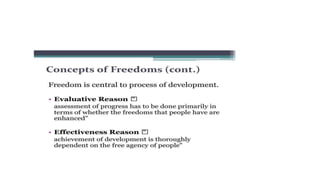
• FREEDOM IS CENTRAL TO PROCESS OF DEVELOPMENT
• 1 EVALUATIVE REASON : Assesment of progress has to be done primarily in terms of whether the freedoms
that people have are enhanced
• 2.Effectiveness Reason: Achivement of development throughly dependent on the free agency of people
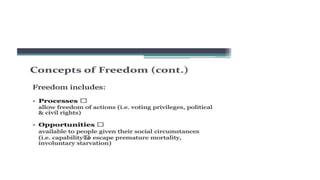
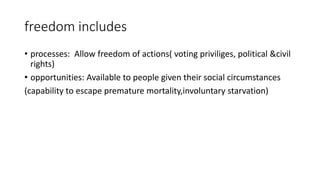
freedom includes
• processes: Allow freedom of actions( voting priviliges, political &civil
rights)
• opportunities: Available to people given their social circumstances
(capability to escape premature mortality,involuntary starvation)
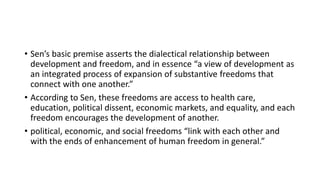
• Sen’s basic premise asserts the dialectical relationship between
development and freedom, and in essence “a view of development as
an integrated process of expansion of substantive freedoms that
connect with one another.”
• According to Sen, these freedoms are access to health care,
education, political dissent, economic markets, and equality, and each
freedom encourages the development of another.
• political, economic, and social freedoms “link with each other and
with the ends of enhancement of human freedom in general.”
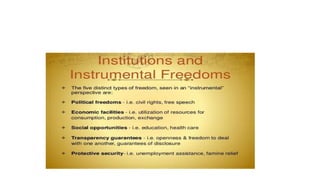
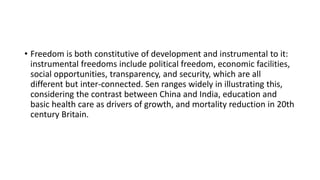
• Freedom is both constitutive of development and instrumental to it:
instrumental freedoms include political freedom, economic facilities,
social opportunities, transparency, and security, which are all
different but inter-connected. Sen ranges widely in illustrating this,
considering the contrast between China and India, education and
basic health care as drivers of growth, and mortality reduction in 20th
century Britain.
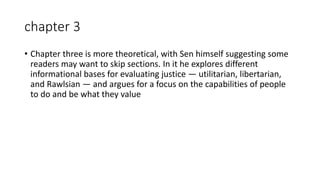
chapter 3
• Chapter three is more theoretical, with Sen himself suggesting some
readers may want to skip sections. In it he explores different
informational bases for evaluating justice — utilitarian, libertarian,
and Rawlsian — and argues for a focus on the capabilities of people
to do and be what they value
chapter 4
• Sen argues that capability deprivation is a better measure of poverty
than low income, because it can capture aspects of poverty hidden by
income measures. Illustrative examples include differences between
the United States and Europe in healthcare and mortality,
comparisons between sub-Saharan African and India in literacy and
infant mortality, and gender inequality and "missing women".
chapter 5
• In chapter five Sen ventures into some of the most contested areas of
economics. He surveys the role of markets, their efficiency, their
ability to provide public goods, and their relationship with the state.
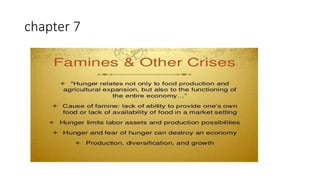
chapter 7
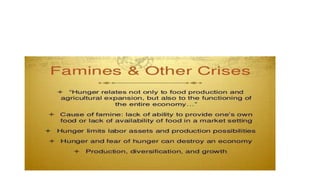
• In chapter seven Sen summarises some of his best-known work, on
famines. These are usually caused by a lack of purchasing power or
entitlements, not by actual food shortage — famine-struck areas
sometimes continue to export food — and are easy and cheap to
avoid, with state employment schemes the most straightforward
approach. Large-scale famines have never happened in a democracy
and, Sen argues, are unlikely to: they can only happen in authoritarian
systems lacking openness of information and transparency.
women development
• the role of women in development. Here he argues that, while
improving their well-being is important, enhancing their agency is just
as critical. One notable illustration: women's literacy and employment
levels are the best predictors of both child survival and fertility rate
reduction.
population growth and food supply
• Looking at population growth and food supply, Sen counters
doomsday predictions of imminent food shortage. And he points out
that Kerala has been more successful than China in limiting
population growth, suggesting that China might have done nearly as
well without the use of coercion.
• According to Sen, development is enhanced by democracy and the
protection of human rights. Such rights, especially freedom of the
press, speech, assembly, and so forth increase the likelihood of
honest, clean, good government.
• He claims that “no famine has ever taken place in the history of the
world in a functioning democracy”. This is because democratic
governments “have to win elections and face public criticism, and
have strong incentive to undertake measures to avert famines and
other catastrophes”.
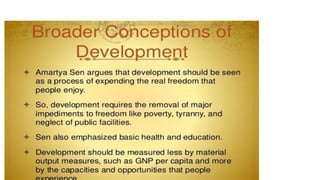
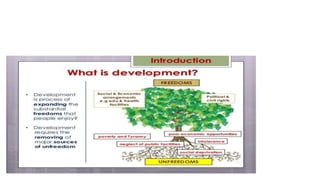
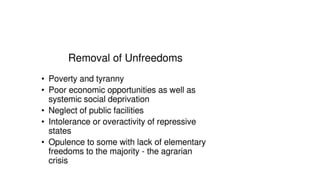
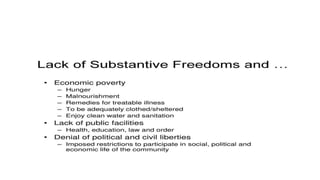
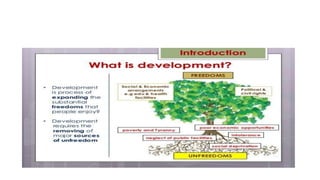
• “development requires the removal of major sources of unfreedom:
poverty as well as tyranny, poor economic opportunities as well as
systemic social deprivation, neglect of public facilities as well as
intolerance or overactivity of repressive states”.
• Sen argues that there are five types of interrelated freedoms, namely,
political freedom, economic facilities, social opportunities,
transparency and security. The state has a role in supporting
freedoms by providing public education, health care, social safety
nets, good macroeconomic policies, productivity and protecting the
environment.
• Freedom implies not just to do something, but the capabilities to
make it happen. What people can achieve (their capabilities) is
influenced by “economic opportunities, political liberties, social
powers, and the enabling condition of good health, basic education,
and the encouragement and cultivation of initiatives”. Sen calculates
that if women in Asia and North Africa were given the same health
care and attention, the world would have 100 million more women.
• For Sen, “capability deprivation” is a better measure of poverty than
low income. While higher GDP does produce improvements in most
measures of the quality of life, but there are exceptions. Some places
with low GDP/capita like Sri Lanka, China and the India state of Kerala
have higher life expectancies and literacy rates than richer countries
like Brazil, South Africa and Namibia. And Afro-Americans have a
lower life expectancy than males in China and parts of India, although
their average real income is far higher.
• Cultural freedoms should be embraced as basic human rights and as
necessities for the development of the increasingly diverse societies
of the 21st century. All people should have the right to maintain their
ethnic, linguistic, and religious identities. The adoption of policies that
recognize and protect these identities is the only sustainable
approach to development in diverse societies. Economic globalization
cannot succeed unless cultural freedoms are also respected and
protected, and the xenophobic resistance to cultural diversity should
be addressed and overcome.
• According to Sen, development is enhanced by democracy and the
protection of human rights. Such rights, especially freedom of the
press, speech, assembly, and so forth increase the likelihood of
honest, clean, good government.
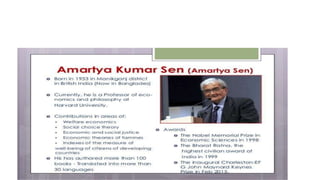
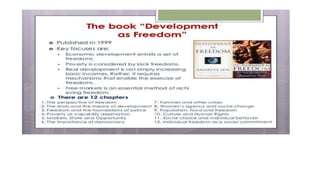
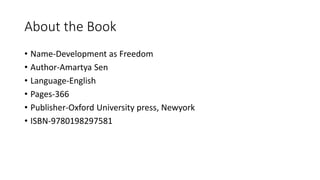
About the Book
• Name-Development as Freedom
• Author-Amartya Sen
• Language-English
• Pages-366
• Publisher-Oxford University press, Newyork
• ISBN-9780198297581
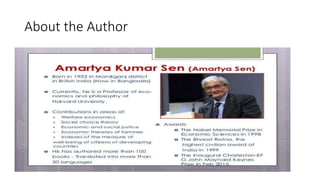
About the Book
About the Author
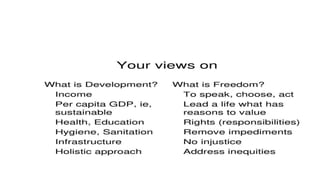
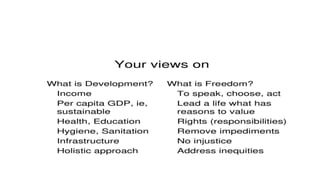
What is Development
• the process of developing or being developed.
• an event constituting a new stage in a changing situation.
• Development is a process that creates growth, progress,
positive change.
• the process of coming into existence or of creating something
new or more advanced.
What is freedom
• the state of not being imprisoned or enslaved.
• the power or right to act, speak, or think as one wants.
• Freedom is understood as either having the ability to act or change
without constraint.
• Freedom is the power or right to act, speak, or think as one wants
without hindrance or restraint,
• the state of being free: such as; : the power to do what you want to
do the ability to move or act freely.
• Freedom is the state of being allowed to do what you want to do.
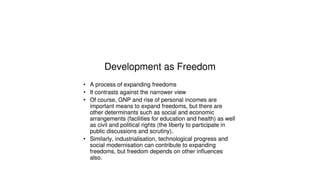
What is the concept of development as freedom?
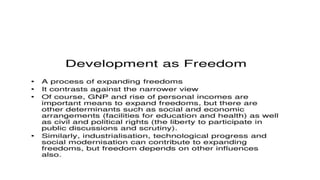
Development is the process of expanding human
freedom. It is “the enhancement of freedoms that
allow people to lead lives that they have reason to
live”.
What is an example of development as freedom?
• For example, expanding social freedoms by providing educational
opportunities (especially among women) tends to increase income
and reduce infant mortality. Similarly, economic freedom leads to
faster income growth, which in turn provides the resources necessary
for education, health care, and similar goods.
What are the five freedoms mentioned by
Amartya Sen?
• Sen mentions five distinct freedoms: political freedoms, economic
facilities, social opportunities, transparency guarantees, and
protective security
How does Amartya Sen define human
development?
• According to Sen, human development can be defined as “the process
of expanding the real freedoms that people enjoy”
Why is freedom important in development?
• The Findings show that freedom can protect humans against natural
disasters (such as flood, earthquake, drought etc), social problems
(such as mortality, low life expectancy and illiteracy) and economic
problems (like unfair income distribution, low income per capita and
so on) by expanding human choices and providing .
chapter 4
• Sen argues that capability deprivation is a better measure of poverty
than low income, because it can capture aspects of poverty hidden by
income measures. Illustrative examples include differences between
the United States and Europe in healthcare and mortality,
comparisons between sub-Saharan African and India in literacy and
infant mortality, and gender inequality and "missing women"
chapter 5
• In chapter five Sen ventures into some of the most contested areas of
economics. He surveys the role of markets, their efficiency, their
ability to provide public goods, and their relationship with the state.
chapter 7
CHAPTER SIX
THE IMPORTANCE OF DEMOCRACY
• Sen elucidated democracy as the best system of governance by
arguing that democracy plays an instrumental role to freedom and
giving people a voice to construct and shape their norms and values.
He pointed out ‘' Political rights, including freedom of expression and
discussion, Are not only pivotal in inducing social responses to
economic needs, but they are also central to the conceptualization of
economic needs themselves." This quote shows that Sen supported
the effective function of democracy, and without good democratic
culture, formal rules will never work.
chapter 3
• Chapter three is more theoretical, with Sen himself suggesting some
readers may want to skip sections. In it he explores different
informational bases for evaluating justice — utilitarian, libertarian,
and Rawlsian — and argues for a focus on the capabilities of people
to do and be what they value.
CHAPTER 8
WOMENS AGENCY AND SOCIAL CHANGE:
• Sen critically argued that women's literacy and employability will
increase the well being of women and contribute to the
development. He claimed that education and employment
engagement is good for both the child and the fertility rate reduction.
CHAPTER-9
POPULATION, FOOD, FREEDOM
• On the other hand, Sen predicted that an imminent food shortage
would end up doomsday, which means limiting population growth
will help to improve people's well-being, because of the mismatching
the demand of population growth and the limited food supply chain
Chapter 10 – Culture and Human Rights
• It may be best to see human rights as a set of ethical claims which
must not be identified with legislated legal rights. But they can still be
useful as a system of ethical reasoning and the basis of political
demands
Chapter 11 – Social choice and individual
behaviour
• For this we need an evaluative framework and institutions that work
to promote our goals and we need behavioural norms and reasoning
that allow us to achieve what we are trying to achieve.
Chapter 12 – individual freedom as a social
commitment
• Interdependence between freedom and responsibility – we are only
free to exercise our responsibility individually if we are surrounded by
factors to do with the state, i.e. other institutions and agents. Justice
freedom and responsibility – focusing on substantive freedoms helps
here.

Presentation1.pptx

  • 5.
  • 18.
    CONCEPT OF FREEDOM •FREEDOM IS CENTRAL TO PROCESS OF DEVELOPMENT • 1 EVALUATIVE REASON : Assesment of progress has to be done primarily in terms of whether the freedoms that people have are enhanced • 2.Effectiveness Reason: Achivement of development throughly dependent on the free agency of people
  • 19.
    freedom includes • processes:Allow freedom of actions( voting priviliges, political &civil rights) • opportunities: Available to people given their social circumstances (capability to escape premature mortality,involuntary starvation)
  • 20.
    • Sen’s basicpremise asserts the dialectical relationship between development and freedom, and in essence “a view of development as an integrated process of expansion of substantive freedoms that connect with one another.” • According to Sen, these freedoms are access to health care, education, political dissent, economic markets, and equality, and each freedom encourages the development of another. • political, economic, and social freedoms “link with each other and with the ends of enhancement of human freedom in general.”
  • 21.
    • Freedom isboth constitutive of development and instrumental to it: instrumental freedoms include political freedom, economic facilities, social opportunities, transparency, and security, which are all different but inter-connected. Sen ranges widely in illustrating this, considering the contrast between China and India, education and basic health care as drivers of growth, and mortality reduction in 20th century Britain.
  • 22.
    chapter 3 • Chapterthree is more theoretical, with Sen himself suggesting some readers may want to skip sections. In it he explores different informational bases for evaluating justice — utilitarian, libertarian, and Rawlsian — and argues for a focus on the capabilities of people to do and be what they value
  • 23.
    chapter 4 • Senargues that capability deprivation is a better measure of poverty than low income, because it can capture aspects of poverty hidden by income measures. Illustrative examples include differences between the United States and Europe in healthcare and mortality, comparisons between sub-Saharan African and India in literacy and infant mortality, and gender inequality and "missing women".
  • 24.
    chapter 5 • Inchapter five Sen ventures into some of the most contested areas of economics. He surveys the role of markets, their efficiency, their ability to provide public goods, and their relationship with the state.
  • 25.
    chapter 7 • Inchapter seven Sen summarises some of his best-known work, on famines. These are usually caused by a lack of purchasing power or entitlements, not by actual food shortage — famine-struck areas sometimes continue to export food — and are easy and cheap to avoid, with state employment schemes the most straightforward approach. Large-scale famines have never happened in a democracy and, Sen argues, are unlikely to: they can only happen in authoritarian systems lacking openness of information and transparency.
  • 26.
    women development • therole of women in development. Here he argues that, while improving their well-being is important, enhancing their agency is just as critical. One notable illustration: women's literacy and employment levels are the best predictors of both child survival and fertility rate reduction.
  • 27.
    population growth andfood supply • Looking at population growth and food supply, Sen counters doomsday predictions of imminent food shortage. And he points out that Kerala has been more successful than China in limiting population growth, suggesting that China might have done nearly as well without the use of coercion.
  • 28.
    • According toSen, development is enhanced by democracy and the protection of human rights. Such rights, especially freedom of the press, speech, assembly, and so forth increase the likelihood of honest, clean, good government. • He claims that “no famine has ever taken place in the history of the world in a functioning democracy”. This is because democratic governments “have to win elections and face public criticism, and have strong incentive to undertake measures to avert famines and other catastrophes”.
  • 29.
    • “development requiresthe removal of major sources of unfreedom: poverty as well as tyranny, poor economic opportunities as well as systemic social deprivation, neglect of public facilities as well as intolerance or overactivity of repressive states”. • Sen argues that there are five types of interrelated freedoms, namely, political freedom, economic facilities, social opportunities, transparency and security. The state has a role in supporting freedoms by providing public education, health care, social safety nets, good macroeconomic policies, productivity and protecting the environment.
  • 30.
    • Freedom impliesnot just to do something, but the capabilities to make it happen. What people can achieve (their capabilities) is influenced by “economic opportunities, political liberties, social powers, and the enabling condition of good health, basic education, and the encouragement and cultivation of initiatives”. Sen calculates that if women in Asia and North Africa were given the same health care and attention, the world would have 100 million more women.
  • 31.
    • For Sen,“capability deprivation” is a better measure of poverty than low income. While higher GDP does produce improvements in most measures of the quality of life, but there are exceptions. Some places with low GDP/capita like Sri Lanka, China and the India state of Kerala have higher life expectancies and literacy rates than richer countries like Brazil, South Africa and Namibia. And Afro-Americans have a lower life expectancy than males in China and parts of India, although their average real income is far higher.
  • 32.
    • Cultural freedomsshould be embraced as basic human rights and as necessities for the development of the increasingly diverse societies of the 21st century. All people should have the right to maintain their ethnic, linguistic, and religious identities. The adoption of policies that recognize and protect these identities is the only sustainable approach to development in diverse societies. Economic globalization cannot succeed unless cultural freedoms are also respected and protected, and the xenophobic resistance to cultural diversity should be addressed and overcome.
  • 33.
    • According toSen, development is enhanced by democracy and the protection of human rights. Such rights, especially freedom of the press, speech, assembly, and so forth increase the likelihood of honest, clean, good government.
  • 35.
    About the Book •Name-Development as Freedom • Author-Amartya Sen • Language-English • Pages-366 • Publisher-Oxford University press, Newyork • ISBN-9780198297581
  • 36.
  • 37.
  • 39.
    What is Development •the process of developing or being developed. • an event constituting a new stage in a changing situation. • Development is a process that creates growth, progress, positive change. • the process of coming into existence or of creating something new or more advanced.
  • 40.
    What is freedom •the state of not being imprisoned or enslaved. • the power or right to act, speak, or think as one wants. • Freedom is understood as either having the ability to act or change without constraint. • Freedom is the power or right to act, speak, or think as one wants without hindrance or restraint, • the state of being free: such as; : the power to do what you want to do the ability to move or act freely. • Freedom is the state of being allowed to do what you want to do.
  • 41.
    What is theconcept of development as freedom? Development is the process of expanding human freedom. It is “the enhancement of freedoms that allow people to lead lives that they have reason to live”.
  • 46.
    What is anexample of development as freedom? • For example, expanding social freedoms by providing educational opportunities (especially among women) tends to increase income and reduce infant mortality. Similarly, economic freedom leads to faster income growth, which in turn provides the resources necessary for education, health care, and similar goods.
  • 50.
    What are thefive freedoms mentioned by Amartya Sen? • Sen mentions five distinct freedoms: political freedoms, economic facilities, social opportunities, transparency guarantees, and protective security
  • 52.
    How does AmartyaSen define human development? • According to Sen, human development can be defined as “the process of expanding the real freedoms that people enjoy”
  • 53.
    Why is freedomimportant in development? • The Findings show that freedom can protect humans against natural disasters (such as flood, earthquake, drought etc), social problems (such as mortality, low life expectancy and illiteracy) and economic problems (like unfair income distribution, low income per capita and so on) by expanding human choices and providing .
  • 54.
    chapter 4 • Senargues that capability deprivation is a better measure of poverty than low income, because it can capture aspects of poverty hidden by income measures. Illustrative examples include differences between the United States and Europe in healthcare and mortality, comparisons between sub-Saharan African and India in literacy and infant mortality, and gender inequality and "missing women"
  • 55.
    chapter 5 • Inchapter five Sen ventures into some of the most contested areas of economics. He surveys the role of markets, their efficiency, their ability to provide public goods, and their relationship with the state.
  • 56.
  • 57.
    CHAPTER SIX THE IMPORTANCEOF DEMOCRACY • Sen elucidated democracy as the best system of governance by arguing that democracy plays an instrumental role to freedom and giving people a voice to construct and shape their norms and values. He pointed out ‘' Political rights, including freedom of expression and discussion, Are not only pivotal in inducing social responses to economic needs, but they are also central to the conceptualization of economic needs themselves." This quote shows that Sen supported the effective function of democracy, and without good democratic culture, formal rules will never work.
  • 58.
    chapter 3 • Chapterthree is more theoretical, with Sen himself suggesting some readers may want to skip sections. In it he explores different informational bases for evaluating justice — utilitarian, libertarian, and Rawlsian — and argues for a focus on the capabilities of people to do and be what they value.
  • 59.
    CHAPTER 8 WOMENS AGENCYAND SOCIAL CHANGE: • Sen critically argued that women's literacy and employability will increase the well being of women and contribute to the development. He claimed that education and employment engagement is good for both the child and the fertility rate reduction.
  • 60.
    CHAPTER-9 POPULATION, FOOD, FREEDOM •On the other hand, Sen predicted that an imminent food shortage would end up doomsday, which means limiting population growth will help to improve people's well-being, because of the mismatching the demand of population growth and the limited food supply chain
  • 61.
    Chapter 10 –Culture and Human Rights • It may be best to see human rights as a set of ethical claims which must not be identified with legislated legal rights. But they can still be useful as a system of ethical reasoning and the basis of political demands
  • 62.
    Chapter 11 –Social choice and individual behaviour • For this we need an evaluative framework and institutions that work to promote our goals and we need behavioural norms and reasoning that allow us to achieve what we are trying to achieve.
  • 63.
    Chapter 12 –individual freedom as a social commitment • Interdependence between freedom and responsibility – we are only free to exercise our responsibility individually if we are surrounded by factors to do with the state, i.e. other institutions and agents. Justice freedom and responsibility – focusing on substantive freedoms helps here.