Moderation, Knowledge and Modesty

            November 2008


         Professor Asher Tishler
          Faculty of Management
            Tel Aviv University


             November 2008


                                    1
The financial crisis:


The problem

The causes

Future actions

Comments about Israel

                        2
The financial crisis in the world

Began as a crisis in the subprime
market.

Today, it is a liquidity crisis (trust
crisis).

Today, the crisis is global. It is not
just a problem for the USA.


                                         3
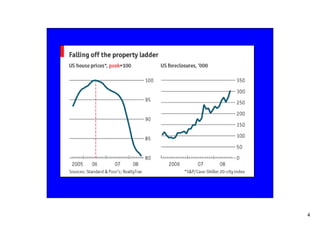
4
Initially, the financial crisis due to the sub-prime problem
(mainly in the USA)

Initially, a drop of $2 trillion in the value of houses

The drop in the value of houses is due to excess building,
unbridled granting of mortgages (a mortgage higher than
the value of the house, too long a period of grace for
overdue mortgage payments, and so on)

The existence of overly sophisticated financial assets that
hide the extent of the problem (securitization of mortgages,
‘new assets’, and more) and prevent a simple solution

There is a problem of liquidity in the various banking
institutions


                                                               5
The response of the US government: purchase of troubled
assets from financial institutions

What and how to buy? (buy bonds using the right
techniques)

How much to pay? (today the market price is low due to
liquidity problems)

The government needs to help where there is a problem of
liquidity. It should not rescue badly managed financial
institutions (with weak customers, inefficient management,
too high risk, etc)

Banks (financial institutions) that are badly managed should
be allowed to go under. The receivership process should
be fair (selling assets to other institutions)


                                                               6
Reasons for the financial crisis


The bubble in the real estate market.

Too many overly complex financial assets
(throughout the world).

Financial systems with regulation that is
defective or completely absent.

Defective regulation systems in other
markets.

                                            7
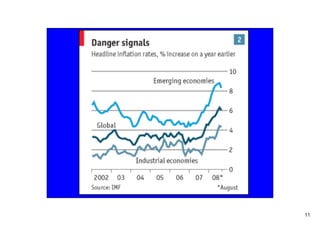
Signs of problems in financial markets

Exist for a long time

Are reflected in many real markets

Are reflected mainly in the ‘alternative investments’ markets

We did not ‘connect’ all the signs

Governments (economists) did not understand the problems

No government response


                                                                8
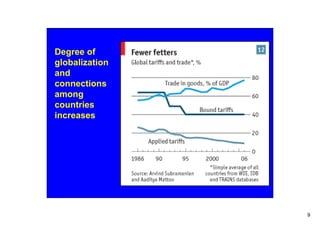
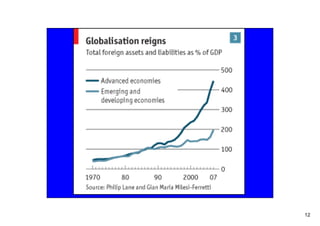
Degree of
globalization
and
connections
among
countries
increases


                9
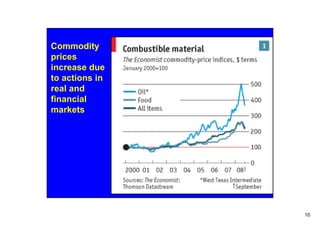
Commodity
prices
increase due
to actions in
real and
financial
markets


                10
11
12
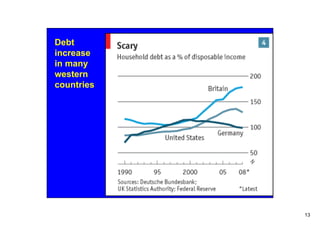
Debt
increase
in many
western
countries


            13
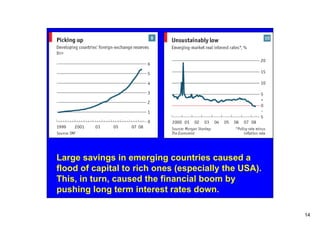
Large savings in emerging countries caused a
flood of capital to rich ones (especially the USA).
This, in turn, caused the financial boom by
pushing long term interest rates down.

                                                      14
15
Banks hold a lot
of ‘short term’
liabilities (and
‘long term’ assets).
It is difficult for
governments to
offer guarantees
for depositors.


                       16
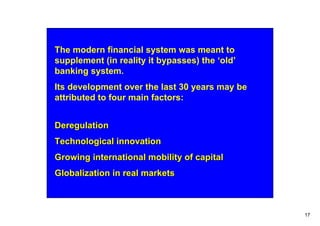
The modern financial system was meant to
supplement (in reality it bypasses) the ‘old’
banking system.
Its development over the last 30 years may be
attributed to four main factors:


Deregulation
Technological innovation
Growing international mobility of capital
Globalization in real markets


                                                17
The development of the financial markets over the
last 30 years
Securitization: Banks collected together bank loans,
particularly mortgages, and sold the package to various
financial institutions.
Other banks, particularly investment banks, collected
these assets and repackaged them according to various
risk types (and additional categories), added a bit of
leverage, and sold the package on. This process was
repeated several times.
Technological developments, including the appropriate
algorithms, made possible the creation of several types of
derivatives, the trade in which ballooned significantly
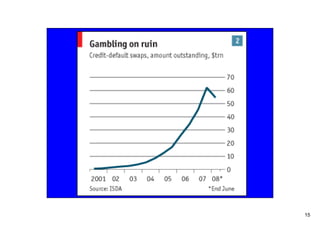
(credit-default swaps, for instance). At the end of 2007 the
total number of contracts was 600 trillion (12 times the
world’s GDP!!!)


                                                               18
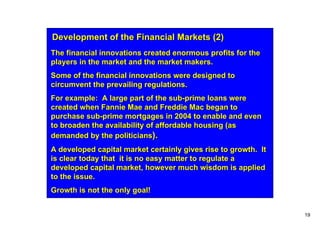
Development of the Financial Markets (2)
The financial innovations created enormous profits for the
players in the market and the market makers.
Some of the financial innovations were designed to
circumvent the prevailing regulations.
For example: A large part of the sub-prime loans were
created when Fannie Mae and Freddie Mac began to
purchase sub-prime mortgages in 2004 to enable and even
to broaden the availability of affordable housing (as
demanded by the politicians).
A developed capital market certainly gives rise to growth. It
is clear today that it is no easy matter to regulate a
developed capital market, however much wisdom is applied
to the issue.
Growth is not the only goal!


                                                                19
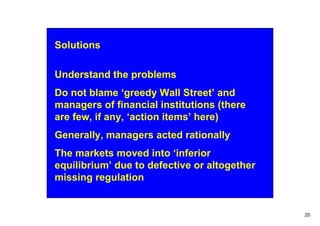
Solutions

Understand the problems
Do not blame ‘greedy Wall Street’ and
managers of financial institutions (there
are few, if any, ‘action items’ here)
Generally, managers acted rationally
The markets moved into ‘inferior
equilibrium’ due to defective or altogether
missing regulation


                                              20
Solutions

Short run (now) – solve the liquidity (lack
of trust) problem
Inject capital to banks, boost the economy
(mostly in infrastructure), pay attention to
the poor, weak and old (they will be hurt)


Long run – set better regulation in financial
and real markets (governments should not
replace the private sector)

                                                21
Is it possible to regulate the market better?


It’s difficult. Individual players will always be one step
ahead of the regulators (preferably, they should be only one
step ahead and not more).


The tension between nationality and international regulation


In general (the economists’ answer): Politicians should be
prevented from introducing distortions into the capital
market.
Set simple regulation and simple rules


                                                               22
Changes that will take place following the
 crisis
All the important financial markets in the West (derivatives,
mutual funds, securitization, etc) will be subject to stronger
(hopefully better) regulation. The minimum capital
regulation will be stronger and more conservative, leading
to much smaller leverage than at present.

The regulation array itself will change substantially and will
be arranged in an orderly fashion (it will be clear who
regulates what and the relations between the various
regulators will be plainly set out).

There will be more government intervention in real
markets, particularly, but not only, through regulation.


                                                                 23
Changes that will take place following the
crisis (continued)

Emerging markets will have more of a say in what goes on
in the financial markets.


Generally speaking, inconsistent and unwise government
activity in financial and real markets (defective regulation,
inappropriate subsidies, poorly executed ideological
reforms, etc) contributed substantially to the current crisis.
Governments will now be more conservative and certainly
wiser (less ‘ideology’ and more knowledge).


The comparative advantage of countries with high levels
of human capital will increase.


                                                                 24
Why is Israel in “good” shape?

There is no real estate bubble.
The economy is in good shape (five years of
healthy growth, low unemployment, an export
surplus.

We lagged behind in adopting the overly complex
assets.

The banks are fairly well regulated (the alternative
capital market less so).

A problem: Defective regulation in most of the
other markets.

                                                       25
Israel
A strong, growing and successful private sector


A government sector with many planning and
operations problems

Infrastructure planning and operations by a weak
public sector: defense, education, higher
education, the legal system

Defective regulation of oligopolistic markets:
water, electricity, the ports, telecommunications


                                                    26
Why does the public sector have so many problems?

The public sector is burdened by many difficult
tasks (security, welfare, …)
The public sector has no strategy and lacks
planning integration
The pay in the public sector is low, it has a large
number of unskilled employees and a small
number of skilled employees
It suffers from a lack of awareness of the need for
long-term planning (in a rapidly changing world!)
There is a lack of professional knowledge and
experience (managerial and other), particularly at the
center, amongst the integrators (MOF, PM)

                                                         27
Policy required in Israel (we are somewhat
lucky in the current crisis)
In the short run – concentrate on the crisis

In the long run – there is a need for long-term
planning in a number of focal areas

Need for a serious level of professional knowledge,
permanently in place

Need for professional personnel with the ability to
manage complex systems

Need for knowledge and professional personnel to
regulate rapidly changing markets

                                                      28
Policy in Israel


Moderation (no extreme capitalism or socialism)


Acquire more knowledge


Be more modest


                                                  29

Asher Tishler Moderation, Knowedge And Modesty

  • 1.
    Moderation, Knowledge andModesty November 2008 Professor Asher Tishler Faculty of Management Tel Aviv University November 2008 1
  • 2.
    The financial crisis: Theproblem The causes Future actions Comments about Israel 2
  • 3.
    The financial crisisin the world Began as a crisis in the subprime market. Today, it is a liquidity crisis (trust crisis). Today, the crisis is global. It is not just a problem for the USA. 3
  • 4.
  • 5.
    Initially, the financialcrisis due to the sub-prime problem (mainly in the USA) Initially, a drop of $2 trillion in the value of houses The drop in the value of houses is due to excess building, unbridled granting of mortgages (a mortgage higher than the value of the house, too long a period of grace for overdue mortgage payments, and so on) The existence of overly sophisticated financial assets that hide the extent of the problem (securitization of mortgages, ‘new assets’, and more) and prevent a simple solution There is a problem of liquidity in the various banking institutions 5
  • 6.
    The response ofthe US government: purchase of troubled assets from financial institutions What and how to buy? (buy bonds using the right techniques) How much to pay? (today the market price is low due to liquidity problems) The government needs to help where there is a problem of liquidity. It should not rescue badly managed financial institutions (with weak customers, inefficient management, too high risk, etc) Banks (financial institutions) that are badly managed should be allowed to go under. The receivership process should be fair (selling assets to other institutions) 6
  • 7.
    Reasons for thefinancial crisis The bubble in the real estate market. Too many overly complex financial assets (throughout the world). Financial systems with regulation that is defective or completely absent. Defective regulation systems in other markets. 7
  • 8.
    Signs of problemsin financial markets Exist for a long time Are reflected in many real markets Are reflected mainly in the ‘alternative investments’ markets We did not ‘connect’ all the signs Governments (economists) did not understand the problems No government response 8
  • 9.
  • 10.
    Commodity prices increase due to actionsin real and financial markets 10
  • 11.
  • 12.
  • 13.
  • 14.
    Large savings inemerging countries caused a flood of capital to rich ones (especially the USA). This, in turn, caused the financial boom by pushing long term interest rates down. 14
  • 15.
  • 16.
    Banks hold alot of ‘short term’ liabilities (and ‘long term’ assets). It is difficult for governments to offer guarantees for depositors. 16
  • 17.
    The modern financialsystem was meant to supplement (in reality it bypasses) the ‘old’ banking system. Its development over the last 30 years may be attributed to four main factors: Deregulation Technological innovation Growing international mobility of capital Globalization in real markets 17
  • 18.
    The development ofthe financial markets over the last 30 years Securitization: Banks collected together bank loans, particularly mortgages, and sold the package to various financial institutions. Other banks, particularly investment banks, collected these assets and repackaged them according to various risk types (and additional categories), added a bit of leverage, and sold the package on. This process was repeated several times. Technological developments, including the appropriate algorithms, made possible the creation of several types of derivatives, the trade in which ballooned significantly (credit-default swaps, for instance). At the end of 2007 the total number of contracts was 600 trillion (12 times the world’s GDP!!!) 18
  • 19.
    Development of theFinancial Markets (2) The financial innovations created enormous profits for the players in the market and the market makers. Some of the financial innovations were designed to circumvent the prevailing regulations. For example: A large part of the sub-prime loans were created when Fannie Mae and Freddie Mac began to purchase sub-prime mortgages in 2004 to enable and even to broaden the availability of affordable housing (as demanded by the politicians). A developed capital market certainly gives rise to growth. It is clear today that it is no easy matter to regulate a developed capital market, however much wisdom is applied to the issue. Growth is not the only goal! 19
  • 20.
    Solutions Understand the problems Donot blame ‘greedy Wall Street’ and managers of financial institutions (there are few, if any, ‘action items’ here) Generally, managers acted rationally The markets moved into ‘inferior equilibrium’ due to defective or altogether missing regulation 20
  • 21.
    Solutions Short run (now)– solve the liquidity (lack of trust) problem Inject capital to banks, boost the economy (mostly in infrastructure), pay attention to the poor, weak and old (they will be hurt) Long run – set better regulation in financial and real markets (governments should not replace the private sector) 21
  • 22.
    Is it possibleto regulate the market better? It’s difficult. Individual players will always be one step ahead of the regulators (preferably, they should be only one step ahead and not more). The tension between nationality and international regulation In general (the economists’ answer): Politicians should be prevented from introducing distortions into the capital market. Set simple regulation and simple rules 22
  • 23.
    Changes that willtake place following the crisis All the important financial markets in the West (derivatives, mutual funds, securitization, etc) will be subject to stronger (hopefully better) regulation. The minimum capital regulation will be stronger and more conservative, leading to much smaller leverage than at present. The regulation array itself will change substantially and will be arranged in an orderly fashion (it will be clear who regulates what and the relations between the various regulators will be plainly set out). There will be more government intervention in real markets, particularly, but not only, through regulation. 23
  • 24.
    Changes that willtake place following the crisis (continued) Emerging markets will have more of a say in what goes on in the financial markets. Generally speaking, inconsistent and unwise government activity in financial and real markets (defective regulation, inappropriate subsidies, poorly executed ideological reforms, etc) contributed substantially to the current crisis. Governments will now be more conservative and certainly wiser (less ‘ideology’ and more knowledge). The comparative advantage of countries with high levels of human capital will increase. 24
  • 25.
    Why is Israelin “good” shape? There is no real estate bubble. The economy is in good shape (five years of healthy growth, low unemployment, an export surplus. We lagged behind in adopting the overly complex assets. The banks are fairly well regulated (the alternative capital market less so). A problem: Defective regulation in most of the other markets. 25
  • 26.
    Israel A strong, growingand successful private sector A government sector with many planning and operations problems Infrastructure planning and operations by a weak public sector: defense, education, higher education, the legal system Defective regulation of oligopolistic markets: water, electricity, the ports, telecommunications 26
  • 27.
    Why does thepublic sector have so many problems? The public sector is burdened by many difficult tasks (security, welfare, …) The public sector has no strategy and lacks planning integration The pay in the public sector is low, it has a large number of unskilled employees and a small number of skilled employees It suffers from a lack of awareness of the need for long-term planning (in a rapidly changing world!) There is a lack of professional knowledge and experience (managerial and other), particularly at the center, amongst the integrators (MOF, PM) 27
  • 28.
    Policy required inIsrael (we are somewhat lucky in the current crisis) In the short run – concentrate on the crisis In the long run – there is a need for long-term planning in a number of focal areas Need for a serious level of professional knowledge, permanently in place Need for professional personnel with the ability to manage complex systems Need for knowledge and professional personnel to regulate rapidly changing markets 28
  • 29.
    Policy in Israel Moderation(no extreme capitalism or socialism) Acquire more knowledge Be more modest 29