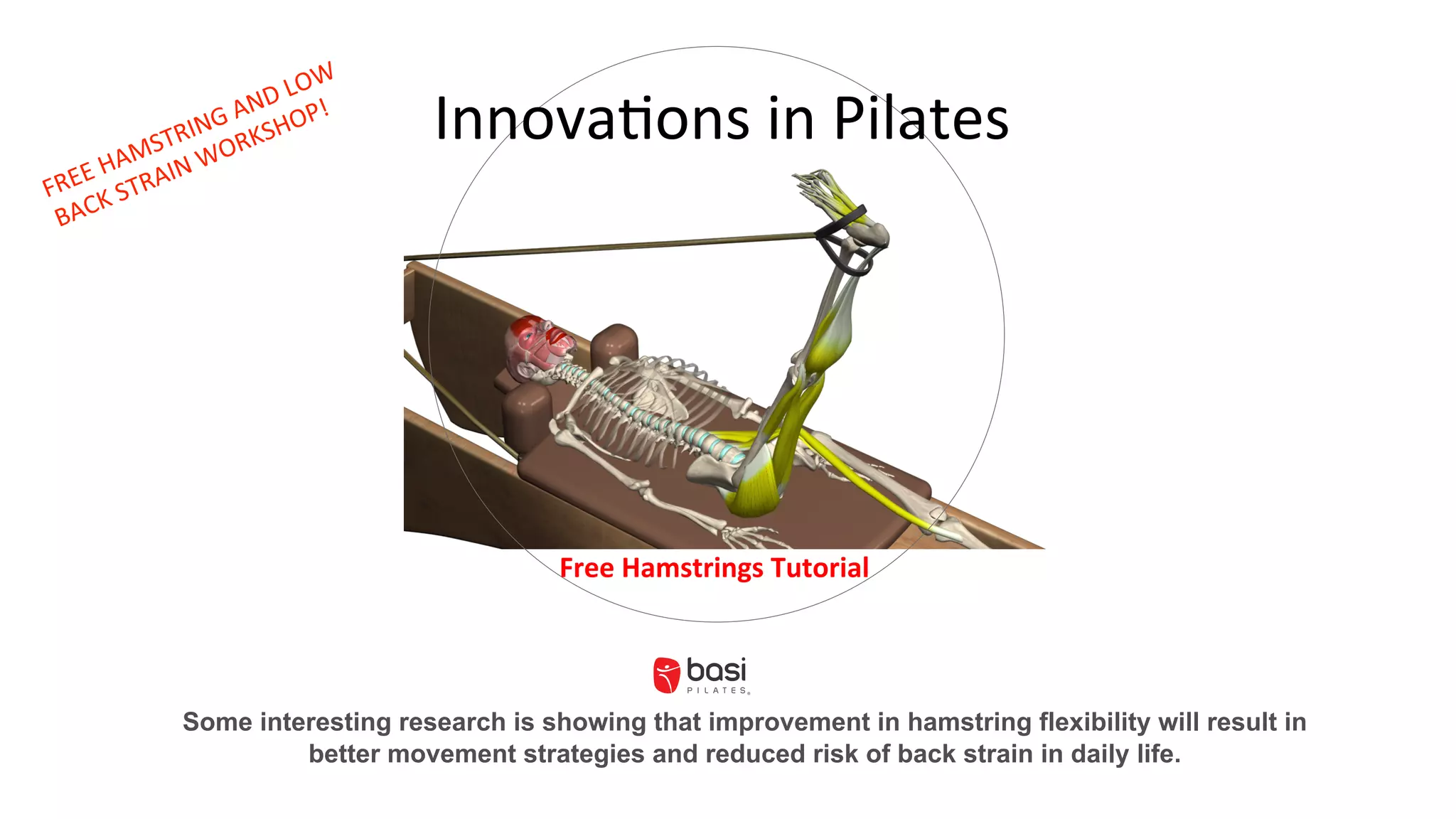
Some interesting research is showing that improvement in hamstring flexibility will result in
better movement strategies and reduced risk of back strain in daily life.
Innova&ons	
  in	
  Pilates	
  
Free	
  Hamstrings	
  Tutorial	
  
 
Here's a link to the research papers:
http://goo.gl/IixTFF
http://goo.gl/HNZvZq
What the research found:
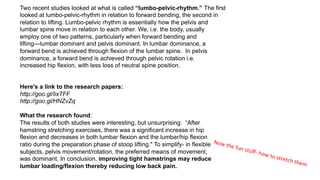
The results of both studies were interesting, but unsurprising: “After
hamstring stretching exercises, there was a significant increase in hip
flexion and decreases in both lumbar flexion and the lumbar/hip flexion
ratio during the preparation phase of stoop lifting." To simplify- in flexible
subjects, pelvis movement/rotation, the preferred means of movement,
was dominant. In conclusion, improving tight hamstrings may reduce
lumbar loading/flexion thereby reducing low back pain.
Two recent studies looked at what is called “lumbo-pelvic-rhythm.” The first
looked at lumbo-pelvic-rhythm in relation to forward bending, the second in
relation to lifting. Lumbo-pelvic rhythm is essentially how the pelvis and
lumbar spine move in relation to each other. We, i.e. the body, usually
employ one of two patterns, particularly when forward bending and
lifting—lumbar dominant and pelvis dominant. In lumbar dominance, a
forward bend is achieved through flexion of the lumbar spine. In pelvis
dominance, a forward bend is achieved through pelvic rotation i.e.
increased hip flexion, with less loss of neutral spine position.
Now	
  the	
  fun	
  stuff-­‐	
  how	
  to	
  stretch	
  them	
  
In the first part of this workshop we will look at how to stretch the Hamstrings and Adductor Magnus. In
the second part we will focus on Gluteus Maximus, the lateral hamstrings and Piriformis. Our goal will be
to improve their flexibility and as a result facilitate a forward bend that is achieved through pelvic rotation
instead of lumbar flexion.
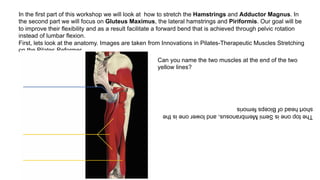
First, lets look at the anatomy. Images are taken from Innovations in Pilates-Therapeutic Muscles Stretching
on the Pilates Reformer
Can you name the two muscles at the end of the two
yellow lines?


ThetoponeisSemiMembranosus,andloweroneisthe
shortheadofBicepsfemoris
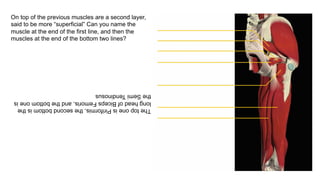
On top of the previous muscles are a second layer,
said to be more “superficial” Can you name the
muscle at the end of the first line, and then the
muscles at the end of the bottom two lines?


ThetoponeisPiriformis,thesecondbottomisthe
longheadofBicepsFemoris,andthebottomoneis
theSemiTendinosus
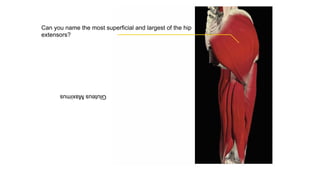
Can you name the most superficial and largest of the hip
extensors?
GluteusMaximus
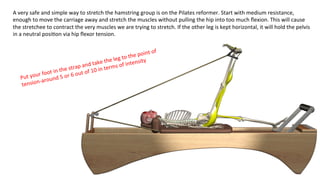
A	
  very	
  safe	
  and	
  simple	
  way	
  to	
  stretch	
  the	
  hamstring	
  group	
  is	
  on	
  the	
  Pilates	
  reformer.	
  Start	
  with	
  medium	
  resistance,	
  
enough	
  to	
  move	
  the	
  carriage	
  away	
  and	
  stretch	
  the	
  muscles	
  without	
  pulling	
  the	
  hip	
  into	
  too	
  much	
  flexion.	
  This	
  will	
  cause	
  
the	
  stretchee	
  to	
  contract	
  the	
  very	
  muscles	
  we	
  are	
  trying	
  to	
  stretch.	
  If	
  the	
  other	
  leg	
  is	
  kept	
  horizontal,	
  it	
  will	
  hold	
  the	
  pelvis	
  
in	
  a	
  neutral	
  posi&on	
  via	
  hip	
  flexor	
  tension.	
  
Put	
  your	
  foot	
  in	
  the	
  strap	
  and	
  take	
  the	
  leg	
  to	
  the	
  point	
  of	
  
tension-­‐around	
  5	
  or	
  6	
  out	
  of	
  10	
  in	
  terms	
  of	
  intensity	
  
This	
  close	
  up	
  makes	
  it	
  easy	
  for	
  you	
  to	
  see	
  the	
  Gluteus	
  Maximus,	
  the	
  short	
  head	
  and	
  long	
  head	
  of	
  Biceps	
  
Femoris	
  as	
  well	
  as	
  Semi	
  Tendinosus	
  and	
  Membranosis.	
  If	
  you	
  dorsi	
  flex	
  your	
  foot,	
  i.e.	
  point	
  your	
  toes	
  
toward	
  your	
  face,	
  you	
  can	
  see	
  that	
  the	
  Gastrocnemius	
  will	
  be	
  stretched	
  more	
  also.	
  This	
  part	
  of	
  the	
  stretch	
  is	
  
more	
  intense	
  in	
  the	
  bulk	
  of	
  the	
  hamstring	
  group.	
  In	
  a	
  moment,	
  we	
  will	
  alter	
  the	
  leg	
  posi&on	
  to	
  change	
  the	
  
focus	
  to	
  the	
  lateral	
  band	
  of	
  muscles.	
  
Take	
  some	
  deep	
  breaths	
  and	
  hold	
  the	
  posi&on	
  
for	
  around	
  30	
  seconds,	
  or	
  5	
  to	
  10	
  deep	
  breaths.	
  
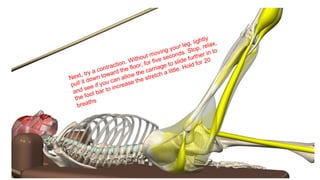
Next, try a contraction. Without moving your leg, lightly
pull it down toward the floor, for five seconds. Stop, relax,
and see if you can allow the carriage to slide further in to
the foot bar to increase the stretch a little. Hold for 20
breaths
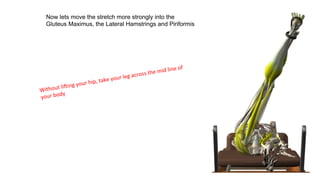
Now lets move the stretch more strongly into the
Gluteus Maximus, the Lateral Hamstrings and Piriformis
Without	
  liPing	
  your	
  hip,	
  take	
  your	
  leg	
  across	
  the	
  mid	
  line	
  of	
  
your	
  body	
  
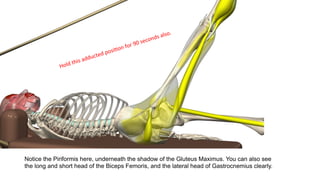
Notice the Piriformis here, underneath the shadow of the Gluteus Maximus. You can also see
the long and short head of the Biceps Femoris, and the lateral head of Gastrocnemius clearly.
Hold	
  this	
  adducted	
  posi&on	
  for	
  90	
  seconds	
  also.	
  
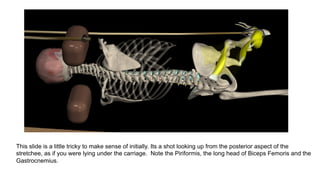
This slide is a little tricky to make sense of initially. Its a shot looking up from the posterior aspect of the
stretchee, as if you were lying under the carriage. Note the Piriformis, the long head of Biceps Femoris and the
Gastrocnemius.
Finally, bend your knee and come out of the stretch
slowly. Normal range of motion is said to be 80 to
90 degrees of hip flexion. In my experience though,
it is more common to find about 60 degrees as
normal, especially in males. Recall the research
study information in the first slide in the
presentation. To bend effectively from the hip joints,
without flexing the lumbar spine constantly, at least
normal range of movement is required The
absence of this “normal range” could be one of the
major contributing factors to the high incidence of
Low back pain so prevalent nowadays.
The take home lesson?
Work consistently to ensure you and your clients have at least 90 degrees of hip flexion.
Then, rehearse the safe and effective practice of bending via pelvic rotation instead of
lumbar flexion.
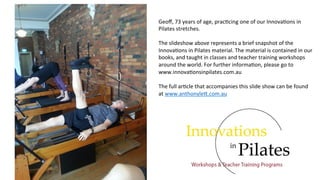
If Geoff, our 73 year old client can do it, you can too!
Geoff,	
  73	
  years	
  of	
  age,	
  prac&cing	
  one	
  of	
  our	
  Innova&ons	
  in	
  
Pilates	
  stretches.	


The	
  slideshow	
  above	
  represents	
  a	
  brief	
  snapshot	
  of	
  the	
  
Innova&ons	
  in	
  Pilates	
  material.	
  The	
  material	
  is	
  contained	
  in	
  our	
  
books,	
  and	
  taught	
  in	
  classes	
  and	
  teacher	
  training	
  workshops	
  
around	
  the	
  world.	
  For	
  further	
  informa&on,	
  please	
  go	
  to	
  
www.innova&onsinpilates.com.au	


The	
  full	
  ar&cle	
  that	
  accompanies	
  this	
  slide	
  show	
  can	
  be	
  found	
  
at	
  www.anthonyleT.com.au	


FREE HAMSTRINGS TUTORIAL

  • 1.
      Some interesting researchis showing that improvement in hamstring flexibility will result in better movement strategies and reduced risk of back strain in daily life. Innova&ons  in  Pilates   Free  Hamstrings  Tutorial  
  • 2.
      Here's a linkto the research papers: http://goo.gl/IixTFF http://goo.gl/HNZvZq What the research found: The results of both studies were interesting, but unsurprising: “After hamstring stretching exercises, there was a significant increase in hip flexion and decreases in both lumbar flexion and the lumbar/hip flexion ratio during the preparation phase of stoop lifting." To simplify- in flexible subjects, pelvis movement/rotation, the preferred means of movement, was dominant. In conclusion, improving tight hamstrings may reduce lumbar loading/flexion thereby reducing low back pain. Two recent studies looked at what is called “lumbo-pelvic-rhythm.” The first looked at lumbo-pelvic-rhythm in relation to forward bending, the second in relation to lifting. Lumbo-pelvic rhythm is essentially how the pelvis and lumbar spine move in relation to each other. We, i.e. the body, usually employ one of two patterns, particularly when forward bending and lifting—lumbar dominant and pelvis dominant. In lumbar dominance, a forward bend is achieved through flexion of the lumbar spine. In pelvis dominance, a forward bend is achieved through pelvic rotation i.e. increased hip flexion, with less loss of neutral spine position. Now  the  fun  stuff-­‐  how  to  stretch  them  
  • 3.
    In the firstpart of this workshop we will look at how to stretch the Hamstrings and Adductor Magnus. In the second part we will focus on Gluteus Maximus, the lateral hamstrings and Piriformis. Our goal will be to improve their flexibility and as a result facilitate a forward bend that is achieved through pelvic rotation instead of lumbar flexion. First, lets look at the anatomy. Images are taken from Innovations in Pilates-Therapeutic Muscles Stretching on the Pilates Reformer Can you name the two muscles at the end of the two yellow lines?       ThetoponeisSemiMembranosus,andloweroneisthe shortheadofBicepsfemoris
  • 4.
    On top ofthe previous muscles are a second layer, said to be more “superficial” Can you name the muscle at the end of the first line, and then the muscles at the end of the bottom two lines?     ThetoponeisPiriformis,thesecondbottomisthe longheadofBicepsFemoris,andthebottomoneis theSemiTendinosus
  • 5.
    Can you namethe most superficial and largest of the hip extensors? GluteusMaximus
  • 6.
    A  very  safe  and  simple  way  to  stretch  the  hamstring  group  is  on  the  Pilates  reformer.  Start  with  medium  resistance,   enough  to  move  the  carriage  away  and  stretch  the  muscles  without  pulling  the  hip  into  too  much  flexion.  This  will  cause   the  stretchee  to  contract  the  very  muscles  we  are  trying  to  stretch.  If  the  other  leg  is  kept  horizontal,  it  will  hold  the  pelvis   in  a  neutral  posi&on  via  hip  flexor  tension.   Put  your  foot  in  the  strap  and  take  the  leg  to  the  point  of   tension-­‐around  5  or  6  out  of  10  in  terms  of  intensity  
  • 7.
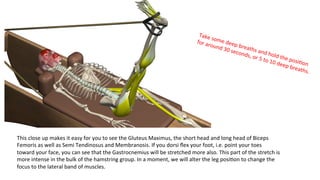
    This  close  up  makes  it  easy  for  you  to  see  the  Gluteus  Maximus,  the  short  head  and  long  head  of  Biceps   Femoris  as  well  as  Semi  Tendinosus  and  Membranosis.  If  you  dorsi  flex  your  foot,  i.e.  point  your  toes   toward  your  face,  you  can  see  that  the  Gastrocnemius  will  be  stretched  more  also.  This  part  of  the  stretch  is   more  intense  in  the  bulk  of  the  hamstring  group.  In  a  moment,  we  will  alter  the  leg  posi&on  to  change  the   focus  to  the  lateral  band  of  muscles.   Take  some  deep  breaths  and  hold  the  posi&on   for  around  30  seconds,  or  5  to  10  deep  breaths.  
  • 8.
    Next, try acontraction. Without moving your leg, lightly pull it down toward the floor, for five seconds. Stop, relax, and see if you can allow the carriage to slide further in to the foot bar to increase the stretch a little. Hold for 20 breaths
  • 9.
    Now lets movethe stretch more strongly into the Gluteus Maximus, the Lateral Hamstrings and Piriformis Without  liPing  your  hip,  take  your  leg  across  the  mid  line  of   your  body  
  • 10.
    Notice the Piriformishere, underneath the shadow of the Gluteus Maximus. You can also see the long and short head of the Biceps Femoris, and the lateral head of Gastrocnemius clearly. Hold  this  adducted  posi&on  for  90  seconds  also.  
  • 11.
    This slide isa little tricky to make sense of initially. Its a shot looking up from the posterior aspect of the stretchee, as if you were lying under the carriage. Note the Piriformis, the long head of Biceps Femoris and the Gastrocnemius.
  • 12.
    Finally, bend yourknee and come out of the stretch slowly. Normal range of motion is said to be 80 to 90 degrees of hip flexion. In my experience though, it is more common to find about 60 degrees as normal, especially in males. Recall the research study information in the first slide in the presentation. To bend effectively from the hip joints, without flexing the lumbar spine constantly, at least normal range of movement is required The absence of this “normal range” could be one of the major contributing factors to the high incidence of Low back pain so prevalent nowadays. The take home lesson? Work consistently to ensure you and your clients have at least 90 degrees of hip flexion. Then, rehearse the safe and effective practice of bending via pelvic rotation instead of lumbar flexion. If Geoff, our 73 year old client can do it, you can too!
  • 13.
    Geoff,  73  years  of  age,  prac&cing  one  of  our  Innova&ons  in   Pilates  stretches.     The  slideshow  above  represents  a  brief  snapshot  of  the   Innova&ons  in  Pilates  material.  The  material  is  contained  in  our   books,  and  taught  in  classes  and  teacher  training  workshops   around  the  world.  For  further  informa&on,  please  go  to   www.innova&onsinpilates.com.au     The  full  ar&cle  that  accompanies  this  slide  show  can  be  found   at  www.anthonyleT.com.au