Management Control System

 Free Cash Flow
Group Members
Neelam Chhipa
Swati Kamthe
Manju Naicker
Princy Philip
Ashish Nimbalkar
Introduction
 Measure    of financial performance.

 A company     is able to generate after laying out.

 Free   cash flow is important.

 Without cash,    it's tough to develop new products.

 FCF    is calculated as:

  EBIT(1-Tax Rate) + Depreciation & Amortization -
   Change in Net Working Capital - Capital Expenditure.
 Another    way of calculating FCF.

 It   is important to note that negative free cash flow.

 Company      is making large investments.

 The    strategy has the potential to pay off in the long
  run.
Free Cash Flow For The Firm
 Measure   of financial performance

 that expresses.

 Calculated   as:

      FCFF = Operating cash flow- Expenses-
     Taxes- Change in NWC- Change in
     Investment.
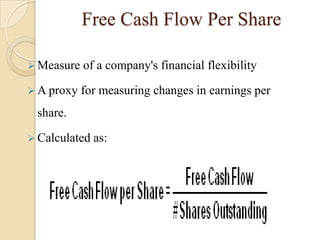
Free Cash Flow Per Share

 Measure   of a company's financial flexibility

 A proxy   for measuring changes in earnings per
 share.

 Calculated   as:
Free Cash Flow To Equity
 How   much cash can be paid to the equity shareholders

 FCFE   is often used

 Calculated   as:

     FCFE = Net Income - Net Capital Expenditure -
     Change in Net Working Capital + New Debt - Debt
     Repayment
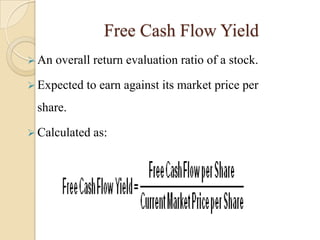
Free Cash Flow Yield
 An   overall return evaluation ratio of a stock.

 Expected   to earn against its market price per
 share.

 Calculated   as:
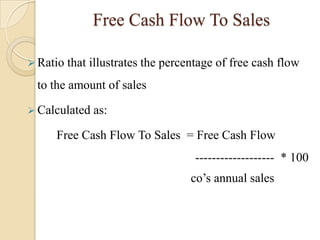
Free Cash Flow To Sales

 Ratio   that illustrates the percentage of free cash flow
 to the amount of sales

 Calculated   as:

     Free Cash Flow To Sales = Free Cash Flow
                                    ------------------- * 100
                                    co’s annual sales
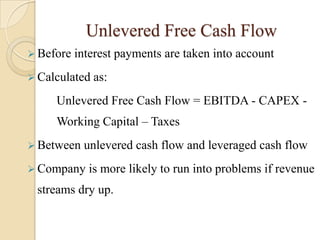
Unlevered Free Cash Flow
 Before   interest payments are taken into account
 Calculated   as:
     Unlevered Free Cash Flow = EBITDA - CAPEX -
     Working Capital – Taxes
 Between   unlevered cash flow and leveraged cash flow
 Company    is more likely to run into problems if revenue
 streams dry up.
Free cash flow

Free cash flow

  • 1.
  • 2.
    Group Members Neelam Chhipa SwatiKamthe Manju Naicker Princy Philip Ashish Nimbalkar
  • 3.
    Introduction  Measure of financial performance.  A company is able to generate after laying out.  Free cash flow is important.  Without cash, it's tough to develop new products.  FCF is calculated as: EBIT(1-Tax Rate) + Depreciation & Amortization - Change in Net Working Capital - Capital Expenditure.
  • 4.
     Another way of calculating FCF.  It is important to note that negative free cash flow.  Company is making large investments.  The strategy has the potential to pay off in the long run.
  • 5.
    Free Cash FlowFor The Firm  Measure of financial performance that expresses.  Calculated as: FCFF = Operating cash flow- Expenses- Taxes- Change in NWC- Change in Investment.
  • 6.
    Free Cash FlowPer Share  Measure of a company's financial flexibility  A proxy for measuring changes in earnings per share.  Calculated as:
  • 7.
    Free Cash FlowTo Equity  How much cash can be paid to the equity shareholders  FCFE is often used  Calculated as: FCFE = Net Income - Net Capital Expenditure - Change in Net Working Capital + New Debt - Debt Repayment
  • 8.
    Free Cash FlowYield  An overall return evaluation ratio of a stock.  Expected to earn against its market price per share.  Calculated as:
  • 9.
    Free Cash FlowTo Sales  Ratio that illustrates the percentage of free cash flow to the amount of sales  Calculated as: Free Cash Flow To Sales = Free Cash Flow ------------------- * 100 co’s annual sales
  • 10.
    Unlevered Free CashFlow  Before interest payments are taken into account  Calculated as: Unlevered Free Cash Flow = EBITDA - CAPEX - Working Capital – Taxes  Between unlevered cash flow and leveraged cash flow  Company is more likely to run into problems if revenue streams dry up.