Framing the future:
The effects of message framing in political
communication on climate change policies
Mauro Bertolotti
Patrizia Catellani
1st International Conference on Anticipation, Trento, November 5-7, 2015
Bertolotti & Catellani
If I eat less red meat, I will have a
longer, healthier life.
Thinking and communicating the
future
 Individuals anticipate future events through
prefactual thinking (Gleicher et al., 1995; Bakker et al., 1997).
 When individuals engage in or are exposed to
prefactual thoughts:
 They focus on a course of action leading to an expected
outcome (Petrocelli et al., 2012);
 They prepare for that course of action (Roese & Epstude,
2008; Sanna, 2006).
If we cut carbon emissions, we will
reduce the effects of global warming
Bertolotti & Catellani
Anticipating climate change
 Climate change is an emerging global issue
threatening our future as individuals, members of a
community and human beings.
 The scientific community first, and governmental
institutions then, have undergone collective efforts
to deal with this issue.
 Communication to the general public has been
limited, resulting in wavering support for climate
change policies.
Bertolotti & Catellani
Communication factors hindering
support for climate change action
1. Communication about climate change policies is often
very complex.
2. Communication often focuses on the threats of climate
change (global warming, natural disasters etc...), and
less often on the opportunities deriving from policy
adoption (technological advancements etc...).
3. Communication rarely defines the actors responsible for
climate change policies (the international community,
nations, individual citizens...)
Bertolotti & Catellani
Promoting support for climate change
action with message framing
Prefactual communication and message framing can be
used to:
1. select and organise information, providing it a
meaningful interpretation (Entman, 1993; Scheufele, 1999).
2. highlight both positive and negative aspects of
policy adoption (or non-adoption) (Cesario et al., 2013).
3. focus on given actors with whom the public
identifies (Masson & Fritsche, 2014; Schuck & De Vreese, 2006).
Bertolotti & Catellani
Prefactual framing and
regulatory focus
 Individuals spontaneously think about the future in
terms of opportunities and risks, depending on
situations and individual differences in regulatory focus
(Higgins, 1997).
 Message framing can be designed to reflect recipients'
self-regulatory processes (Cesario et al., 2013).
 Regulatory fit derives from the interaction among
multiple levels of framing and recipients' focus (Cesario et
al., 2004; Higgins et al., 2002).
Bertolotti & Catellani
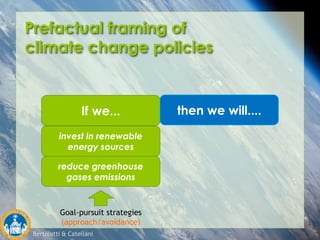
Prefactual framing of
climate change policies
If we... then we will....
invest in renewable
energy sources
reduce greenhouse
gases emissions
Goal-pursuit strategies
(approach/avoidance)
Bertolotti & Catellani
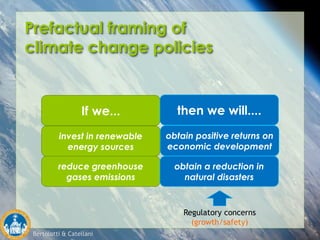
Prefactual framing of
climate change policies
If we... then we will....
invest in renewable
energy sources
reduce greenhouse
gases emissions
obtain positive returns on
economic development
obtain a reduction in
natural disasters
Regulatory concerns
(growth/safety)
Bertolotti & Catellani
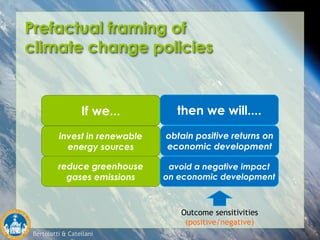
Prefactual framing of
climate change policies
If we... then we will....
invest in renewable
energy sources
reduce greenhouse
gases emissions
obtain positive returns on
economic development
avoid a negative impact
on economic development
Outcome sensitivities
(positive/negative)
Bertolotti & Catellani
Prefactual framing and
regulatory focus
Two online studies (N = 95; N = 66) with student
participants (77.5 % females, age M = 24.5).
Independent variables:
 Goal-pursuit strategy
 Regulatory concern
 Outcome sensitivity
Measured variables:
 Initial attitudes towards the policy
 Agreement with the policy message
 Voting intention
 Individual regulatory focus scale (Lockwood et al., 2002)
(Bertolotti & Catellani, EJSP, 2014)
Bertolotti & Catellani
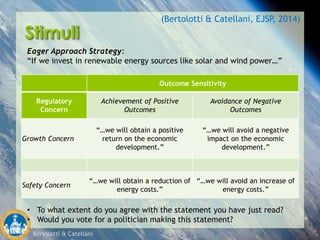
Stimuli
Outcome Sensitivity
Regulatory
Concern
Achievement of Positive
Outcomes
Avoidance of Negative
Outcomes
Growth Concern
“…we will obtain a positive
return on the economic
development.”
“…we will avoid a negative
impact on the economic
development.”
Safety Concern
“…we will obtain a reduction of
energy costs.”
“…we will avoid an increase of
energy costs.”
Eager Approach Strategy:
“If we invest in renewable energy sources like solar and wind power…”
• To what extent do you agree with the statement you have just read?
• Would you vote for a politician making this statement?
(Bertolotti & Catellani, EJSP, 2014)
Bertolotti & Catellani
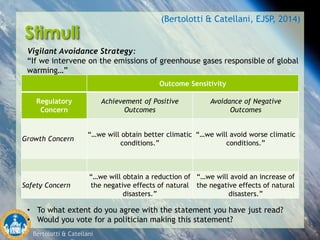
Stimuli
Outcome Sensitivity
Regulatory
Concern
Achievement of Positive
Outcomes
Avoidance of Negative
Outcomes
Growth Concern
“…we will obtain better climatic
conditions.”
“…we will avoid worse climatic
conditions.”
Safety Concern
“…we will obtain a reduction of
the negative effects of natural
disasters.”
“…we will avoid an increase of
the negative effects of natural
disasters.”
Vigilant Avoidance Strategy:
“If we intervene on the emissions of greenhouse gases responsible of global
warming…”
• To what extent do you agree with the statement you have just read?
• Would you vote for a politician making this statement?
(Bertolotti & Catellani, EJSP, 2014)
Bertolotti & Catellani
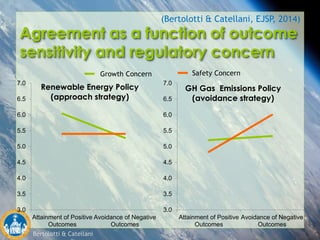
Agreement as a function of outcome
sensitivity and regulatory concern
3.0
3.5
4.0
4.5
5.0
5.5
6.0
6.5
7.0
Attainment of Positive
Outcomes
Avoidance of Negative
Outcomes
Renewable Energy Policy
(approach strategy)
3.0
3.5
4.0
4.5
5.0
5.5
6.0
6.5
7.0
Attainment of Positive
Outcomes
Avoidance of Negative
Outcomes
GH Gas Emissions Policy
(avoidance strategy)
(Bertolotti & Catellani, EJSP, 2014)
Growth Concern Safety Concern
Bertolotti & Catellani
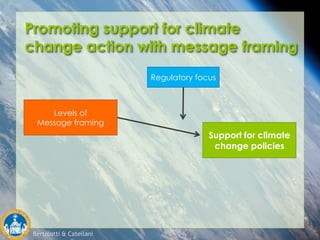
Promoting support for climate
change action with message framing
Levels of
Message framing
Support for climate
change policies
Regulatory focus
Bertolotti & Catellani
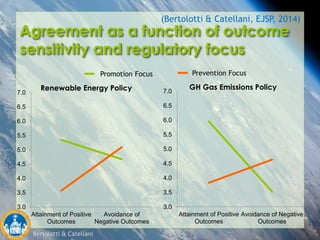
Agreement as a function of outcome
sensitivity and regulatory focus
3.0
3.5
4.0
4.5
5.0
5.5
6.0
6.5
7.0
Attainment of Positive
Outcomes
Avoidance of
Negative Outcomes
Renewable Energy Policy
3.0
3.5
4.0
4.5
5.0
5.5
6.0
6.5
7.0
Attainment of Positive
Outcomes
Avoidance of Negative
Outcomes
GH Gas Emissions Policy
(Bertolotti & Catellani, EJSP, 2014)
Promotion Focus Prevention Focus
Bertolotti & Catellani
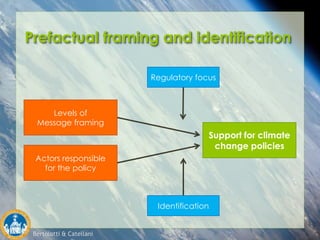
Prefactual framing and identification
Levels of
Message framing
Actors responsible
for the policy
Identification
Support for climate
change policies
Regulatory focus
Bertolotti & Catellani
Identification with the actors
responsible for climate change policies
 Climate change policy are currently designed and
implemented at a national or supra-national level.
 People can identify with different groups at once
(Castano et al., 2004; Turner et al., 1987).
 When communication focuses on the role of national or
supra-national institutions, recipients identified with
them more likely accept and support a policy.
Bertolotti & Catellani
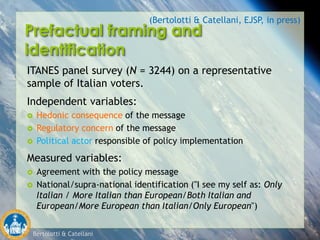
Prefactual framing and
identification
ITANES panel survey (N = 3244) on a representative
sample of Italian voters.
Independent variables:
 Hedonic consequence of the message
 Regulatory concern of the message
 Political actor responsible of policy implementation
Measured variables:
 Agreement with the policy message
 National/supra-national identification ("I see my self as: Only
Italian / More Italian than European/Both Italian and
European/More European than Italian/Only European")
(Bertolotti & Catellani, EJSP, in press)
Bertolotti & Catellani
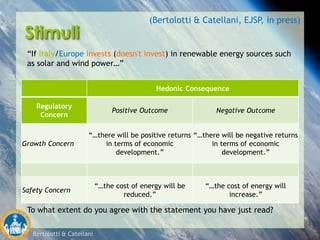
Stimuli
Hedonic Consequence
Regulatory
Concern
Positive Outcome Negative Outcome
Growth Concern
“…there will be positive returns
in terms of economic
development.”
“…there will be negative returns
in terms of economic
development.”
Safety Concern
“…the cost of energy will be
reduced.”
“…the cost of energy will
increase.”
“If Italy/Europe invests (doesn't invest) in renewable energy sources such
as solar and wind power…”
To what extent do you agree with the statement you have just read?
(Bertolotti & Catellani, EJSP, in press)
Bertolotti & Catellani
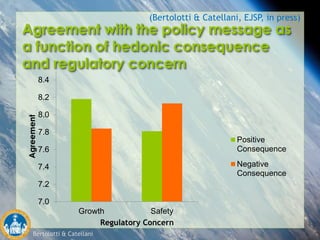
Agreement with the policy message as
a function of hedonic consequence
and regulatory concern
7.0
7.2
7.4
7.6
7.8
8.0
8.2
8.4
Growth Safety
Agreement
Positive
Consequence
Negative
Consequence
(Bertolotti & Catellani, EJSP, in press)
Regulatory Concern
Bertolotti & Catellani
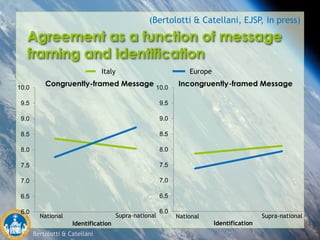
Agreement as a function of message
framing and identification
6.0
6.5
7.0
7.5
8.0
8.5
9.0
9.5
10.0
Congruently-framed Message
Identification
National Supra-national
6.0
6.5
7.0
7.5
8.0
8.5
9.0
9.5
10.0
Incongruently-framed Message
Identification
National Supra-national
(Bertolotti & Catellani, EJSP, in press)
Italy Europe
Bertolotti & Catellani
Conclusions
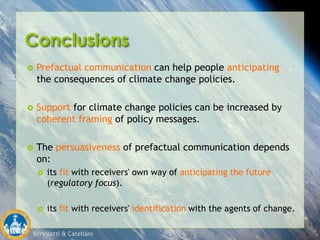
 Prefactual communication can help people anticipating
the consequences of climate change policies.
 Support for climate change policies can be increased by
coherent framing of policy messages.
 The persuasiveness of prefactual communication depends
on:
 its fit with receivers' own way of anticipating the future
(regulatory focus).
 its fit with receivers' identification with the agents of change.
Thank you!

Framing the future climate change (trento 2015)

  • 1.
    Framing the future: Theeffects of message framing in political communication on climate change policies Mauro Bertolotti Patrizia Catellani 1st International Conference on Anticipation, Trento, November 5-7, 2015
  • 2.
    Bertolotti & Catellani IfI eat less red meat, I will have a longer, healthier life. Thinking and communicating the future  Individuals anticipate future events through prefactual thinking (Gleicher et al., 1995; Bakker et al., 1997).  When individuals engage in or are exposed to prefactual thoughts:  They focus on a course of action leading to an expected outcome (Petrocelli et al., 2012);  They prepare for that course of action (Roese & Epstude, 2008; Sanna, 2006). If we cut carbon emissions, we will reduce the effects of global warming
  • 3.
    Bertolotti & Catellani Anticipatingclimate change  Climate change is an emerging global issue threatening our future as individuals, members of a community and human beings.  The scientific community first, and governmental institutions then, have undergone collective efforts to deal with this issue.  Communication to the general public has been limited, resulting in wavering support for climate change policies.
  • 4.
    Bertolotti & Catellani Communicationfactors hindering support for climate change action 1. Communication about climate change policies is often very complex. 2. Communication often focuses on the threats of climate change (global warming, natural disasters etc...), and less often on the opportunities deriving from policy adoption (technological advancements etc...). 3. Communication rarely defines the actors responsible for climate change policies (the international community, nations, individual citizens...)
  • 5.
    Bertolotti & Catellani Promotingsupport for climate change action with message framing Prefactual communication and message framing can be used to: 1. select and organise information, providing it a meaningful interpretation (Entman, 1993; Scheufele, 1999). 2. highlight both positive and negative aspects of policy adoption (or non-adoption) (Cesario et al., 2013). 3. focus on given actors with whom the public identifies (Masson & Fritsche, 2014; Schuck & De Vreese, 2006).
  • 6.
    Bertolotti & Catellani Prefactualframing and regulatory focus  Individuals spontaneously think about the future in terms of opportunities and risks, depending on situations and individual differences in regulatory focus (Higgins, 1997).  Message framing can be designed to reflect recipients' self-regulatory processes (Cesario et al., 2013).  Regulatory fit derives from the interaction among multiple levels of framing and recipients' focus (Cesario et al., 2004; Higgins et al., 2002).
  • 7.
    Bertolotti & Catellani Prefactualframing of climate change policies If we... then we will.... invest in renewable energy sources reduce greenhouse gases emissions Goal-pursuit strategies (approach/avoidance)
  • 8.
    Bertolotti & Catellani Prefactualframing of climate change policies If we... then we will.... invest in renewable energy sources reduce greenhouse gases emissions obtain positive returns on economic development obtain a reduction in natural disasters Regulatory concerns (growth/safety)
  • 9.
    Bertolotti & Catellani Prefactualframing of climate change policies If we... then we will.... invest in renewable energy sources reduce greenhouse gases emissions obtain positive returns on economic development avoid a negative impact on economic development Outcome sensitivities (positive/negative)
  • 10.
    Bertolotti & Catellani Prefactualframing and regulatory focus Two online studies (N = 95; N = 66) with student participants (77.5 % females, age M = 24.5). Independent variables:  Goal-pursuit strategy  Regulatory concern  Outcome sensitivity Measured variables:  Initial attitudes towards the policy  Agreement with the policy message  Voting intention  Individual regulatory focus scale (Lockwood et al., 2002) (Bertolotti & Catellani, EJSP, 2014)
  • 11.
    Bertolotti & Catellani Stimuli OutcomeSensitivity Regulatory Concern Achievement of Positive Outcomes Avoidance of Negative Outcomes Growth Concern “…we will obtain a positive return on the economic development.” “…we will avoid a negative impact on the economic development.” Safety Concern “…we will obtain a reduction of energy costs.” “…we will avoid an increase of energy costs.” Eager Approach Strategy: “If we invest in renewable energy sources like solar and wind power…” • To what extent do you agree with the statement you have just read? • Would you vote for a politician making this statement? (Bertolotti & Catellani, EJSP, 2014)
  • 12.
    Bertolotti & Catellani Stimuli OutcomeSensitivity Regulatory Concern Achievement of Positive Outcomes Avoidance of Negative Outcomes Growth Concern “…we will obtain better climatic conditions.” “…we will avoid worse climatic conditions.” Safety Concern “…we will obtain a reduction of the negative effects of natural disasters.” “…we will avoid an increase of the negative effects of natural disasters.” Vigilant Avoidance Strategy: “If we intervene on the emissions of greenhouse gases responsible of global warming…” • To what extent do you agree with the statement you have just read? • Would you vote for a politician making this statement? (Bertolotti & Catellani, EJSP, 2014)
  • 13.
    Bertolotti & Catellani Agreementas a function of outcome sensitivity and regulatory concern 3.0 3.5 4.0 4.5 5.0 5.5 6.0 6.5 7.0 Attainment of Positive Outcomes Avoidance of Negative Outcomes Renewable Energy Policy (approach strategy) 3.0 3.5 4.0 4.5 5.0 5.5 6.0 6.5 7.0 Attainment of Positive Outcomes Avoidance of Negative Outcomes GH Gas Emissions Policy (avoidance strategy) (Bertolotti & Catellani, EJSP, 2014) Growth Concern Safety Concern
  • 14.
    Bertolotti & Catellani Promotingsupport for climate change action with message framing Levels of Message framing Support for climate change policies Regulatory focus
  • 15.
    Bertolotti & Catellani Agreementas a function of outcome sensitivity and regulatory focus 3.0 3.5 4.0 4.5 5.0 5.5 6.0 6.5 7.0 Attainment of Positive Outcomes Avoidance of Negative Outcomes Renewable Energy Policy 3.0 3.5 4.0 4.5 5.0 5.5 6.0 6.5 7.0 Attainment of Positive Outcomes Avoidance of Negative Outcomes GH Gas Emissions Policy (Bertolotti & Catellani, EJSP, 2014) Promotion Focus Prevention Focus
  • 16.
    Bertolotti & Catellani Prefactualframing and identification Levels of Message framing Actors responsible for the policy Identification Support for climate change policies Regulatory focus
  • 17.
    Bertolotti & Catellani Identificationwith the actors responsible for climate change policies  Climate change policy are currently designed and implemented at a national or supra-national level.  People can identify with different groups at once (Castano et al., 2004; Turner et al., 1987).  When communication focuses on the role of national or supra-national institutions, recipients identified with them more likely accept and support a policy.
  • 18.
    Bertolotti & Catellani Prefactualframing and identification ITANES panel survey (N = 3244) on a representative sample of Italian voters. Independent variables:  Hedonic consequence of the message  Regulatory concern of the message  Political actor responsible of policy implementation Measured variables:  Agreement with the policy message  National/supra-national identification ("I see my self as: Only Italian / More Italian than European/Both Italian and European/More European than Italian/Only European") (Bertolotti & Catellani, EJSP, in press)
  • 19.
    Bertolotti & Catellani Stimuli HedonicConsequence Regulatory Concern Positive Outcome Negative Outcome Growth Concern “…there will be positive returns in terms of economic development.” “…there will be negative returns in terms of economic development.” Safety Concern “…the cost of energy will be reduced.” “…the cost of energy will increase.” “If Italy/Europe invests (doesn't invest) in renewable energy sources such as solar and wind power…” To what extent do you agree with the statement you have just read? (Bertolotti & Catellani, EJSP, in press)
  • 20.
    Bertolotti & Catellani Agreementwith the policy message as a function of hedonic consequence and regulatory concern 7.0 7.2 7.4 7.6 7.8 8.0 8.2 8.4 Growth Safety Agreement Positive Consequence Negative Consequence (Bertolotti & Catellani, EJSP, in press) Regulatory Concern
  • 21.
    Bertolotti & Catellani Agreementas a function of message framing and identification 6.0 6.5 7.0 7.5 8.0 8.5 9.0 9.5 10.0 Congruently-framed Message Identification National Supra-national 6.0 6.5 7.0 7.5 8.0 8.5 9.0 9.5 10.0 Incongruently-framed Message Identification National Supra-national (Bertolotti & Catellani, EJSP, in press) Italy Europe
  • 22.
    Bertolotti & Catellani Conclusions Prefactual communication can help people anticipating the consequences of climate change policies.  Support for climate change policies can be increased by coherent framing of policy messages.  The persuasiveness of prefactual communication depends on:  its fit with receivers' own way of anticipating the future (regulatory focus).  its fit with receivers' identification with the agents of change.
  • 23.