

Case study   Group 1
CASE         The patients were brother, aged 2 year 9 months and 1 year 8 months, and were referred to hospital for evaluation for development delay.
The elder brotherWas born at term when his mother was 22 year old and his father 33.Birth weight was 3260g.Screening for metabolic diseases (-) and hypothyroidism (-).Controlled his head at the age of 5 months, began to walk at 20 months but never spoke meaningful words. He had gross psychomotor retardation.Physical examination showed a hyperactive boy with a height of 94.5cm, weight of 13.2 kg and head circumference of 47.8cm.
His face somewhat long and square-shaped with high forehead. His ears were large and prominent. His left lower  incisor was absent. psychometric testing revealed a developmental quotient (DQ) that was 38% that of a normal child.He had unique behavioral abnormalities characterized by hyperactivity, short attention span, poor eye contact and excessive withdrawal response to strange persons or environment However, these behaviors did not meet the diagnostic and statistical manual of mental disorders (DMS)-IV criteria for childhood autistic disorders.Electroencephalography (EEG)- (N), Acoustic brainstem response (ABR) – (N).
The younger brotherWas born at 36the week of gestation with birth weight of 2780g.His psychomotor development was moderately retarded.He controlled his head at the age of 4 months, sat alone 10 months, and could stand up holding onto furniture at 20 months.But not acquired any meaningful words yet.PE showed a hyperactive boy with normal height and head circumference.His face was somewhat square shaped with prominent forehead everted ears, and absent of left lower incisor same as his brother.His DQ was 47% of normal child.He had a short attention span but no social aversion or hand mannerisms.EEG and  ABR were not remarkable, but massive epileptic discharge during sleep had become evident on the  bilateral parito-occipital region since 1 Y and 6 M of age.
The familyAll family members were normal except one maternal aunt with presence of mental retardation.Her motor development was normal, but speech was grossly delayed. She attended special school.PE at 20 years age showed a shy and mentally retarded girl with normal body but long face with proganthism.IQ of 45 (normal, 77-124).
Patient’s mother’s IQ was 92 by the wechsler adult intelligence scale test. she give birth to girl, almost normal just somewhat square face.Her IQ was 85% of normal child.
diagnosisThe two probands presented moderate to severe developmental retardations which was not associated with any recognizable malformation syndrome.Features included long square shaped face, large prominent ears, unique behavioral abnormalities  and mental retardation , etc. the familial disease could be consistence with X-linked inheritance with low penetrance in females.Because fragile X syndrome represents about 40 to 50% of all X- linked familial mental ratardation, diagnostic workup should be initiated on this disorder.
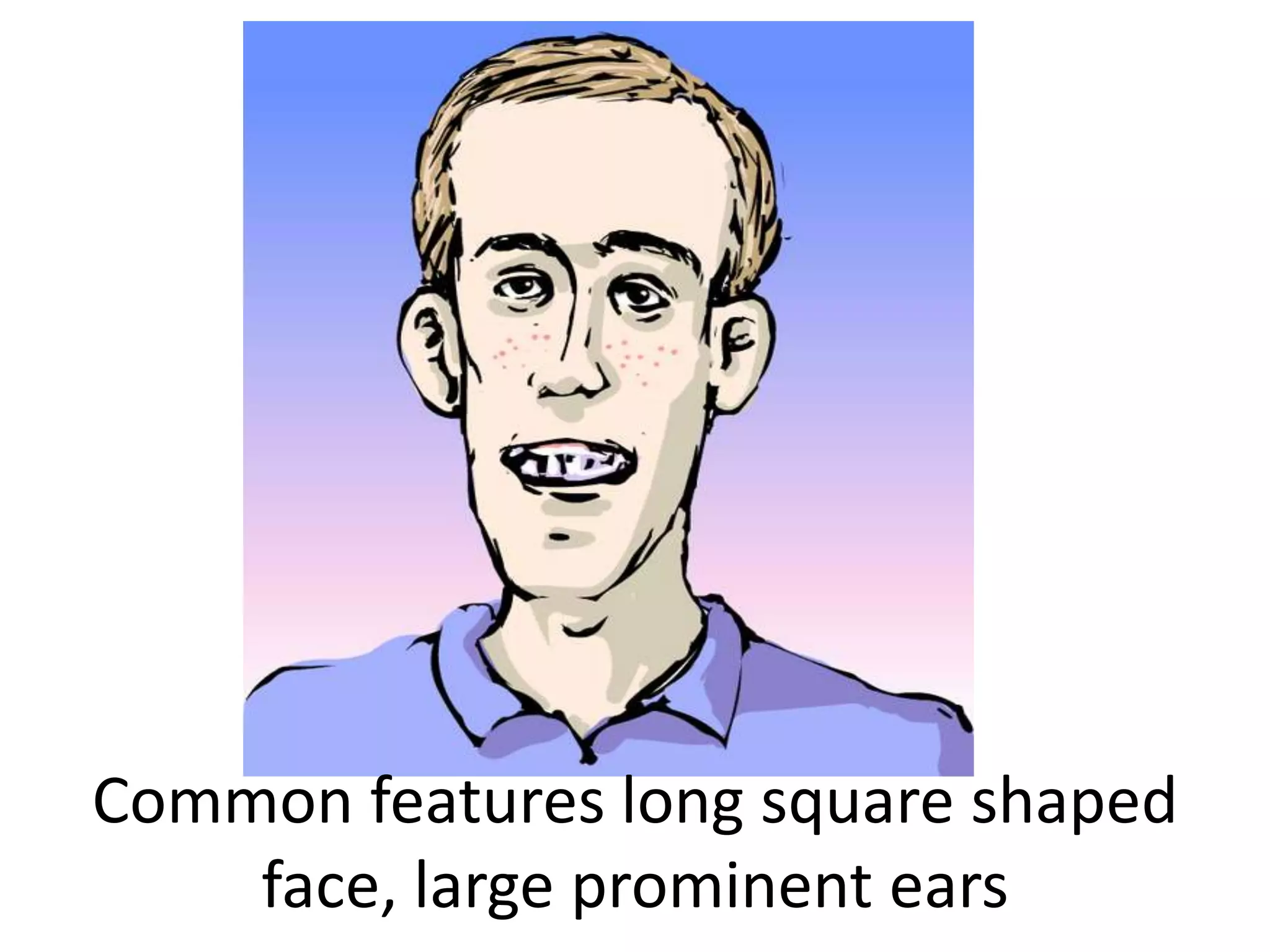
Common features long square shaped face, large prominent ears
What is fragile X syndrome?And What is fragile X mental retardation-1(FMRI) gene is?
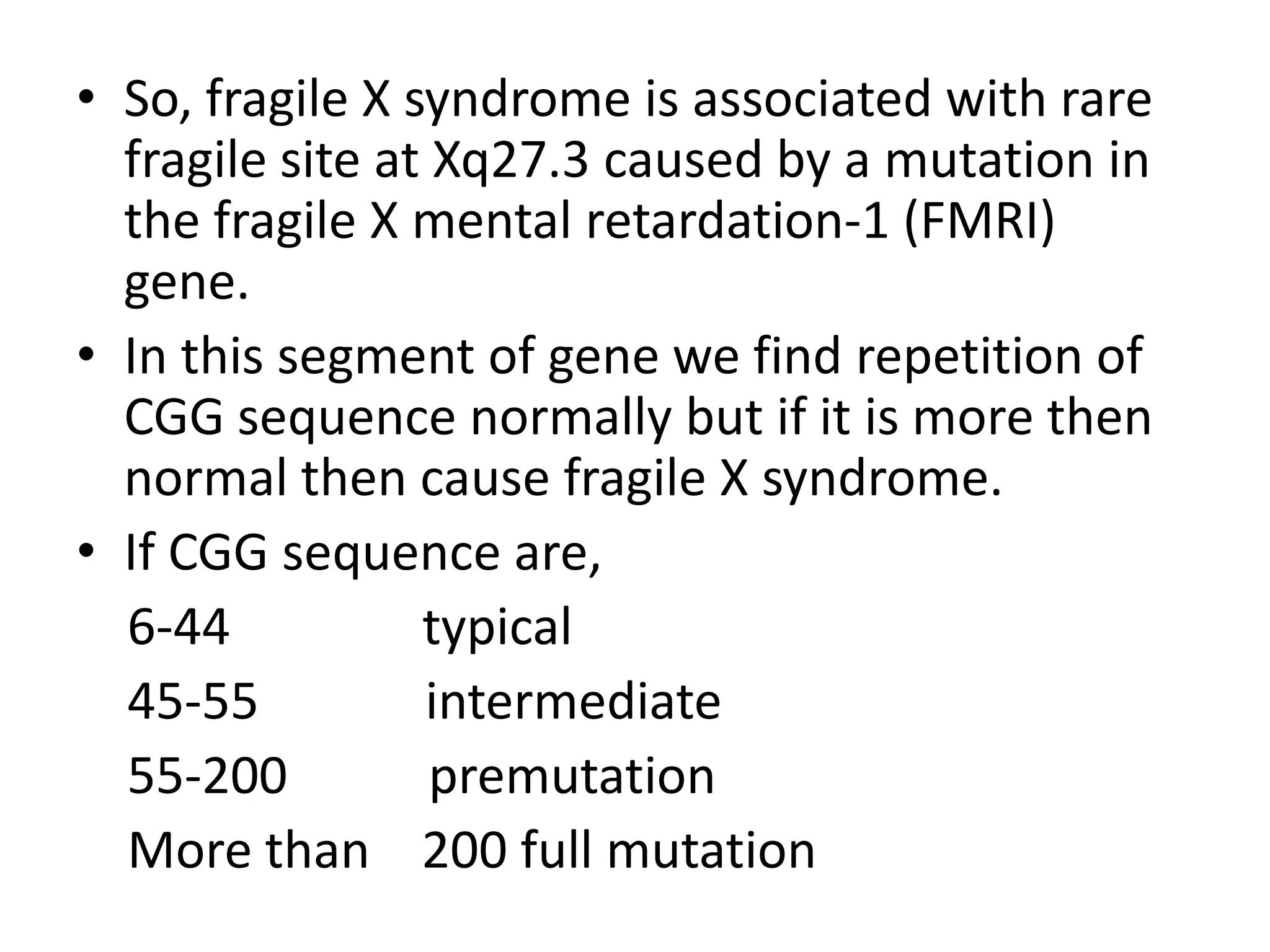
So, fragile X syndrome is associated with rare fragile site at Xq27.3 caused by a mutation in the fragile X mental retardation-1 (FMRI) gene.In this segment of gene we find repetition of CGG sequence normally but if it is more then normal then cause fragile X syndrome.If CGG sequence are,    6-44               typical    45-55             intermediate    55-200           premutation    More than    200 full mutation
So, if we know repetition of CGG sequence then we can diagnose fragile X syndrome.For that there are two methods.1. southern blotting2. polymerese chain reaction (PCR)
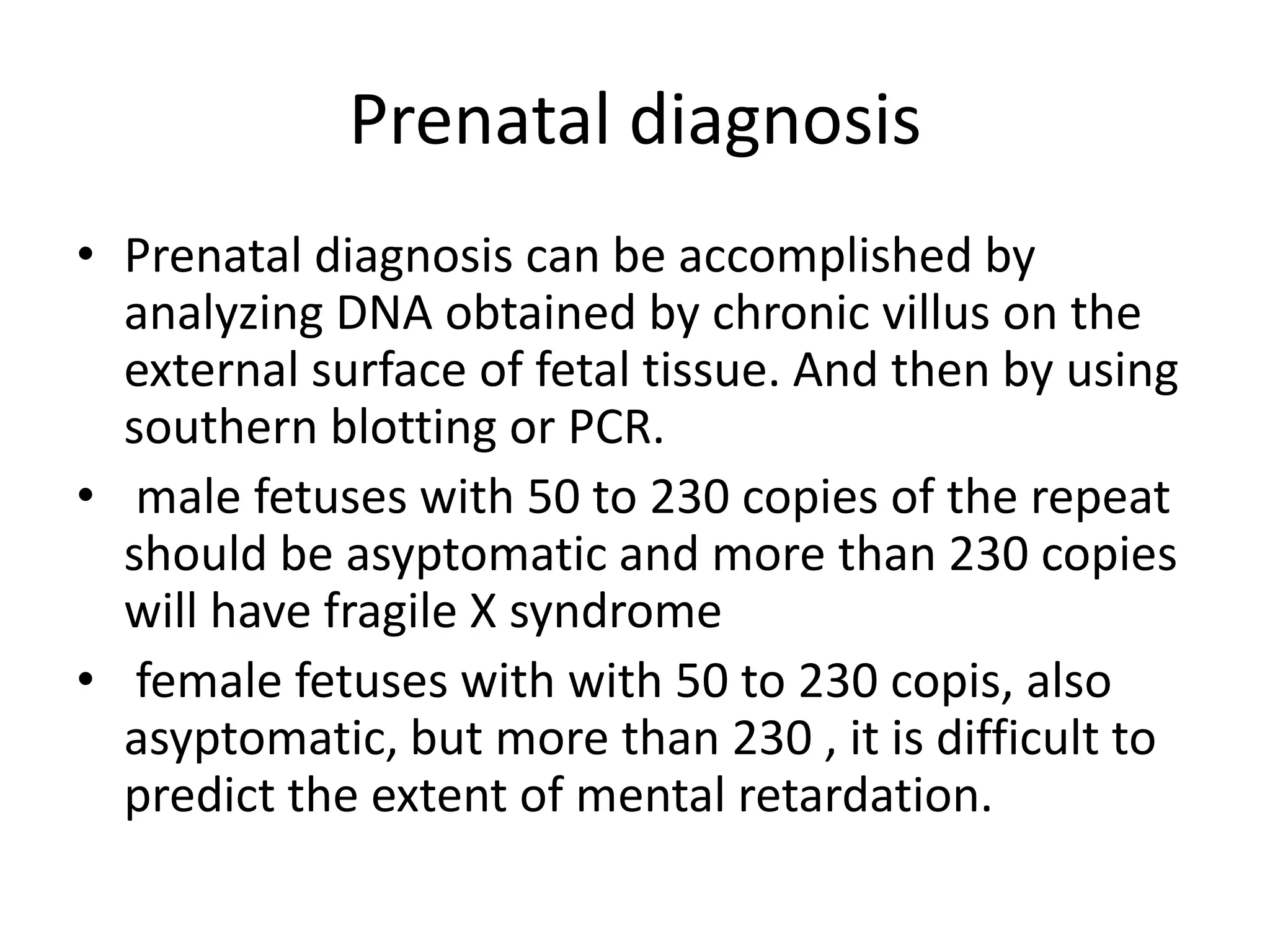
Prenatal diagnosisPrenatal diagnosis can be accomplished by analyzing DNA obtained by chronic villus on the external surface of fetal tissue. And then by using southern blotting or PCR. male fetuses with 50 to 230 copies of the repeat should be asyptomatic and more than 230 copies will have fragile X syndrome  female fetuses with with 50 to 230 copis, also asyptomatic, but more than 230 , it is difficult to predict the extent of mental retardation.
Therapy No specific treatment is available.Medical management in fragile X syndrome is includes medical treatment for specific  behavioral problems and complications.CNS stimulants, such as methylphenidate and dextroamphetamine, have proved to be effective in improving the attention span and learning performance of some hyperactive fragile X children. educational intervention can be given with the neuropsychological characteristics to help them to reach their intellectual potentials.
                                              Thank you………

Fragile X syndrome

  • 1.
  • 2.
    CASE The patients were brother, aged 2 year 9 months and 1 year 8 months, and were referred to hospital for evaluation for development delay.
  • 3.
    The elder brotherWasborn at term when his mother was 22 year old and his father 33.Birth weight was 3260g.Screening for metabolic diseases (-) and hypothyroidism (-).Controlled his head at the age of 5 months, began to walk at 20 months but never spoke meaningful words. He had gross psychomotor retardation.Physical examination showed a hyperactive boy with a height of 94.5cm, weight of 13.2 kg and head circumference of 47.8cm.
  • 4.
    His face somewhatlong and square-shaped with high forehead. His ears were large and prominent. His left lower incisor was absent. psychometric testing revealed a developmental quotient (DQ) that was 38% that of a normal child.He had unique behavioral abnormalities characterized by hyperactivity, short attention span, poor eye contact and excessive withdrawal response to strange persons or environment However, these behaviors did not meet the diagnostic and statistical manual of mental disorders (DMS)-IV criteria for childhood autistic disorders.Electroencephalography (EEG)- (N), Acoustic brainstem response (ABR) – (N).
  • 5.
    The younger brotherWasborn at 36the week of gestation with birth weight of 2780g.His psychomotor development was moderately retarded.He controlled his head at the age of 4 months, sat alone 10 months, and could stand up holding onto furniture at 20 months.But not acquired any meaningful words yet.PE showed a hyperactive boy with normal height and head circumference.His face was somewhat square shaped with prominent forehead everted ears, and absent of left lower incisor same as his brother.His DQ was 47% of normal child.He had a short attention span but no social aversion or hand mannerisms.EEG and ABR were not remarkable, but massive epileptic discharge during sleep had become evident on the bilateral parito-occipital region since 1 Y and 6 M of age.
  • 6.
    The familyAll familymembers were normal except one maternal aunt with presence of mental retardation.Her motor development was normal, but speech was grossly delayed. She attended special school.PE at 20 years age showed a shy and mentally retarded girl with normal body but long face with proganthism.IQ of 45 (normal, 77-124).
  • 7.
    Patient’s mother’s IQwas 92 by the wechsler adult intelligence scale test. she give birth to girl, almost normal just somewhat square face.Her IQ was 85% of normal child.
  • 8.
    diagnosisThe two probandspresented moderate to severe developmental retardations which was not associated with any recognizable malformation syndrome.Features included long square shaped face, large prominent ears, unique behavioral abnormalities and mental retardation , etc. the familial disease could be consistence with X-linked inheritance with low penetrance in females.Because fragile X syndrome represents about 40 to 50% of all X- linked familial mental ratardation, diagnostic workup should be initiated on this disorder.
  • 9.
    Common features longsquare shaped face, large prominent ears
  • 10.
    What is fragileX syndrome?And What is fragile X mental retardation-1(FMRI) gene is?
  • 12.
    So, fragile Xsyndrome is associated with rare fragile site at Xq27.3 caused by a mutation in the fragile X mental retardation-1 (FMRI) gene.In this segment of gene we find repetition of CGG sequence normally but if it is more then normal then cause fragile X syndrome.If CGG sequence are, 6-44 typical 45-55 intermediate 55-200 premutation More than 200 full mutation
  • 13.
    So, if weknow repetition of CGG sequence then we can diagnose fragile X syndrome.For that there are two methods.1. southern blotting2. polymerese chain reaction (PCR)
  • 14.
    Prenatal diagnosisPrenatal diagnosiscan be accomplished by analyzing DNA obtained by chronic villus on the external surface of fetal tissue. And then by using southern blotting or PCR. male fetuses with 50 to 230 copies of the repeat should be asyptomatic and more than 230 copies will have fragile X syndrome female fetuses with with 50 to 230 copis, also asyptomatic, but more than 230 , it is difficult to predict the extent of mental retardation.
  • 15.
    Therapy No specifictreatment is available.Medical management in fragile X syndrome is includes medical treatment for specific behavioral problems and complications.CNS stimulants, such as methylphenidate and dextroamphetamine, have proved to be effective in improving the attention span and learning performance of some hyperactive fragile X children. educational intervention can be given with the neuropsychological characteristics to help them to reach their intellectual potentials.
  • 16.
    Thank you………