CHARACTERISTICS OF FRAGILE X SYNDROME FOR MALES prominent or long ears a long face delayed speech large testes (macroorchidism) Hyperactivity tactile defensiveness gross motor delays autistic-like behaviors.
CHARACTERISTICS OF FRAGILE X FOR FEMALES Only about half of all females who carry the genetic mutation have symptoms  Of those, half are of normal intelligence, and only one-fourth have an IQ under seventy Few fragile X girls have autistic symptoms, although they tend to be shy and quiet.
Causes of Fragile X Syndrome The gene responsible for fragile X is called the  FMR1  (fragile X mental retardation 1) gene.  The full mutation causes the gene to shut down or  methylate  a region of the FMR -1 gene.  Normally, the FMR-1 gene produces a protein called FMRP. When the gene is turned off, the individual does not make fragile X mental retardation protein  (FMRP) . The lack of this specific protein causes fragile X syndrome.
3,500 to 8,900 males is affected by the full mutation of the  FMR1  gene  one in 1,000 males has the premutation form of the  FMR1  gene.  one in 250 to 500 females in the general population has the premutation  one in 4,000 females is affected by the full mutation.
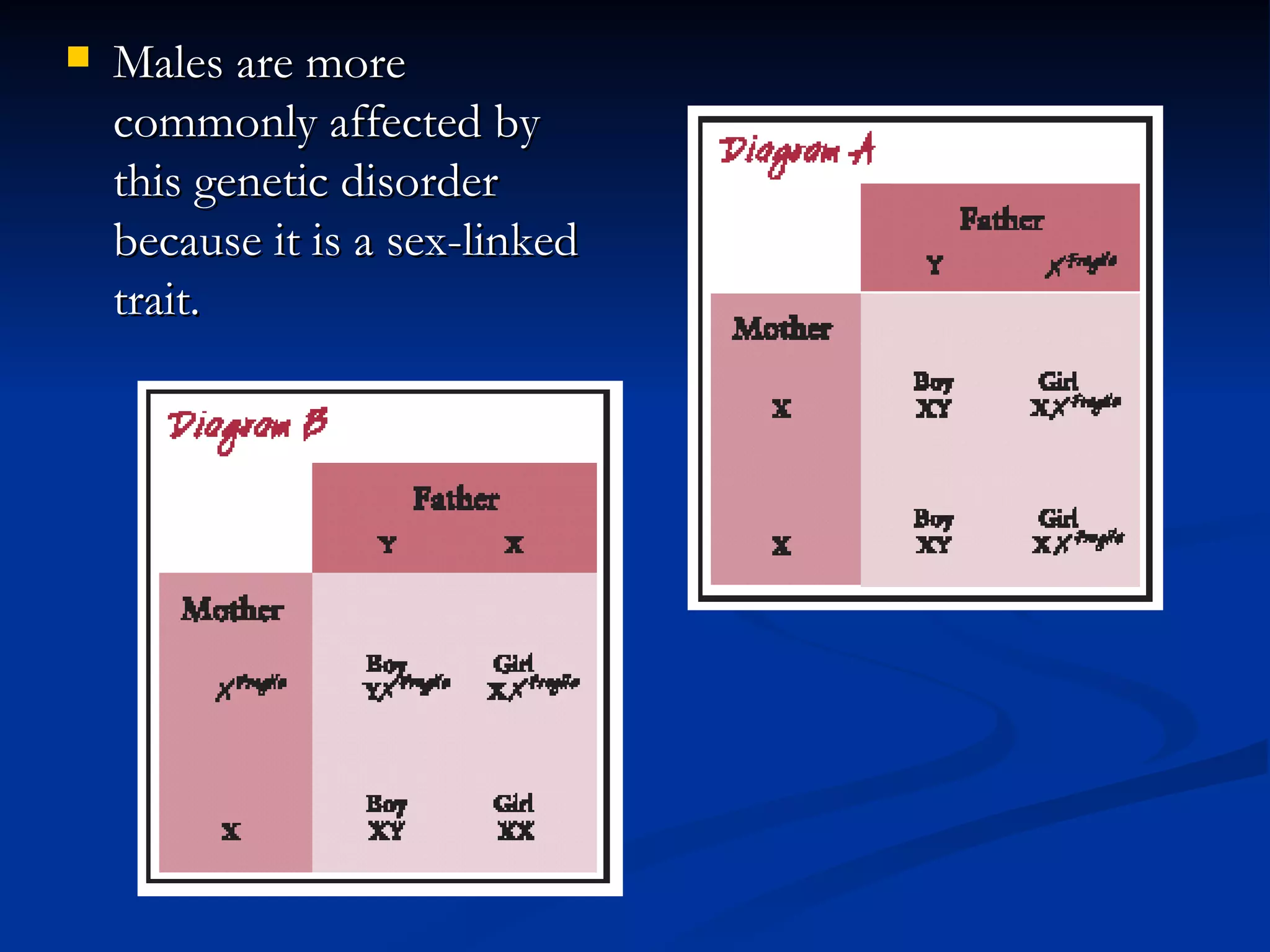
Males are more commonly affected by this genetic disorder because it is a sex-linked trait.
approximately 1 per 8,000 females suffer from fragile X syndrome approx 1 in 16,000 or 0.01% or 17,000 people in USA  about 1 in 1500 males.  approx 1 in 3,000 or 0.03% or 90,666 people in USA  90,666 per year, 7,555 per month, 1,743 per week, 248 per day, 10 per hour Occurance Rate of Fragile X
Cures and Treatments for Fragile X There is no definitive, single treatment for Fragile X. Children with Fragile X who receive appropriate education, behavioral or physical therapy, and medication have the best chance of using their individual capabilities and skills.  One important factor in developing a child’s long-term potential is early intervention. The sooner a child begins to get help, the more opportunity for learning.

Fragile x syndrome

  • 1.
    CHARACTERISTICS OF FRAGILEX SYNDROME FOR MALES prominent or long ears a long face delayed speech large testes (macroorchidism) Hyperactivity tactile defensiveness gross motor delays autistic-like behaviors.
  • 2.
    CHARACTERISTICS OF FRAGILEX FOR FEMALES Only about half of all females who carry the genetic mutation have symptoms Of those, half are of normal intelligence, and only one-fourth have an IQ under seventy Few fragile X girls have autistic symptoms, although they tend to be shy and quiet.
  • 3.
    Causes of FragileX Syndrome The gene responsible for fragile X is called the FMR1 (fragile X mental retardation 1) gene. The full mutation causes the gene to shut down or methylate a region of the FMR -1 gene. Normally, the FMR-1 gene produces a protein called FMRP. When the gene is turned off, the individual does not make fragile X mental retardation protein (FMRP) . The lack of this specific protein causes fragile X syndrome.
  • 4.
    3,500 to 8,900males is affected by the full mutation of the FMR1 gene one in 1,000 males has the premutation form of the FMR1 gene. one in 250 to 500 females in the general population has the premutation one in 4,000 females is affected by the full mutation.
  • 5.
    Males are morecommonly affected by this genetic disorder because it is a sex-linked trait.
  • 6.
    approximately 1 per8,000 females suffer from fragile X syndrome approx 1 in 16,000 or 0.01% or 17,000 people in USA about 1 in 1500 males. approx 1 in 3,000 or 0.03% or 90,666 people in USA 90,666 per year, 7,555 per month, 1,743 per week, 248 per day, 10 per hour Occurance Rate of Fragile X
  • 7.
    Cures and Treatmentsfor Fragile X There is no definitive, single treatment for Fragile X. Children with Fragile X who receive appropriate education, behavioral or physical therapy, and medication have the best chance of using their individual capabilities and skills. One important factor in developing a child’s long-term potential is early intervention. The sooner a child begins to get help, the more opportunity for learning.