Nathan Johnson
Attorney
Njohnson@theOEC.org
Fracking in Ohio:
Environmental Impacts
& Regulatory Failures
Ohio Environmental Council
Our Mission:
To secure healthy air,
land, and water for all
who call Ohio home.
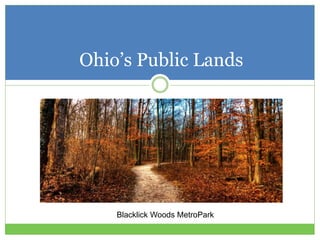
Ohio’s Public Lands
Blacklick Woods MetroPark
Ohio ranks 7th in the nation in population, but a
mere 47th in public land available per capita.
We need to protect what little public natural
resources we have left.
OH Public Lands
 HB 133 (2011) opened State Parks to oil and gas
drilling for first time in their history.
 Centralized leasing authority in new Leasing
Commission. (State universities and other state
agencies no longer have final say over leases).
 New nomination process allows for public
comment.
Headline in Yesterday’s Dispatch
Ohio House bill
would ease fracking
in state parks
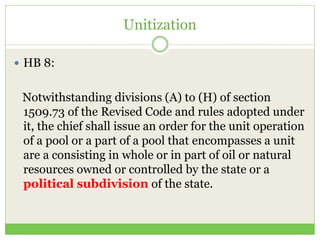
Unitization
 HB 8:
Notwithstanding divisions (A) to (H) of section
1509.73 of the Revised Code and rules adopted under
it, the chief shall issue an order for the unit operation
of a pool or a part of a pool that encompasses a unit
are a consisting in whole or in part of oil or natural
resources owned or controlled by the state or a
political subdivision of the state.
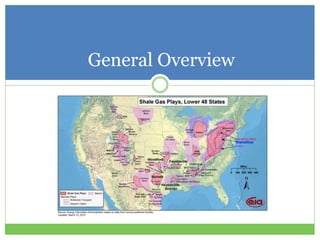
General Overview
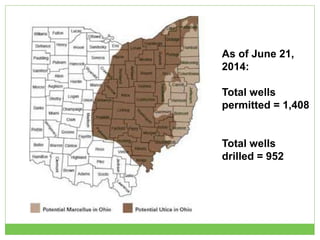
As of June 21,
2014:
Total wells
permitted = 1,408
Total wells
drilled = 952
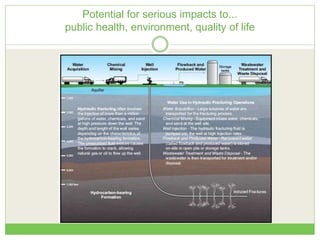
Potential for serious impacts to...
public health, environment, quality of life
Risks to Water Quality
• Cornell University study
– “An uncontrolled health
experiment on an enormous
scale”
• Duke University study
– Found methane concentrations
17X higher in drinking water
wells closer to natural gas wells
• Akron Beacon Journal
– 1 million pounds of chemicals
used at a single well site
More Chemicals
Conventional: 700 to 2,800 lbs. of chemical
additives per frack.
HVHHF: 205,000 to 935,000 lbs. per frack.
Typical 7-well site could receive 4 million
lbs. of chemicals.
More Toxic Wastewater
Amount Generated
1 Shale Wellpad = 1,000 traditional wells
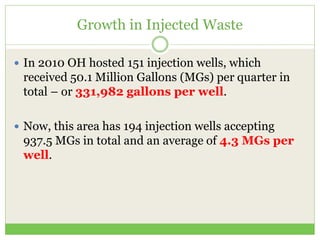
Growth in Injected Waste
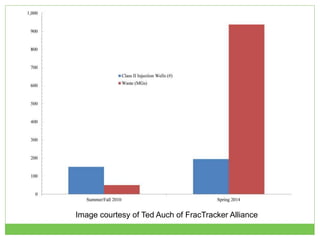
 In 2010 OH hosted 151 injection wells, which
received 50.1 Million Gallons (MGs) per quarter in
total – or 331,982 gallons per well.
 Now, this area has 194 injection wells accepting
937.5 MGs in total and an average of 4.3 MGs per
well.
Image courtesy of Ted Auch of FracTracker Alliance
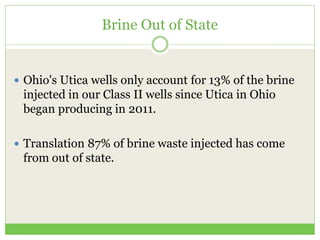
Brine Out of State
 Ohio's Utica wells only account for 13% of the brine
injected in our Class II wells since Utica in Ohio
began producing in 2011.
 Translation 87% of brine waste injected has come
from out of state.
Injection Wells
 A ProPublica review of well records, case histories
and government summaries of more than 220,000
well inspections found that structural failures
inside injection wells are routine. From late
2007 to late 2010, one well integrity violation
was issued for every six deep injection wells
examined — more than 17,000 violations
nationally.
Injection Wells
Roughly half of the injection well test failures
analyzed by ProPublica involved what federal water
protection regulations describe as "fluid migration"
and "significant leaks."
Where Else Does Fracking Brine Go?
Our Roads…
Brine On Roads: A Public Health Risk
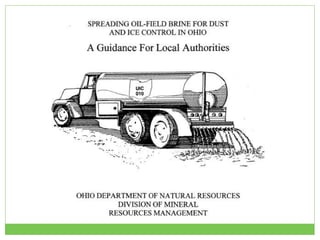
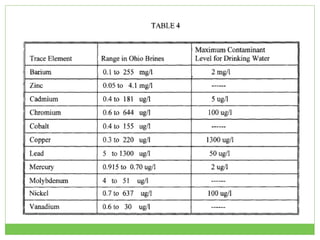
 ODNR’s brine spreading guide for local authorities notes that Ohio
produced brines contain high levels of several toxic contaminants.
(Pages 19 and 20):
http://ohiodnr.com/Portals/11/publications/pdf/Brine.pdf
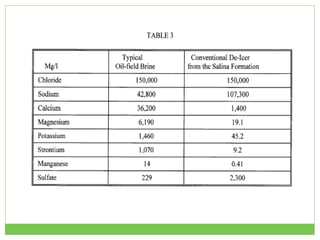
 The ODNR guide states that typical oil and gas field brines contain
1,070 Mg/l (milligrams per liter) of the radioactive element
Strontium, whereas traditional de-icers contain far less at 9.2 Mg/l.
Strontium replaces bone calcium and can cause cancer.
http://www.epa.gov/radiation/radionuclides/strontium.html
 ODNR guide states Cadmium in Ohio brines ranges from 0.4 to 181
ug/l (micrograms per liter), which far exceeds the EPA 5 ug/l
maximum contaminant level for drinking water. Cadmium is a
known human carcinogen and can cause kidney, lung, and bone
damage. http://www.atsdr.cdc.gov/toxfaqs/tf.asp?id=47&tid=15
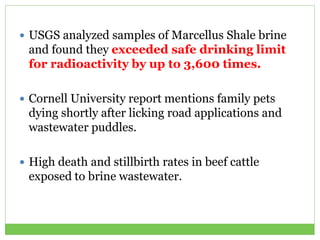
 USGS analyzed samples of Marcellus Shale brine
and found they exceeded safe drinking limit
for radioactivity by up to 3,600 times.
 Cornell University report mentions family pets
dying shortly after licking road applications and
wastewater puddles.
 High death and stillbirth rates in beef cattle
exposed to brine wastewater.
Authorizations in 33 of 88 Counties
Ashland, Ashtabula, Athens, Carroll, Columbiana,
Coshocton, Cuyahoga, Delaware, Fairfield, Geauga,
Guernsey, Harrison, Hocking, Holmes, Jefferson,
Knox, Licking, Mahoning, Medina, Meigs, Monroe,
Morrow, Muskingum, Noble, Perry, Portage, Richland,
Summit, Trumbull, Tuscarawas, Union, Washington,
Wayne
Air Pollution
• Colorado School of Public Health:
– “Our data show that it is important to
include air pollution in the national
dialogue on natural gas
development that has focused
largely on water exposures to
hydraulic fracturing,” said Lisa
McKenzie, Ph.D., MPH
– “We also calculated higher cancer
risks for residents living nearer to
the wells as compared to those
residing further [away],” the report
said. “Benzene is the major
contributor to lifetime excess cancer
risk from both scenarios.”
http://attheorefront.ucdenver.edu/?p=2546
More Trucks
 National Park Service estimates between 300 and
1,300 truck trips per well.
 Other sources estimated between 2,920 and 4,445
truck trips necessary for a three well multi-well pad.
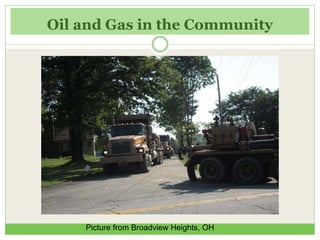
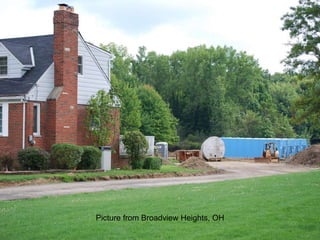
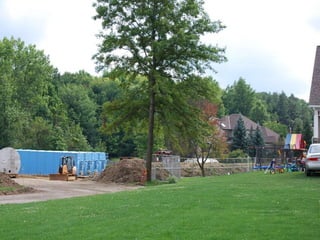
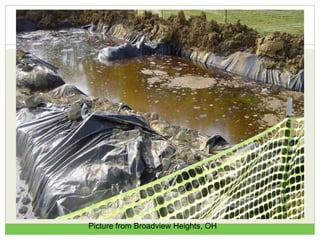
Oil and Gas in the Community
Picture from Broadview Heights, OH
RECENT EXPLOSIONS AND SPILLS
ILLUSTRATE NEED FOR BETTER
REGULATION
Fracking Incidents
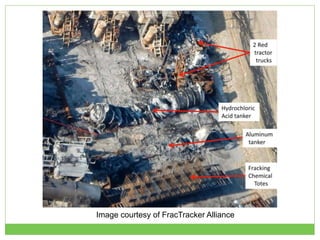
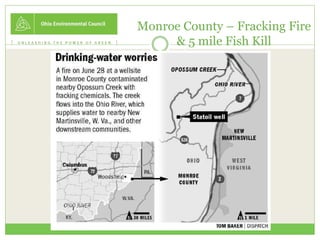
Monroe/Morgan County Overview
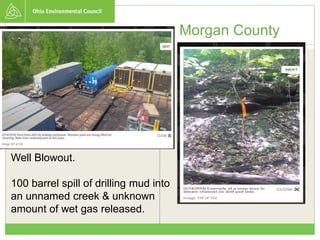
 Morgan County: well blow out and resulting oil spill
pollutes nearby creek.
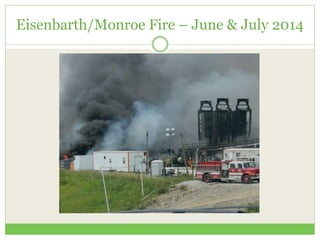
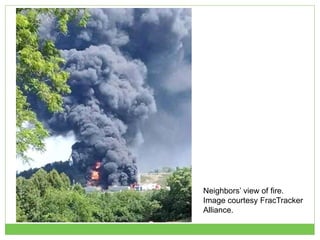
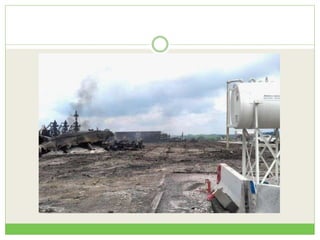
 Well pad fire in Monroe County:
 took nearly a week to completely extinguish,
 risked firefighter safety,
 forced the evacuation of 25 households,
 posed a potential risk to drinking water supplies,
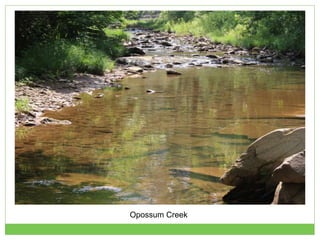
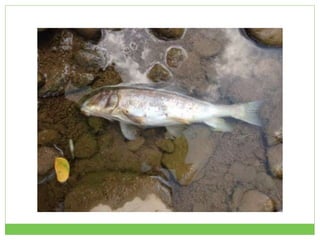
 killed more than 70,000 fish in a 5-mile long fish kill.
Morgan County
Well Blowout.
100 barrel spill of drilling mud into
an unnamed creek & unknown
amount of wet gas released.
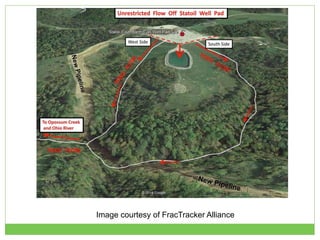
Eisenbarth/Monroe Fire – June & July 2014
Neighbors’ view of fire.
Image courtesy FracTracker
Alliance.
Image courtesy of FracTracker Alliance
Monroe County – Fracking Fire
& 5 mile Fish Kill
Opossum Creek
Needed Legislative Fixes - Overview
Incidents Illustrate Need for Better:
 Chemical Disclosure
 Setbacks
 First Responder Funding & Training
 Secondary Containment
Chemical Disclosure
Ohio Revised Code, Sec. 1509.10(H) – (J)
Ohio’s Legal “Lockbox” for “Trade Secret” Fracking
Chemicals.
 Only diagnosing/treating physicians & ODNR may
require disclosure of proprietary fracking chemicals.
 Neither physicians nor ODNR may share proprietary
chemical information with cooperating/interested
agencies, first responders, or drinking water utilities.
Chemical Disclosure
 What we need:
Instantaneous disclosure of all fracking chemicals
stored or in use at an oil and gas well upon the
request of a fire department, first responders, or
drinking water authorities.
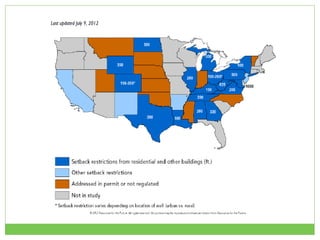
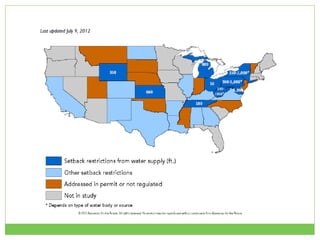
Setbacks
What we need:
 Strengthened minimum distance setbacks
separating all new oil and gas wells from occupied
dwellings, waterways, and other sensitive areas.
First Responders
What we need:
 Dedicate revenue from the state oil and gas
severance tax for training and equipment for
emergency response to oil and gas incidents by the
Ohio EPA, local fire departments, and emergency
management agencies.
Secondary Containment
 ODNR rules do not require spill prevention and
secondary containment measures at oil + gas wells.
 There was no earthen berm at the Monroe Cty. well
pad, contributing to the spill.
 ODNR working on well site construction rules, but
NO provisions included for secondary containment.
Image courtesy of FracTracker Alliance
2014 and 2015 Legislation
HB 490: (2014)
 House proposed opening all state lands to fracking.
 Would include nature preserves;
 Includes political subdivisions;
 Unitization.
 Kasich proposes stronger fracking enforcement.
 House eliminates Kasich improvements & hits current law.
 Language would have helped emergency
responders/public water utilities get chem info.
F E E L F R E E TO C O N TAC T M E :
N J O H N S O N @ T H E O E C . O R G
(614) 487-5841
Questions?

Fracking in Ohio: Environmental Impacts & Regulatory Failures

  • 1.
    Nathan Johnson Attorney Njohnson@theOEC.org Fracking inOhio: Environmental Impacts & Regulatory Failures
  • 2.
    Ohio Environmental Council OurMission: To secure healthy air, land, and water for all who call Ohio home.
  • 3.
  • 4.
    Ohio ranks 7thin the nation in population, but a mere 47th in public land available per capita. We need to protect what little public natural resources we have left.
  • 5.
    OH Public Lands HB 133 (2011) opened State Parks to oil and gas drilling for first time in their history.  Centralized leasing authority in new Leasing Commission. (State universities and other state agencies no longer have final say over leases).  New nomination process allows for public comment.
  • 6.
    Headline in Yesterday’sDispatch Ohio House bill would ease fracking in state parks
  • 7.
    Unitization  HB 8: Notwithstandingdivisions (A) to (H) of section 1509.73 of the Revised Code and rules adopted under it, the chief shall issue an order for the unit operation of a pool or a part of a pool that encompasses a unit are a consisting in whole or in part of oil or natural resources owned or controlled by the state or a political subdivision of the state.
  • 8.
  • 9.
    As of June21, 2014: Total wells permitted = 1,408 Total wells drilled = 952
  • 10.
    Potential for seriousimpacts to... public health, environment, quality of life
  • 11.
    Risks to WaterQuality • Cornell University study – “An uncontrolled health experiment on an enormous scale” • Duke University study – Found methane concentrations 17X higher in drinking water wells closer to natural gas wells • Akron Beacon Journal – 1 million pounds of chemicals used at a single well site
  • 12.
    More Chemicals Conventional: 700to 2,800 lbs. of chemical additives per frack. HVHHF: 205,000 to 935,000 lbs. per frack. Typical 7-well site could receive 4 million lbs. of chemicals.
  • 13.
    More Toxic Wastewater AmountGenerated 1 Shale Wellpad = 1,000 traditional wells
  • 14.
    Growth in InjectedWaste  In 2010 OH hosted 151 injection wells, which received 50.1 Million Gallons (MGs) per quarter in total – or 331,982 gallons per well.  Now, this area has 194 injection wells accepting 937.5 MGs in total and an average of 4.3 MGs per well.
  • 15.
    Image courtesy ofTed Auch of FracTracker Alliance
  • 16.
    Brine Out ofState  Ohio's Utica wells only account for 13% of the brine injected in our Class II wells since Utica in Ohio began producing in 2011.  Translation 87% of brine waste injected has come from out of state.
  • 17.
    Injection Wells  AProPublica review of well records, case histories and government summaries of more than 220,000 well inspections found that structural failures inside injection wells are routine. From late 2007 to late 2010, one well integrity violation was issued for every six deep injection wells examined — more than 17,000 violations nationally.
  • 18.
    Injection Wells Roughly halfof the injection well test failures analyzed by ProPublica involved what federal water protection regulations describe as "fluid migration" and "significant leaks."
  • 19.
    Where Else DoesFracking Brine Go? Our Roads…
  • 20.
    Brine On Roads:A Public Health Risk  ODNR’s brine spreading guide for local authorities notes that Ohio produced brines contain high levels of several toxic contaminants. (Pages 19 and 20): http://ohiodnr.com/Portals/11/publications/pdf/Brine.pdf  The ODNR guide states that typical oil and gas field brines contain 1,070 Mg/l (milligrams per liter) of the radioactive element Strontium, whereas traditional de-icers contain far less at 9.2 Mg/l. Strontium replaces bone calcium and can cause cancer. http://www.epa.gov/radiation/radionuclides/strontium.html  ODNR guide states Cadmium in Ohio brines ranges from 0.4 to 181 ug/l (micrograms per liter), which far exceeds the EPA 5 ug/l maximum contaminant level for drinking water. Cadmium is a known human carcinogen and can cause kidney, lung, and bone damage. http://www.atsdr.cdc.gov/toxfaqs/tf.asp?id=47&tid=15
  • 21.
     USGS analyzedsamples of Marcellus Shale brine and found they exceeded safe drinking limit for radioactivity by up to 3,600 times.  Cornell University report mentions family pets dying shortly after licking road applications and wastewater puddles.  High death and stillbirth rates in beef cattle exposed to brine wastewater.
  • 25.
    Authorizations in 33of 88 Counties Ashland, Ashtabula, Athens, Carroll, Columbiana, Coshocton, Cuyahoga, Delaware, Fairfield, Geauga, Guernsey, Harrison, Hocking, Holmes, Jefferson, Knox, Licking, Mahoning, Medina, Meigs, Monroe, Morrow, Muskingum, Noble, Perry, Portage, Richland, Summit, Trumbull, Tuscarawas, Union, Washington, Wayne
  • 26.
    Air Pollution • ColoradoSchool of Public Health: – “Our data show that it is important to include air pollution in the national dialogue on natural gas development that has focused largely on water exposures to hydraulic fracturing,” said Lisa McKenzie, Ph.D., MPH – “We also calculated higher cancer risks for residents living nearer to the wells as compared to those residing further [away],” the report said. “Benzene is the major contributor to lifetime excess cancer risk from both scenarios.” http://attheorefront.ucdenver.edu/?p=2546
  • 27.
    More Trucks  NationalPark Service estimates between 300 and 1,300 truck trips per well.  Other sources estimated between 2,920 and 4,445 truck trips necessary for a three well multi-well pad.
  • 28.
    Oil and Gasin the Community Picture from Broadview Heights, OH
  • 29.
  • 30.
  • 31.
  • 32.
    RECENT EXPLOSIONS ANDSPILLS ILLUSTRATE NEED FOR BETTER REGULATION Fracking Incidents
  • 33.
    Monroe/Morgan County Overview Morgan County: well blow out and resulting oil spill pollutes nearby creek.  Well pad fire in Monroe County:  took nearly a week to completely extinguish,  risked firefighter safety,  forced the evacuation of 25 households,  posed a potential risk to drinking water supplies,  killed more than 70,000 fish in a 5-mile long fish kill.
  • 34.
    Morgan County Well Blowout. 100barrel spill of drilling mud into an unnamed creek & unknown amount of wet gas released.
  • 35.
  • 36.
    Neighbors’ view offire. Image courtesy FracTracker Alliance.
  • 38.
    Image courtesy ofFracTracker Alliance
  • 39.
    Monroe County –Fracking Fire & 5 mile Fish Kill
  • 40.
  • 42.
    Needed Legislative Fixes- Overview Incidents Illustrate Need for Better:  Chemical Disclosure  Setbacks  First Responder Funding & Training  Secondary Containment
  • 43.
    Chemical Disclosure Ohio RevisedCode, Sec. 1509.10(H) – (J) Ohio’s Legal “Lockbox” for “Trade Secret” Fracking Chemicals.  Only diagnosing/treating physicians & ODNR may require disclosure of proprietary fracking chemicals.  Neither physicians nor ODNR may share proprietary chemical information with cooperating/interested agencies, first responders, or drinking water utilities.
  • 44.
    Chemical Disclosure  Whatwe need: Instantaneous disclosure of all fracking chemicals stored or in use at an oil and gas well upon the request of a fire department, first responders, or drinking water authorities.
  • 45.
    Setbacks What we need: Strengthened minimum distance setbacks separating all new oil and gas wells from occupied dwellings, waterways, and other sensitive areas.
  • 48.
    First Responders What weneed:  Dedicate revenue from the state oil and gas severance tax for training and equipment for emergency response to oil and gas incidents by the Ohio EPA, local fire departments, and emergency management agencies.
  • 49.
    Secondary Containment  ODNRrules do not require spill prevention and secondary containment measures at oil + gas wells.  There was no earthen berm at the Monroe Cty. well pad, contributing to the spill.  ODNR working on well site construction rules, but NO provisions included for secondary containment.
  • 50.
    Image courtesy ofFracTracker Alliance
  • 51.
    2014 and 2015Legislation HB 490: (2014)  House proposed opening all state lands to fracking.  Would include nature preserves;  Includes political subdivisions;  Unitization.  Kasich proposes stronger fracking enforcement.  House eliminates Kasich improvements & hits current law.  Language would have helped emergency responders/public water utilities get chem info.
  • 52.
    F E EL F R E E TO C O N TAC T M E : N J O H N S O N @ T H E O E C . O R G (614) 487-5841 Questions?

Editor's Notes

  • #11 As with any industrial activity, the development of oil and gas involves risks to air, land, water, wildlife and communities. Many of you have probably seen these sorts of images depicting the new combination of horizontal drilling with hydraulic fracturing, or the use of sand, water, and chemicals injected at high pressures to blast open the shale rock and release the trapped gas. What industry will argue is that this technology has been around for 40 years. But that is not correct. While the use of hydraulic fracturing to drill vertical wells has been around that long, using the technique of hydraulic fracturing combined with horizontal drilling is very new and only began in 2011 in Ohio.
  • #13 Just top chemicals used. Hundreds have been identified. The U.S. House of Representative Committee on Energy and the Environment report, Chemicals Used in Hydraulic Fracturing, has identified 29 chemicals used in 650 different products that are carcinogens, hazardous air pollutants and regulated under Safe Drinking Water Act A report by the U.S. House of Representatives Committee on Energy and Commerce, entitled Chemicals in Hydraulic Fracturing, states that 21.9 million gallons of 2-BE products were injected between 2005-2009. The safety standard of 2-BE is TLV/TWA 25 ppm – parts per million. The EPA also found benzene, another carcinogen, at 50 times its safety level as well as phenols, acetone, toluene, naphthalene and traces of diesel fuel.
  • #29 Diesel exhaust. Prob with roads.
  • #32 Bird watchers? Serve effects on wildlife. Children could fall into. DO YOU leave a plastic bag of --- for a child to stumble upon?
  • #35 Even with few producing wells in the state of Ohio, incidents have already cropped up. The OEC assisted a gentleman in Harrison county in submitting a verified complain to the Ohio EPA regarding a white substance which was running out of an underground spring down the hill 75 ft. below the Dodson Well Pad. Two state regulatory agencies, plus the US EPA, are conducting remediation of over 200,000 gallons of brine (fracking waste) that were dumped into a storm drain which empties into the Mahoning River in Youngstown, Ohio (article date: Feb 6, 2013). A criminal investigation is also underway. And finally, we were made aware of “frack outs” or releases of bentonite clay slurry by Mark West Company during pipeline drilling in Harrison County. These frack outs caused clay slurry to accumulate in streams and wetlands, smothering out macroinvertebrates and negatively affecting aquatic life.
  • #40 Halliburton delayed releasing details on fracking chemicals after Monroe County spill By Laura Arenschield The Columbus Dispatch  •  Monday July 21, 2014 5:16 AM A fracking company made federal and state agencies that oversee drinking-water safety wait days before it shared a list of toxic chemicals that spilled from a drilling site into a tributary of the Ohio River. Although the spill following a fire on June 28 at the Statoil North America well pad in Monroe County stretched 5 miles along the creek and killed more than 70,000 fish and wildlife, state officials said they do not believe drinking water was affected. But environmental advocacy groups said they wonder how the state can be sure. A U.S. Environmental Protection Agency report obtained by The Dispatch shows that the federal and state EPA officials had to wait five days before they were given a full list of the fracking chemicals the drilling company used at the site. Halliburton, the company hired by Statoil to frack the horizontal well, provided a partial list up front that included most of the chemicals. Others, which are protected by Ohio’s trade-secrets law, were omitted. “How can communities know that they are being protected when an incident like this happens?” said Teresa Mills, an environmental activist and Ohio organizer with the Center for Health, Environment and Justice. “We need more transparent laws.” To pull oil and natural gas from shale, companies drill vertically and then turn sideways into the rock. Then they blast millions of gallons of water, sand and chemicals into the shafts to free trapped oil and gas in the process called fracking. During the process, fluids bubble back up to the surface with the gas. Once a fracking job is finished, drilling companies have 60 days to disclose what chemicals they used to the Department of Natural Resources, which oversees drilling and fracking operations in Ohio. Ohio law says that companies have to disclose the contents of proprietary fracking mixes only to firefighters or Natural Resources if there is an emergency, such as fires or spills. In this case, both were given the full list but did not share the details with other agencies. Halliburton has yet to finish fracking the Monroe County well that caught fire. Chris Abbruzzese, an Ohio EPA spokesman, said that on the day of the fire and spill, a representative from a group that represents the federal and state EPA offices, the Ohio Department of Natural Resources and Monroe County emergency management and fire workers asked Statoil and Halliburton for a list of the chemicals. “Once they realized that the proprietary information wasn’t included, there were additional (requests) made,” Abbruzzese said. Natural Resources, which regulates drilling in Ohio, has authority under state law to see the entire list and asked on its own two days after the fire. Halliburton, the company hired by Statoil to frack the well, gave the list to the single agency. But Natural Resources did not share that information with either EPA office. “Internal communication is something we’re going to work on,” said Bethany McCorkle, a Natural Resources spokeswoman. Kirsten Henriksen, a spokeswoman for Statoil, said the company hired an outside toxicology firm to test both the creek and the Ohio River for toxic chemicals. None were found in the Ohio River, she said. The Ohio River Valley Water Sanitation Commission, a multi-state agency that tests the river, also found no contaminants. “Based on the chemicals that we were aware of, if there had been any other chemicals that would have been there, they all would have showed up (in tests),” Abbruzzese said. Kelly Scribner, a toxicologist with the Center for Toxicology and Environmental Health, which was hired by Statoil to perform the tests, said she wasn’t given a full list of chemicals either. But, she said, the tests would have shown abnormalities in the water either way. Fracking chemicals include ethylene glycol, which can damage kidneys; formaldehyde, a known cancer risk; and naphthalene, considered a possible carcinogen. The water tests showed elevated levels of chlorides, salt and acetone in the creek near the well pad. By the time federal and state EPA officials were given the full list, those chemicals likely flowed past towns along the Ohio River that draw in drinking water. That worries some state lawmakers and environmental advocacy groups. “We’ve got 70,000 or so fish that died,” said Nathan Johnson, an attorney for the Ohio Environmental Council. “Clearly, something was wrong with the water.” The group has been lobbying the Ohio legislature to pass laws that would force companies during emergencies to immediately disclose the full list of chemicals to all state agencies. Oil and gas industry officials and regulators have pushed back against additional regulations, saying Ohio’s laws are more than adequate to protect people. In a speech on Tuesday outside Mansfield, Gov. John Kasich said Ohio has “very tough regulations” concerning fracking. “If the accidents happen, and we’re not minding the store, or we’re looking the other way, that would be a disaster for us,” he said. Kasich told The Dispatch it would be unacceptable for emergency responders, including federal and Ohio EPA officials, not to know the full list of chemicals that might have spilled into the river. “We want people to know what the fracking fluid contains,” he said. Other states, including Pennsylvania and Texas, make companies disclose the full list of chemicals within 30 days of wrapping up a fracking operation. In Oklahoma, they must disclose the chemicals to state regulators before a well is drilled. The Statoil fire started on the morning of June 28 when, according to preliminary reports, a hydraulic line used during the fracking process broke. The broken line sprayed fracking fluid onto hot equipment, igniting it. The fire spread to 20 trucks, which went up in flames. No workers were hurt, but one firefighter was treated for smoke inhalation. About 25 people who live near the wells were evacuated. The fire continued to smolder for six days. As it burned, firefighters doused it with water and foam, washing chemicals from the site into the tributary, which flows for five miles before reaching the Ohio River. Legislators and environmental groups say the Statoil fire illustrates a gap in the law that allows fracking companies to determine when they release information and to whom. “It is a huge problem,” said Johnson, the Ohio Environmental Council attorney. “We’re essentially at the behest of the company with the chemical information.” Dispatch Public Affairs Editor Darrel Rowland contributed to this story.