Building Your Best BoardBuilding Your Best Board
A 2‐part webinar series: October 2 & 9, 2013
Thank you for joining us We will begin in few minutesThank you for joining us. We will begin in few minutes. 
Please check your speakers/phone connection.                  
If you experience any problems please let us know byIf you experience any problems, please let us know by 
typing in the chat box.
Follow the OEC on Twitter: @OhioEnviro.Follow the OEC on Twitter: @OhioEnviro.                          
The hashtag for this webinar is #OECwebinar
Building Your Best Board
Part I: Board Roles & Best Practices for 
Board Development
Kristy Meyer
Ohio Environmental Council
Francisco Ollervides & Diana Toledo 
River Network
Peter Lane & Nancy Oswald
Institute for Conservation Leadership
Ohio Environmental Council
The OEC is the Ohio’s most comprehensive, effective and respected 
environmental advocate for a healthier more sustainable Ohioenvironmental advocate for a healthier, more sustainable Ohio. 
Our experts work daily to restore, protect, and strengthen the 
quality of life for families and communities—from the air wequality of life for families and communities from the air we 
breathe and the water we drink to the food we eat and natural 
resources we enjoy.
Please join us! OEC members:
 Receive great benefits
B f h i ki d Become part of the community working to restore, protect, and 
strengthen the quality of life for families and communities in 
Ohio.
Join us today at www.theOEC.org.
Polls
4
Goals of Webinar series
By the end of this Series you will be able to:
 Reflect on the roles and responsibilities of a nonprofit Board 
and assess areas where your own Board can be strengthenedand assess areas where your own Board can be strengthened
 Identify steps you can take to strengthen your organization’s 
Board recruitment and orientation practices
 Identify the benefits of a board governance plan and know 5 
things every plan should include 
C id t t b d i b ildi l Consider steps to engage your board in building a plan
 Create accountability mechanisms to ensure progress
5
It comes down to leadership…
“Development of the Board of 
Di t i th t f d t lDirectors is the most fundamental 
activity needed to build and maintain 
a strong nucleus for a nonprofit 
organization.” 
Marc Smiley, Solid Ground
O i i l D l G
6
Organizational Development Guru
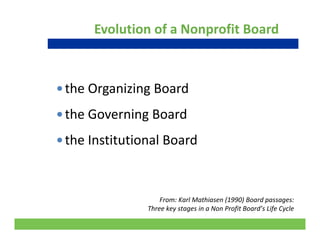
Evolution of a Nonprofit Board
the Organizing Board
the Governing Board
the Institutional Boardthe Institutional Board
From: Karl Mathiasen (1990) Board passages:
7
From: Karl Mathiasen (1990) Board passages: 
Three key stages in a Non Profit Board’s Life Cycle
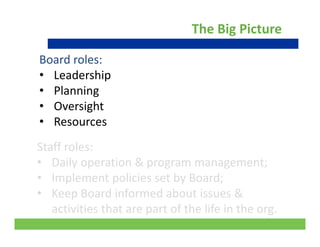
The Big Picture
Board roles:
• LeadershipLeadership
• Planning
• OversightOversight
• Resources
Staff roles:
• Daily operation & program management; 
• Implement policies set by Board; 
• Keep Board informed about issues & 
8
activities that are part of the life in the org.
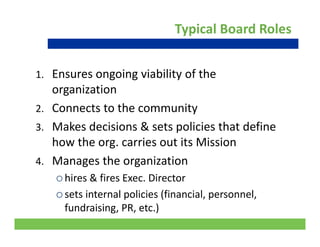
Typical Board Roles
1. Ensures ongoing viability of the1. Ensures ongoing viability of the 
organization
2 Connects to the community2. Connects to the community
3. Makes decisions & sets policies that define 
h th i t it Mi ihow the org. carries out its Mission
4. Manages the organization
 hires & fires Exec. Director
 sets internal policies (financial, personnel, 
9
fundraising, PR, etc.)
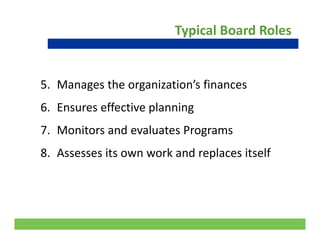
Typical Board Roles
5. Manages the organization’s finances
6 Ensures effective planning6. Ensures effective planning
7. Monitors and evaluates Programs 
8. Assesses its own work and replaces itself
10
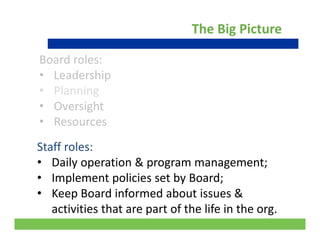
The Big Picture
Board roles:
• LeadershipLeadership
• Planning
• OversightOversight
• Resources
Staff roles:
• Daily operation & program management; 
• Implement policies set by Board; 
• Keep Board informed about issues & 
11
activities that are part of the life in the org.
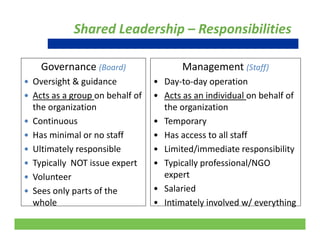
Shared Leadership – Responsibilities
Governance (Board) Management (Staff)
 Oversight & guidance
 Acts as a group on behalf of 
the organization
• Day‐to‐day operation
• Acts as an individual on behalf of 
the organizationthe organization
 Continuous
 Has minimal or no staff
the organization
• Temporary
• Has access to all staff
 Ultimately responsible
 Typically  NOT issue expert
• Limited/immediate responsibility
• Typically professional/NGO 
 Volunteer
 Sees only parts of the 
whole
expert
• Salaried
• Intimately involved w/ everything
12
whole • Intimately involved w/ everything
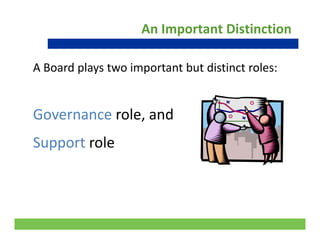
An Important Distinction
A Board plays two important but distinct roles:
Governance role, and
S t lSupport role
13
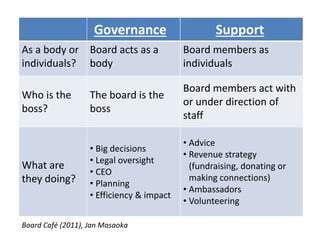
Governance Support
b d d d bAs a body or 
individuals?
Board acts as a 
body
Board members as 
individuals
Who is the 
boss?
The board is the 
boss
Board members act with 
or under direction of 
boss? boss
staff
What are 
• Big decisions
• Legal oversight
CEO
• Advice
• Revenue strategy 
(fundraising, donating or 
they doing?
• CEO
• Planning
• Efficiency & impact
( g, g
making connections)
• Ambassadors
• Volunteering
14
• Volunteering
Board Café (2011), Jan Masaoka
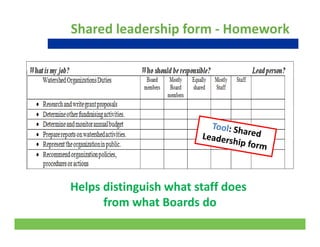
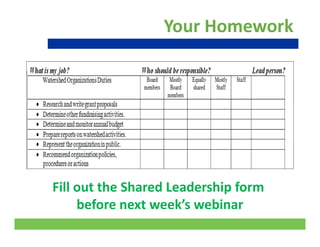
Shared leadership form ‐ Homework
Helps distinguish what staff does 
from what Boards do
15
from what Boards do
Are there aspects of your organization’s 
work where more clarity on the staff’s 
vs. the Board’s role could be helpful?
16
pf
Five “BMPs” for  Creating a Strong Board
1 Select well1. Select well
2. Articulate expectations
3. Provide organizational information & 
ongoing education
4. Engage each Board member and promote 
team workteam work
5. Anticipate and prepare for leadership 
transitions
17
transitions
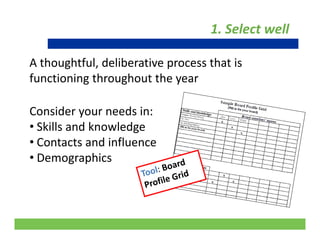
1. Select well
A thoughtful, deliberative process that is 
functioning throughout the yearfunctioning throughout the year
C id d iConsider your needs in:
• Skills and knowledge
C t t d i fl• Contacts and influence
• Demographics
18
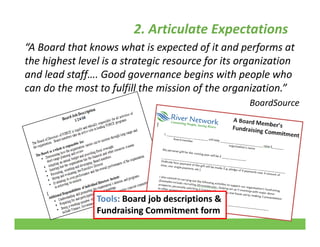
2. Articulate Expectations
“A Board that knows what is expected of it and performs at“A Board that knows what is expected of it and performs at 
the highest level is a strategic resource for its organization 
and lead staff…. Good governance begins with people whoand lead staff…. Good governance begins with people who 
can do the most to fulfill the mission of the organization.”
BoardSource
Tools: Board job descriptions &
19
Tools: Board job descriptions & 
Fundraising Commitment form
3. Provide Needed Information & Ongoing Education
• Board Manual
• Board meetings & retreatsBoard meetings & retreats
• New Board member orientation
• Committees
• Board & Committee workplansp
20
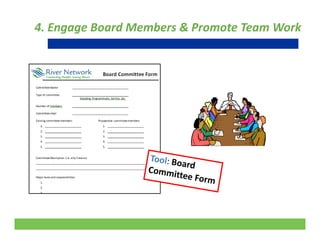
4. Engage Board Members & Promote Team Work
21
4. Engage Board Members…
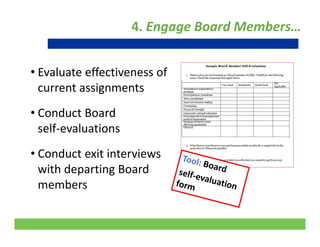
• Evaluate effectiveness of 
current assignments
• Conduct Board 
self‐evaluations 
• Conduct exit interviews 
with departing Boardwith departing Board 
members
22
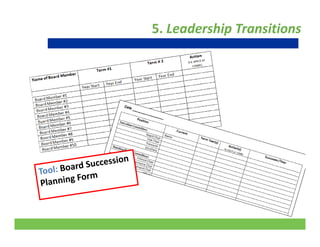
5. Plan for Leadership Transitions ‐ Steps
1. Review bylaws regarding term limits for Board 
members & officers
2. Review current make‐up of Board, officers and 
committees
3. Determine upcoming term expirations & vacancies
4. Review your needs with regard to upcoming projects, y g p g p j ,
developments, etc.
5. Review potential new Board members identified 
throughout the year for skills and dynamics
23
5. Leadership Transitions
24
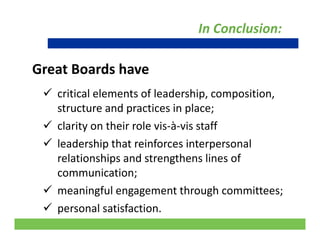
In Conclusion:
Great Boards have
 critical elements of leadership, composition, 
structure and practices in place;structure and practices in place;
 clarity on their role vis‐à‐vis staff
 leadership that reinforces interpersonal 
relationships and strengthens lines of 
i ticommunication;
 meaningful engagement through committees;
25
 personal satisfaction.
Your Homework
Fill out the Shared Leadership form 
b f t k’ bi
26
before next week’s webinar
Upcoming Programs
• River Network Financial Management Webinar Series g
• 6‐month intensive training, starting November ‘13
• Six 90‐min. webinars, first Tuesday of every month 
(Nov. ‘13 – April ‘14) 
• Five hours of one‐on‐one consulting 
• Email follervides@rivernetwork.org for more information@ g
• National River Rally Pittsburgh PA• National River Rally, Pittsburgh, PA 
(May 30‐June 2, 2014)
27
Tools & Resources
• Resources from webinar
• Shared Leadership form & Board Succession Planning form
previously sent
• For others, email follervides@rivernetwork.org
i k hi fi• River Network Partnership Benefits 
• Free fundraising database, insurance discounts, quarterly 
publications, discounted services & morep ,
• http://www.rivernetwork.org/partner‐benefits
• River Network Resource library y
http://www.rivernetwork.org/resource‐library?tid=All
• Organizational Assessment Tool 
// /
28
http://www.rivernetwork.org/status‐report‐survey
 See you next week!  
o Building Your Best Board (Part 2); 
October 9th, 1 ‐ 2 p.m. EST, p
o If you registered for Part 1,  you are 
already registered for Part 2already registered for Part 2. 
o You will receive another email with 
login instructions for Part 2.

Building Your Best Board - Part 1