SATELLITE COMMUNICATION
UNIT IV – SATELLITE ACCESS AND CODING
METHODS
KARPAGAM INSTITUTE OF TECHNOLOGY
COIMBATORE - 105.
DEPARTMENT OF ELECTRONICS AND COMMUNICATION ENGINEERING
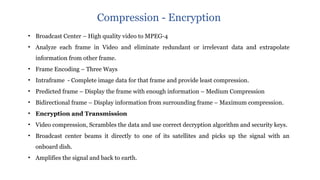
• Broadcast Center – High quality video to MPEG-4
• Analyze each frame in Video and eliminate redundant or irrelevant data and extrapolate
information from other frame.
• Frame Encoding – Three Ways
• Intraframe - Complete image data for that frame and provide least compression.
• Predicted frame – Display the frame with enough information – Medium Compression
• Bidirectional frame – Display information from surrounding frame – Maximum compression.
• Encryption and Transmission
• Video compression, Scrambles the data and use correct decryption algorithm and security keys.
• Broadcast center beams it directly to one of its satellites and picks up the signal with an
onboard dish.
• Amplifies the signal and back to earth.
Compression - Encryption
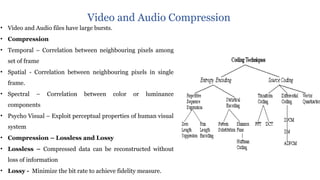
• Video and Audio files have large bursts.
• Compression
• Temporal – Correlation between neighbouring pixels among
set of frame
• Spatial - Correlation between neighbouring pixels in single
frame.
• Spectral – Correlation between color or luminance
components
• Psycho Visual – Exploit perceptual properties of human visual
system
• Compression – Lossless and Lossy
• Lossless – Compressed data can be reconstructed without
loss of information
• Lossy - Minimize the bit rate to achieve fidelity measure.
Video and Audio Compression
• Promote system interoperability
among audio and video devices.
• MPTEG-1 : Encoding and Decoding
Streaming Video and Audio files
• MPEG-2: Digital television; Compress
files for high quality video
transmission.
• MPEG-4: Standard for compression
high definition video into smaller scale
files to computers cell phone and
PDA’s
• MPEG-2I: Referred to as multimedia
framework. Interprets what digital
content to which individual use.
MPEG Video Coding Standards
• Encryption
• Plain text, Cipher text
• Symmetric Key encryption – Common keys
• Public key encryption – Public key, Private key
Encryption
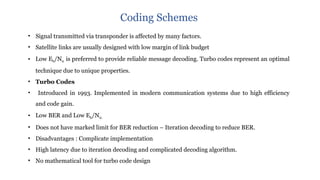
• Signal transmitted via transponder is affected by many factors.
• Satellite links are usually designed with low margin of link budget
• Low Eb/N0 is preferred to provide reliable message decoding. Turbo codes represent an optimal
technique due to unique properties.
• Turbo Codes
• Introduced in 1993. Implemented in modern communication systems due to high efficiency
and code gain.
• Low BER and Low Eb/N0.
• Does not have marked limit for BER reduction – Iteration decoding to reduce BER.
• Disadvantages : Complicate implementation
• High latency due to iteration decoding and complicated decoding algorithm.
• No mathematical tool for turbo code design
Coding Schemes
• Compromise between turbo code complexity and efficiency is the basic task of turbo code
designing.
• For offline systems, error free detection of message can be reached for channel with strong
noise and jamming.
• SMS – Low Noise ration and error free detection
• Decoding of Turbo Codes
• Code gain with maximum channel capacity and high encoder complexity.
• Classical algorithms cannot be used for decoding.
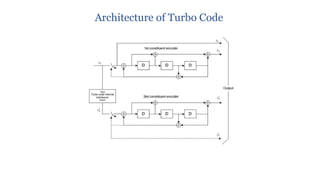
• Two SISO (Soft Input Soft Output) decoders connected with iteration loop.
• Posteriori probability estimation
• Log likelihood Ratio (LLR)
Turbo Codes
Architecture of Turbo Code
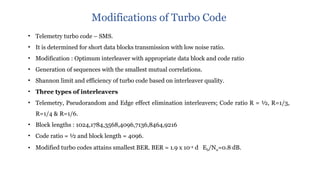
• Telemetry turbo code – SMS.
• It is determined for short data blocks transmission with low noise ratio.
• Modification : Optimum interleaver with appropriate data block and code ratio
• Generation of sequences with the smallest mutual correlations.
• Shannon limit and efficiency of turbo code based on interleaver quality.
• Three types of interleavers
• Telemetry, Pseudorandom and Edge effect elimination interleavers; Code ratio R = ½, R=1/3,
R=1/4 & R=1/6.
• Block lengths : 1024,1784,3568,4096,7136,8464,9216
• Code ratio = ½ and block length = 4096.
• Modified turbo codes attains smallest BER. BER = 1.9 x 10⁻⁴
d Eb/N0=0.8 dB.
Modifications of Turbo Code
Compression and Coding schemes sat communications

Compression and Coding schemes sat communications

  • 1.
    SATELLITE COMMUNICATION UNIT IV– SATELLITE ACCESS AND CODING METHODS KARPAGAM INSTITUTE OF TECHNOLOGY COIMBATORE - 105. DEPARTMENT OF ELECTRONICS AND COMMUNICATION ENGINEERING
  • 2.
    • Broadcast Center– High quality video to MPEG-4 • Analyze each frame in Video and eliminate redundant or irrelevant data and extrapolate information from other frame. • Frame Encoding – Three Ways • Intraframe - Complete image data for that frame and provide least compression. • Predicted frame – Display the frame with enough information – Medium Compression • Bidirectional frame – Display information from surrounding frame – Maximum compression. • Encryption and Transmission • Video compression, Scrambles the data and use correct decryption algorithm and security keys. • Broadcast center beams it directly to one of its satellites and picks up the signal with an onboard dish. • Amplifies the signal and back to earth. Compression - Encryption
  • 3.
    • Video andAudio files have large bursts. • Compression • Temporal – Correlation between neighbouring pixels among set of frame • Spatial - Correlation between neighbouring pixels in single frame. • Spectral – Correlation between color or luminance components • Psycho Visual – Exploit perceptual properties of human visual system • Compression – Lossless and Lossy • Lossless – Compressed data can be reconstructed without loss of information • Lossy - Minimize the bit rate to achieve fidelity measure. Video and Audio Compression
  • 4.
    • Promote systeminteroperability among audio and video devices. • MPTEG-1 : Encoding and Decoding Streaming Video and Audio files • MPEG-2: Digital television; Compress files for high quality video transmission. • MPEG-4: Standard for compression high definition video into smaller scale files to computers cell phone and PDA’s • MPEG-2I: Referred to as multimedia framework. Interprets what digital content to which individual use. MPEG Video Coding Standards
  • 5.
    • Encryption • Plaintext, Cipher text • Symmetric Key encryption – Common keys • Public key encryption – Public key, Private key Encryption
  • 6.
    • Signal transmittedvia transponder is affected by many factors. • Satellite links are usually designed with low margin of link budget • Low Eb/N0 is preferred to provide reliable message decoding. Turbo codes represent an optimal technique due to unique properties. • Turbo Codes • Introduced in 1993. Implemented in modern communication systems due to high efficiency and code gain. • Low BER and Low Eb/N0. • Does not have marked limit for BER reduction – Iteration decoding to reduce BER. • Disadvantages : Complicate implementation • High latency due to iteration decoding and complicated decoding algorithm. • No mathematical tool for turbo code design Coding Schemes
  • 7.
    • Compromise betweenturbo code complexity and efficiency is the basic task of turbo code designing. • For offline systems, error free detection of message can be reached for channel with strong noise and jamming. • SMS – Low Noise ration and error free detection • Decoding of Turbo Codes • Code gain with maximum channel capacity and high encoder complexity. • Classical algorithms cannot be used for decoding. • Two SISO (Soft Input Soft Output) decoders connected with iteration loop. • Posteriori probability estimation • Log likelihood Ratio (LLR) Turbo Codes
  • 8.
  • 9.
    • Telemetry turbocode – SMS. • It is determined for short data blocks transmission with low noise ratio. • Modification : Optimum interleaver with appropriate data block and code ratio • Generation of sequences with the smallest mutual correlations. • Shannon limit and efficiency of turbo code based on interleaver quality. • Three types of interleavers • Telemetry, Pseudorandom and Edge effect elimination interleavers; Code ratio R = ½, R=1/3, R=1/4 & R=1/6. • Block lengths : 1024,1784,3568,4096,7136,8464,9216 • Code ratio = ½ and block length = 4096. • Modified turbo codes attains smallest BER. BER = 1.9 x 10⁻⁴ d Eb/N0=0.8 dB. Modifications of Turbo Code