Digital Communications
( 디지털 통신 )
중앙대학교 전자전기공학부
이정우
Email: jwlee2@cau.ac.kr
Homepage: http://cau.ac.kr/~jwlee2
office: 신공학관 409 호
Phone: 820-5734
2
• Main text: class notes
• References
– “Digital transmission of information” by Richard E. Blahut,
Addison-Wesley, 1990.
– “Communication systems” by Simon Haykin, John Wiley &
Sons, 2001.
• Test
– 중간고사 (35%), 기말고사 (35%), 과제물 4 번 ( 각 5%),
참여도 (10%)
Introduction to
Digital Communications
4
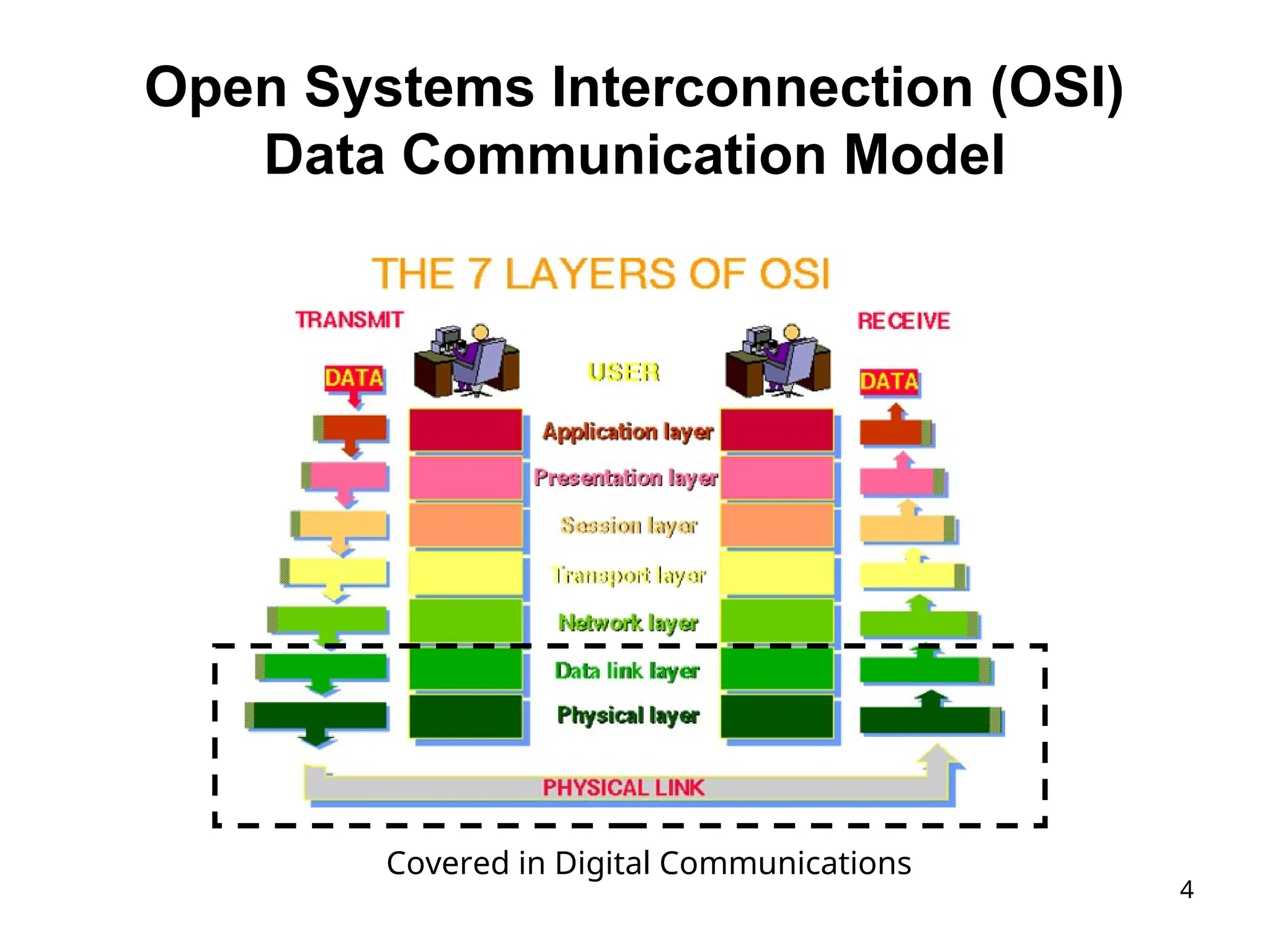
Open Systems Interconnection (OSI)
Data Communication Model
Covered in Digital Communications
5
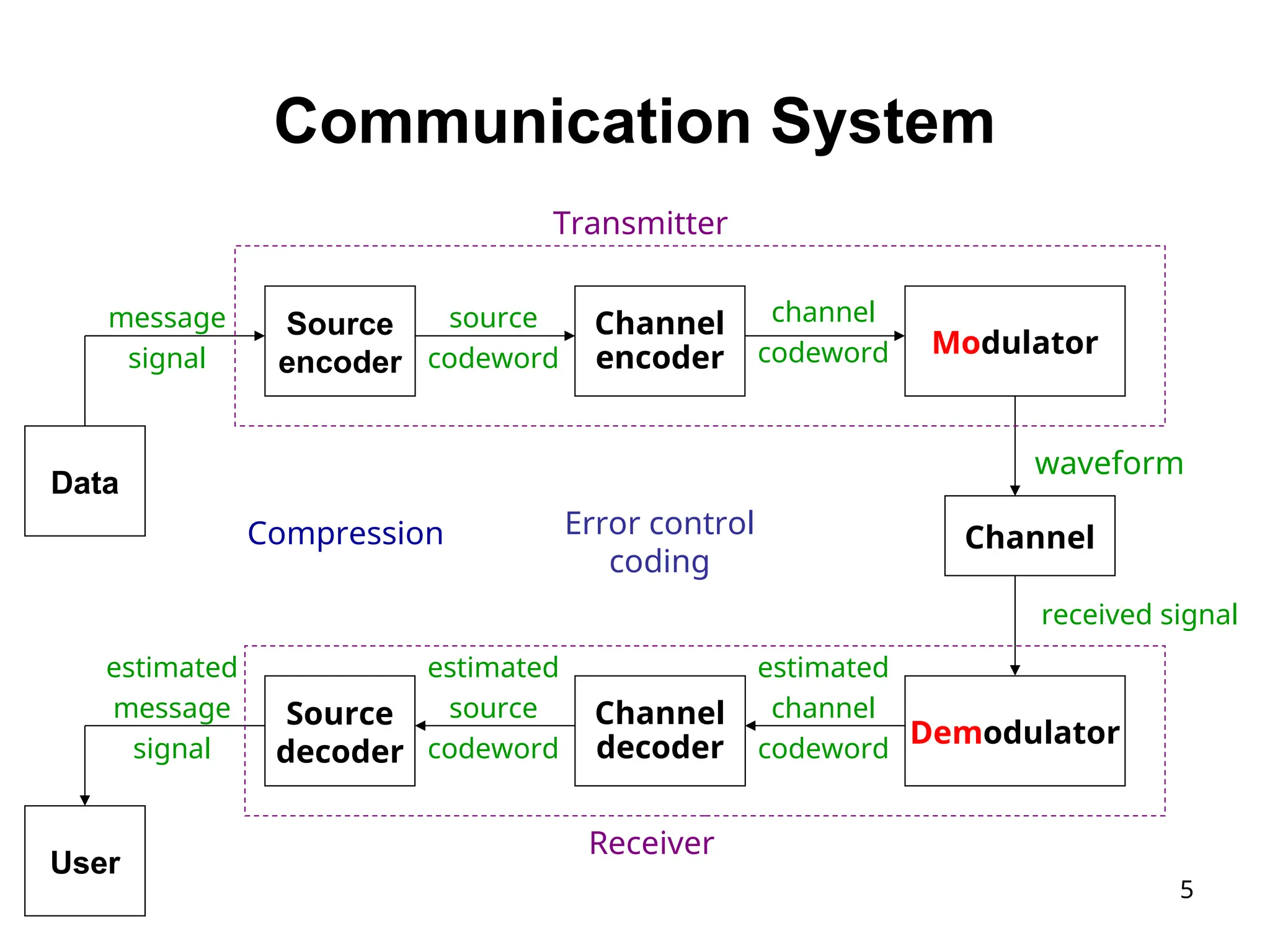
Communication System
Channel
encoder
Source
encoder
Modulator
Demodulator
Channel
Channel
decoder
Source
decoder
Error control
coding
Compression
Transmitter
Receiver
waveform
received signal
channel
codeword
estimated
channel
codeword
source
codeword
estimated
source
codeword
message
signal
estimated
message
signal
Data
User
6
Communication System
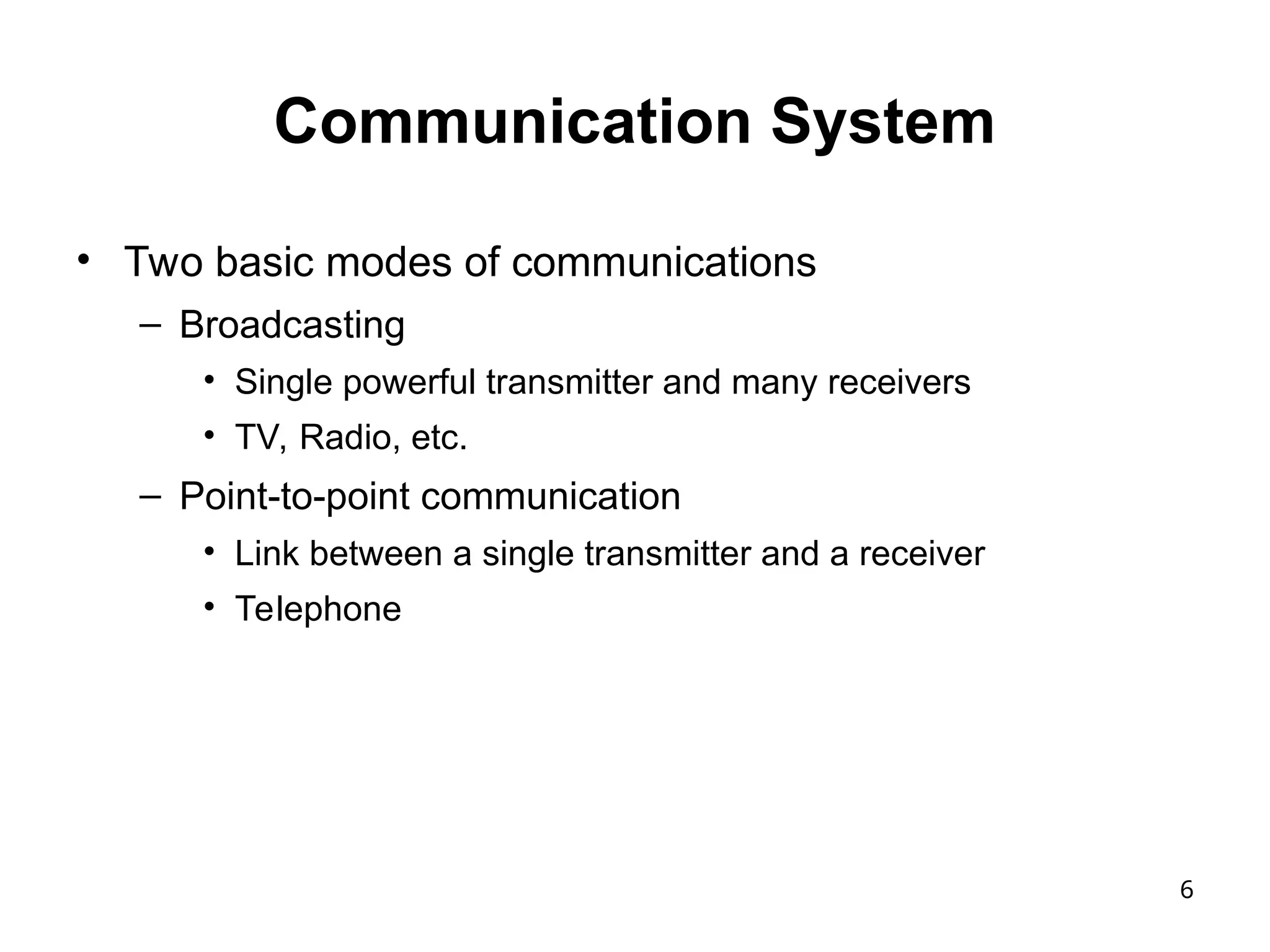
• Two basic modes of communications
– Broadcasting
• Single powerful transmitter and many receivers
• TV, Radio, etc.
– Point-to-point communication
• Link between a single transmitter and a receiver
• Telephone
7
Communication Resources
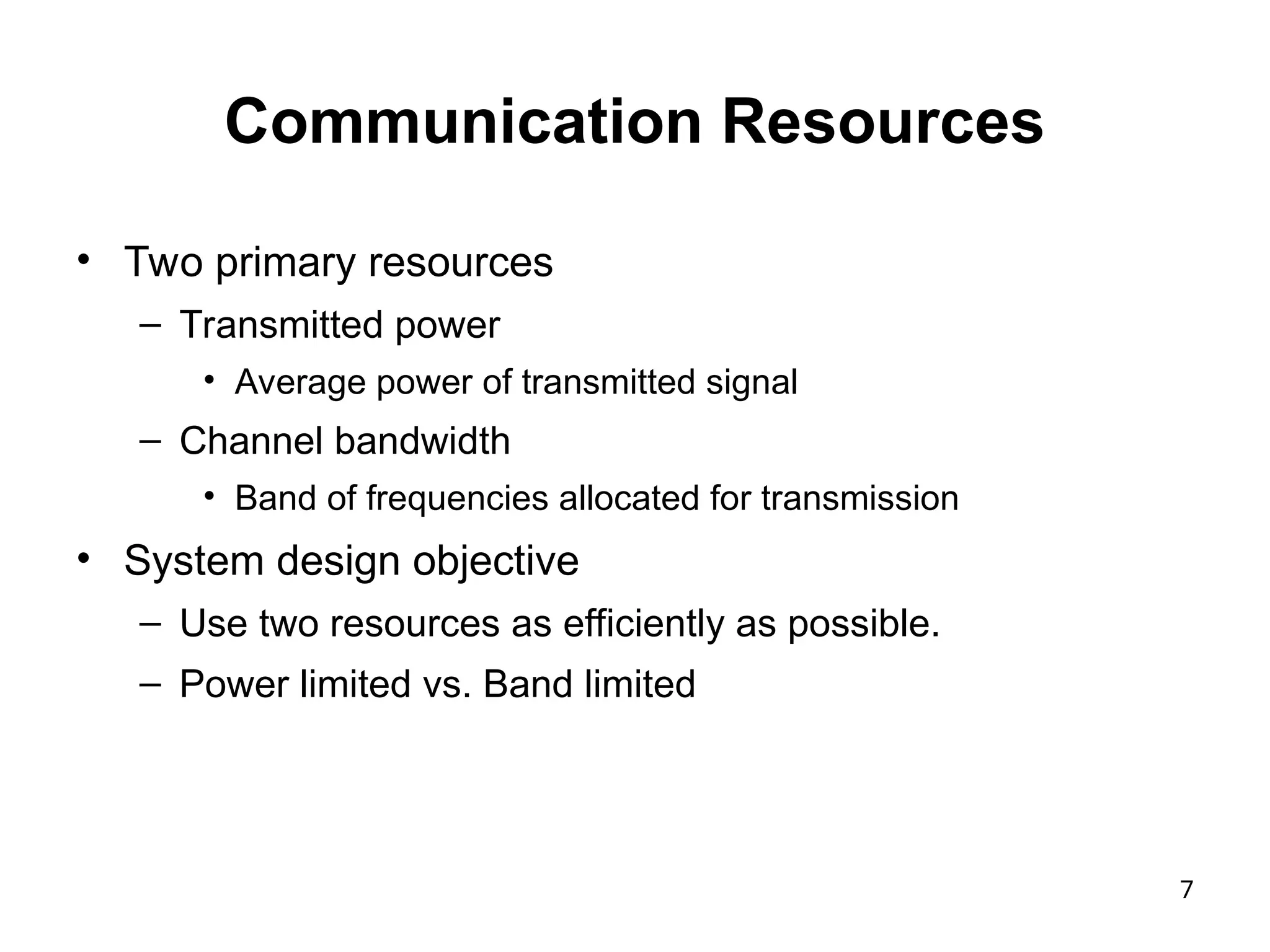
• Two primary resources
– Transmitted power
• Average power of transmitted signal
– Channel bandwidth
• Band of frequencies allocated for transmission
• System design objective
– Use two resources as efficiently as possible.
– Power limited vs. Band limited
8
Communication Channels
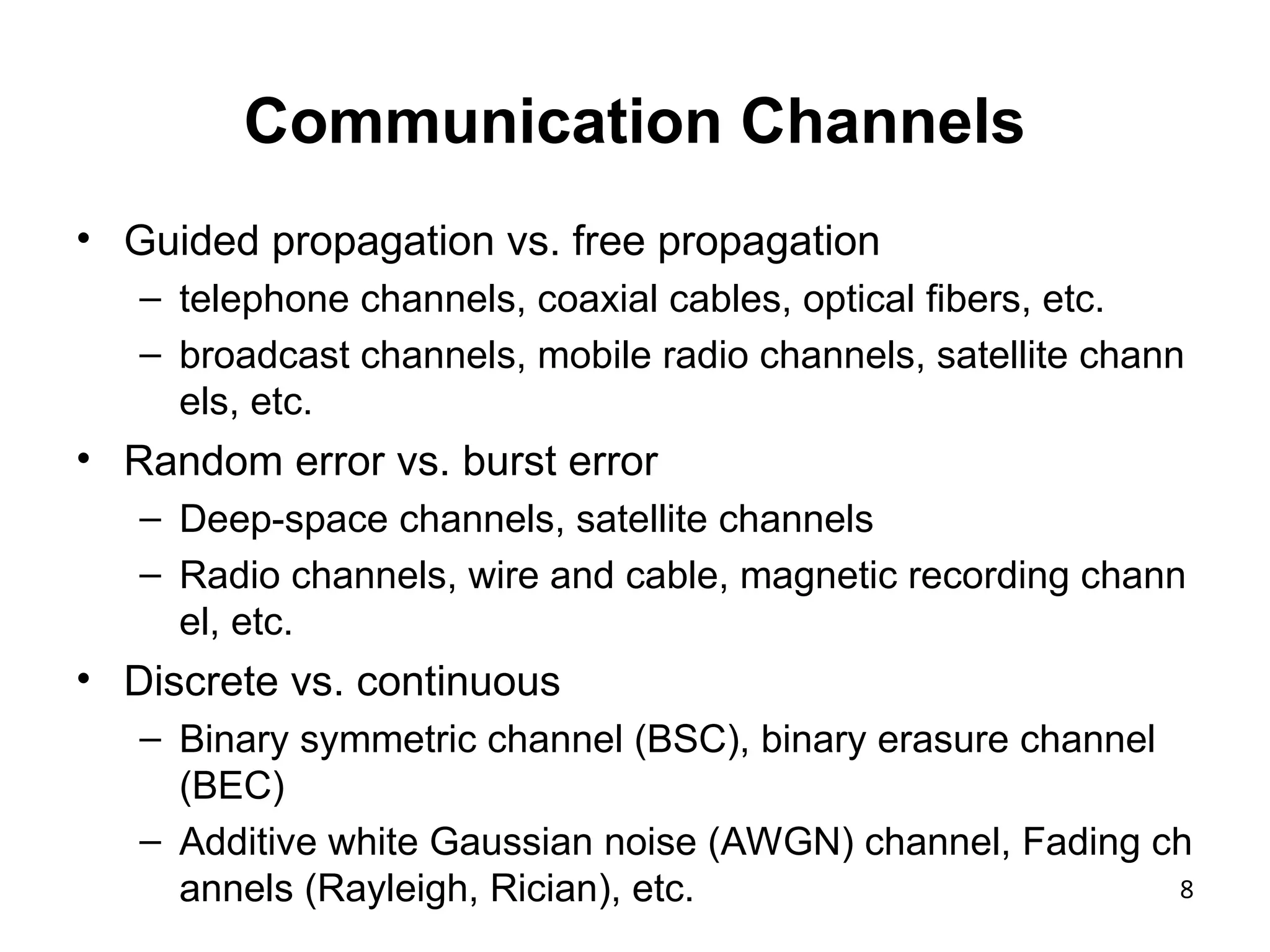
• Guided propagation vs. free propagation
– telephone channels, coaxial cables, optical fibers, etc.
– broadcast channels, mobile radio channels, satellite chann
els, etc.
• Random error vs. burst error
– Deep-space channels, satellite channels
– Radio channels, wire and cable, magnetic recording chann
el, etc.
• Discrete vs. continuous
– Binary symmetric channel (BSC), binary erasure channel
(BEC)
– Additive white Gaussian noise (AWGN) channel, Fading ch
annels (Rayleigh, Rician), etc.
9
Channel Capacity
• Shannon (1948)
– If you transmit information at a rate R < C, then the error-
free transmission is possible.
• Definition of channel capacity C
– Maximum rate at which information can be transmitted
across the channel without error.
• Goal of communication system design in power-limited
environment:
– achieve a target error rate of data transmission with as low
signal power as possible.
• Similar to achieving the capacity bound as close as possible
with less power.
10
Channel Capacity
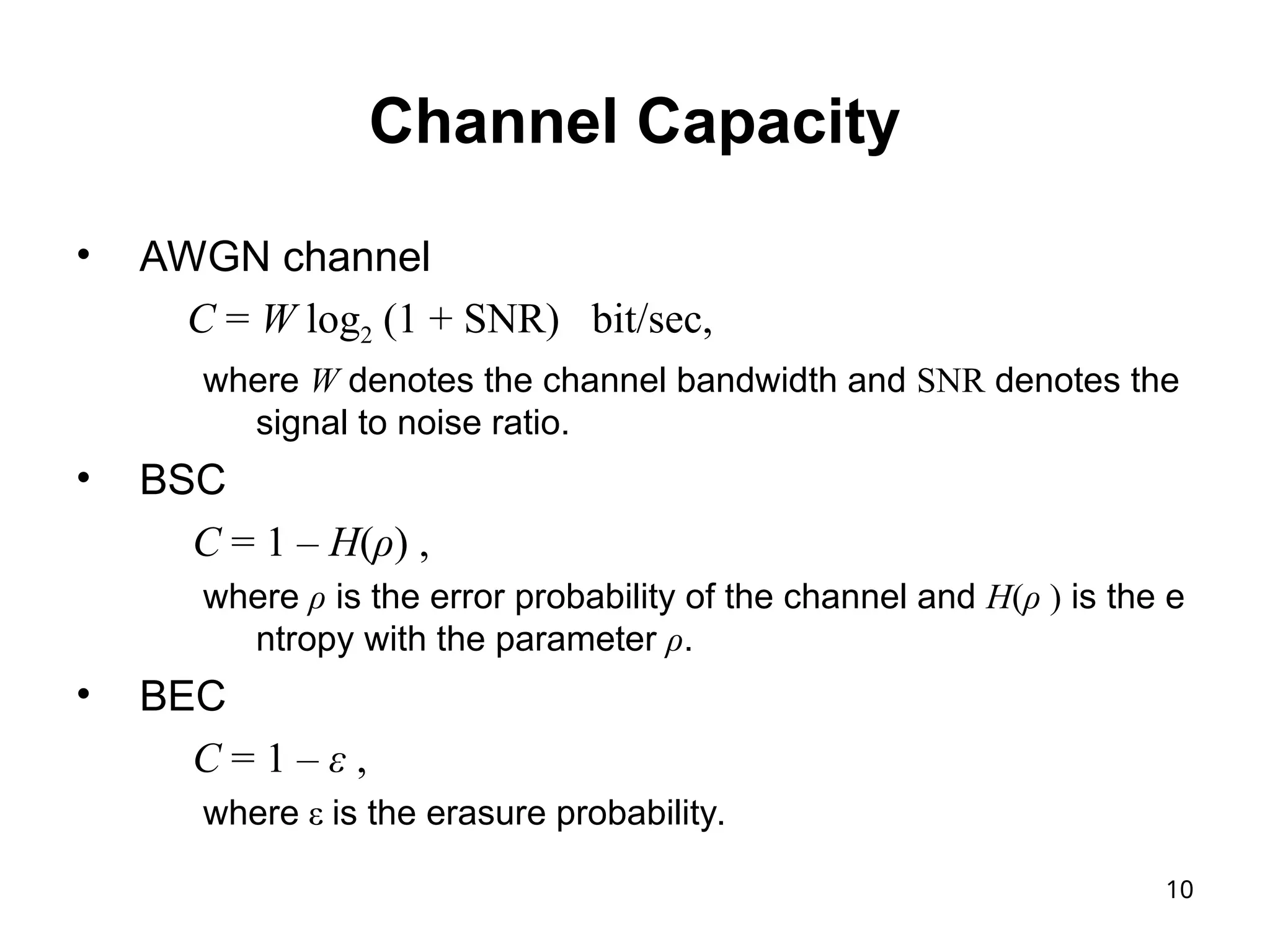
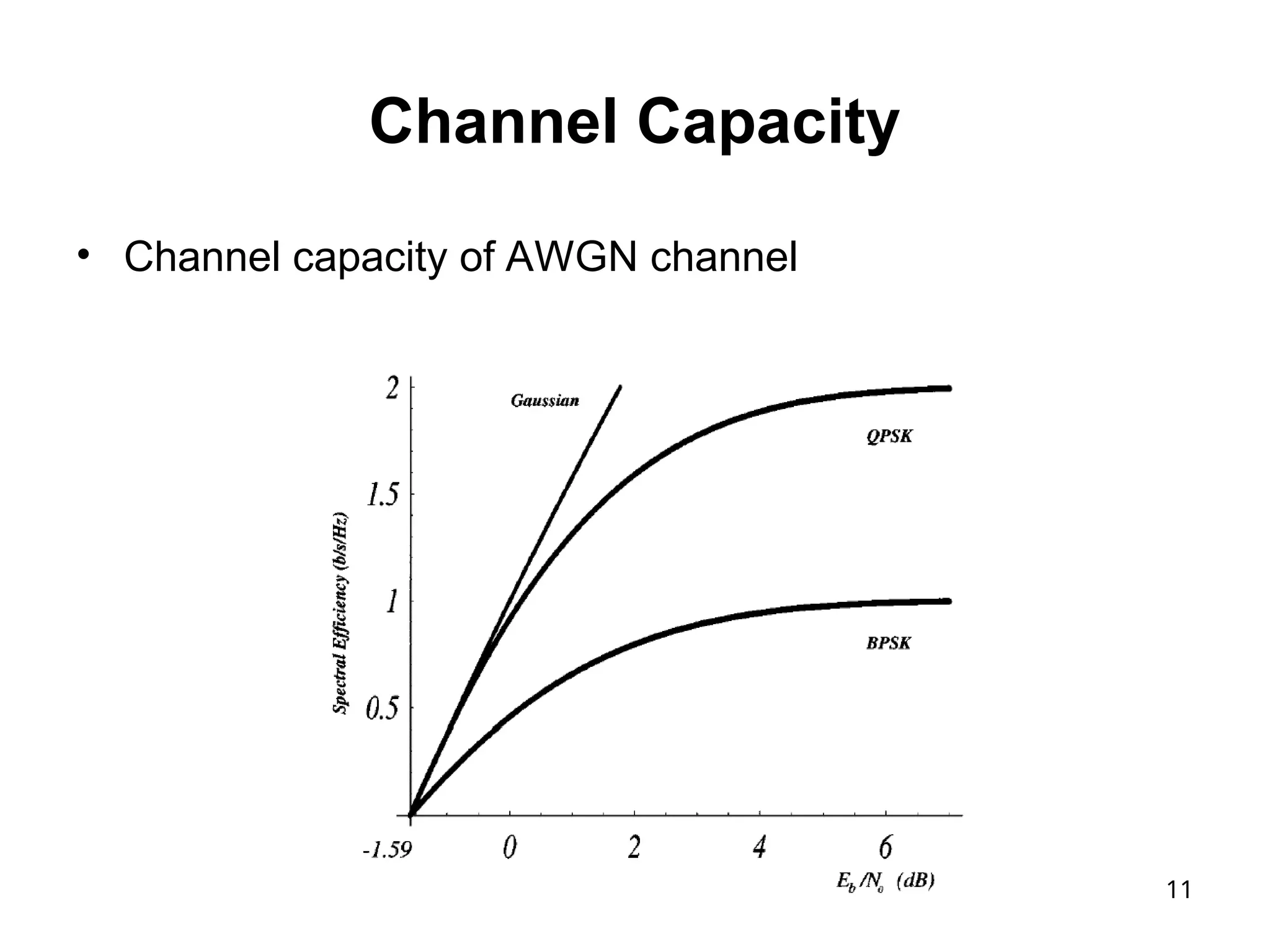
• AWGN channel
C = W log2 (1 + SNR) bit/sec,
where W denotes the channel bandwidth and SNR denotes the
signal to noise ratio.
• BSC
C = 1 – H(ρ) ,
where ρ is the error probability of the channel and H(ρ ) is the e
ntropy with the parameter ρ.
• BEC
C = 1 – ε ,
where ε is the erasure probability.
11
Channel Capacity
• Channel capacity of AWGN channel
12
Modulation
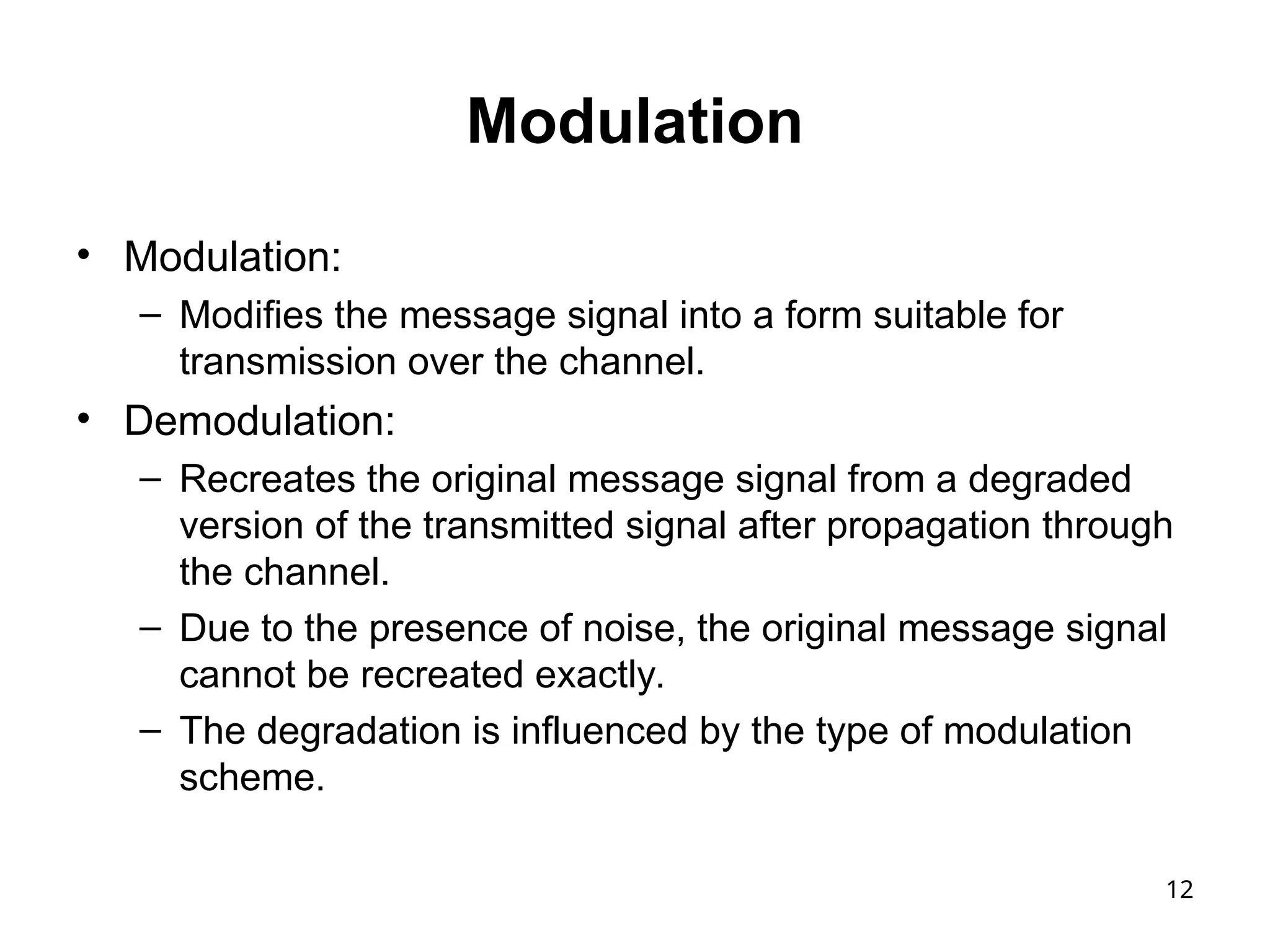
• Modulation:
– Modifies the message signal into a form suitable for
transmission over the channel.
• Demodulation:
– Recreates the original message signal from a degraded
version of the transmitted signal after propagation through
the channel.
– Due to the presence of noise, the original message signal
cannot be recreated exactly.
– The degradation is influenced by the type of modulation
scheme.
13
Modulation
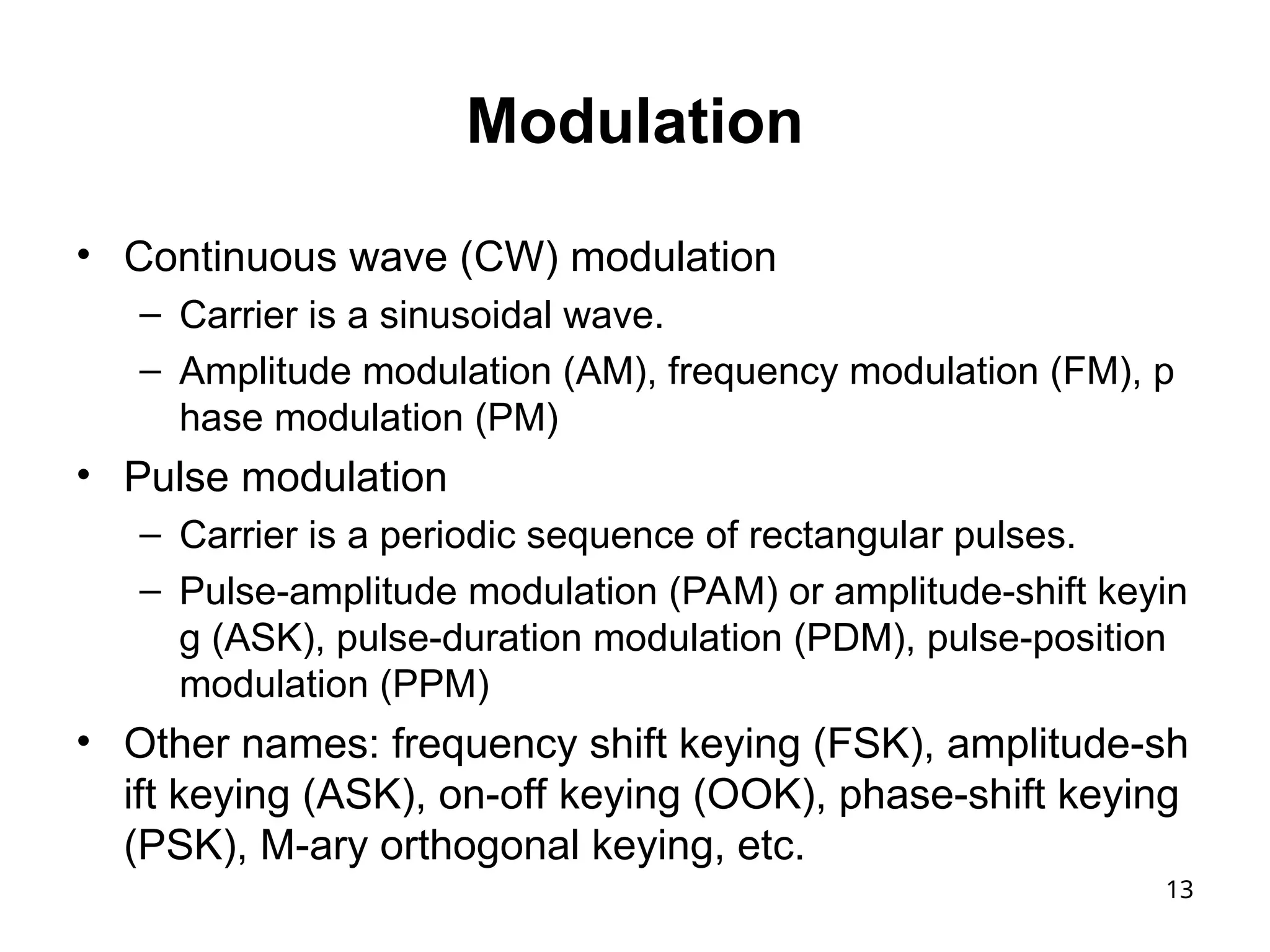
• Continuous wave (CW) modulation
– Carrier is a sinusoidal wave.
– Amplitude modulation (AM), frequency modulation (FM), p
hase modulation (PM)
• Pulse modulation
– Carrier is a periodic sequence of rectangular pulses.
– Pulse-amplitude modulation (PAM) or amplitude-shift keyin
g (ASK), pulse-duration modulation (PDM), pulse-position
modulation (PPM)
• Other names: frequency shift keying (FSK), amplitude-sh
ift keying (ASK), on-off keying (OOK), phase-shift keying
(PSK), M-ary orthogonal keying, etc.
14
Modulation
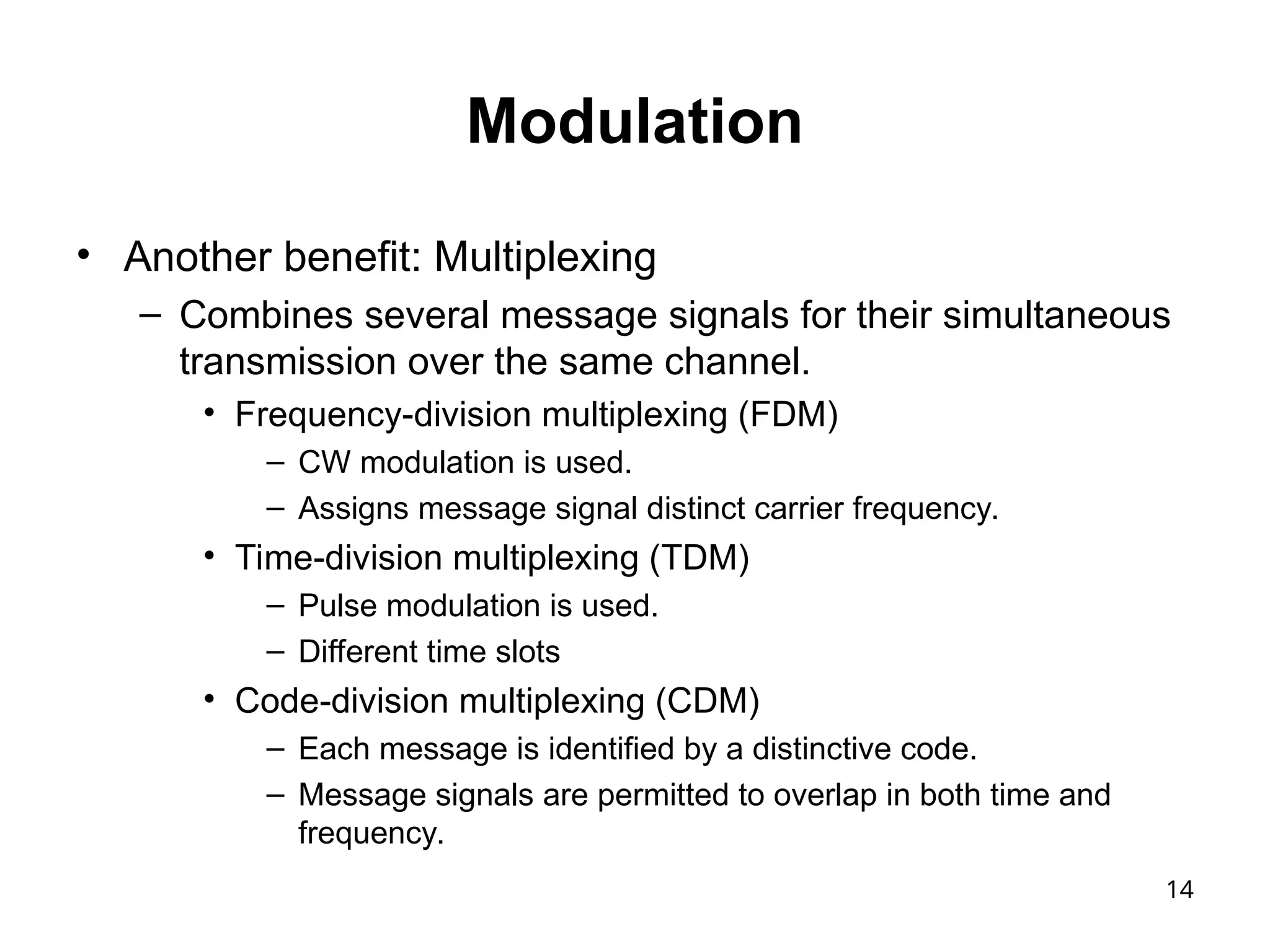
• Another benefit: Multiplexing
– Combines several message signals for their simultaneous
transmission over the same channel.
• Frequency-division multiplexing (FDM)
– CW modulation is used.
– Assigns message signal distinct carrier frequency.
• Time-division multiplexing (TDM)
– Pulse modulation is used.
– Different time slots
• Code-division multiplexing (CDM)
– Each message is identified by a distinctive code.
– Message signals are permitted to overlap in both time and
frequency.
15
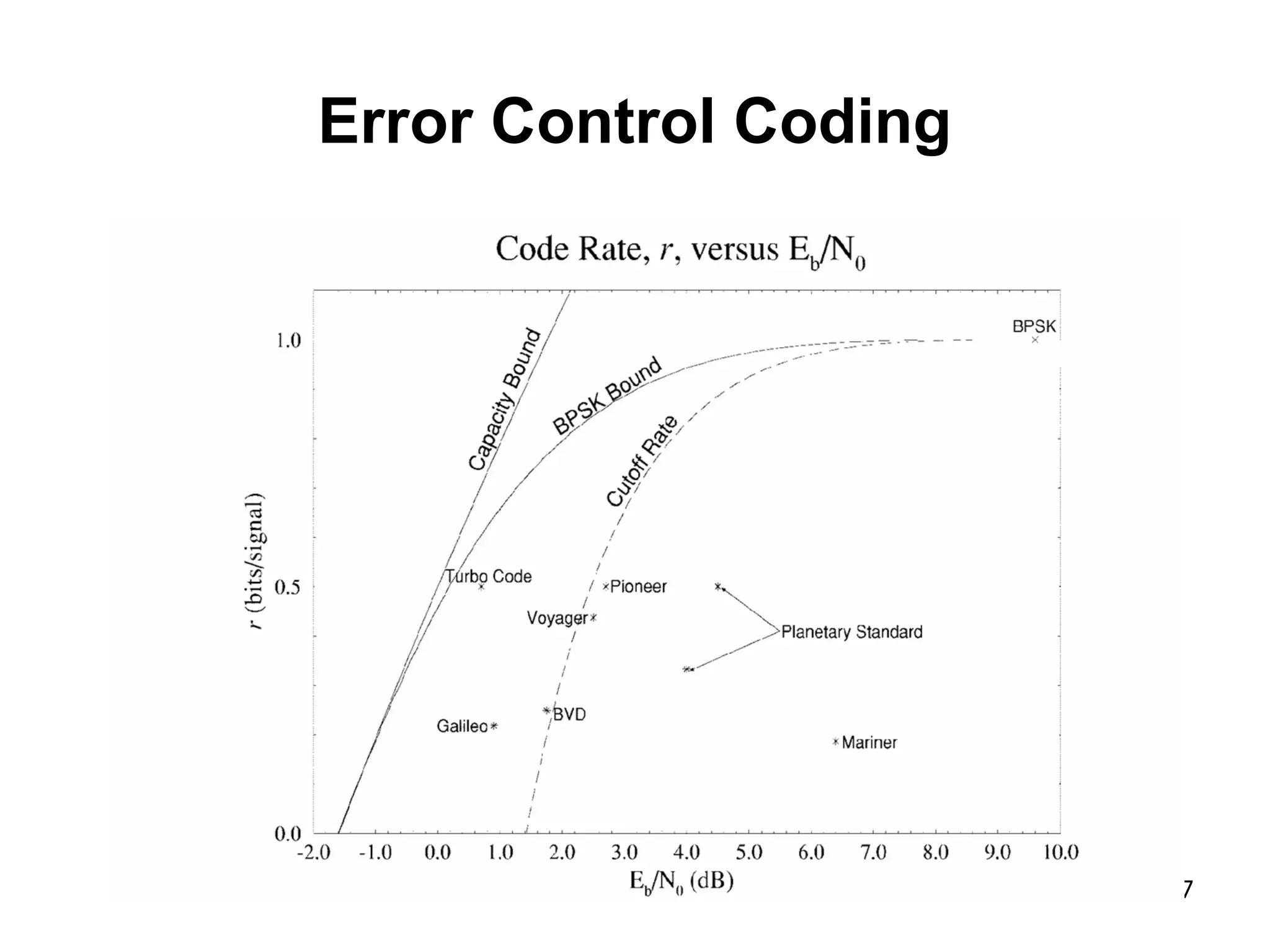
Error Control Coding
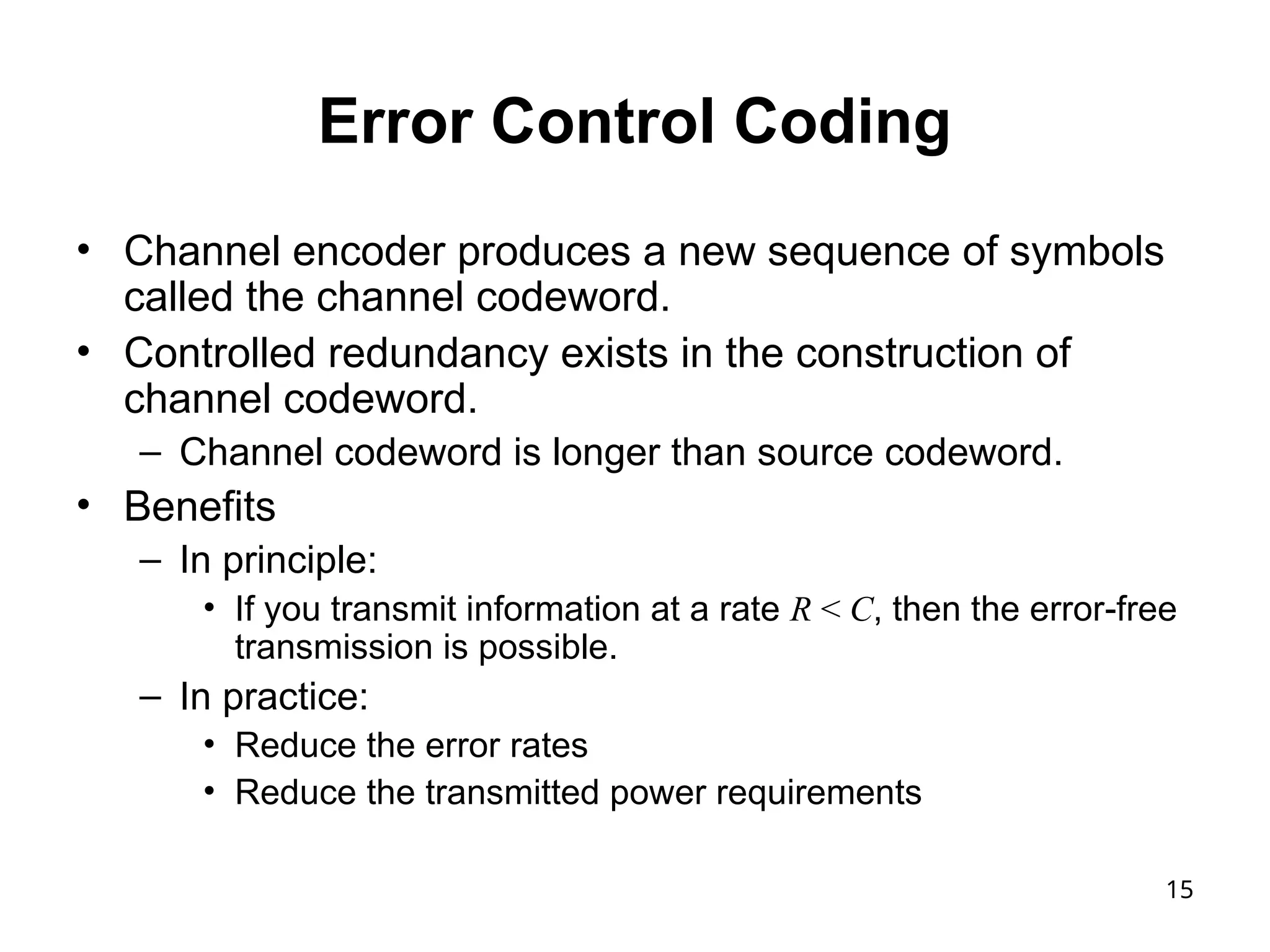
• Channel encoder produces a new sequence of symbols
called the channel codeword.
• Controlled redundancy exists in the construction of
channel codeword.
– Channel codeword is longer than source codeword.
• Benefits
– In principle:
• If you transmit information at a rate R < C, then the error-free
transmission is possible.
– In practice:
• Reduce the error rates
• Reduce the transmitted power requirements
16
Error Control Coding
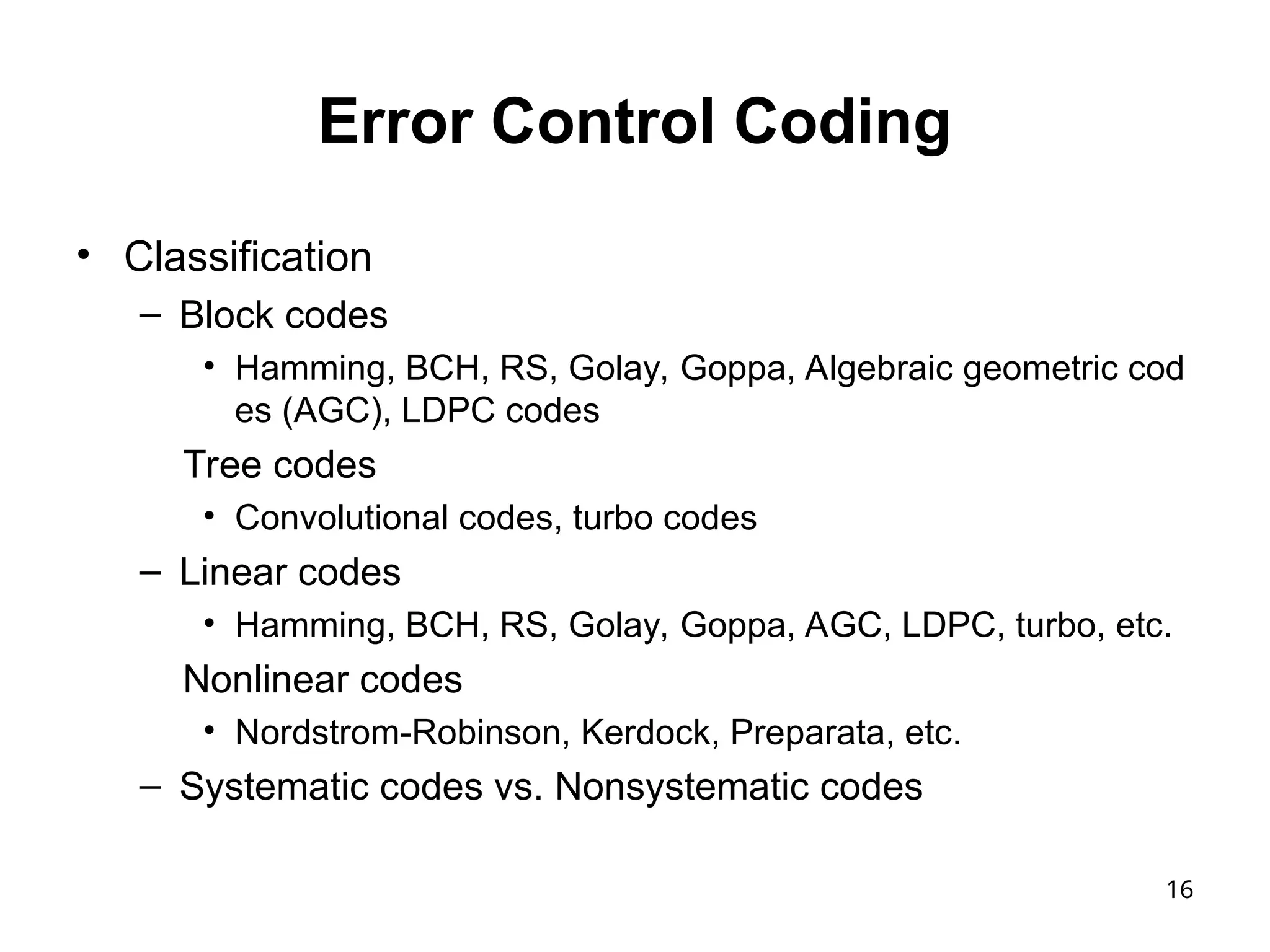
• Classification
– Block codes
• Hamming, BCH, RS, Golay, Goppa, Algebraic geometric cod
es (AGC), LDPC codes
Tree codes
• Convolutional codes, turbo codes
– Linear codes
• Hamming, BCH, RS, Golay, Goppa, AGC, LDPC, turbo, etc.
Nonlinear codes
• Nordstrom-Robinson, Kerdock, Preparata, etc.
– Systematic codes vs. Nonsystematic codes
17
Error Control Coding
18
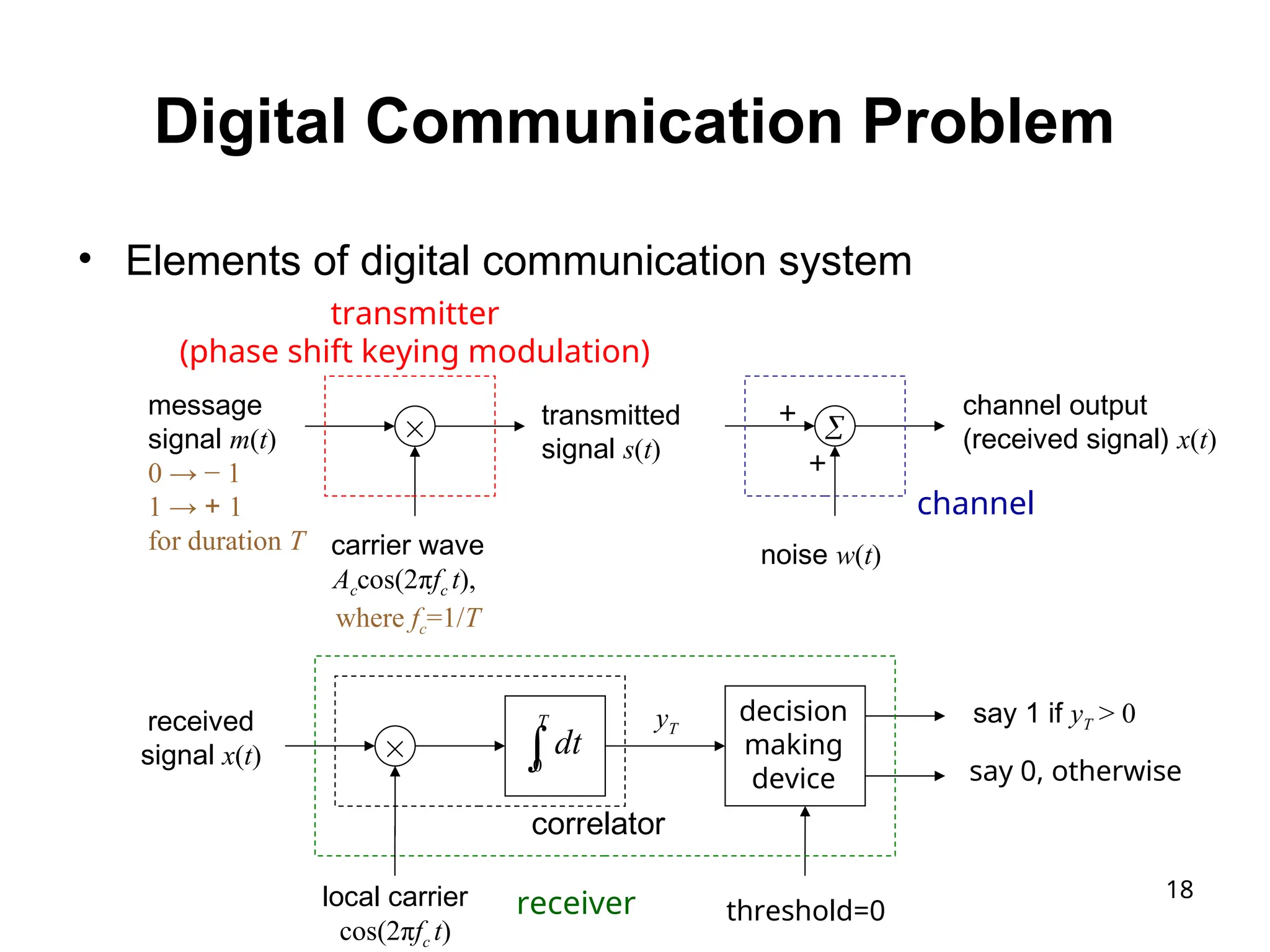
Digital Communication Problem
• Elements of digital communication system


message
signal m(t)
0 → − 1
1 → + 1
for duration T
transmitted
signal s(t)
carrier wave
Accos(2πfc t),
where fc=1/T
noise w(t)
channel output
(received signal) x(t)

+
+

T
dt
0
decision
making
device
say 1 if yT > 0
say 0, otherwise
threshold=0
local carrier
cos(2πfc t)
received
signal x(t)
transmitter
(phase shift keying modulation)
channel
receiver
yT
correlator
19
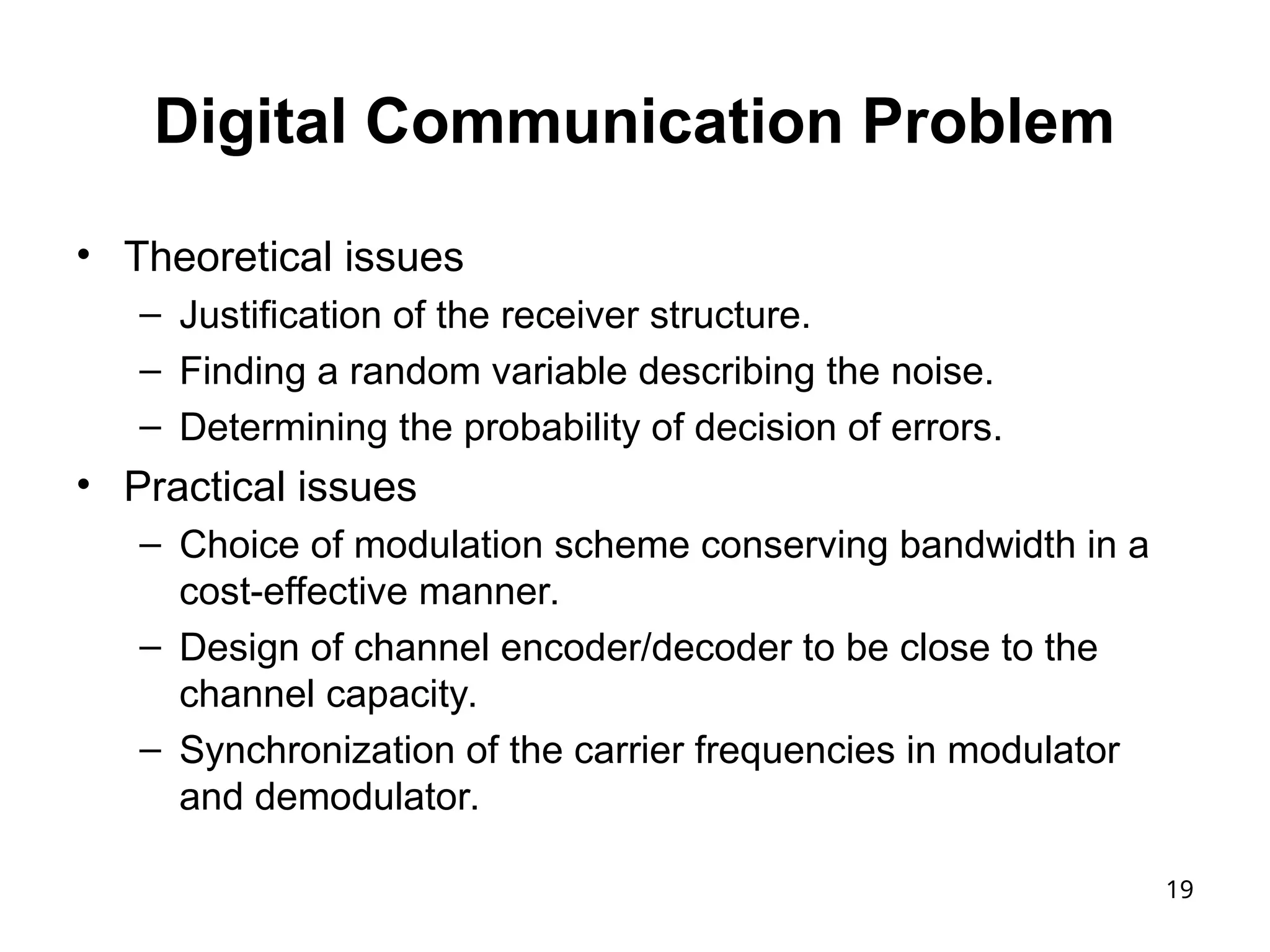
Digital Communication Problem
• Theoretical issues
– Justification of the receiver structure.
– Finding a random variable describing the noise.
– Determining the probability of decision of errors.
• Practical issues
– Choice of modulation scheme conserving bandwidth in a
cost-effective manner.
– Design of channel encoder/decoder to be close to the
channel capacity.
– Synchronization of the carrier frequencies in modulator
and demodulator.
Topics in
Digital Communications
21
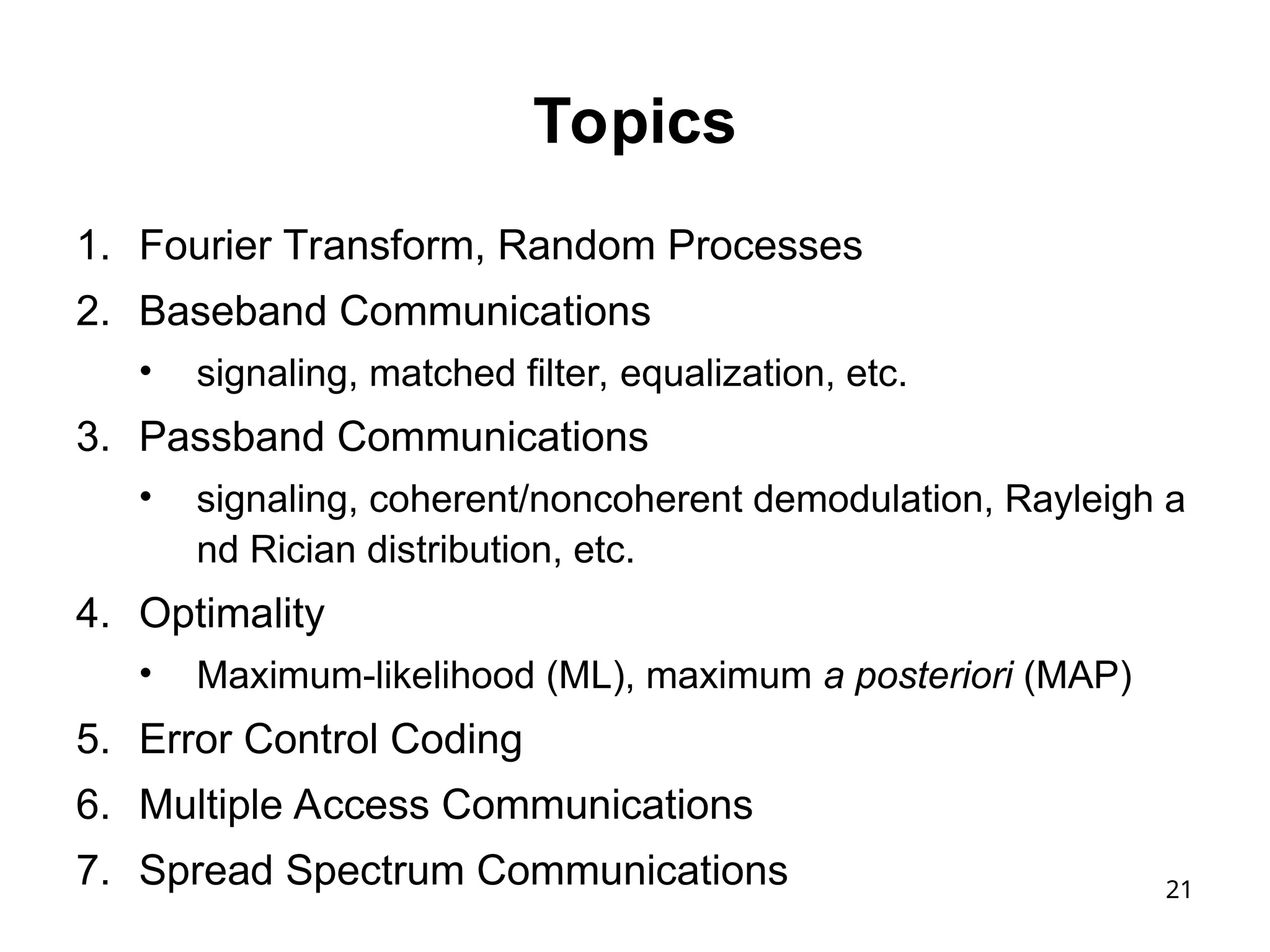
Topics
1. Fourier Transform, Random Processes
2. Baseband Communications
• signaling, matched filter, equalization, etc.
3. Passband Communications
• signaling, coherent/noncoherent demodulation, Rayleigh a
nd Rician distribution, etc.
4. Optimality
• Maximum-likelihood (ML), maximum a posteriori (MAP)
5. Error Control Coding
6. Multiple Access Communications
7. Spread Spectrum Communications

introduction to digital communication....

  • 1.
    Digital Communications ( 디지털통신 ) 중앙대학교 전자전기공학부 이정우 Email: jwlee2@cau.ac.kr Homepage: http://cau.ac.kr/~jwlee2 office: 신공학관 409 호 Phone: 820-5734
  • 2.
    2 • Main text:class notes • References – “Digital transmission of information” by Richard E. Blahut, Addison-Wesley, 1990. – “Communication systems” by Simon Haykin, John Wiley & Sons, 2001. • Test – 중간고사 (35%), 기말고사 (35%), 과제물 4 번 ( 각 5%), 참여도 (10%)
  • 3.
  • 4.
    4 Open Systems Interconnection(OSI) Data Communication Model Covered in Digital Communications
  • 5.
    5 Communication System Channel encoder Source encoder Modulator Demodulator Channel Channel decoder Source decoder Error control coding Compression Transmitter Receiver waveform receivedsignal channel codeword estimated channel codeword source codeword estimated source codeword message signal estimated message signal Data User
  • 6.
    6 Communication System • Twobasic modes of communications – Broadcasting • Single powerful transmitter and many receivers • TV, Radio, etc. – Point-to-point communication • Link between a single transmitter and a receiver • Telephone
  • 7.
    7 Communication Resources • Twoprimary resources – Transmitted power • Average power of transmitted signal – Channel bandwidth • Band of frequencies allocated for transmission • System design objective – Use two resources as efficiently as possible. – Power limited vs. Band limited
  • 8.
    8 Communication Channels • Guidedpropagation vs. free propagation – telephone channels, coaxial cables, optical fibers, etc. – broadcast channels, mobile radio channels, satellite chann els, etc. • Random error vs. burst error – Deep-space channels, satellite channels – Radio channels, wire and cable, magnetic recording chann el, etc. • Discrete vs. continuous – Binary symmetric channel (BSC), binary erasure channel (BEC) – Additive white Gaussian noise (AWGN) channel, Fading ch annels (Rayleigh, Rician), etc.
  • 9.
    9 Channel Capacity • Shannon(1948) – If you transmit information at a rate R < C, then the error- free transmission is possible. • Definition of channel capacity C – Maximum rate at which information can be transmitted across the channel without error. • Goal of communication system design in power-limited environment: – achieve a target error rate of data transmission with as low signal power as possible. • Similar to achieving the capacity bound as close as possible with less power.
  • 10.
    10 Channel Capacity • AWGNchannel C = W log2 (1 + SNR) bit/sec, where W denotes the channel bandwidth and SNR denotes the signal to noise ratio. • BSC C = 1 – H(ρ) , where ρ is the error probability of the channel and H(ρ ) is the e ntropy with the parameter ρ. • BEC C = 1 – ε , where ε is the erasure probability.
  • 11.
    11 Channel Capacity • Channelcapacity of AWGN channel
  • 12.
    12 Modulation • Modulation: – Modifiesthe message signal into a form suitable for transmission over the channel. • Demodulation: – Recreates the original message signal from a degraded version of the transmitted signal after propagation through the channel. – Due to the presence of noise, the original message signal cannot be recreated exactly. – The degradation is influenced by the type of modulation scheme.
  • 13.
    13 Modulation • Continuous wave(CW) modulation – Carrier is a sinusoidal wave. – Amplitude modulation (AM), frequency modulation (FM), p hase modulation (PM) • Pulse modulation – Carrier is a periodic sequence of rectangular pulses. – Pulse-amplitude modulation (PAM) or amplitude-shift keyin g (ASK), pulse-duration modulation (PDM), pulse-position modulation (PPM) • Other names: frequency shift keying (FSK), amplitude-sh ift keying (ASK), on-off keying (OOK), phase-shift keying (PSK), M-ary orthogonal keying, etc.
  • 14.
    14 Modulation • Another benefit:Multiplexing – Combines several message signals for their simultaneous transmission over the same channel. • Frequency-division multiplexing (FDM) – CW modulation is used. – Assigns message signal distinct carrier frequency. • Time-division multiplexing (TDM) – Pulse modulation is used. – Different time slots • Code-division multiplexing (CDM) – Each message is identified by a distinctive code. – Message signals are permitted to overlap in both time and frequency.
  • 15.
    15 Error Control Coding •Channel encoder produces a new sequence of symbols called the channel codeword. • Controlled redundancy exists in the construction of channel codeword. – Channel codeword is longer than source codeword. • Benefits – In principle: • If you transmit information at a rate R < C, then the error-free transmission is possible. – In practice: • Reduce the error rates • Reduce the transmitted power requirements
  • 16.
    16 Error Control Coding •Classification – Block codes • Hamming, BCH, RS, Golay, Goppa, Algebraic geometric cod es (AGC), LDPC codes Tree codes • Convolutional codes, turbo codes – Linear codes • Hamming, BCH, RS, Golay, Goppa, AGC, LDPC, turbo, etc. Nonlinear codes • Nordstrom-Robinson, Kerdock, Preparata, etc. – Systematic codes vs. Nonsystematic codes
  • 17.
  • 18.
    18 Digital Communication Problem •Elements of digital communication system   message signal m(t) 0 → − 1 1 → + 1 for duration T transmitted signal s(t) carrier wave Accos(2πfc t), where fc=1/T noise w(t) channel output (received signal) x(t)  + +  T dt 0 decision making device say 1 if yT > 0 say 0, otherwise threshold=0 local carrier cos(2πfc t) received signal x(t) transmitter (phase shift keying modulation) channel receiver yT correlator
  • 19.
    19 Digital Communication Problem •Theoretical issues – Justification of the receiver structure. – Finding a random variable describing the noise. – Determining the probability of decision of errors. • Practical issues – Choice of modulation scheme conserving bandwidth in a cost-effective manner. – Design of channel encoder/decoder to be close to the channel capacity. – Synchronization of the carrier frequencies in modulator and demodulator.
  • 20.
  • 21.
    21 Topics 1. Fourier Transform,Random Processes 2. Baseband Communications • signaling, matched filter, equalization, etc. 3. Passband Communications • signaling, coherent/noncoherent demodulation, Rayleigh a nd Rician distribution, etc. 4. Optimality • Maximum-likelihood (ML), maximum a posteriori (MAP) 5. Error Control Coding 6. Multiple Access Communications 7. Spread Spectrum Communications